You’ve probably heard that dark chocolate is good for your heart. But what actually happens inside your body when you eat it every day for weeks or months? And does any dark chocolate work, or are some types useless?
Scientists have asked hundreds of people to eat 30–50 grams of dark chocolate daily—about one to two small squares—for 4 to 12 weeks. Then they measured what changed in their arteries, blood pressure, and overall heart health.
The results reveal something many articles won’t tell you: the chocolate you buy at the store probably won’t give you the same benefits the studies found. That’s because most commercial dark chocolate has been stripped of the compounds that protect your heart.
This article breaks down exactly what happens when you eat the right kind of chocolate at the right dose. You’ll learn why a 90% cocoa bar might be worthless while a 70% bar could work wonders. You’ll understand which people benefit most and who won’t see much change at all.
Let’s start with what happens to your blood vessels within hours of eating high-quality dark chocolate.
Your Blood Vessels Relax Within Hours
When you eat dark chocolate rich in flavanols, something remarkable happens inside your arteries. Within two hours, the lining of your blood vessels—called the endothelium—starts producing more nitric oxide.
Nitric oxide is a molecule that tells your blood vessels to relax and widen. Think of it like opening a valve. When blood flows through wider vessels, your heart doesn’t have to work as hard to pump blood throughout your body.
Scientists measure this effect using something called flow-mediated dilation, or FMD. It’s a fancy term for how well your arteries can expand when blood flow increases. Studies show that eating high-flavanol chocolate daily improves FMD by 1–3% after just a few weeks.
That might not sound like much. But in the world of heart health, a 1–3% improvement in how flexible your arteries are translates to meaningful protection against heart disease.
Here’s the catch: this only works if your chocolate contains epicatechin. That’s a specific type of flavanol molecule. Not all chocolate has it, and not all cocoa percentages guarantee it.
In 2008, researchers at the University of California, San Francisco tested 45 overweight adults in a controlled trial. They gave some participants 22 grams of cocoa powder with about 900mg of flavanols. Others got 37 grams of solid dark chocolate with roughly 400mg of flavanols. The cocoa powder group saw their blood vessel function improve by 5.7% after just one dose. The solid chocolate group showed smaller changes, likely because the sugar content interfered with the flavanol effects.
This effect isn’t just a one-time boost. When people ate flavanol-rich chocolate daily for four weeks, their endothelial function stayed improved. Stop eating it, and the benefits fade within a week or two.
The mechanism behind this is the same one that makes certain medications work for erectile dysfunction. Both rely on nitric oxide to relax blood vessels. This isn’t just about your heart—it’s about your entire circulatory system working more efficiently. As you age, your body naturally produces less nitric oxide, which is why vascular problems become more common. Flavanols help compensate for that decline.
Blood Pressure Drops—If You Need It To
Multiple studies lasting 2 to 18 weeks found that people eating 30–50 grams of dark chocolate daily saw their blood pressure drop. On average, systolic pressure (the top number) fell by 2–4 mmHg, and diastolic pressure (the bottom number) dropped by 1–2 mmHg.
But here’s what makes this interesting: not everyone responds the same way.
People with high blood pressure saw dramatic improvements. In one analysis, participants with hypertension experienced a 4.5 mmHg drop in systolic pressure. That’s roughly half the effect you’d get from some blood pressure medications.
People with normal blood pressure? They saw barely any change—just 1.2 mmHg on average.
A 2017 analysis examined 35 separate trials involving 1,804 people. Researchers found that the blood pressure benefits were heavily concentrated in people whose bodies were already struggling to regulate pressure. When they broke down the results by starting blood pressure, the pattern became clear: chocolate helps most when you need help most.
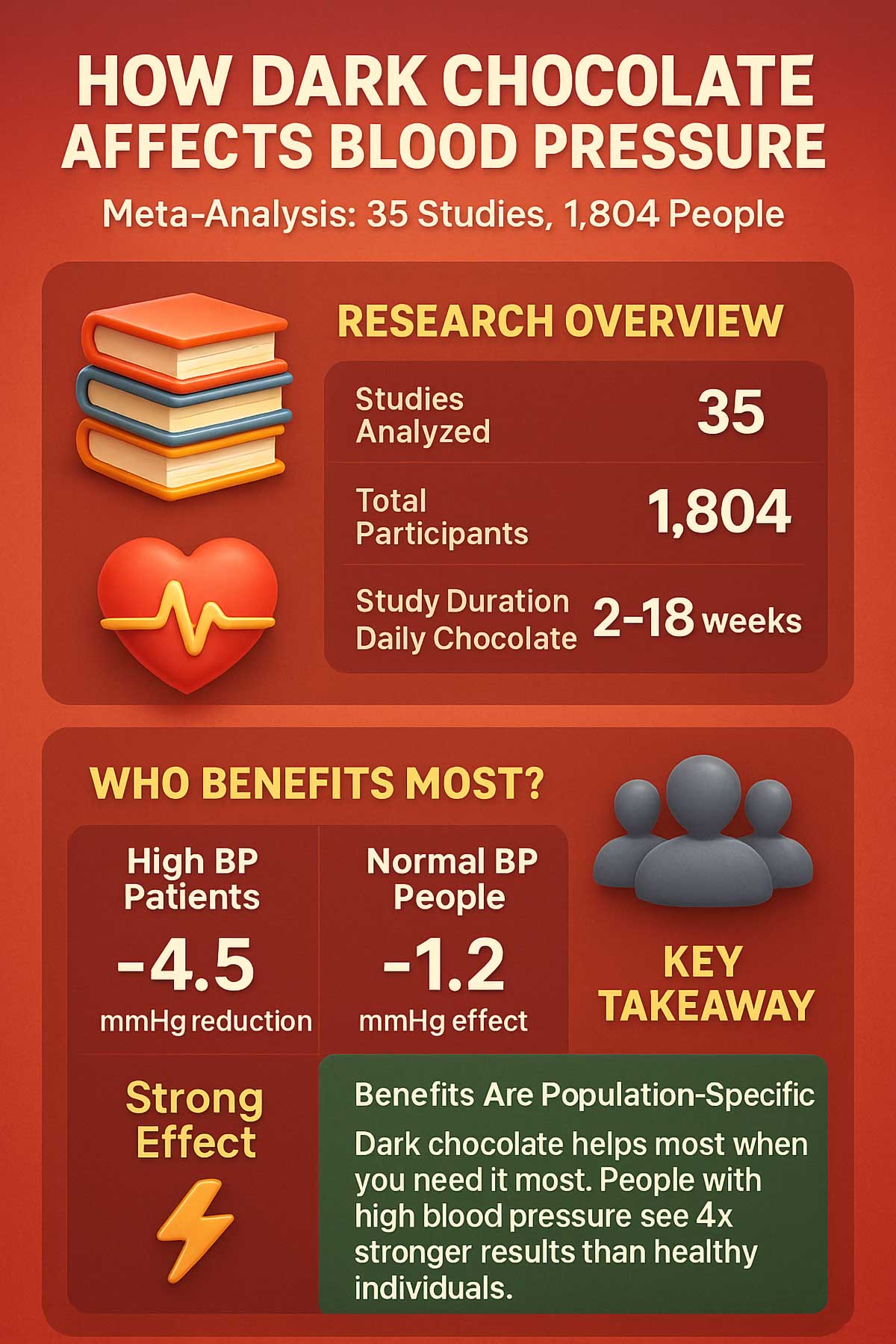
Why does this matter? Because it means dark chocolate works best as a support tool for people who already have cardiovascular risk factors. If your blood pressure is already in a healthy range, don’t expect chocolate to lower it further.
This makes biological sense. Your body has built-in systems to keep blood pressure stable. When those systems are working well, adding more nitric oxide from chocolate doesn’t push things further. But when your blood vessels are already stiff or your blood pressure is elevated, the extra help from flavanols can make a real difference.
One more important detail: these studies typically used chocolate containing 200–600 mg of flavanols per day. Most commercial dark chocolate contains only 50–150 mg because processing destroys the rest. We’ll come back to this problem later.
When You’ll See Changes: A Timeline
Understanding what happens week by week helps set realistic expectations. Here’s what researchers observed:
| Time After Starting | What’s Happening in Your Body | What You Might Notice |
|---|---|---|
| 2 hours | Flavanols absorbed, nitric oxide production increases | Possibly nothing; some people feel more alert |
| 1 week | Early improvements in blood vessel flexibility | Blood pressure may drop 1-2 points (if elevated) |
| 2-4 weeks | Endothelial function improves measurably (1-2% FMD increase) | Slight energy improvements; BP reduction stabilizes |
| 4-8 weeks | Maximum vascular benefits achieved (2-3% FMD increase) | BP reduction peaks (2-4 mmHg if hypertensive) |
| 12+ weeks | Benefits maintained with continued intake | Sustained improvements as long as intake continues |
| 1-2 weeks after stopping | Benefits begin to fade | Blood vessel function returns toward baseline |
The acute effects within two hours come from the immediate release of nitric oxide after flavanol absorption. But the longer-term benefits require consistent daily intake to maintain elevated nitric oxide production and improved endothelial cell function.
Some people report feeling more alert after eating dark chocolate. This comes from small amounts of caffeine and theobromine—a compound similar to caffeine but milder. A 40-gram serving contains about 30-40 mg of caffeine, which is less than a cup of tea but enough to notice if you’re sensitive.
The Truth About Chocolate and Cholesterol
You’ve probably read that dark chocolate lowers cholesterol. The truth is more complicated.
Some studies did show reductions in LDL cholesterol—the kind that contributes to plaque buildup in arteries. But when you look closely at those studies, you find something surprising.
The most famous cholesterol study, published in 2008, used chocolate fortified with plant sterols. Plant sterols are compounds that block cholesterol absorption in your gut. They’re added to some margarines and supplements specifically to lower cholesterol.
In that 8-week trial with 49 adults who had elevated cholesterol, participants ate chocolate bars containing 2 grams of plant sterols plus about 200 mg of cocoa flavanols. Their LDL cholesterol dropped significantly. But the drop came from the plant sterols, not the cocoa.
When researchers tested plain dark chocolate without added sterols, the effects on cholesterol were modest at best. Some studies showed small LDL reductions. Others showed no change at all.
A major Cochrane review published in 2012 examined 42 randomized controlled trials with 1,297 participants. The researchers found that cocoa products produced only minimal improvements in lipid profiles. The effects were inconsistent across studies and much smaller than the blood pressure and vascular benefits.
So where does this leave us? Plain dark chocolate has a neutral to slightly positive effect on cholesterol. It’s not a cholesterol-lowering superfood. The real benefit comes from how it improves blood vessel function, not from scrubbing cholesterol out of your bloodstream.
This matters because many people eat dark chocolate thinking it will fix their cholesterol numbers. It probably won’t. But it might still help your heart in other ways.
The Sweet Spot: Why More Isn’t Better
Here’s something that surprised even researchers: eating more dark chocolate doesn’t give you more benefits.
A 2019 analysis examined 40 studies to figure out the ideal dose of cocoa flavanols. They found an inverted U-shaped curve. Benefits increased as people consumed more flavanols—up to a point.
That point was around 710 mg of flavanols per day. At that dose, blood vessel function improved by 1.17%. But when people consumed more than that, the benefits actually declined.
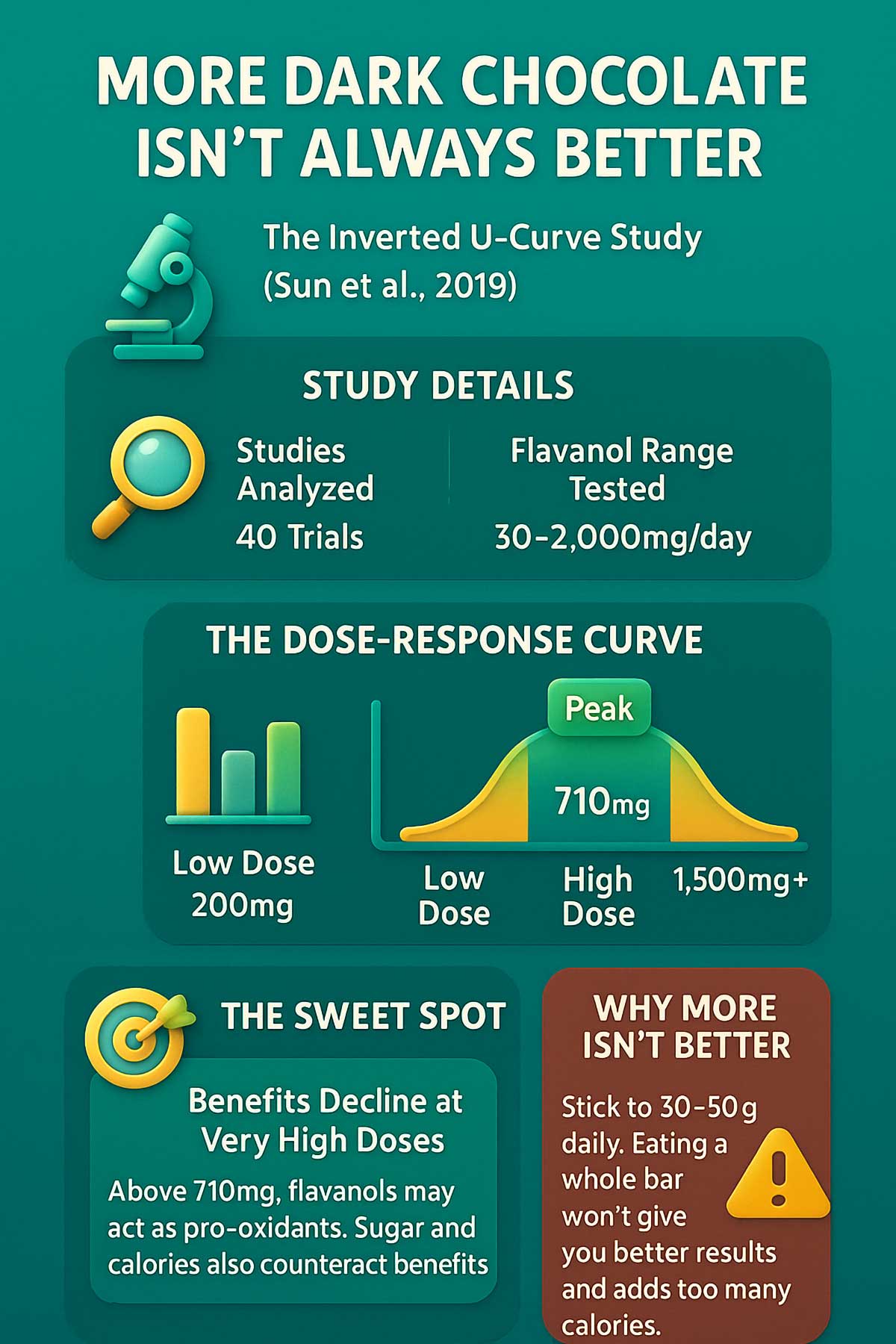
Why would more flavanols be worse? Scientists think that at very high doses, flavanols might start acting as pro-oxidants instead of antioxidants. They could also trigger negative metabolic effects when combined with the sugar and fat that comes with eating large amounts of chocolate.
This finding challenges the “more is better” assumption. It suggests there’s a specific target zone where chocolate helps your heart without causing problems.
For most people, 30–50 grams of high-flavanol dark chocolate hits that sweet spot. That’s roughly 1 to 1.5 ounces—about one or two small squares depending on the brand.
To get 710 mg of flavanols from commercial chocolate, you’d need to eat 50–100 grams of a high-quality, minimally processed bar. That’s 250–500 calories. Without adjusting the rest of your diet, you’d gain weight—which would cancel out any heart benefits.
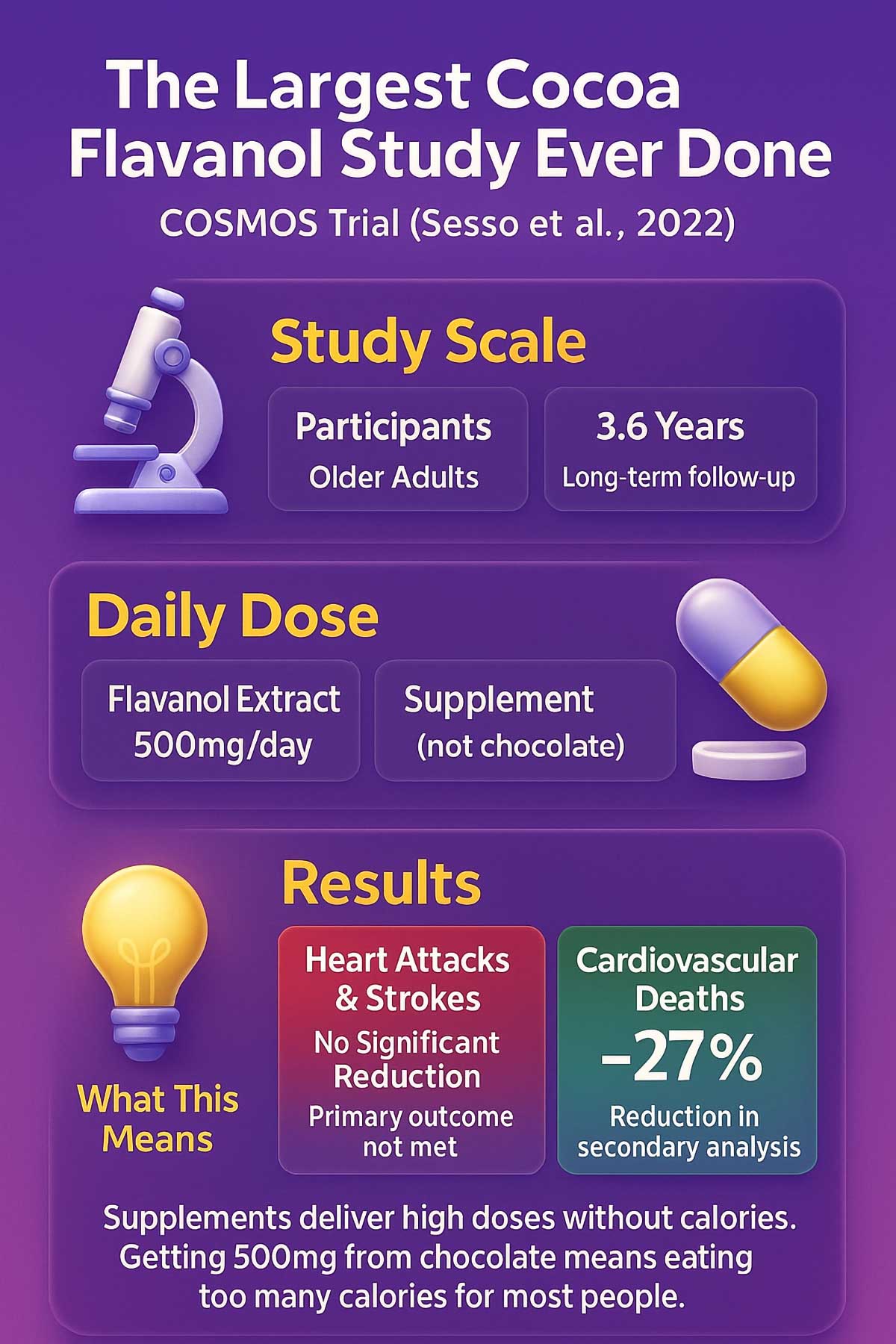
This is why some studies used cocoa supplements instead of chocolate bars. A supplement can deliver 500–700 mg of flavanols in a capsule with almost no calories.
The COSMOS trial, published in 2022, followed 21,442 older adults for 3.6 years. This was the largest and most rigorous study on cocoa flavanols and hard cardiovascular outcomes. Participants took 500 mg of cocoa flavanol extract daily in supplement form. The study didn’t find a reduction in heart attacks or strokes overall. But in secondary analyses, researchers found a 27% reduction in cardiovascular deaths.
To get that same 500 mg from chocolate would require eating 600+ calories worth every day. That’s not practical for most people trying to maintain a healthy weight.
The Processing Problem: Why Your Expensive Bar Might Be Worthless
Walk into any grocery store and you’ll see dozens of dark chocolate bars claiming high cocoa content. 70%, 85%, even 90% cocoa. They’re expensive, they taste bitter, and you assume they’re packed with heart-healthy compounds.
Often, they’re not.
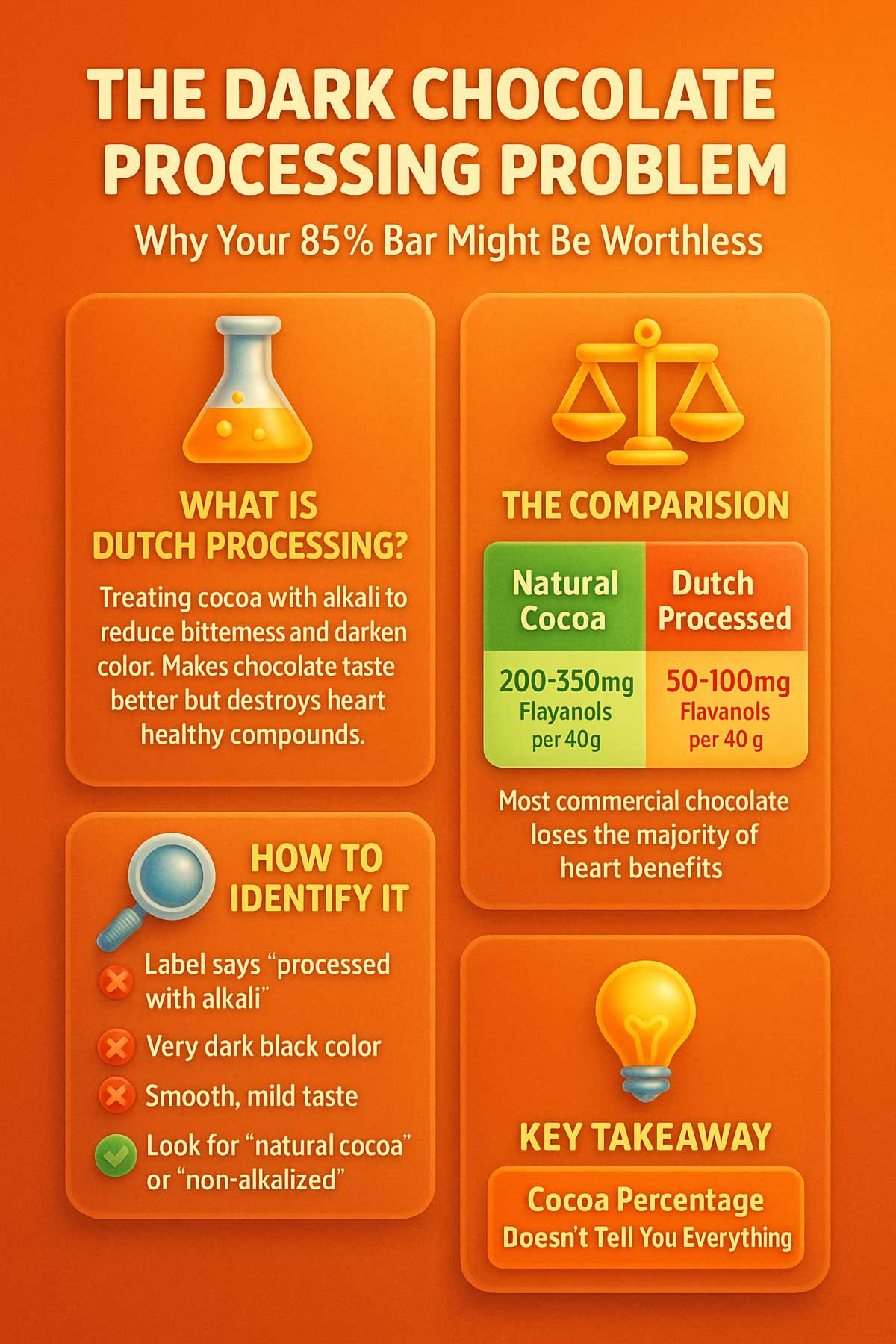
The problem is something called Dutch processing, also known as alkalization. Manufacturers treat cocoa with an alkaline solution to reduce bitterness and darken the color. It makes chocolate taste smoother and look fancier.
But it destroys 60–90% of the flavanols.
That means your 85% cocoa bar that went through Dutch processing could have fewer heart-protective compounds than a less-processed 70% bar. The percentage on the label tells you nothing about flavanol content.
What Is Dutch Processing?
In the early 1800s, a Dutch chemist named Coenraad van Houten invented a process to make cocoa less acidic and bitter. He treated it with alkaline salts like potassium carbonate. The result was darker, milder cocoa that dissolved better in liquids.
Today, most commercial chocolate undergoes some form of alkalization. It’s become the industry standard because consumers prefer the taste. But the chemical process that reduces acidity also breaks down the delicate flavanol molecules.
How It Destroys Flavanols
Flavanols are sensitive to pH changes. When you expose them to alkaline conditions, their molecular structure changes. They lose their ability to trigger nitric oxide production in your blood vessels. What remains is cocoa with color and flavor but minimal cardiovascular benefits.
Different manufacturers use different levels of alkalization. Some use mild processing, which destroys 30-50% of flavanols. Others use heavy alkalization, which can eliminate 80-90%. The label doesn’t tell you which level was used.
How to Identify It
Look at the ingredients list. If it says “cocoa processed with alkali” or “Dutch cocoa,” most of the flavanols are gone. You’re eating expensive calories with minimal cardiovascular benefit.
Natural cocoa retains far more flavanols. It tends to be reddish-brown instead of deep black. It tastes more acidic and astringent. Those qualities actually signal that the beneficial compounds are still intact.
Some brands now list flavanol content on their labels. CocoaVia and Endangered Species are two examples. If a bar claims to be heart-healthy but doesn’t specify flavanol content and lists “processed with alkali” in the ingredients, be skeptical.
Raw or stone-ground chocolate is another option. These undergo minimal processing, which preserves more of the natural flavanols. They’re harder to find and often more expensive, but they deliver what the studies suggest works.
This is the “Dutching deception.” You think you’re buying premium chocolate based on cocoa percentage, but processing has stripped out the very compounds that make dark chocolate beneficial for your heart.
Comparing Common Brands: What You’re Really Getting
Not all dark chocolate delivers the same benefits. Here’s how popular brands stack up based on their processing methods and estimated flavanol content:
🍫 Dark Chocolate Brand Finder
Select a brand from the dropdown to see Cocoa %, Processing, Estimated Flavanols, Health Score, Sugar, and Price Range.
*Estimated based on processing method; few brands test and report actual flavanol content
How to use this table: If your goal is heart health, focus on the “Est. Flavanol Content” column, not the cocoa percentage. Notice that Lindt 85% has less flavanol than Endangered Species 88%, despite similar cocoa content. The difference is processing.
CocoaVia is unique because they add back purified flavanols after processing. This lets them control the exact dose. It’s more expensive, but you’re guaranteed to get therapeutic levels.
For budget-conscious buyers, Ghirardelli 72% offers a middle ground. It’s partially Dutched, so you lose some flavanols but not all. At roughly half the price of premium bars, it might be worth the trade-off if you can’t afford $3-4 per bar.
Regional note: European chocolate often retains more flavanols than American brands because European manufacturers use less aggressive processing. If you’re traveling to Europe, that’s actually a good time to stock up on high-quality dark chocolate.
Managing the Calorie Trade-Off
Let’s be honest about the numbers. Thirty to 50 grams of dark chocolate contains 150–250 calories, mostly from fat and sugar. If you simply add that to your current diet without changing anything else, you’ll gain weight.
Weight gain increases cardiovascular risk. It raises blood pressure, worsens cholesterol, and increases inflammation. So if eating dark chocolate makes you gain weight, any heart benefits get canceled out.
The solution isn’t to avoid chocolate. It’s to make smart substitutions.
Replace, Don’t Add
Swap your usual dessert for a square of high-quality dark chocolate. Skip the afternoon cookies and have chocolate instead. Trade your sweetened coffee drink for black coffee with a piece of dark chocolate on the side.
In a 2012 study with 22 adults who had stage-1 hypertension and were overweight, participants ate 50 grams of 70% dark chocolate daily for four weeks. Their endothelial function improved significantly, but researchers carefully instructed them to replace other foods to maintain stable calorie intake. This design ensured that improvements came from the chocolate, not from weight changes.
Use Cocoa Powder for Maximum Flavanols, Minimum Calories
Another option: use unsweetened natural cocoa powder. Twenty grams of cocoa powder (about 2 tablespoons) can deliver 400–900 mg of flavanols with only 50 calories. Mix it into smoothies, oatmeal, or Greek yogurt. You get the cardiovascular benefits without the calorie burden.
Many studies that showed cardiovascular benefits either controlled participants’ total calorie intake or used cocoa supplements. They didn’t just tell people to eat more chocolate without guidance.
Pre-Portion Your Servings
Buy individually wrapped squares or measure out 30-50 grams and put the rest away. It’s easy to eat an entire bar mindlessly while watching TV. One square eaten slowly and mindfully gives you the benefits without the excess.
Think of dark chocolate as a functional food, not a free pass. It can support heart health when incorporated thoughtfully. But it won’t work if it leads to weight gain or replaces healthier foods in your diet.
Who Benefits Most
The evidence shows that dark chocolate isn’t equally helpful for everyone. Your starting point matters.
If you have high blood pressure, prediabetes, metabolic syndrome, or other cardiovascular risk factors, you’re likely to see meaningful benefits. Your body is already struggling with inflammation and blood vessel dysfunction. The flavanols in dark chocolate help compensate for those problems.
If you’re young, healthy, and your cardiovascular system is working well, the benefits are much smaller. Your arteries are already flexible, your blood pressure is normal, and your body is efficiently producing nitric oxide on its own.
People with High Blood Pressure
This is where dark chocolate shines. A 2017 analysis found that people with hypertension saw their systolic blood pressure drop by 4.5 mmHg on average, compared to just 1.2 mmHg in people with normal blood pressure. That’s nearly four times the effect.
For someone with blood pressure of 145/95, a 4-5 point drop moves them closer to the safe zone. Combined with other lifestyle changes, that reduction could mean the difference between needing medication or not.
People with Normal Blood Pressure
If your blood pressure is already 120/80 or below, don’t expect dark chocolate to push it lower. Your body’s regulatory systems are working fine. Adding more nitric oxide doesn’t improve what’s already optimal.
A 22-person study of adults with stage-1 hypertension and overweight found significant improvements in endothelial function after four weeks of eating 50 grams of 70% dark chocolate daily. But their blood pressure, cholesterol, and inflammation markers didn’t change much.
This shows something important: vascular benefits don’t always translate to improvements in standard risk factors. Dark chocolate might make your arteries work better without dramatically changing your lab numbers.
Age Considerations
Age matters too. The COSMOS trial focused on older adults because that’s when cardiovascular disease becomes more common. As you age, your body produces less nitric oxide naturally. Your blood vessels become stiffer. Your endothelial cells don’t function as well.
Flavanols can help compensate for age-related vascular decline. But in younger people with healthy blood vessels, there’s less room for improvement.
Special Populations
Post-menopausal women: Estrogen helps protect blood vessels. After menopause, cardiovascular risk increases. Some research suggests cocoa flavanols might help offset the loss of estrogen’s protective effects, but more studies are needed.
People with chronic inflammation: Conditions like rheumatoid arthritis or inflammatory bowel disease increase cardiovascular risk through chronic inflammation. Some evidence suggests cocoa flavanols have anti-inflammatory properties that might help, though this research is still early.
Athletes: Some athletes use cocoa flavanols to improve circulation and oxygen delivery to muscles. A few small studies suggest potential performance benefits, but the evidence isn’t as strong as it is for cardiovascular health.
A Word About Medications
If you’re taking blood pressure medication, dark chocolate isn’t a replacement. At best, it might help reduce your dose over time. Talk to your doctor before making changes. The 2-4 mmHg reduction from chocolate is helpful but modest compared to what medications can do.
Women might respond differently than men due to hormonal influences on blood vessel function. More research is needed to understand sex-specific effects.
The bottom line: dark chocolate works best for people who need it most. It’s a complementary tool for those already at cardiovascular risk, not a prevention strategy for healthy individuals with no risk factors.
💊 Medication Interaction Checker
Check if dark chocolate is safe with your medications
No medications selected yet
Should You Try It? A Decision Guide
Use this table to figure out whether daily dark chocolate makes sense for your situation:
| Your Situation | Should You Try Daily Dark Chocolate? | Expected Benefit Level | Important Notes |
|---|---|---|---|
| High blood pressure (140/90+) | Yes – Strong evidence | High (3-5 mmHg reduction) | Not a medication replacement; monitor BP weekly |
| Prehypertension (120-139/80-89) | Yes – Moderate evidence | Moderate (2-3 mmHg) | May help prevent progression to hypertension |
| Normal BP + family history of heart disease | Maybe – Preventive approach | Low to Moderate | Benefits unclear for primary prevention |
| Normal BP + no risk factors | Optional – Minimal benefit | Very Low (<1 mmHg) | Eat for enjoyment, not health |
| Type 2 diabetes | Yes, with caution | Moderate (vascular benefits) | Monitor blood sugar; choose 85%+ cocoa |
| High cholesterol | Neutral – Weak evidence | Low (minimal LDL effect) | Focus on proven cholesterol interventions first |
| Already taking BP medication | Yes – May complement | Moderate (additive effects) | Don’t adjust meds without doctor approval |
| History of kidney stones | Caution – Oxalate content | N/A | Dark chocolate is high in oxalates; limit intake |
| Migraine triggers | Caution – Individual response | N/A | Chocolate triggers migraines in some people |
How to use this guide: Find your situation in the left column. The second column tells you whether the evidence supports trying dark chocolate. The third column sets realistic expectations for how much benefit you might see.
Pay attention to the notes column. These are important caveats that apply to your specific situation.
If you have diabetes, the vascular benefits might still help, but managing blood sugar takes priority. Choose chocolate with 85% or higher cocoa content to minimize sugar. Check your blood glucose 1-2 hours after eating to see how your body responds.
If you have a history of kidney stones, dark chocolate’s high oxalate content is a concern. Oxalates can contribute to calcium oxalate stones, which are the most common type. If this applies to you, limit intake to 30 grams or less, and make sure you’re drinking plenty of water.
Some people find that chocolate triggers their migraines. If you’re prone to migraines, start with small amounts and pay attention to whether chocolate is a trigger for you. The caffeine, theobromine, and tyramine in chocolate can all potentially trigger migraines in sensitive individuals.
Your Grocery Store Strategy
You want the heart benefits researchers found in studies. Here’s how to choose chocolate that actually works.
Step 1: Read the Ingredients List
Look for “natural cocoa,” “cacao,” or “non-alkalized cocoa.” Avoid anything that says “processed with alkali” or “Dutch cocoa.” This single detail determines whether you’re getting flavanols or just expensive calories.
The ingredients should be short and simple: cacao beans (or cocoa), cane sugar, cocoa butter, and maybe vanilla or lecithin. That’s it. If you see a long list of additives, artificial flavors, or vegetable oils, put it back.
Step 2: Check the Sugar Content
Sugar should not be the first ingredient. Some brands list cocoa or cacao first, which is what you want. The less sugar, the better—but you need to balance health benefits with taste. If chocolate tastes so bitter you can’t eat it consistently, it won’t help.
For a 40-gram serving, look for 8 grams of sugar or less. That’s about 2 teaspoons. Anything over 12 grams means you’re eating more sugar than cocoa.
Step 3: Choose 70% Cocoa or Higher
This isn’t a perfect indicator because of the processing problem. But combined with checking for non-alkalized cocoa, it’s a reasonable starting point. Anything below 70% typically has too much sugar and too little cocoa to deliver meaningful flavanol doses.
Step 4: Look for Flavanol Claims
A few brands specifically market high-flavanol content. If the label mentions flavanol content or lists epicatechin, that’s a good sign. Most brands don’t provide this information, which is frustrating but understandable since testing is expensive.
CocoaVia is currently the only major brand that lists exact flavanol content on the label. They guarantee 200 mg of cocoa flavanols per serving.
Step 5: Buy Darker Brown, Not Black
Visually, natural cocoa tends to be reddish-brown. Heavily processed chocolate is often deep black. This isn’t foolproof, but it’s one more clue about how the chocolate was made.
Hold two bars side by side. One that’s been heavily Dutched will be noticeably darker and have a smoother, almost waxy appearance. Natural cocoa has a rougher texture and lighter color.
Step 6: Consider Cocoa Powder
For maximum flavanols with minimum calories, buy unsweetened natural cocoa powder. Hershey’s and Ghirardelli both make natural (non-Dutch) versions. Add it to smoothies, coffee, or yogurt. You won’t get the satisfaction of eating a chocolate bar, but you’ll get more cardiovascular benefit per calorie.
Check the label carefully. “Natural” and “unsweetened” are not the same thing. You want both. Some unsweetened cocoa powders are still Dutched.
Step 7: Stick to 30-50 Grams Daily
That’s roughly one to two squares. Eating more doesn’t increase benefits and adds unnecessary calories. Consistency matters more than quantity.
Pre-measure your portions if you need to. Weigh out 40 grams once so you know what it looks like. Then you can eyeball it going forward.
Reading Labels: Good vs. Bad Examples
Good Label Example:
Ingredients: Cacao beans, cane sugar, cocoa butter
Cocoa: 85%

Net Carbs: 8g (5g sugar)
✅ Natural processing
✅ Simple ingredients
✅ Low sugar
Bad Label Example:
Ingredients: Sugar, chocolate liquor processed with alkali, cocoa butter, soy lecithin
Cocoa: 70%
Net Carbs: 15g (12g sugar)
❌ Sugar listed first
❌ Alkali processed
❌ High sugar content
The first ingredient tells you what the product contains most of. In the bad example, there’s more sugar than chocolate. In the good example, cacao comes first.
Where to Shop
Natural food stores like Whole Foods or Sprouts typically carry more minimally-processed options. Regular supermarkets are getting better, but you need to be more selective.
Online retailers like Thrive Market or Amazon often have better prices on specialty brands like Endangered Species or Alter Eco. Buy several bars at once to offset shipping costs.
Some brands to specifically look for:
- Endangered Species (lists processing method)
- Alter Eco (stone-ground options)
- Theo Chocolate (organic and fair trade)
- Taza Chocolate (stone-ground, minimal processing)
- Equal Exchange (organic, often minimally processed)
Avoid:
- Most mass-market brands (Dutched)
- Anything labeled “mellow” or “smooth” (usually heavily processed)
- Chocolate “candy” bars with add-ins (nuts, caramel, etc. add calories without benefits)
How Much Flavanol Are You Really Getting?
This table helps you understand what different chocolate sources actually deliver:
| Food Source | Serving Size | Approx. Flavanol Content | Calories | Best Use |
|---|---|---|---|---|
| High-quality dark chocolate (85%, natural) | 40g (1.4 oz) | 200-350mg | 240 | Daily treat |
| Commercial dark chocolate (70%, Dutched) | 40g | 50-150mg | 220 | Occasional treat |
| Unsweetened natural cocoa powder | 20g (2 tbsp) | 400-900mg | 50 | Smoothies, baking |
| CocoaVia supplement | 2 capsules | 500mg | 10 | Maximum benefit, minimal calories |
| Hot cocoa (natural cocoa powder) | 1 cup with 15g powder | 300-600mg | 100-150 | Winter option |
| Cacao nibs | 28g (1 oz) | 300-500mg | 130 | Snacking, yogurt topping |
How to use this table: Match your goal to the right source. If you want maximum flavanols with minimum calories, cocoa powder or supplements win. If you want the pleasure of eating chocolate, choose high-quality bars.
Notice that cacao nibs—crushed, unprocessed cacao beans—deliver high flavanol content with moderate calories. They’re crunchy and bitter, more like a nut than chocolate. Some people love them sprinkled on yogurt or oatmeal. Others find them too intense.
The hot cocoa option works well in winter. Use natural cocoa powder, not cocoa mix packets (those are loaded with sugar and usually Dutched). Heat milk or milk alternative, whisk in cocoa powder, and add minimal sweetener.
What to Expect: The Reality Check
If you start eating high-flavanol dark chocolate daily, what will you actually notice?
Probably nothing, at least at first. The changes happen inside your arteries at a level you can’t feel. Your blood vessels become slightly more flexible. Your blood pressure might drop by a few points. These are measurable in a lab but not obvious to you.
Some people report feeling more alert after eating dark chocolate, likely due to small amounts of caffeine and theobromine. A 40-gram serving contains about 30-40 mg of caffeine—less than a cup of tea.
If you have high blood pressure and check it regularly at home, you might notice a few points lower after several weeks. Don’t expect dramatic drops. We’re talking 2-4 mmHg at most, and only if your chocolate actually contains enough flavanols.
The Benefits Are Cumulative
Studies show improvements at 2 weeks, with effects strengthening at 4-8 weeks. If you eat chocolate sporadically, you won’t see consistent benefits. Daily intake is what the research supports.
A 2017 review of randomized controlled trials across healthy, at-risk, and cardiovascular disease populations found strong evidence for improved endothelial function (1-3% FMD improvement). Moderate evidence supported blood pressure reductions. But weak evidence existed for lipid improvements. The key finding: benefits depend on flavanol content, not cocoa percentage.
Timeline matters. Acute effects on blood vessel function can happen within 2 hours. But sustained improvements in vascular health require weeks of consistent intake.
Stop eating the chocolate, and benefits fade within a week or two. This isn’t a one-time fix. It’s an ongoing dietary practice.
Don’t expect chocolate to fix underlying health
problems. It won’t reverse years of poor diet and inactivity. It won’t replace medications or eliminate the need for exercise. What it can do is provide modest, complementary support for cardiovascular function when combined with other healthy habits.
If you have diabetes, monitor your blood sugar carefully. Even dark chocolate contains sugar and can raise blood glucose. The benefits to blood vessels might be offset by poor blood sugar control if you’re not careful.
Some people experience digestive discomfort from eating dark chocolate daily, especially higher-cocoa varieties. Start with smaller amounts and see how your body responds.
Transitioning Your Taste Buds
If you’re used to milk chocolate, jumping straight to 85% dark chocolate might be too intense. Your taste buds need time to adjust.
Start with 70% dark chocolate for the first two weeks. The higher sugar content makes it more palatable. Once you’re comfortable with that level, move to 75% or 80%. After another couple of weeks, try 85% or higher.
The astringent, bitter taste that bothers you at first will become less noticeable over time. Your taste buds actually adapt to detect more subtle flavors when you reduce sugar intake.
Pairing can help too. Have your dark chocolate with a handful of almonds or a few strawberries. The natural sweetness and fat from nuts balance the bitterness without adding excessive calories.
Important Safety Considerations
Dark chocolate is generally safe for most people, but there are some interactions and concerns to be aware of:
| Medication/Condition | Interaction Risk | What to Know |
|---|---|---|
| Blood pressure medications (ACE inhibitors, beta-blockers) | Low risk, additive effect | Dark chocolate may lower BP further; monitor levels |
| Blood thinners (warfarin, aspirin) | Low to moderate | Cocoa has mild antiplatelet effects; consult doctor if on therapeutic doses |
| MAO inhibitors (antidepressants) | Moderate risk | Tyramine in chocolate may interact; discuss with doctor |
| Migraine medications | Low risk | Some people find chocolate triggers migraines |
| Stimulants (ADHD meds, caffeine pills) | Low risk | Chocolate contains caffeine; monitor total intake |
| Kidney stones (history) | Moderate concern | High oxalate content; limit to 30g daily |
| IBS or digestive issues | Individual response | High cocoa % may cause discomfort in sensitive individuals |
When to call your doctor: If you experience dizziness, very low BP (below 90/60), unusual bleeding or bruising, or digestive distress after starting daily dark chocolate.
The caffeine content matters if you’re sensitive to stimulants. Eating dark chocolate late in the day might interfere with sleep for some people. If you notice sleep problems, move your chocolate consumption to morning or early afternoon.
Chocolate contains small amounts of tyramine, an amino acid that can trigger migraines in susceptible people and interact with certain antidepressants. If you take MAO inhibitors, check with your doctor before adding daily dark chocolate.
Track Your Progress
If you decide to try daily dark chocolate for heart health, tracking helps you stay consistent and notice changes. Here’s a simple template:
| Week | Chocolate Type & Amount | Blood Pressure (if applicable) | Notable Changes | Calories Replaced |
|---|---|---|---|---|
| 1 | ||||
| 2 | ||||
| 3 | ||||
| 4 | ||||
| 8 | ||||
| 12 |
Tracking tips:
- Measure BP at the same time daily (morning is most consistent)
- Note what food you replaced with chocolate
- Record any digestive changes or sleep issues
- Document energy levels or mood shifts
- Take note of taste preference changes (does 85% get easier over time?)
Don’t weigh yourself daily—weight fluctuates too much day-to-day. But do weigh yourself weekly at the same time to make sure you’re not gaining weight from the added calories.
After 4 weeks, assess whether you’re seeing benefits. If your blood pressure hasn’t budged and you don’t notice any improvements, either your chocolate doesn’t contain enough flavanols, or you might be in the group that doesn’t respond strongly.
At that point, you could try switching to a higher-flavanol option (like CocoaVia or cocoa powder) or accept that dark chocolate might just be an enjoyable treat for you rather than a health intervention.
High-Flavanol Recipes: Getting Benefits Without the Calorie Load
The recipes below solve a key problem: how to get study-level flavanol doses (400-700mg) without eating 400-600 calories of chocolate. These use natural cocoa powder as the primary source, which delivers maximum flavanols with minimal calories.
Heart-Healthy Hot Chocolate
Delivers 400-600mg flavanols in under 150 calories
Ingredients:
- 2 tbsp natural unsweetened cocoa powder (not Dutch-processed)
- 1 cup unsweetened almond milk
- 1 tsp honey or stevia to taste
- Pinch of cinnamon
- Optional: 1/4 tsp vanilla extract
- Optional: tiny pinch of cayenne for depth
Instructions:
- Heat almond milk in small pot until steaming (don’t boil—high heat can damage some flavanols)
- Add cocoa powder and whisk vigorously until fully dissolved and no lumps remain
- Add sweetener, cinnamon, and vanilla if using
- Pour into mug and enjoy immediately
Why it works: Natural cocoa powder retains 400-900mg of flavanols per 20g serving (about 2 tablespoons). You get study-level flavanol doses without the calorie load of chocolate bars. The cinnamon adds natural sweetness and has its own cardiovascular benefits.
Timing tip: Drink this 1-2 hours before exercise for potential circulation benefits, or in the evening as a dessert replacement.
Dark Chocolate Smoothie Bowl
300-500mg flavanols, 280 calories, replaces breakfast
Ingredients:
- 1 frozen banana (provides natural sweetness and creamy texture)
- 1 tbsp natural cocoa powder
- 15g (1/2 oz) 85% dark chocolate, chopped
- 1/2 cup plain Greek yogurt (protein to keep you full)
- 1/4 cup unsweetened almond milk
- Toppings: 5-6 sliced strawberries, 1 tsp chia seeds, 1 tsp cocoa nibs
Instructions:
- Blend banana, cocoa powder, yogurt, and almond milk until smooth and thick
- Pour into bowl (should be thick enough to support toppings)
- Arrange chopped chocolate and other toppings on top
- Eat with a spoon immediately
Why it works: This replaces a typical breakfast (300-400 calories) with similar calories but added cardiovascular benefits. The Greek yogurt provides protein to keep you satisfied. The frozen banana creates a thick, ice cream-like texture without added sugar.
Prep tip: Keep peeled bananas in your freezer in a sealed bag. They’ll stay good for months and be ready whenever you want a smoothie bowl.
No-Bake Flavanol Energy Bites
Makes 12 bites; each 2-bite serving contains ~150mg flavanols and 120 calories
Ingredients:
- 1 cup rolled oats
- 1/4 cup natural cocoa powder
- 1/4 cup almond butter (or peanut butter)
- 3 tbsp honey
- 30g dark chocolate chips (85%, natural) – about 2 tablespoons
- Pinch of sea salt
- Optional: 2 tbsp ground flaxseed for extra fiber
Instructions:
- Mix all ingredients in a bowl until fully combined and sticky
- If mixture is too dry, add 1 tsp water or milk; if too wet, add more oats
- Roll into 12 small balls (about 1 inch diameter each)
- Place on plate and refrigerate 30 minutes to firm up
- Store in airtight container in fridge up to 1 week, or freeze up to 3 months
Why it works: Each bite is pre-portioned. Two bites provide a controlled chocolate dose without risk of overeating. The oats and nut butter add fiber and protein, making these filling despite being small. Perfect for afternoon energy slumps.
Portion control tip: Take two bites out of the container, close it, and walk away. Don’t bring the whole container to your desk or couch.
Simple Cocoa-Dusted Almonds
200-300mg flavanols, 180 calories, perfect afternoon snack
Ingredients:
- 28g (1 oz) raw almonds – about 23 almonds
- 1 tbsp natural cocoa powder
- 1/2 tsp cinnamon
- 1/2 tsp coconut sugar or regular sugar
- Tiny pinch of salt
Instructions:
- Place almonds in a small bowl
- Mix cocoa powder, cinnamon, sugar, and salt in another small bowl
- Spray or lightly mist almonds with water (just enough to make them slightly damp)
- Add cocoa mixture and toss until almonds are evenly coated
- Spread on plate and let dry for 10 minutes
Why it works: Almonds provide heart-healthy fats that complement the cardiovascular benefits of cocoa. The coating uses minimal cocoa powder but delivers significant flavanols. Much healthier than commercial chocolate-covered almonds, which use Dutched cocoa and excess sugar.
Make-ahead option: Double or triple the recipe and store in an airtight container for up to 2 weeks.
Conclusion
Dark chocolate can support heart health, but only under specific conditions.
You need chocolate rich in flavanols, not just high in cocoa percentage. Most commercial chocolate doesn’t qualify because processing destroys the beneficial compounds. You need to eat the right amount—30-50 grams daily—consistently over weeks to see benefits. You need to manage the calories by replacing other foods, not just adding chocolate to your diet.
And you need realistic expectations. Chocolate isn’t medicine. It won’t prevent heart disease on its own. The benefits are modest: a few points lower blood pressure, slightly better blood vessel function, no dramatic cholesterol improvements.
For people with existing cardiovascular risk factors, those modest benefits could add up over time. For healthy individuals, the effects are minimal.
The flavanol content makes all the difference. A $2 bar that’s been heavily processed is nearly useless. A $6 bar that lists natural cocoa and higher flavanol content could actually deliver benefits.
Check ingredients before you buy. Look for non-alkalized cocoa. Choose 70% or higher. Stick to one or two squares daily. Consider cocoa powder if you want maximum flavanols with minimum calories.
Done right, dark chocolate becomes a small but meaningful tool for supporting your cardiovascular system. Done wrong—buying the cheapest high-percentage bar and eating half the bar at once—you’re just consuming extra calories with little benefit.
The research is clear on what works. A 2024 review examining normotensive, hypertensive, and metabolic syndrome populations confirmed that regular cocoa intake with meaningful flavanol content improves endothelial function and modestly reduces blood pressure. But the review also emphasized that sugar and calorie content in commercial chocolate often counteracts benefits.
Now you know how to apply it. Start with one square of high-quality, naturally processed dark chocolate. Replace a less healthy treat in your current diet. Give it 4-8 weeks of consistent daily intake. Track your blood pressure if it’s elevated. And adjust based on what you observe.
This isn’t about perfection. It’s about making informed choices that might provide modest cardiovascular support over time. Combined with exercise, stress management, adequate sleep, and an overall healthy diet, dark chocolate can be one small piece of a larger heart health strategy.
FAQs
Can I eat dark chocolate if I have diabetes?
Yes, but monitor portions carefully. Choose 85%+ cocoa varieties with minimal sugar. A 30-40g serving contains 3-8g of sugar depending on the brand. Check your blood glucose 1-2 hours after eating to see how your body responds. The cardiovascular benefits may still apply, but blood sugar management takes priority. Some people with diabetes find that the fat content in dark chocolate helps slow sugar absorption, leading to a smaller blood sugar spike than you’d get from the same amount of sugar in another form. Work with your healthcare provider to determine if dark chocolate fits your meal plan.
Is dark chocolate safe during pregnancy?
Dark chocolate in moderate amounts (30-40g daily) is generally safe during pregnancy. It contains less caffeine than coffee (30-40mg per serving vs 95mg in coffee). Some studies suggest very high flavanol intake might affect fetal blood flow, though this hasn’t been demonstrated at typical chocolate consumption levels. Consult your doctor, especially if you have gestational hypertension. The bigger concern is usually the caffeine content—keep total caffeine intake below 200mg daily during pregnancy, which means accounting for coffee, tea, and chocolate combined.
Does milk chocolate have any heart benefits?
No. Milk chocolate typically contains less than 40% cocoa and undergoes heavy processing. The high sugar and low flavanol content mean it provides no cardiovascular benefits. The milk proteins may actually interfere with flavanol absorption. Stick to 70%+ dark chocolate. If you can’t tolerate dark chocolate’s bitterness, you’re better off using cocoa powder in recipes where you can control the sugar content.
Can I take cocoa supplements instead of eating chocolate?
Yes. Cocoa flavanol supplements like CocoaVia provide 500-750mg of flavanols with minimal calories. They’re more practical for people watching their weight. The COSMOS trial used supplements, not chocolate bars, for this reason. The downside is that you miss out on the pleasure and ritual of eating chocolate. But if your goal is purely cardiovascular benefit and you’re concerned about calories, supplements are the most efficient option. Look for supplements that specify their flavanol content—vague “cocoa extract” supplements may not deliver meaningful doses.
Why does my chocolate say “cocoa processed with alkali” if it’s 85% cocoa?
High cocoa percentage doesn’t guarantee high flavanol content. Alkali processing (Dutching) reduces bitterness but destroys 60-90% of flavanols. A 70% non-alkalized bar can have more heart benefits than an 85% Dutched bar. This is the most common source of confusion about dark chocolate. Manufacturers focus on cocoa percentage in their marketing because consumers understand that number. But processing method matters far more for health benefits. Always check the ingredients list, not just the percentage.
How quickly will I see results?
Blood vessel improvements begin within 2 hours but peak at 4-8 weeks of daily intake. Blood pressure reductions become noticeable after 2-4 weeks if you have elevated pressure. Healthy individuals may see minimal changes. Don’t expect to “feel” different day-to-day. The benefits are measurable with medical tests but not necessarily perceptible to you. If you’re tracking blood pressure at home, that’s the most reliable way to notice changes.
Can children eat dark chocolate for health benefits?
Children with normal cardiovascular health don’t need dark chocolate for heart benefits. The studies focused on adults with or at risk for heart disease. For children, dark chocolate is just a treat, not a health food. Kids’ blood vessels and cardiovascular systems are typically functioning optimally already, so there’s no deficit for flavanols to address. Save the expensive high-flavanol chocolate for adults who might benefit, and let kids enjoy regular treats in moderation.
Does heating chocolate destroy flavanols?
Moderate heating (for hot chocolate or baking under 350°F) causes some flavanol loss but not complete destruction. Using natural cocoa powder that starts with high flavanol content compensates for this loss. Very high heat (above 400°F) or prolonged cooking causes more significant degradation. For hot chocolate, keep the temperature below boiling. For baking, flavanol content will be reduced, so baked goods shouldn’t be considered a reliable source of cardiovascular benefits—use them as treats, and get your flavanols from chocolate bars or cocoa drinks instead.
I get heartburn from chocolate. Can I still get the benefits?
Chocolate can trigger acid reflux in some people due to its fat content and mild acidity. If chocolate causes heartburn, you have a few options: try cocoa powder in smoothies (blended with other foods, it may cause less reflux), take cocoa flavanol supplements instead, or work with your doctor on managing reflux so you can tolerate small amounts of chocolate. Eating chocolate earlier in the day rather than close to bedtime may help. Also avoid lying down within 2-3 hours of eating chocolate.
Does dark chocolate interact with my medications?
Dark chocolate can have mild interactions with certain medications. It contains small amounts of caffeine (may interact with stimulants), has mild blood-thinning effects (may enhance blood thinners), and contains tyramine (may interact with MAO inhibitors). The effects are generally mild at typical consumption levels (30-50g daily), but consult your doctor if you’re on multiple medications or therapeutic doses of blood thinners. Most people can safely eat moderate amounts of dark chocolate while on common medications, but individual circumstances vary.
Why do I feel jittery after eating dark chocolate?
Dark chocolate contains caffeine and theobromine, both stimulants. A 40g serving has about 30-40mg of caffeine plus 200-300mg of theobromine. If you’re sensitive to stimulants, this can cause jitteriness, especially if you’re also drinking coffee or tea. Try eating your chocolate earlier in the day, reduce your portion size, or choose a slightly lower cocoa percentage (70% instead of 90%). You could also switch to cocoa powder, which you can control the dose more precisely.
Will organic or fair-trade chocolate have more flavanols?
Not necessarily. Organic and fair-trade certifications ensure ethical sourcing and lack of pesticides, but they don’t guarantee processing method. You can have organic Dutched chocolate (low flavanol) or conventional natural chocolate (high flavanol). Check the ingredients list for processing method regardless of other certifications. That said, craft chocolate makers who emphasize organic and fair-trade often use less processing overall, so there may be an indirect correlation—but it’s not guaranteed.
Disclaimer: This article is for informational purposes only and does not constitute medical advice. Always consult your healthcare provider before making significant dietary changes, especially if you have existing health conditions, take medications, or are pregnant or nursing. Individual responses to dietary interventions vary, and what works for one person may not work for another.