Eggs might be the most underrated muscle-building food on your plate. New research shows that eating three whole eggs daily while training can boost your gains by up to 40% compared to egg whites alone. That’s not a typo. The yolk you’ve been tossing? It’s packed with nutrients that turn on your body’s muscle-building switches.
Let’s break down what science tells us about eggs and muscle growth.
Why Whole Eggs Beat Egg Whites for Building Muscle
Most gym-goers think protein is protein. Eat your 18 grams and call it a day. But your muscles don’t work that way.
Researchers at the University of Illinois studied this exact question in 2017. They brought in ten young men who lifted weights regularly. After a leg workout, each participant ate either three whole eggs or just the whites. Both meals contained identical protein—18 grams. Scientists then measured what happened inside their muscles over the next five hours.
The whole egg group experienced something remarkable. Their muscles built 40% more new protein compared to the egg white group. The measurement was precise: muscle protein synthesis rates hit 0.09% per hour with whole eggs versus 0.07% per hour with whites alone.
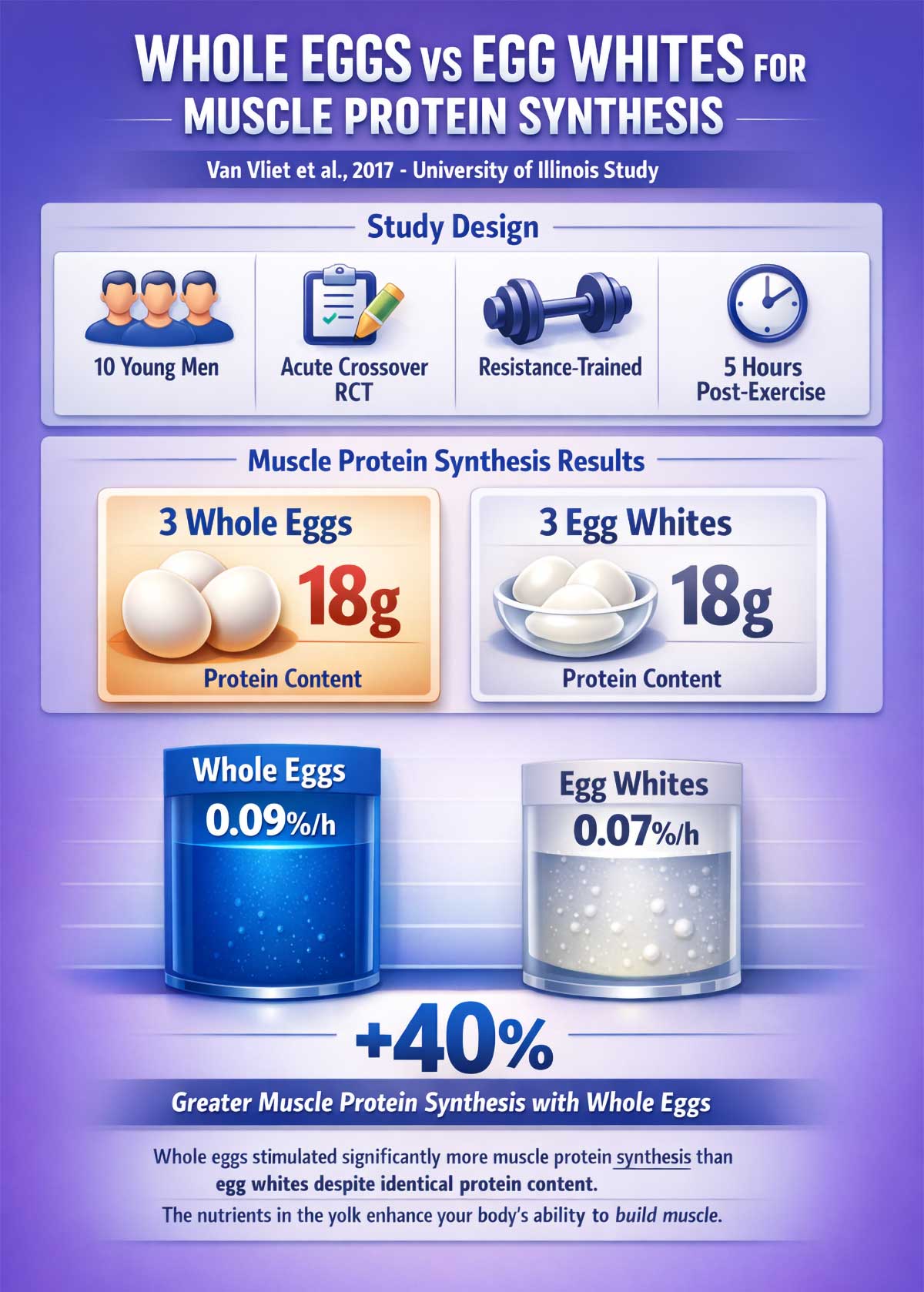
Why such a big difference? The yolk contains fats, vitamins, and other compounds that help your body use protein more effectively. Think of it like this: protein is the building material, but the yolk provides the construction crew and tools.
The Nutrition Breakdown: What’s Really in Those Eggs
Let’s look at what you’re actually getting when you eat three whole eggs versus three egg whites:
| Nutrient | 3 Whole Eggs | 3 Egg Whites | Why It Matters for Muscle |
|---|---|---|---|
| Protein | 18g | 11g | Building blocks for muscle tissue |
| Leucine | 1.6g | 1.0g | Triggers muscle protein synthesis |
| Calories | 216 | 51 | Energy for training and recovery |
| Fat | 15g | 0g | Hormone production, nutrient absorption |
| Vitamin D | 82 IU | 0 IU | Supports testosterone, bone health |
| Choline | 441mg | 1mg | Muscle contraction, brain function |
| Vitamin B12 | 1.3mcg | 0.2mcg | Energy production, recovery |
The difference is staggering. You’re not just losing a bit of fat when you toss the yolk. You’re throwing away nutrients your body needs to build muscle efficiently.
The 12-Week Muscle Gain: What Actually Happens
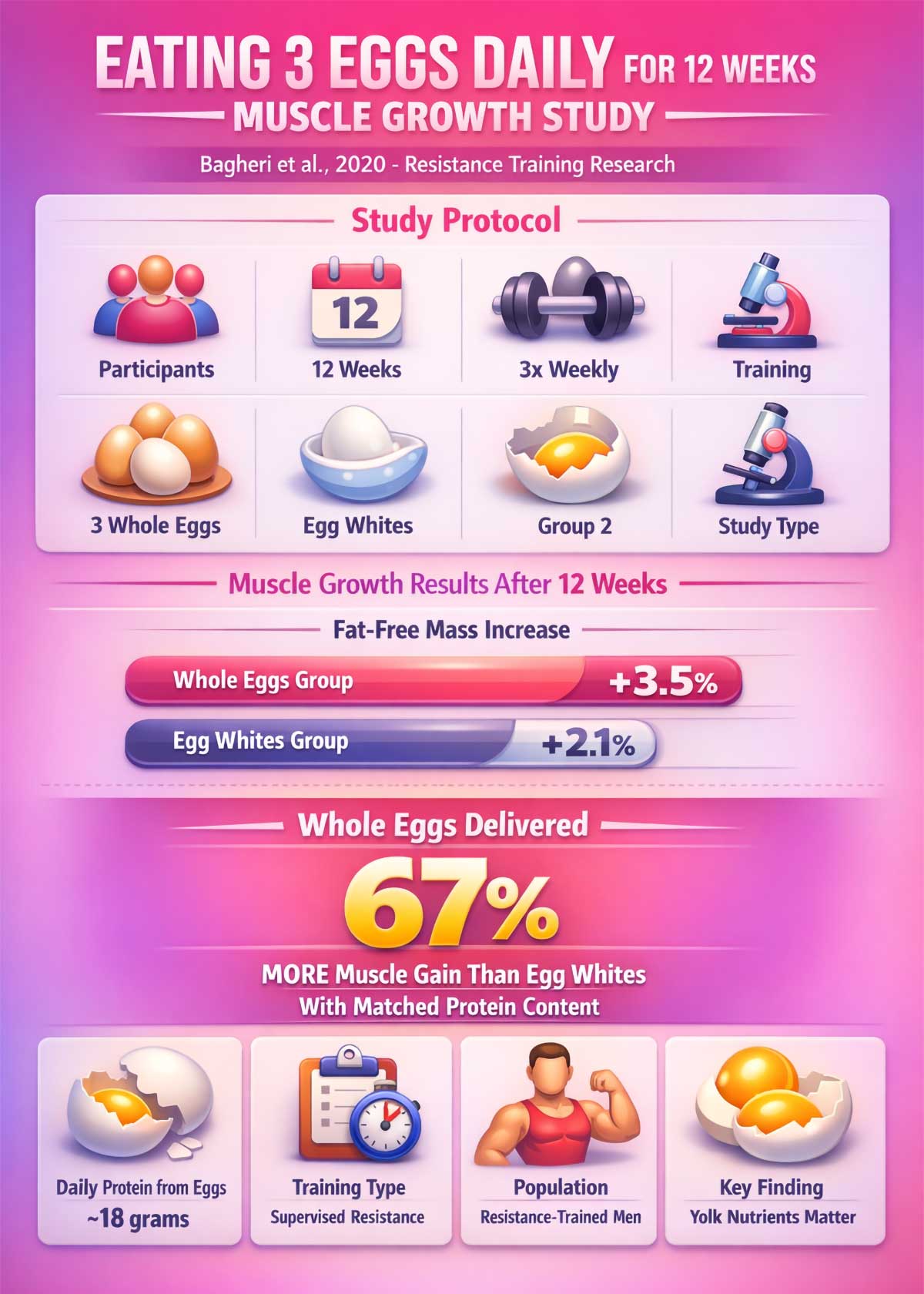
A team of Iranian researchers put the whole egg theory to a rigorous test in 2020. They recruited 30 young men who already trained with weights regularly. All participants followed the same supervised resistance training program—three sessions per week for 12 weeks. The only difference: half ate three whole eggs daily, while the other half ate egg whites with matched protein content.
After 12 weeks, both groups got stronger and added muscle. But the whole egg group gained significantly more:
| Metric | Whole Eggs Group | Egg Whites Group | Difference |
|---|---|---|---|
| Fat-Free Mass Gain | +3.5% | +2.1% | +67% better |
| Total Strength Increase | Higher gains | Moderate gains | Measurable advantage |
| Body Fat Change | Minimal increase | Minimal increase | Similar |
That’s a 67% bigger gain from simply eating the whole egg instead of just the white. On a 180-pound man, that’s an extra 2.5 pounds of pure muscle tissue over three months.
Strength improvements followed a similar pattern. The whole egg group posted bigger gains on bench press and leg press. They recovered faster between sessions. Their bodies adapted better to training stress.
How Eggs Flip Your Muscle-Building Switch
Your muscles don’t grow during workouts. They grow afterward, when your body repairs the damage. This process needs two things: amino acids and the signal to start building.
Eggs provide both.
Each large egg contains about 0.54 grams of leucine, an amino acid that activates mTOR—your body’s master growth pathway. Think of mTOR as the foreman on a construction site. Without enough leucine, the foreman never shows up, and construction stalls.
Three eggs give you roughly 1.6 grams of leucine. A comprehensive review published in 2011 examined protein quality and muscle protein synthesis across dozens of studies. The researchers found that you need 2 to 3 grams of leucine per meal to maximize muscle protein synthesis. With three eggs as your base, add some Greek yogurt or a slice of cheese, and you hit that target easily.
But here’s where whole eggs shine: the nutrients in the yolk—vitamins A, D, E, and healthy fats—help your body respond to that leucine signal more strongly. The egg white provides the amino acids. The yolk makes sure your body uses them.
How Eggs Compare to Other Protein Sources
You have options for protein. So why choose eggs? Let’s see how they stack up:
| Protein Source | Cost per 25g Protein | Prep Time | Leucine Content | Bioavailability |
|---|---|---|---|---|
| Eggs (4 large) | $0.60 | 5 min | 2.1g | Excellent |
| Chicken breast | $1.20 | 15 min | 2.0g | Excellent |
| Whey protein | $1.00 | 2 min | 2.7g | Excellent |
| Greek yogurt | $1.50 | 0 min | 2.2g | Excellent |
Eggs win on cost and convenience. They’re cheaper than most protein sources and take just minutes to prepare. An 8-week study from 2013 compared egg protein supplementation to whey protein in 30 resistance-trained men. Both groups followed a periodized training program four times per week. The egg protein group gained 2.1 kilograms of lean mass, while the whey group gained 2.3 kilograms—virtually identical results.
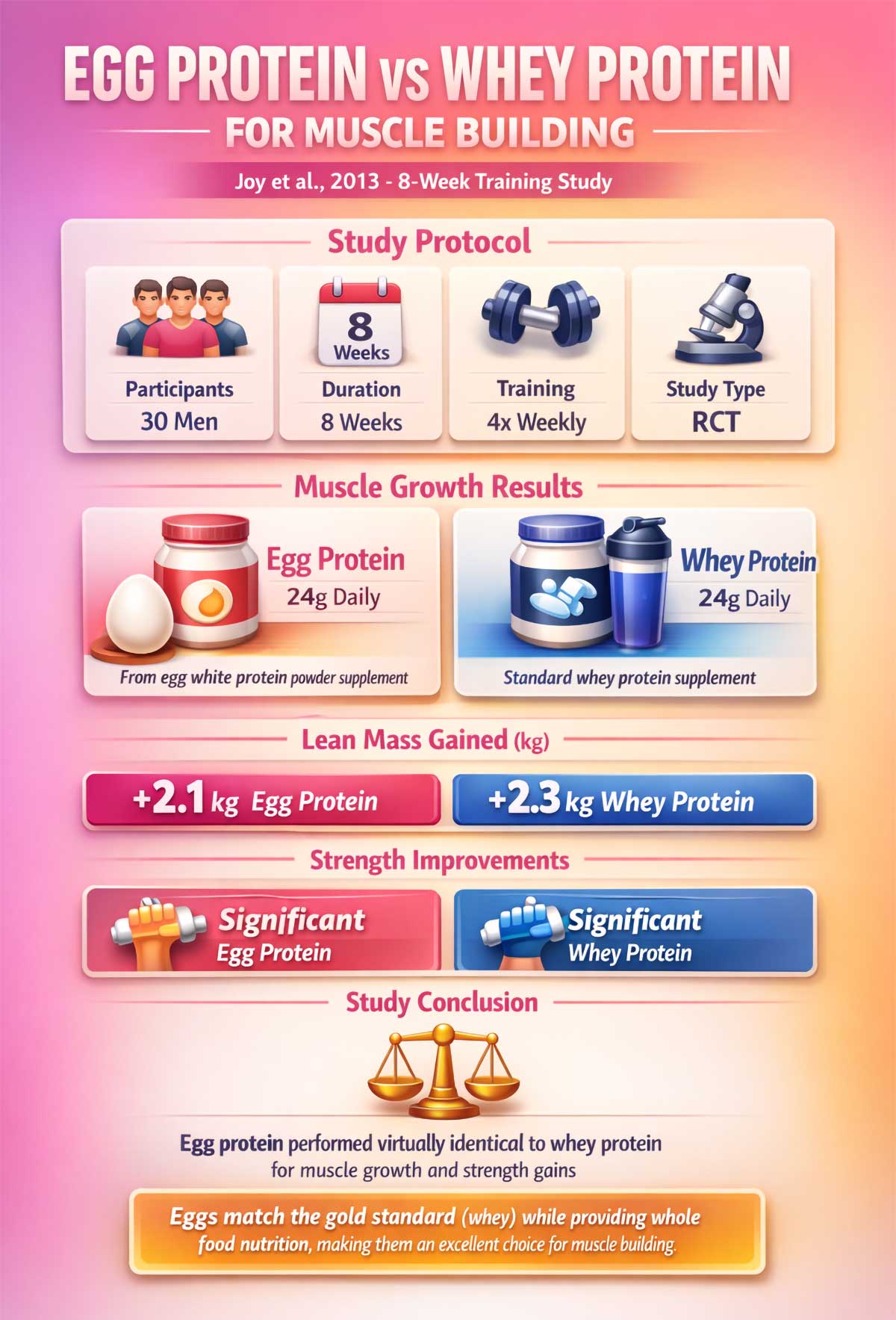
This matters because it shows eggs stand toe-to-toe with whey, often considered the gold standard for muscle building. But eggs have advantages: they’re whole foods with added nutrients, they’re cheaper than most protein powders, and they require no special equipment or mixing.
Your Body Composition Gets Better, Not Just Bigger
Building muscle without adding fat? That’s the holy grail. Most people accept some fat gain when they’re trying to grow. But eggs might change that equation.
The 12-week Iranian study tracked body fat percentage throughout the intervention. Despite eating three whole eggs daily (about 270 extra calories), the whole egg group didn’t gain significantly more body fat than the egg white group. They built more muscle with minimal fat storage.
Why? Eggs have a high thermic effect. Your body burns about 20 to 30% of egg protein’s calories just to digest it. That’s much higher than carbs or fats. You’re essentially spending energy to process the food, which helps keep fat gain in check.
Plus, all that extra muscle tissue increases your resting metabolism. More muscle means more calories burned, even while you sleep.
The Cholesterol Question: Should You Worry?
Let’s address the elephant in the room. Three eggs pack about 560 milligrams of cholesterol. For years, doctors warned against this. But science has moved on.
A 2020 review found that dietary cholesterol has minimal impact on blood cholesterol for most people. Your liver makes about 1,000 milligrams daily and adjusts production based on what you eat. Eat more cholesterol, your liver makes less. It’s a self-regulating system.
What about your lipid profile after 84 days of three eggs daily? Studies show that for healthy, active people, egg consumption doesn’t negatively affect heart disease markers. A 2017 study conducted in Korea followed 30 healthy young adults who ate three eggs daily for 12 weeks while doing resistance training. Not only did they gain muscle mass, but their lipid profiles actually improved. HDL cholesterol (the good kind) increased, while harmful lipid markers remained stable.
But there’s another angle here: testosterone. Your body uses cholesterol as a building block for testosterone and other hormones. Low-fat diets can tank testosterone levels in men. Eggs provide the raw materials your body needs to maintain healthy hormone production.
Higher testosterone means better recovery, more strength gains, and yes—more muscle growth. It’s another reason why whole eggs outperform egg whites.
When to Eat Your Eggs for Maximum Gains
You’ve probably heard about the “anabolic window”—that magical 30-minute window after training when you supposedly need protein or your gains disappear. That’s mostly hype.
Researchers in Australia tested different protein timing strategies in 2013. They had 24 resistance-trained men perform leg workouts, then gave them different protein feeding patterns over the next 12 hours. One group got two large 40-gram doses. Another got eight small 10-gram doses. The third group got four 20-gram doses spread evenly.
The winner? Four 20-gram doses spread throughout the day. This pattern kept muscle protein synthesis elevated longer than the other approaches. The frequent, moderate doses beat both the infrequent large doses and the constant small doses.
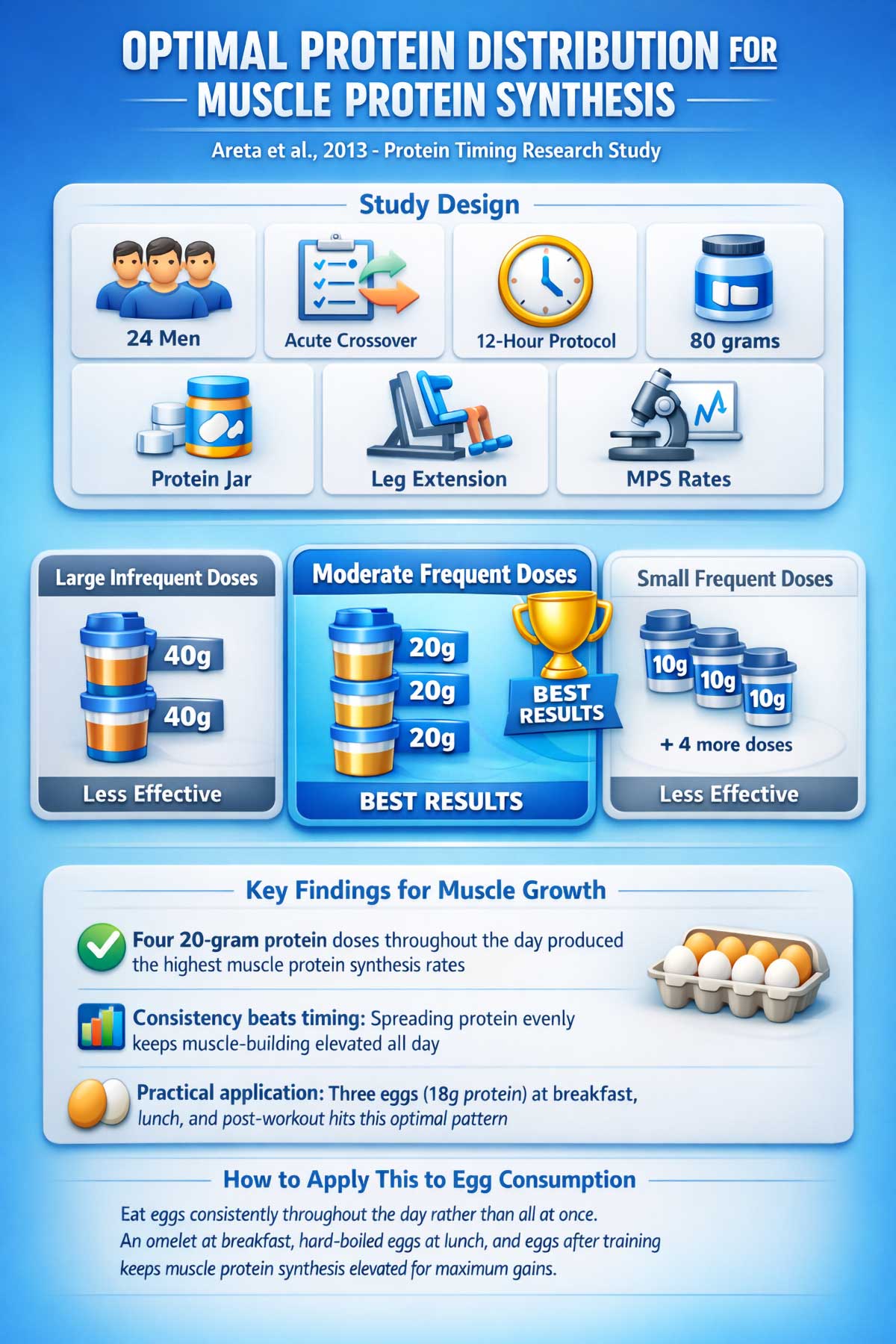
The takeaway: consistency beats timing. Eating protein every few hours keeps muscle protein synthesis elevated all day. An early morning omelet, a hard-boiled egg at lunch, and another with dinner works beautifully.
That said, eating eggs after training isn’t a bad idea. Post-workout, your muscles are primed to use nutrients. A three-egg omelet with vegetables gives you protein, fats, and micronutrients when your body needs them most.
Sample Daily Protein Distribution
Here’s how to structure your protein intake throughout the day using eggs as your foundation:
| Meal | Eggs | Additional Protein | Total Protein | Leucine |
|---|---|---|---|---|
| Breakfast | 3 whole eggs | 1 cup Greek yogurt | ~35g | ~3.2g |
| Lunch | — | 6oz chicken breast | ~40g | ~3.0g |
| Post-Workout | 2 whole eggs | Protein shake | ~35g | ~3.0g |
| Dinner | — | 8oz salmon | ~45g | ~3.5g |
| Daily Total | 5 eggs | Various | ~155g | ~12.7g |
A 2015 meta-analysis examined protein requirements for athletes and military personnel across multiple studies. The researchers found that protein intakes above 1.6 grams per kilogram of body weight per day from quality sources supported greater lean mass gains during training—typically an extra 0.3 to 0.5 kilograms compared to lower protein intake.
For a 180-pound (82 kg) man, that’s roughly 130 to 180 grams daily. The sample plan above hits the middle of that range while distributing leucine optimally throughout the day.
5 Muscle-Building Egg Recipes You Can Make in Under 10 Minutes
Eating three eggs daily sounds simple until you get bored. Here are five recipes to keep things interesting:
Post-Workout Power Scramble
Whisk three whole eggs in a bowl. Heat a pan over medium heat with a teaspoon of olive oil. Add the eggs, then toss in half a cup of fresh spinach, a quarter cup of diced tomatoes, and two tablespoons of shredded cheese. Stir until cooked through. Season with salt, pepper, and hot sauce to taste.
Nutrition per serving: 28g protein, 2.1g leucine, 320 calories. The spinach adds iron and vitamins, while the cheese boosts protein and calcium. Perfect within an hour after training.
Meal Prep Egg Muffins (Makes 12)
Preheat your oven to 350°F. Whisk 12 whole eggs in a large bowl. Add one cup of diced vegetables (bell peppers, onions, mushrooms), half a cup of cooked turkey sausage, and a pinch of salt and pepper. Pour into a greased muffin tin, filling each cup about three-quarters full. Bake for 20 minutes until set.
Per muffin: 6g protein. Store in the fridge for up to five days. Grab two or three for a quick breakfast or snack. Reheat in the microwave for 30 seconds.
Quick Protein-Packed Breakfast Bowl
Use three hard-boiled eggs you prepped on Sunday. Chop them and place in a bowl with half a cup of cooked oats, a tablespoon of almond butter, and a sprinkle of cinnamon. Mix together.
Nutrition: 25g protein with balanced carbs and healthy fats. This combination provides sustained energy for morning training sessions.
Greek Omelet for Gains
Beat three whole eggs. Pour into a heated pan. When the eggs start to set, add a quarter cup of crumbled feta cheese, sliced olives, diced cucumber, and chopped tomato on one half. Fold the omelet and cook for another minute.
Nutrition: 24g protein with healthy fats from olives and feta. The Mediterranean-style ingredients provide antioxidants and flavor variety.
The 5-Minute Microwave Scramble
Perfect for busy mornings. Crack three eggs into a microwave-safe bowl. Whisk thoroughly. Add diced vegetables (pre-chopped saves time). Microwave on high for 90 seconds. Remove, stir, then microwave for another 60 seconds. Season and eat.
This method works when you’re rushing to work or need protein between clients. Not fancy, but effective.
The Complete 12-Week Egg Protocol
Ready to test this yourself? Here’s your roadmap broken down by phase:
Week 1-4: Adaptation Phase
Eat three whole eggs daily. Cook them however you like—boiled, poached, scrambled, or fried in a bit of olive oil. Don’t stress about exact timing. Just get them in.
Train three to four times per week with compound movements: squats, deadlifts, bench press, rows. Aim for three to four sets of 8 to 12 reps on each exercise. Focus on form before adding weight.
Expect better recovery during this phase. You might notice less muscle soreness and more energy between sessions. Your body is adapting to both the training stimulus and the consistent protein intake. Don’t expect visible muscle changes yet—you’re building the foundation.
Week 5-8: Strength Phase
By now, your strength should be climbing. Track your big lifts in a notebook or app. You should see steady progress on weight or reps week to week. Keep your egg intake consistent. If you miss a day, don’t double up the next day—just get back on track.
Your body composition starts shifting here. Clothes might fit differently. Shirts feel tighter in the chest and arms. You’re not just getting stronger; you’re building visible muscle tissue.
This is when people start asking if you’ve been working out. Take that as confirmation the protocol is working.
Week 9-12: Growth Phase
This is where the magic happens. Fat-free mass gains accelerate. The cumulative effect of consistent training and nutrition pays off. Measurements show real changes: bigger arms, thicker chest, fuller legs.
Take progress photos and measurements at the start and end. The scale might not move much—muscle is denser than fat. But your body will look and perform differently. Strength should be significantly higher than week one. Exercises that felt impossible now feel manageable.
At the end of week 12, assess your results. Compare photos, measurements, and lift numbers to your baseline. Most people are surprised by how much changed in three months.
The Training Split That Works Best with Eggs
The research studies used three to four training sessions per week. Here are two proven splits:
3-Day Full Body Split
This works well for beginners or people with limited time. You hit every major muscle group three times per week, which maximizes the muscle-building signal.
Monday: Squats (3 sets of 8-10 reps), Bench Press (3 sets of 8-10), Barbell Rows (3 sets of 8-10), Overhead Press (3 sets of 8-12)
Wednesday: Deadlifts (3 sets of 5-8), Incline Dumbbell Press (3 sets of 8-12), Pull-ups (3 sets to failure), Dumbbell Curls (3 sets of 10-12)
Friday: Leg Press (3 sets of 10-12), Dips (3 sets of 8-10), Lat Pulldowns (3 sets of 10-12), Tricep Extensions (3 sets of 10-12)
4-Day Upper/Lower Split
This split allows more volume per muscle group while maintaining adequate recovery. Better for intermediate lifters who can handle more work.
Monday – Upper Push: Bench Press, Overhead Press, Incline Dumbbell Press, Tricep Dips, Lateral Raises
Tuesday – Lower: Squats, Romanian Deadlifts, Leg Press, Leg Curls, Calf Raises
Thursday – Upper Pull: Deadlifts, Pull-ups, Barbell Rows, Face Pulls, Bicep Curls
Friday – Lower: Front Squats, Leg Press, Walking Lunges, Leg Extensions, Hamstring Curls
Both splits work. Pick the one that fits your schedule and stick with it for the full 12 weeks. Consistency matters more than the perfect program.
Beyond Protein: What Else Eggs Provide for Muscle Growth
Eggs aren’t just protein bombs. Each whole egg delivers nutrients that directly support training and recovery:
Vitamin B12 plays a crucial role in nerve function and energy production. It helps convert the food you eat into usable fuel for your workouts. One large egg provides about 6% of your daily needs. Three eggs get you close to 20%. Many athletes run low on B12, especially those who restrict calories or eat limited animal products.
Vitamin D supports bone health, immune function, and testosterone production. The research is clear: low vitamin D correlates with lower testosterone levels in men. Each egg yolk contains about 40 IU of vitamin D. While that’s not huge, every bit helps, especially during winter months when sun exposure drops.
Choline is needed for muscle contraction and brain function. Your body uses it to produce acetylcholine, a neurotransmitter that tells your muscles to contract. The yolk is one of the best food sources—three eggs provide nearly 100% of the daily adequate intake for women and about 80% for men.
Healthy fats in the yolk include omega-3 fatty acids and monounsaturated fats. These reduce inflammation after training and support hormone production. Don’t fear the fat in eggs. Your body needs it.
These nutrients work together. They support training performance, recovery speed, and overall health. You can’t get this combination from a protein shake or chicken breast alone.
Should You Combine Eggs with Supplements?
Eggs are powerful on their own, but certain supplements create synergy:
Creatine plus eggs makes sense. Creatine increases strength and power output. Eggs provide the protein to build muscle. Together, they attack muscle growth from two angles. Take 5 grams of creatine monohydrate daily, any time of day. Don’t bother with loading phases or fancy versions.
Vitamin D supplementation might be worth it if you’re deficient. Get bloodwork done. If your vitamin D levels are below 30 ng/mL, consider taking 2,000 to 4,000 IU daily along with your eggs. The fat in eggs helps absorb the supplement better.
Fish oil provides omega-3s that reduce inflammation and support joint health. If you don’t eat fatty fish twice per week, take 2 to 3 grams of combined EPA and DHA daily. The anti-inflammatory effects complement the muscle-building effects of eggs.
What NOT to waste money on: Branch-chain amino acids (BCAAs). Eggs already contain all the BCAAs you need, including leucine. Taking BCAA supplements on top of whole eggs provides zero additional benefit. Save your money.
How to Track Your Progress Over 12 Weeks
You can’t improve what you don’t measure. Here’s a systematic approach:
Week 0 Baseline Measurements
Take these measurements before starting. Use the same conditions each time—same time of day, same clothing (or none), same scale.
Body weight (first thing in the morning, after using the bathroom) Waist circumference (at belly button level) Arm circumference (flexed, at the peak) Chest circumference (at nipple level) Thigh circumference (mid-thigh, standing relaxed) Progress photos (front, side, back in consistent lighting) Max lifts on three to five key exercises (or 5-rep maxes if you don’t test true 1RMs)
Weekly Check-ins
Every week, record the following:
Body weight (same day, same time) Workout performance (weight lifted, reps completed) Energy levels (rate 1 to 10) Recovery quality (how sore are you, 1 to 10 scale) Egg consumption (did you hit three eggs daily)
This takes five minutes but provides valuable data. You’ll spot trends—maybe strength jumps after a good sleep week, or you feel sluggish when you skip eggs.
Monthly Assessments
At the end of weeks 4, 8, and 12, retake all your baseline measurements:
All circumference measurements Progress photos Updated max lifts or rep maxes
Compare to previous months. You should see steady improvement. If not, something needs adjustment—training intensity, total calorie intake, sleep quality, or consistency.
What If You’re Not Seeing Results?
Sometimes the protocol doesn’t work as expected. Here’s how to troubleshoot:
You’re not training hard enough. Muscle growth requires progressive overload. That means lifting heavier weight or doing more reps over time. If you’re using the same weights for 12 weeks, you won’t grow. Add 5 pounds to the bar each week on big lifts. Add one rep per set on accessory work. Push yourself.
Your egg consumption is inconsistent. Missing two to three days per week undermines the entire protocol. The research showed results with daily consumption. Eating eggs Monday through Friday but skipping weekends means you’re only getting five days of the stimulus. Set a phone reminder. Prep hard-boiled eggs on Sunday. Make it automatic.
You’re not eating enough total calories. Three eggs add 216 calories to your day. If you’re trying to lose fat while building muscle, you might be in too deep a deficit. Muscle growth requires energy. Calculate your maintenance calories, then add 200 to 300 calories per day. The eggs cover most of that surplus.
Your sleep is poor. Seven to nine hours of quality sleep is non-negotiable for muscle growth. Your body releases growth hormone during deep sleep. Skimp on sleep and you sabotage your results. Fix your sleep before blaming the eggs.
Stress levels are too high. Chronic stress elevates cortisol, a hormone that breaks down muscle tissue. If work stress, relationship stress, or life stress is crushing you, your body can’t build muscle efficiently. Address stress through meditation, walks, therapy, or whatever works for you.
When Eggs Might NOT Be Your Best Choice
This protocol isn’t for everyone. Here are situations where eggs might not work:
Egg allergies or sensitivities. This seems obvious but needs stating. If eggs cause digestive distress, skin reactions, or other issues, don’t force them. Look into other high-quality proteins like chicken, fish, or Greek yogurt.
Existing high cholesterol with poor lipid markers. Most healthy people handle dietary cholesterol fine. But if your doctor says your LDL is dangerously high and you’re at risk for cardiovascular disease, get medical guidance before eating three eggs daily. You might be a “hyper-responder”—someone whose blood cholesterol rises significantly with dietary cholesterol. This affects about 25% of people.
Limited budget requiring protein variety. While eggs are cheap, eating only eggs for protein gets boring and might leave nutritional gaps. You need variety in your diet—different proteins provide different micronutrients. Don’t let eggs crowd out fish, beef, or legumes.
Digestive issues with high-fat meals. Some people struggle with fat digestion, especially in the morning. Three whole eggs contain 15 grams of fat. If this causes nausea or bathroom issues, try eating two whole eggs plus one white, or split your eggs between two meals.
Vegetarian or vegan athletes. If you avoid eggs for ethical reasons, this protocol obviously won’t work. Plant-based athletes can build muscle effectively with combinations of legumes, grains, nuts, and seeds to get complete amino acid profiles.
What Happens After Your First 12-Week Cycle?
You finished 12 weeks. You gained muscle and strength. Now what?
Maintenance phase. You don’t need to eat three eggs daily forever. Drop to two eggs per day and see if you maintain your gains. Some people find two eggs maintains their muscle while three eggs drives growth. Experiment and track your results.
Cycle your protein sources. Variety benefits both your palate and your nutrition. Spend the next 12 weeks emphasizing fish, then another cycle with more chicken and beef. Rotate back to eggs for another growth phase. This prevents boredom and ensures you get diverse micronutrients.
Set new goals. Maybe you gained 5 pounds of muscle. Great. Now aim for another 3 to 5 pounds over the next 12 weeks. Or shift focus to strength—chase a 300-pound bench press or 400-pound squat. Keep progressing.
Realistic long-term expectations. Natural muscle growth slows as you advance. A beginner might gain 15 to 20 pounds of muscle in their first year of serious training. An intermediate lifter might add 5 to 10 pounds in year two. Advanced lifters fight for 2 to 3 pounds per year. The eggs help you maximize your potential at whatever stage you’re at.
When to repeat the protocol. If you took a break from eggs and noticed your progress slowed, jump back into a 12-week cycle. Or if you’re preparing for a competition, vacation, or event where you want to look your best, use eggs as your secret weapon for the 12 weeks leading up to it.
A Final Look at the Science
Cross-sectional research published in 2006 examined 2,066 older adults to investigate the relationship between diet and muscle mass. The researchers found that higher egg consumption correlated with greater muscle mass in the elderly population, independent of other protein sources. This suggests eggs provide unique benefits beyond just protein content.
This aligns with the mechanistic studies showing whole eggs boost muscle protein synthesis more than egg whites. It also matches the intervention studies demonstrating superior muscle gains with whole egg consumption during training.
The evidence points in one direction: if you’re serious about building muscle, eggs deserve a central role in your diet.
Conclusion
Science backs what old-school bodybuilders knew: eggs build muscle. But the new research reveals something they didn’t know—the yolk is essential, not optional.
Eating three whole eggs daily for 12 weeks while training three to four times per week leads to measurably better gains in muscle mass and strength compared to egg whites alone. The nutrients in the yolk activate muscle protein synthesis more effectively, support hormone production, and provide vitamins your body needs to recover and grow.
This isn’t about chasing the next superfood trend. It’s about using proven, affordable nutrition to support your training. Eggs won’t replace hard work in the gym. But they’ll make that work pay off better.
Here’s what to do right now:
Buy two to three dozen eggs this week. Calculate your protein needs (body weight in kg × 1.6 to 2.2). Plan your training split—pick the three-day or four-day program from earlier. Take your baseline measurements and photos. Set a reminder to eat three eggs daily.
Start your own 12-week test. Track your lifts, measure your progress, and eat your eggs—yolk included. Three months from now, you’ll see the difference in the mirror and feel it in your lifts.
FAQs
Can I eat 3 eggs every day safely?
Yes. Research shows healthy, active people can eat three eggs daily without negative effects on cholesterol or heart health. Athletes often eat even more—five to eight eggs per day is common among bodybuilders and strength athletes. The key word is “healthy.” If you have existing cardiovascular issues or a family history of heart disease, talk to your doctor first. For most people, three eggs daily is perfectly safe.
Should I eat eggs before or after working out?
Both work. Post-workout eggs help with recovery by providing amino acids when your muscles need them most. Pre-workout eggs (eaten two to three hours before training) provide sustained energy without causing digestive discomfort. Daily consistency matters more than exact timing. If you train in the morning, eat eggs afterward. If you train in the evening, have them for breakfast. Just get them in.
What if I only eat egg whites?
You’ll still gain muscle, but 40% less efficiently than eating whole eggs, based on the muscle protein synthesis research. The yolk contains nutrients that boost your body’s ability to use protein. Eating just whites means you’re working harder for smaller results. Unless you have a specific medical reason to avoid yolks, eat the whole egg.
How long before I see results?
Expect better recovery by week two to three. You’ll notice less soreness and more energy in the gym. Strength gains typically show up by week four to six. You’ll add weight to the bar or knock out more reps. Visible muscle growth becomes apparent by week eight to twelve. Photos and measurements reveal changes you might miss in the mirror. Be patient. Muscle growth is a slow process.
Can I eat more than 3 eggs?
Yes. Some bodybuilders eat six to eight daily. Start with three and assess how you feel after a month. If you’re still hungry, your training is intense, and you want faster results, add another egg or two. Just make sure your total daily protein intake stays between 1.6 and 2.2 grams per kilogram of body weight. More isn’t always better once you hit that range.
Are organic or free-range eggs better for muscle building?
The protein content is nearly identical—about 6 grams per large egg regardless of how the hen was raised. Free-range and pasture-raised eggs may have slightly more omega-3 fatty acids and a better omega-6 to omega-3 ratio. They also tend to have richer yolks with more vitamin D. That said, regular eggs work fine for muscle growth. Buy what fits your budget. The most important factor is eating them consistently.