There’s a quiet ritual practiced by millions every morning. It turns out that habit may be one of the most powerful things you can do for your brain.
A growing body of research now links daily green tea consumption to a significantly lower risk of memory loss and dementia. We’re not talking about modest improvements. One major study found that people who drank green tea every day were 68% less likely to develop cognitive decline compared to those who didn’t. That’s not a rounding error. That’s a finding that deserves your attention.
The 5-Year Study That Changed the Conversation
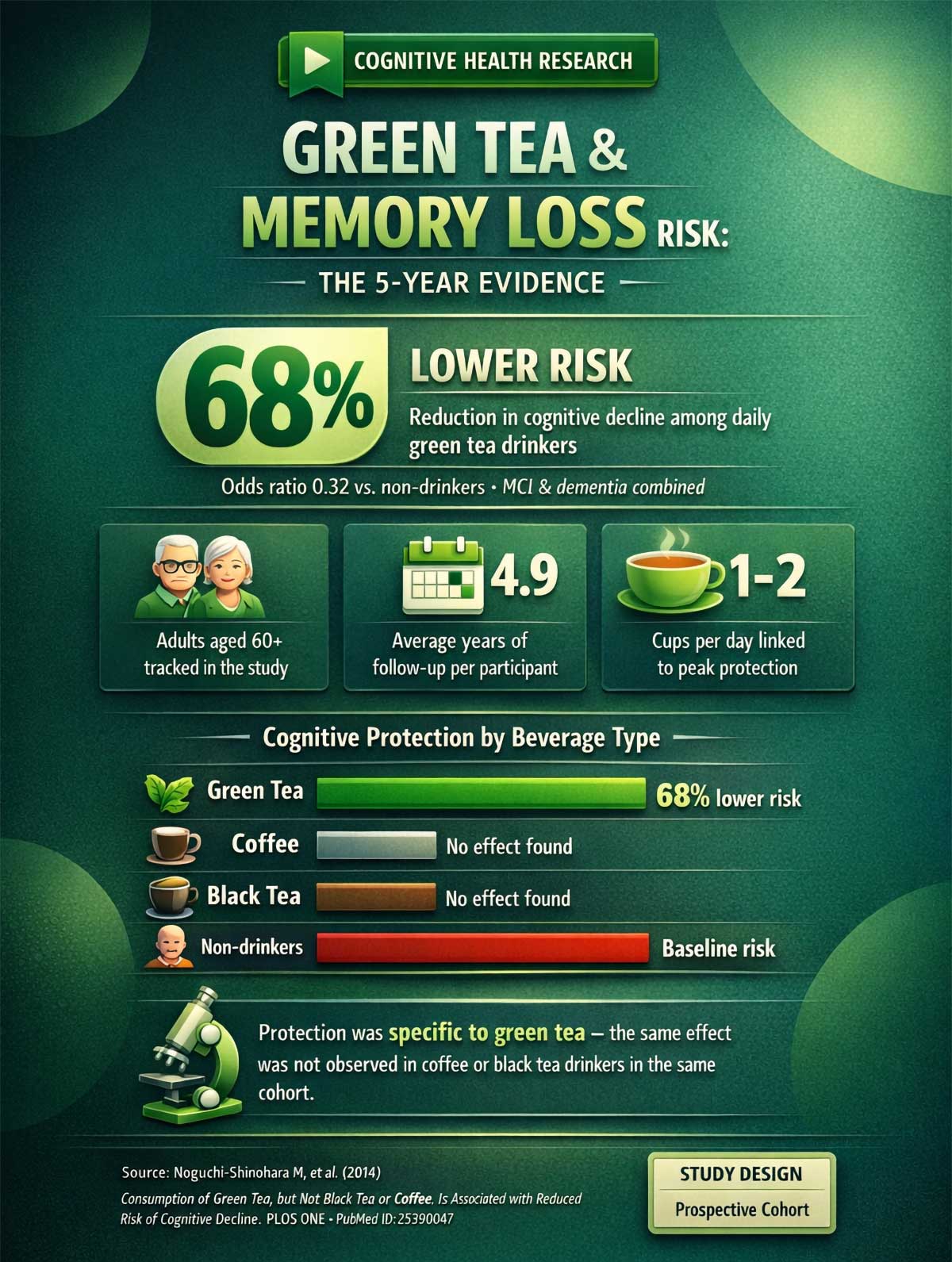
In 2014, researchers in Japan followed 723 adults aged 60 and older for nearly five years. Their goal was simple: track what people drank and see who developed cognitive problems over time.
The results were striking. Published in PLOS ONE, the Noguchi-Shinohara et al. study found that daily green tea drinkers had an odds ratio of just 0.32 for cognitive decline — meaning they were roughly 68% less likely to develop mild cognitive impairment (MCI) or dementia. Non-drinkers fared significantly worse across the board.
What made this study stand out wasn’t just the size of the benefit. It was the specificity. The same protection was not observed in people who drank coffee or black tea. Something in green tea — its unique chemistry — appeared to be doing the work.
Participants who drank at least one to two cups per day showed the strongest protection. The takeaway? You don’t need to overhaul your entire routine. One cup a day may be enough to get started.
Does More Tea Mean More Protection?
Once researchers confirmed that green tea helped, the next question was obvious: does drinking more of it make an even bigger difference?
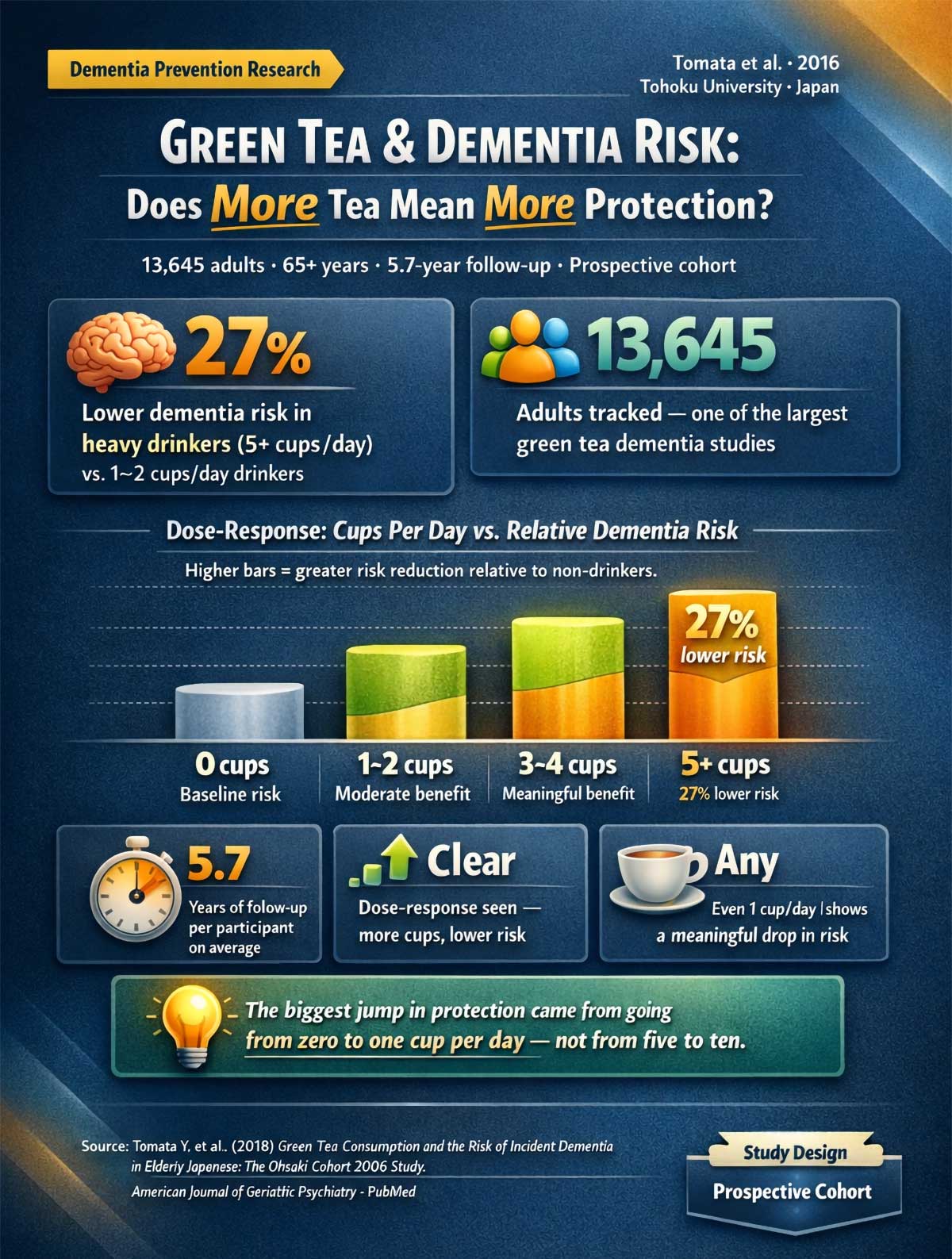
A large cohort study led by Tomata et al. (2016) tracked 13,645 older adults in Japan over 5.7 years, focusing on who developed dementia and how much tea they consumed each day. People who drank five or more cups per day saw their dementia risk drop by 27% compared to those who drank one to two cups daily — establishing a clear dose-response relationship. The more green tea people drank, up to a point, the lower their risk appeared to be.
But here’s the part most articles miss: the biggest leap in protection happened when people went from drinking none to drinking any. The jump from zero to one or two cups daily delivered the most significant benefit. Drinking five cups instead of two added a meaningful boost, but it wasn’t the make-or-break factor. Consistency — drinking it every day — mattered more than volume.
Think of it like sunscreen. Wearing SPF 30 every single day protects you far more than SPF 100 applied once a week.
Short-Term Gains: Can Green Tea Sharpen Memory Right Now?
So far, the evidence covers long-term risk reduction over years. But what about your memory today? Can green tea help you think more clearly in the near term?
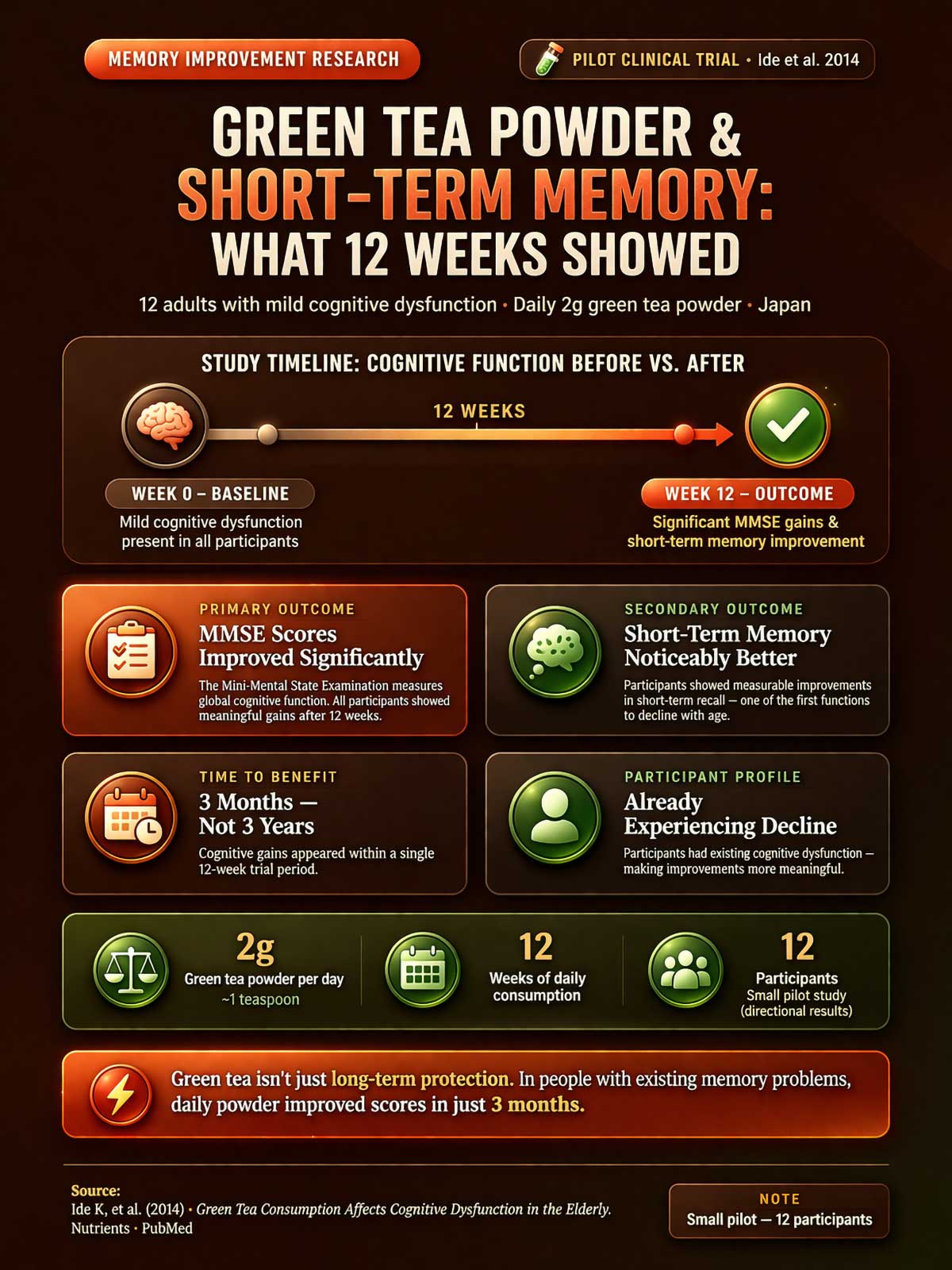
A pilot clinical trial by Ide et al. (2014) tackled this directly. Researchers recruited 12 adults who were already experiencing mild cognitive dysfunction — people struggling with the kind of brain fog that signals early decline. Each participant consumed 2 grams of green tea powder daily for 12 weeks. It’s worth noting this was a small pilot study; its findings are promising but should be viewed alongside the larger cohort data rather than in isolation.
After just three months, participants showed significant improvements in MMSE scores. The MMSE — the Mini-Mental State Examination — is the standard clinical test for measuring global cognitive function. Short-term memory and overall cognitive performance both improved noticeably.
This isn’t a story about preventing something that might happen in 20 years. These were people who already had memory problems, and daily green tea powder made a measurable difference in 12 weeks. The daily habit isn’t just a long-term insurance policy. It may start paying out sooner than you expect.
Matcha vs. Steeped Tea: What the Research Shows
Not all green tea is the same. There’s a meaningful difference between dropping a tea bag into hot water and drinking matcha — a powdered form of green tea made from shade-grown leaves.
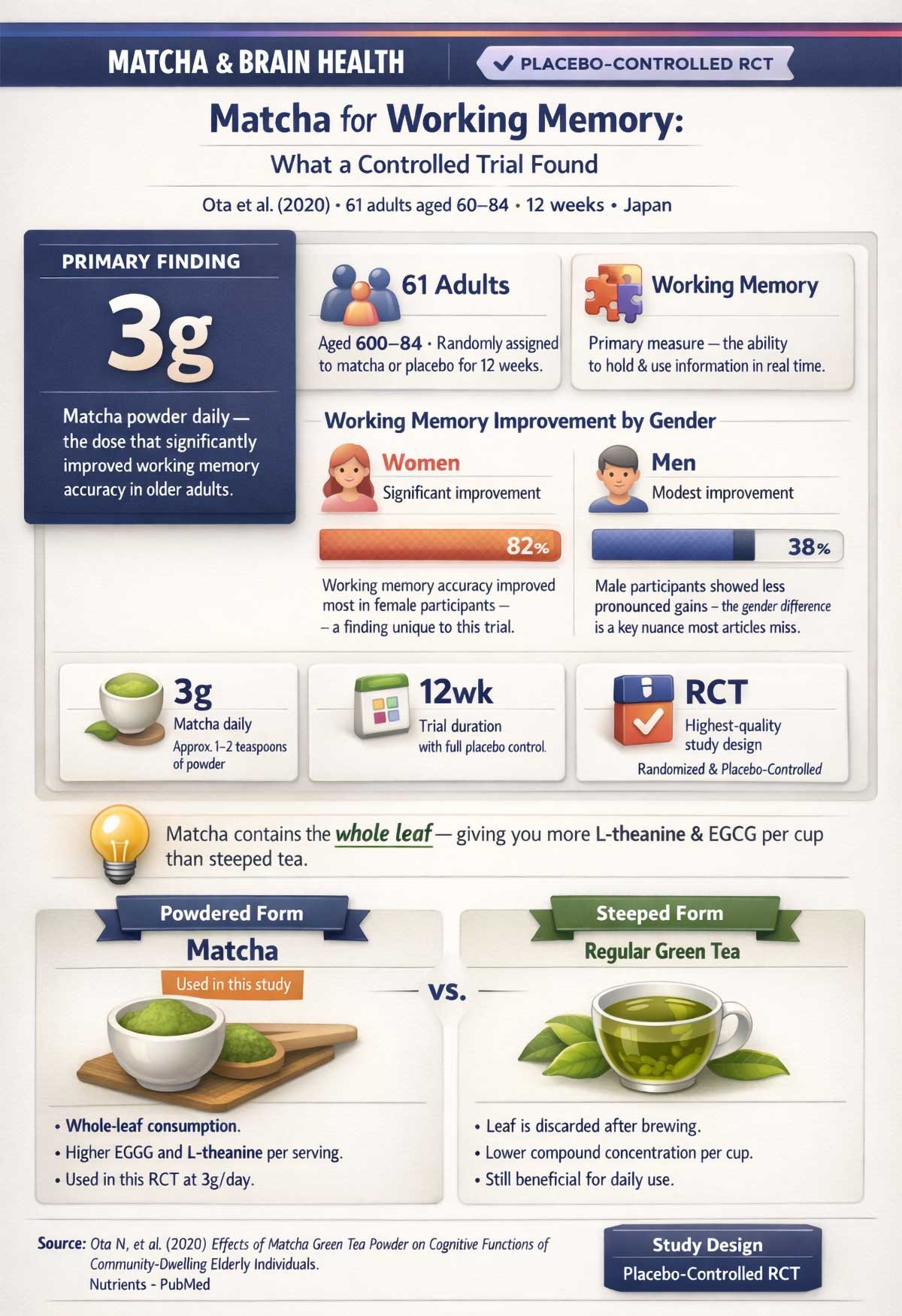
A randomized, placebo-controlled trial by Ota et al. (2020) examined 61 adults between the ages of 60 and 84. Half received 3 grams of matcha daily for 12 weeks; the other half got a placebo. Researchers measured working memory and attention throughout.
Working memory is the mental workspace you use to hold and process information in real time. It’s what lets you follow a conversation, remember a phone number, or stay focused during a stressful task. It’s also one of the first cognitive functions to decline with age.
The trial found that matcha significantly improved cognitive performance — particularly in women. Working memory accuracy improved most among female participants, a nuance that most broad-topic articles overlook entirely.
Why might matcha outperform a regular tea bag? Concentration. When you steep loose-leaf tea or a bag, most of the leaf is discarded with the water. When you drink matcha, you consume the whole leaf in powdered form. The result is a more concentrated dose of the exact compounds driving these benefits.
The Science Behind Green Tea and Cognitive Decline: A Study Summary
Before going deeper into the biology, it helps to see the full picture of the evidence in one place. These four studies form the backbone of what we know about green tea and brain health.
| Study | Participants | Duration | Key Finding |
|---|---|---|---|
| Noguchi-Shinohara et al. (2014) | 723 adults, 60+ | ~5 years | Daily drinkers had 68% lower cognitive decline risk (OR 0.32) |
| Tomata et al. (2016) | 13,645 adults, 65+ | 5.7 years | 5+ cups/day linked to 27% lower dementia risk; clear dose-response |
| Ide et al. (2014) | 12 adults with cognitive dysfunction | 12 weeks | Daily 2g green tea powder improved MMSE scores and short-term memory |
| Ota et al. (2020) | 61 adults, 60–84 | 12 weeks | Daily 3g matcha improved working memory accuracy, especially in women |
The studies span different designs — large population cohorts, a controlled pilot, and a placebo-controlled trial — which makes the consistent direction of results more meaningful.
The Two Compounds Behind the Benefits
You’ve probably noticed that green tea feels different from coffee — calmer, cleaner. That’s not in your head. It’s chemistry. Two specific molecules in green tea drive that effect, and both play a direct role in brain protection: L-theanine and EGCG.
L-theanine is an amino acid found almost exclusively in tea. It promotes what researchers describe as “calm alertness” — a focused mental state without the jitteriness that caffeine alone can cause. L-theanine modulates neurotransmitters in the brain, including GABA, serotonin, and dopamine. It also softens the stimulant edge of caffeine, producing a smoother, more sustained attention effect. L-theanine crosses the blood-brain barrier readily, which means it gets to work on the brain directly rather than just affecting your gut or bloodstream.
EGCG (epigallocatechin gallate) is the dominant catechin in green tea and one of the most studied plant compounds in brain science. It acts as a powerful antioxidant, reducing oxidative stress in the brain — a major driver of age-related cognitive decline. EGCG has also been shown in lab and animal studies to reduce the build-up of beta-amyloid plaques, the protein deposits strongly linked to Alzheimer’s disease. Research suggests EGCG reaches the brain as well, though in smaller amounts than L-theanine, and its neuroprotective effects appear to accumulate with consistent daily intake.
What makes green tea special isn’t either compound alone. It’s the combination. L-theanine provides the calm, focused mental state you feel. EGCG does the structural, protective work beneath the surface. That’s why the benefits seen in the 723-person cohort and the matcha RCT can’t simply be replicated by taking caffeine or a generic antioxidant supplement. The full package matters.
What to Buy: Green Tea Types and Quality
Here’s something most articles skip entirely. Not all green tea delivers the same level of brain-protective compounds. The type you buy — and where it comes from — makes a real difference.
Japanese green teas tend to be highest in both EGCG and L-theanine. This is largely due to how they’re grown and processed. The main varieties worth knowing are:
Matcha is the most concentrated option. Made from shade-grown leaves that are stone-ground into a fine powder, it delivers the highest levels of L-theanine and EGCG per serving. This is what the Ota et al. trial used at 3 grams daily. It’s the best choice when you want a targeted, potent dose.
Gyokuro is a shade-grown loose-leaf tea — the same growing method as matcha, but steeped rather than powdered. It has high L-theanine content and a naturally sweet, umami-rich flavor. A good choice for daily drinking.
Sencha is the most common Japanese green tea. It’s widely available, reasonably priced, and still offers solid EGCG levels. Most of the large cohort studies in Japan were conducted in populations drinking sencha. This is a practical, everyday starting point.
Chinese green teas like dragonwell (longjing) and gunpowder green are often processed differently — pan-fired rather than steamed — which can reduce catechin content. They still offer benefits, but the EGCG levels tend to be lower than Japanese varieties.
One more thing: avoid cheap supermarket tea bags with long shelf lives. EGCG degrades with heat, light, and time. Look for teas stored in sealed, opaque packaging with a recent harvest date. Freshness matters more than most people realize.
4 Ways to Get More From Your Green Tea
Knowing what to drink is only half the equation. How you prepare it — and when you drink it — affects how much of the active compounds actually reach your brain.
1. Don’t Scald the Leaves
Boiling water (100°C / 212°F) destroys catechins — including EGCG — before they ever reach your cup. Brewing at 70–80°C (160–175°F) preserves significantly more of the compounds you’re after. Let your water cool for one to two minutes after boiling before you pour. This single change can increase the neuroprotective content of every cup you drink.
2. Add Citrus
Vitamin C stabilizes catechins during digestion, helping more EGCG survive the journey through your gut and into your bloodstream. Research by Ferruzzi and colleagues found that adding ascorbic acid — the active compound in citrus juice — to green tea can increase antioxidant recovery after digestion by a significant margin, with some estimates in the range of three to five times compared to drinking it plain. A small squeeze of fresh lemon is the simplest way to do this.
3. Time It Right
Green tea contains both caffeine and L-theanine. Research on their combined effect shows that the focus and alertness benefit tends to peak around 30 to 60 minutes after drinking. Morning or early afternoon — ideally 30 minutes before a mentally demanding task — is the best window. Avoid drinking it within four to six hours of bedtime. Caffeine’s half-life means an afternoon cup can still affect sleep quality, and poor sleep is itself a significant risk factor for cognitive decline.
4. Switch to Matcha for a Stronger Dose
For targeted brain support — especially before demanding work — matcha delivers a higher concentration of both L-theanine and EGCG than steeped tea. The Ota et al. RCT used 3 grams daily, which is roughly one to two teaspoons of quality matcha powder mixed into water or milk. Regular sencha or gyokuro still offer meaningful benefits for daily use. But if you want the most potent dose for working memory or sustained focus, powdered matcha is worth the switch at least a few times per week.
Who Should Be Cautious
Green tea is safe for most healthy adults. That said, a few groups should exercise care before significantly increasing their intake.
People on blood thinners — particularly warfarin — should check with their doctor first. Green tea contains vitamin K, which can interfere with anticoagulant medications. The effect is generally modest from one to two cups daily, but larger amounts may be a concern.
People with liver conditions should be aware that very high doses of green tea extract — the concentrated supplement form, not brewed tea — have been linked to rare cases of liver stress. Drinking brewed tea in normal amounts does not appear to carry this risk, but concentrated supplements are a different matter.
People sensitive to caffeine may find that more than two to three cups daily causes sleep disruption, anxiety, or an elevated heart rate. Matcha, in particular, has a higher caffeine content per gram than loose-leaf tea. Start with one cup and assess your tolerance.
Pregnant women are generally advised to limit caffeine intake to under 200mg per day. One cup of green tea contains roughly 25–45mg, so moderate consumption is typically considered safe — but it’s worth discussing with a healthcare provider.
None of this means green tea is risky for most people. It means a little awareness goes a long way.
Your 5-Year Brain Preservation Plan, One Cup at a Time
The research here isn’t theoretical. It spans thousands of participants, multiple study designs, and years of rigorous follow-up. The picture it paints is consistent: people who drink green tea regularly protect their brains in measurable ways.
You might be thinking: it’s just tea. But the evidence is hard to dismiss. The Noguchi-Shinohara cohort showed 68% lower cognitive decline risk over nearly five years. The Tomata study of 13,645 adults confirmed a dose-response pattern reaching a 27% dementia reduction. A clinical pilot showed real improvements in people who already had memory problems — in just 12 weeks. A placebo-controlled trial confirmed working memory gains in older adults drinking matcha daily.
The barrier to entry here is low. Swap one daily beverage — a second coffee, a soda, even plain water — for a cup of green tea. Buy a quality Japanese sencha or a small tin of matcha. Brew it at the right temperature. Add a squeeze of lemon. Drink it in the morning or before a focused work session.
Your brain is doing the quiet work of protecting itself every day. This is one of the simplest ways to help it along.
Frequently Asked Questions
How many cups of green tea should I drink per day for memory? The research suggests that even one to two cups per day offers meaningful protection against cognitive decline. The Noguchi-Shinohara study found significant benefits at that level. Drinking five or more cups daily showed an additional 27% reduction in dementia risk in the Tomata cohort, but consistency matters more than volume. One cup every day is more effective than five cups a few times a week.
Does green tea help with brain fog? It may. Green tea contains L-theanine, which promotes calm, focused alertness by modulating key neurotransmitters including GABA, serotonin, and dopamine. Combined with the moderate caffeine in green tea, this can produce a cleaner, more sustained focus than coffee alone. The pilot trial by Ide et al. also showed improvements in short-term memory and cognitive scores in adults with existing cognitive dysfunction after 12 weeks of daily green tea powder.
Is matcha better than regular green tea for brain health? For a concentrated dose of brain-protective compounds, yes. Matcha is made from whole, powdered leaves, so you consume far more L-theanine and EGCG per serving than you would from steeping a bag or loose leaves. The Ota et al. placebo-controlled trial specifically used 3 grams of matcha daily and found significant improvements in working memory — particularly in women. Regular green tea still offers substantial benefits, especially for long-term daily use.
How long does it take for green tea to improve memory? For short-term focus, the L-theanine and caffeine combination takes effect within 30 to 60 minutes. For measurable cognitive improvements in people with existing decline, the Ide et al. pilot trial saw significant MMSE score gains after 12 weeks of daily use. For long-term risk reduction — the 68% and 27% figures from the large cohort studies — the benefits appear to build over years of consistent daily consumption.
Can green tea prevent Alzheimer’s disease? Current research is promising but not conclusive. EGCG has been shown in lab and animal studies to reduce beta-amyloid plaque formation, a hallmark of Alzheimer’s. The large population studies show meaningful reductions in dementia risk among daily drinkers. However, no clinical trial has yet proven that green tea directly prevents Alzheimer’s in humans. What the evidence does support is that regular consumption is associated with a significantly lower risk of cognitive decline — and that makes it a sensible daily habit for brain health.
Does the type of green tea matter? Yes. Japanese green teas — particularly matcha, gyokuro, and sencha — tend to have higher EGCG and L-theanine levels than most Chinese varieties due to differences in growing and processing methods. Freshness also matters; EGCG degrades over time. Look for teas in sealed, opaque packaging with a recent harvest date for the best results.
Always speak with a qualified healthcare provider before making significant changes to your diet, especially if you have a medical condition or take medications.