You’re productive, praised, and privately falling apart. The psychology behind why success hides the one thing you can’t afford to miss.
You’re hitting every target. Deadlines met. Inbox managed. Clients happy. On the outside, everything looks fine.
But inside? You feel like a machine running on fumes — functional, but hollow. Every task requires twice the effort it used to.
This is high-functioning burnout. It doesn’t look like burnout from the outside. That’s exactly what makes it so dangerous.
Unlike the popular image of someone who “falls apart,” high-functioning burnout describes a state where external output stays high while internal reserves quietly empty. The person carrying it often has no idea. And that’s no accident.
The very qualities that drove their success — perfectionism, relentless drive, high standards — are the same ones blocking them from seeing what’s happening.
The High-Performer’s Paradox
Most people think burnout means breaking down. Calling in sick. Crying in the bathroom. Missing deadlines.
High-functioning burnout doesn’t work that way.
The high-functioning person keeps showing up. They keep delivering. They keep getting praised. And each round of praise reinforces a quiet lie: I must be fine. Look at everything I’m getting done.
This is what researchers Christina Maslach and Michael Leiter describe as a gradual process of mismatch — between the person’s internal state and the demands placed on them. In their 2016 review published in the Annual Review of Organizational Psychology, they found that burnout develops slowly across six areas of work life: workload, control, reward, community, fairness, and values. People often don’t notice because the decline is so gradual. The slow drift becomes the new normal.
That’s the paradox. Success itself becomes the blindfold.
1. The Interoceptive Gap: Why You Can’t Feel Your Own Fatigue
Here’s something most burnout articles skip entirely: many people with high-functioning burnout aren’t ignoring their body signals. They genuinely can’t feel them.
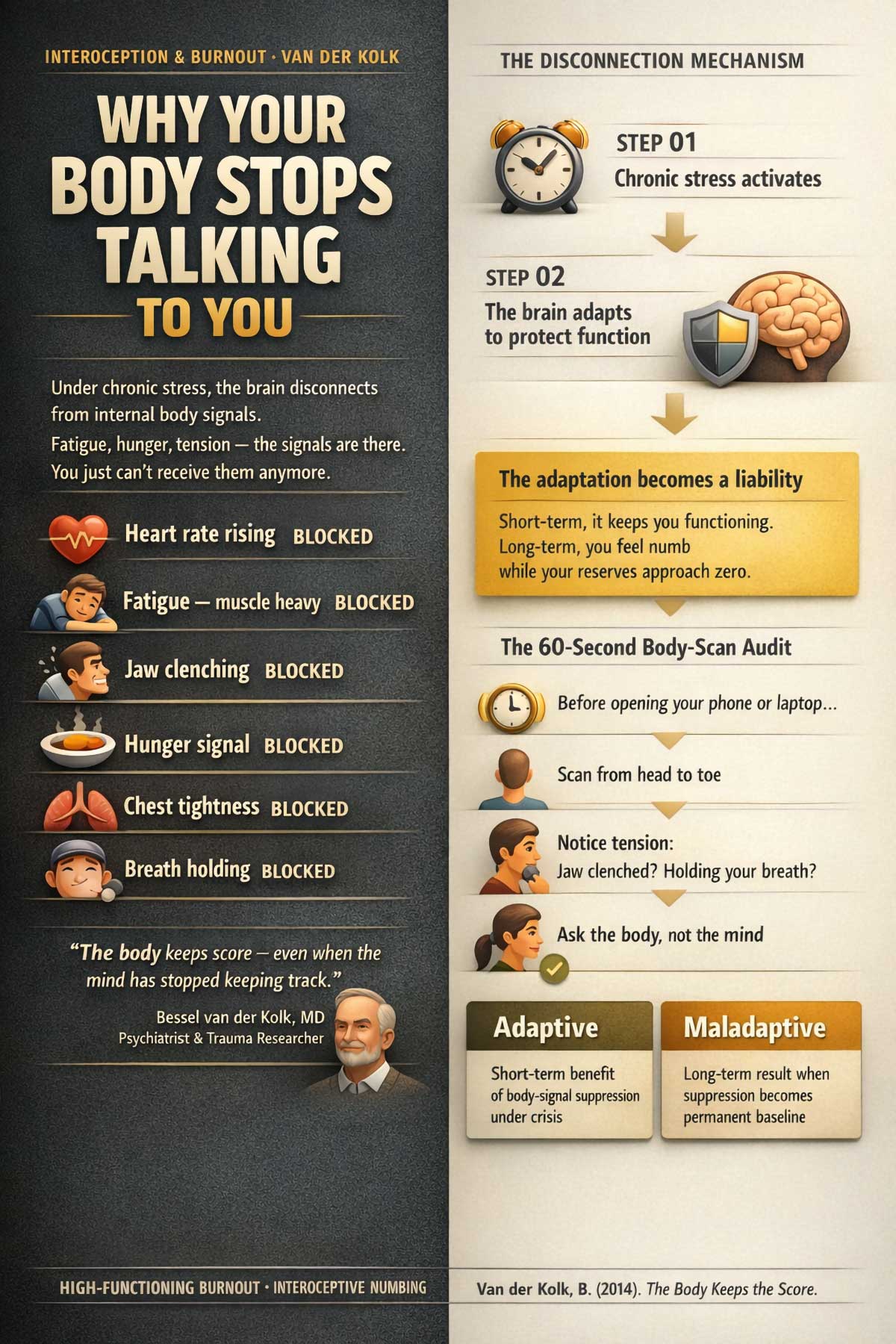
Interoception is the brain’s ability to read internal body states — hunger, fatigue, a racing pulse, tension in the chest. Under chronic stress, this system gets disrupted. The brain essentially stops relaying clear messages from the body as a coping strategy.
Psychiatrist and trauma researcher Bessel van der Kolk has documented this mechanism extensively in his work with trauma survivors — findings that apply equally to chronic occupational stress. His clinical research shows that chronic stress disconnects people from their own internal signals — fatigue, pain, and distress — as an adaptive response. In the short term, it helps a person keep going. Over time, it becomes a liability. You stop registering the warning lights. The signals are there; you just can’t receive them anymore.
This explains a common report from high-functioning burnout sufferers: they don’t feel tired, they feel numb. Or they feel a flat, efficient hum of productivity that slowly loses any color or meaning.
A practical tool: the 60-second body-scan audit. Before checking your phone in the morning or opening your laptop, take 60 seconds to scan your body from head to toe. Notice without judging. Where is there tension? Where are you holding your breath? Is your jaw clenched? This brief check-in bypasses the cognitive story of “I’m fine” and asks the body directly.
The goal isn’t to feel better immediately. It’s to rebuild the habit of listening.
2. The Recovery Paradox: When Rest Feels Like a Threat
Most people assume that if you’re exhausted, you’ll want to rest.
For high-functioning burnout, the opposite is often true.
Occupational psychologist Sabine Sonnentag’s 2018 review in the Annual Review of Organizational Psychology introduced what she calls the “Recovery Paradox.” Her research found that the people who are most stressed and most in need of recovery are the least likely to actually detach and rest. Chronic job stress impairs the very psychological mechanisms that allow a person to switch off.
In plain terms: the more you need a break, the harder it becomes to take one.
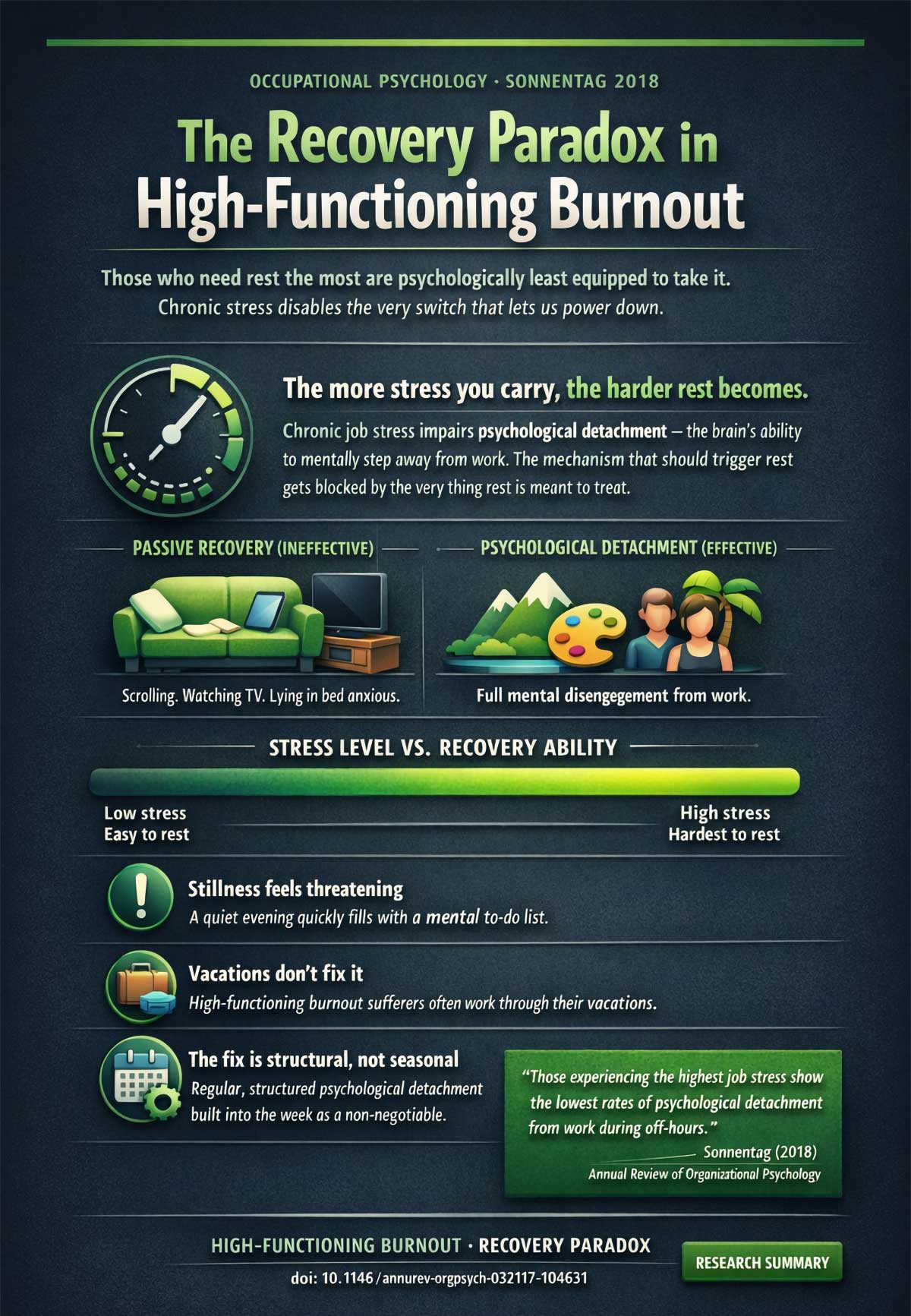
For many high achievers, stopping feels threatening. Stillness triggers anxiety. A quiet evening quickly fills with a mental to-do list. A weekend with no plans feels wasteful. This isn’t laziness in reverse — it’s a nervous system that has been trained to associate activity with safety.
The solution isn’t passive rest. Scrolling through your phone or watching three hours of TV doesn’t count as real recovery — and most high-functioners know it. What research supports is psychological detachment — mentally and emotionally stepping away from work. This can look like a walk with no podcasts, a physical hobby that demands full attention, or time with people who have nothing to do with your professional identity.
The shift isn’t from “working” to “doing nothing.” It’s from “performing” to “being present in something else entirely.”
3. The Perfectionist Override: Ignoring the Warning Lights
Perfectionism is often framed as a virtue. In high-achievement cultures, it gets rewarded.
But perfectionism carries a hidden cost: it teaches people to treat their own limits as moral failures.
Psychologists Paul Hewitt and Gordon Flett identified this in their foundational 1991 research on multidimensional perfectionism, published in the Journal of Personality and Social Psychology. Their findings showed that self-oriented perfectionism — holding yourself to impossibly high internal standards — correlates strongly with self-criticism and an inability to acknowledge personal limits. Perfectionists tend to push through exhaustion rather than recognize it as a signal worth heeding.
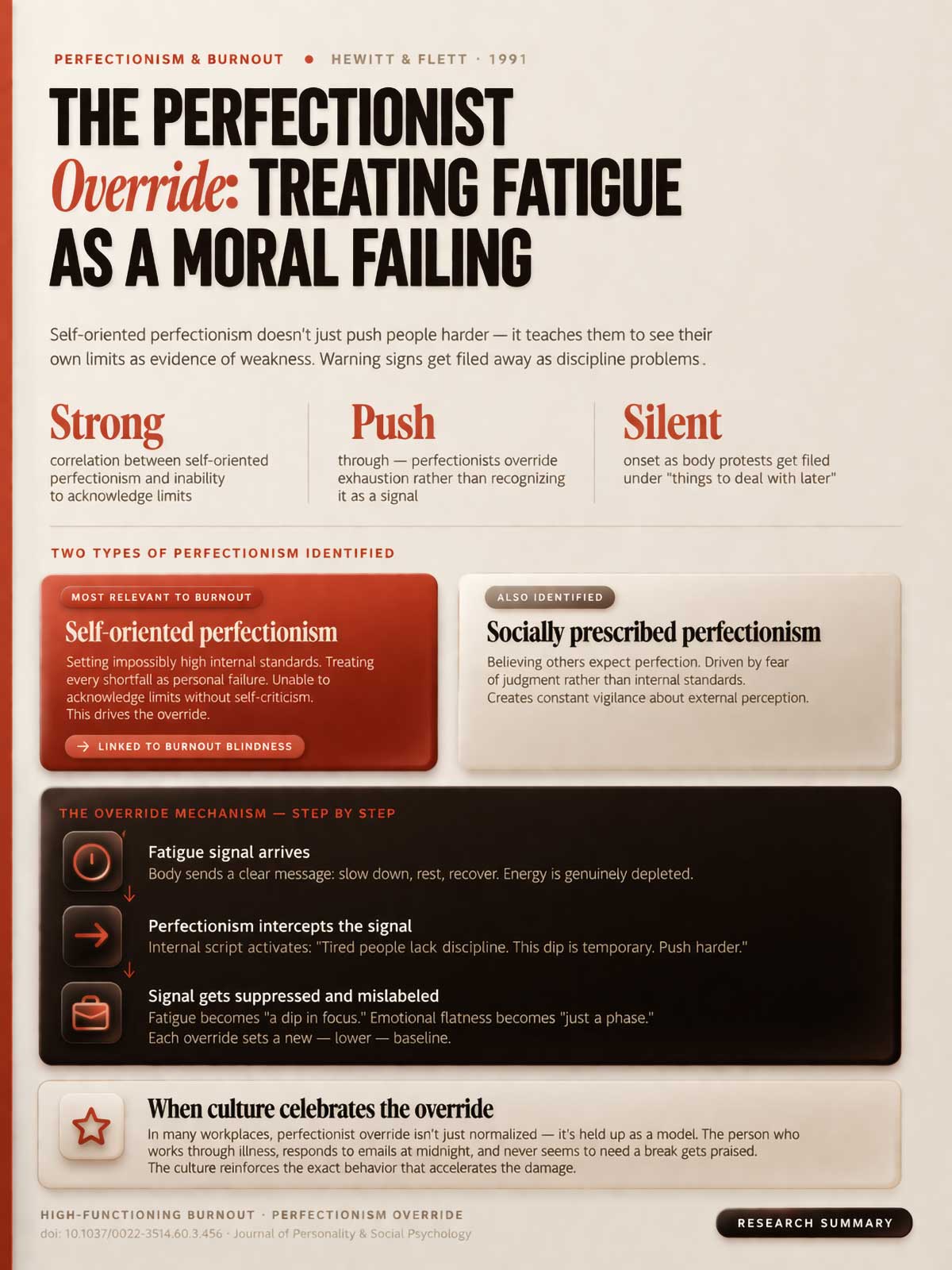
The internal script sounds something like this: Tired people aren’t disciplined enough. I just need to push harder. This slowdown is temporary.
Fatigue gets reframed as a “dip in focus.” Emotional flatness becomes “just a phase.” The body’s protests get filed under “things to deal with later.”
This override system is effective — until it isn’t. What makes the perfectionist override so insidious is that it works, right up until the point where it catastrophically doesn’t.
In many professional environments, this override isn’t just normalized — it’s celebrated. The person who works through illness, who responds to emails at midnight, who never seems to need a break gets held up as the model. The culture reinforces exactly the behavior that accelerates the damage.
4. Reframing Anxiety as “Drive”
Ask a high-functioning burnout sufferer how they feel and a common answer is: Driven. Focused. A little wired, but that’s normal for me.
That “wired” feeling? It’s often anxiety wearing the costume of ambition.
Research from Koutsimani, Montgomery, and Georganta (2019), analyzing data from 67 studies across nearly 14,000 participants, confirmed moderate to strong links between burnout, depression, and anxiety. Clinical observations suggest that high-performing individuals often reframe anxiety symptoms not as warning signs, but as positive traits — the racing thoughts become “big ideas,” the inability to relax becomes “being driven.”
This reframing is understandable. In many professional cultures, anxiety looks like high performance. The constant urgency, the inability to truly disengage, the sense that slowing down means falling behind — these pass as admirable work ethic.
The distinction between healthy drive and anxious over-functioning often comes down to one question: Does stopping feel like a choice, or does it feel impossible?
Healthy engagement allows genuine rest. Anxious over-functioning punishes it.
5. The Normalization of the “Slow Boil”
Burnout is rarely a sudden event. It’s a long, quiet process that happens in the background while life keeps moving.
Maslach and Leiter’s work is clear on this: the mismatch between a person and their work builds over months or years across multiple life areas. Each mismatch, on its own, feels manageable. Together, they create a weight that compresses the person slowly, like water pressure at depth.
What makes this especially hard to catch is adaptation. When your baseline for “normal” shifts to 11-hour days, a constant to-do list, and poor sleep, the original “normal” — the one where you felt calm, present, and energized — is long forgotten. You lose your reference point.
This normalization process is backed by data from a large-scale study by Schaufeli and colleagues in 2009, involving 14,521 employees across 10 countries. The research found that work engagement and burnout, though distinct, can coexist. High engagement can mask the early signs of depletion — a person looks and acts engaged while the internal reserves are running low. External performance continues long after internal wellbeing has started to decline.
The slow boil is dangerous precisely because it feels like progress.
The “Last to Know” Checklist: 5 Signs Your Performance Is a Mask
High-functioning burnout rarely arrives with a dramatic announcement. It shows up in the small cracks — the ones you’ve been spackling over for months.
Here are five signs that the performance on the outside may not match what’s happening on the inside.
1. You’re irritable, but only with the people closest to you. At work, you’re composed, professional, effective. At home, you snap at small things. This isn’t a personality flaw — it’s what happens when all your emotional regulation goes into public performance, leaving nothing for private life.
2. You can’t switch off, even when there’s nothing left to do. The laptop is closed. The workday is technically over. But your brain is still running — rehearsing tomorrow’s meeting, replaying today’s conversation, cataloguing unfinished items. Psychological detachment feels impossible.
3. You rely on “prop-up” substances to get through transitions. More coffee than you’d like to admit in the morning. A glass of wine that’s become a requirement, not a treat, in the evening. These aren’t moral failures — they’re signs that your nervous system is struggling to manage the shift between states on its own.
4. You feel what might be called “cynical competence.” You do the work. You do it well. But at some point, you stopped caring about the outcome. The job gets done with skill and without meaning. This emotional detachment from work that used to matter is one of the core markers of burnout, as identified in Maslach and Leiter’s research.
5. Your body is sending messages you’ve labeled as “just stress.” Jaw clenching. Poor sleep. Digestive changes. A tight chest that comes and goes. These aren’t random. They’re the body attempting to communicate what the brain has learned to filter out. A study by Taris and colleagues in 2017, involving 201 employees over a year, found meaningful gaps between how workers rated their own burnout and how their colleagues perceived them — with high achievers showing particularly notable underreporting of their own symptoms.
If several of these feel uncomfortably familiar, that recognition itself is worth something.
The Path Out: Reclaiming Awareness
Here’s what most recovery advice gets wrong for high-functioning burnout: a vacation won’t fix it.
Research supports this. High-functioners often work through their vacations — physically present on a beach while mentally managing three projects. Even when they do fully unplug, the relief is temporary if the underlying patterns don’t change. They return, the pace resumes, and within weeks the same state returns.
What the research, particularly Sonnentag’s work on recovery, points toward is a more fundamental shift in how a person relates to their own limits. This means building in regular, genuine psychological detachment — not as a luxury, but as a structured part of the week. It means treating attention and energy as finite resources rather than bottomless wells of willpower.
It also means questioning the identity structures that made burnout invisible in the first place.
Dyrbye and colleagues, in a 2014 cross-sectional study of nearly 8,000 medical students — a population that is, by definition, high-achieving — found that over 52% met burnout criteria. Yet they were significantly less likely to seek help or acknowledge impairment. The barrier wasn’t lack of resources. It was a professional identity deeply tied to being the person who handles things. Acknowledging burnout felt like a threat to that identity.
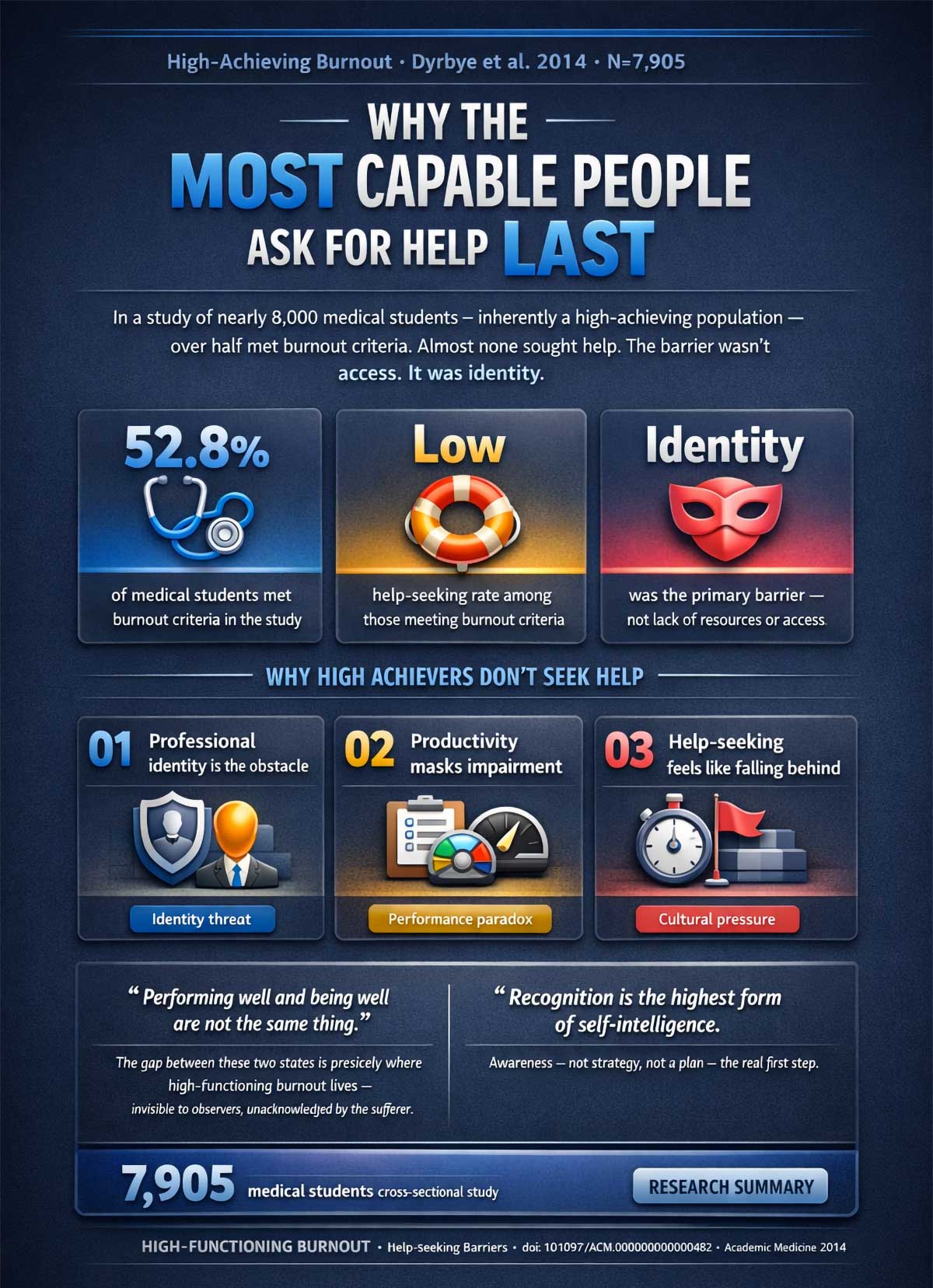
This is why awareness is the real first step. Not a plan, not a strategy — awareness. Recognizing that what you’ve been calling “drive” might be distress. That what you’ve called “efficiency” might be numbness. That performing well and being well are not the same thing.
Burnout isn’t a crash. It’s a quiet erosion — gradual, adaptive, and easy to miss. Recognizing it isn’t weakness. It’s the clearest signal that your self-awareness is still working, even when everything else has been running on override.
That recognition is where the real work begins.