You’ve probably heard that sauerkraut is good for your gut. But how good? And how long do you need to eat it before you see real changes?
Scientists have answers. They tracked people who ate sauerkraut daily for 4 to 10 weeks. The results show clear shifts in gut bacteria and inflammation levels. Some people also felt relief from digestive symptoms like bloating and irregular bowel movements.
This isn’t about eating sauerkraut once and hoping for the best. Real changes take time and consistency. Here’s what the research shows.
What the Clinical Studies Found
| Study | Duration | Participants | Daily Amount | Key Results |
|---|---|---|---|---|
| Nielsen 2018 | 6 weeks | IBS patients | ~100g (1/2 cup) | Reduced symptoms in both pasteurized and raw groups |
| Wastyk 2021 | 10 weeks | Healthy adults | 6 servings fermented foods | Increased diversity, reduced 19 inflammatory markers |
| Nielsen 2019 | 6 weeks | IBS patients | Fermented cabbage | Improved microbial profiles and symptom relief |
| Marco 2017 | Review: 4-12 weeks | Mixed populations | Varied fermented foods | Support for microbial diversity and gut function |
The 4-Week Mark: When Your Gut Starts to Shift
Why Single Servings Don’t Work
Your gut contains trillions of bacteria. They live in a stable environment that resists quick changes. Eating sauerkraut once won’t move the needle. Your existing bacteria will dominate.
Think of it like planting seeds in a crowded garden. One handful of seeds won’t take over. But if you plant seeds every day for weeks, they start to establish roots.
That’s what happens with sauerkraut. The lactic acid bacteria in fermented cabbage need repeated exposure to take hold. Daily intake gives them a chance to stick around and multiply.
The IBS Breakthrough: 6 Weeks of Relief
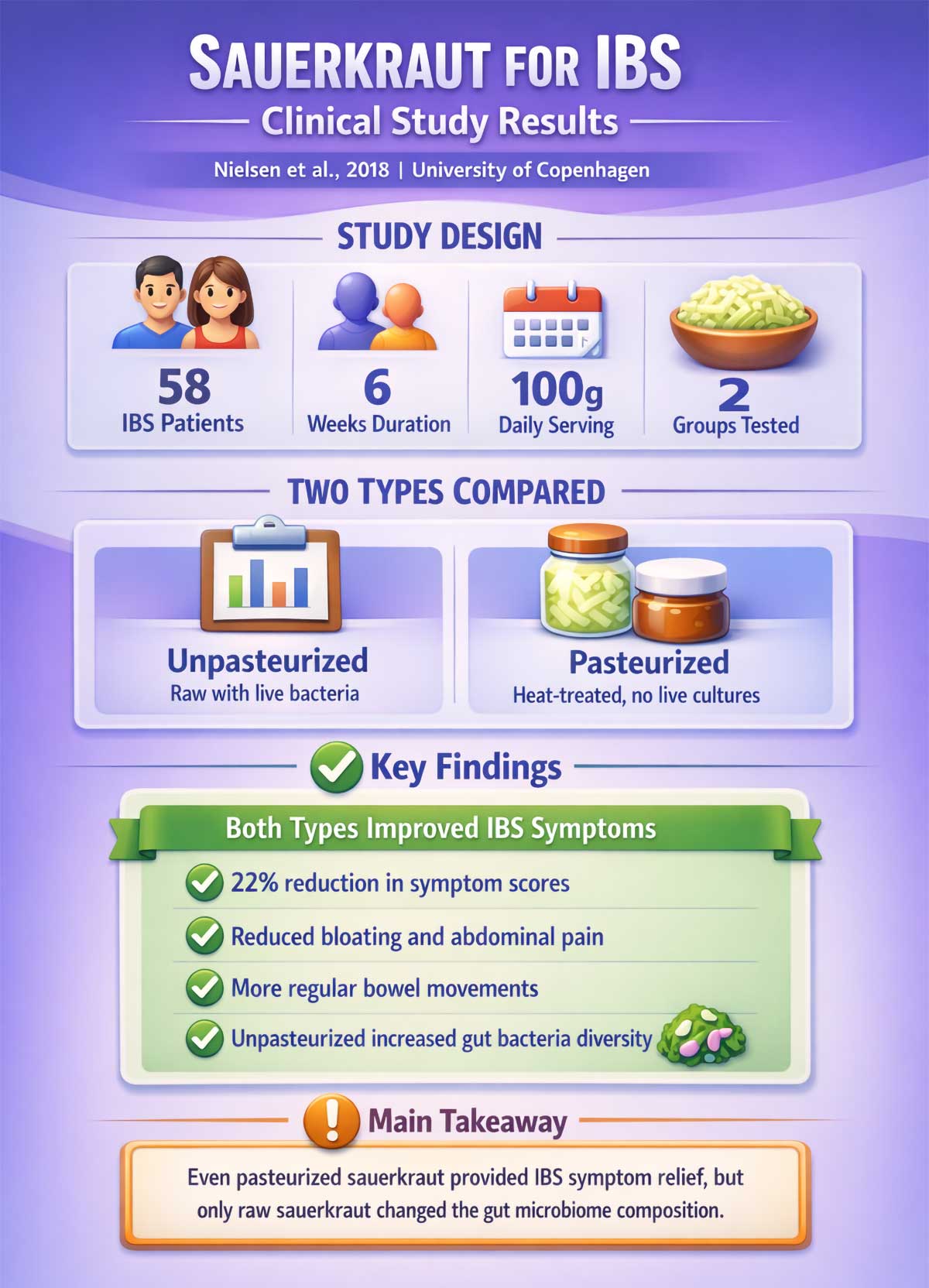
Researchers at the University of Copenhagen tested sauerkraut on adults with IBS in 2018. They split 58 participants into two groups. One ate unpasteurized sauerkraut. The other ate pasteurized sauerkraut. Both groups consumed about 100 grams daily for 6 weeks.
The results surprised many experts. Both types of sauerkraut improved IBS symptoms. People reported less bloating, less pain, and more regular bowel movements. The symptom scores dropped by an average of 22% across both groups.
The unpasteurized version did something extra. It changed the makeup of gut bacteria. Lactic acid bacteria increased significantly. These are the beneficial bacteria that help break down food and produce helpful compounds.
Even the pasteurized version helped, though. It didn’t increase live bacteria counts. But it still reduced symptoms. Scientists think dead bacterial cells and fermentation byproducts may have beneficial effects on their own. These compounds, called postbiotics, can influence the immune system and gut barrier even without living organisms.
How Bacteria Colonize Your Gut
When you eat sauerkraut, you’re not just adding nutrients. You’re adding living organisms.
These bacteria don’t move in permanently. They’re more like temporary visitors. But while they’re there, they influence your gut environment.
Lactic acid bacteria produce acid. This lowers the pH in your intestines. A lower pH makes it harder for harmful bacteria to survive. It’s like changing the temperature in a room. Some organisms thrive, others struggle.
After about 4 weeks of daily intake, these bacteria establish what scientists call a “foothold.” They’re present in high enough numbers to affect digestion and immune responses. The Nielsen 2019 follow-up study confirmed this pattern. After 6 weeks of fermented cabbage intake, participants showed measurable shifts in their gut microbial profiles, with increased populations of beneficial species.
The 10-Week Microbiome Explosion: Beyond Basic Digestion
Increasing Diversity Through Fermented Foods
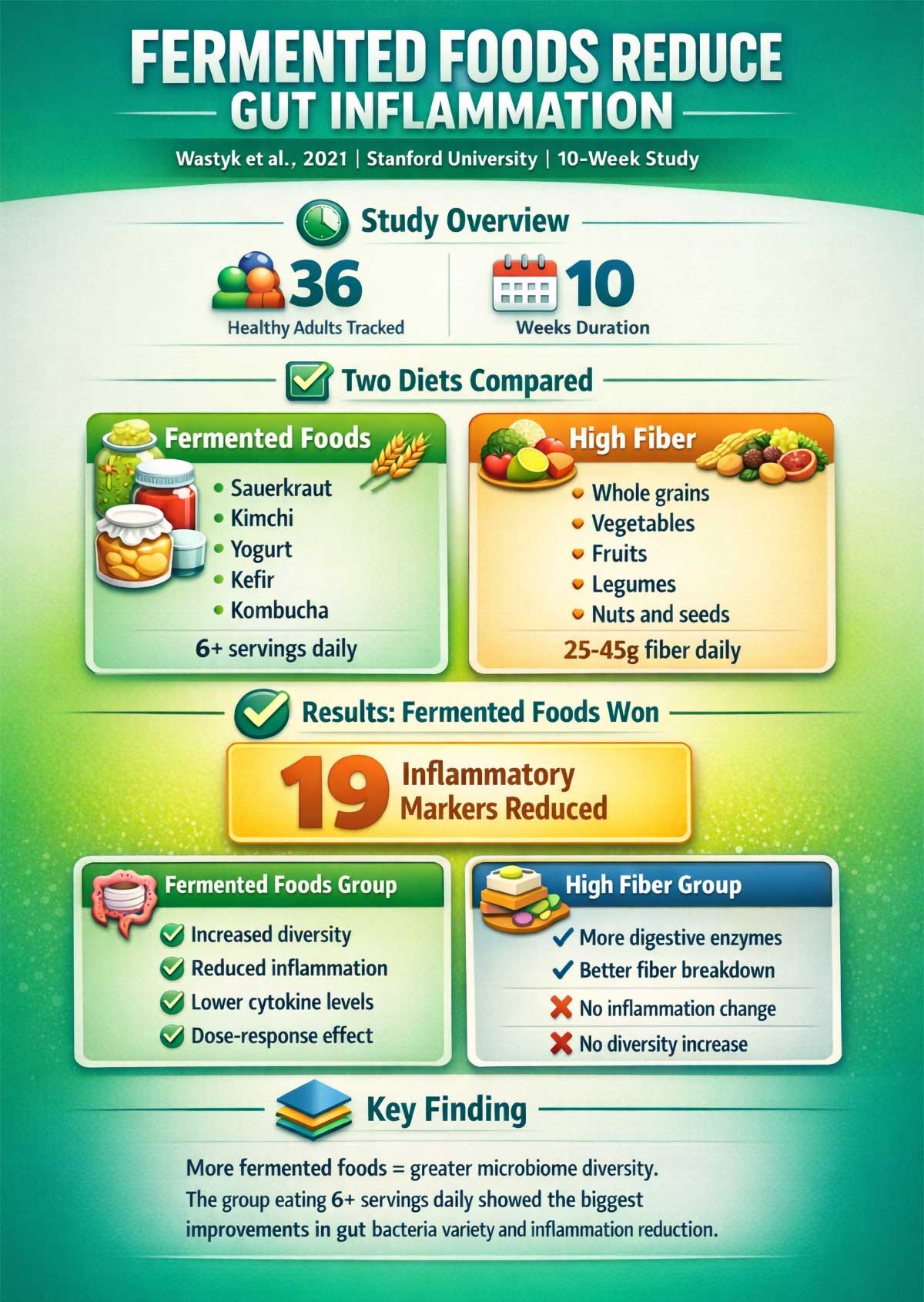
A Stanford University study published in 2021 tracked 36 healthy adults for 10 weeks. The research team, led by Dr. Christopher Gardner and Dr. Erica Sonnenburg, split participants into two groups. Half ate a diet high in fermented foods. This included sauerkraut, kimchi, yogurt, kefir, kombucha, and other fermented vegetables. The other half ate a high-fiber diet with 25-45 grams of fiber daily.
Both diets were healthy. But they had different effects.
The fermented food group showed increased microbiome diversity. That means they had more types of bacteria in their gut. Diversity is linked to better health outcomes. A diverse microbiome handles stress better, fights off infections more easily, and supports stronger immune function.
The more fermented food people ate, the more their diversity increased. It was a dose-response relationship. Participants eating 6 or more servings daily saw the biggest gains. More input equals more change.
The Inflammation Discovery
The same 10-week study found something even more striking. Blood tests showed that fermented foods reduced 19 different inflammatory markers. These included interleukin-6, interleukin-8, and other cytokines that drive chronic inflammation.
Inflammation is your immune system’s response to threats. Short-term inflammation helps you heal. But chronic low-level inflammation damages tissues. It’s linked to heart disease, diabetes, and autoimmune conditions.
The high-fiber diet didn’t reduce inflammation markers. It did increase genes for carbohydrate-digesting enzymes. That’s helpful for breaking down plant fibers. But it didn’t calm the immune system the same way.
This was unexpected. Most nutrition advice focuses on fiber for gut health. And fiber is important. But living bacteria from fermented foods offer something different.
The researchers noted that the anti-inflammatory effects were most pronounced in participants who started with higher baseline inflammation. This suggests fermented foods may be especially valuable for people dealing with inflammatory conditions.
Why “Living” Food Outperforms Fiber Alone
Fiber feeds your existing gut bacteria. It’s a prebiotic. Your microbes break it down and produce short-chain fatty acids. These compounds support gut health.
Fermented foods do that too. But they also introduce new bacterial strains. These strains interact with your immune cells. They train your immune system to respond appropriately to threats without overreacting.
The combination of new bacteria and fermentation byproducts creates effects that fiber alone can’t match. Both are valuable. But for immune health and inflammation control, fermented foods show unique benefits.
A 2017 review by Marco and colleagues examined multiple human intervention studies with fermented foods. The review found consistent support for the idea that fermented vegetables help maintain microbial diversity and support gut barrier function. The review covered studies ranging from 4 to 12 weeks, all showing some degree of gut health improvement.
The Live Culture Debate: Raw vs. Pasteurized
What Pasteurization Does
Pasteurization uses heat to kill bacteria. Food manufacturers do this to extend shelf life and reduce food safety risks.
But it also kills the beneficial bacteria in sauerkraut.
Raw sauerkraut sits in the refrigerated section. It contains millions of live bacteria per serving. Pasteurized sauerkraut sits on regular shelves. It has zero live bacteria.
For maximum probiotic benefits, raw is better. The 10-week Stanford study used unpasteurized fermented foods. That’s how they achieved the diversity increases.
| Feature | Raw Sauerkraut | Pasteurized Sauerkraut |
|---|---|---|
| Live bacteria | 1-10 billion CFU per serving | Zero |
| Shelf life | 4-6 months refrigerated | 1-2 years at room temp |
| Probiotic benefits | Yes | No |
| Postbiotic benefits | Yes | Yes (partial) |
| IBS symptom relief | Yes | Yes |
| Microbiome changes | Yes | Minimal |
| Typical location | Refrigerated section | Canned goods aisle |
| Price range | $5-8 per jar | $3-5 per jar |
The Surprising IBS Exception
But here’s where it gets interesting. The Nielsen 2018 study showed that even pasteurized sauerkraut helped reduce symptoms.
How can dead bacteria improve digestion?
Scientists have a few theories. Dead bacterial cells still contain beneficial compounds. Their cell walls have structures that interact with immune cells. These are called postbiotics.
Fermentation also produces organic acids, vitamins, and bioactive peptides. Heat treatment doesn’t destroy all of these. They may reduce gut inflammation or strengthen the intestinal barrier.
The organic acids alone can shift gut pH. Vitamins like K2 are produced during fermentation and survive pasteurization. These factors might explain why even heat-treated sauerkraut provided relief to IBS patients in the study.
So if you have IBS and can only find pasteurized sauerkraut, it’s still worth trying. You won’t get the microbiome changes. But you might get symptom relief.
How to Identify Live Cultures
Read the label carefully. Look for these phrases:
- “Raw”
- “Unpasteurized”
- “Live and active cultures”
- “Contains probiotics”
- “Keep refrigerated”
Check the ingredients list. Real sauerkraut has only cabbage and salt. Sometimes caraway seeds or other spices.
Avoid products that list vinegar. True sauerkraut is fermented, not pickled. Vinegar-brined cabbage tastes similar but has no live bacteria. It’s a shortcut that skips fermentation entirely.
Also check where it’s stored. Raw sauerkraut must be refrigerated. If it’s on a regular shelf, it’s been pasteurized.
The jar should feel cold when you pick it up. Many stores place raw kraut near pickles in the refrigerated section. Some natural food stores have a dedicated fermented foods area.
How to Make Your Own Sauerkraut
Making sauerkraut at home gives you complete control over quality. It’s also much cheaper than buying it. One batch costs about $2 and yields the same amount as a $7 store-bought jar.
The process is simple. You need only two ingredients: cabbage and salt. The fermentation happens naturally from bacteria already present on the cabbage leaves.
Basic Sauerkraut Recipe (1-Quart Batch)
Ingredients:
- 2 pounds cabbage (1 medium head)
- 1 tablespoon sea salt (non-iodized)
Iodized salt can inhibit fermentation. Use sea salt, kosher salt, or pickling salt.
Equipment:
- 1-quart mason jar
- Smaller jar that fits inside (for weighing down)
- Clean hands or food-grade gloves
- Large mixing bowl
- Sharp knife or mandoline
Instructions:
- Remove the outer leaves of the cabbage. Set aside one clean outer leaf. You’ll use this later.
- Quarter the cabbage through the core. Cut out the hard core section from each quarter. Slice the cabbage into thin strips, about 1/8 inch wide. A mandoline makes this easier, but a knife works fine.
- Place the sliced cabbage in a large bowl. Sprinkle the salt evenly over the cabbage.
- Now comes the important part. Massage the cabbage with your hands for 5 to 10 minutes. Really work it. Squeeze it between your fists. The cabbage will release liquid and shrink to about half its original volume. This liquid is the brine that will protect your ferment.
- Pack the cabbage tightly into your quart jar. Use your fist or a wooden spoon to press it down firmly. Push out any air pockets. The cabbage should be tightly packed. Pour any liquid left in the bowl into the jar.
- The liquid should cover the cabbage by at least 1 inch. If it doesn’t, make extra brine. Dissolve 1 teaspoon of salt in 1 cup of water. Add this to the jar until the cabbage is fully submerged.
- Take that reserved outer cabbage leaf. Fold it to fit inside the jar opening. Press it down on top of the shredded cabbage. Tuck the edges down around the sides. This keeps everything submerged.
- Place your smaller jar on top of the folded leaf. This weights everything down. The goal is to keep all cabbage pieces below the liquid level.
- Cover the jar loosely with its lid or a clean cloth. Don’t seal it tightly. Gases need to escape during fermentation. Place the jar on a plate to catch any overflow.
- Let it sit at room temperature, away from direct sunlight. Ideal temperature is 65-75°F. Cooler slows fermentation. Warmer speeds it up.
- Check it daily. Press down on the weight if cabbage pieces float up. You may see bubbles. That’s normal. You may see white scum on the surface. Skim it off. It’s harmless yeast, but removing it improves flavor.
- Start tasting after 3 days. Use a clean fork to pull out a small amount. The flavor will be mild at first. As days pass, it gets tangier and more sour. Most people prefer the taste after 7 to 14 days.
- When you like the flavor, remove the weight and folding leaf. Press the kraut down one final time. Cap the jar tightly. Move it to the refrigerator. Cold storage stops fermentation. It will keep for 4 to 6 months in the fridge.
Troubleshooting Your Ferment:
- Mold on the surface: A small amount of white surface mold can be skimmed off. The sauerkraut below is usually fine. If you see pink, black, or fuzzy mold, or if it smells rotten, discard the batch and start over.
- Cabbage not submerged: Add more salt brine. Mix 1 teaspoon salt per cup of water. Pour it in until everything is covered.
- Too salty: Rinse the sauerkraut under cold water before eating. Or let it ferment longer. Bacteria consume some salt as they multiply.
- Not sour enough: Let it ferment longer. Temperature might be too cool. Move it to a warmer spot.
- Slimy texture: This can happen if the salt ratio was too low or if the temperature was too warm. The kraut is still safe but may not taste good.
Advanced Variations
Once you master basic kraut, try these additions:
- Caraway seeds (1 tablespoon per batch)
- Juniper berries (5-6 berries)
- Grated ginger (2 tablespoons)
- Shredded carrots or beets (mix 1 part other vegetable to 3 parts cabbage)
- Garlic cloves (2-3 smashed cloves)
Add these when you mix the salt with the cabbage. They ferment along with the cabbage and add flavor complexity.
Understanding the Bacterial Strains in Sauerkraut
Not all probiotics are the same. Different bacterial strains do different things. Knowing what’s in your sauerkraut helps you understand its effects.
The Primary Players
Lactiplantibacillus plantarum (formerly Lactobacillus plantarum) This is the main species in sauerkraut. It produces lactic acid quickly. This lowers pH and prevents harmful bacteria from growing. L. plantarum also produces enzymes that break down proteins and fibers. Some strains produce compounds that strengthen the intestinal barrier.
Leuconostoc mesenteroides This species often starts the fermentation. It’s present on raw cabbage leaves. It produces carbon dioxide and lactic acid. The CO2 creates an oxygen-free environment. This helps other beneficial bacteria thrive.
Pediococcus pentosaceus This bacterium takes over in later fermentation stages. It tolerates higher acid levels than Leuconostoc. It produces more lactic acid, increasing sourness. It also creates compounds that give sauerkraut its characteristic flavor.
Lactiplantibacillus brevis Another lactic acid producer. Some strains make vitamins, including B12. Though B12 from fermented vegetables is usually in a form humans can’t use well.
Limosilactobacillus fermentum Found in smaller amounts. Produces antimicrobial compounds that protect against pathogens.
The exact mix of species varies by batch. Temperature, salt concentration, and cabbage type all affect which bacteria dominate. This is why homemade kraut tastes different each time. It’s also why rotating between different fermented foods increases the variety of bacteria you consume.
Sauerkraut vs. Other Probiotic Foods
Sauerkraut isn’t the only fermented food that supports gut health. Here’s how it compares to other common options.
Yogurt
- Bacteria type: Streptococcus thermophilus, Lactobacillus bulgaricus, sometimes Bifidobacterium
- CFU count: 1-10 billion per serving
- Pros: Easy to find, mild flavor, contains protein and calcium
- Cons: Dairy-based (not suitable for lactose intolerance), often contains added sugar
- Best for: People who tolerate dairy and want protein along with probiotics
Kimchi
- Bacteria type: Similar to sauerkraut, plus Weissella species
- CFU count: Similar to sauerkraut
- Pros: Higher vegetable variety, contains garlic and ginger (additional benefits), spicy flavor
- Cons: Strong taste some people dislike, often higher in sodium
- Best for: People who enjoy spicy foods and want more vegetable diversity
Kefir
- Bacteria type: 30-50 different strains including bacteria and beneficial yeasts
- CFU count: 10-50 billion per serving (highest of common fermented foods)
- Pros: Highest diversity, liquid form (easy to consume), most lactose is consumed during fermentation
- Cons: Dairy-based, tangy flavor takes getting used to, more expensive
- Best for: People seeking maximum bacterial diversity who can tolerate dairy
Kombucha
- Bacteria type: Acetic acid bacteria, yeasts, various Lactobacillus species
- CFU count: 1-5 billion per serving
- Pros: Refreshing drink format, contains B vitamins, some people find it energizing
- Cons: Contains small amounts of alcohol, often high in sugar, expensive
- Best for: People who want probiotics in beverage form and enjoy fizzy drinks
Miso
- Bacteria type: Varies by type, often includes Aspergillus oryzae (beneficial fungus) and bacteria
- CFU count: Varies widely
- Pros: Rich in minerals and antioxidants, concentrated flavor (small amounts go far)
- Cons: Very high in sodium, heating it kills probiotics (best used in cold applications)
- Best for: Cooking applications where you want umami flavor
Tempeh
- Bacteria type: Primarily Rhizopus fungus, some bacterial fermentation
- CFU count: Lower than other fermented foods
- Pros: High protein, contains prebiotics from soybeans, firm texture works in many dishes
- Cons: Mild probiotic content compared to other options, requires cooking (which kills organisms)
- Best for: Plant-based protein source with some fermented food benefits
Cost Comparison (per serving):
- Homemade sauerkraut: $0.30-0.50
- Store-bought sauerkraut: $0.80-1.20
- Yogurt: $0.50-1.00
- Kimchi: $1.00-1.50
- Kefir: $1.00-2.00
- Kombucha: $2.00-4.00
For gut health specifically, rotating between several types gives you the best results. The Wastyk 2021 study found that variety matters. Participants who ate multiple types of fermented foods showed greater diversity increases than those who ate only one type.
Nutritional Content: What’s Actually in Sauerkraut
Beyond probiotics, sauerkraut provides nutrients. Here’s what you get in a typical 1/2 cup serving of raw sauerkraut:
| Nutrient | Amount | % Daily Value | Benefit |
|---|---|---|---|
| Calories | 14 | <1% | Very low calorie density |
| Vitamin C | 11mg | 12% | Immune support, antioxidant protection |
| Vitamin K1 | 9mcg | 8% | Blood clotting, bone health |
| Vitamin B6 | 0.1mg | 6% | Brain function, red blood cell formation |
| Folate | 17mcg | 4% | DNA synthesis, cell division |
| Fiber | 2g | 8% | Digestive health, blood sugar control |
| Iron | 0.9mg | 5% | Oxygen transport, energy production |
| Manganese | 0.1mg | 5% | Metabolism, bone formation |
| Sodium | 460mg | 20% | Fluid balance (watch if restricting salt) |
| Potassium | 120mg | 3% | Heart function, muscle contractions |
| Probiotics | 1-10 billion CFU | N/A | Gut microbiome support |
The Vitamin K Consideration: Sauerkraut is one of the richest sources of vitamin K1. This vitamin helps blood clot properly. But it can interfere with blood-thinning medications like warfarin (Coumadin).
If you take blood thinners, talk to your doctor before adding sauerkraut to your diet. You don’t necessarily need to avoid it. But your medication dose may need adjustment. The key is consistency. Eating the same amount daily helps your doctor calibrate your medication properly.
The Sodium Reality: One serving contains about 20% of the daily sodium limit. That’s significant. But context matters.
If you’re eating processed foods, this adds to your total. If you’re eating mostly whole foods, this might be one of your only significant sodium sources.
People on sodium-restricted diets should rinse sauerkraut before eating. This removes about half the salt. You can also make homemade kraut with less salt (though this may affect fermentation safety and shelf life).
How Much Should You Actually Eat?
The Clinical Dosage
Studies used different amounts. But most fell within a similar range.
The Nielsen 2018 and 2019 IBS trials used about 1/2 cup (75-100 grams) per day. Participants ate this amount for 6 weeks. This was enough to produce measurable symptom relief and microbiome changes.
The 10-week Stanford microbiome study encouraged at least 6 servings of fermented foods per day. A serving was about 1/4 cup. Total daily intake was roughly 1.5 cups of various fermented vegetables combined. Not all sauerkraut—participants rotated between kimchi, yogurt, kefir, and other fermented options.
More isn’t always better. But consistency matters more than volume. Eating a small amount daily beats eating a large amount once a week.
Starting Slowly to Avoid Digestive Upset
Don’t jump straight to 1/2 cup per day if you’ve never eaten sauerkraut before.
Your gut needs time to adjust. Fermented foods can cause gas and bloating at first. This happens as your microbiome shifts. It’s not harmful, but it’s uncomfortable.
Start with 1-2 tablespoons per day. Eat this amount for 3-5 days. If you feel fine, increase to 1/4 cup. After another few days, go to 1/2 cup.
Some people experience what’s called a “die-off” reaction. As good bacteria increase, they crowd out less beneficial strains. Those dying bacteria release compounds that can cause temporary symptoms. Headaches, fatigue, and digestive changes are common.
These symptoms usually pass within a few days. If they’re severe, reduce your intake and increase more gradually. There’s no rush.
Rotating Different Fermented Vegetables
Don’t limit yourself to just sauerkraut. Different fermented vegetables contain different bacterial strains.
Kimchi uses similar fermentation but includes different vegetables and spices. The bacterial profile differs slightly from sauerkraut. The garlic, ginger, and chili peppers add compounds with their own health benefits.
Fermented pickles, carrots, and beets each support different strains. Rotating between them increases the variety of bacteria you introduce.
The Wastyk 2021 study found that people who ate more types of fermented foods had greater diversity increases. Variety accelerates the process. Aim for 3-4 different fermented foods throughout the week rather than just one type daily.
What Happens Inside Your Gut?
How Lactic Acid Bacteria Work
Sauerkraut is dominated by lactic acid bacteria. The main genera are Lactiplantibacillus, Leuconostoc, and Pediococcus.
These bacteria convert sugars in cabbage into lactic acid. That’s what gives sauerkraut its tangy taste.
But lactic acid does more than add flavor. It lowers the pH in your gut. Most harmful bacteria prefer a neutral pH. They struggle in acidic conditions.
This creates a hostile environment for pathogens. E. coli, Salmonella, and other disease-causing bacteria can’t compete. Your beneficial bacteria, which tolerate acid better, thrive.
The pH shift happens quickly. Within hours of eating raw sauerkraut, the lactic acid begins affecting your gut environment. This creates an immediate protective effect, even before new bacteria colonize.
Strengthening the Gut Barrier
Your intestinal lining is a selective barrier. It lets nutrients through while blocking toxins and bacteria. The barrier is one cell layer thick. Special proteins called tight junctions seal the gaps between cells.
When this barrier weakens, larger particles can slip through. This triggers immune responses. Scientists call this increased intestinal permeability. You might know it as “leaky gut.”
Studies show that fermented vegetables help maintain barrier integrity. The bacteria produce compounds that tighten the junctions between intestinal cells. They also reduce inflammatory signals that damage the lining.
One key compound is butyrate. This is a short-chain fatty acid. Your gut bacteria produce it when they ferment fiber. Butyrate is the primary fuel source for the cells lining your colon. It keeps them healthy and functioning properly.
Sauerkraut provides both the bacteria and the fiber they need to produce butyrate. This dual benefit supports barrier strength.
A stronger barrier means fewer foreign particles entering your bloodstream. That reduces systemic inflammation. The Nielsen studies found that improved gut barrier function correlated with reduced IBS symptoms. Less leakage meant less pain and bloating.
Breaking Down Complex Carbohydrates
Your body can’t digest every type of fiber. You need bacterial enzymes to break down certain plant compounds.
Eating fermented foods doesn’t just add bacteria. It also increases the genes for digestive enzymes in your existing microbiome.
The high-fiber group in the Wastyk 2021 study showed this effect strongly. After 10 weeks, they had more genes encoding carbohydrate-active enzymes. These enzymes break down complex plant fibers that human cells can’t process.
But the fermented food group also saw increases in these enzyme-coding genes. Not as dramatic as the fiber group. But still significant.
More enzyme activity means better extraction of nutrients from plant foods. You get more energy and vitamins from the vegetables you eat. Your body can access nutrients that would otherwise pass through undigested.
The Immune System Connection
About 70% of your immune system lives in your gut. The bacteria there train your immune cells to distinguish between threats and harmless substances.
When this training goes wrong, you get allergies, autoimmune diseases, or chronic inflammation. Your immune system attacks things it shouldn’t.
Fermented foods help calibrate this response. The bacteria interact directly with immune cells in the gut lining. They produce molecules that reduce unnecessary inflammatory responses.
The Wastyk study measured 19 different inflammatory markers in blood samples. After 10 weeks of fermented food intake, all 19 decreased. These included:
- Interleukin-6 (linked to chronic inflammation)
- Interleukin-8 (involved in tissue damage)
- C-reactive protein (general inflammation marker)
- TNF-alpha (drives inflammatory cascades)
The high-fiber diet didn’t produce these changes. Only the fermented foods did. This suggests something unique about living bacteria and their metabolic products.
Researchers think the bacterial cell wall components trigger specific immune pathways. These pathways tell immune cells to calm down unless there’s a real threat. It’s immune training, not immune suppression.
Timeline: What to Expect and When
| Timeframe | What’s Happening | What You Might Notice |
|---|---|---|
| Days 1-3 | Initial bacterial introduction, gut environment starting to shift | Possible increase in gas, subtle changes in stool, mild bloating |
| Days 4-7 | Lactic acid bacteria competing with existing strains, possible die-off of less beneficial bacteria | Die-off symptoms (headache, fatigue) or improved energy, gas may peak |
| Weeks 2-3 | pH changes stabilizing, new bacteria establishing presence, tight junctions strengthening | Reduced bloating, more regular bowel movements, gas decreasing |
| Week 4 | Bacterial foothold achieved, measurable microbiome shifts occurring | Consistent improvement in digestion, stable bowel patterns |
| Weeks 5-6 | IBS symptom relief plateau (based on Nielsen studies) | Significant reduction in pain and bloating if IBS symptoms were present |
| Weeks 7-9 | Continued diversity increases, enzyme production ramping up | Better tolerance of fibrous foods, improved nutrient extraction |
| Week 10+ | Maximum diversity increase achieved (based on Wastyk study), inflammatory markers reduced | Better overall gut function, reduced inflammation markers in blood, stronger immune responses |
This timeline is based on average responses from clinical studies. Your experience may differ. Some people notice changes within days. Others need the full 6 weeks before symptoms improve.
Keep a simple journal. Note your symptoms daily. After 4 weeks, look back. Patterns become clear when you track consistently.
Common Mistakes That Reduce Benefits
Buying Vinegar-Pickled Cabbage Instead of Fermented
This is the most common error. Many products labeled “sauerkraut” are just cabbage soaked in vinegar. They’re pickled, not fermented.
Check the ingredients. If you see vinegar listed, it’s not real sauerkraut. Real kraut has only cabbage, salt, and sometimes spices. The sour taste comes from lactic acid produced during fermentation, not added vinegar.
Pickled cabbage tastes similar. But it has zero probiotic value. You’re wasting your money if gut health is your goal.
Draining the Brine
The liquid in the jar is called brine. It’s packed with bacteria, minerals, and organic acids. Many people drain sauerkraut before eating it. They’re throwing away the most concentrated source of benefits.
Use the brine. Add a spoonful to salad dressings. Drink it straight as a digestive tonic. Mix it into smoothies for a probiotic boost.
Some people take a shot of brine before meals. It stimulates digestive enzyme production and primes the gut for food. The acidity signals your stomach to prepare for incoming food.
Heating It
Heat kills bacteria. If you cook your sauerkraut, you lose the probiotic benefits. This includes adding it to hot soup, frying it, or baking it into dishes.
Use it as a cold topping. Add it to sandwiches, salads, or grain bowls after cooking. Let hot foods cool slightly before adding sauerkraut.
Warm is fine. Boiling is not. Keep it below 115°F (46°C) to preserve live cultures. At this temperature, most bacteria survive. Above 120°F, they start dying quickly.
Traditional dishes like Reuben sandwiches heat sauerkraut. They’re delicious. But understand you’re eating it for flavor and fiber, not probiotics.
Eating Inconsistently
The studies showing benefits all used daily intake. Eating sauerkraut twice a week won’t produce the same results as eating it seven times a week.
The bacteria don’t colonize permanently. They need regular reinforcement. Think of it like watering a plant. You can’t water it once and expect it to thrive for weeks.
Build it into your routine. Add it to lunch every day. Or have a forkful with dinner. Make it a habit, not an occasional treat.
Not Gradually Increasing Amount
Starting with large amounts overwhelms your system. Your gut bacteria aren’t used to the influx of lactic acid and new organisms.
This causes excessive gas, bloating, and sometimes diarrhea. These symptoms discourage people from continuing. They assume sauerkraut “doesn’t agree with them.” But they just increased too quickly.
Start small. Be patient. Your gut adapts within days if you give it time.
Storing It Incorrectly After Opening
Once you open a jar of raw sauerkraut, it needs refrigeration. The cold slows fermentation. Without refrigeration, the bacteria keep multiplying. The kraut gets sourer and eventually spoils.
Keep it in the fridge. Make sure it stays submerged in brine. If the liquid level drops, add a little salt water (1 teaspoon salt per cup of water).
Properly stored, raw sauerkraut lasts 4-6 months in the refrigerator. The flavor gets stronger over time, but it remains safe to eat.
5 Ways to Use Sauerkraut for Better Gut Health
Add It to Breakfast
Most people think of sauerkraut as a side dish for dinner. But it works well at breakfast too.
Add a forkful to scrambled eggs or an omelet. The tangy flavor balances rich, fatty foods. The combination of protein and probiotics keeps you satisfied.
Try it on avocado toast. The sour kraut
cuts through the creamy avocado. Add a poached egg on top for complete nutrition.
It also helps stabilize blood sugar. Fermented foods eaten with carbohydrates can reduce the glucose spike. Studies show this effect with other fermented vegetables. The organic acids slow digestion and improve insulin response.
Pair It with Prebiotic Foods
Probiotics are the bacteria. Prebiotics are the food that feeds them.
Fermented foods work better when combined with prebiotic fibers. These fibers feed both the bacteria you’re adding and your existing microbiome.
Good prebiotic sources include:
- Onions (raw or cooked)
- Leeks
- Garlic
- Asparagus
- Bananas (especially slightly green ones)
- Oats
- Artichokes
- Dandelion greens
Add sauerkraut to meals that include these foods. A grain bowl with quinoa, roasted vegetables, and kraut is ideal. So is a salad with raw onions and a brine-based dressing.
The combination creates synergy. The prebiotics help the new bacteria establish themselves faster. They provide immediate fuel for multiplication.
Use the Brine as a Digestive Aid
Don’t throw away the juice. It’s more concentrated than the solid kraut.
Take 1-2 tablespoons of brine 15-20 minutes before a large meal. This primes your digestive system. The acidity signals your stomach to start producing enzymes. By the time food arrives, you’re ready to break it down efficiently.
Some people drink it first thing in the morning. A shot of brine on an empty stomach can stimulate bowel movements. It’s a natural way to support regularity.
You can also use it in cooking:
- Add to salad dressings (replace vinegar)
- Mix into hummus or bean dips
- Use as a marinade for meats (the acid tenderizes)
- Add to smoothies for a probiotic punch
Make It a Condiment, Not a Side Dish
Stop thinking of sauerkraut as something you eat separately. Treat it like hot sauce or mustard. Add it to almost anything.
Put it on:
- Burgers and sandwiches
- Tacos and burritos
- Baked potatoes
- Grain bowls
- Eggs (any style)
- Salads
- Cheese and crackers
- Roasted vegetables
A few forkfuls added to whatever you’re already eating is easier than planning it as a side dish. You’re more likely to eat it consistently if it’s simple.
Track Your Symptoms and Adjust
Changes happen gradually. Without tracking, you might not notice improvements.
Keep a simple log for 6 weeks. Note each day:
- Did you eat sauerkraut? How much?
- Number of bowel movements
- Stool consistency (use the Bristol Stool Chart as reference)
- Bloating level (0-10 scale)
- Energy throughout the day (0-10 scale)
- Any other digestive symptoms
After 4 weeks, review your notes. You’ll probably see patterns. Many people notice better regularity first. Energy improvements come later. Bloating often decreases after the initial adjustment period.
If you’re not seeing improvements by week 6, try:
- Increasing the amount
- Switching to a different brand (bacterial strains vary)
- Adding other fermented foods
- Consulting a doctor (you may have an underlying issue)
How to Shop for Sauerkraut: A Store Guide
Finding quality sauerkraut can be tricky. Here’s what to look for when shopping.
Where to Look
In the refrigerated section: This is where raw, unpasteurized sauerkraut lives. Look near the pickles, often in the natural foods or specialty sections. Some stores have a dedicated fermented foods area with kimchi, pickles, and other cultured vegetables.
The jar should feel cold when you pick it up. If it’s even slightly warm, it’s been sitting out too long.
Not in the canned goods aisle: Canned sauerkraut is always pasteurized. It’s shelf-stable because the heat treatment killed all bacteria. Skip this section if you want probiotic benefits.
Brand Recognition
Quality brands to look for (available in most US stores):
- Bubbies (widely available, consistently good)
- Farmhouse Culture (organic, multiple flavors)
- Wildbrine (organic, good variety)
- Pickled Planet (small batch, high quality)
- Cleveland Kraut (regional but expanding)
These brands use traditional fermentation. They’re refrigerated and contain live cultures. Prices range from $5-8 per 16-ounce jar.
Reading the Label
Good signs:
- “Raw” or “Unpasteurized”
- “Live and active cultures”
- “Keep refrigerated”
- Short ingredient list (cabbage, salt, maybe spices)
- Bubbles visible in the jar (sign of active fermentation)
- Cloudy brine (normal for fermented foods)
Red flags:
- “Pasteurized” anywhere on the label
- Vinegar in ingredients
- Shelf-stable
- Clear brine (might be vinegar-brined)
- Added preservatives (sodium benzoate, potassium sorbate)
Price Expectations
Raw sauerkraut costs more than canned. You’re paying for:
- Refrigerated shipping and storage
- Shorter shelf life (stores can’t keep it as long)
- Traditional production methods
- Live cultures
Expect to pay $5-8 for a 16-ounce jar. That yields about 5-7 servings of 1/4 cup each. Per serving cost is roughly $0.80-1.20.
Compare this to homemade at $0.30-0.50 per serving. Making your own saves significant money if you eat it regularly.
Serving Size Calculations
A 16-ounce jar contains about 2 cups. If you eat 1/2 cup daily (the amount used in studies), one jar lasts 4 days. You’ll need about 2 jars per week. That’s $10-16 weekly, or $40-64 monthly.
If budget is a concern, start with 1/4 cup daily. One jar lasts a week. That’s more affordable at $5-8 weekly, $20-32 monthly.
Or make your own. A 2-pound cabbage costs $1-2 and makes about 4 cups of finished kraut. That’s 2 weeks of supply at 1/2 cup daily for under $2.
Who Should Avoid or Limit Sauerkraut
Sauerkraut is safe for most people. But some groups should be cautious or avoid it entirely.
People Taking Blood Thinners
Sauerkraut is high in vitamin K1. This vitamin helps blood clot. It can interfere with anticoagulant medications like warfarin (Coumadin), apixaban (Eliquis), and others.
If you take blood thinners, don’t avoid sauerkraut without asking your doctor. But don’t start eating large amounts suddenly either. Consistency is key.
Your doctor calibrates your medication based on your vitamin K intake. If you suddenly increase K intake, your medication becomes less effective. If you suddenly decrease it, you risk excessive bleeding.
Talk to your doctor. They may adjust your dose. Or they may recommend eating the same amount of sauerkraut daily so your medication can be properly calibrated.
Those with Histamine Intolerance
Fermented foods are high in histamine. Bacteria produce histamine during fermentation. For most people, this isn’t a problem. Your body breaks down histamine easily.
But some people have histamine intolerance. Their bodies can’t break down histamine fast enough. Excess histamine causes symptoms:
- Headaches or migraines
- Flushing or skin rashes
- Rapid heartbeat
- Digestive upset
- Anxiety or panic sensations
If you experience these symptoms after eating fermented foods, you may have histamine intolerance. Try eliminating sauerkraut for 2 weeks. If symptoms improve, histamine is likely the issue.
Shorter fermentation produces less histamine. Three-day kraut has less histamine than 14-day kraut. You might tolerate younger ferments better.
Individuals on Sodium-Restricted Diets
One serving of sauerkraut (1/2 cup) contains 400-500mg of sodium. That’s about 20% of the 2,300mg daily limit recommended for most adults.
If you’re on a strict low-sodium diet for heart failure, kidney disease, or hypertension, this is significant.
Options:
- Rinse the kraut before eating (removes about 50% of sodium)
- Make homemade kraut with less salt (though this may affect safety and shelf life)
- Eat smaller portions (1/4 cup instead of 1/2 cup)
- Account for the sodium in your daily total
Don’t avoid it entirely unless your doctor says to. The benefits may outweigh the sodium concern, especially if you’ve eliminated other high-sodium foods.
People with FODMAP Sensitivities During Active Flare-Ups
FODMAPs are certain carbohydrates that ferment in the gut. They cause gas and bloating in sensitive individuals. Cabbage contains moderate FODMAPs.
The fermentation process reduces FODMAP content. Bacteria consume some of the problematic carbs. Well-fermented sauerkraut is lower in FODMAPs than raw cabbage.
But it’s not FODMAP-free. If you’re following a strict low-FODMAP diet during an IBS flare-up, you might need to avoid it temporarily.
Once symptoms calm down, try reintroducing small amounts. Many people with IBS tolerate fermented cabbage better than fresh cabbage. The Nielsen studies showed that sauerkraut improved IBS symptoms for most participants.
Start with 1 tablespoon. Wait 24 hours. If you tolerate it, try 2 tablespoons. Gradually increase. You may find you can handle it in small amounts even during the FODMAP elimination phase.
Those with Compromised Immune Systems
Raw fermented foods contain living bacteria. For healthy people, this is beneficial. For immunocompromised individuals, it could pose risks.
If you’re undergoing chemotherapy, have HIV/AIDS, take immunosuppressant drugs, or have another condition that weakens immunity, talk to your doctor before eating raw fermented foods.
You might need to stick with pasteurized versions. Or your doctor might clear you to eat raw kraut if your immune function is only mildly compromised.
Don’t make this decision alone. Get medical guidance.
Pregnant Women: Exercise Normal Food Safety
Pregnancy weakens the immune system slightly. This helps prevent rejection of the fetus. But it also makes you more susceptible to foodborne illness.
Raw sauerkraut from reputable commercial sources is generally safe during pregnancy. The lactic acid bacteria create an acidic environment that prevents pathogen growth.
Home-fermented kraut is probably fine too if you follow proper procedures. But there’s slightly more risk if contamination occurs during fermentation.
If you’re pregnant:
- Buy from established brands with good safety records
- Avoid cloudy brine with unusual colors (pink, black)
- Smell before eating (should smell sour and tangy, not rotten)
- When in doubt, choose pasteurized
Most obstetricians consider commercial raw sauerkraut safe. But if yours advises against it, follow their guidance.
What the Science Doesn’t Show Yet
Research on sauerkraut and gut health is growing. But significant gaps remain. Understanding these limitations helps you set realistic expectations.
Long-Term Effects Beyond 10 Weeks Unknown
The longest study we have is 10 weeks. That’s enough to see microbiome changes and inflammatory marker reductions. But what happens after 6 months? One year? Five years?
We don’t know if diversity gains continue. Or if they plateau at 10 weeks. We don’t know if inflammatory benefits persist with ongoing consumption or if the body adapts.
Common sense suggests continued benefits from regular intake. But we don’t have data to confirm this.
Optimal Dosage Not Established
The studies used different amounts. The IBS trials used 100g daily. The Wastyk study used 6 servings of various fermented foods. But is more better? Is there an upper limit where benefits plateau?
We don’t have a precise dose-response curve. The relationship seems positive (more intake equals more diversity). But the optimal amount for maximum benefit remains unclear.
Is 1/4 cup enough? Is 1 cup better? We can’t say with certainty.
Individual Variation Not Well Studied
The studies report average results. But individual responses varied widely. Some people showed dramatic diversity increases. Others showed modest changes.
Why do some people respond better? Is it baseline microbiome composition? Genetics? Diet quality? Medication use? We don’t know.
This means your results might differ from study averages. You might respond better or worse than the typical participant.
Specific Strains vs. Mixed Cultures Not Compared
Commercial probiotic supplements often contain specific strains. They’ll list Lactobacillus rhamnosus GG or Bifidobacterium longum BB536.
Sauerkraut contains dozens of strains in varying amounts. Which approach is better? Do specific strains target specific issues? Or is diversity more important?
We don’t have direct comparisons. Both approaches show benefits in different studies. But we can’t say which is superior for gut health.
Effects in Children and Elderly Need More Research
Most studies used healthy adults or adults with IBS. We have limited data on children, teenagers, and elderly populations.
Children’s microbiomes are still developing. Elderly microbiomes have typically lost diversity. Would sauerkraut help both groups? The theoretical answer is yes. But we need clinical trials to confirm.
Parents shouldn’t hesitate to offer kids small amounts of sauerkraut. It’s a traditional food eaten by children for centuries. But understand we don’t have specific research validating benefits for pediatric gut health.
Similarly, older adults would likely benefit. But dosing and safety in this age group hasn’t been specifically studied.
Interactions with Medications Understudied
We know about the vitamin K and blood thinner interaction. But what about other medications?
Antibiotics kill gut bacteria. Would eating sauerkraut during antibiotic treatment help maintain microbiome diversity? Or would the antibiotics just kill the sauerkraut bacteria too?
What about proton pump inhibitors (PPIs) that reduce stomach acid? Does lower acid affect how well probiotic bacteria survive passage through the stomach?
These questions lack clear answers. More research is needed.
Summary: Is the 4–10 Week Commitment Worth It?
The research is clear. Eating sauerkraut daily for 4 to 10 weeks creates measurable changes in your gut.
You can expect:
- Increased microbiome diversity after 10 weeks of consistent intake
- Reduced inflammatory markers in blood tests, including 19 different cytokines
- Improved IBS symptoms after 6 weeks, including less bloating and pain
- Better digestion and regularity after 4 weeks of daily consumption
- Strengthened gut barrier function
- Enhanced immune system training
These aren’t vague health claims. They’re documented outcomes from controlled studies involving real participants tracked over weeks and months.
The cost is low. A jar of raw sauerkraut costs $5-8 and lasts about a week at typical serving sizes. That’s less than most probiotic supplements. And you’re getting nutrients, fiber, and fermentation byproducts along with the bacteria. Making your own costs even less, around $2 per batch.
The time commitment is minimal. Eating a few forkfuls per day takes seconds. No pills to remember. No complicated protocols. Just add it to meals you’re already eating.
For most people, the benefits outweigh the effort. Your gut microbiome affects digestion, immunity, mood, and more. Supporting it with fermented foods is one of the simplest health interventions available.
Start small. Begin with 1-2 tablespoons daily. Be consistent. Eat it every day, not occasionally. Track your results in a simple journal. Note bowel movements, energy, and bloating levels.
After 6 weeks, review your notes. Decide if the changes justify continuing. The science suggests they will.
Most people who stick with it for 6 weeks keep eating it. Not because they’re forcing themselves. But because they feel the difference. Better digestion becomes normal. They miss it when they skip a day.
The bacterial strains in sauerkraut have been supporting human gut health for thousands of years. Modern science is just confirming what traditional cultures already knew. Fermented vegetables work.
Give your gut those 4 to 10 weeks. Let the bacteria establish themselves. Let the changes accumulate. Then see how you feel.
The investment is small. The potential return is substantial.
FAQs
How Much Sauerkraut Should I Eat Daily for Gut Health?
Studies showing benefits used 1/2 cup (75-100g) daily for 6 weeks. This amount produced measurable microbiome changes and reduced IBS symptoms. Start with 1-2 tablespoons if you’re new to fermented foods. Increase gradually over 1-2 weeks until you reach 1/2 cup. Some people eat more without problems. But 1/2 cup is the evidence-based amount.
Does Cooking Sauerkraut Kill the Probiotics?
Yes. Heat above 115°F (46°C) starts killing beneficial bacteria. Boiling destroys them completely. Use sauerkraut cold or add it after cooking. You can warm it slightly without major losses. But don’t fry it, bake it, or add it to hot soup if you want probiotic benefits. Cooked kraut still provides fiber and nutrients. Just no live cultures.
Can I Eat Sauerkraut if I Have IBS?
Studies show sauerkraut helped IBS symptoms after 6 weeks. The Nielsen 2018 research found reduced bloating, pain, and irregular bowel movements in IBS patients who ate 100g daily. Both pasteurized and raw versions helped. Start with very small amounts (1 tablespoon). Some people with IBS experience temporary worsening before improvement. If symptoms become severe, stop and consult a doctor. Many people with IBS tolerate fermented cabbage well once adjusted.
Is Store-Bought Sauerkraut as Good as Homemade?
Raw, unpasteurized store-bought sauerkraut has similar benefits to homemade. The bacterial content is comparable. The main differences are cost (homemade is cheaper) and flavor (homemade lets you control fermentation time and additions). Store-bought is more convenient. Homemade saves money if you eat it regularly. Both work for gut health if the store version is raw and refrigerated.
How Long Does It Take to See Results from Eating Sauerkraut?
Most people notice digestive changes within 2-4 weeks. The Nielsen studies found IBS symptom relief after 6 weeks. The Wastyk study showed maximum microbiome diversity increases after 10 weeks. Your timeline might differ. Some people feel better within days. Others need the full 6 weeks. Keep a symptom journal. After 4 weeks, review it to identify patterns.
What’s the Difference Between Sauerkraut and Pickles?
Sauerkraut is fermented. Bacteria naturally present on cabbage convert sugars to lactic acid. This creates the sour taste and produces probiotics. Most store-bought pickles are made with vinegar. They’re pickled, not fermented. Vinegar is added to create sourness. No bacteria involved. No probiotics. Some pickles are fermented (look for “naturally fermented” on the label). But most are just cucumbers in vinegar brine. Only fermented foods provide probiotic benefits.
Can I Drink the Sauerkraut Juice?
Yes. The brine is highly beneficial. It contains concentrated bacteria, minerals, and organic acids. Many people drink 1-2 tablespoons before meals to aid digestion. It can also be used in salad dressings, smoothies, or as a marinade. The brine has more bacteria per ounce than the solid kraut. Don’t drain it off. Use it.
Will Sauerkraut Help Me Lose Weight?
There’s no direct evidence that sauerkraut causes weight loss. It’s very low in calories (14 per serving). The probiotics may indirectly support weight management by improving gut health and reducing inflammation. Some research links diverse gut microbiomes to healthier body weight. But sauerkraut alone won’t make you lose weight. It’s one component of a healthy diet.
Is Sauerkraut Safe During Pregnancy?
Commercial raw sauerkraut from reputable brands is generally safe during pregnancy. The acidic environment prevents pathogen growth. Follow normal food safety practices. Check that it smells tangy and sour, not rotten. Avoid jars with unusual colors or mold. If you’re making your own, follow fermentation guidelines carefully. When in doubt, ask your obstetrician. Most consider it safe. But some may recommend pasteurized versions for extra caution.
Can I Eat Too Much Sauerkraut?
Yes. Excessive amounts can cause digestive upset, especially at first. The high sodium content is also a concern. Eating 2-3 cups daily would provide over 100% of your daily sodium limit. Stick to 1/2 to 1 cup daily. More isn’t necessarily better. The studies showing benefits used moderate amounts. Listen to your body. If you experience bloating, gas, or diarrhea, reduce your intake.