Hitting your daily protein goal means nothing if you’re eating it wrong. There’s a threshold most people never reach.
You’ve probably heard it at the gym. “Eat more than 30 grams of protein in one sitting and it just goes to waste.” It’s one of the most repeated claims in fitness culture, and like most gym myths, it’s built on a small grain of truth wrapped in a lot of confusion.
Your gut doesn’t waste protein. It’s actually remarkably good at digesting and absorbing almost all of it. The issue isn’t absorption. The real question is what your body does with that protein once it’s been absorbed, and whether there’s enough of a signal per meal to put it to work building and repairing muscle.
That’s the distinction most articles miss entirely. Digestion and absorption are not the same thing as utilization. Protein that gets absorbed but isn’t used for Muscle Protein Synthesis (MPS) gets burned for energy or used in other body processes. So the real cap isn’t on how much protein your gut takes in. It’s on how much your muscles can actually use from a single meal to grow and repair.
Getting that threshold right turns out to matter quite a bit. And it gets more complicated as you get older.
The Leucine Trigger: Your Body’s Hidden On/Off Switch
Think of Muscle Protein Synthesis like a furnace that needs a specific key to turn on. That key is an amino acid called leucine.
Leucine is one of the three branched-chain amino acids (BCAAs), and it plays a special role that the others don’t. It acts as the metabolic signal that tells your muscles to switch from breakdown mode into building mode. Without enough leucine from a single meal, that furnace stays off, no matter how much protein you consumed over the day.
Research by Paddon-Jones and Rasmussen (2009) shed light on this mechanism, showing that protein use in muscles is limited by the leucine content arriving from a single meal rather than by total daily intake. The data points to roughly 2.5 grams of leucine per meal as the threshold needed to trigger muscle protein synthesis.
What does 2.5 grams of leucine actually look like on a plate? A standard 25–30 gram serving of a high-quality protein source like chicken, eggs, beef, or whey protein delivers right around that amount. This is why grazing on low-protein snacks throughout the day doesn’t work well for muscle building. A handful of almonds or a small yogurt won’t get you there. You need a real protein dose at each meal.
This also explains why protein quality matters. Plant-based sources tend to have lower leucine concentrations per gram than animal proteins, which is why people relying on plant proteins may need to eat slightly more per meal to hit the same threshold.
→ See why shorter workouts may be more effective after 50
Why the Total Number on Your Nutrition App Isn’t the Full Story
Most people tracking macros focus almost entirely on hitting a total daily protein number. Get to 150 grams and call it a day. It sounds logical. The research says it’s not that simple.
Mamerow et al. (2014) ran a 7-day randomized controlled trial comparing two groups of healthy adults eating the same total amount of protein each day. One group spread their intake evenly across meals (roughly 30 grams per meal). The other group backloaded their protein, eating most of it at dinner (roughly 10 grams at breakfast, 16 at lunch, and 63 at dinner). Total daily protein was identical between the groups.
The result was stark. The group with evenly distributed protein had 24-hour MPS rates that were 25% higher than the backloaded group. Eating the same total protein, just more evenly, produced meaningfully more muscle protein synthesis across the full day. And when participants stayed on each pattern for 7 days, the gap held.
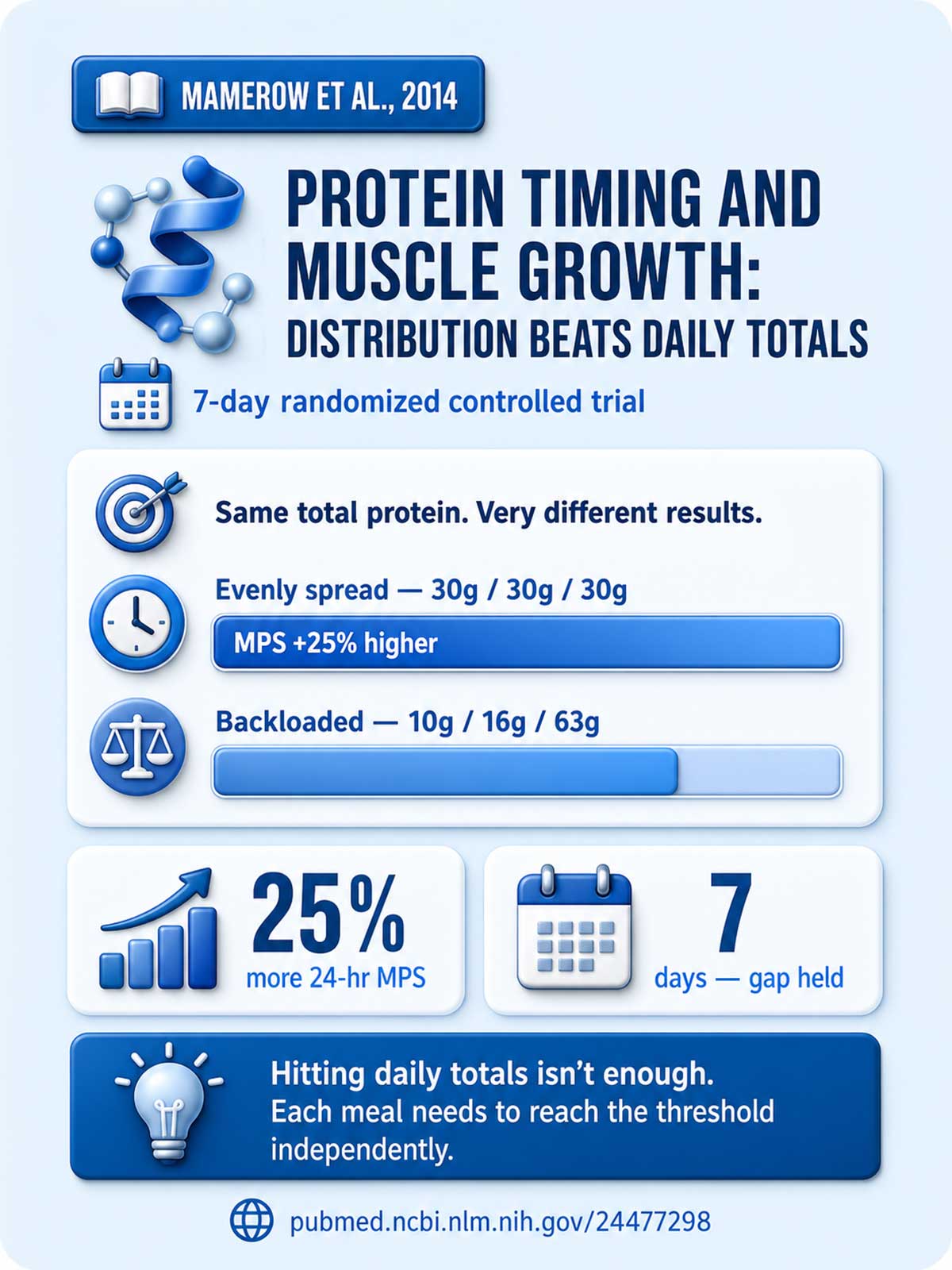
The reason goes back to the leucine threshold. When breakfast only delivers 10 grams of protein, you don’t hit the trigger. That meal’s protein gets used for energy or diverted to other metabolic needs. You’ve skipped a muscle-building window. Do that twice a day at breakfast and lunch, then load up at dinner, and you’re leaving significant synthesis potential on the table even if your daily total looks perfect.
Three meals, each hitting around 30 grams of quality protein, keeps MPS elevated throughout the day in a way that one big protein-heavy dinner simply can’t replicate.
The Silent Decline: What Happens to Muscle Sensitivity as You Age
Here’s the part most articles don’t explain well, and it’s arguably the most important for anyone over 40.
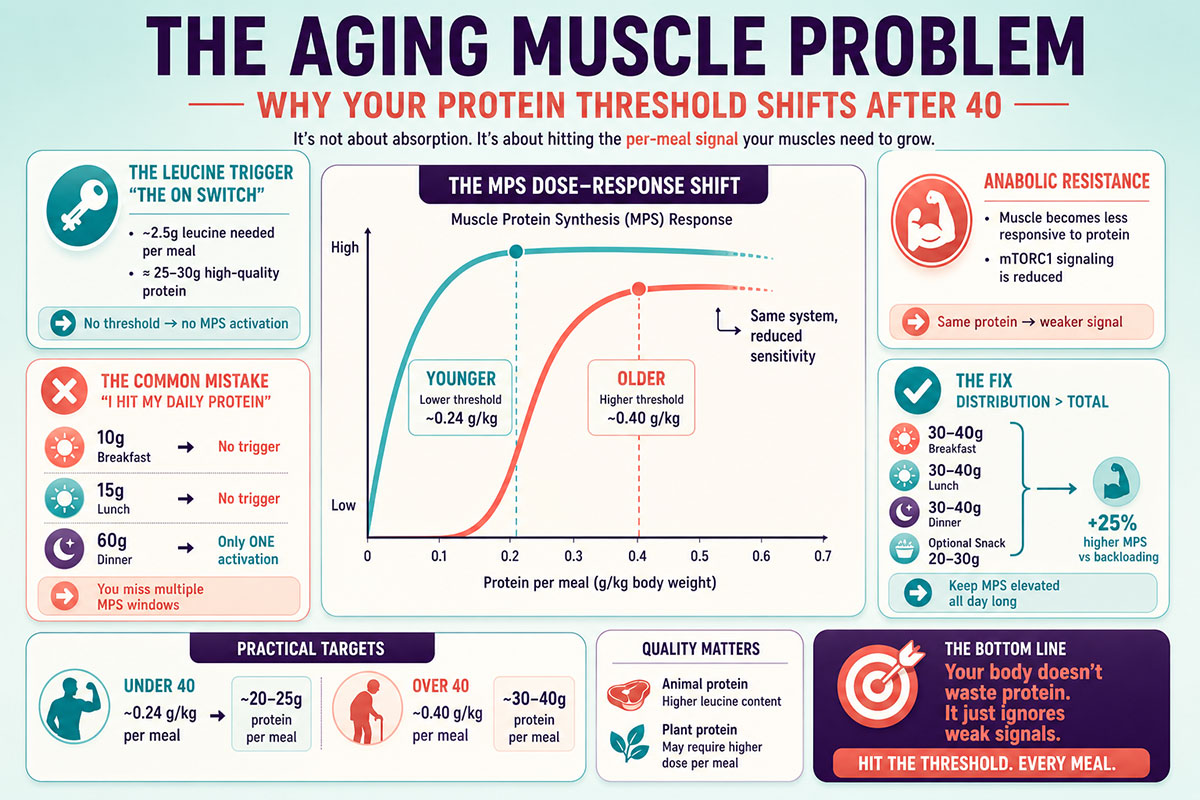
Your muscles don’t respond to protein the same way as you get older. The machinery still works, but it becomes less sensitive to the signal. Scientists call this anabolic resistance, and it’s one of the primary biological drivers of the muscle loss that happens gradually with aging (a condition known as sarcopenia).
A study identified anabolic resistance in a clinical review of older adults, confirming that aging reduces the sensitivity of muscle protein synthesis to protein intake. The muscles still respond, they just need a louder signal to get started.
The cellular explanation for this comes from Drummond et al. (2009), who found that a key protein signaling pathway called mTORC1 becomes less active following protein ingestion in older adults compared to younger ones. mTORC1 is the cellular mechanism that actually turns on the muscle-building process downstream of the leucine trigger. When that signaling is muffled, the same dose of protein that would spark MPS in a 25-year-old falls short in a 60-year-old.
The practical takeaway here is significant. Aging isn’t a failure of muscle. It’s a change in sensitivity. The machinery is intact, it just needs more fuel to fire.
Recalculating the Threshold After 40
Because of anabolic resistance, the protein dose that maximizes MPS in younger adults isn’t enough to do the same job in older ones.
Moore et al. (2015), with Stuart M. Phillips as senior author, compared MPS dose-response data between younger men (around age 22) and older men (around age 71) ingesting varying amounts of protein in a single sitting. Their findings were clear. Younger men maximized MPS at approximately 0.24 grams of protein per kilogram of body weight per meal. Older men needed roughly 0.40 grams per kilogram to reach the same ceiling.
That’s not a trivial difference. Run the numbers on a 180-pound (81 kg) adult. A younger person needs about 19–20 grams per meal to hit their peak MPS response. An older person of the same weight needs at least 32–35 grams per meal to push past the resistance and get a comparable muscle-building signal.
That same 20-gram post-workout shake that worked well in your 20s is likely undershooting the mark by your 50s. It’s still doing something, but it’s not maximizing what your muscles are capable of.
Supporting this, early work by Tipton et al. (2001) showed that just 6 grams of essential amino acids can stimulate MPS in healthy adults, but also demonstrated that a plateau effect exists. At some point, more protein per meal stops adding more MPS benefit. What the research on aging shows is that this plateau point shifts upward as the years pass.
What a Wolfe (2017) Meta-Analysis Confirmed
Some researchers have pushed back on per-meal protein thresholds, arguing that total daily intake is what matters most. A review by Wolfe (2017), focused specifically on aging populations, addressed this debate directly.
The findings supported the per-meal threshold model. Total daily protein intake matters, but achieving an adequate dose per individual meal is what actually drives the muscle-building response. In older adults especially, the analysis confirmed that muscle loss can occur even when total daily protein looks sufficient on paper, if that protein isn’t distributed in a way that repeatedly hits the threshold at each meal.
This has real implications for how older adults should think about eating. A high-protein dinner doesn’t compensate for a carbohydrate-heavy breakfast and a light lunch. The windows matter individually, not just collectively.
Putting It Into Practice: A Simple Blueprint
The science points to a clear and actionable set of principles for getting the most out of the protein you eat.
Stop worrying about protein going to waste in your gut. Your digestive system is doing its job efficiently. The question is whether you’re giving your muscles the right signal, at the right time, in the right amount.
Aim for at least 30 grams of a high-quality protein source at each meal to reliably hit the leucine threshold. Think chicken, fish, eggs, beef, dairy, or a quality protein powder. Grazing on small protein snacks throughout the day won’t get the job done.
Spread that intake across breakfast, lunch, and dinner. Backloading protein at your evening meal costs you two synthesis windows per day, regardless of what your daily total looks like.
If you’re over 40, your per-meal target should be higher, somewhere in the range of 35–40 grams per meal, depending on your body weight. Calculate it based on roughly 0.4 grams per kilogram of your body weight. That higher dose is what it takes to overcome the reduced mTORC1 signaling that comes with age.
Choose protein sources with strong leucine content. Whey protein is particularly high in leucine compared to most plant sources, which is one reason it’s studied so frequently in MPS research. If you rely on plant proteins, consider a leucine-fortified blend or increase your per-meal dose slightly to compensate.
One more factor worth building into the picture: exercise makes your muscles more receptive to protein. A meal hitting the 30-gram threshold after a resistance training session produces a stronger MPS response than the same meal eaten at rest. The workout primes the muscle to act on the leucine signal more aggressively. Timing your highest-protein meal around your training doesn’t replace the need for even distribution across the day, but it does add a meaningful edge.
The body doesn’t waste the protein you eat. But it does have a threshold for putting that protein to work. Hit that threshold at every meal, not just at dinner, and your muscles will reflect the difference.