Every overthinking tip assumes the loop starts with a thought. Psychologists say it starts much earlier, and that changes everything about how to stop it.
There’s a specific kind of exhaustion that comes from fighting your own mind. It’s the bone-deep drain of a brain that refuses to stop, and according to psychologists, the battle isn’t happening in your thoughts. It’s happening in your infrastructure.
You’ve tried the breathing exercises. You’ve told yourself to “just let it go.” You’ve even set a timer and given yourself a “worry window.” And yet here you are at 1 a.m., still replaying a conversation from three weeks ago.
The advice you’ve been given wasn’t wrong, exactly. It was just aimed at the wrong target. By the time an anxious thought arrives, the conditions for it were already set hours, days, or even years before. The thought loop isn’t the problem. It’s the symptom of a brain that was quietly primed to loop, long before you had any say in the matter.
What psychologists have found is that chronic overthinking has upstream triggers: neurological and psychological conditions that make the brain far more likely to lock onto a thought and spin. Understanding those triggers won’t give you a quick fix. But it might be the first time you understand why the quick fixes keep failing.
1. Your Brain Is Running a Threat Scanner in the Background
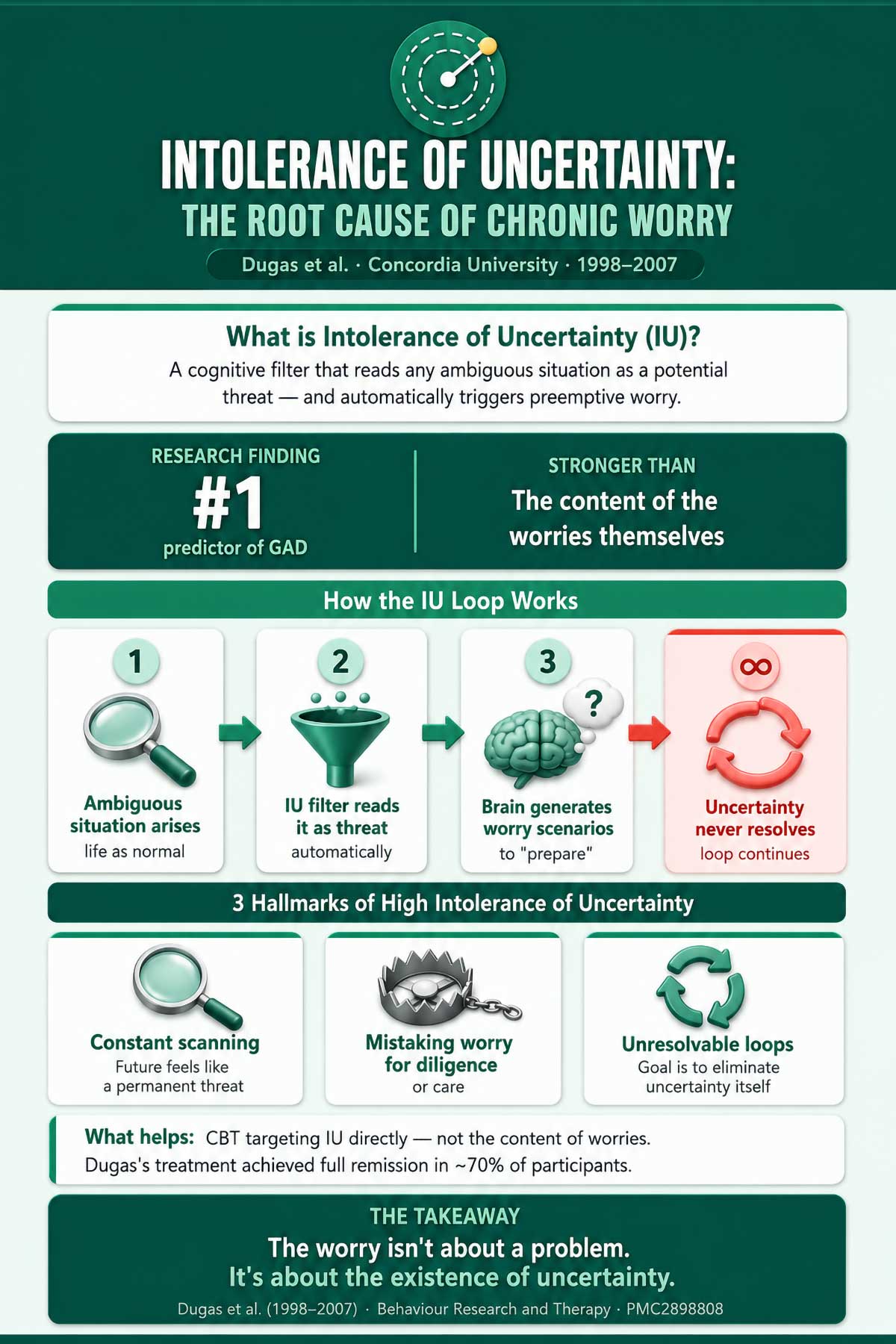
Some people don’t just worry about specific problems. They exist in a baseline state of low-level unease, scanning the future for anything that could go wrong. This isn’t a personality flaw. Psychologists call it intolerance of uncertainty (IU), and it functions like a background process that never shuts off.
Clinical psychologist Michel Dugas and colleagues at Concordia University spent decades showing that IU is the single strongest predictor of Generalized Anxiety Disorder, stronger even than the content of the worries themselves.
In a series of studies on the cognitive model of GAD, Dugas found that IU acts as a cognitive filter. Any ambiguous situation gets automatically read as a threat. The brain then generates worries as a way of mentally preparing for bad outcomes that might (but probably won’t) happen.
The trap is that IU-driven worry never actually resolves anything. The goal isn’t solving a specific problem. It’s eliminating uncertainty itself. That’s not possible, so the loop keeps running.
People with high IU tend to mistake this scanning for diligence. They believe that worrying about something means they’re taking it seriously. That belief is exactly what makes it so hard to interrupt.
2. One Bad Night of Sleep Rewires How Your Brain Reads Threats
This one has a number attached to it, and the number is hard to shake.
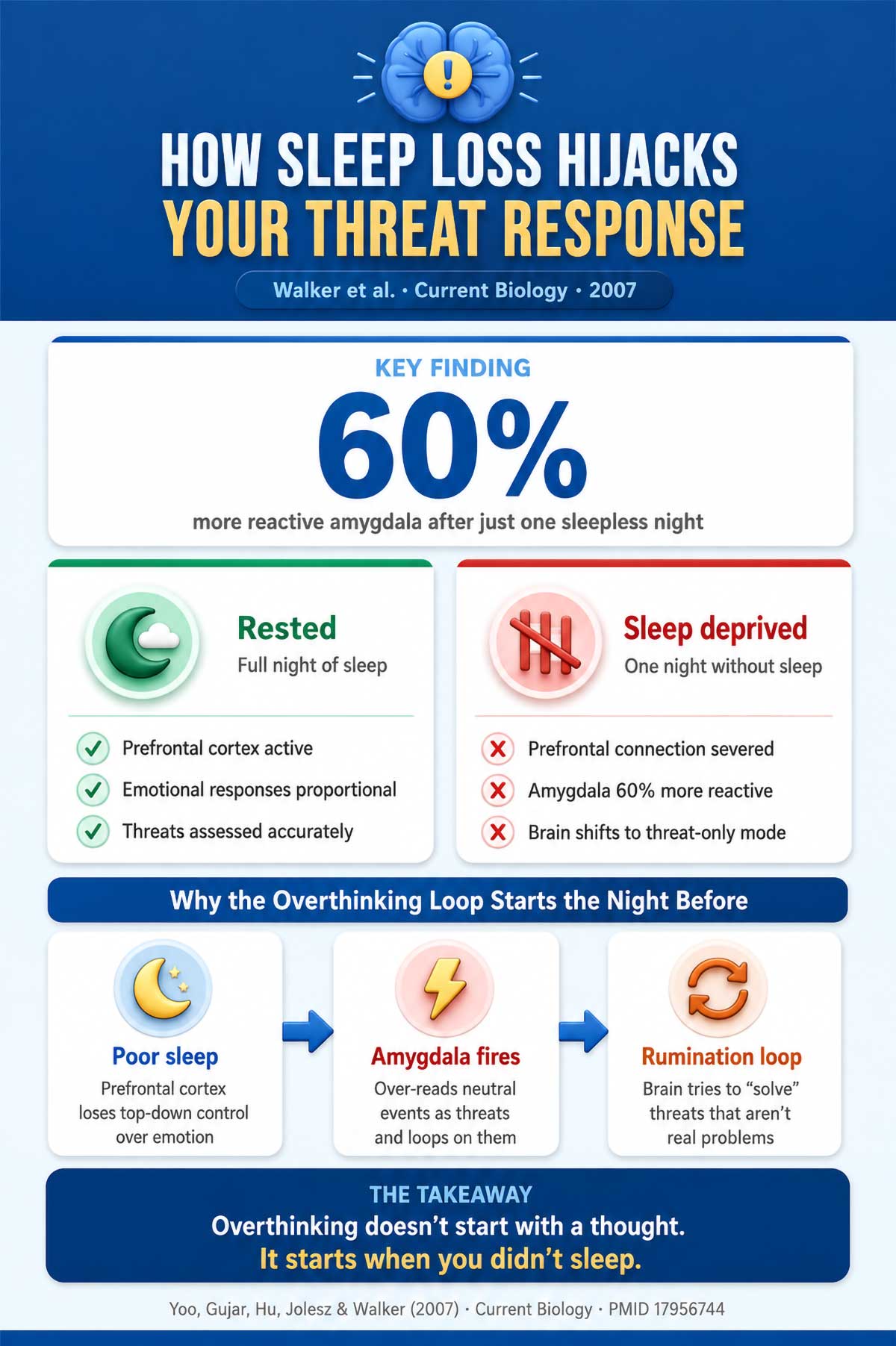
Neuroscientist Matthew Walker and colleagues published a study in Current Biology showing that just one night without sleep caused the amygdala (the brain’s emotional alarm center) to become roughly 60% more reactive to negative stimuli.
The prefrontal cortex, which normally keeps emotional responses in check, essentially lost its connection to the amygdala. Without that top-down control, the brain shifted into something close to a threat-detection-only mode.
What this means day-to-day: a mildly awkward email you’d brush off after a full night’s sleep becomes something you turn over in your mind for hours after a poor one. The situation didn’t change. Your brain’s ability to read it accurately did.
Sleep deprivation doesn’t just make you tired. It actively dismantles the check system that keeps fear responses proportional. Chronic poor sleep isn’t just a symptom of anxiety. It’s a physiological primer for it. The overthinking loop isn’t even beginning with a thought. It’s beginning hours earlier, when you didn’t sleep.
→ See how blueberries support memory and brain function
3. Your Nervous System May Be Stuck in Anticipation Mode
Stress is supposed to be temporary. The body releases cortisol to deal with an immediate threat, then levels return to baseline. That’s the design. But when stressors are chronic (a difficult job, a strained relationship, money pressure that doesn’t resolve), the HPA axis can get stuck in a semi-activated state. The HPA axis is the hormonal system that governs the stress response.
The Harvard Health explanation of the stress response describes how sustained high cortisol levels actually shrink the hippocampus, which is the brain region responsible for memory and context. A compromised hippocampus means the brain struggles to judge whether a past danger is still relevant now. It also weakens executive function, which is the mental capacity most needed to redirect a thought spiral.
The result is a nervous system stuck in low-level search mode, scanning for problems because it has been wired to expect them. This is why chronic overthinkers often can’t name what they’re worried about. They’re not reacting to a specific threat. They’re reacting to a body that has learned, neurochemically, to stay ready for one.
4. Rest Is When the Brain Turns on Itself
You’d expect that sitting quietly or doing nothing would offer some relief from overthinking. For chronic overthinkers, it reliably does the opposite. The reason has a name: Default Mode Network (DMN) overactivity.
The DMN is the neural network that activates when the brain isn’t focused on an outside task. It’s the brain’s “resting state,” responsible for self-referential thought: reflecting on the past, imagining future scenarios, thinking about how others see you. In healthy function, the DMN is useful. It processes experience and helps build a sense of self.
A landmark review in Nature Reviews Neuroscience found that in people prone to rumination and depression, the DMN has unusually strong connections to the subgenual prefrontal cortex, a region tied to negative self-referential processing. When this circuit runs hot, the brain’s “resting” state defaults to self-critical loops rather than neutral reflection. The quieter the environment, the louder the internal noise becomes.
This explains something overthinkers often find confusing: why vacations, weekends, and slow evenings can feel like anxiety triggers rather than relief. The external demands that kept the brain occupied are gone, and the DMN rushes in to fill the space with everything you’ve been too busy to overthink until now.
5. The Subconscious Belief That Worrying Is Keeping You Safe
There’s a stubborn paradox at the center of overthinking: the conscious mind hates it, but a deeper part of the brain insists on it. This is what psychologist Adrian Wells identified as metacognitive beliefs, specifically the subconscious conviction that worrying is a form of protection.
Wells’s cognitive model of GAD draws a line between two types of worry. Type 1 worry is ordinary concern about real problems. Type 2 worry, or “meta-worry,” is worry about the worry itself:
I can’t stop thinking about this; something must be seriously wrong. But what drives the whole system is a set of positive beliefs running underneath: If I think about this enough, I’ll be prepared. Worrying means I care. If I stop worrying, something bad will happen.
These beliefs are seldom consciously stated. They don’t need to be. The brain has automated the process. As long as the underlying belief holds that vigilance equals safety, any attempt to “just stop” gets resisted at a subconscious level. The conscious mind has to fight not just the thoughts, but the entire justification system that generates them.
6. Perfectionism Doesn’t Just Set Unrealistic Standards. It Manufactures the Past.
Most descriptions of perfectionism focus on the future: the impossible standards, the fear of failure before something begins. But perfectionism has another dimension that’s less discussed and more psychologically damaging. It also reaches backward.
Gordon Flett and Paul Hewitt at York University and the University of British Columbia published foundational research on perfectionism cognitions and rumination. They found that people high in perfectionism are much more likely to engage in retrospective rumination: repeatedly analyzing past events, decisions, and conversations.
Not to learn from them, but to find the exact moment things could have gone differently. The brain frames this as problem-solving, but the past isn’t a problem that can be solved.
What makes this especially hard to break is that the emotional stakes are high. Perfectionists tie their self-worth directly to outcomes. A mistake isn’t just something that happened. It’s taken as evidence of something fundamentally wrong.
So the rumination isn’t idle replaying. It’s the brain’s attempt to retroactively fix something that cannot be changed, running on a loop because it never reaches a satisfactory conclusion.
7. The Social Feed Isn’t Just Distracting. It’s Training Your Brain to Compare.
Upward social comparison (measuring yourself against people who appear more successful, more attractive, or more put-together) has always existed. But social media platforms have turned what was once an occasional social experience into a constant and quantified one.
A study on social comparison and Facebook use published in Computers in Human Behavior found that social media exposure correlates with elevated “evaluative concerns,” a state in which the brain fixates on where it ranks relative to others.
The brain processes social status much like it processes physical threat: a perceived drop in standing activates the same survival circuitry. The comparison doesn’t resolve with a conclusion. It generates a loop of mental self-improvement attempts, each one prompting another comparison, prompting another loop.
This trigger is the most environmental of the eight. Unlike the neurobiological conditions above, it’s also the most immediately modifiable. The brain can’t easily opt out of its DMN or its cortisol response. But it can opt out of the feed.
8. When the Working Memory Gets Full, the Filter Breaks Down
Cognitive load is often framed as a productivity issue: too many tasks, too little mental space. But its effect on overthinking is more specific than that. The prefrontal cortex handles executive function, but it also handles inhibitory control, which is the ability to suppress irrelevant or unwanted thoughts before they reach conscious attention.
Research on working memory and thought suppression found that when cognitive resources are depleted (by mental fatigue, decision overload, or sustained stress), inhibitory control weakens significantly.
The brain loses its ability to gate incoming thoughts. Intrusive, repetitive, low-value mental content that would normally be filtered out starts breaking through. The mind that felt sharp at 9 a.m. is hosting an open-door policy for anxious thoughts by 10 p.m.
This is why overthinking clusters at night or after long, demanding days. The brain isn’t generating more worries at those times. It’s just too tired to keep the gate closed.
The Thread Running Through All of It
Eight triggers, and none of them are “you think too much.” Every single one is a system (neurological, psychological, or environmental) doing something it was designed to do, in conditions that make it go wrong.
The amygdala was built to detect threats. The DMN was built to process experience. The perfectionist’s ruminative loop is the brain trying, badly, to protect a fragile sense of self-worth. Metacognitive beliefs evolved because, in some environments, vigilance genuinely did prevent harm.
The problem isn’t the machinery. It’s that the machinery is running in contexts it wasn’t built for, triggered by conditions that most standard advice never addresses.
Stopping a thought in the moment is a losing strategy because you’re arriving after the setup is already complete. The more useful question isn’t how do I stop this thought? It’s which of these upstream conditions am I actually able to change?
For most people, that answer isn’t everything at once. It’s one thing, worked on consistently, until the brain stops getting primed the same way it always has.