A can of Corona Light can test below the 20 parts per million threshold labs use to call food gluten-free. The label still won’t say so. That one-word omission trips up more shoppers than almost any other question in the beer aisle, and there’s a real reason for it: the agency deciding the answer isn’t the one most drinkers assume.
Corona is not gluten-free. Corona Extra and Corona Light are brewed from barley, a gluten-containing grain, and no amount of processing changes what the beer is made from. For someone managing celiac disease, that fact matters more than any lab reading on a spec sheet.
The confusion is understandable. Beer labeled “crafted to remove gluten” sits on the same shelf as beer that’s genuinely gluten-free from the first ingredient, and the difference between the two isn’t obvious unless someone has already read the fine print.
What Gluten Actually Does to the Body
Gluten is a protein found in wheat, barley, and rye. It gives bread its stretch and beer its body, and for most people it passes through the digestive system without incident.
For a smaller group, it doesn’t. Celiac disease is an autoimmune condition in which gluten triggers an immune response that damages the small intestine. About one in 100 people has it, according to a 2025 review in Gastrointestinal Endoscopy Clinics, though the review notes most cases go undiagnosed unless a doctor actively screens for them.
Non-celiac gluten sensitivity is different. There’s no intestinal damage on a biopsy, but the symptoms, which include bloating, fatigue, brain fog, and joint pain, can look strikingly similar. Estimates of how common it is vary widely, from well under one percent to as high as thirteen percent in a 2015 systematic review in Alimentary Pharmacology & Therapeutics, and roughly six percent is the figure most often cited as a working estimate.
A third group reacts to wheat itself through a true allergy, which involves the immune system’s IgE antibodies rather than the autoimmune pathway celiac disease follows. And most people fall into a fourth category: no reaction to gluten at all.
Don’t self-diagnose any of these. A doctor can run blood tests for celiac antibodies, and in some cases a small intestine biopsy, before anyone changes their diet based on symptoms alone.
Which Corona Products Actually Contain Gluten
Not every bottle in the Corona lineup is made the same way, and the differences matter more than the branding suggests.
Corona Extra, Corona Light, Corona Premier, Corona Familiar, Corona Sunbrew, and Corona Non-Alcoholic are all brewed from malted barley, which means all six contain gluten at the ingredient level. Corona Extra and Corona Light go through additional processing that lowers their gluten content substantially, but “lowered” is not the same as “removed.”
Two products break from that pattern entirely. Corona Refresca and Corona Hard Seltzer are made without any gluten-containing grain, which puts them in a different category altogether, one where a gluten-free claim is actually accurate.
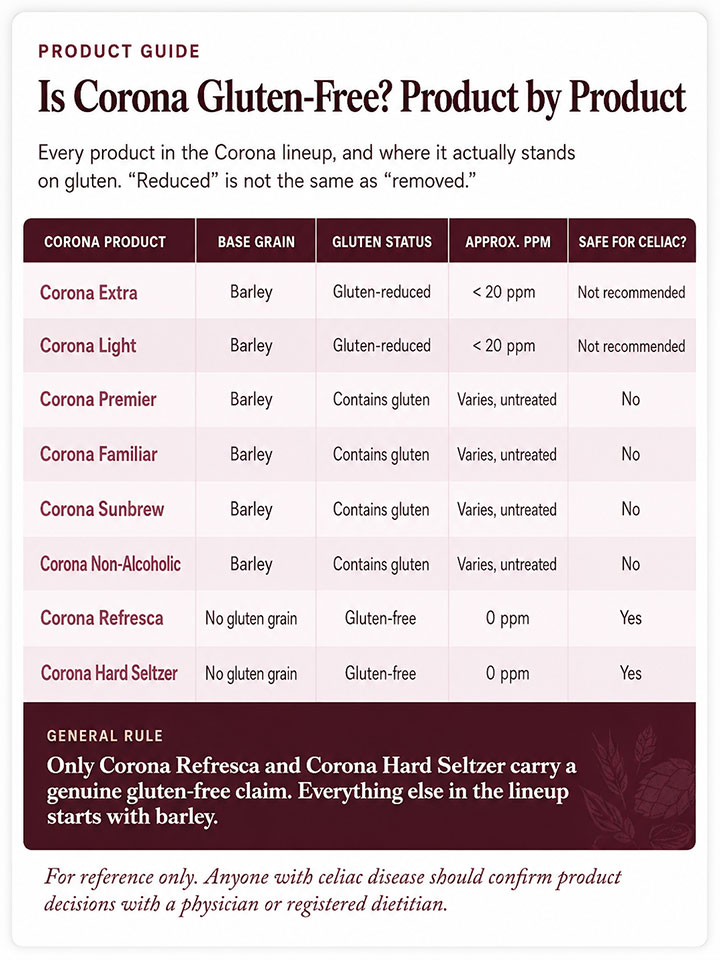
“Gluten-reduced” and “gluten-free” describe two different things, and the industry’s own language doesn’t always make that obvious. A gluten-reduced beer starts with barley and strips most of the protein out afterward.
A gluten-free beer never contained barley to begin with. Corona Extra and Light fall firmly in the first category.
Why Corona Can’t Legally Call Itself Gluten-Free
Corona’s gluten-free status isn’t actually the FDA’s call to make, and that single fact explains most of the confusion around it.
For packaged foods, the FDA sets the familiar 20 parts per million threshold. Beer brewed from barley or wheat doesn’t fall under FDA labeling authority at all. It’s regulated separately by the Alcohol and Tobacco Tax and Trade Bureau, and the TTB takes a considerably harder line than the ppm threshold most drinkers have in mind.
Under TTB rules, no beer brewed from a gluten-containing grain can be labeled gluten-free, regardless of how low it tests. The most a brewer can claim is that the beer was processed, treated, or crafted to remove gluten, and even that claim has to carry a disclaimer stating the beer was made from barley and may still contain gluten.
Corona Extra testing under 20 ppm doesn’t change any of this. The grain it started from is what decides the label, not the number that comes out the other end.
It’s worth thinking about why the agencies split the difference this way. Wine and spirits fall under FDA rules and can carry a gluten-free label if they meet the FDA’s standard.
Beer, because it’s fermented from grain in a way wine and spirits generally aren’t, got carved out to its own regulator with its own, stricter answer. The split feels arbitrary from a grocery aisle. It isn’t arbitrary to the agencies that wrote it.
Other countries handle the same question differently. The European Union uses the same 20 ppm line the FDA does, and allows gluten-reduced beer to carry a gluten-free label if it clears that bar.
Australia and New Zealand go further than either country, requiring no detectable gluten at all for any gluten-free claim. Canada sets its threshold at 20 ppm, matching the EU and the FDA’s general food standard, but applies it without the TTB’s carve-out for malt beverages.
How Brewers Try to Strip Out the Gluten
Corona’s reduced-gluten process uses enzymatic hydrolysis, a step where enzymes break the gluten proteins in barley into smaller fragments during brewing. It’s an effective way to lower gluten content. It doesn’t eliminate the protein so much as chop it into pieces too small for standard tests to easily catch, which creates a separate problem: measuring what’s actually left.
The standard sandwich ELISA test, the workhorse method for checking gluten in most packaged foods, misses these smaller fragments almost entirely. The R5 Competitive ELISA test catches more of them and is the method the Codex Alimentarius Commission recommends for fermented products like beer.
That recommendation comes with an asterisk few people ever see: the FDA’s own 2020 final rule on gluten-free labeling states plainly that the R5 Competitive ELISA is not considered suitable for quantifying gluten in fermented or hydrolyzed foods, precisely because those broken-down fragments behave unpredictably from batch to batch.
That gap between “best available test” and “test the FDA actually trusts” is the real reason ppm numbers on gluten-removed beer carry an asterisk, no matter which brand prints them on a website.
What the Research Actually Shows
Alessio Fasano, director of the Center for Celiac Research and Treatment at Massachusetts General Hospital, has spent years making the same point to celiac patients: even trace amounts of gluten can provoke an immune response, which is why he generally steers patients toward products that are certified gluten-free rather than merely gluten-reduced.
Peter Green, director of the Celiac Disease Center at Columbia University, has taken a similarly cautious position on gluten-removed beer specifically, noting that there isn’t enough evidence to call products like Omission or reduced-gluten Corona safe for celiac patients just because they test low.
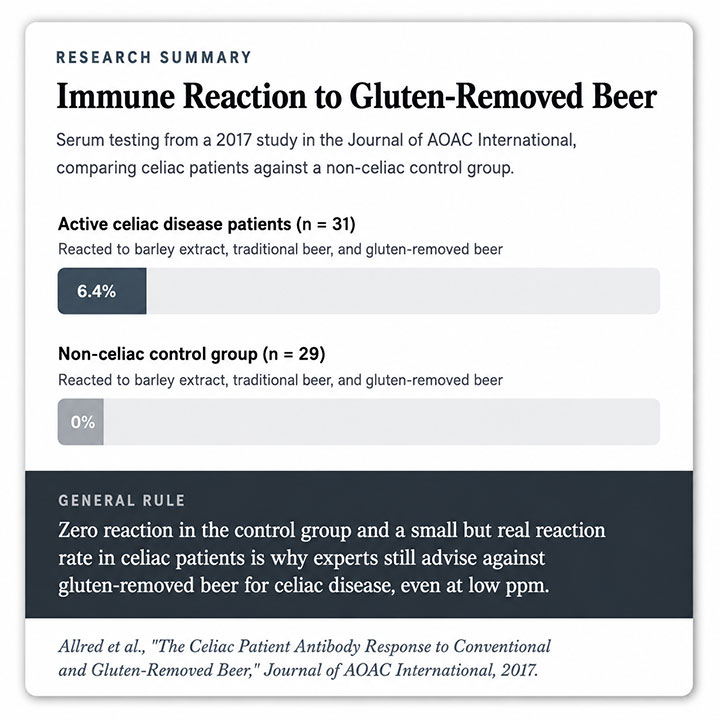
The data backs up the caution, though not quite as dramatically as either expert’s warning might suggest. A 2017 study in the Journal of AOAC International tested blood serum from 31 people with active celiac disease and 29 people without it against barley extract, traditional beer, and gluten-removed beer.
None of the 29 non-celiac participants reacted to any of the three. Two of the 31 celiac patients, about six percent, showed an immune response to all three samples, gluten-removed beer included.
That’s a small number. It’s also not zero, and for an autoimmune condition where the safe threshold is close to zero exposure, a six percent reaction rate in the population it’s meant to protect is the finding that ends the debate for most gastroenterologists.
Should You Drink It?
The honest answer depends on which category applies to you, and it changes more than most FAQ sections let on. Use the tool below to get a straight answer based on your own situation rather than a generic bullet list.
Corona & Beer Gluten Safety Checker
A tailored answer based on your own situation, not a generic list.
Corona’s Family: What About Pacifico and Modelo?
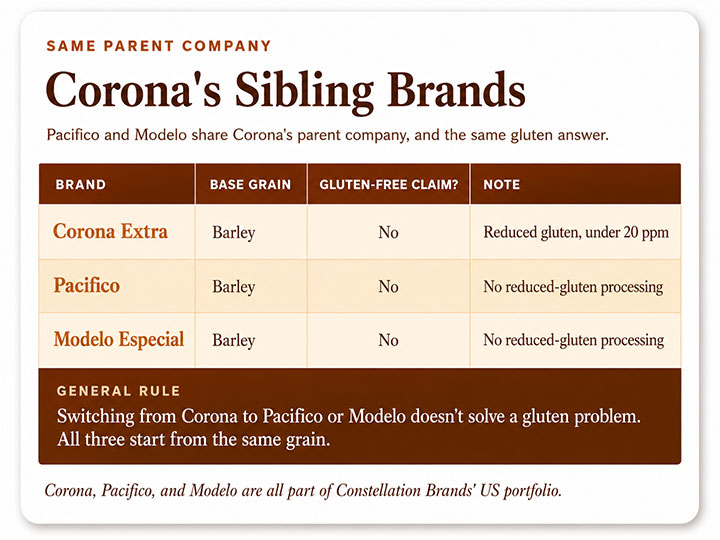
Corona shares a parent company with two other beers that come up constantly in the same breath online: Pacifico and Modelo, both part of the Constellation Brands portfolio that also owns Corona in the United States.
Neither one is any better than Corona on this front. Both Pacifico and Modelo Especial are brewed from barley malt, and neither carries a gluten-free certification or claim.
If a beer with a similar profile and no reduced-gluten processing is what you’re looking for, they’re not it. If reduced gluten is acceptable for your situation, none of the three offers a meaningful advantage over the others.
Real Gluten-Free Alternatives, If You’re Skipping Corona
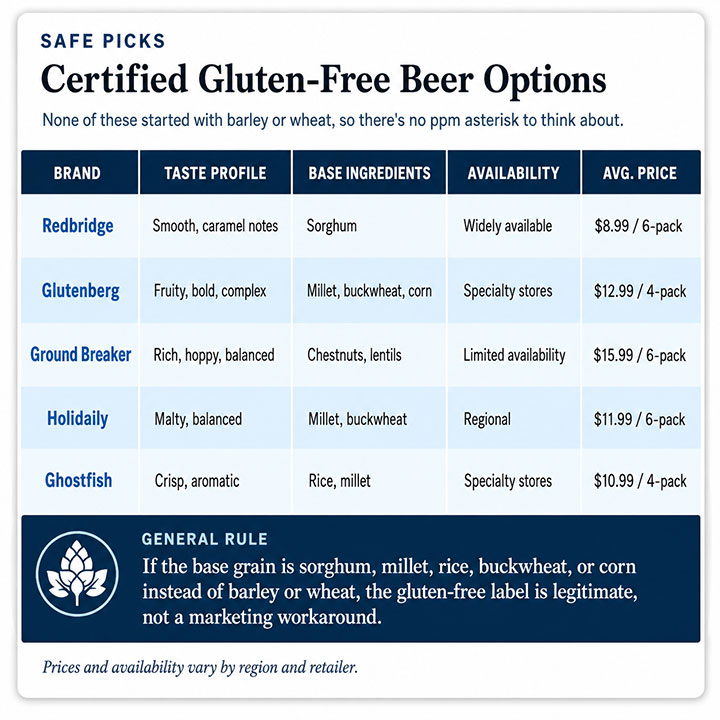
Fortunately, there are several gluten-free beers available that cater to different tastes, and none of them require squinting at a ppm number to feel confident about.

Redbridge, brewed from sorghum, is one of the more widely available options and reads closer to a traditional lager than most alternative-grain beers manage. Glutenberg and Holidaily lean into millet and buckwheat for a bolder, more complex profile.
Ground Breaker uses chestnuts and lentils instead of grain entirely, which produces a hoppier, richer beer that tastes almost nothing like Corona, by design.
Beer isn’t the only option at the bar. Wine is naturally gluten-free in almost every case. Distilled spirits, such as vodka, gin, rum, and tequila made from 100 percent agave, lose their gluten proteins in distillation regardless of what grain they started from.
Hard ciders like Angry Orchard and Strongbow skip grain altogether, and hard seltzers such as White Claw, Truly, and Corona’s own Hard Seltzer line are safe bets across the board.
How Corona Stacks Up Against Other Popular Beers
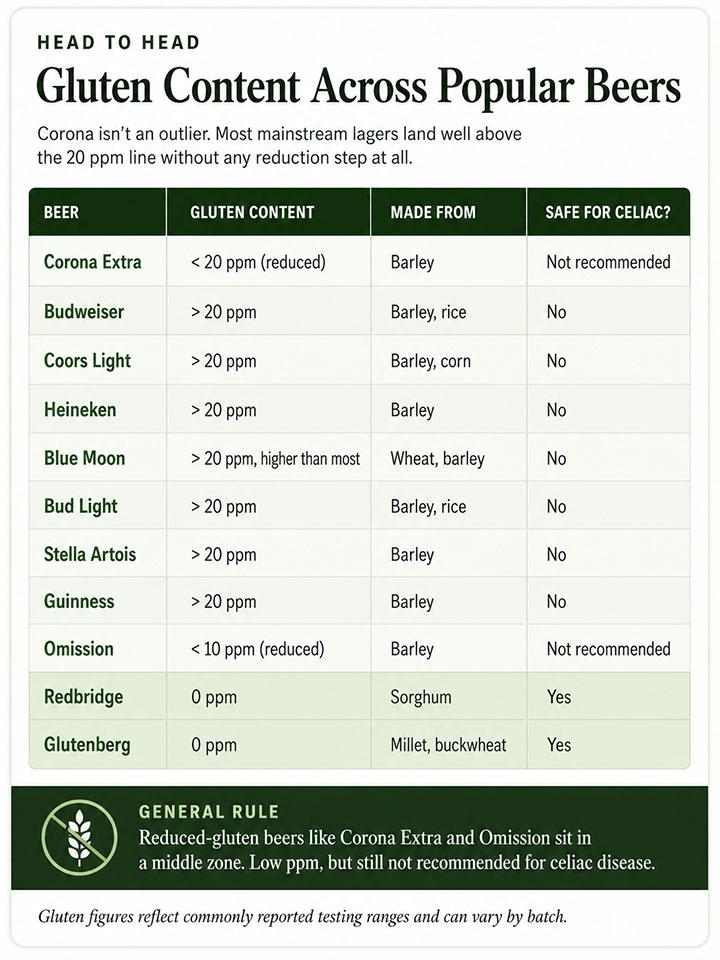
Corona isn’t unusual for a mainstream lager. Most major brands, Budweiser, Coors Light, Heineken, Bud Light, Stella Artois, and Guinness among them, are brewed from barley or wheat and land well above the 20 ppm mark without any gluten-reduction step at all.
Blue Moon is a common source of confusion here too. Its Belgian-style wheat base pushes its gluten content noticeably higher than a standard lager, despite a reputation among some drinkers as a “lighter” choice.
Ordering at the Bar Without Guessing
Picture this: you’re at a crowded bar, the tap list is handwritten, and the bartender is three drinks deep into a rush. This is exactly when gluten mistakes happen, and a few habits make it considerably less likely.
Ask about dedicated taps before you order. Cross-contamination happens more often in shared tap lines than most drinkers realize, so a bottled option is frequently the safer call. Stick to ciders, seltzers, or wine when you’re genuinely unsure, and don’t be shy about asking the bartender directly rather than guessing from the tap handle art.
Hidden Gluten Sources Worth a Second Look
Gluten shows up in places that have nothing to do with the beer list. Malt flavoring and malt extract appear in cereals and snack foods well beyond anything brewed.
Traditional soy sauce is wheat-based unless specifically labeled otherwise. Beer-based marinades and cooking sauces are an easy one to miss at a restaurant that otherwise handles gluten-free requests carefully.
Reading labels catches most of this. Shared fryers and prep surfaces in a restaurant kitchen catch the rest, or don’t, which is why celiac patients in particular tend to ask more questions than a casual gluten-sensitive diner might.
The number on a lab report was never really the question. The regulator writing the rule was, and once that’s clear, so is everything else: Corona Extra and Light are barley beers with the gluten dialed down, not removed, and no amount of testing changes which agency gets to decide what “gluten-free” is allowed to mean. For a beer aisle built on labels doing the explaining, that’s the one label doing the least work.
Frequently Asked Questions
Is Corona okay for gluten intolerance?
It depends on which kind. Corona Extra and Light test below 20 ppm and may be tolerable for mild, non-celiac sensitivity, but neither is recommended for celiac disease, where even trace gluten exposure carries risk.
Is Corona Non-Alcoholic gluten-free?
No. Corona Non-Alcoholic is brewed from the same malted barley base as Corona Extra, and removing the alcohol doesn’t remove the gluten.
Is Corona Seltzer gluten-free?
Yes. Corona Hard Seltzer is made without barley or any other gluten-containing grain, which puts it in a genuinely different category from the rest of the Corona lineup.
Is Blue Moon gluten-free?
No, and it’s not close. Blue Moon’s wheat-based Belgian style gives it a higher gluten content than most standard lagers, Corona included.
What’s the difference between “gluten-removed” and “gluten-free” beer?
Gluten-removed beer starts with barley or wheat and goes through processing that breaks down most of the protein afterward. Gluten-free beer is made from grains like sorghum, rice, or millet that never contained gluten in the first place. Only the second kind carries a genuine gluten-free claim under TTB rules.
What beer is best for gluten sensitivity?
Beers brewed from naturally gluten-free grains, sorghum, rice, millet, or buckwheat are the safest bet. Redbridge, Glutenberg, and Ground Breaker are three widely available options built on exactly that foundation.
Is Corona Light made with wheat?
No. Corona Light is brewed from barley malt, not wheat, though both grains contain gluten and the distinction doesn’t change anything for someone avoiding it.