Olive oil’s reputation as a liver-friendly food is well earned. What surprised researchers was how dramatically the results changed from one group of people to another.
Olive oil gets sold as something close to a liver cure. Pour it on everything, the advice goes, and watch a fatty liver fade. The best controlled trials tell a quieter and more useful story, and it starts with who you are before it ever gets to how much you pour.
The honest version is this. Olive oil can help a struggling liver, but how much it helps depends on your weight, on what the oil is replacing, and on the quality of what is in the bottle. Strip those conditions away, and the benefit shrinks fast.
That matters because fatty liver is no longer a rare diagnosis. Metabolic dysfunction-associated steatotic liver disease, the condition formerly called non-alcoholic fatty liver disease, now affects close to a third of adults worldwide. Most people who have it feel nothing at all until it is well advanced.
First, a word of medical caution
Olive oil supports a liver-friendly diet. It does not replace medical care, and it will not reverse advanced scarring or cirrhosis on its own.
Get baseline liver function tests before you make any changes, so any improvement at 8 to 12 weeks is a real measure rather than a guess. If you take a blood thinner such as warfarin or have known gallbladder disease, talk to your doctor first, because added fat of any kind changes how those conditions behave. Yellowing of the skin or eyes, persistent right-sided abdominal pain, or unexplained weight loss are reasons to be seen promptly, not managed with diet.
What the controlled trials actually found
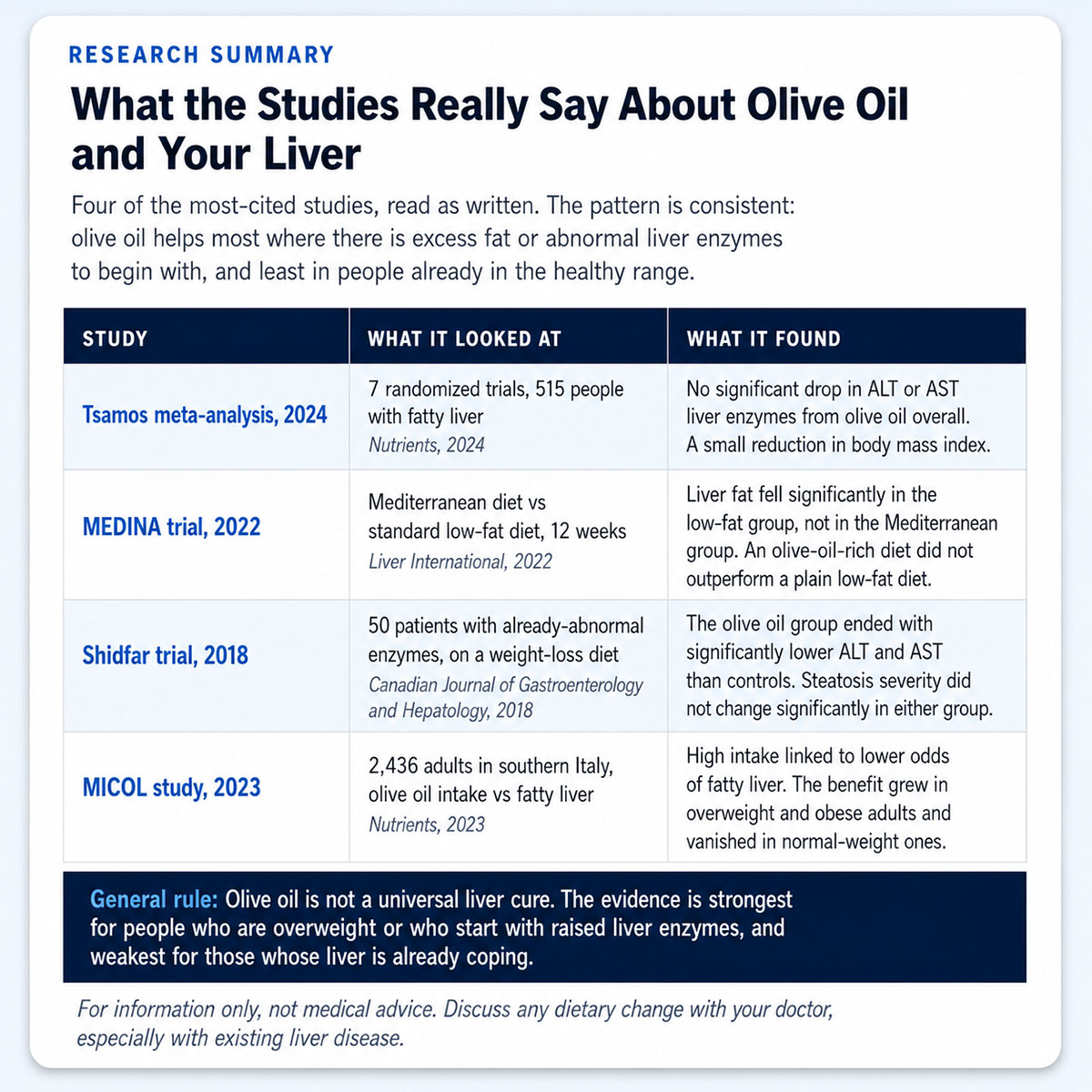
Pool the randomized trials together, and the picture is more sober than the headlines. A 2024 meta-analysis in Nutrients, led by Georgios Tsamos at Aristotle University of Thessaloniki, combined seven trials covering 515 people with fatty liver. It found no statistically significant drop in the liver enzymes ALT or AST from olive oil, though it did find a small reduction in body mass index.
The MEDINA trial reinforced the finding. Run by dietitian Elena George and colleagues across Melbourne hospitals and published in Liver International in 2022, it compared an ad libitum Mediterranean diet to a standard low-fat diet for 12 weeks. Liver fat fell significantly in the low-fat group. The Mediterranean group’s smaller drop did not reach significance, and the two diets did not differ from each other overall. A diet built around olive oil did not outperform a plain low-fat diet on the one number that mattered most.
Olive oil’s good reputation comes mostly from people who started out worse. The clearest single trial, Farzad Shidfar’s 2018 study in the Canadian Journal of Gastroenterology and Hepatology, enrolled 50 patients whose liver enzymes were already abnormal and gave one group 20 percent of daily calories as olive oil alongside a weight-loss diet. That group ended with significantly lower ALT and AST than the control group, though the ultrasound-measured steatosis itself did not improve significantly in either group.
That pattern took some untangling to see. Olive oil seems to do the most for the livers that need it most, and very little for livers that are already coping.
Who actually benefits from olive oil
The trial evidence is mixed, but the population data leans in one direction, and it points to body weight. The MICOL study from southern Italy, published in Nutrients in 2023, followed 2,436 adults and found that high olive oil intake was linked to lower odds of fatty liver, with an odds ratio of 0.73 for the highest consumers against the lowest.
What the headlines skip is who that protection impacted. The benefit grew in overweight participants and grew further in obese ones, and in normal-weight people, it disappeared entirely. Olive oil looks less like a universal tonic and more like a tool that works when there is excess fat to act on.
An earlier reading of the PREDIMED trial pointed in the same way. In a Bellvitge sub-study in the Journal of Nutrition in 2019, older adults at high cardiovascular risk who followed a Mediterranean diet with extra virgin olive oil had fatty liver far less often than the control group, 8.8 percent versus 33 percent, even though no one was advised to lose weight.
Not every cohort agrees on who exactly benefits. The NUTRIHEP cohort in Nutrients (2024) found the protective link held for women but not men, a sex difference that researchers still cannot fully explain.
One thread runs through all of it. Olive oil rarely acts alone in these studies. It acts in combination with vegetables, fish, nuts, and coffee within a whole eating pattern, and pulling it out of that pattern weakens what it can do.
How to use olive oil for fatty liver
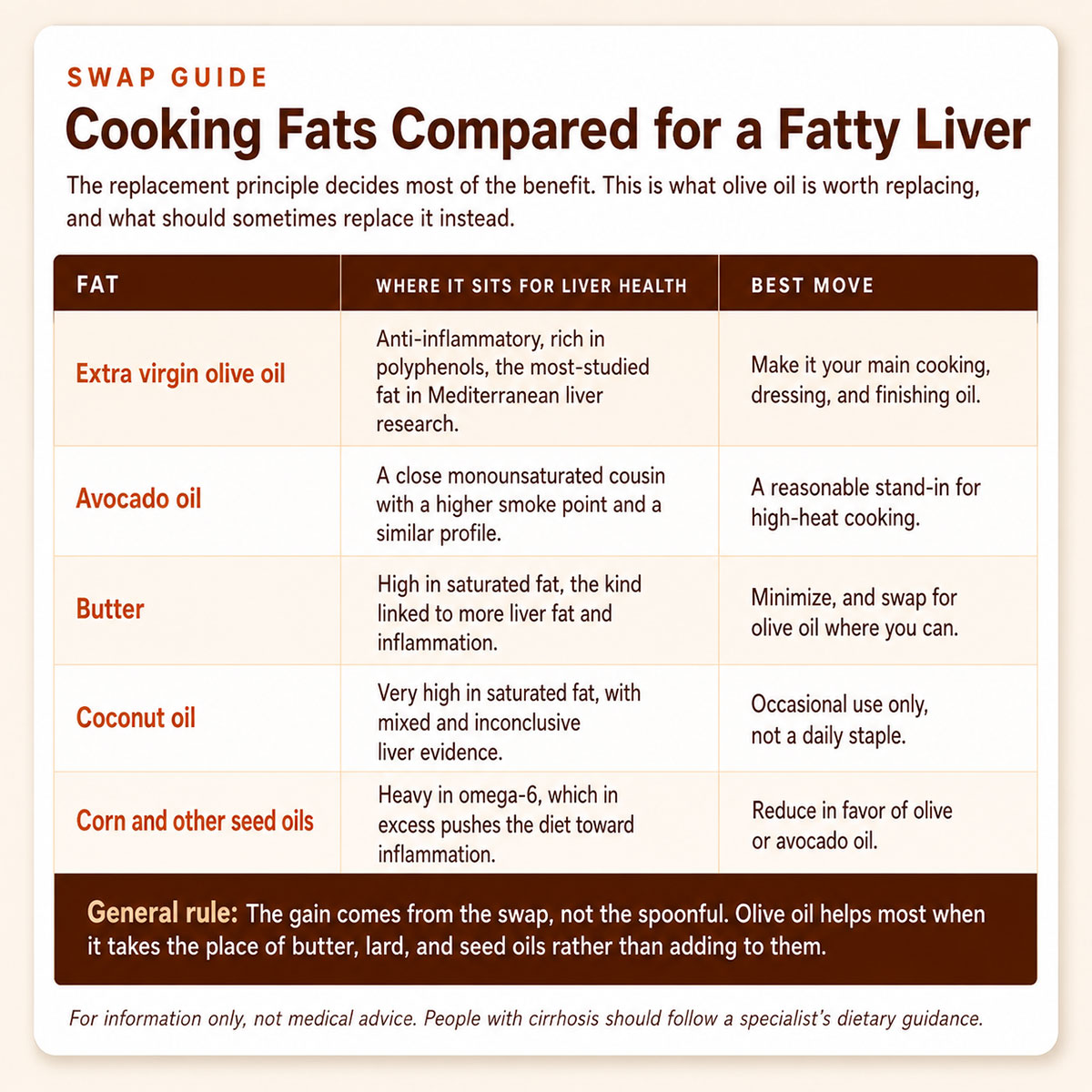
The single most important rule is the one most people get backward. Olive oil helps when it replaces a bad fat, not when it joins the plate as an extra.
UChicago Medicine states this plainly in its fatty liver disease diet guidance, where the standing advice for non-alcoholic fatty liver is to use olive oil in place of other cooking fats in a Mediterranean pattern. Swapping, not stacking, is the whole game.
Integrate it into your diet like this:
- Cook with it in place of butter, margarine, and seed oils for sautéing, roasting, and pan-frying.
- Dress with it by whisking oil and lemon instead of reaching for a bottled, cream-based dressing.
- Finish with it by drizzling a raw spoonful over cooked vegetables, fish, or soup, where the flavor and polyphenols stay intact.
- Measure for the first week, so two to three tablespoons across the day becomes a habit rather than a guess.
A common shortcut deserves a straight answer. The trend of a morning shot of olive oil and lemon on an empty stomach has spread widely online, but its support comes from social media, not science. There is no good evidence that a fasted shot does more for your liver than the same oil used in food, and on a high-calorie diet, it simply adds calories. Skip the ritual and use the oil where it actually earns its place.
A reusable lemon-herb dressing covers most of a day’s target in one go:
- Add 4 tablespoons of extra virgin olive oil, 2 tablespoons of fresh lemon juice, 1 minced garlic clove, and a pinch of salt to a jar.
- Seal and shake for 30 seconds until it thickens slightly.
- Use 1 tablespoon per salad, which delivers roughly a third of a daily target, and refrigerate the rest for up to five days.
How much olive oil per day for fatty liver?
The amounts used in research cluster between 2 and 4 tablespoons a day, which is about 25 to 50 milliliters. UChicago Medicine’s clinical advice sits at the top of that range, around four tablespoons, for patients actively managing fatty liver.
The catch is arithmetic, not biology. Three tablespoons contain roughly 360 calories, so adding that on top of an unchanged diet increases weight, and weight gain works directly against the liver. Keep the oil inside your existing calorie budget by removing the fats it replaces, and the math stays in your favor.
Which olive oil is best for your liver?
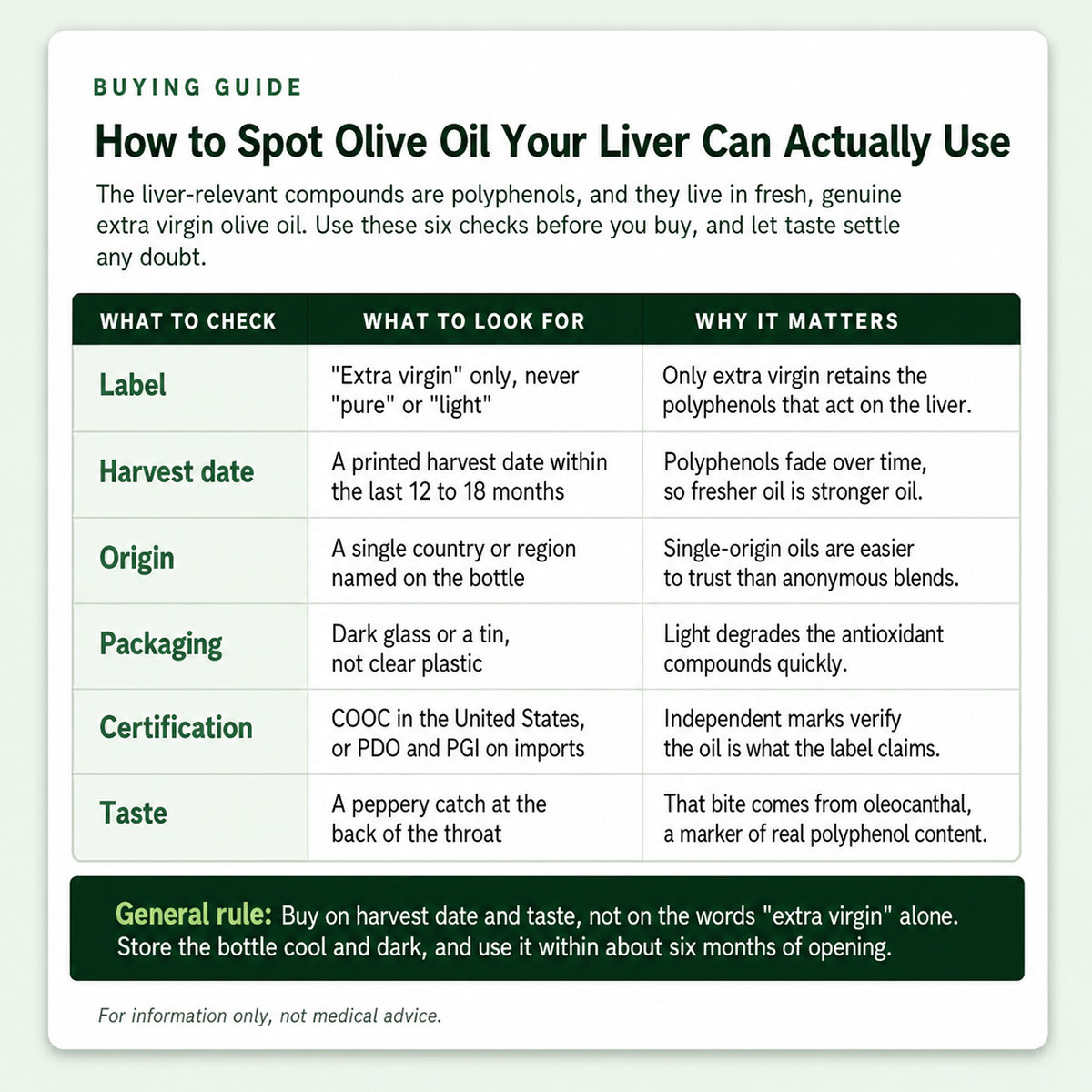
Type matters more than people expect. The liver-relevant compounds are the polyphenols, and those live almost entirely in genuine extra virgin olive oil. A 2023 systematic review in Clinical Nutrition ESPEN concluded that olive oil may ease hepatic steatosis and that higher-polyphenol oils appear to do it better than refined ones.
Polyphenols also fade with time and light, which is why a fresh, well-stored bottle outperforms a cheap one that has sat under store lights for a year. The same antioxidant logic is why other polyphenol-rich foods continue to appear in liver research.
You can shortlist a good bottle on sight and taste. Look for the words “extra virgin,” a recent harvest date, a single country or region of origin, a dark glass bottle or tin, and a certification mark such as COOC in the United States or PDO on imported oils. A real one bites slightly at the back of the throat, a peppery catch that comes from a polyphenol called oleocanthal. Flat or greasy oil has little to offer your liver.
One caveat on the scare statistics. Claims that most supermarket olive oil is fake trace back to a contested 2010 University of California, Davis report, and nobody has run a test rigorous enough to settle the real number. Buy on harvest date and taste anyway, since that habit works whether the true rate is 10 percent or 80.
Is olive oil good for liver cirrhosis?
Caution comes first here. Cirrhosis is scarring, not simple fat, and no oil treats it. Anyone with cirrhosis needs a specialist directing their diet, because protein, salt, and calorie needs in advanced liver disease can be highly specific and sometimes counterintuitive.
Within general healthy eating, olive oil still has a place. The British Liver Trust advises people with cirrhosis to use oils such as olive, vegetable, or sunflower in place of butter, lard, and solid fats like coconut and palm. The hard part is not the oil. It is resisting the urge to manage a disease this serious without the guidance of a medical professional.
What you can reasonably expect
If you have abnormal liver enzymes and excess weight, the replacement approach is worth a focused 8-to-12-week trial, with blood work at the start and end. People in that situation are the ones the evidence supports most.
If your weight is in the normal range and your liver numbers are already fine, expect less. The cohort data suggests olive oil’s protective effect is modest to absent in that group, and it works best as one habit inside a broader Mediterranean pattern rather than a standalone fix. Energy and digestion may stabilize before any lab value moves, which is a good sign but not proof that liver function has recovered. Whether that smaller effect is worth the daily tablespoons is a judgment call the research does not make for you.
So is olive oil good for your liver?
Whether olive oil is good for your liver was always the wrong place to start. What it replaces, what your weight and liver numbers look like, and what is actually in the bottle decide nearly all of it. Get those three right, and a Mediterranean spoonful stops being a folk cure and becomes a small, evidence-shaped tool, one that helps the people who need it most. That is a more modest promise than the headlines make. It is also the one the research can keep.
Frequently asked questions
How much olive oil per day for fatty liver?
Research uses 2 to 4 tablespoons, roughly 25 to 50 milliliters, daily. It should replace other fats rather than add to your total calories, and the effect depends on consistency over weeks.
Can olive oil reverse fatty liver disease?
It can help reduce liver fat and support healthier enzyme levels for some people, especially those who are overweight or whose liver enzymes started out abnormal. Pooled trials do not show a guaranteed enzyme drop for everyone, and advanced disease needs medical treatment beyond diet.
What does drinking a spoonful of olive oil at night do?
There is no reliable evidence that a nighttime or fasted shot of olive oil benefits the liver more than using the same oil in meals. On an unchanged diet, it mainly adds calories, which can work against liver health.
What type of olive oil is best for liver health?
Extra virgin olive oil, ideally high in polyphenols, with a recent harvest date and single-origin labeling. Refined, “pure,” and “light” oils lose the antioxidant compounds that matter.
How long does it take for olive oil to help your liver?
When it helps, enzyme changes tend to appear over several weeks of consistent daily use, and any imaging change takes longer. Responses vary widely, and some people see little change, which is why baseline and follow-up testing is worth doing.
Is olive oil good for liver cirrhosis?
Olive oil is not a treatment for cirrhosis. As part of general healthy eating, it can replace butter and solid fats, but cirrhosis diets must be guided by a specialist because individual needs differ.
Is olive oil safe if I have gallstones?
Fat stimulates the gallbladder, so olive oil can trigger pain if you have gallstones. Start with a teaspoon, increase only if you tolerate it, and stop and see your doctor if eating fat causes pain or nausea.