A UK Biobank study tracked 60,000+ adults’ sleep for 8 years. Most people obsess over one number, and it’s probably the wrong one
For years, the number that mattered was eight. Eight hours, tracked nightly, defended like a diet goal. A team at Monash University in Australia just found a different number that predicts who lives longer, and it has nothing to do with how many hours anyone actually sleeps.
The number is regularity. It measures whether someone falls asleep and wakes up at roughly the same clock time night after night, rather than how many hours they log. In a study of more than 60,000 adults, that single habit was a better predictor than total sleep time of who died early and who didn’t.
Sleep trackers count minutes. They rarely flag how much a bedtime drifts across a week, and they almost never catch the weekend swing that quietly undoes a week of consistency. That blind spot turns out to matter more than most people would guess.
The Study That Undercuts the 8-Hour Obsession
Daniel Windred, a sleep researcher at Monash University’s Turner Institute, spent months working through more than ten million hours of accelerometer data pulled from over 60,000 UK Biobank participants, then tracked their health records for close to eight years in a 2024 study in the journal Sleep.
He and senior author Andrew Phillips wanted an answer that sleep science had never directly tested: hours slept, or bedtime consistency, which one actually predicts an early death? Nobody had run that comparison with objective, device-measured data before.
Earlier research on sleep timing mostly relied on self-report, a shakier foundation for measuring something as precise as a bedtime swinging by an hour or two. Wearable accelerometer data gave Windred and Phillips something more exact to work with, and a large enough sample to catch differences that smaller studies relying on memory alone would likely have missed.
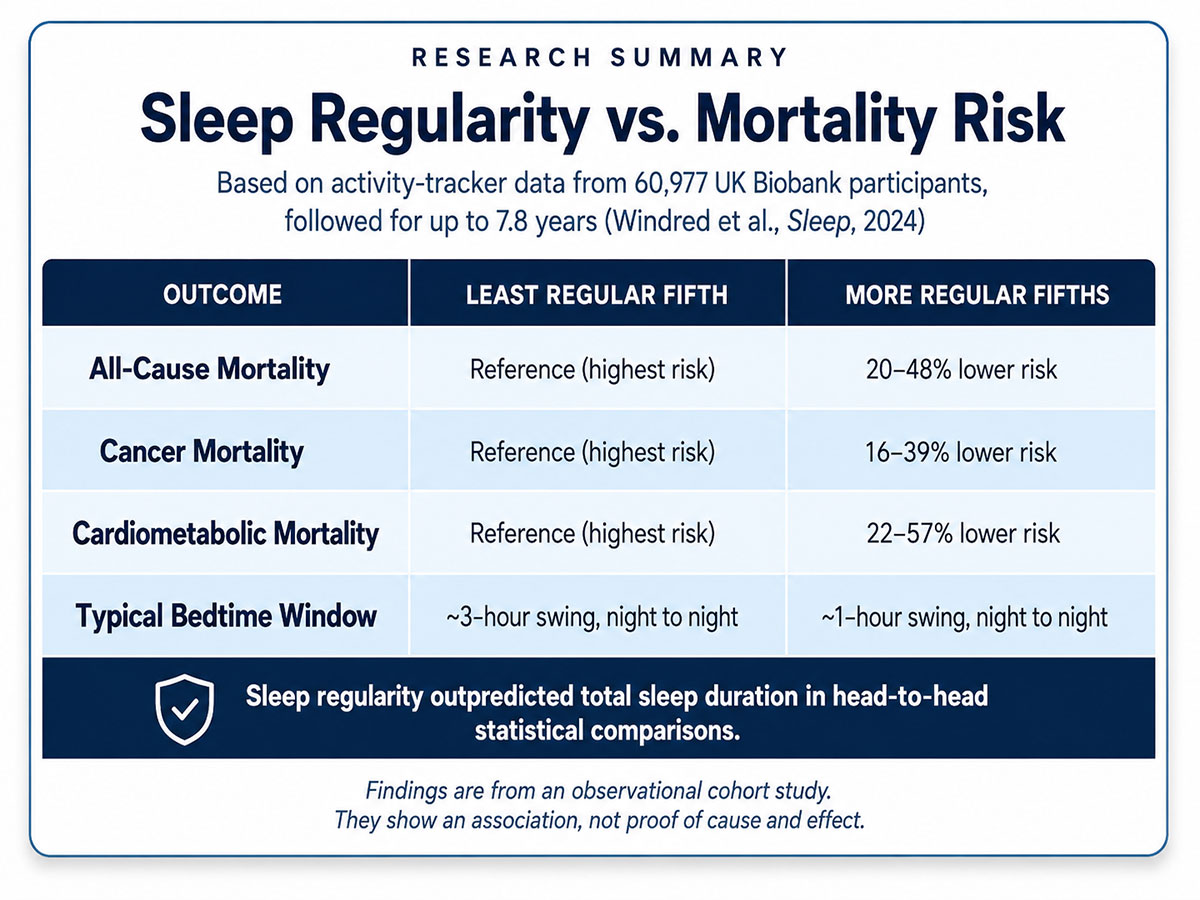
The results were stark. People in the most irregular fifth of sleepers had up to 48% higher risk of dying from any cause than the most regular fifth, even after accounting for age, health conditions, and lifestyle factors.
Cancer mortality dropped by as much as 39% in the more regular group. Cardiometabolic deaths, the heart attacks and strokes, dropped by as much as 57% in the more regular group.
When Windred and Phillips built statistical models pitting regularity directly against duration, adding sleep duration back into the equation added no meaningful predictive power once regularity was already accounted for. Which raises an obvious question: why has duration been the only number anyone bothered to track?
How Wide Is Too Wide?
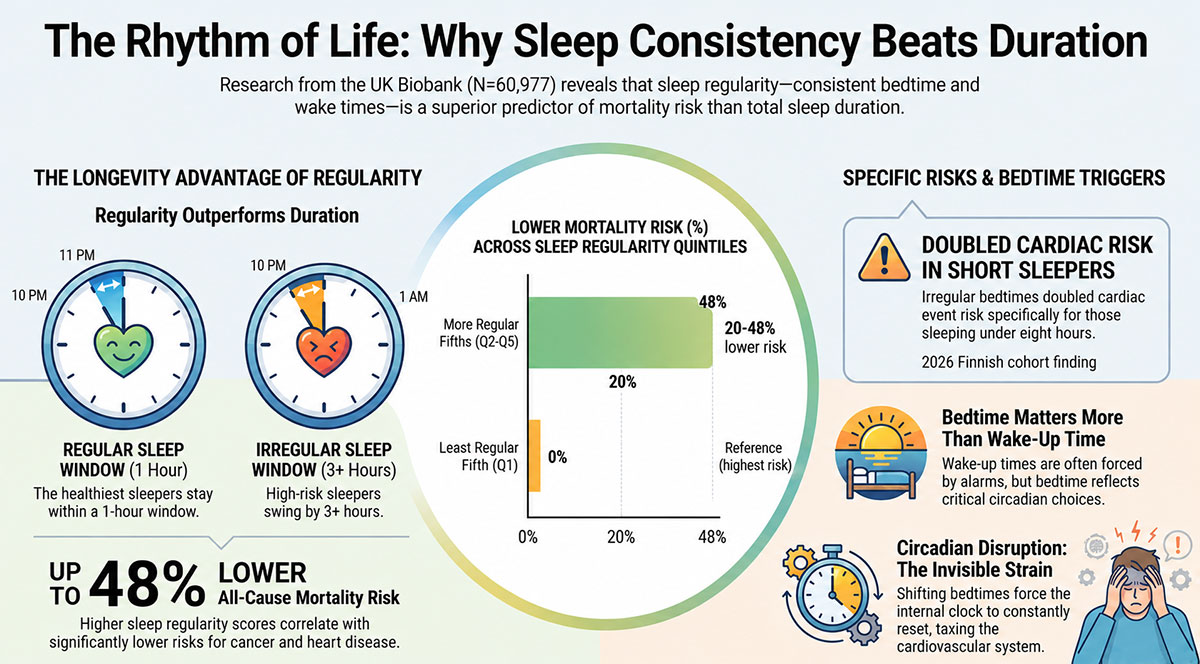
Windred and Phillips also looked at what “regular” and “irregular” actually look like in practice. People in the steadiest fifth of the group fell asleep and woke up within about a one-hour window most nights. People in the least steady fifth swung by roughly three hours, sometimes going to bed at 10 pm on a Tuesday and 1 am on a Friday.
A three-hour swing sounds dramatic until you picture an ordinary week. Maybe an early night follows a long shift, then a late one follows drinks with friends. A weekend lie-in pushes bedtime back another two hours because the alarm didn’t need to go off.
None of that looks reckless. It looks like an unremarkable routine. But it’s close to the exact pattern shown by the fifth of the study group carrying the highest mortality risk.
Narrowing that swing doesn’t require a rigid schedule. It usually starts with picking one anchor, a wake-up time or the start of a wind-down routine, and protecting it most nights rather than chasing a bedtime fixed to the minute. A repeatable cue before sleep, the same sequence in roughly the same order, gives the body something consistent to respond to even when the exact clock time shifts by twenty or thirty minutes.
The Twist: Regularity Might Matter Most When Sleep Is Already Short
A 2026 study in BMC Cardiovascular Disorders adds a wrinkle to the picture. Researchers at the University of Oulu in Finland tracked sleep timing in more than 3,200 adults through their mid-40s, then followed their cardiac health for a decade.
People with the most irregular bedtimes had roughly double the risk of a major cardiac event, a heart attack, stroke, or hospitalization for heart failure, compared to people with steady bedtimes. The catch: that risk showed up only in people already sleeping less than eight hours a night. Wake-up time variability, oddly, didn’t seem to matter at all.
Laura Nauha, the postdoctoral researcher at Oulu who led the study, explains that bedtime captures something wake time doesn’t. Mornings are often dictated by alarms and obligations rather than personal timing, while bedtime reflects an actual daily choice.
Why bedtime specifically, and not wake time, isn’t fully settled yet.
The leading theory points to circadian disruption. A bedtime that swings by hours night to night leaves the body’s internal clock guessing which day it’s living in, and that confusion may tax the cardiovascular system more than a few missing hours ever could.
This is observational data, so the researchers can’t rule out other lifestyle factors that tend to accompany an irregular bedtime. But the effect held up after those factors were built into the model, and a near-doubling of risk is hard to dismiss as noise.
Who This Actually Applies To
The UK Biobank cohort skews older, with an average age in the early 60s at the time of measurement. That’s not a flaw in the research, but it does mean the mortality data is strongest for people already past midlife, and thinner for anyone younger wondering whether the same magnitude of risk applies to them.
Shift workers and parents of young children don’t fit neatly into this research at all. Their bedtimes often swing because of circumstance rather than choice, and the studies don’t distinguish between a schedule that shifts due to a rotating roster and one that shifts due to three nights of late scrolling. Windred and Phillips didn’t test whether forced irregularity carries the same risk as voluntary irregularity, and that’s worth sitting with rather than glossing over.
There’s a third group this research doesn’t fully account for: the Finnish data found that elevated cardiac risk from irregular bedtimes only showed up in people already sleeping under eight hours. Someone on a wildly variable schedule who still logs eight or nine hours most nights may sit in a different risk category entirely, at least for that specific outcome. Nobody has tested that combination directly.
Bedtime Consistency Checker
See how wide your weekly bedtime window really is
What This Doesn’t Mean
None of this adds up to a mandate for a bedtime alarm and a spreadsheet. The National Sleep Foundation’s consensus panel on sleep timing reviewed this same body of research in 2023 and stopped well short of demanding an identical bedtime every night. Its position allows for extra sleep on days off, within reason. Nobody’s proposing a citation for sleeping in.
The distinction matters. A rough one-hour window most nights, not a locked schedule down to the minute, is what separated the healthiest group in the UK Biobank data from everyone else. Perfection was never the finding.
Weekend catch-up sleep is where this gets complicated for a lot of people. Sleeping in on Saturday to recover from a short week doesn’t erase the swing. It often creates one, especially if Friday night ran late as well. The data doesn’t punish an occasional late night. It’s the repeated back-and-forth, week after week, that shows up in the mortality numbers.
The reach isn’t limited to the heart. Dong-Run Li and colleagues at China Medical University, in a study in Psychological Medicine, tracked irregular sleep against rates of depression and anxiety, independent of total hours slept, and found the same divide showing up again. A pattern that surfaces across cardiology, oncology, and mental health research on its own stops looking like a coincidence.
Conclusion
The eight-hour number isn’t wrong, only incomplete, and it’s been standing in for a more useful question. A tracker that only counts hours can’t tell anyone whether their bedtime moved by twenty minutes or three hours this week, and that gap is exactly where the UK Biobank data found its signal. Windred and Phillips didn’t set out to dethrone sleep duration. They set out to test it against something nobody had measured properly, and it lost. The practical shift is smaller than it sounds: a narrower window, not a perfect schedule. Somewhere between chasing eight hours and giving up on consistency entirely sits the actual lever, overlooked the whole time.