You get through the day. You meet your responsibilities. Nothing is obviously wrong. Yet life feels strangely flat. Researchers have a name for that feeling.
There’s a particular kind of feeling bad that is not obvious. No crying in the car. No crisis. Just a persistent, low-grade sense that you’re going through the motions, getting things done, showing up, functioning, while some quieter part of you has gone offline.
You’re not sad. You’re not anxious. If someone asked if you were okay, you’d probably say yes, because technically you are. You just don’t feel anything much.
Sociologist Corey Keyes spent three decades at Emory University trying to name exactly this experience. The word he settled on was languishing, and the clinical picture he built around it is more serious than most people who are living it would ever suspect.
What languishing actually is (and why it’s not nothing)
The standard mental health conversation divides people into two buckets: mentally ill and mentally well. Keyes spent his career arguing that this is wrong in ways that cause real harm.
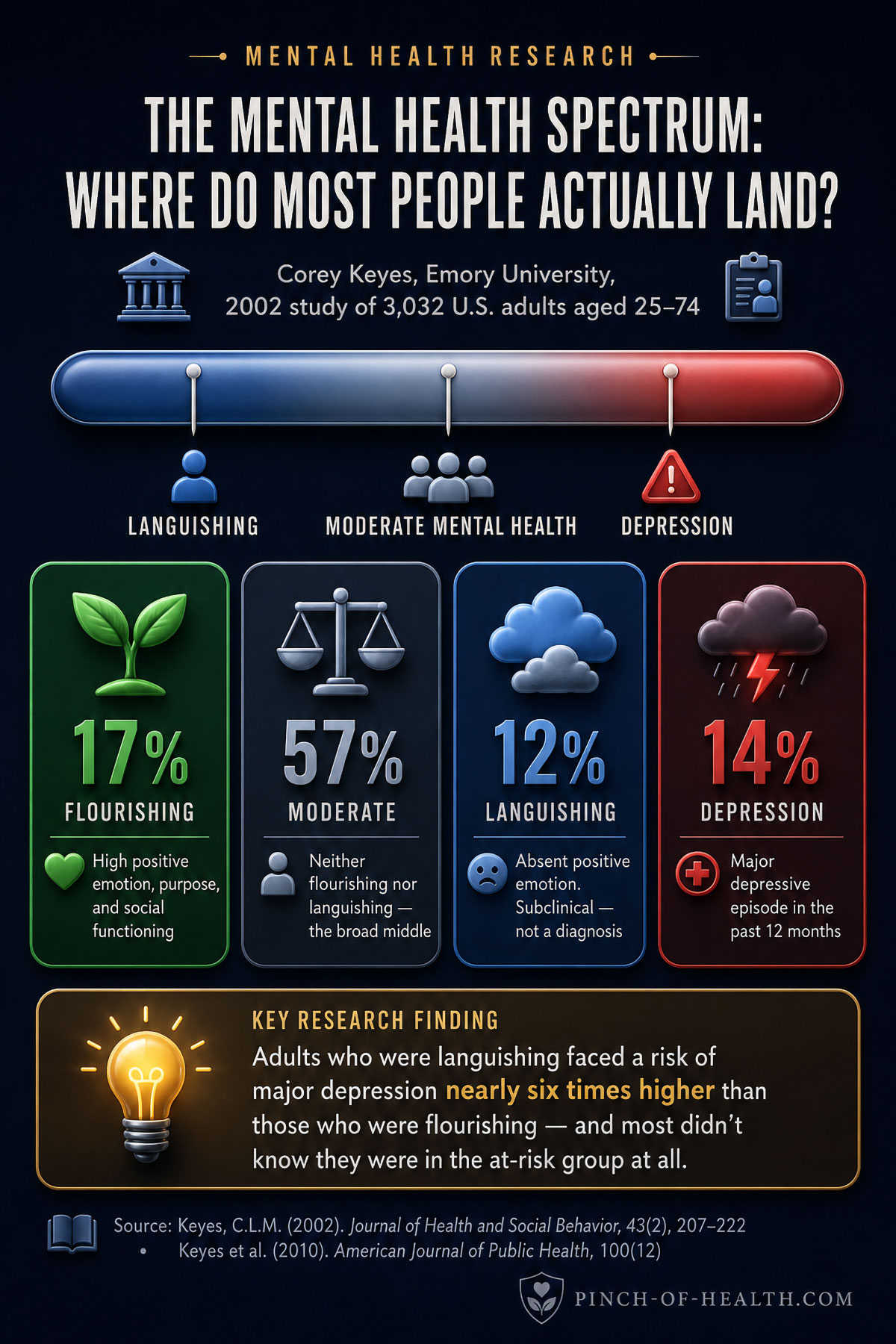
His research, published in the Journal of Health and Social Behavior, introduced a continuum model with three distinct zones. At one end: flourishing, characterized by high positive emotion, purpose, and engagement with life. At the other: the diagnosable territory of depression, anxiety, and other clinical disorders. In the middle: a large population of people who are neither.
Languishing sits at the low end of that middle zone. Keyes defined it as the absence of mental well-being rather than the presence of illness, “devoid of positive emotion toward life” and not functioning well psychologically or socially, without meeting the criteria for any diagnosable disorder.
In his foundational study of 3,032 U.S. adults, 12.1% met the criteria for languishing. That’s roughly 1 in 8. Another 56.6% were in the middle category, not flourishing, not languishing, but not quite right either. Only 17.2% were flourishing.
Why “you’re not depressed” is not reassurance
When people who are languishing finally describe what they’re experiencing to a doctor or therapist, the response they most often receive is: “You don’t have depression.” The subtext being: you’re fine. Go home.
This is where the clinical picture gets uncomfortable.
A 10-year longitudinal study tracking the same adults from 1995 to 2005 found that people who were languishing at the start were significantly more likely to develop a major depressive episode, panic disorder, or generalized anxiety disorder by the end. Among those languishing in 1995, about half had improved a decade later. The other half had not, and some had declined further.
The risk of a major depressive episode was nearly six times higher among adults who were languishing compared to adults who were flourishing. Not six times higher than people with depression. Six times higher than people who were doing well.
Keyes described languishing as an “existential alarm clock”, the body’s signal that something needs attention before the more serious machinery kicks in. The alarm is quiet, which is why most people ignore it.
How languishing differs from depression and burnout
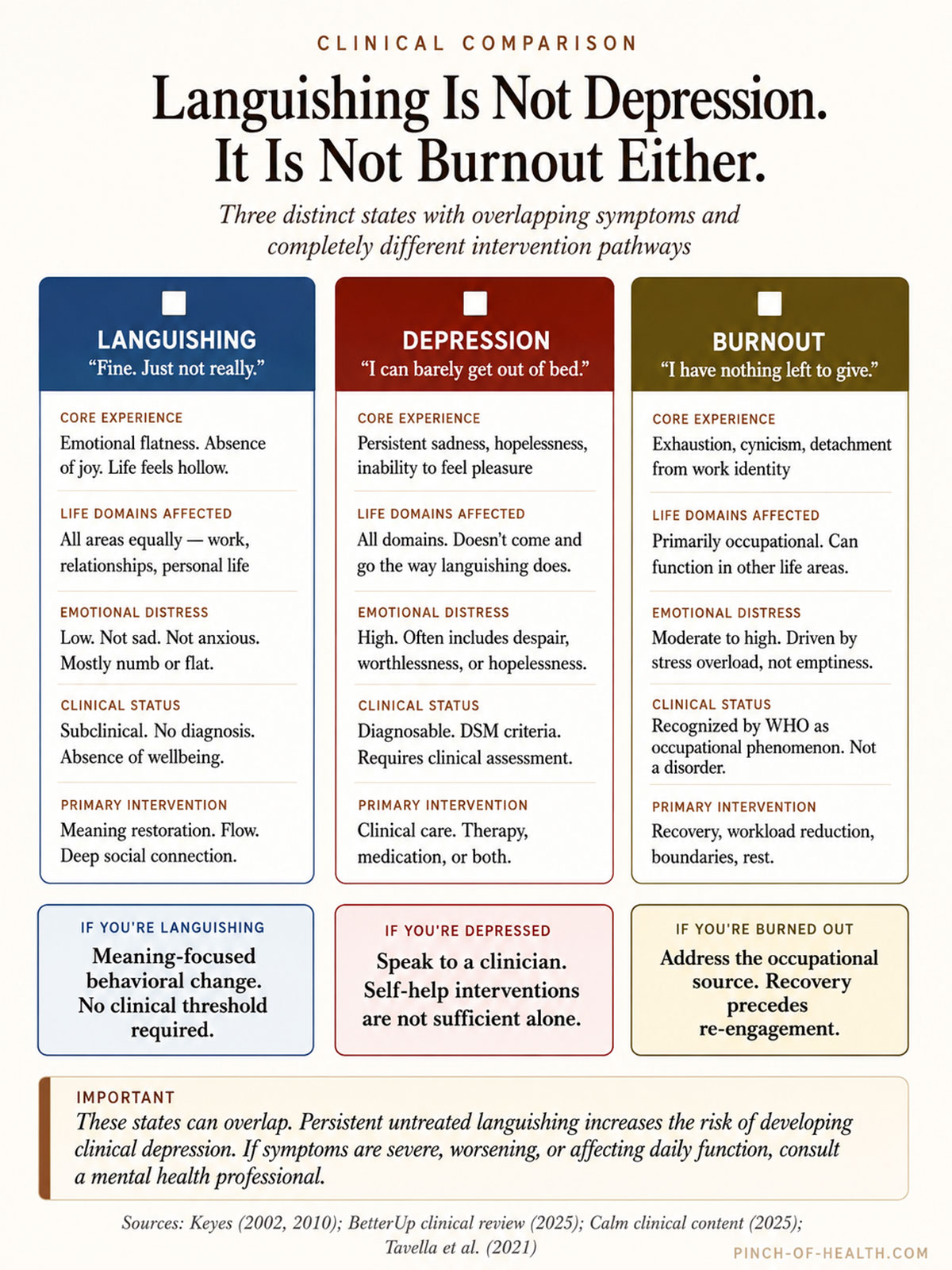
The confusion is understandable. The three states share surface features, low energy, reduced motivation, and a general sense of not being quite yourself. The differences matter because they point to different exits.
Depression is characterized by persistent sadness, hopelessness, and a loss of pleasure across most or all life domains. It typically requires clinical intervention, therapy, medication, or both. It doesn’t come and go in the way that languishing does.
Burnout is domain-specific. It arises from chronic occupational stress and manifests as exhaustion, cynicism, and a reduced sense of professional efficacy. A person can be burned out at work and functioning reasonably well everywhere else. Languishing, by contrast, affects all areas of life simultaneously and doesn’t have an obvious external cause.
Languishing carries no significant emotional distress. The person isn’t in pain the way a depressed person is in pain. They’re flat. Apathetic rather than sad. Going through the motions rather than falling apart.
This is precisely why it goes unaddressed for so long. The absence of distress reads as the absence of a problem.
The specific exits that research supports
The generic wellness prescription, sleep more, exercise, and practice gratitude, is not wrong. It’s just insufficient for someone who has already tried it and found that the needle didn’t move. Languishing has a more specific evidence base.
Flow over stimulation. The intervention that has the strongest alignment with languishing’s core features is flow: the state of deep absorption in a skill-matched activity, first described by psychologist Mihaly Csikszentmihalyi. Flow isn’t relaxation. It’s full engagement, the kind that happens when a task is challenging enough to require your complete attention but not so difficult that it tips into anxiety.
A 2023 meta-analysis confirmed that flow experiences are positively associated with life satisfaction and well-being across cultures. The reason this matters for languishing specifically is that the hallmark of languishing, emotional flatness, disengagement, the sense that nothing quite engages you, is the precise opposite of the flow state. The therapeutic mechanism isn’t distraction. It’s reactivation.
Activities that reliably generate flow vary by person but tend to involve skill-building, clear feedback, and complete absorption: playing a musical instrument, writing, building something physical, cooking at a level of complexity that requires focus. The activity matters less than the cognitive engagement it demands.
The quality of social connection, not the quantity. The 2023 U.S. Surgeon General’s Advisory declared loneliness a public health epidemic, with up to 40% of adults reporting it. A 2024 systematic review in World Psychiatry by Julianne Holt-Lunstad placed social connection alongside diet, sleep, and exercise as a fundamental pillar of health, with evidence linking social isolation to increased mortality risk comparable to that of smoking.
The key finding for languishing specifically isn’t that isolated people languish (though they often do). It’s that the depth of connection matters more than the number of people you see. Someone who is socially busy but experiencing few genuine, reciprocal exchanges is still at risk. The corrective is not adding social activity, it’s identifying where in your existing relationships, the quality of connection has eroded, and addressing that specifically.
Meaning before mood. Keyes’ model distinguishes between emotional well-being, how you feel, and what he calls eudaimonic functioning: whether you have purpose, whether you feel that your life is contributing to something, and whether you have a sense of direction. People can languish with relatively stable emotional states but significant erosion in this second dimension.
The implication is that mood-focused interventions, gratitude journals, positive thinking exercises, and mood tracking target the wrong variable. The more productive questions are around purpose and direction: What activities did you previously find meaningful that you’ve let drop? What roles, relationships, or pursuits gave your day a sense of purpose? Languishing often marks the moment when those anchors have quietly come loose.