Most people think you need intense workouts or brain puzzles to stay sharp. That assumption is wrong. Growing research points to something far simpler.
Walking three times a week — done with intention and the right structure — produces measurable changes in how your brain works. These aren’t vague “feel-better” effects. They’re specific, documented improvements in how you think, decide, and filter out distractions.
This isn’t about staying active for the sake of it. It’s about what actually happens inside your brain when you lace up your shoes three times a week.
Most of this research comes from studies of adults aged 60 and older — the group where cognitive decline is most measurable and walking interventions have been most rigorously tested. But the mechanisms are relevant to anyone thinking ahead about long-term brain health.
Your Brain’s “CEO” — and Why Walking Targets It
When researchers talk about mental acuity, memory gets most of the attention. But memory is just one piece of the picture.
The more important piece? Executive function.
Think of executive function as your brain’s management system. It handles inhibition — your ability to ignore what doesn’t matter. It controls task-switching — moving cleanly from one job to the next. It drives decision-making when pressure is high. These skills determine whether your day runs smoothly or falls apart.
Executive function lives mostly in the prefrontal cortex. It’s also one of the first areas to show wear as we age.
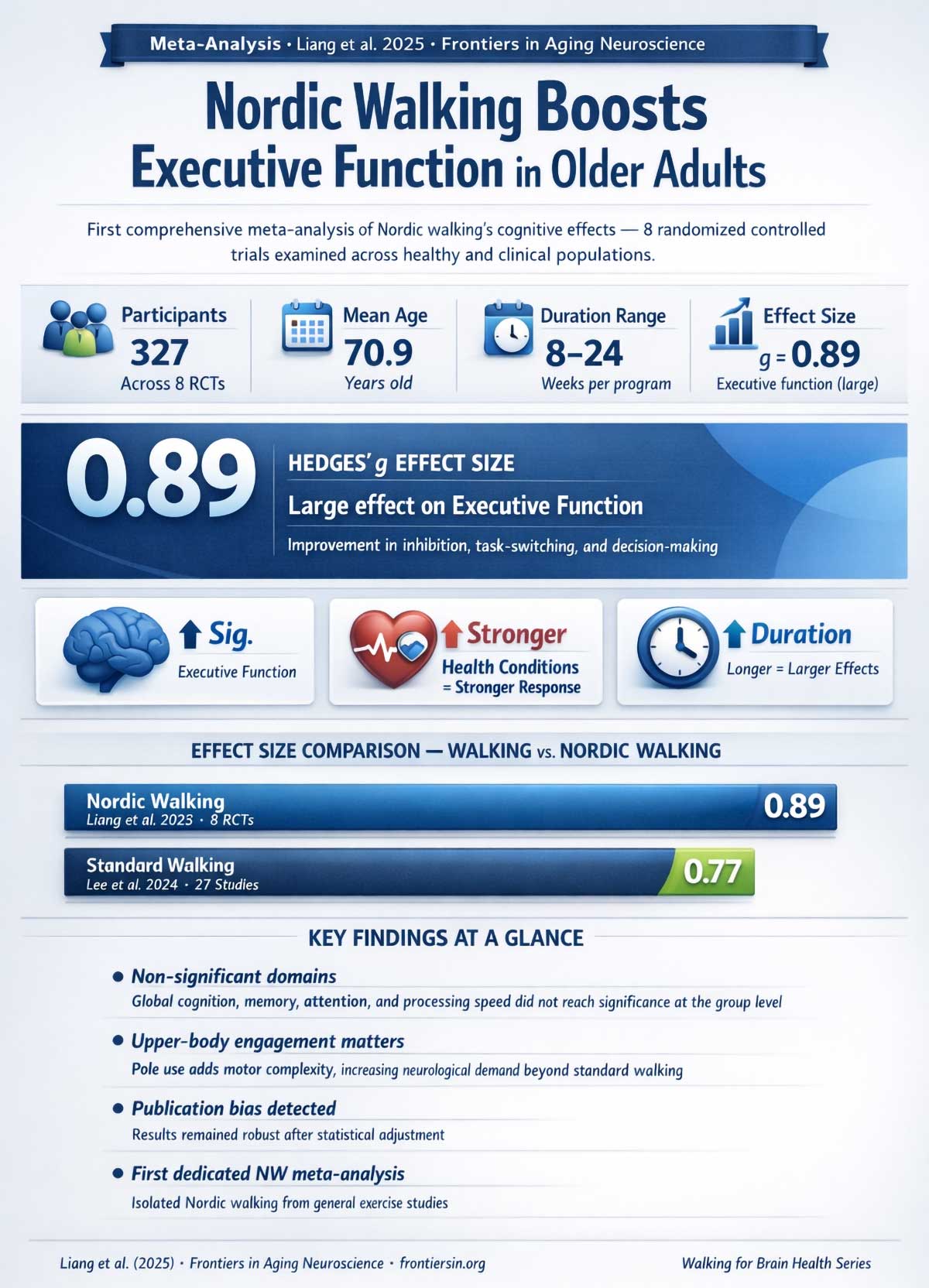
A 2025 meta-analysis by Liang and colleagues examined eight randomized controlled trials involving 327 older adults with a mean age of 70.9 years. Walking-based exercise produced a large effect on executive function, with a standardized effect score of 0.89. That’s meaningful. It means structured walking consistently improves your brain’s ability to manage attention, filter distractions, and switch between tasks.
The gains don’t show up at every intensity level or in every walking format. The structure of the program matters — and that’s what separates this research from generic fitness advice.
One more finding worth flagging early: if you’re managing a health condition like Parkinson’s disease or type 2 diabetes, your brain may respond even more strongly to a structured walking program than someone with no underlying conditions. This isn’t about severity. It’s about how a brain already adapting to a health challenge appears primed to respond further when given the right stimulus. More on this later — but it’s worth holding onto as you read.
Why “Just Go for a Walk” Isn’t Enough
Most health advice says: walk more. It rarely says how to walk, for how long, or at what frequency to actually see brain benefits. That gap is exactly where this research steps in.
A 2024 meta-analysis by Lee and colleagues reviewed 27 studies in older adult populations. Programs using complex or combined exercise formats showed a medium effect on global cognitive scores. But the optimal structure was specific: 10 to 19 weeks in duration, three sessions per week, and 60 minutes per session.
Three times a week. Sixty minutes each time. That’s the framework that produced the clearest, most consistent results.
Not five days a week at 30 minutes. Not a casual stroll when you feel like it. The research points to a structure that’s frequent enough to build neurological change and long enough to generate the aerobic and motor demands your brain actually responds to.
The Nordic Walking Advantage
Here’s where things get more interesting.
Nordic walking — using two poles while you walk — isn’t just a fitness trend. It changes the neurological demand of the activity. When you use poles, you engage your upper body, your coordination, and your spatial awareness all at once. Your brain manages more input with every step.
Torre and colleagues ran an 8-week study in 2024 with healthy older adults averaging 71 years of age. Participants walked three times per week for 75 minutes in a natural park using Nordic poles. Researchers measured multiple cognitive areas: global cognition, executive function, processing speed, and visuospatial ability.
The standout result: 71% of participants improved their visuospatial ability. This is your brain’s capacity to map its physical environment — navigating a parking lot, judging distances, orienting yourself in a new space. These are practical, real-world skills. And they shifted meaningfully in just eight weeks.

It’s also worth being clear about how Nordic walking compares to standard walking. The 2024 Lee meta-analysis reviewed 27 walking studies broadly and found a medium effect on cognitive function. When the 2025 Liang team focused specifically on Nordic walking, the effect on executive function was larger — a score of 0.89 versus 0.772. The gap isn’t enormous, but it’s consistent. This suggests it’s not just the act of walking that matters. The structure of how you walk shapes how strongly your brain responds. Standard walking works. Nordic walking appears to work better, particularly for executive function.
The natural park setting appears to matter, too. Outdoor terrain is unpredictable. Varying light, changing surfaces, and shifting stimuli keep your brain engaged in a way a treadmill simply can’t replicate.
Not Everyone Responds the Same Way — And That’s Okay
One of the more honest findings in the research: not everyone sees the same gains across all cognitive areas. But not responding in one domain doesn’t mean the program did nothing.
In the Torre et al. study, group-level scores for executive function didn’t reach statistical significance overall. But individual results told a different story. Among participants, 28% showed meaningful improvements in inhibition — the ability to block irrelevant input and stay focused on what matters. For visuospatial ability, that figure jumped to 71%.
These aren’t universal responses. But they represent meaningful gains for between one-third and three-quarters of participants, depending on which cognitive skill is being measured. This is a realistic picture — not a guarantee, but strong enough odds to act on.
A group average can flatten individual wins. If your inhibition improves by 28%, your daily experience of focus and distraction resistance changes in ways that don’t show up in a group mean.
Beyond individual variation, duration also plays a role. The Torre study ran for just 8 weeks — and the Liang meta-analysis specifically noted that total intervention length moderated effect sizes. Longer programs consistently produced stronger results. Eight weeks gets you started. More time builds a deeper foundation.
The Durability Factor: Gains That Stick
Here’s something most people don’t expect: the benefits may outlast the program itself.
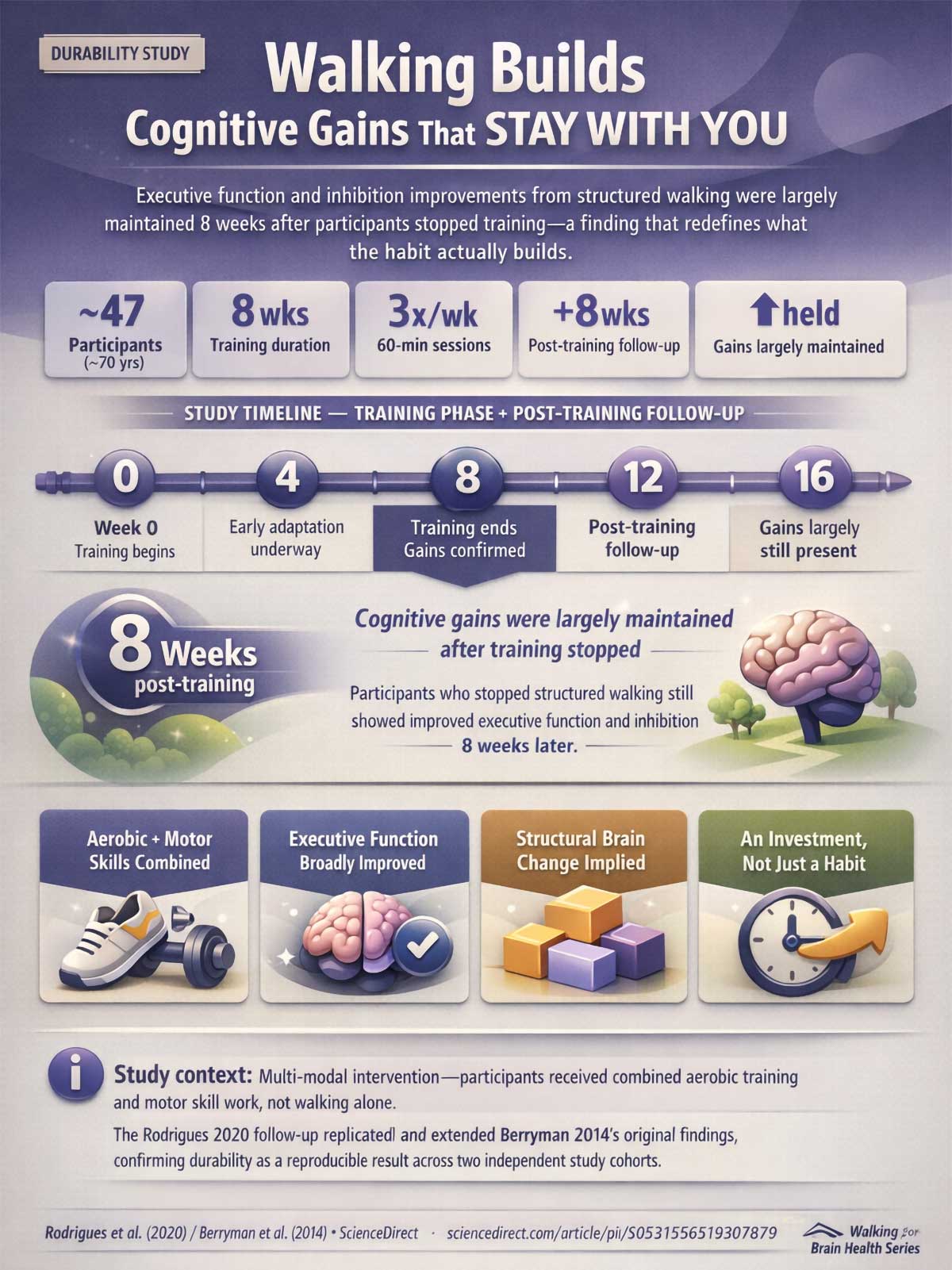
A study by Rodrigues and colleagues — building on foundational work by Berryman from 2014 — found that aerobic and motor-skill-based walking training improved inhibition and executive function in older adults. What stood out was durability. Cognitive gains were largely maintained eight weeks after the training program ended. Participants stopped the structured walking — and their brains held onto what they’d built.
That finding shifts how you think about a walking habit. The right structure doesn’t just produce a temporary lift. In many cases, it builds change that lasts well beyond the last session.
This durability likely has to do with how the brain adapts at a structural level — not just a chemical one. Regular aerobic movement, especially when paired with motor complexity, appears to reinforce neural pathways rather than simply stimulating them temporarily.
The Dual-Task Method: Walking While Thinking
One of the more striking approaches in recent research involves layering a mental task on top of physical movement. Researchers call this a “dual-task” method.
A 2026 pilot trial with older adults averaging 72 years of age tested an 8-week walking program with built-in cognitive demands. Participants walked three times per week while completing mental tasks during the session — navigating routes from memory, completing word challenges, or managing attention tasks while moving.
Results showed significant improvements in both executive function and overall cognitive performance. The dual-task model works because it mirrors how real life actually operates. You’re crossing a busy street while replaying a to-do list while monitoring your footing. Training your brain to handle layered demands isn’t just effective in a lab — it may be one of the most practical things you can do for long-term mental sharpness.
Adding a mental challenge to just one of your three weekly walks may be enough to generate this benefit. It doesn’t need to be elaborate. Here’s what it can look like in practice:
Choose a route you’ve walked before but haven’t fully memorized. Walk it from memory without checking your phone, and notice where you second-guess yourself. Or, at the start of your walk, mentally recite a short list — a grocery run, five upcoming appointments — then check yourself at the end. Or count backward from 100 by sevens while keeping your pace steady. These aren’t complicated interventions. They’re simple cognitive tasks layered on top of aerobic movement, creating exactly the kind of dual demand your brain responds to.
The 8-Week Mark — and Why 19 Weeks Is Better
You don’t need to wait months to notice a difference. But the research draws a clear line between early gains and deeper ones.
At eight weeks, studies begin to show measurable improvements in specific areas — processing speed and visuospatial ability in particular. These are real gains. But the broader research base tells a more precise story: the 10-to-19-week window is where medium-to-large effects on executive function appear most consistently. Eight weeks is the verification checkpoint. It confirms your brain is responding. The 10-to-19-week range is the foundation-building phase — where the gains become reliable and broad.
The Lee et al. meta-analysis made this distinction clearly. Eight weeks shows early promise. Sustained programs through 19 weeks produce more consistent results across more cognitive domains.
It’s not a huge commitment — but it does require staying with the program past the point where early motivation typically fades.
How Walking Actually Changes the Brain
The mechanism behind these results isn’t abstract. It comes down to blood flow and something researchers call cognitive reserve.
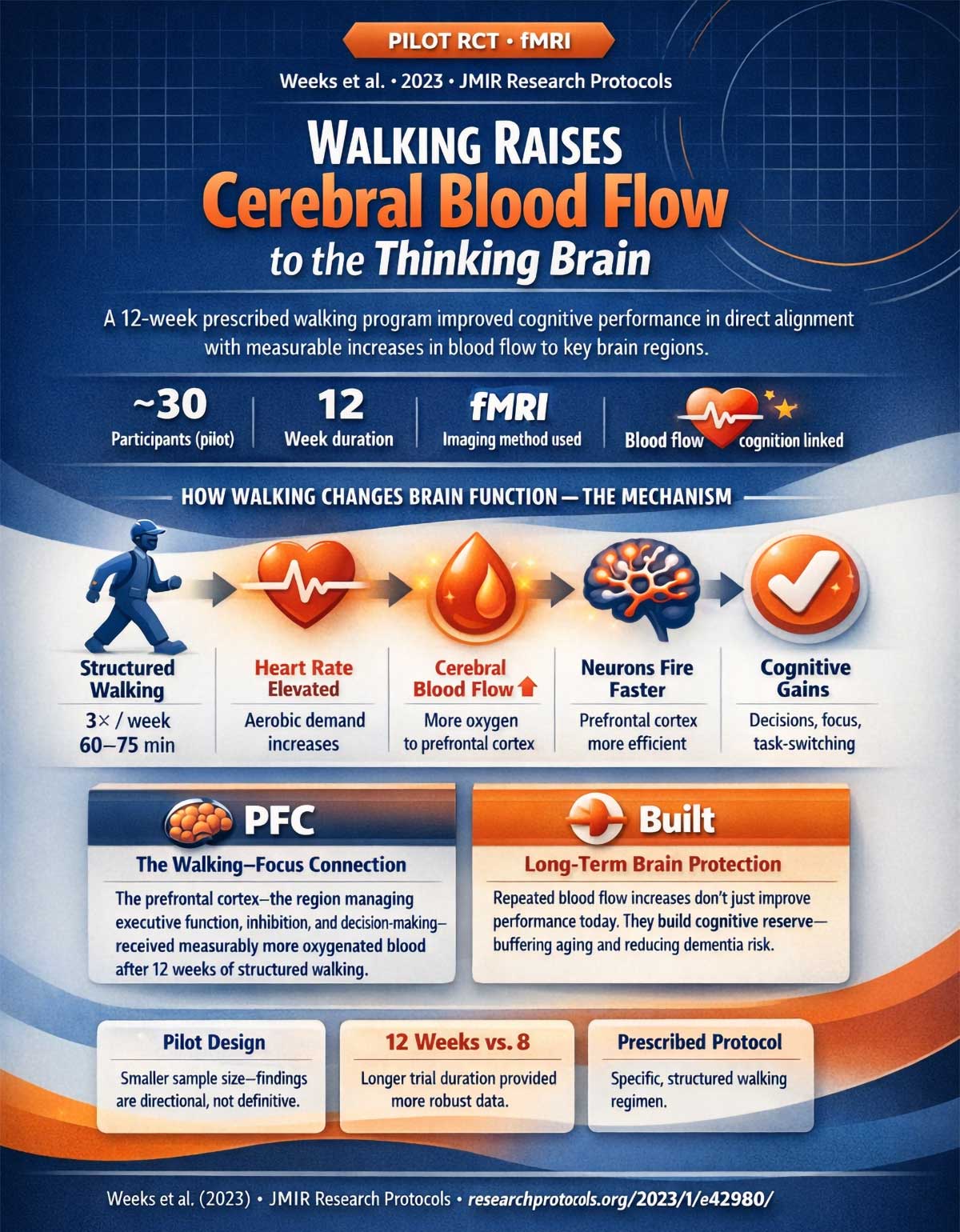
A 2023 pilot randomized controlled trial by Weeks and colleagues measured cerebral blood flow in participants who completed a 12-week walking program. Improvements in cognitive performance aligned directly with increased blood flow to the brain. More oxygen reaching the prefrontal cortex means neurons fire more efficiently — and that’s exactly the region responsible for decision-making and focused attention.
Over time, this consistent oxygenation helps build cognitive reserve: a kind of neurological buffer that may slow the effects of aging on the brain. Specifically, the prefrontal cortex — the region managing executive function — becomes more efficient. Better blood flow means faster neural firing. That translates directly to quicker decisions, better distraction filtering, and smoother task-switching in your daily life. The mechanism and the benefit connect in one clear line.
A 2025 review by Li and colleagues, published in Frontiers in Aging Neuroscience, found that walking-based exercise improves executive function and memory consistently across older adult populations — including those managing health conditions. The finding about Parkinson’s disease and type 2 diabetes deserves its own focus here.
Adults managing these conditions showed stronger cognitive responses to structured walking programs than their healthy peers. This is counterintuitive. We tend to assume healthier people benefit more from exercise. But this research suggests the opposite may be true for brain outcomes. A brain already adapting to a health challenge appears more ready to respond to new, structured input. The neurological adaptation that disease demands may actually prime the brain for further change when the right stimulus is applied consistently.
If you’re managing a chronic health condition, this isn’t a reason to approach exercise with more caution. It may be the most compelling reason to approach it with more intention.
Your 3-Day Mental Acuity Protocol
The research converges on a clear, repeatable structure. Here’s what it looks like applied to real life.
Frequency: Three fixed days per week. Consistency matters more than perfect timing. Pick days you can protect and schedule them like appointments.
Duration: 60 to 75 minutes per session. This range appears in nearly every study showing meaningful cognitive benefits.
Session structure:
- Two sessions per week: Brisk walking outdoors on varied terrain — a park, a trail, or any route with changing surfaces.
- One session per week: Add Nordic poles or incorporate a dual-task challenge. A navigation task from memory, a mental math sequence, or a word-recall exercise performed during the walk qualifies.
Timeline: Target eight weeks as your verification checkpoint — you should notice early shifts in processing speed and visuospatial ability. Then commit through the 10-to-19-week range where executive function gains become consistent and broad.
What to watch for: Changes in how you handle distractions, switch between tasks, and make quick decisions in daily life. These are the practical markers of improved executive function — and they matter more than lab scores.
Conclusion
Walking three times a week is no longer just “light exercise.” The research treats it as a structured neurological tool.
It improves executive function — your capacity to focus, decide, and filter out noise. It builds visuospatial skill, processing speed, and inhibition. It increases blood flow to key areas of the brain. And in many cases, those gains hold even after the program ends.
The key is structure. Three sessions. Sixty minutes each. Eight weeks at minimum. Add poles or cognitive tasks where you can. Walk outside when possible.
Your brain responds to the right input. This is the right input.