If exercise suddenly feels less rewarding than it did a decade ago, you may be experiencing a little-known phenomenon that most women are never warned about.
The stairs got harder first. Then the jars. Then, one day, you looked at your arms and noticed something had quietly changed, not dramatically, not overnight, but enough. You’re still exercising. You’re eating reasonably well. And yet the muscle you’ve relied on for decades is slipping away in ways that feel completely disconnected from how hard you’re trying.
That gap between effort and result is not a failure of discipline. It’s a failure of information. Something specific is happening inside your muscle tissue during the menopausal transition, a biological shift that almost nobody talks about, that most doctors don’t mention, and that changes everything about how your body responds to exercise and protein.
Understanding it won’t fix the problem on its own. But it will explain why the approach that worked for you at 38 is producing different results at 48, and what a more effective approach actually looks like.
This Isn’t Just Aging, the Timing Matters
Muscle loss is typically framed as something that happens in your 60s and 70s, the slow attrition of old age. That framing is wrong, and it’s costing women years of preventable decline.
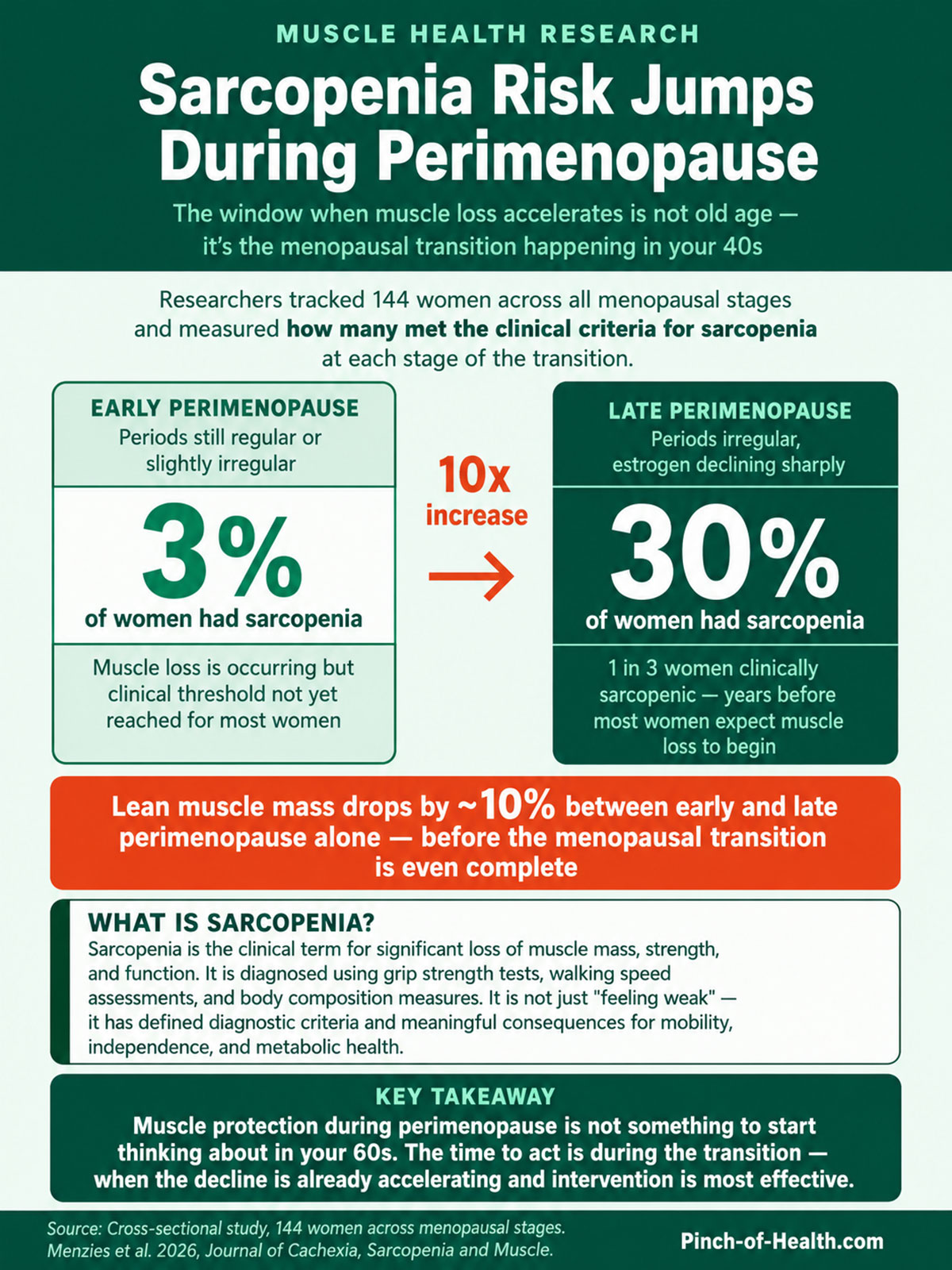
A cross-sectional study of 144 women at various stages of the menopausal transition found that lean muscle mass dropped by roughly 10% between early and late perimenopause alone. More striking was what happened to sarcopenia rates, sarcopenia being the clinical term for significant muscle loss that affects strength and function. In early perimenopause, about 3% of women met the criteria. By late perimenopause, that figure had climbed to 30%. That shift happens during the transition, not decades later.
A 2026 review published in the Journal of Cachexia, Sarcopenia and Muscle that analyzed data across multiple longitudinal studies found perimenopausal women had roughly 2.5% less lean mass than premenopausal women, while postmenopausal women showed a 5.7% reduction. These aren’t numbers that emerge in a clinic at 70. They accumulate through your 40s and early 50s, quietly, while you’re still getting on with life.
The reason isn’t simply that women age. Men age too, and their muscle loss follows a different curve. The menopausal transition introduces a hormonal change that acts directly on muscle tissue in a way that nothing else in female physiology quite replicates.
What Estrogen Was Actually Doing
Most of the conversation about estrogen and menopause centers on hot flashes, bone density, and cardiovascular risk. The muscle story rarely gets told, which is strange, given how fundamental it turns out to be.
Skeletal muscle repairs and rebuilds through a population of stem cells called satellite cells. Think of them as the maintenance crew living inside your muscle fibers. When you exercise and create small amounts of muscle damage, which is how training works, satellite cells activate, multiply, and rebuild the tissue slightly stronger than it was before. This process is how muscle grows and how it recovers from use.
In 2019, researchers at the University of Minnesota, led by Dr. Dawn Lowe, published findings in Cell Reports that were the first to establish estrogen as essential to satellite cell health. When they removed estrogen supply in mice (by removing the ovaries) or disabled the estrogen receptor in muscle stem cells, satellite cell populations dropped 30 to 60% across five different muscle groups. The surviving cells struggled to reproduce and generate new muscle after injury.
The finding held in humans too. As part of the same research, Finnish scientists performed muscle biopsies on women shortly before and after the menopausal transition. Satellite cell counts correlated strongly with serum estradiol levels. As estrogen fell, the maintenance crew thinned out.
It doesn’t quite make sense until you picture what this means in practice: every workout you do creates a repair demand, and after menopause, the crew available to meet that demand is a fraction of what it was. The muscle can still recover. It just does so more slowly, less completely, and with less capacity to build new tissue in the process.
Why Your Workouts Feel Less Effective
Here is the part that frustrates most women most: resistance training still works after menopause. The evidence for that is consistent and clear. But the amount of training that produces a given result changes significantly, and nobody recalibrates women’s expectations to account for it.
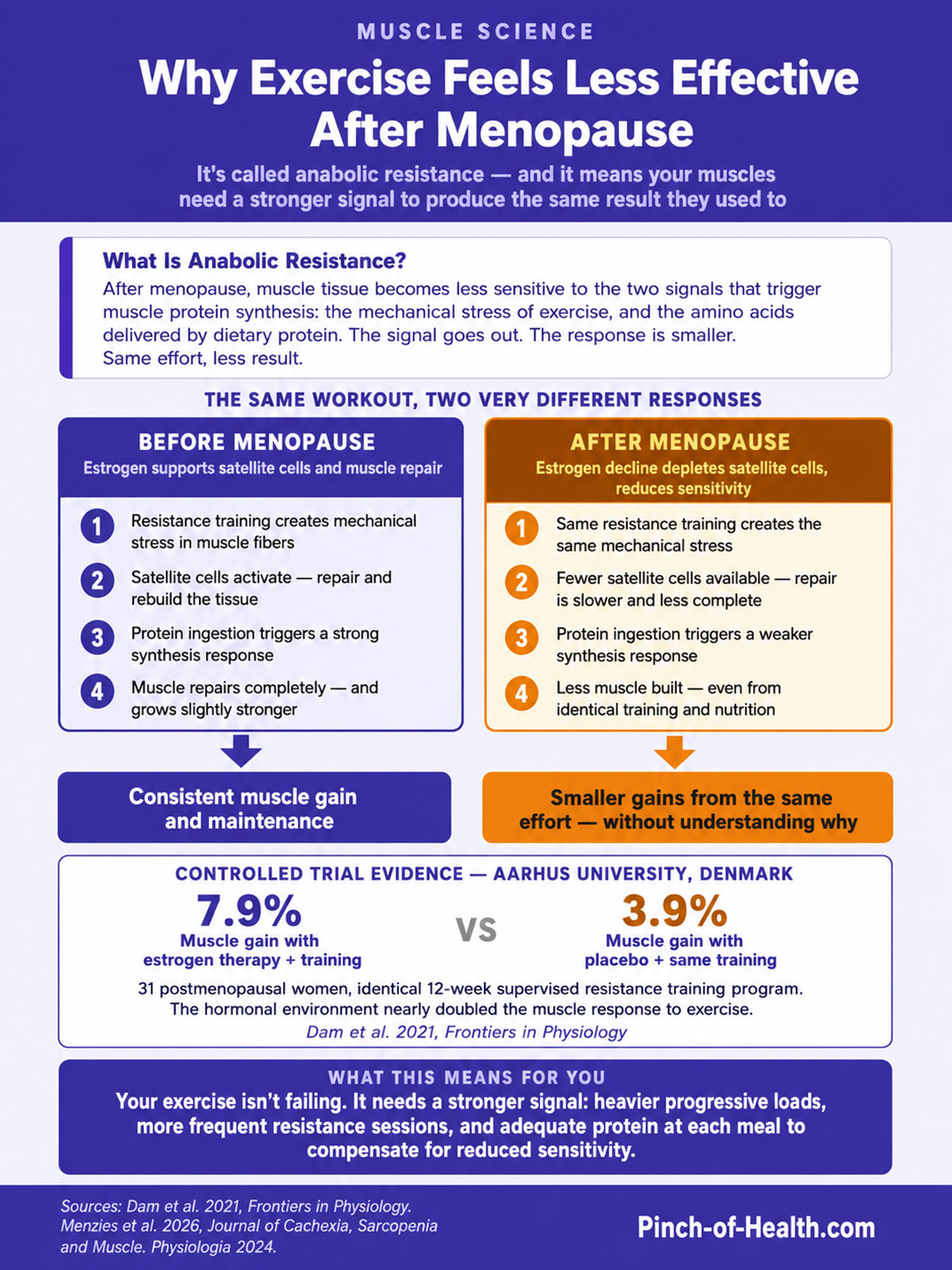
The concept researchers use is anabolic resistance. After menopause, muscle tissue becomes less sensitive to the two main signals that trigger muscle protein synthesis: the mechanical stress of exercise and the amino acids delivered by dietary protein.
The signal goes out, but the response is blunted. In practical terms, this means the same workout that produced visible progress at 40 may produce noticeably less at 52, not because you’re doing anything wrong, but because the biological amplifier that used to boost the training signal has weakened.
A 2024 narrative review in Physiologia ties this directly to estrogen decline: lower estrogen drives both chronic low-grade inflammation and reduced insulin sensitivity in muscle tissue, both of which dampen the anabolic response. The muscle is still capable of growth. It just needs a louder signal to hear the instruction.
A controlled trial published in Frontiers in Physiology by researchers at Aarhus University in Denmark makes this concrete. Thirty-one postmenopausal women completed 12 weeks of identical supervised resistance training. Half received transdermal estrogen therapy, half received a placebo. Both groups got stronger. But the estrogen group achieved a 7.9% increase in quadriceps cross-sectional area, compared to 3.9% in the placebo group, essentially double the muscle gain from the same training volume.
That is not an argument for or against hormone therapy. It is a demonstration of how much the hormonal environment shapes the response to exercise. The muscle’s capacity to adapt didn’t disappear. It was operating at reduced efficiency.
The Protein Gap Nobody Mentions
There is a compounding problem layered on top of anabolic resistance that makes muscle loss during menopause harder to address than most people realize.
At the same time that postmenopausal muscles need more dietary protein per gram consumed (because each gram triggers a weaker synthesis response), research suggests women actually eat less protein after menopause, not more.
A 2024 survey of resistance-trained women across menopausal stages found postmenopausal women were consuming significantly less protein relative to body weight than premenopausal women, 0.81 g/kg/day versus 1.47 g/kg/day. The gap was specific to protein. No other macronutrient showed the same divergence.
The reasons are practical and behavioral, reduced appetite, less social eating, and calorie-conscious habits carried over from decades of weight management. But the effect is that many women arrive at the stage of life when their muscles are most resistant to protein’s building signal while consuming the least amount of protein they have since early adulthood.
Researchers studying this population generally recommend aiming for 1.2 to 1.6 grams of protein per kilogram of body weight daily, well above the standard dietary guideline of 0.8 g/kg, which was designed for a general adult population and does not account for postmenopausal anabolic resistance.
A large cross-sectional analysis of 5,652 postmenopausal women from Korea’s national health survey, published in Maturitas, found that women who hit at least 1.0 to 1.2 g/kg daily and did resistance exercise at least twice a week had meaningfully stronger grip strength and lower rates of muscle weakness than those who did neither. The combination mattered more than either factor alone.
>Menopause Protein Calculator
Find out how much protein your muscles actually need during and after the menopausal transition
After menopause, muscles develop "anabolic resistance" — they need more dietary protein to produce the same muscle-building response. This calculator gives you a personalised daily target and a per-meal breakdown based on current research for postmenopausal women.
This calculator provides general guidance based on published research for postmenopausal women. Protein needs vary by activity level, health status, and individual factors. Always consult your doctor or a registered dietitian for personalised recommendations.
What an Effective Protocol Actually Looks Like
The research points toward a set of adjustments that, taken together, address the changed biology rather than fighting against it with a pre-menopause playbook.
Resistance training, at least twice a week. Not general exercise, not cardio, not stretching. Resistance training means asking your muscles to work against meaningful load, whether that is weights, bands, or bodyweight exercises that genuinely challenge you by the end of each set. The KNHANES data found that twice weekly was the threshold where the protective effects on grip strength and muscle weakness became consistent. More is not necessarily better for this purpose, but less is consistently less effective.
One important recalibration: the definition of “challenging” needs to be updated. A weight that felt hard at 38 may no longer be hard enough to produce a sufficient training signal in the context of anabolic resistance. Progressive challenge, gradually increasing resistance as your capacity grows, matters more after menopause, not less.
Protein with every main meal. Rather than thinking about daily totals in the abstract, distributing protein across meals appears to be more effective at triggering muscle protein synthesis than consuming the same total in one or two large servings. Aim for 25 to 40 grams per meal from quality sources: eggs, fish, poultry, Greek yogurt, legumes, tofu. The specific source matters less than consistency and adequacy of amount.
Consistency over intensity. A 12-week RCT by Ioannidou and colleagues, published in 2024, found that postmenopausal women who combined free-weight resistance training with higher protein intake improved skeletal muscle mass and strength more than those doing training alone or protein alone, but the effect required sustained consistency, not heroic effort in individual sessions. Three training sessions per week for 12 weeks, combined with attention to protein intake, produced measurable changes in body composition and strength capacity.
None of this requires a gym membership, a personal trainer, or significant time. The 15-minute bodyweight routines and band-based protocols that fit into ordinary daily life can meet the threshold, provided they are genuinely progressive and genuinely challenging.
A Note on Hormone Therapy
The Aarhus trial is worth returning to briefly, not to recommend hormone therapy but to give it fair context. A 2025 systematic review of available evidence on hormone replacement therapy and sarcopenia found no consistent benefit when applying modern diagnostic criteria for sarcopenia, a more rigorous standard than older studies used. The authors noted significant methodological variation across studies and older drug formulations that complicate comparison.
The honest answer is that nobody has fully resolved this question yet. What the evidence does support is that the hormonal environment shapes the muscle’s response to training, that estrogen plays a direct role in satellite cell survival and function, and that women in perimenopause or recently postmenopausal who are considering hormone therapy have a legitimate, evidence-grounded question to raise with their doctor about what that might mean for their muscle health, not just their bone density or cardiovascular risk.
It is one conversation worth having, among several.
The Muscle You Have Now Is Still Worth Fighting For
In 2024, a group of researchers published a paper in Climacteric, the journal of the International Menopause Society, coining the term “musculoskeletal syndrome of menopause” to describe the cluster of changes, muscle loss, joint pain, bone loss, connective tissue changes, that share a common hormonal root. More than 70% of women in the menopausal transition experience musculoskeletal symptoms of some kind. Twenty-five percent are significantly disabled by them.
That framing matters because it recontextualizes what has often been treated as individual variation or personal resilience as a recognizable, named, addressable clinical phenomenon. The reader who noticed her arms changing, who found the stairs harder, who is doing the right things and wondering why they’re not working the same way, she is not imagining it. She is experiencing something specific and well-documented, with specific and well-documented responses available to her.
The biology is real. The recalibration is straightforward. And muscle, unlike some of what menopause takes, responds.