It’s a tiny change that takes seconds, costs nothing, and doesn’t mean giving up eggs. Yet over a year, the calorie difference can be surprisingly large.
The egg is almost the least interesting variable. Type “how many calories in a fried egg” into any calorie tracker, and you will get a number (usually between 70 and 90) that assumes the pan was dry. For most people, making an actual breakfast, that number is where the counting begins, not where it ends.
A large egg cracked into a dry non-stick pan contributes 77 to 90 calories, depending on the source. A tablespoon of butter alongside it adds more than 100 calories on its own. A teaspoon of olive oil adds 40 to 60. Cooking spray adds fewer than 5. The fat in the pan determines whether a fried egg is a 75-calorie meal or a 190-calorie one, and most apps log it as the former by default.
That gap matters more than it appears in any single meal. Across a year of daily breakfasts, the difference between a spray-fried egg and a butter-fried one is a real energy gap. The egg is just the beginning of the calculation.
Fried Egg Calories: Complete Breakdown by Size and Cooking Method
The USDA puts a large whole egg, cooked without added fat, at 77 calories. Other databases report 90 calories for the same egg, which includes a small amount of fat that transfers from the pan surface during cooking. Neither figure is wrong. Both use USDA FoodData Central values as their foundation.
What separates those sources from each other (and from what most people are actually eating) is the cooking fat. The baseline numbers below assume no added fat. Every real-world preparation starts here and adds from there.
Calories by Egg Size
Size makes a meaningful difference. A jumbo egg without added fat contains roughly 67% more calories than a small one. For people who habitually cook with the largest eggs they can find, the size contribution is already significant before any fat enters the picture.
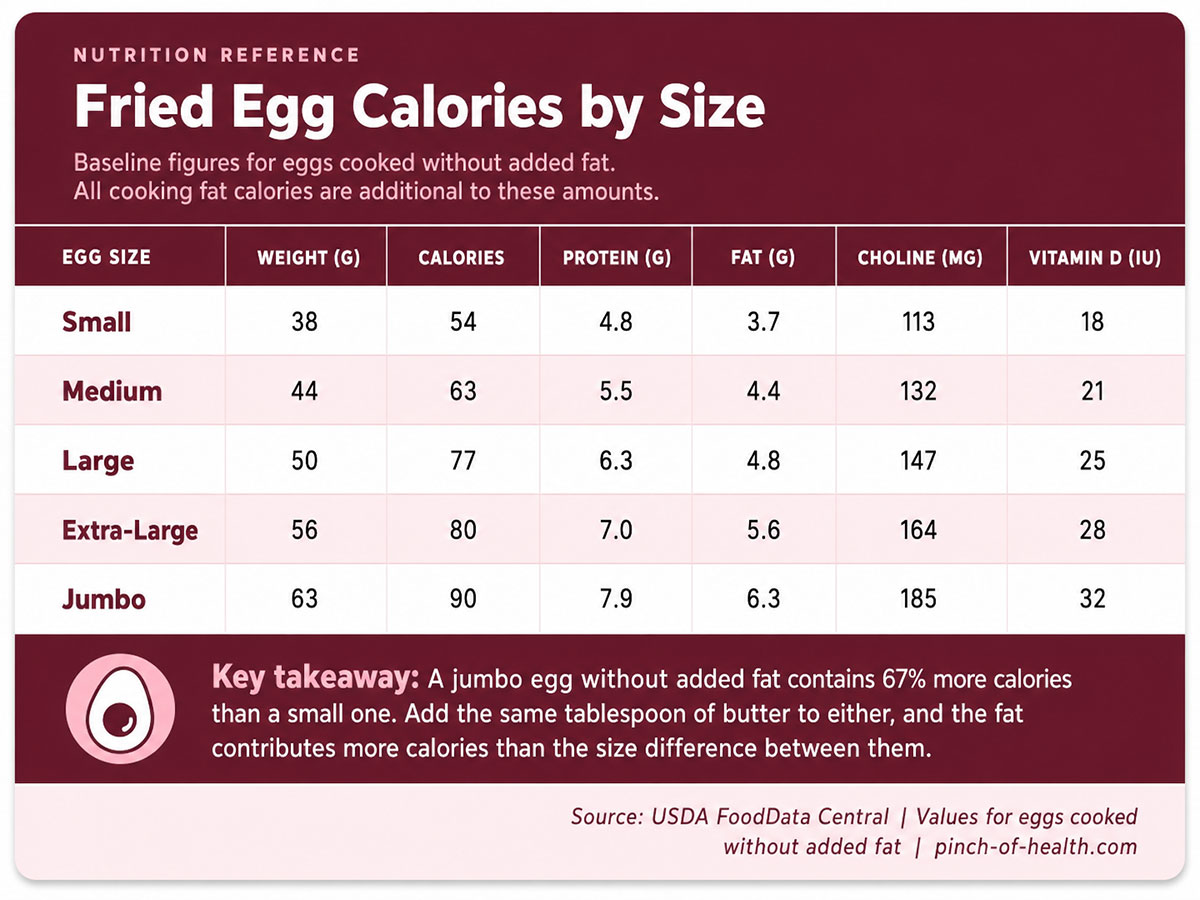
These figures are for eggs cooked without added fat, per USDA FoodData Central. Choline and vitamin D values come from the same source. Both nutrients are concentrated in the yolk, which means they scale with egg size in the same way calories do.
How Many Calories Are in 2 Fried Eggs
Two large fried eggs cooked without added fat amount to approximately 154 to 180 calories with about 12.6 grams of protein. That shifts considerably depending on what is in the pan.
Cooking spray keeps two large eggs under 175 calories. A tablespoon of butter pushes that toward 280. The spread between those two numbers (about 100 calories) is invisible in most calorie apps, which log a fried egg at roughly the same figure regardless of what was in the pan.
How Cooking Fat Changes the Total
This is the variable most calorie apps undercount. The fat added to the pan often contributes more calories than the egg itself:
- Large egg, no added fat (dry non-stick pan): 77 to 90 calories
- Large egg fried with cooking spray: approximately 85 to 92 calories
- Large egg fried in 1 teaspoon of olive oil: approximately 110 to 120 calories
- Large egg fried in 1 tablespoon of butter: approximately 170 to 190 calories
Most people use between half a teaspoon and a tablespoon of fat when frying an egg at home. That range accounts for 20 to 100 additional calories per egg, depending on the fat type and amount used.
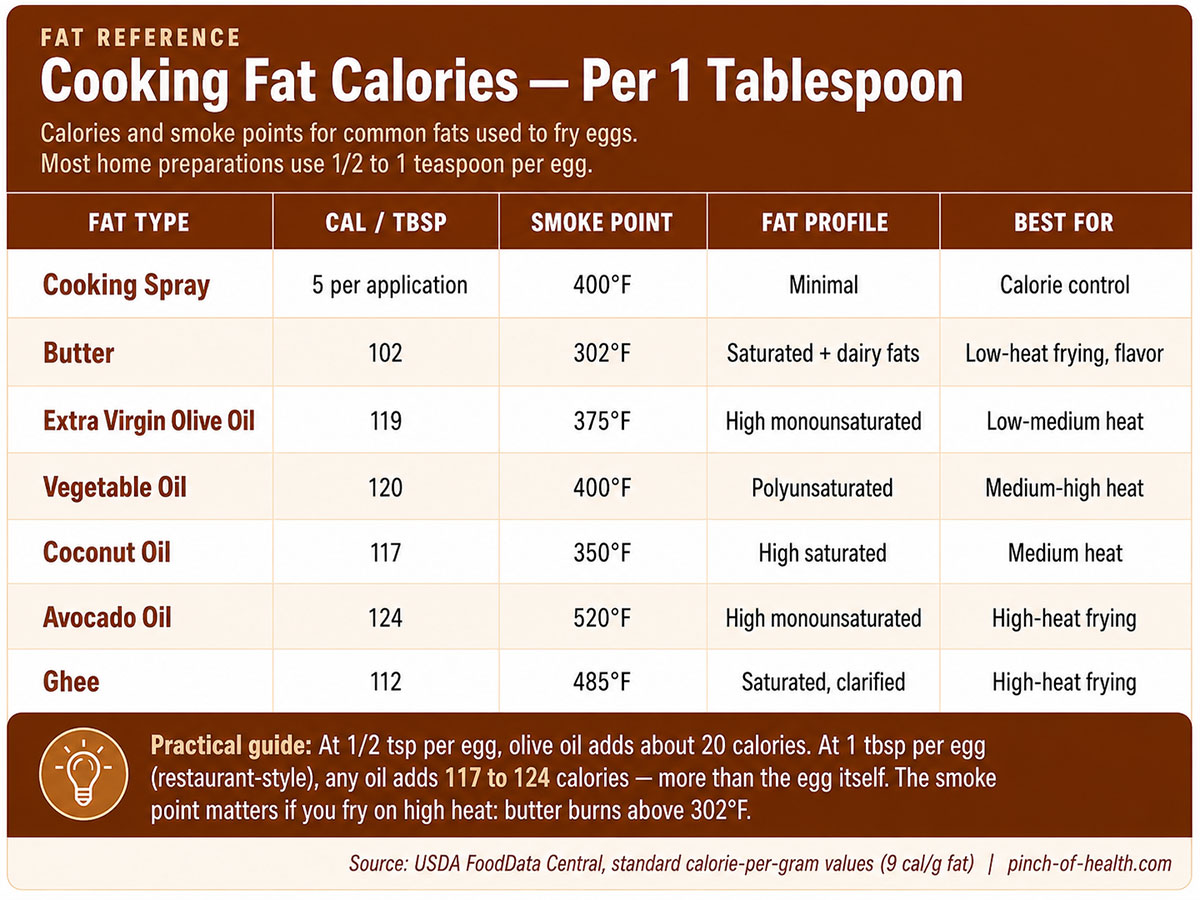
Olive oil and avocado oil sit within a few calories of each other per tablespoon. The real difference between them is thermal: avocado oil handles high heat without degrading, while extra virgin olive oil performs better at lower temperatures. Butter costs fewer calories than most poured oils but burns at a lower temperature than all of them, which is why eggs fried in butter need a medium heat.
Calculate Your Exact Combination
The ranges above cover the most common preparations. For a precise figure based on your specific egg size, cooking fat, and quantity, the calculator below gives a more accurate answer.
Fried Egg Calorie Calculator
Select your egg size, cooking fat, and quantity for an exact count
The Full Nutritional Picture
Calories are the most searched number, but they represent a small part of what a fried egg contributes. A large egg fried in half a tablespoon of olive oil provides approximately 130 calories alongside 6.3 grams of complete protein, 147 milligrams of choline, and 41 IU of vitamin D. Each of those nutrients is genuinely difficult to source in comparable quantities from other common breakfast foods.
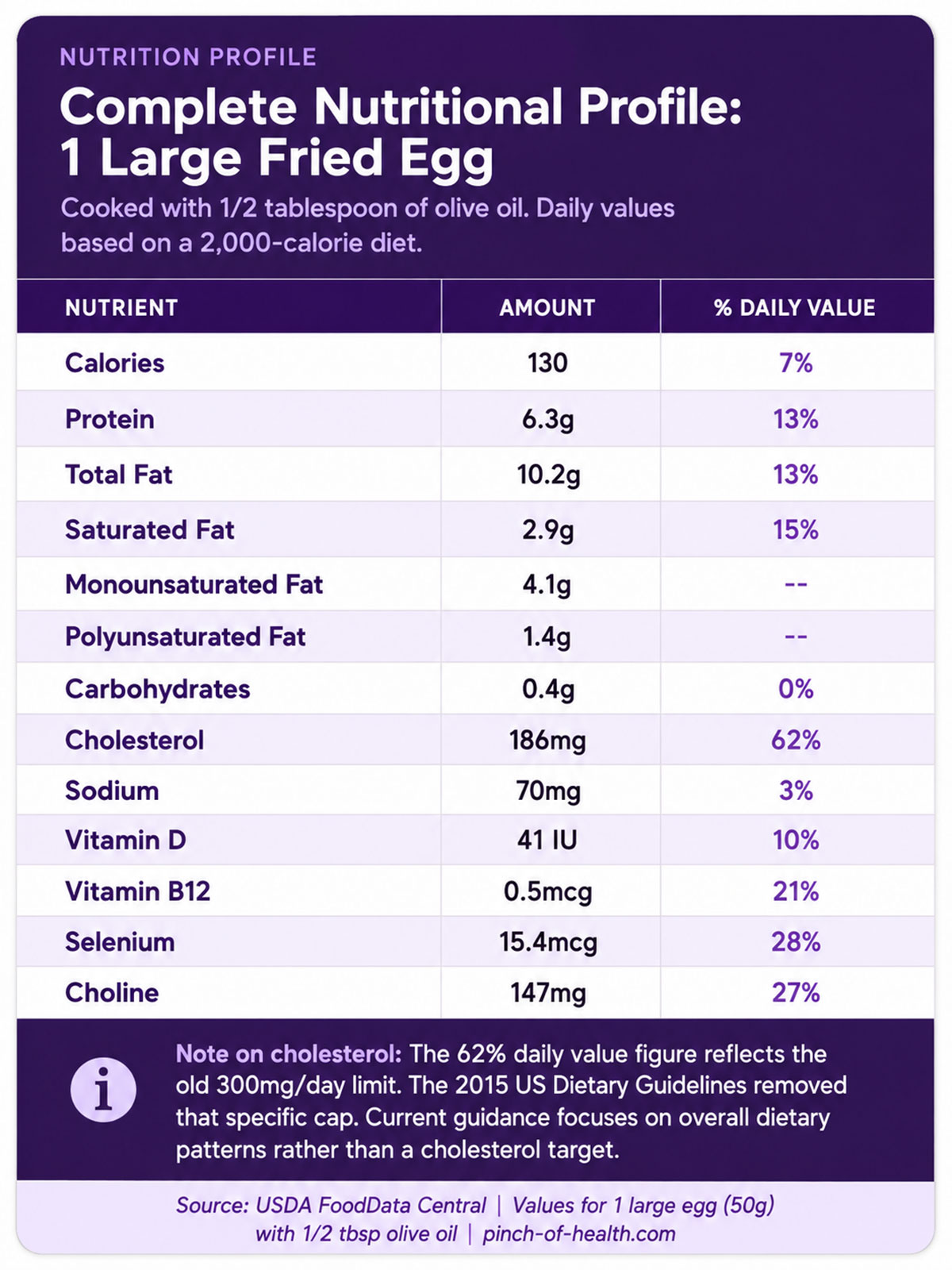
The choline figure is worth thinking about. The adequate daily intake is 425 mg for women and 550 mg for men, according to the Institute of Medicine. Most adults fall short of that target, and eggs are one of the few everyday foods that contribute meaningfully toward it. A single large egg provides about 27% of the target for men. Two eggs get most people most of the way there.
Selenium and vitamin B12 are also present in quantities that matter. Selenium at 15.4 mcg covers roughly 28% of the recommended daily intake. B12 at 0.5 mcg covers about 21%. Both are nutrients more reliably found in animal foods than in plant foods.
Are Fried Eggs Healthy? What the Current Research Shows
For roughly five decades, dietary cholesterol was treated as a direct contributor to cardiovascular disease, and eggs, with approximately 186 mg of cholesterol per large yolk, were caught in the middle of that concern. The current scientific picture has shifted, though not in the simple direction that most nutrition headlines suggest.
In 2015, the US Dietary Guidelines Advisory Committee removed dietary cholesterol from the list of nutrients requiring a specific intake cap, citing insufficient evidence for the 300 mg/day limit that had been in place since 1968.
A 2019 science advisory from the American Heart Association, published in Circulation, concluded that guidance for cardiovascular health should focus on overall dietary patterns rather than specific cholesterol targets, and noted that healthy adults can include one whole egg per day within a heart-healthy dietary pattern.
The evidence base is now large enough to say something with reasonable confidence. A 2022 systematic review in Frontiers in Nutrition drew on 55 prospective cohort studies and more than 2.7 million people. The cardiovascular mortality finding across that dataset was null.
A separate meta-analysis in Circulation the same year confirmed it. Both studies did find a modest association with all-cause mortality at higher consumption levels, worth acknowledging, but not the same thing as heart disease risk. That distinction matters.
The honest summary: egg consumption at moderate levels (one or two per day) does not appear to raise cardiovascular mortality risk for most healthy adults. The picture is more conditional for people with existing heart disease or type 2 diabetes, who should discuss egg intake with their physician.
What is less contested is the nutrient profile. A 2025 systematic review in Nutritional Neuroscience found that daily choline intake from egg consumption in the range of 187 to 399 mg (roughly one to two eggs) was associated with better cognitive function across multiple studies.
A 2024 analysis from the Rush Memory and Aging Project found that consuming more than one egg per week was associated with a 47% lower risk of Alzheimer’s dementia diagnosis over a mean follow-up of 6.7 years. Observational studies of this kind cannot establish causation. The consistency of the finding across different research designs is still worth noting.
Health Benefits of a Fried Egg
Two nutrients stand out. Choline is scarce in the modern diet (most adults fall short of the adequate intake), and eggs are one of the few common foods that contribute meaningfully toward it. Vitamin D is rarer still: outside fatty fish and fortified foods, there are almost no convenient dietary sources, and a single egg covers roughly 10% of the daily target.
- Complete protein: A large egg contains all nine essential amino acids, with approximately 6.3 grams of protein per egg.
- Lutein and zeaxanthin: Two carotenoids concentrated in the yolk that accumulate in retinal tissue and support long-term eye health.
- Selenium: An antioxidant mineral at roughly 28% of the recommended daily intake per egg.
Frying Without Undermining the Nutritional Profile
- Use olive oil or avocado oil rather than butter or processed vegetable oils. Both offer favorable fatty acid profiles alongside the cooking fat calories they add.
- Cook on medium heat. High heat oxidizes the fats in the yolk, the same fats that contribute most of the egg’s nutritional value.
- Avoid overcooking the yolk. Most of the fat-soluble vitamins and lutein are in the yolk. A firm, rubbery yolk still contains them, but lighter cooking preserves more.
- Add vegetables to the pan for the last minute of cooking. Bell pepper, spinach, or tomato add volume and micronutrients for minimal additional calories.
How Fried Egg Calories Compare to Other Egg Preparations
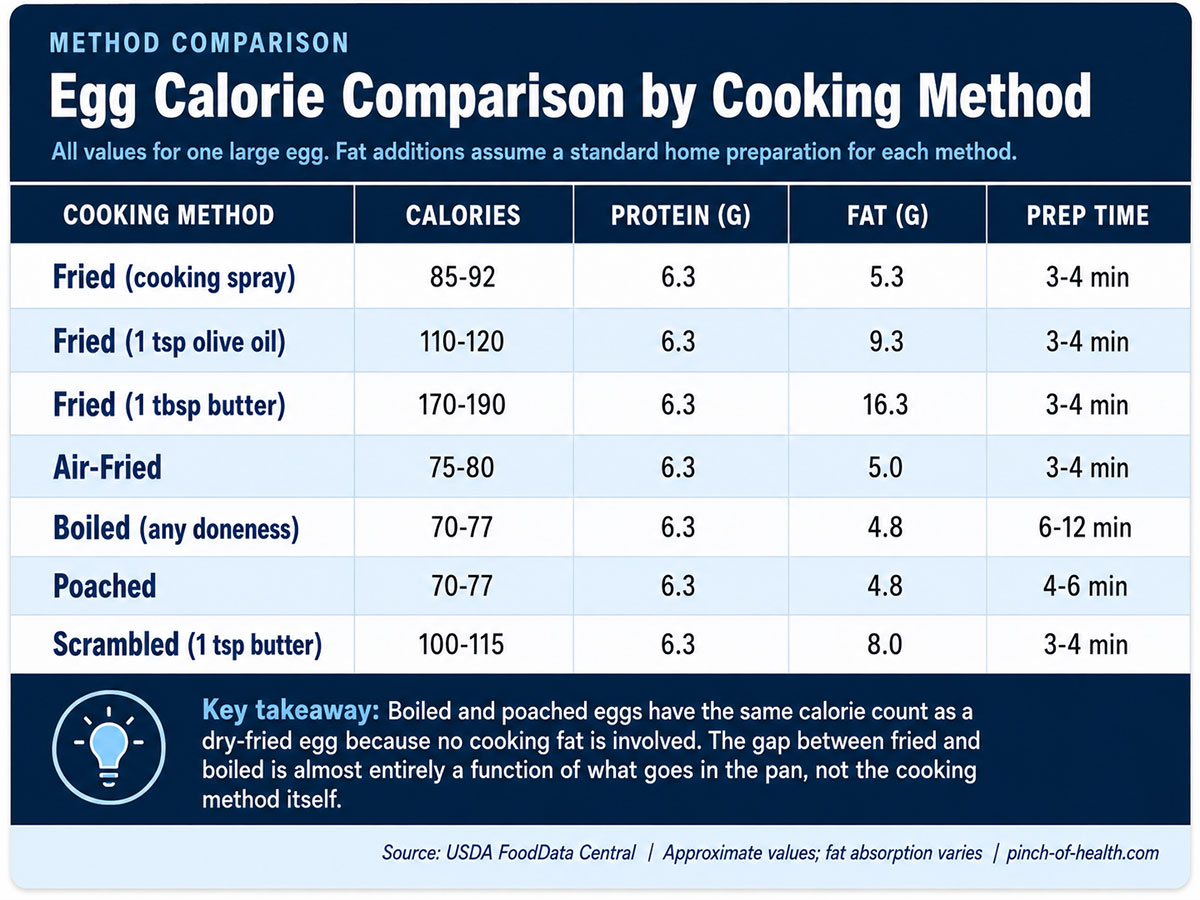
Boiled and poached eggs have essentially the same calorie content as a fried egg without added fat, because no cooking fat is involved. The gap between fried and other preparations exists almost entirely because of the pan.
A restaurant-style fried egg is typically 140 to 180 calories because professional cooks use a tablespoon of butter or oil per egg as a standard. A home-fried egg made with cooking spray lands closer to 85 calories. Fat in the pan accounts for the entire calorie difference.
How Many Calories in a Fried Egg Sandwich
A fried egg sandwich draws calories from several ingredients, and the egg is often the smallest contributor. Bread adds 80 to 150 calories per slice, depending on type, cheese adds 60 to 110 per slice, and bacon adds 40 to 70 per strip. The egg itself contributes 77 to 90 calories without fat, more with it.
Three reference points that cover most home-prepared versions:
- Wholegrain toast (2 slices) plus a spray-fried large egg: 220 to 260 calories, approximately 15 grams of protein
- White bread (2 slices) plus a large egg fried in butter plus a slice of cheese: 380 to 420 calories
- Brioche bun plus a large egg fried in butter plus cheese plus two strips of bacon: approximately 480 to 550 calories
Standard fast-food fried egg sandwiches typically land between 400 and 550 calories, driven by the bun and other additions rather than the egg. The bread choice and any additions account for far more calorie variation than the egg preparation method.
Egg White vs. Whole Fried Egg Calories
Removing the yolk reduces calories by roughly 60%, from about 90 calories for a whole egg to about 17 calories for the white alone. With a small amount of cooking fat added, the practical comparison is closer to 90 calories for a whole egg versus 35 calories for an egg white, both with cooking spray.
The trade-off is significant nutritionally. The yolk contains almost all the fat, all the cholesterol, and the great majority of the fat-soluble vitamins, choline, and lutein. An egg white provides protein (3.6 grams) and almost nothing else.
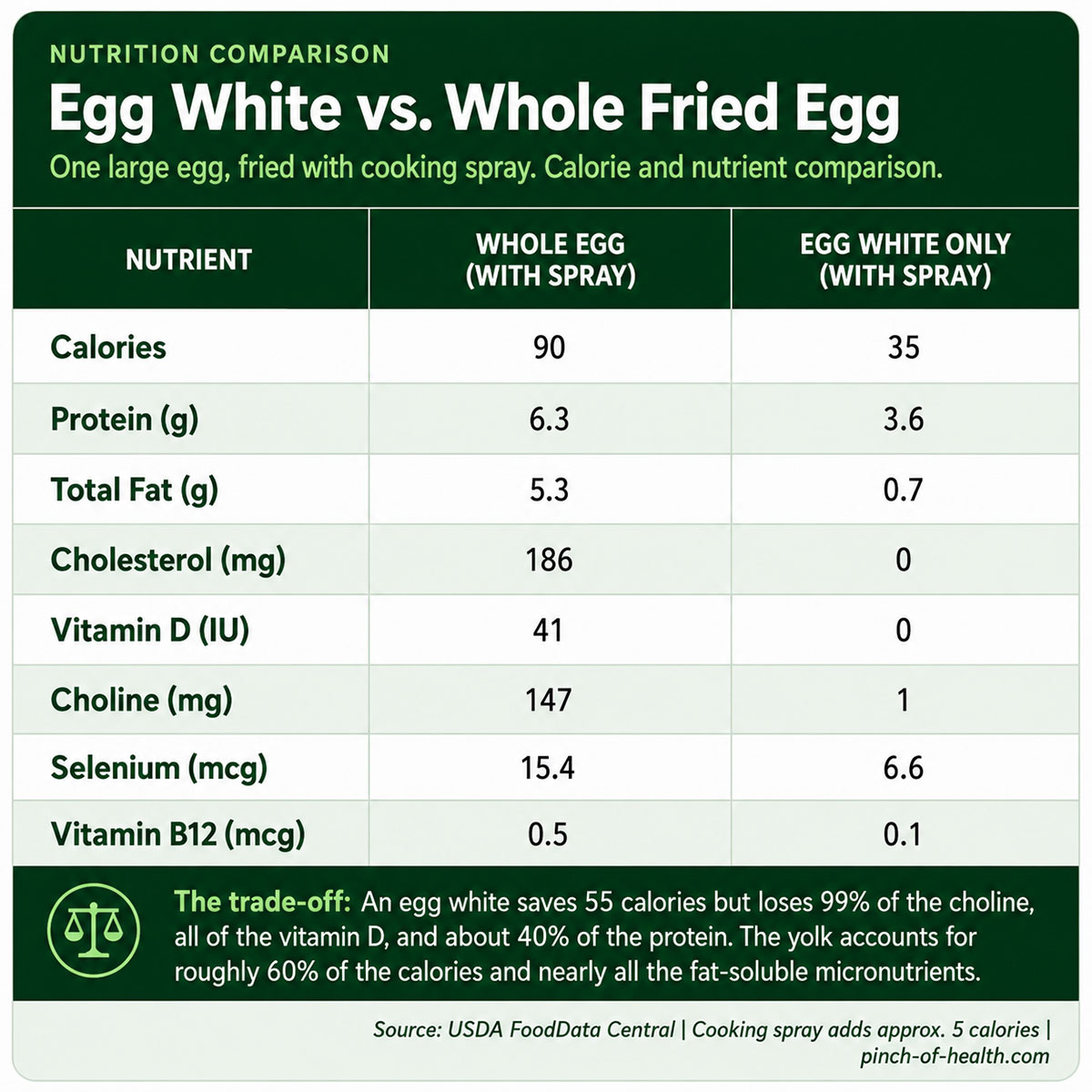
For calorie reduction, the substitution is one of the more effective dietary adjustments available. For people trying to maximize nutrient density per calorie, the yolk is doing most of the work.
The egg white saves roughly 55 calories and surrenders almost everything worth eating beyond protein. Whether that trade makes sense depends entirely on what you are optimizing for.
Low-Calorie Ways to Fry Eggs
Five approaches that reduce the fat contribution without changing the fried egg format:
- Use cooking spray instead of poured oil or butter. A standard spray application adds 3 to 5 calories per egg, compared to 40 to 100 for a teaspoon or tablespoon of fat.
- Use a high-quality non-stick pan. A good non-stick surface requires only a spray or a single drop of oil to prevent sticking. The pan does more work than the fat in keeping the egg from adhering.
- Add water during cooking. A splash of water in the pan (about a teaspoon) and a lid for the last 30 seconds steams the top of the egg without requiring additional fat.
- Use an air fryer. At 350°F for 3 to 4 minutes, an air fryer produces a fried egg texture with minimal added fat (approximately 75 to 80 calories for a large egg).
- Choose a smaller egg. A medium egg contains approximately 63 calories without added fat, versus 70 to 90 for a large one. Over daily cooking, that gap accumulates.
Conclusion
The 90-calorie figure for a fried egg is not wrong. It is the answer to a specific question: how many calories are in a large egg cooked without any fat. For people cooking on a dry non-stick surface with cooking spray, it is the accurate answer.
For most other preparations, that figure is a starting point. The cooking fat closes the gap between a 90-calorie breakfast and a 190-calorie one, and that gap sits largely invisible in the way most calorie trackers handle egg entries. The practical implication is small on any given morning.
Across a year of daily breakfasts, a switch from a tablespoon of butter to cooking spray removes roughly 35,000 calories from the equation, equivalent to approximately ten pounds of body fat, with no change to what is eaten beyond what goes in the pan.
FAQs
How much protein is in a fried egg?
A large fried egg contains approximately 6.3 grams of protein. That protein includes all nine essential amino acids, which makes it a complete protein source. The protein content remains consistent regardless of how the egg is cooked, though the addition of cooking fat changes the total calorie figure.
Is it healthy to eat fried eggs every day?
For most healthy adults, yes. The 2015 Dietary Guidelines for Americans removed the previous limit on dietary cholesterol, and a 2019 American Heart Association science advisory supports one whole egg daily within a heart-healthy dietary pattern. People with existing cardiovascular disease or type 2 diabetes should discuss daily egg intake with their physician, as the research picture for those groups is less clear-cut.
Is it healthy to eat 2 fried eggs a day?
Current research suggests that moderate egg consumption of one to two eggs per day does not increase cardiovascular mortality risk for most healthy adults. The Frontiers in Nutrition meta-analysis reviewed 55 studies and found no association between eggs and cardiovascular deaths. As with any dietary question, individual health context matters, and people with specific lipid disorders should get personalized guidance.
What is the best oil for frying eggs?
Olive oil and avocado oil are the strongest choices from a fatty acid standpoint. Both offer monounsaturated fat profiles and are stable at the medium-heat temperatures typical for egg frying. Butter produces a good flavor but has a lower smoke point and contributes saturated fat. Heavily refined vegetable oils like canola are stable at higher temperatures but offer less nutritional interest. Avoid reusing cooking fat between batches.
How can I fry an egg without adding extra calories?
The most effective approach is a quality non-stick pan with cooking spray. A standard spray application adds 3 to 5 calories per egg, versus 40 to 100 for a teaspoon or tablespoon of poured fat. A well-seasoned cast-iron pan or a heavy non-stick pan requires almost no fat to prevent sticking at medium heat. Adding a teaspoon of water to the pan and covering it briefly also allows the top of the yolk to set without additional oil.
Do fried eggs have more calories than scrambled eggs?
Not inherently. The calorie difference between fried and scrambled eggs depends almost entirely on the cooking fat used in each preparation. A scrambled egg made with butter or cream in the pan often contains more calories than a spray-fried egg. The cooking method itself (frying versus scrambling) does not change the calorie count. The fat and any additions do.
Are brown eggs different in calories than white eggs?
No. Shell color is a function of the breed of hen and has no effect on the nutritional composition of the egg inside. A large brown egg and a large white egg of the same weight contain identical calories, protein, and micronutrient profiles. The same applies to cage-free and conventionally raised eggs. Farming method affects husbandry practices but not egg nutritional content in any meaningful way.
Can I eat fried eggs on a weight loss diet?
Yes. Fried eggs can fit into a calorie-controlled eating plan when cooked with minimal fat. A large egg fried with cooking spray contributes approximately 90 calories and 6.3 grams of protein. Protein is satiating: it supports appetite management in a way that an equivalent calorie amount from carbohydrates typically does not. The practical challenge is accounting for the cooking fat accurately, which most tracking apps underestimate by default.
What is the lowest calorie way to eat eggs?
Poaching or boiling requires no cooking fat at all, making those the lowest-calorie preparation methods at approximately 70 to 77 calories per large egg. For fried eggs specifically, cooking spray on a non-stick pan at medium heat brings a large egg in under 90 calories. Egg whites, whether fried or cooked by any other method, contain roughly 17 calories each without added fat, though the trade-off is the loss of almost all the nutritional content that is not protein.
What is the 3-3-3 rule for eggs?
The 3-3-3 rule refers to safe storage of hard-boiled eggs: refrigerate within 3 hours of cooking, store for no more than 3 days in the refrigerator, and reheat to 165°F before eating leftovers. The rule applies to cooked eggs generally. Raw eggs in their shell keep longer (up to 3 to 5 weeks refrigerated), but peeled or cooked eggs become susceptible to bacterial growth considerably faster once the protection of the shell or heat treatment is no longer present.