A Harvard-led meta-analysis reviewed the outcomes. Same total fat, one ingredient swapped. The difference in heart disease risk wasn’t small
Two people can eat the same number of fat grams today. One person’s heart disease risk just shifted. The other’s risk stayed exactly where it was.
What separated them wasn’t the amount of fat on the plate. It was which fat filled it, butter and red meat fat on one side, a bottle of sunflower or soybean oil on the other.
The analysis followed hundreds of thousands of people making close to that exact swap. The size of the difference surprised even the researchers who ran it.
Saturated fat has spent the last decade bouncing between villain and comeback story. One year, butter was culturally rehabilitated, and the next, a new meta-analysis reversed that rehabilitation.
Frank Hu, the Harvard nutrition researcher behind much of this work, has openly described the resulting coverage as confusing and, at points, sensational.
The confusion has less to do with how much saturated fat people eat than with what replaces it when they eat less.
What the Harvard-Led Swap Study Actually Found
Maryam Farvid and her colleagues at the Harvard T.H. Chan School of Public Health wanted an answer more specific than whether polyunsaturated fat is good for the heart. They wanted a number: how much protection a real, measurable swap actually buys.
Pooling thirteen cohort studies that followed more than 310,000 adults, the team calculated what happens when linoleic acid, the dominant polyunsaturated fat in vegetable oils, nuts, and seeds, takes the place of saturated fat.
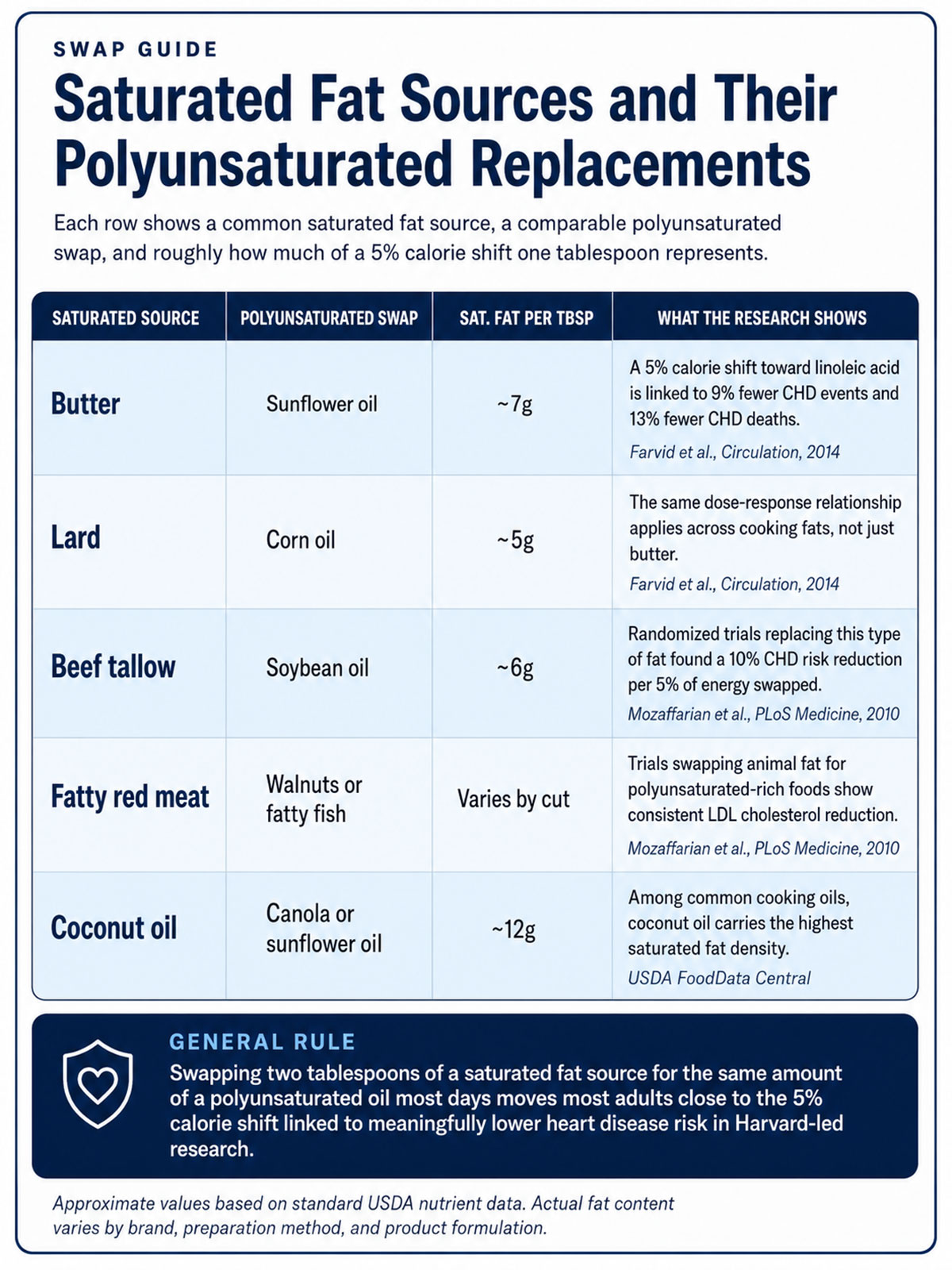
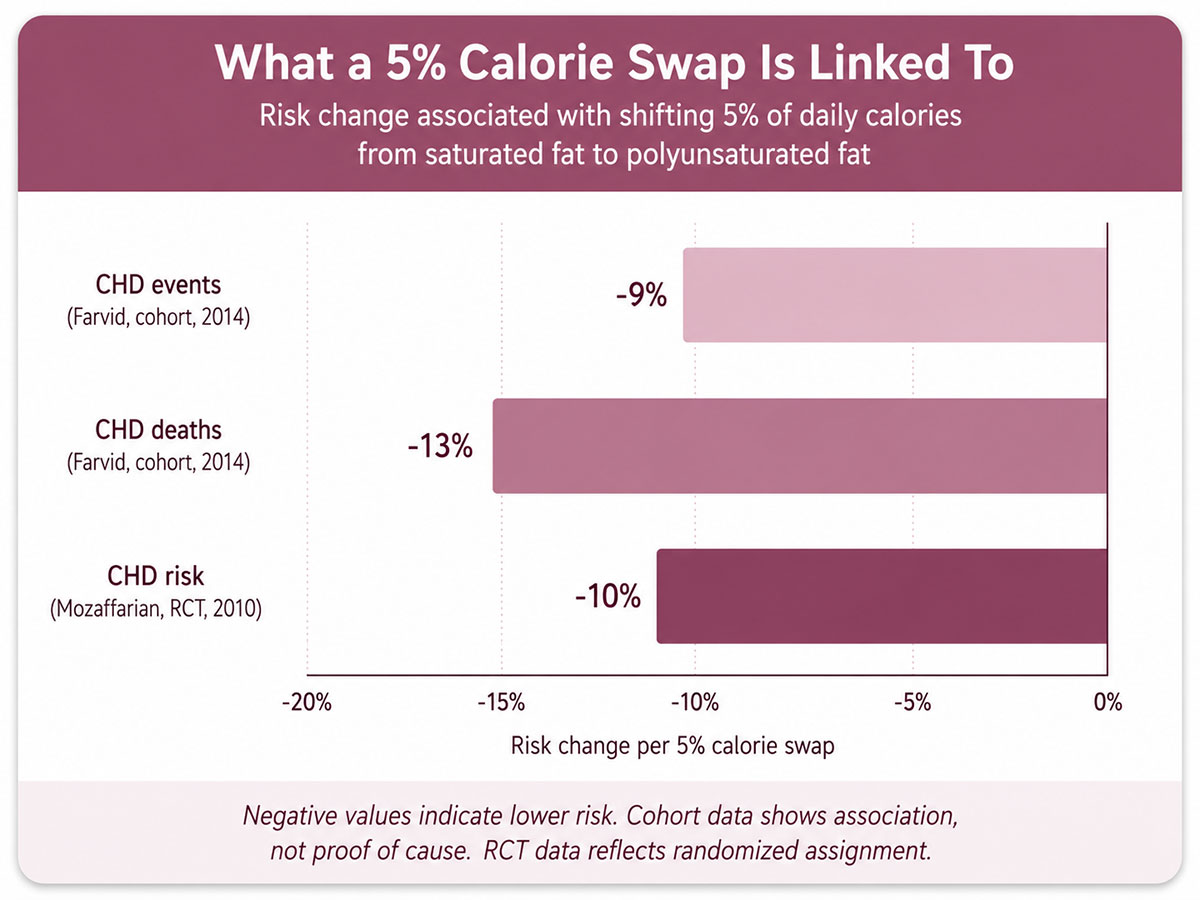
Move 5% of daily calories from saturated fat to linoleic acid, and coronary heart disease events fell by 9%, the analysis calculated. Deaths from coronary heart disease fell by 13%. Those figures came from a 2014 analysis in Circulation, built on a dose-response model rather than a single comparison.
That’s a meaningful gap for one ingredient swap.
Compare the highest linoleic acid intake to the lowest instead, and the gap widens further: 15% lower risk of coronary events, 21% lower risk of coronary death.
This is observational data. It tracks what people have already eaten rather than assigning their diets for them, so it shows association rather than proof of cause. Frank Hu, the study’s senior author, has spent much of the past decade trying to resolve exactly the kind of confusion that surrounds numbers like these, and he has pointed to randomized trial evidence as the piece that turns association into something closer to certainty.

The Randomized Trials Say the Same Thing
Dariush Mozaffarian had already tested a rougher version of this same question four years earlier, while he was still at Harvard Medical School, using a design that removes a lot of the guesswork: randomized controlled trials, where researchers assign the diet instead of watching what people already eat. The number his team landed on was a 10% lower coronary heart disease risk for each 5% of energy shifted.
Pooling data from eight qualifying trials with more than 13,000 participants, the researchers found that assignment to more polyunsaturated fat produced a 19% lower rate of coronary events across the pooled trials, a result that appeared in PLoS Medicine in 2010.
Two different research designs. Nearly the same number.
Meta-regression within that same analysis showed that longer trials produced larger benefits, which suggests the protection compounds over time rather than appearing all at once.
Why the Advice Keeps Sounding Like It Changes
Part of the reason stems from a separate meta-analysis released the same year as Farvid’s, led by researchers including Rajiv Chowdhury, which appeared in Annals of Internal Medicine. It examined saturated fat on its own and overturned the simple story entirely.
No statistically significant link to coronary risk turned up: a relative risk of 1.03, close enough to 1.0 to count as no effect. Mainstream coverage amplified it.
Farvid’s data is about what replaces saturated fat, not about saturated fat in isolation. Swap it for refined carbohydrate, and the evidence points to little benefit. Swap it for polyunsaturated fat instead, and the risk reduction shows up consistently in both observational and randomized evidence.
The American Heart Association’s 2017 review of the full trial evidence went further. Led by Frank Sacks at the Harvard T.H. Chan School of Public Health, the 2017 advisory concluded that randomized trials swapping saturated fat for polyunsaturated vegetable oil cut cardiovascular disease by about 30%, a reduction similar in size to what statin medications typically achieve.
That 30% figure comes from trials with a larger dietary shift than the 5% used to calculate Farvid’s numbers. Treat it as confirmation of direction, not an exact match to that smaller, 5% shift.
One Study Complicates the Picture
Christopher Ramsden, a physician-researcher at the National Institutes of Health, spent years piecing together data from a 1968 trial that had never been fully published, recovered from decades-old magnetic tape and paper records.
The Minnesota Coronary Experiment had randomized more than 9,000 adults living in state hospitals and nursing homes to a diet replacing saturated fat with corn oil and corn-oil margarine, or to a control diet matched for calories and total fat. Serum cholesterol in the intervention group dropped by roughly 13.8% from baseline, compared with about 1% in the control group. Their risk of death did not drop with it.
Ramsden’s 2016 reanalysis in BMJ paired that finding with a systematic review of five similar trials covering nearly 11,000 people. Across all of them, diets built around linoleic acid lowered cholesterol reliably but showed no mortality benefit, either from coronary heart disease specifically or from any cause.
Researchers still don’t fully agree on why that result diverges from the newer, larger body of evidence behind Farvid’s and Mozaffarian’s numbers. One possibility researchers have raised is that older trials leaned almost entirely on corn oil, a single concentrated source of linoleic acid, while modern diets mix in canola, soybean, and olive oil alongside nuts and fatty fish.
Diversifying the source of polyunsaturated fat, rather than relying on one oil alone, sidesteps that specific criticism entirely. Whether that fully explains the outlier result remains an open question.
What the 5% Swap Actually Looks Like
One tablespoon of butter carries close to 7 grams of saturated fat. Swap it for a tablespoon of sunflower oil instead, and the pan goes from a hard, milky solid to something already pooling and shimmering at room temperature, most of that fat now polyunsaturated rather than saturated.
A person who cooks with two tablespoons of butter most days and switches to two tablespoons of soybean oil has moved close to that 5% mark on their own, without touching a single other habit.
Polyunsaturated fat concentrates in sunflower oil, corn oil, and soybean oil, plus walnuts, pumpkin seeds, flaxseed, and fatty fish like salmon and mackerel. Saturated fat concentrates in butter, lard, tallow, fatty cuts of red meat, processed meat, and tropical oils like coconut and palm.
None of this requires eliminating saturated fat completely, and treating it that way is the easiest way to abandon the swap after a week. The evidence points toward substitution, not elimination, and it adds up faster in a kitchen than it sounds on paper.

Conclusion
The two people from the beginning of this piece were never really eating different amounts of fat. They were making a choice most people make several times a day without thinking about it: which bottle to reach for, which cut of meat to buy, which spread goes on the toast.
Frank Hu’s team put a number on how much a small, specific choice is worth, repeated often enough to matter, going well beyond simply confirming that polyunsaturated fat helps the heart. The next time a hand reaches for the butter dish, that number is worth carrying, less as a rule to follow perfectly than as a reminder that the choice was never as small as it looked.