Two memory systems. Different brain regions. One falls apart under stress while the other barely notices. Knowing which one is failing you makes all the difference.
You have spent more time than you care to admit standing in the middle of a room, completely forgetting why you walked in there. It is a very specific, annoying kind of blankness. You are so sure of yourself ten seconds ago, then you cross a doorway, and the thought just vanishes. It is frustrating because your brain clearly has plenty of room for useless information. It can still pull up a commercial jingle from the nineties or the exact smell of your grandmother’s house without a single mistake.
This is not a sign that you are losing your edge. It is actually just a clash between two different memory systems. One is built to store your life story, but the other is a short-term system that is incredibly sensitive to distractions. Understanding why that short-term system clears out when you change rooms says a lot more about how your brain works than just worrying about your age.
Most Memory Complaints Aren’t What You Think
When people say their memory is failing, they almost always mean they forgot to do something. A bill, a call, a medication. They walked out of the house without the thing they had set down by the door. They missed the errand they’d been meaning to run all week. Between 50 and 80 percent of daily memory complaints are failures to carry out a plan, not failures to recall the past. That gap matters because the two systems fail for different reasons. Fixing one does almost nothing for the other.
Retrospective memory is what most people picture when they say “memory.” It holds what has already happened: your first day at a new job, the capital of France, the name of someone you met twice at a party. Prospective memory works on a different problem. It’s the ability to act on an intention at the right future moment. Take the medication with dinner. Call your sister when you get home. Send the email after the meeting. It’s not a record of an event. It’s a plan held in waiting.
Two Systems, Different Brain Addresses
The split isn’t just a concept. It’s physical. Retrospective memory, the kind that stores personal experiences, runs through the hippocampus and the medial temporal lobe. These are well-mapped structures, deep in the brain, studied for decades. Prospective memory lives in a different area.
Burgess, Gonen-Yaacovi, and Volle’s neuroimaging review found a striking pattern across studies: every one that compared holding a delayed intention versus not holding one showed activation in the rostral prefrontal cortex, specifically Brodmann Area 10. BA10 acts like a switching station. It holds your pending intention in reserve while your attention stays on whatever is in front of you, then flips your focus back when the moment is right.
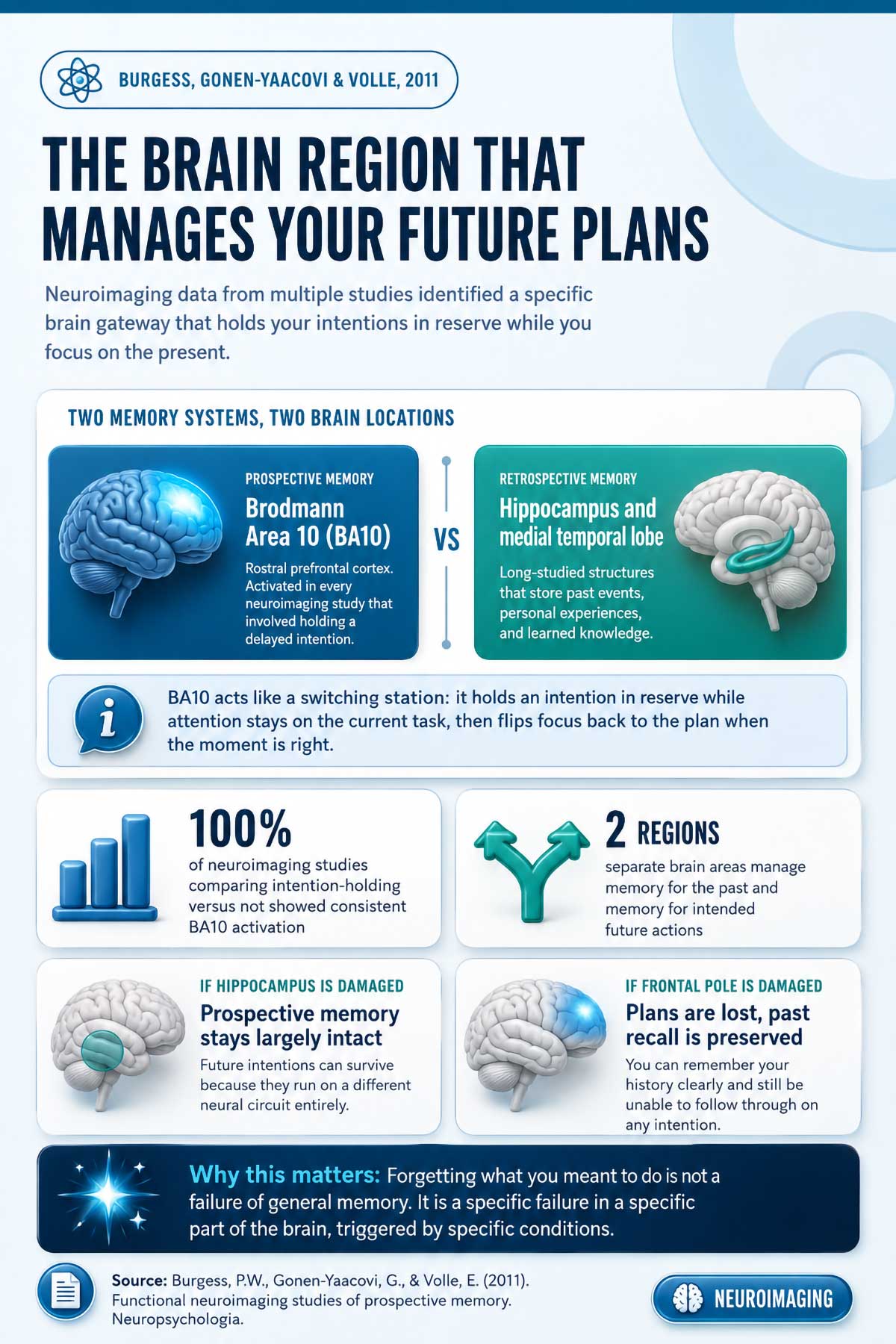
PET imaging work by Okuda and colleagues mapped this divide with more precision. The front of the frontal pole fired strongly during tasks tied to future intentions. The medial temporal lobe was more active during recall of past events.
The real-world consequence is worth sitting with. Damage to the hippocampus can leave prospective memory largely intact, but damage to the frontal pole can wipe out your ability to follow through on plans while your recall of the past stays nearly untouched.
Why Modern Life Is Particularly Hard on One of These Systems
Prospective memory has an enemy that retrospective memory mostly doesn’t: competing attention. Recalling a childhood event doesn’t require you to be doing nothing else. You can retrieve it while driving, while half-asleep, while your phone buzzes on the table. Acting on a future intention is a different demand.
Researchers have found a strong link between prospective memory and the same mental resources used to manage several tasks at once. When those resources run out, future intentions don’t fade. They vanish.
Chronic stress hits this system through a different path. Research on stress hormones and memory shows that high cortisol levels disrupt prefrontal cortex function, and BA10 sits right in that path. The result is specific.
Someone under heavy work pressure may recall past events in detail, hold long conversations, and remember names and faces with no trouble. Yet they consistently miss things they fully planned to do. The intention was formed. The memory of forming it is intact. What fails is retrieving that plan at the moment it was needed.
Not All Intentions Work the Same Way
Two widely cited models explain why some prospective memory failures feel random while others feel predictable. The Preparatory Attentional and Memory (PAM) model, developed by Smith and Bayen, holds that prospective memory always draws on some mental effort.
You’re not storing a plan and triggering it on autopilot. Part of your attention stays on low-level alert, scanning for the moment the intention becomes relevant. That background monitoring costs something, even when it feels invisible.
Not every task demands the same amount of active watching. Some intentions fire almost on their own when a strong cue appears. Seeing an envelope on the kitchen table and instantly thinking of the letter you meant to mail is one example.
Other intentions, especially those tied to a time or a task with no natural trigger, need steady mental effort to stay active. These are the ones most likely to get lost under stress, tiredness, or a packed schedule. Whether you follow through depends less on how much you care and more on the conditions surrounding the task.
The Aging Paradox That Almost Nobody Talks About
Here’s where the science gets genuinely strange. Ask older adults to complete prospective memory tasks in a lab, and they typically score worse than younger adults. The pattern held up reliably enough that many researchers treated it as proof of age-related decline. Then they looked at what happened outside the lab.
Older adults often remembered their plans more reliably than younger people when tasks were part of daily life. Not just a little better. Often a lot better. The lab was capturing something true about the underlying brain changes, but it missed something equally true about how people manage intentions in practice.
Older adults tend to use external reminders on purpose, anchor plans to fixed routines, and treat their stated intentions as higher priority. The biological change is real. The real-world drop in performance doesn’t always follow it.
This connects to what is called the Intention Superiority Effect. An unfinished plan doesn’t sit idle in memory. It stays in mild activation, surfacing as a low-level sense that something is still pending. People who build structure into their day make better use of this. Their surroundings keep supplying the right cue at the right moment, rather than leaving all of that work to the brain alone.
The Environment Remembers Better Than You Do
The most useful finding in this whole body of research is also the one most people never hear. Research on event-based prospective memory showed that when reliable external cues were available, the age-related gaps in performance largely closed.
Older adults who fell behind on lab tasks without cues matched or beat younger adults when a strong cue was present. The conclusion is hard to argue with: the failure is usually not a failure of memory. It’s a failure of self-initiated retrieval in an environment that provides no help.
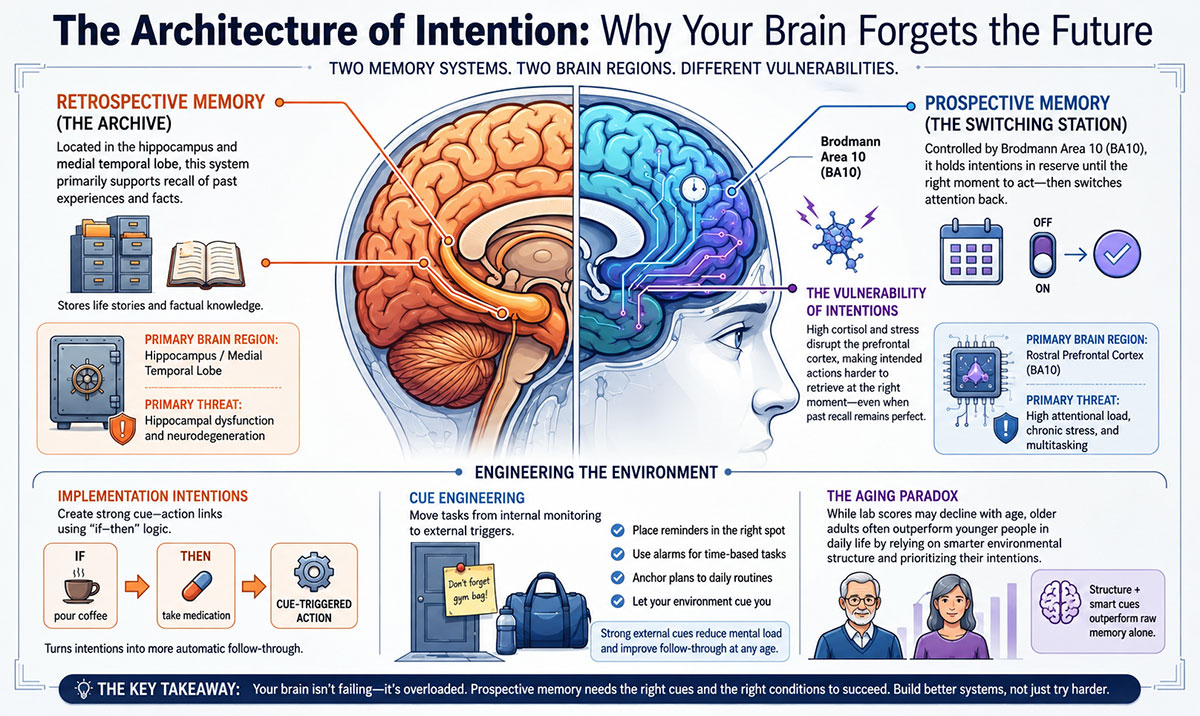
This is why a sticky note on the door beats a mental reminder. Why the medication bottle next to the coffee machine outperforms “I’ll remember.” Why a phone alarm is more dependable than willpower. BA10’s job as a switching station works best when an external cue does the triggering, freeing that background monitoring system from carrying the load on its own. You don’t need a stronger memory. You need smarter surroundings.
How to Actually Use This
Knowing why prospective memory fails is only half the story. The practical question is what to do about it, and the research points to specific answers rather than vague advice about staying organized.
Start by knowing which type of task you’re dealing with. Event-based tasks fire when something happens: you see a person, arrive somewhere, or finish a prior task. These are the easiest to support because you can tie your plan directly to a visible cue. Time-based tasks are harder.
“Remember to call at 3 pm” has no natural trigger in your world, which means your brain has to generate one from scratch. These tasks need either a hard external alarm or a deliberate link to a routine that reliably happens near that time.
The most well-researched tool for prospective memory is called an implementation intention, and it uses a simple if-then structure: “When X happens, I will do Y.” Rather than setting a loose goal like “I need to take my medication today,” you form a tight link: “When I pour my morning coffee, I will take my medication.”
This strategy maps directly onto the Multiprocess Theory’s finding that strong cues cut the monitoring load. It converts a floating intention into something that acts more like a habit trigger. Studies on this approach show consistent gains in follow-through across age groups, and the reason is mechanical, not motivational. The specificity does the heavy lifting.
Stress management matters here in a concrete way. When cortisol rises, prefrontal cortex function drops, and the system that tracks pending intentions becomes less steady. During high-pressure stretches, the right response is to offload more to external tools, not fewer.
More written lists. More phone alerts. More physical cues placed at the exact point where the action needs to happen. This isn’t a sign of weakness or memory loss. It’s the correct response to a known biological constraint, and it’s what the research on older adults shows they’ve learned to do well.
Object placement is one of the most underrated strategies available. Leaving your gym bag by the front door, putting the library books on the driver’s seat, setting the vitamin bottle on your keyboard: these aren’t tricks. They’re cue engineering. Each one turns a time-based or habit-resistant intention into an event-based one with a hard-to-miss trigger. That’s the exact condition under which prospective memory performs most reliably.
What This Actually Changes
There’s a particular kind of shame that comes with forgetting plans. It feels like a character flaw, proof that you don’t care enough or can’t be relied on. That shame rarely shows up when someone forgets a historical fact. Nobody feels bad about blanking on the date of a treaty. But missing a call you promised to make? That one lands differently.
The science makes a clear argument against that shame. These two systems run on different hardware, break down under different conditions, and respond to different fixes. A sharp retrospective memory alongside a struggling prospective memory isn’t a sign of decline.
It’s a sign that one specific system is under load, and that load has a known structure. That structure can be worked with. The brain that forgets what it meant to do isn’t broken. It’s asking for better working conditions to work in.