


Most people think bad posture means their bones are in the wrong place. But the truth is, your muscles are just too tired to hold you upright. When your back muscles run out of gas mid-afternoon, your body takes the path of least resistance — and that means rounding forward.
This is sometimes called “tech neck” — a term for the forward head posture and neck strain that builds up from hours of staring at screens. Your head drifts forward, your chest caves in, and the muscles along your upper back and neck slowly exhaust themselves trying to compensate.
Most people respond by trying to force their shoulders back. Or they buy a posture brace. But braces don’t fix the root problem — they just do the work your muscles should be doing. The moment the brace comes off, you’re back to square one, because the muscles underneath never got stronger.
What actually works? Building what researchers call postural endurance — the stamina in your back and neck muscles to hold a good position for hours at a time, without constantly thinking about it.
The seven yoga poses below are chosen specifically to open a tight chest and strengthen a weak back. No equipment needed. Not even a yoga strap — a folded t-shirt works just as well. These poses target the exact muscle groups shown to improve in clinical yoga research: back extensors, chest openers, and shoulder stabilizers. While the studies cited here used broader yoga programs without listing every specific pose, the exercises below are grounded in that same evidence.
Why Forcing It Doesn’t Fix It
Picture your back muscles like a phone battery. Sitting all day drains that battery fast. By 3 p.m., there’s nothing left to power good posture — so your body hunches to conserve energy.
A posture brace is like plugging into a charger you have to wear forever. The moment it’s gone, the battery is still dead.
Yoga works differently. It’s more like reconditioning the battery itself, so it holds a charge longer.
A 2010 study by Schmid and colleagues put this idea to the test. They looked at 36 office workers with hunched postures and split them into two groups — one practiced Hatha yoga twice a week for eight weeks, the other didn’t. The yoga group didn’t show dramatic changes in the actual angle of their spines. But they showed a significant increase in back muscle endurance. That endurance is what keeps you sitting upright without fighting for it.
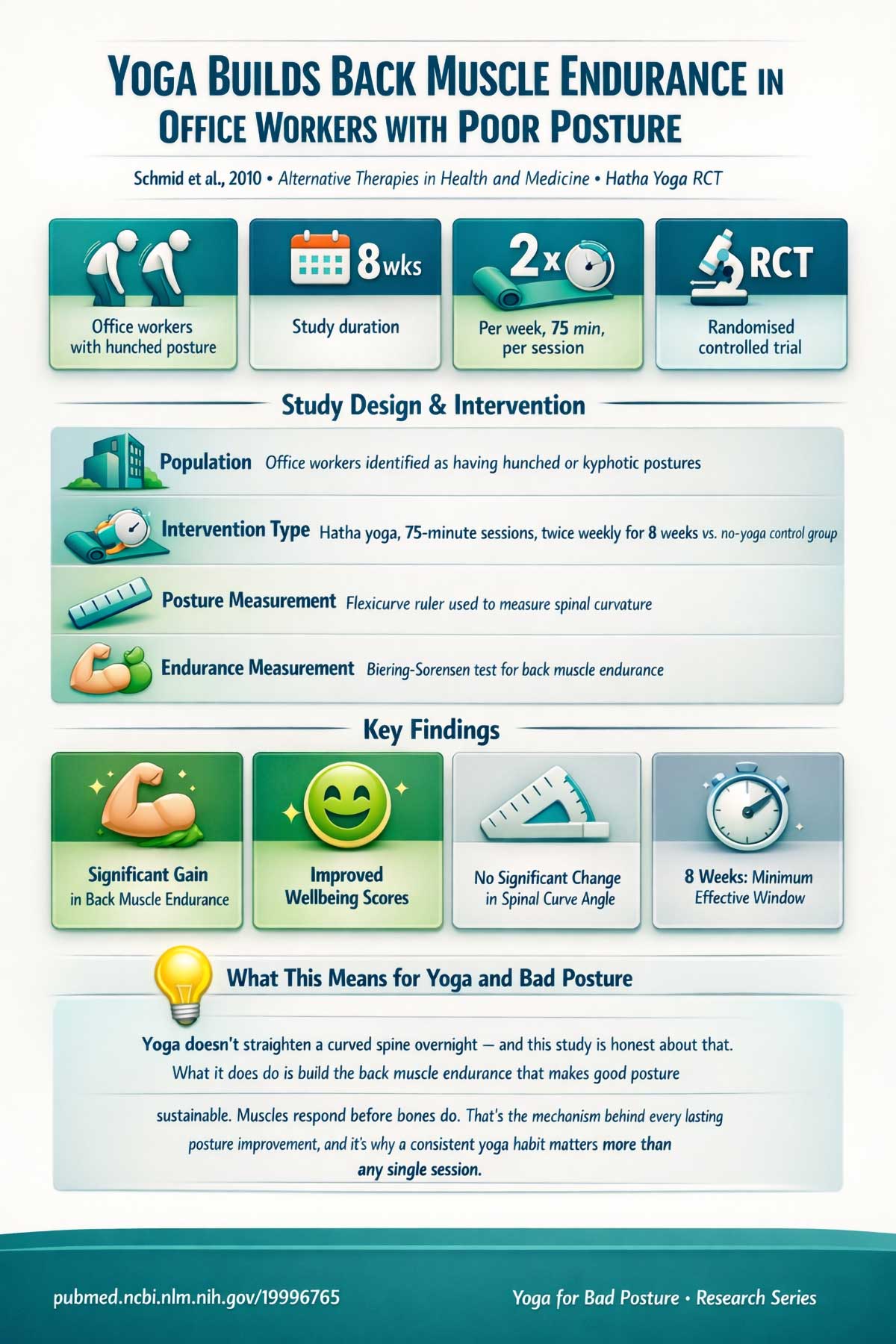
So the goal here isn’t to force your spine into a new shape. It’s to build the muscle stamina that makes good posture feel natural.
How to Use These Poses
Before jumping in, here’s a simple game plan.
Aim to practice three to four times a week. Research on yoga-based posture and pain programs consistently ran for six to nine weeks before participants saw meaningful results. Don’t expect overnight changes — expect a slow, steady shift.
Focus on how each pose feels, not how it looks. If a pose relieves tension in your neck or opens up your chest, that’s the goal.
One safety note: gentle tension is fine. Sharp or shooting pain is a signal to stop. If any pose feels too intense at first, cut the hold time in half or skip it that session — you’ll still benefit from the others.
What to Expect Week by Week
Knowing what’s coming makes it easier to stick with a routine. Based on the research, here’s a rough timeline:
Weeks 1–2: You’ll start noticing your posture more throughout the day. Physical change is minimal at this stage, but body awareness starts to sharpen.
Weeks 3–4: Many people report less tension in the neck and shoulders at the end of the workday. The muscle soreness from new poses fades.
Weeks 6–8: Sitting upright starts to feel easier and more natural. This is the muscle endurance kicking in — the same change documented in clinical trials.
The 7 Poses
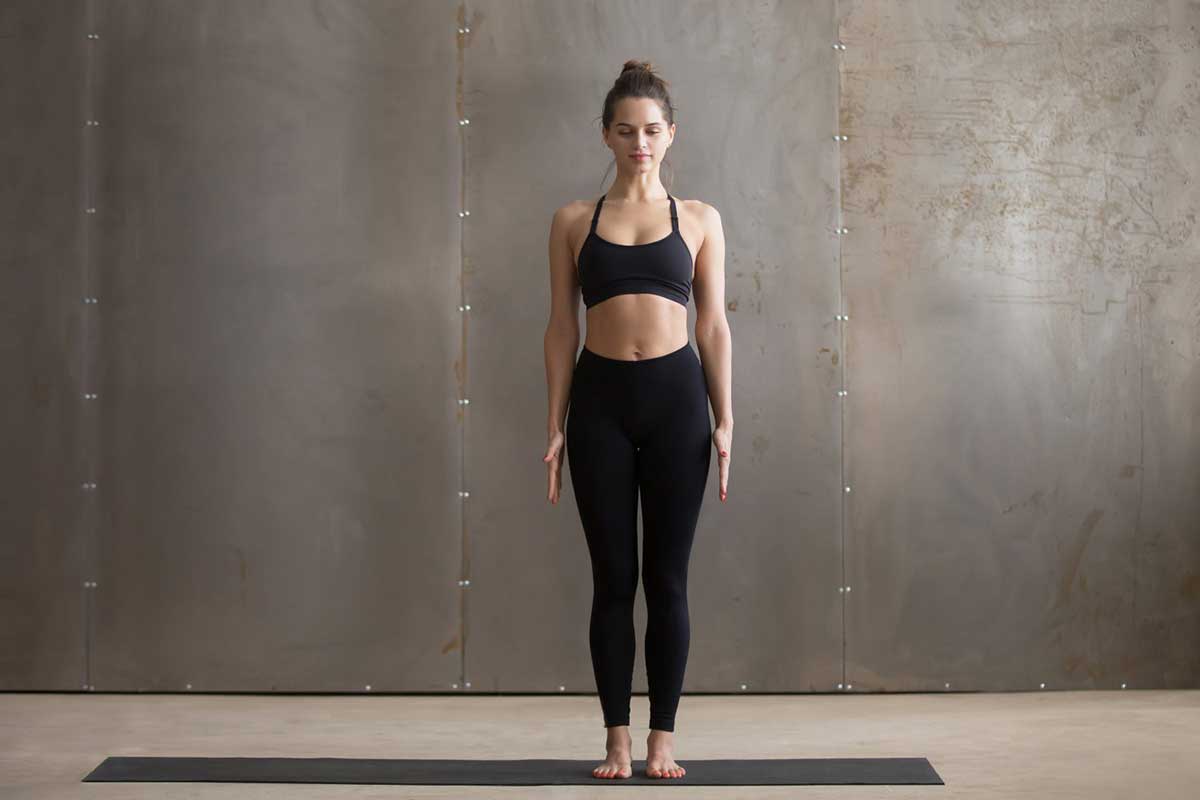
1. Mountain Pose (Tadasana) — The Reset Button
This might look like just standing there. It’s not.
Most people with poor posture have lost touch with what “neutral” actually feels like. Their new normal is a head drifting forward and shoulders curling in. Mountain pose rebuilds that body awareness from the floor up, which is why it’s the conceptual foundation of this whole routine. In the 20-minute session outlined below, Cat-Cow comes first as a warm-up — but Mountain Pose is the standard you’re working toward.
Stand with your feet hip-width apart. Press all four corners of each foot into the floor. Roll your shoulders up, back, and let them drop. Turn your palms to face forward — this small move opens the chest more than you’d expect. Imagine a string attached to the crown of your head, gently pulling you toward the ceiling.
Hold for 10 slow, deep breaths. Pay attention to where your head is in space. Most people are surprised how far forward it was.
2. Sphinx Pose — The Anti-Slouch
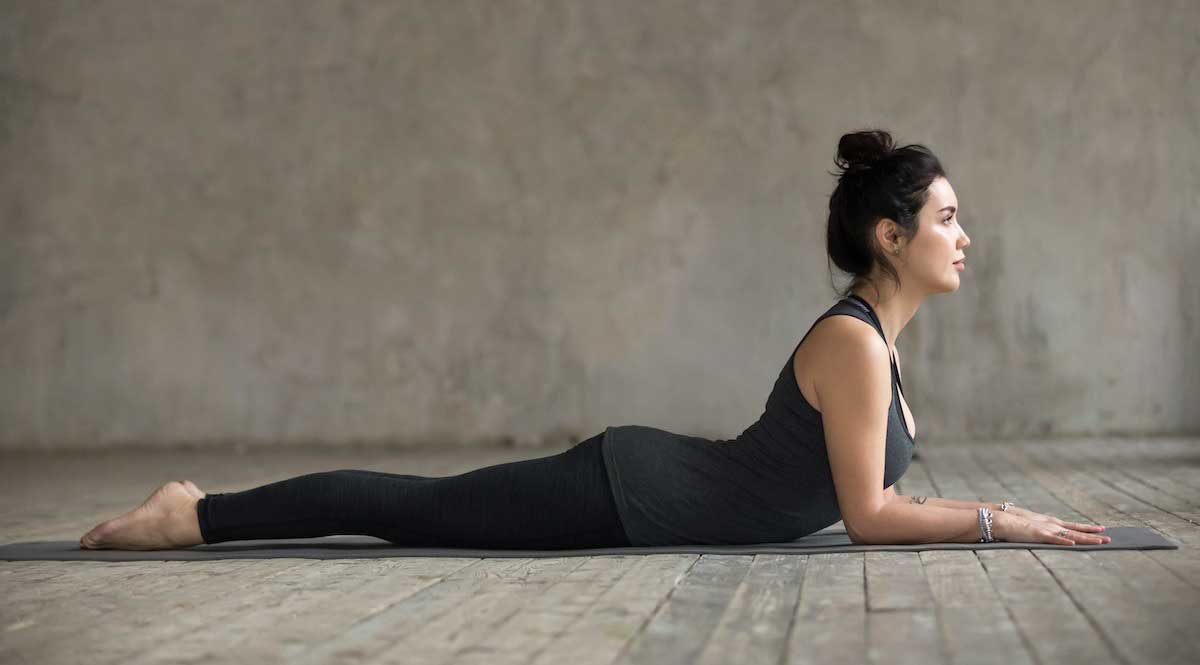
If you spend hours with your upper back rounded forward, Sphinx pose is the counter.
It gently encourages the upper spine to extend in the opposite direction — without the intensity of a full backbend. Think of it as a passive reset for a spine that’s been curled over a screen all day.
Lie on your stomach. Prop yourself up on your forearms with your elbows directly under your shoulders. Press your forearms into the mat and pull your chest forward through your arms. The lift should come from your sternum rising — not from compressing your lower spine. If you feel pinching or pressure in your lower back, ease back slightly and focus on lifting from your chest instead. That’s the cue that tells you the pose is working correctly.
Hold for one to two minutes. Breathe slowly.
3. Cat-Cow Stretch — The Lubricator
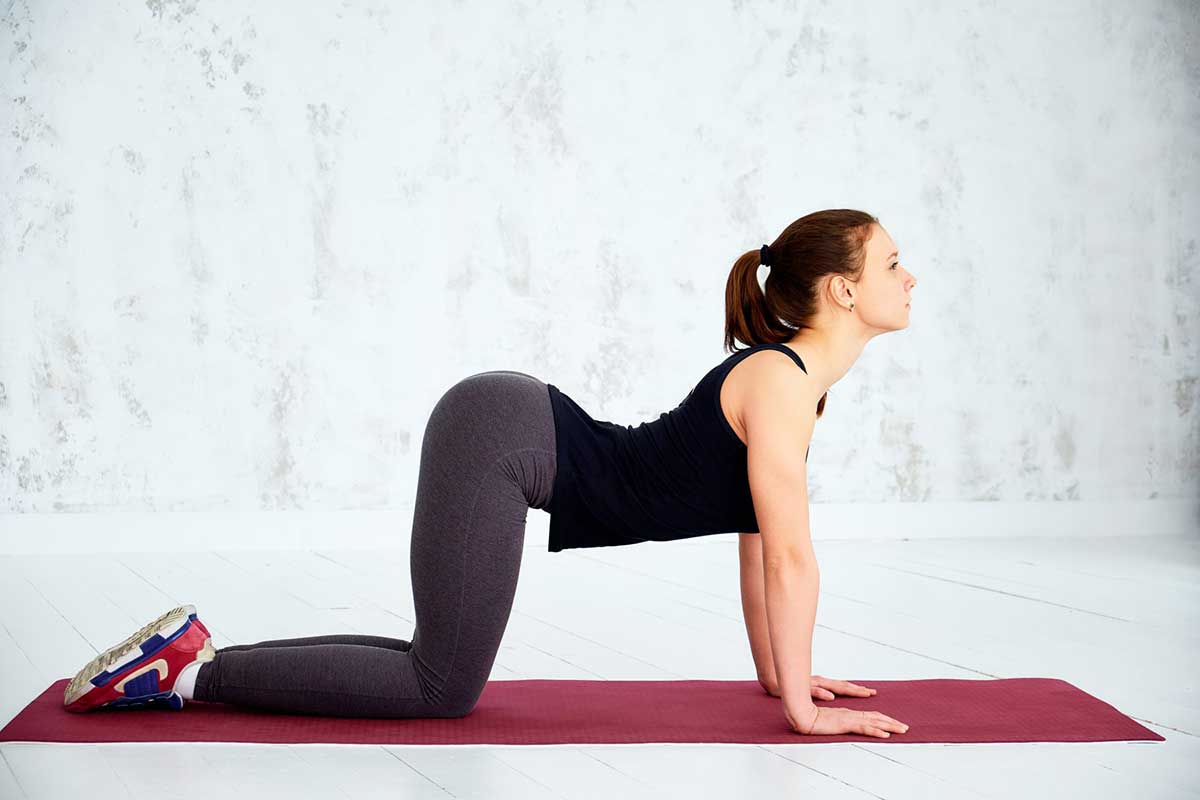
Stiffness in the spine is a big part of why better posture feels so uncomfortable at first. When the muscles along your back are tight, moving into an upright position feels unnatural — so your body avoids it.
Cat-Cow addresses that stiffness directly by taking the spine through its full range of motion, slowly and repeatedly.
Come onto all fours with your wrists under your shoulders and knees under your hips. On an inhale, let your belly drop toward the floor, lift your chest, and look slightly up (Cow). On an exhale, round your spine toward the ceiling, tuck your chin, and draw your belly in (Cat). Let your breath lead the movement — don’t rush it.
Do 10 full rounds. Think of it as wringing tension out of the spine before the real work begins.
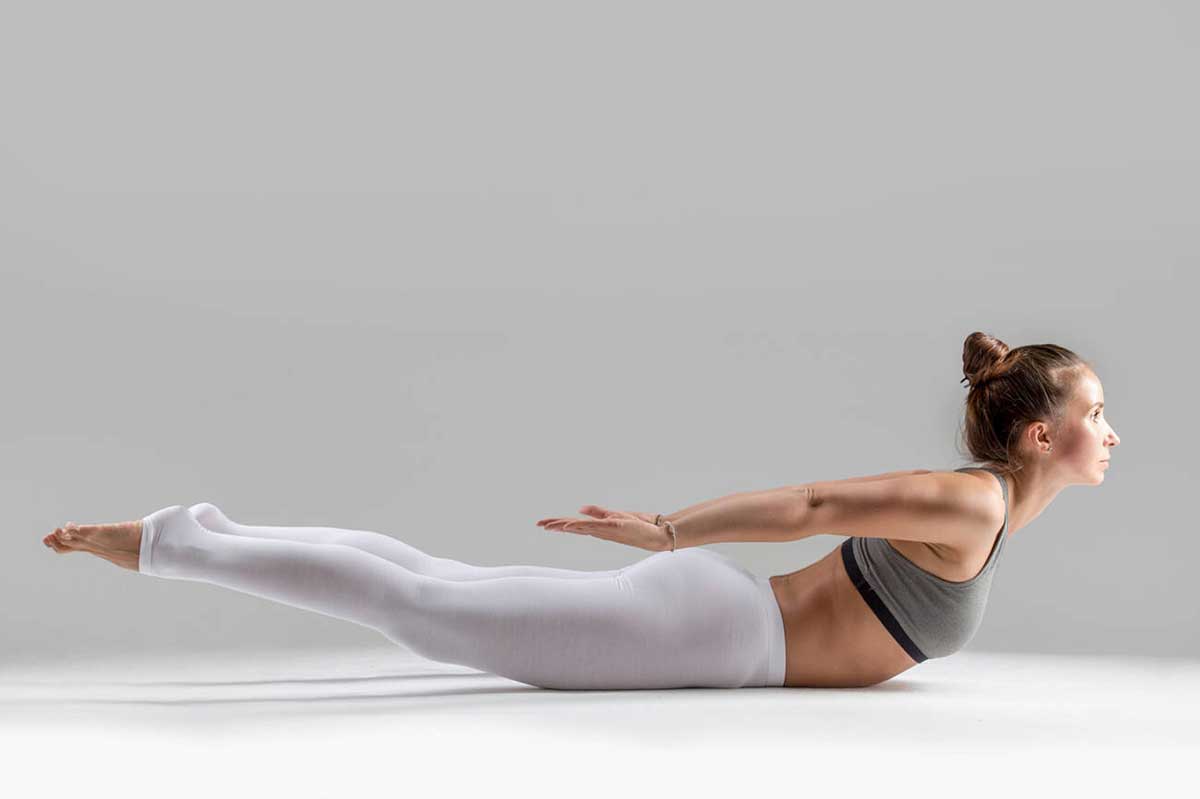
4. Locust Pose (Salabhasana) — The Muscle Builder
This is the hardest pose in the routine, and the most important.
Locust pose directly targets the back extensor muscles — the group responsible for keeping you upright for hours at a time. It’s also the pose most beginners underestimate. Don’t be discouraged if you can only hold it for five seconds at first. Work up gradually.
Lie face down with your arms alongside your body and palms facing down. On an inhale, simultaneously lift your chest, head, arms, and legs off the floor using your back muscles. Squeeze your shoulder blades together as if holding a pencil between them. Keep your gaze toward the floor to protect your neck.
Hold for 10 to 15 seconds, then lower down. Rest for a breath or two, then repeat three times. If 15 seconds is too much, start with five to eight seconds and build from there.
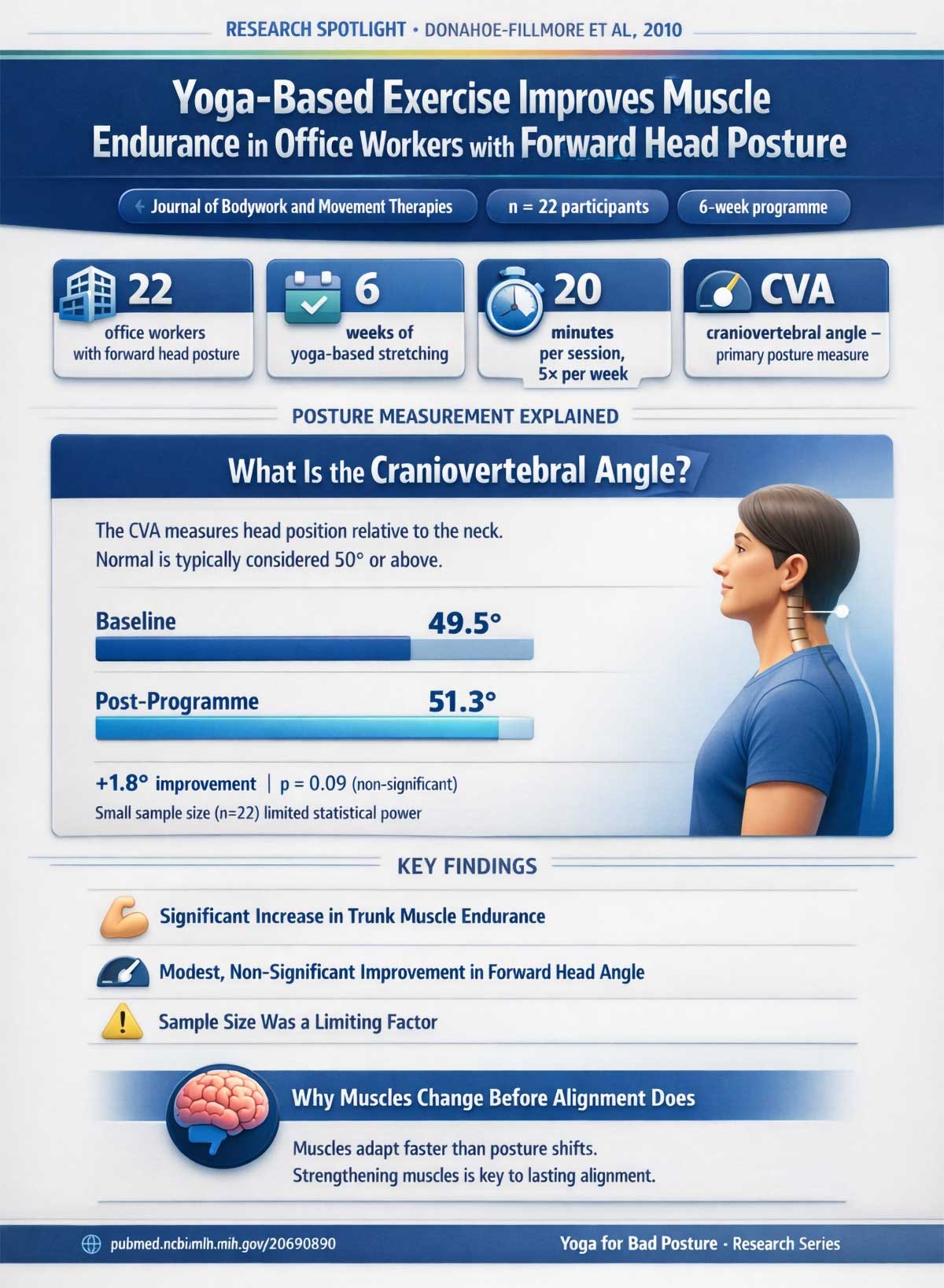
A 2010 study by Donahoe-Fillmore and colleagues worked with 22 office workers who had forward head posture. Over six weeks of yoga-based stretching and strengthening — 15 to 20 minutes, five times a week — participants showed significant improvements in muscle endurance, even though changes to the forward head angle itself were modest and didn’t reach statistical significance. The researchers noted the small group size likely limited the results. The takeaway: muscles respond faster than bone alignment shifts, and that muscle change is what drives long-term improvement.
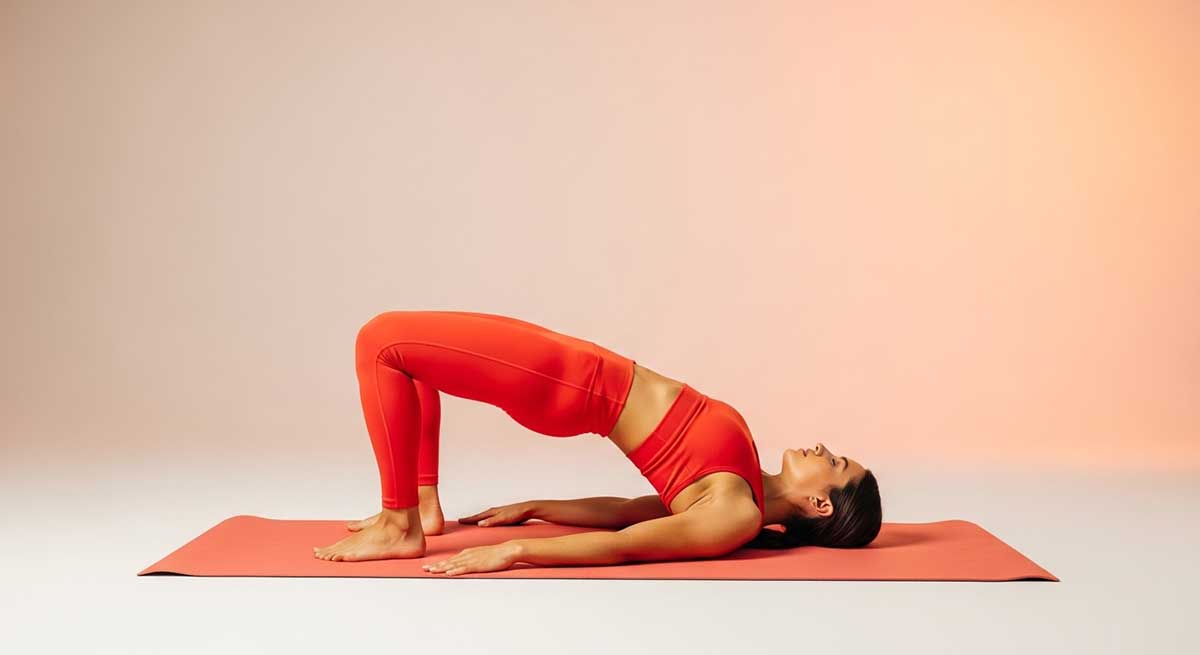
5. Bridge Pose (Setu Bandha Sarvangasana) — The Chest Opener
Sitting shortens two key muscle groups: your chest muscles (pectorals) and your hip flexors. A tight chest pulls your shoulders forward. Tight hip flexors tilt your pelvis and ripple up through your lower back. Bridge pose addresses both in one move.
Lie on your back with your knees bent and feet flat on the floor, hip-width apart. Press through your heels and lift your hips toward the ceiling. If it’s comfortable, interlace your fingers beneath you and roll your shoulders under your body — this deepens the chest stretch considerably.
Hold for 30 seconds to one minute.
If lifting your hips fully feels too intense, start by just pressing through your feet and lifting your tailbone slightly off the floor. Even a partial bridge opens the hip flexors and gets the glutes firing.
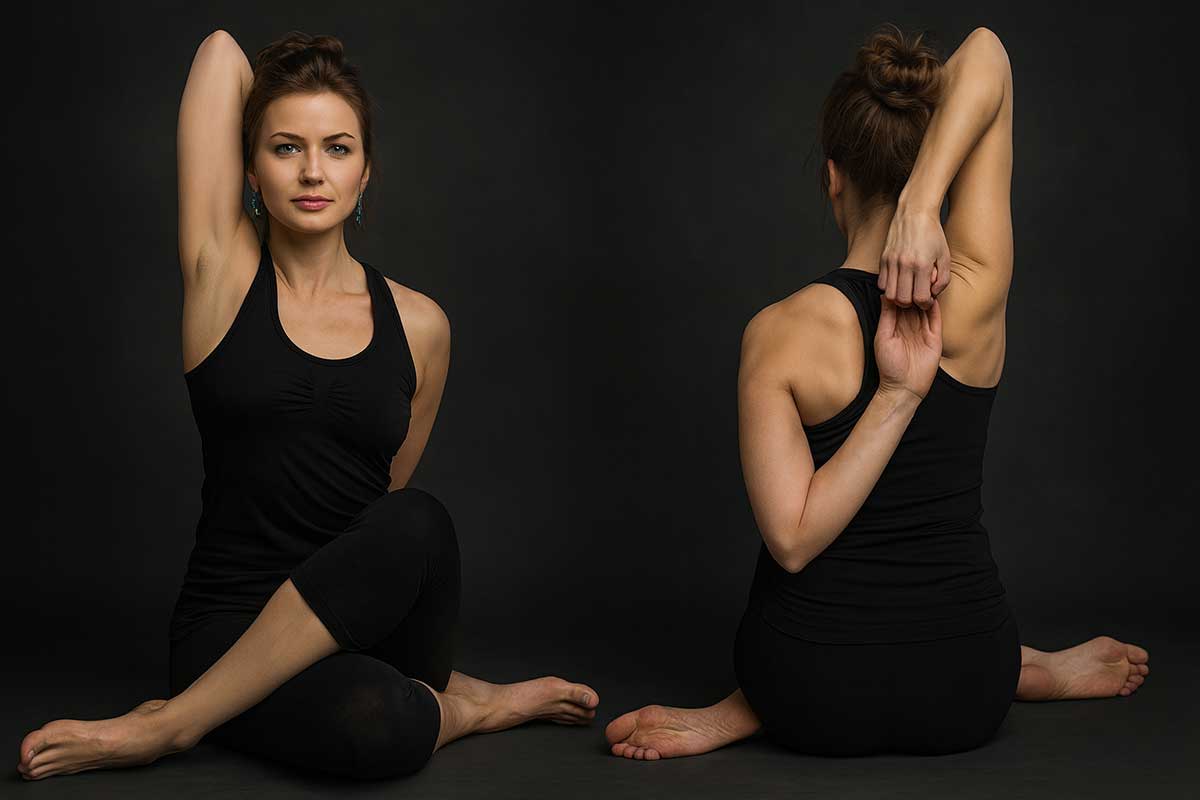
6. Gomukhasana Arms (Cow Face Arms) — The Shoulder Un-Roller
Rounded shoulders are one of the most visible signs of poor posture. The main driver is tightness in the muscles that rotate the arm inward — a pattern that builds up from typing and phone use over months and years.
Cow Face Arms targets that internal rotation directly.
Reach your right arm up toward the ceiling, then bend your elbow and let your hand drop behind your head. Reach your left arm out to the side, then bend it behind your back and try to clasp fingers together. If they don’t reach — which is completely normal for beginners — hold a folded t-shirt or hand towel and grip one end in each hand. No fancy strap needed.
Keep the top elbow pointing straight up, not drifting forward. That’s what tells you the stretch is reaching the right spot. Hold for 30 seconds per side, then switch.
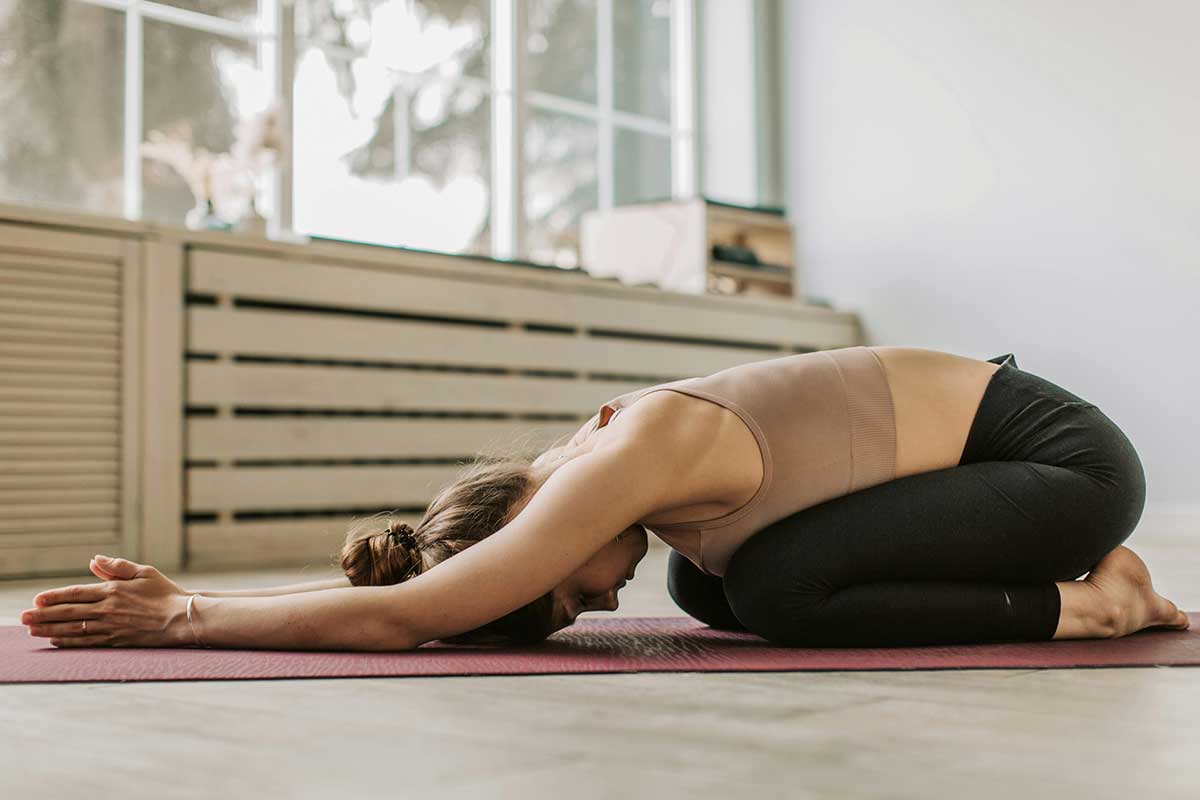
7. Child’s Pose (Balasana) — The Relief
After the strengthening work above, your back needs a release.
Child’s pose gently stretches the full length of the spine and offers quiet relief for the lower back. It’s also a natural way to signal to your body that the session is winding down.
Kneel on the floor with your knees wide and your big toes touching. Sit back toward your heels and stretch your arms forward along the floor. Rest your forehead down. Walk your fingertips as far forward as feels comfortable to deepen the stretch through the sides of your torso.
Hold for one to two minutes. Just breathe.
If sitting back on your heels is uncomfortable, place a folded blanket or pillow between your thighs and calves for support.
The 20-Minute “Desk Detox” Routine
Here’s how to put it all together. The best time to run through this? Right after you finish work, before you sit down on the couch. It helps your body actually leave work behind.
Warm-Up — Cat-Cow: 2 minutes
Body Awareness — Mountain Pose: 1 minute
Strengthening — Locust Pose + Bridge Pose: 5 minutes (alternate between the two with short rests)
Stretching — Sphinx Pose + Cow Face Arms: 5 minutes
Cool Down — Child’s Pose: 2 minutes
That’s roughly 15 minutes of active work, with the rest used for transitions and breathing. It fits into a lunch break or the gap between work and dinner.
What the Research Says About Pain
For many people, the most noticeable benefit of this kind of routine won’t appear in a mirror. It’ll be felt in the body — particularly in the neck.
Two separate trials led by Cramer (2013) and Michalsen (2012) followed 51 adults with chronic neck pain through a nine-week Iyengar yoga program. Both found that yoga significantly cut pain intensity and improved quality of life, with results comparable to targeted exercise and clearly better than usual care alone. Neither study promised a perfectly straight spine. Both delivered real, measurable relief from pain that had been present for months or years.
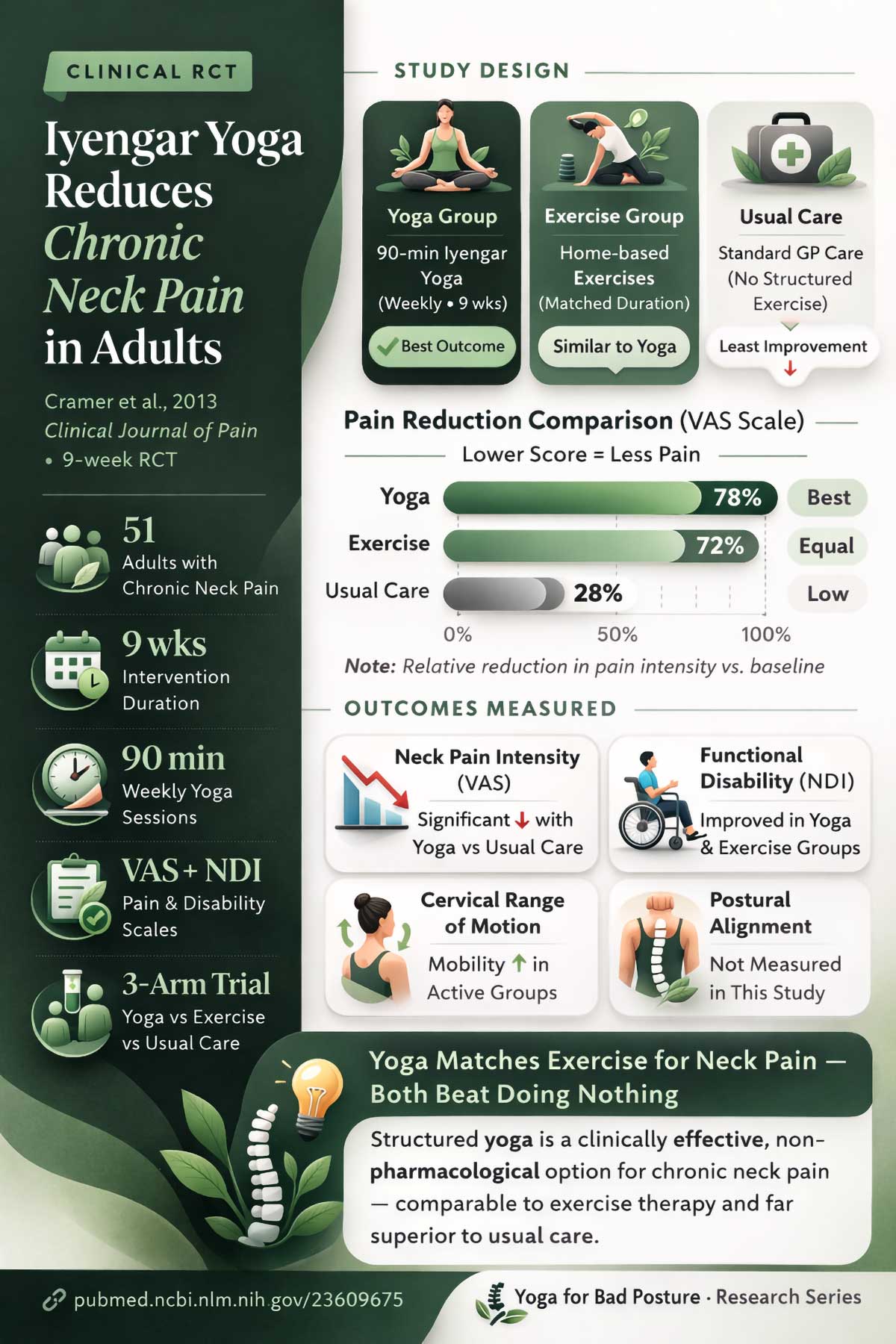
That matters if you’re doing this routine partly because your neck aches every evening. The pain relief may come before you notice any visible change in how you stand.
Conclusion
Good posture isn’t about rigid alignment or forcing your body into a fixed shape. It’s about having muscles that are strong and flexible enough to support you without effort.
The research consistently showed meaningful changes between six and nine weeks, with most benefits appearing by week six. Six weeks isn’t long. It’s the length of a school term or the time it takes to finish a decent book.
Try this routine for six weeks — three to four times a week, 20 minutes a session. Don’t measure yourself in the mirror after week one. Instead, notice whether your neck feels less tight at the end of a long day. Notice whether sitting upright starts to feel less like a chore.