Stress has become our constant companion, an unwelcome guest that overstays its welcome in our bodies and minds. Your body stays stuck in fight-or-flight mode, pumping out cortisol as if preparing for battle. You are not running from a tiger. You are just trying to get through your day.
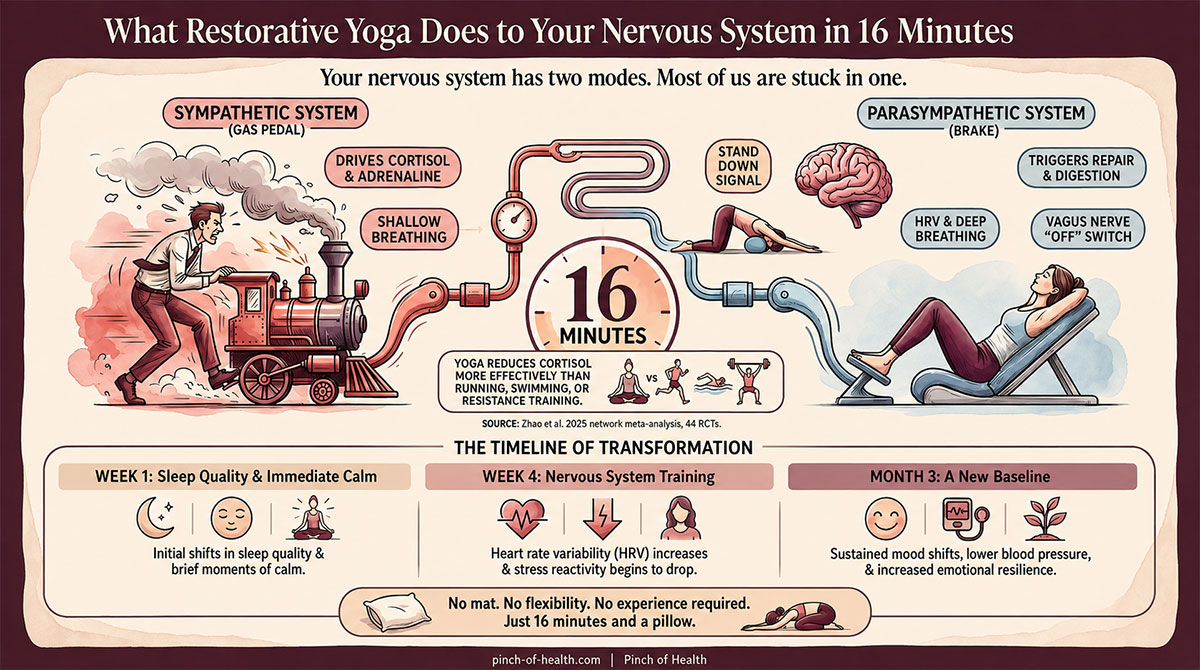
Sixteen minutes of restorative yoga can shift that. Not because it relaxes you the way a bath does, but because it directly changes what your nervous system is doing. A 2025 network meta-analysis of 44 randomized controlled trials found that yoga reduces cortisol in people with psychological distress more effectively than any other form of exercise tested, including running, swimming, and resistance training.
The mechanism is a nerve most people have never deliberately activated. The vagus nerve runs from your brainstem down through your chest and into your digestive system. When it fires, it sends one signal to your brain: the threat is over. Stand down. Restorative yoga is, among other things, a deliberate system for triggering that signal. The best part is that you do not need a studio, expensive gear, or an hour of free time to do it.
Benefits of Restorative Yoga
The research on restorative yoga is more specific than most people expect. These are not vague wellness claims. They are measurable physiological changes that appear consistently across multiple study types.
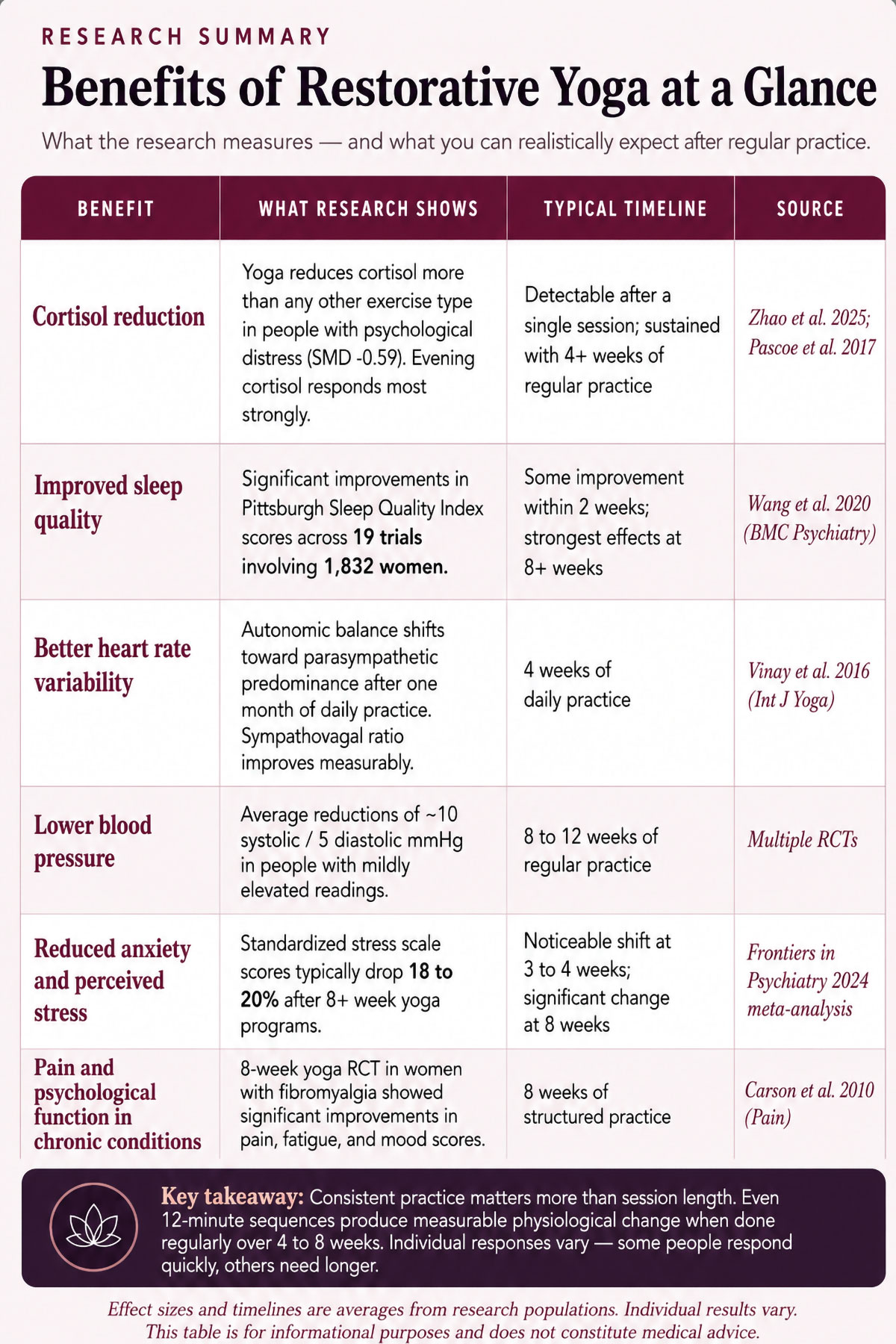
A 2017 meta-analysis in Psychoneuroendocrinology found that yoga significantly reduces cortisol levels, with the most pronounced effects appearing in the evening, when the stress hormone typically must fall for sleep to begin.
Sleep quality improves. Heart rate variability, a measure of the nervous system’s capacity to shift between states, increases after as little as four weeks of practice. Blood pressure responds too: studies consistently show average reductions of 10 systolic and 5 diastolic mmHg in people with mildly elevated readings.
Perhaps the most useful benefit for the people who need this most is accessibility. Restorative yoga requires no strength, no flexibility, and no previous experience. If you can lie on the floor with a pillow under your knees, you can do it.
Understanding Your Stress Response: What Is Really Happening Inside
Before getting into the poses, it helps to understand what stress is actually doing to your body. Not in vague terms, but mechanically.
Your nervous system runs on two tracks. The sympathetic nervous system is your gas pedal: it accelerates everything when you face a challenge. Your heart pumps faster. Breathing gets shallow. Muscles tense. Blood rushes to your arms and legs. The parasympathetic nervous system is your brake. Heart rate drops. Breathing deepens. Digestion works properly. Your body repairs and heals.
Here is the problem. Most people spend their days with one foot stuck on the gas. Your body cannot tell the difference between a work deadline and a charging bear. It treats both as life-or-death threats.
Chronic stress activates what scientists call the HPA axis: your hypothalamus, pituitary gland, and adrenal glands working together. When this system fires, it floods your body with cortisol. A little cortisol is fine. Your body needs it. But too much, for too long, breaks you down. High cortisol reduces the volume of brain regions involved in memory and learning. It weakens immune function. It disrupts digestion. It packs on belly fat. It steals sleep.
Yoga appears to work by improving how the HPA axis regulates itself, according to the same line of research that found cortisol reductions. It helps your body become more sensitive to feedback signals that say the threat is over and you can stand down. The breathwork and slow movements in restorative poses also directly activate the parasympathetic nervous system through vagal stimulation.
Signs Your Nervous System Needs Help
If three or more of those apply to you, your nervous system is probably stuck in stress mode. That is where restorative yoga does its most direct work.
Restorative Yoga Benefits: What the Research Shows
The sleep research was striking enough that it took a moment to sink in properly.
A 2020 systematic review published in BMC Psychiatry, whose literature search concluded in June 2019, analyzed 19 studies involving 1,832 women with sleep problems. Yoga significantly improved sleep quality compared to no treatment, with the strongest effects appearing on the Pittsburgh Sleep Quality Index.
Three of those studies specifically measured insomnia severity and found no significant effect, an important distinction: the evidence is stronger for sleep quality in general than for clinical insomnia specifically.
A separate study followed people with chronic insomnia through 14 weeks of individualized Viniyoga practice. The 2022 trial published in BMC Psychiatry found that participants had fewer nighttime awakenings on actigraphy (a wrist-based activity tracker), though polysomnography, the more sensitive laboratory measure of sleep architecture, showed no significant change. The subjective improvements were real. The objective picture was more mixed than it first appeared. That distinction matters.
The cortisol evidence is more consistent. The Pascoe meta-analysis confirmed significant reductions in cortisol across yoga intervention studies. A 2004 randomized controlled trial by West and colleagues that directly compared Hatha yoga to African dance found that cortisol dropped after the yoga session, while the dance condition produced the opposite pattern.
Yoga also appears to train the nervous system rather than just temporarily calming it. A 2016 study in the International Journal of Yoga enrolled 40 healthy male volunteers in one month of daily yoga practice and measured heart rate variability before and after. The sympathovagal balance shifted meaningfully toward parasympathetic predominance. Their bodies had learned to relax more efficiently.
For heart rate variability specifically, a 2016 randomized controlled trial by Hopkins and colleagues tested heated yoga in women at risk for obesity-related illness. Participants with elevated cortisol reactivity showed greater reductions in their stress hormone response compared to a control group.
Heated yoga differs from the restorative practice described here. The underlying mechanism, vagal activation and HPA axis modulation, is shared. That convergence is worth reflecting on. It suggests that what restorative yoga is actually doing has less to do with the specific poses and more to do with the sustained, supported conditions it creates for the nervous system to downregulate. The container matters more than the content.
For longer-term benefits, a 2025 scoping review published in Frontiers in Neurology analyzed 57 studies on yoga and sleep quality. Interventions lasting 17 weeks or longer showed the most robust results, with all of those long-duration studies reporting significant improvements in sleep quality measures.
This finding is specific to sleep outcomes, not general yoga benefits. Shorter interventions also produced meaningful effects, though less consistently. The honest question the research cannot yet answer is whether those gains persist once someone stops practicing, or whether the nervous system simply resets. Nobody has followed people long enough through a genuine cessation period to find out.
These beginner-friendly props provide the support needed to relax fully into restorative poses and make the practice more comfortable at home.

Manduka Enlight Yoga Bolster
A high-quality bolster is the most important prop for restorative yoga, providing comfortable support in reclined poses, Child's Pose, and chest-opening postures featured throughout the article.

Gaiam Yoga Block (2-Pack)
Yoga blocks help modify poses for different flexibility levels and provide stable support under the hands, hips, or back during longer holds.

Tumaz Yoga Strap
A yoga strap makes supported stretches more accessible without forcing flexibility, aligning perfectly with the article's emphasis on gentle, passive stretching.

Mexican Yoga Blanket
A firm yoga blanket can be folded to support the knees, neck, hips, or shoulders, making nearly every restorative pose more comfortable.
These are Amazon Associate affiliate links, which help support this site at no extra cost to you.
The 7 Poses to Reset Your Nervous System
Each pose targets a different area where tension lives. Hold each one for at least two minutes to give your nervous system time to register the shift for step-by-step bolster positioning and detailed modifications for each pose.
1. Supported Child’s Pose (Balasana)
What it does: This pose grounds you fast. It is as close as restorative yoga has to a reset button you can hit in the first thirty seconds.
Why it works: When you fold forward, you gently stretch your lower back and place gentle compression on your belly. That compression stimulates the vagus nerve, the longest nerve in your body, which runs from your brainstem down through your chest and into your digestive system. When this nerve activates, it sends calm signals throughout your body. Heart rate slows. Breath deepens. The fight-or-flight alarm begins to quiet.
How to do it:
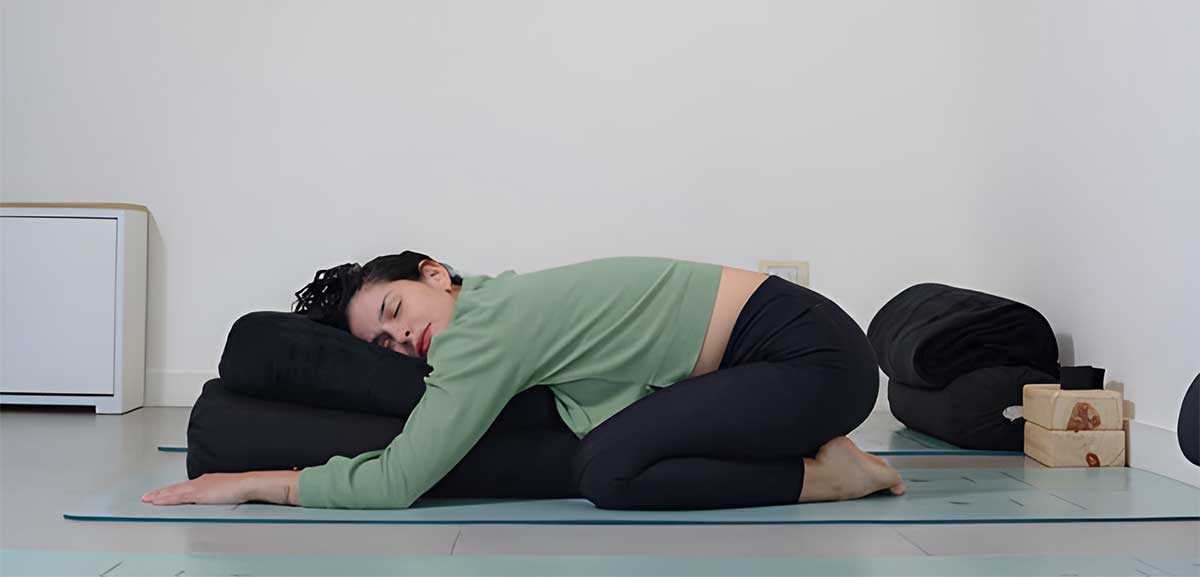
- Kneel on the floor with your knees wide apart and your big toes touching behind you.
- Stack pillows between your knees, high enough that you can rest completely on them without forcing your head down.
- Fold forward and let your torso and head sink into the pillows.
- Rest your arms forward or by your sides, whichever feels more comfortable.
- Close your eyes and breathe into your lower back. Let gravity do the work.
Hold for 3 to 5 minutes.
Common mistakes:
- Do not force your head down when the pillows are not high enough. Add more support until your forehead rests without effort.
- Keeping your knees too close together limits how far you can fold.
- Do not hold tension in your shoulders. Let them drop completely.
Modifications:
- For tight hips, place a rolled towel between your calves and thighs.
- For knee discomfort, fold a blanket behind your knees before you come forward.
- If kneeling is not possible, sit in a chair and fold forward over a pillow on your lap.
What you should feel: A gentle stretch in your lower back and hips, a sense of being held, and your breathing becoming easier with each exhale.
2. Melting Heart Pose (Anahatasana)
Hours at a desk train your chest to stay collapsed. The hunched posture is not laziness. It is the body conserving energy in a position it has learned to expect. What chest-opening poses do is interrupt that expectation. When you lower your sternum toward the floor and let your shoulder blades draw apart, the change in geometry directly affects how deeply you can breathe. Fuller breath activates the vagus nerve through its thoracic branches. The effect is not metaphorical.
How to do it:
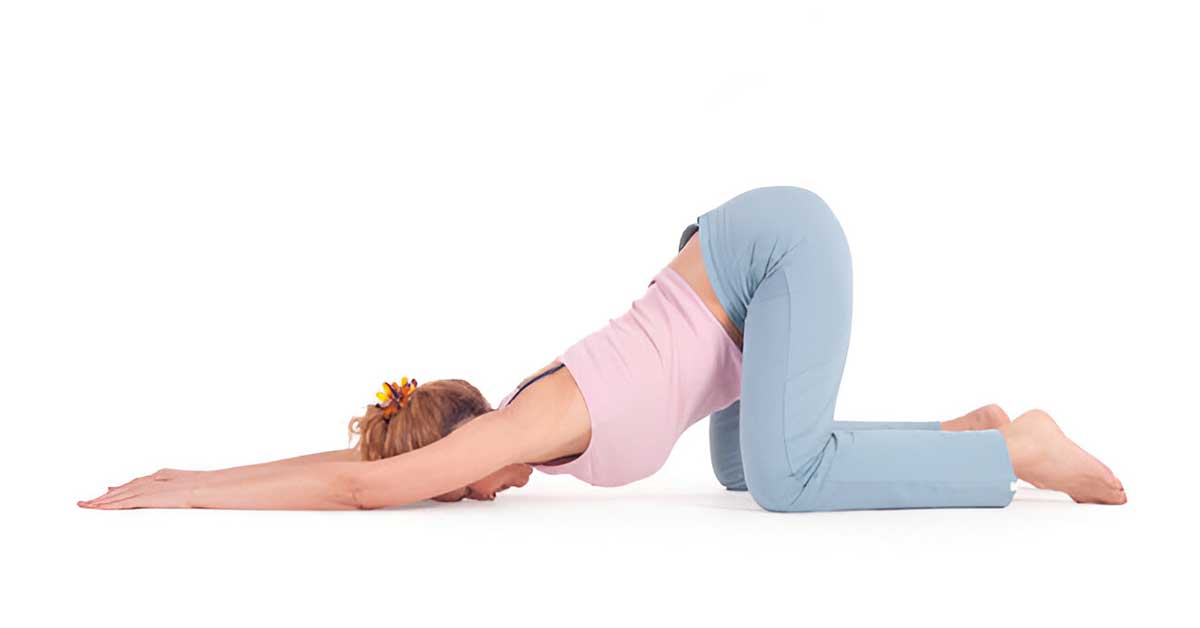
- Start on your hands and knees with your hips directly over your knees.
- Walk your hands forward while lowering your chest toward the floor.
- If your chest does not reach the floor, place a folded blanket underneath for support.
- Rest your forehead on the floor or on a pillow.
- Breathe into the space between your shoulder blades and stay for 2 to 3 minutes.
Hold for 2 to 3 minutes. Do not let your hips drift forward. They stay directly over your knees. Do not hold your breath. For wrist discomfort, place a folded towel under your hands. For shoulder issues, keep your arms wider apart. What you should feel is a strong but comfortable stretch across your chest and in your armpits, and your breathing becoming freer the longer you stay.
3. Supported Bridge Pose (Setu Bandha Sarvangasana)
What it does: This gentle backbend energizes while it calms. It is the sweet spot between active and restful.
Why it works: Sitting all day shortens your hip flexors, and tight hip flexors push stress directly into your lower back. This pose opens the front of your hips and creates a mild inversion that encourages blood flow back toward your heart. A 2016 trial in the Journal of Consulting and Clinical Psychology found that participants with elevated cortisol reactivity who practiced yoga showed greater reductions in their stress hormone response than controls. The bridge pose was part of their practice sequence.
How to do it:
- Lie on your back with your knees bent and your feet flat on the floor.
- Press through your feet and lift your hips a few inches off the ground.
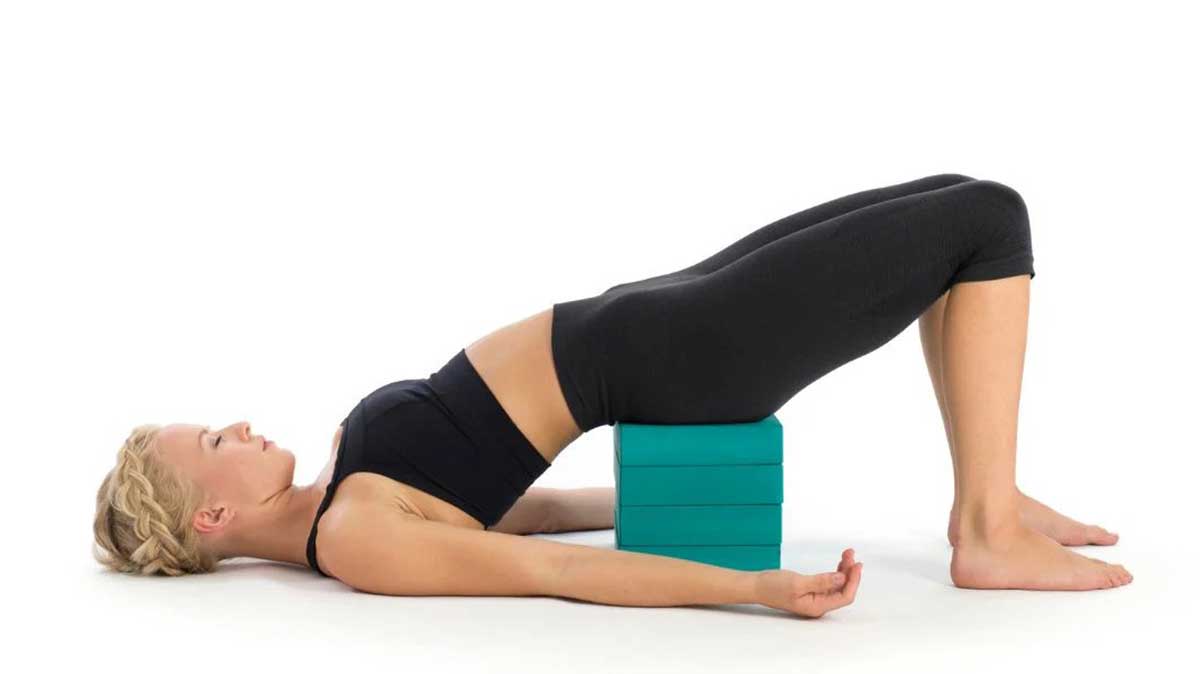
- Slide a firm pillow, folded blanket, or stack of books under your sacrum (the flat bone at the base of your spine).
- Lower your hips onto the support. Your weight should rest comfortably on the prop, not on your lower back muscles.
- Let your arms rest by your sides, palms facing up, and stay for 3 to 5 minutes.
- To come out, press into your feet, lift your hips slightly, remove the prop, and lower slowly.
Hold for 3 to 5 minutes.
Common mistakes:
- Avoid placing the support too high on your back. It should be under your sacrum, not your lumbar spine.
- Do not use a prop that is too soft. You need firm support that holds its shape.
- Do not tense your glutes. Once you are on the support, let everything relax.
Modifications:
- For lower back discomfort, use a lower support and check that it is under the sacrum, not the lumbar curve.
- If your feet slip, place them against a wall.
- For neck sensitivity, place a thin folded towel under your head.
What you should feel: A gentle opening across the front of your hips and a soft arch in your upper back. No pinching or sharp pain in your lower back. If you feel that, lower your support height.
4. Reclined Bound Angle (Supta Baddha Konasana)
What it does: This pose creates deep release in your hips and belly, two of the body’s primary tension storage areas.
Why it works: Your inner thighs and pelvic floor hold chronic stress in ways that most people have no name for. They tighten under anxiety, under frustration, under the low-grade pressure that accumulates over a day, and they rarely receive specific attention in any other practice. When you open those muscles with support underneath and stay long enough for the nervous system to register it, something happens that is not purely physical.
The pelvis and pelvic floor appear to hold emotional tension in ways that researchers are still working to characterize. What is well-documented is that people often feel unexpected emotion in this pose. Not distress. More like a sudden awareness of something that was already there.
A 2010 randomized controlled trial by Carson and colleagues in the journal Pain found that eight weeks of yoga practice in women with fibromyalgia produced significant improvements in pain levels, fatigue, and psychological functioning. Reclined hip-opening poses were central to that program. That is worth knowing before you begin.
How to do it:
- Sit on the floor and bring the soles of your feet together, letting your knees drop open to the sides.
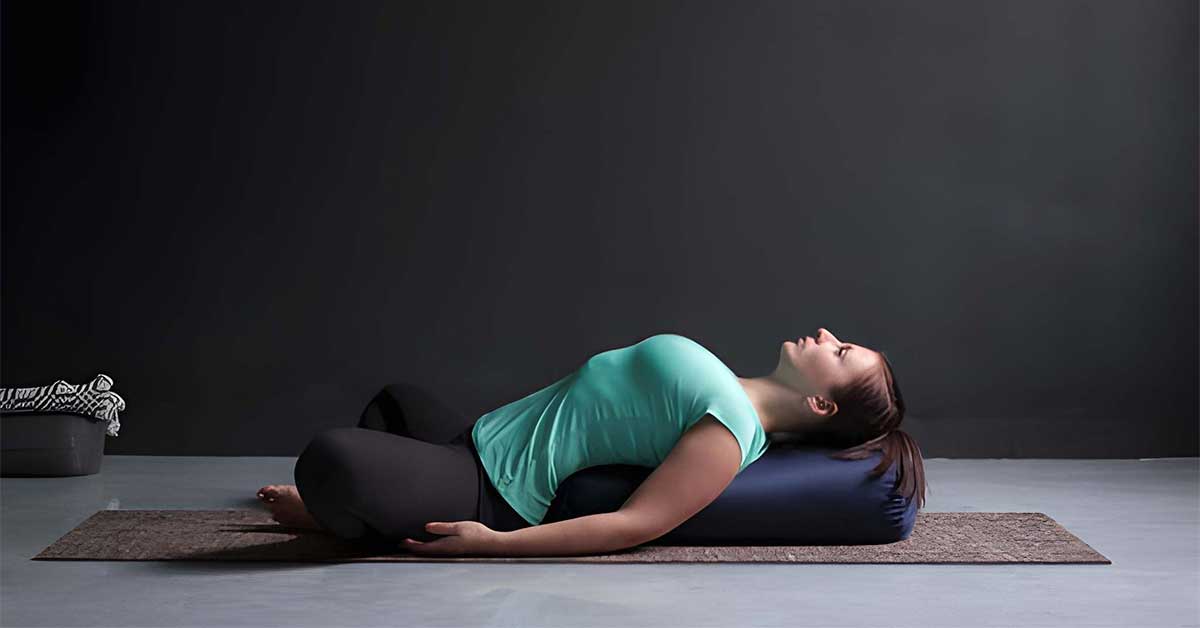
- Place pillows behind you to create a ramp for your back.
- Lie back onto your pillow ramp. If the inner thigh stretch feels too intense, place rolled towels or small pillows under each knee.
- Rest your arms out to the sides with palms facing up.
- Stay for 5 to 10 minutes. This is a pose you can sink into. Let your body get heavy.
Hold for 5 to 10 minutes.
Common mistakes:
- Do not force your knees toward the floor. Gravity should do the work, not muscle effort.
- Avoid lying completely flat without the reclined ramp. The angle helps your lower back stay comfortable.
- Do not hold tension in your shoulders or jaw.
Modifications:
- For tight hips, place blocks or pillows under each knee until the inner thigh sensation is gentle, not sharp.
- If your lower back arches too much, add more pillows under your back.
- For pregnancy in the second or third trimester, elevate your upper body more steeply.
What you should feel: A gentle, sustained stretch in your inner thighs and groin, a softening in your belly, and breathing that feels easy rather than managed. If something emotional moves through, let it. It usually passes within a minute or two.
5. Legs Up the Wall (Viparita Karani)
This is what your body has been waiting for since you sat down this morning.
When your legs are elevated, gravity pulls blood back toward your heart without any muscular effort. Your heart gets a break. Your lymphatic system drains fluid that has been pooling in your lower legs all day. And something quieter happens too: your nervous system registers the changed position as safe, and your stress hormones begin to fall.
The Pascoe meta-analysis of yoga and heart rate variability noted that gentle inversions appear to directly stimulate the vagus nerve through its pathways in the chest and abdomen. That is the physiological explanation for why this pose can feel like a full exhale after a long breath held too long.
How to do it:
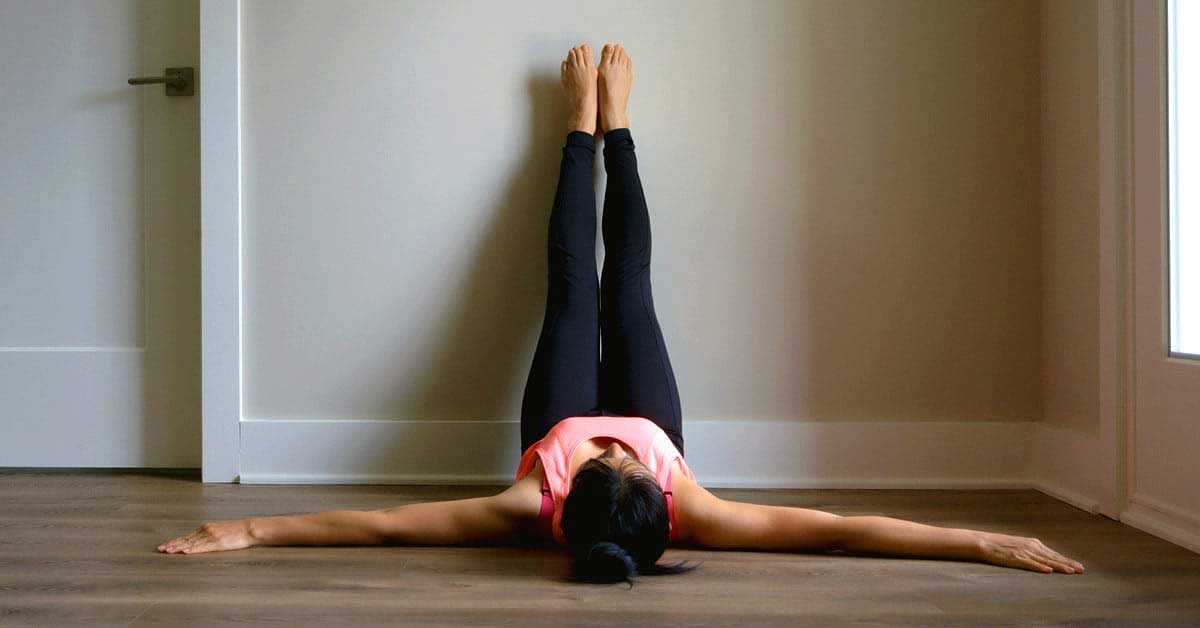
- Sit sideways next to a wall with your hip touching it.
- As you lower onto your side, swing your legs up the wall.
- Scoot your hips as close to the wall as comfortably as you can. They can touch the wall or sit a few inches away.
- Let your arms rest by your sides, palms facing up. A small pillow under your head is optional.
- Stay for 5 to 10 minutes.
- To come out, bend your knees and roll to one side. Rest there for a breath before sitting up.
Hold for 5 to 10 minutes.
For tight hamstrings, move your hips a few inches back from the wall. The inversion effect still works. For lower back sensitivity, slide a folded blanket under your hips. Come out slowly after any inversion. Standing up quickly can cause light-headedness as your circulatory system readjusts.
While you are here, try 4-7-8 breathing: inhale for 4 counts, hold for 7, exhale for 8. That extended exhale directly activates the parasympathetic response and deepens the pose’s effect.
6. Supported Supine Twist
What it does: This twist releases spinal tension and gives your digestive system a gentle massage, which matters because stress and gut function are directly connected through the vagus nerve.
Why it works: Rotation realigns your spine and stimulates your internal organs. The gut-brain connection runs through the same vagal pathways that restorative yoga activates. Gentle compression in twisting poses can stimulate those pathways, which partly explains why people often feel calmer and more settled after twisting poses than they did going in.
How to do it:
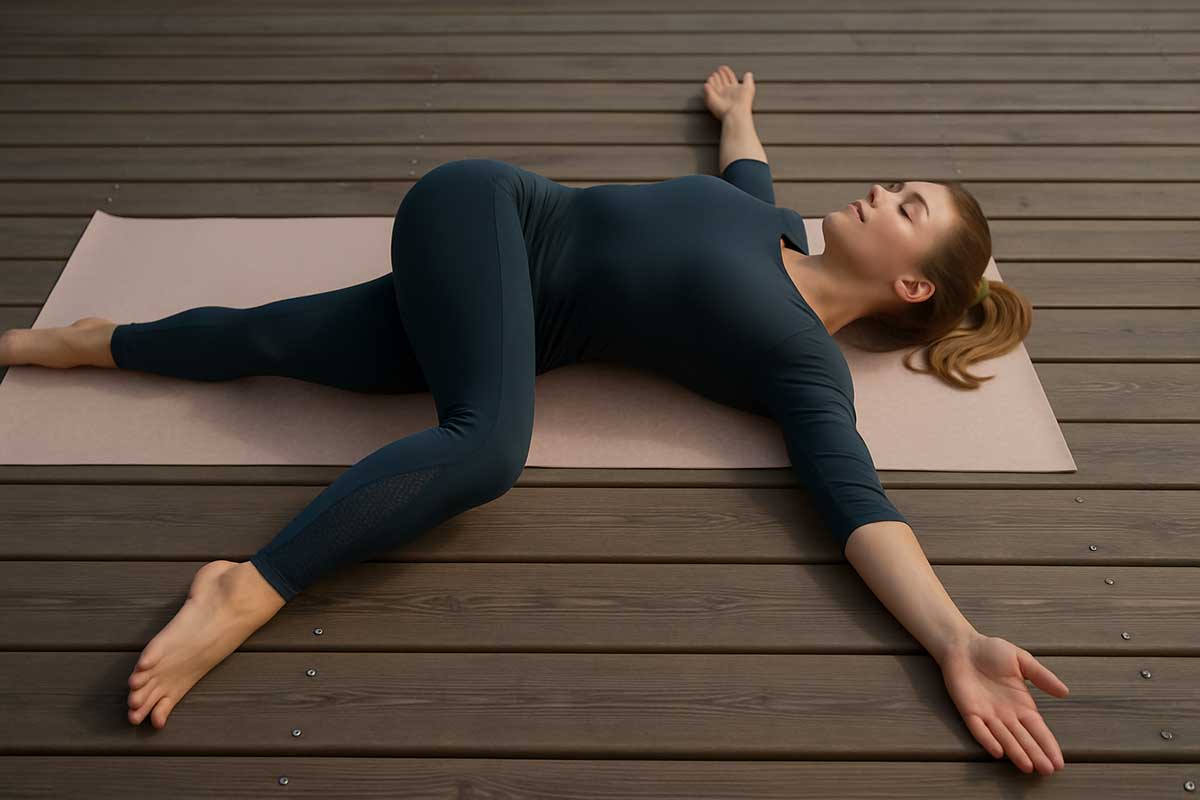
- Lie on your back and draw both knees into your chest.
- Drop your right knee over to your right side, letting it rest on a pillow.
- Extend your arms out to the sides. Turn your head to the left if that feels comfortable on your neck.
- Breathe into your belly and stay for 2 to 3 minutes.
- Bring your knees back to center, hug them briefly, then drop your other knee to the left and repeat.
Hold for 2 to 3 minutes on each side.
Common mistakes:
- Do not force your knees to the floor without a pillow. Use support so your hips and spine can relax.
- Do not twist too far. You should feel a gentle spiral, not strain.
- Do not hold your breath during the twist.
Modifications:
- For shoulder issues, keep your bottom arm down by your side instead of extended.
- For neck sensitivity, keep your head centered rather than turning.
- If your knees do not reach the pillow, stack more support underneath.
What you should feel: A gentle spiral through your spine, a stretch along the outside of your top hip, and relief in your lower back. You may hear gentle cracking. That is joint gas releasing, which is safe and normal.
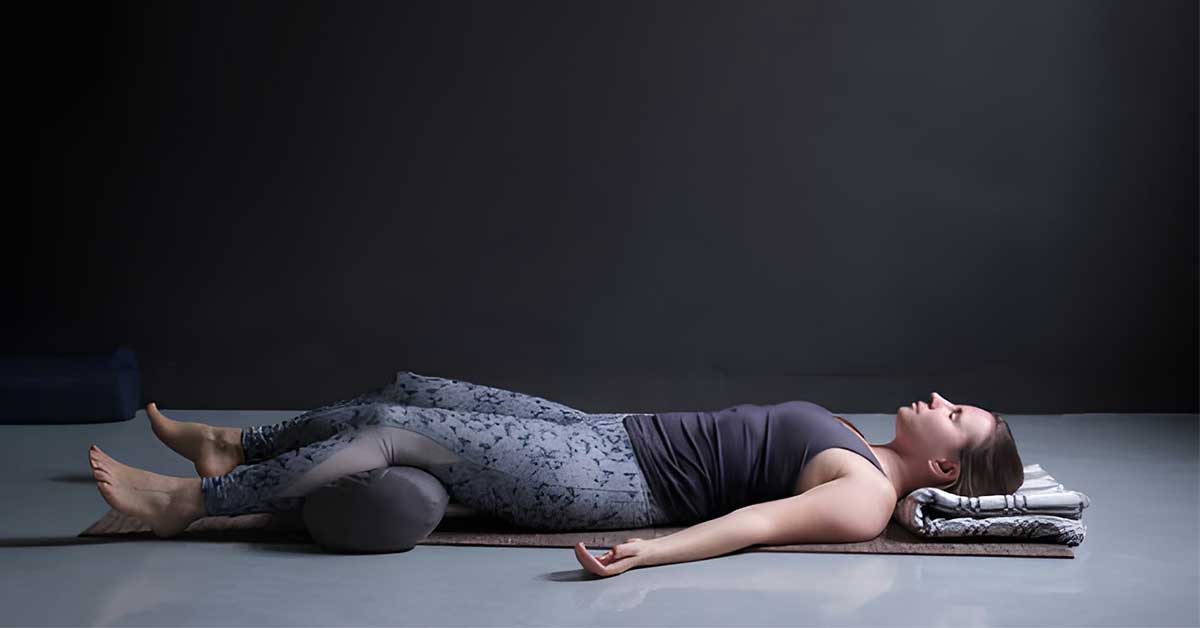
7. Corpse Pose with Bolster (Savasana)
Most people skip this one. That is the mistake.
Everything you did in the last ten minutes consolidates here. The released muscle tension, the slower breathing, the shift in your nervous system: your body needs stillness to process what just happened. Without this final pose, you are closing a file without saving. The work is done. Savasana is where it gets stored.
Researchers studying yoga nidra, a form of conscious relaxation similar to extended Savasana, used electroencephalogram recordings to track brain activity during the practice. Delta wave activity increased in specific brain regions associated with local sleep states, while the practitioner remained conscious. A separate randomized controlled trial found that patients with chronic insomnia who practiced yoga nidra showed improvements in total sleep time and reductions in salivary cortisol. This is not lying around. The body is doing something.
- Lie flat on your back.
- Place a rolled blanket or firm pillow under your knees. This is not optional: it takes pressure off your lower back and makes full relaxation possible.
- Let your feet fall open naturally.
- Rest your arms a few inches from your body, palms up.
- Cover your eyes with a folded cloth if you have one. The gentle pressure helps quiet your mind.
- Set a timer, then forget about it. Be completely still.
- When the timer sounds, take a few deep breaths, wiggle your fingers and toes, roll to one side, and rest there for a breath before sitting up.
Hold for a minimum of 3 to 5 minutes. Ten to twenty minutes is ideal if you have the time.
Your mind will wander. That is not a problem to fix. Each time you notice you have drifted, return your attention to your breath. Count if it helps: inhale (one), exhale (one), inhale (two), exhale (two). Give your busy mind a simple job. Some people fall asleep. That is fine too.
The 16-Minute Restorative Yoga Sequence for Stress Relief
Your guided restorative yoga sequence. Click Start when you are ready, and the timer will walk you through each pose.
Kneel with knees wide, fold forward onto pillows or a bolster. Lengthen each exhale. Let your lower back soften with every breath out.
Stay where you are for a few slow breaths before you get up. That shift in your nervous system is real. Give it a moment to settle.
Breathwork That Amplifies the Benefits
Your breath is the fastest way to change your nervous system. You can use specific breathing techniques to deepen the effect of every pose.
4-7-8 Breath (Relaxing Breath)
Andrew Weil, a physician at the University of Arizona, developed this pattern specifically for anxiety and insomnia. The extended exhale is the key: it directly activates the parasympathetic nervous system.
- Exhale completely through your mouth.
- Close your mouth and inhale through your nose for 4 counts.
- Hold your breath for 7 counts.
- Exhale through your mouth for 8 counts.
Repeat 3 to 4 cycles. Use this during Legs Up the Wall or any time anxiety peaks.
Belly Breathing (Diaphragmatic Breathing)
This is the foundation of all yoga breathing. Full engagement of the diaphragm stimulates the vagus nerve and shifts your breathing from shallow chest breathing to deep abdominal respiration.
- Place one hand on your chest and one on your belly.
- Breathe in through your nose, letting your belly rise while your chest stays relatively still.
- Exhale slowly through your nose, feeling your belly fall.
Continue for 2 to 3 minutes. Use this during Child’s Pose or Savasana.
Extended Exhale Breathing
Exhaling for longer than you inhale reliably shifts you into the parasympathetic state. This asymmetry in breath length is one of the most direct physiological routes to lower heart rate and reduced cortisol output.
- Inhale through your nose for 3 counts.
- Exhale through your nose for 6 counts.
- Gradually extend your exhale to 8 to 10 counts as you become comfortable.
Use this during twists and forward bends, or any time you need to calm down quickly.
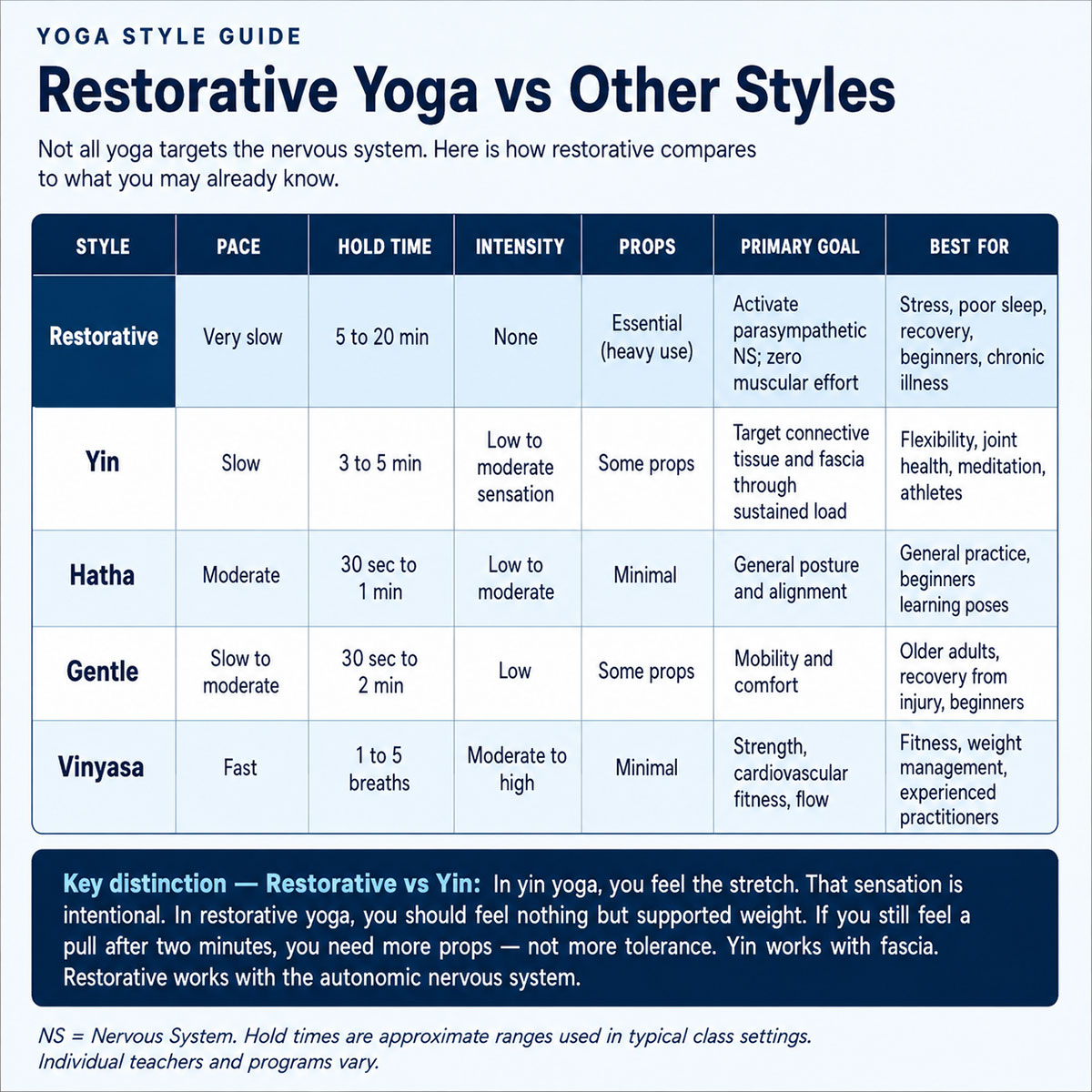
Restorative Yoga vs Other Yoga Styles
Not all yoga is the same. The differences matter, particularly if you have been trying active yoga styles to manage stress and have found the results disappointing.
Restorative Yoga vs Yin Yoga
This distinction comes up constantly, and it matters more than the comparison to active styles. In yin yoga, you feel the stretch. That sensation is intentional: yin targets connective tissue through sustained load, and you are expected to be at your edge for the duration of the hold. In restorative yoga, you should feel nothing but supported weight. If you are still feeling a pull after two minutes, you need more props, not more tolerance.
Yin works with your fascia and joint capsules. Restorative works specifically with your autonomic nervous system. Both are slow, passive, and prop-assisted. But the experience is categorically different: one involves deliberate sensation, the other aims to eliminate it entirely.
Mini Routines for Specific Needs
Sometimes you need targeted help. Here are four specialized sequences for the most common situations.
For Insomnia (15 Minutes Before Bed)
Yoga programs specifically targeting sleep have shown improvements in both how people rate their sleep quality and objective measures like the number of nighttime awakenings. A brief sequence before bed signals to your body that the day is ending.
For Anxiety (10 Minutes Anytime)
For Lower Back Pain (12 Minutes)
For Menstrual Cramps (15 Minutes)
Your 7-Day Restorative Yoga Plan
Starting a new practice can feel overwhelming. This plan builds gradually, beginning with one pose so the habit forms before the routine does.
After week one, aim for the full 16-minute sequence daily, or the complete seven-pose practice three to four times per week. Add the mini routines as specific needs arise.
Common Challenges and How to Fix Them
“I feel more anxious when I slow down”
This is incredibly common. When you stop being busy, you become aware of feelings you have been avoiding. Your activity level has been covering up emotions that surface the moment you get still.
Start with shorter holds of 2 to 3 minutes. Keep your eyes open if closing them feels uncomfortable. Try Legs Up the Wall first. It tends to be the most grounding pose for people who find stillness anxiety-inducing. Consider soft background music. This discomfort typically passes within one to two weeks of regular practice as your nervous system learns that stillness is safe.
“I fall asleep during practice”
This probably means you are sleep-deprived. Your body is taking what it needs. If you are falling asleep in every pose, try practicing earlier in the day. Keep the room slightly cooler. Use more props to stay somewhat upright rather than fully horizontal. If you are chronically exhausted, that is information worth acting on.
“I do not feel anything”
Some people do not notice dramatic changes at first. That does not mean nothing is happening. Track objective markers instead of subjective impressions: are you falling asleep faster? Waking up less? Having fewer tension headaches? Feeling less reactive to small frustrations? The Vinay 2016 HRV study found physiological improvements after four weeks, even in participants who did not report feeling different. Give it three to four weeks of consistent practice before concluding it is not working.
And if you still feel nothing after a month, consider that the changes may be occurring at a level you cannot directly observe. Heart rate variability, cortisol diurnal patterns, and autonomic tone: these are not sensations. Whether subjective experience eventually catches up with physiological change, or whether some people simply respond differently at the level of felt experience, is something the research has not settled.
“My mind will not stop racing”
Your mind’s job is to think. You are not trying to stop thoughts. You are practicing returning attention to breath after you notice it has wandered. Count your breaths: inhale (one), exhale (one), up to ten, then start over. If you lose count, start over at one. This gives your mind a simple task. Some people need to count to one hundred before settling. That is fine.
“I cannot hold poses that long”
Start with two-minute holds. Build up by adding thirty seconds per week. Some poses will always feel more comfortable than others. That is normal. Do the ones that work for your body and skip or abbreviate the rest.
Making It a Habit: Your Practice Plan
The hardest part is not the poses. It is doing them consistently.
Link It to Something You Already Do
Your brain builds habits through repetition paired with existing triggers. After you brush your teeth at night: Legs Up the Wall. After your morning coffee: Child’s Pose. Before you get into bed: the insomnia routine. The specific pairing matters less than choosing one and doing it for two weeks.
Set Up Your Space in Advance
Do not wait until you are already stressed to gather props. Stack your pillows in a designated spot. Keep a folded blanket nearby. Lower every barrier to starting: if your props are ready, you are more likely to use them.
Start With One Pose
Days one through seven: one pose for five minutes. That is the whole practice. Days eight through fourteen: add a second pose. Days fifteen through twenty-one: add a third. Small wins build durable habits.
Track Completion, Not Quality
A simple calendar checkmark for each day you practice is all you need. Research on habit formation found that tracking whether you showed up, rather than how well you performed, is the variable most predictive of long-term adherence. You will have off days. Missing one day does not break a habit. Missing two in a row starts to.
How to Know It Is Working
Changes happen gradually. Here is what to watch for at each stage.
Week 1: Immediate Effects
Brief moments of calm during or right after practice. Slightly better mood in the hours following a session. Occasionally sleeping better if you practice before bed. A single yoga session can produce measurable cortisol reductions, but these early effects are subtle and easy to miss.
Week 4: Building Changes
Falling asleep faster. Fewer tension headaches. Less digestive discomfort. Lower resting heart rate if you are tracking it. Less reactive to small stressors: easier to catch yourself before snapping, slightly longer attention span, more awareness of your breathing throughout the day.
Month 3: Sustained Benefits
Consistently better sleep quality. Reduced muscle tension even on stressful days. Lower blood pressure if it was elevated. Fewer sick days. A noticeably calmer baseline mood, better ability to shift out of stress mode, and more emotional resilience. You may also notice you feel “off” on days when you skip practice. That is your nervous system telling you what it has learned to expect.
Safety and When to Consult a Doctor
Restorative yoga is generally very safe. But there are situations where a conversation with your doctor comes first.
Discuss with Your Doctor Before Starting If You Have
- Recent surgery within the past six months
- Herniated discs or severe back injuries
- Glaucoma or other eye conditions that are affected by inversions
- Uncontrolled high blood pressure
- Pregnancy complications
- Recent joint replacements
- A history of blood clots
This does not mean you cannot practice. It means you may need specific modifications or guidance.
Stop a Pose Immediately If You Feel
- Sharp, sudden pain distinct from a stretching sensation
- Dizziness or light-headedness, particularly in inversions
- Numbness or tingling that does not resolve
- Difficulty breathing
- Nausea
Stretching feels like a gentle pull. Pain feels sharp, burning, or makes you hold your breath. Learning to distinguish between the two is one of the most useful things you can take away from this practice.
This article provides general information about yoga practice and is not a substitute for medical advice. Consult your healthcare provider before starting any new exercise program, including restorative yoga, particularly if you have chronic health conditions or are taking medications.
Taking Calm Into Your Day
The effects of your practice do not have to stay on the floor. You can apply the same principles any time.
Office breathing (2 minutes at your desk): Soften your gaze down, place one hand on your belly, and practice belly breathing for two minutes. Brief breathing breaks during the workday have been shown to reduce cortisol output. Nobody notices.
Traffic light reset: Stopped at a red light? Take three extended exhale breaths: inhale for 3, exhale for 6. By the time the light turns green, your nervous system has already shifted.
Pre-meeting calm: Before a high-stakes meeting, find a bathroom or quiet corner and fold forward over your thighs in a seated position for two minutes. You will walk in noticeably more grounded.
Evening wind-down: The hour before bed shapes sleep quality more than most people realize. Dim the lights. Put your phone in another room. Five to ten minutes of gentle poses, consistent sleep and wake times, and something calming to do rather than a screen: research confirms that consistent sleep routines combined with relaxation practices improve both sleep quality and daytime stress levels.
The Numbers That Matter
For those who track outcomes, here is what the research consistently produces. Resting heart rate typically falls 5 to 15 beats per minute after 8 to 12 weeks of practice. Blood pressure shows average reductions of 10 systolic and 5 diastolic mmHg in people with mildly elevated readings. Participants in yoga stress programs typically report 20 to 30% reductions in perceived stress scale scores after eight or more weeks. Sleep quality improvements appear in the majority of studies, with the strongest results in programs lasting 17 weeks or longer.
These are averages. Individual responses vary. Consistency matters more than any other single factor.
Conclusion
You will not practice perfectly. You will skip days, get busy, forget, fall back into old patterns. That is not failure. That is being human.
What matters is coming back. Not doing it perfectly, but doing it again. Your nervous system is changeable throughout your entire life. Neuroplasticity continues long after most people assume the brain has settled into fixed patterns. Every time you practice, you strengthen the neural pathways that lead toward calm. You are teaching your body a new default setting, one twelve-minute session at a time.
The research is not ambiguous on this. The mechanisms are established. The only remaining question is whether you will show up for it.
Frequently Asked Questions
What exactly is restorative yoga?
Restorative yoga is a style of yoga in which fully supported, prop-assisted poses are held passively for 5 to 20 minutes. The goal is not to stretch but to activate the parasympathetic nervous system by eliminating muscular effort entirely. The body rests on bolsters, blankets, and blocks. Gravity and time do the work.
What are the disadvantages of restorative yoga?
Restorative yoga does not build strength, improve cardiovascular fitness, or provide aerobic conditioning. It should not be someone’s only physical activity. Some people find the stillness genuinely uncomfortable at first, particularly those with anxiety or a history of trauma: the absence of distraction can surface feelings that activity usually keeps at bay. And the benefits require consistent practice to accumulate. A single session produces some effect, but the deeper nervous system changes take weeks. Restorative yoga is a recovery tool, not a fitness program.
What can I expect in a restorative yoga class?
A typical 60-minute restorative class will include only four to six poses, each held for five to fifteen minutes. The room is usually dim and quiet. An instructor will help you set up props for each pose individually, adjusting bolsters and blankets until the position is completely comfortable. You may be offered sandbags to place on your limbs for grounding. Most people feel sleepy by the second or third pose. It is acceptable and even welcome to fall asleep.
How is restorative yoga different from just lying down?
Just lying down is passive rest. Restorative yoga is active relaxation through specific positioning. The poses place your body in configurations that trigger parasympathetic nervous system activity: gentle inversions stimulate the vagus nerve, forward folds create abdominal compression that activates vagal tone, and supported backbends open the chest in ways that facilitate deeper breathing. These poses produce measurable changes in cortisol, heart rate, and heart rate variability that passive lying down does not, as multiple studies have confirmed.
Can I do this if I am not flexible?
Flexibility is not required and is not the goal. Props bring the floor to you so that gravity can do the work without your muscles having to compensate. Many people find restorative yoga more accessible than any other yoga style precisely because you never need to force your body into a shape it is not ready for.
Is restorative yoga appropriate during pregnancy?
Many of these poses are safe during pregnancy with modifications. Elevate your upper body more in reclined poses, particularly after the first trimester. Avoid deep twists. Use extra support under your belly in forward bends. Always consult your healthcare provider first, especially if you have any pregnancy complications.
Can restorative yoga help with anxiety, PTSD, chronic pain, or IBS?
Multiple studies show meaningful promise for all four. Yoga reduces anxiety symptoms, supports PTSD recovery when combined with therapy, improves pain management in chronic conditions, and reduces IBS symptoms. It is not a cure for any of these, but it can be a useful part of a broader treatment plan. Always work with your healthcare provider on conditions that require medical management.
How long before I feel less stressed?
Most people notice some relief during and immediately after their first session. Sustained changes in the stress response take three to four weeks of regular practice. Research on yoga programs targeting stress and sleep consistently shows the strongest effects after eight or more weeks. Think of it the way you think about any physiological training: a few sessions create a spark. Consistent practice over months creates a new baseline.
Can I do this every day?
Yes. Unlike intense exercise, restorative yoga is gentle enough for daily practice. Many people do 10 to 15 minutes every evening. Others do longer sessions a few times per week. Listen to your body: if you are unusually tired, take a rest day. If you feel good, keep practicing.
What if I fall asleep?
That is common, particularly when you are sleep-deprived. If it happens regularly, try practicing earlier in the day or keeping the room slightly cooler. Keeping your eyes soft and partially open during Savasana can help. But if your body needs that sleep, the practice is still working.
I have knee pain. Can I still do these poses?
Most poses can be modified. For Child’s Pose, place padding behind your knees before you fold forward. For Bound Angle, support your knees with pillows so they do not drop too far. Skip or modify any pose that causes sharp pain. Restorative yoga should not hurt.
Should I practice on an empty stomach?
A full meal right before practice can be uncomfortable, particularly in forward bends and twists. Waiting one to two hours after eating is a reasonable approach.