Some dementia diagnoses are wrong. The real cause is a cheap, treatable vitamin deficiency — but only if caught in time.
He was 71 years old. His family had watched him change over several months — forgetting names, losing track of conversations, growing suspicious of people he’d trusted for decades. By the time he reached a neurologist, his score on the Mini-Mental State Examination (MMSE) was 19 out of 30. That’s in the range associated with moderate dementia. A psychiatrist started him on antipsychotic medication. Two months passed. He kept getting worse.
Then someone checked his B12 level.
Within four days of starting B12 therapy, his cognition began to clear. By the two-month mark, his MMSE score had returned to normal. A case documented in Neurology described this exact scenario — a patient managed on antipsychotics for months, whose “dementia” was fully reversed by a simple, inexpensive vitamin.
This isn’t a one-off story. It’s a pattern that plays out in neurology and psychiatry wards more often than most people realize.
Why Vitamin B12 Deficiency Is Called “The Great Masquerader”
Vitamin B12 deficiency is one of the few potentially reversible causes of dementia. That sentence alone should make anyone sit up straighter.
The problem is that it rarely announces itself with obvious symptoms. Instead, it mimics conditions that look nothing like a nutrient deficiency — and by the time a proper diagnosis is made, the window for full recovery may have closed.
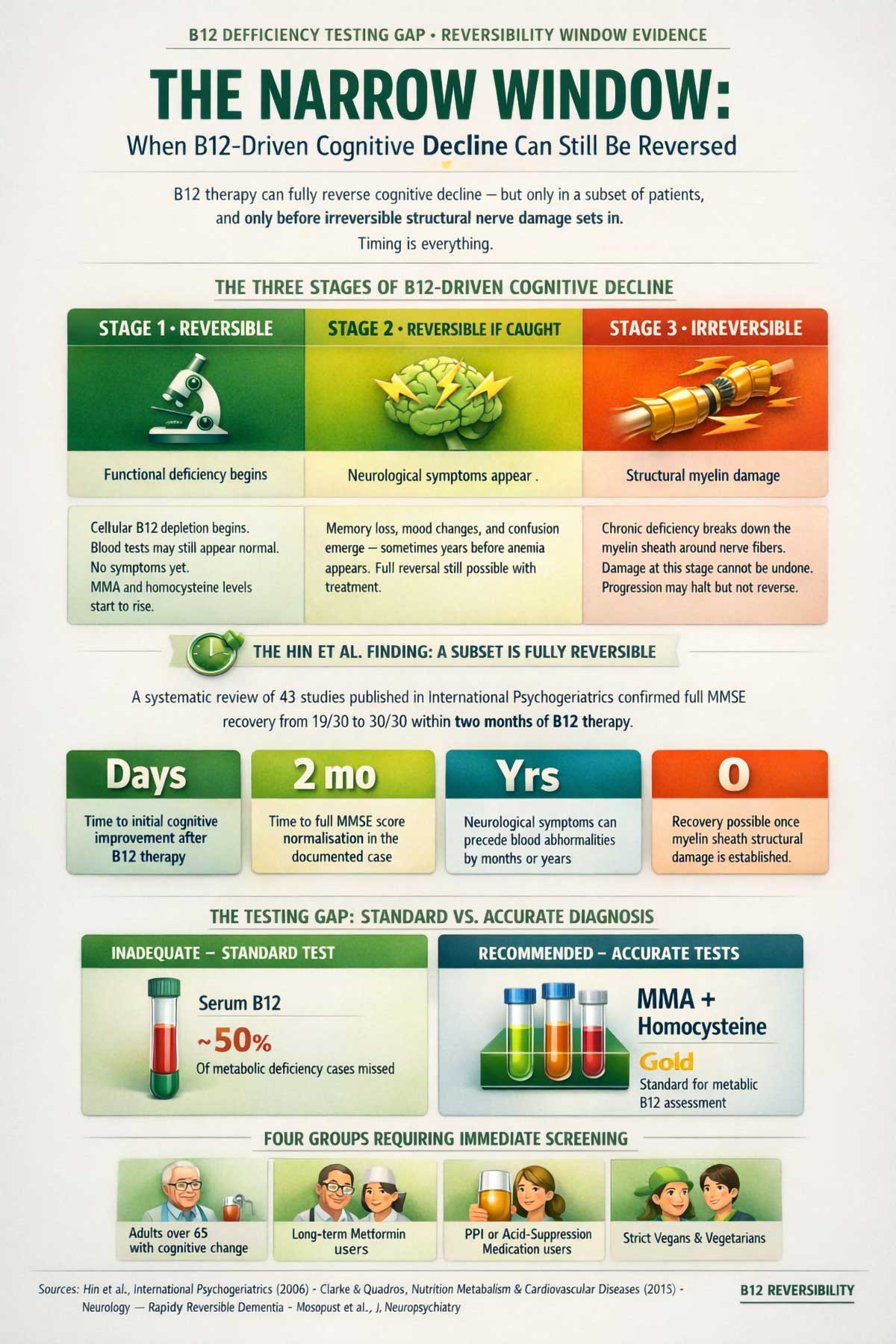
Research published in the Journal of Neuropsychiatry and Clinical Neurosciences found that mental and psychological changes from B12 deficiency — including memory loss, confusion, slow thinking, and full dementia — can appear months or even years before any blood abnormalities show up. In some patients, these neurological changes are the only symptoms present. There’s no anemia. No obvious fatigue. Just a brain that seems to be failing.
That’s why doctors miss it. The classic “low B12 = anemia” equation breaks down when the brain is affected first.
Just How Common Is This?
More common than most people expect.
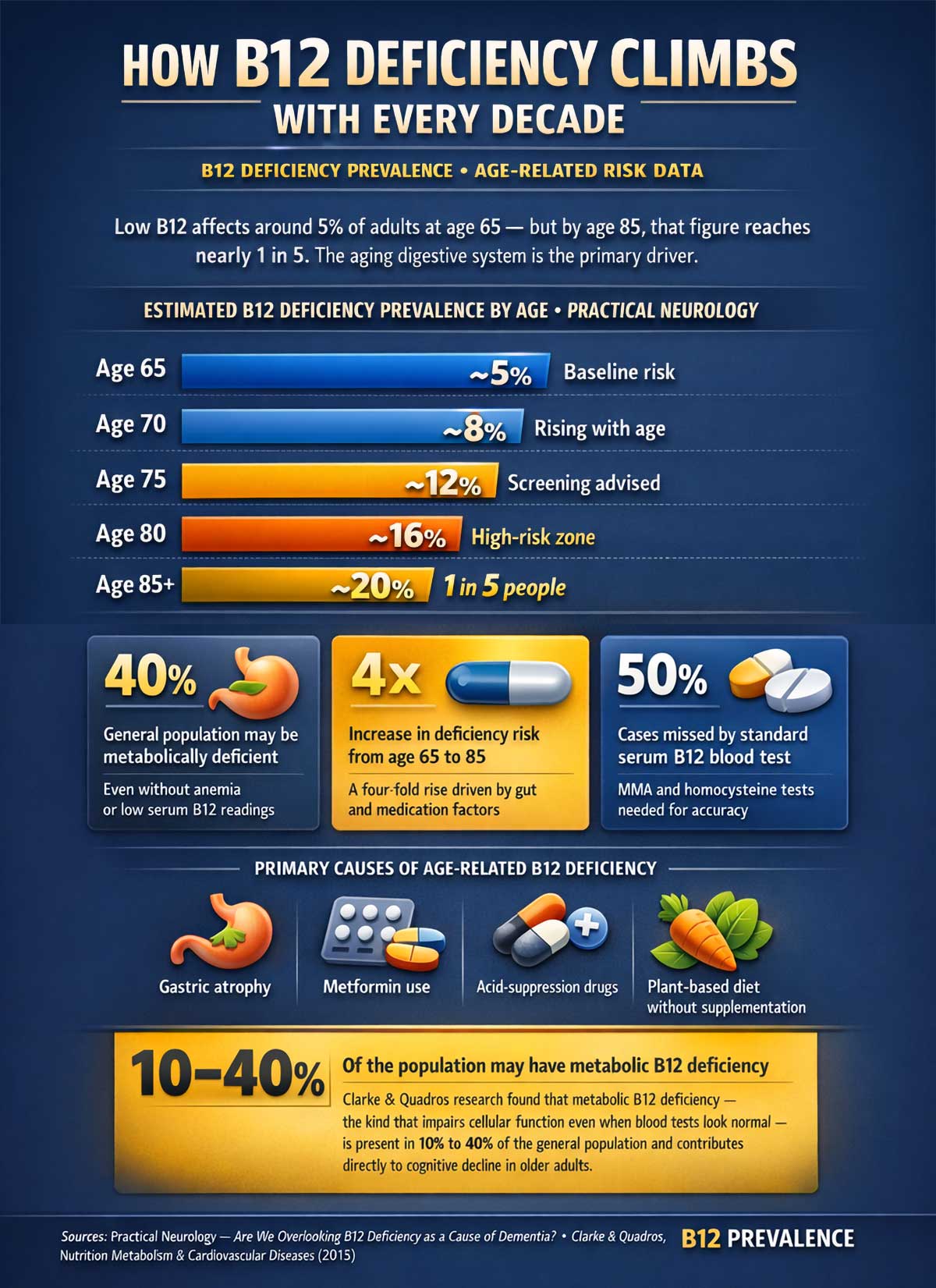
Research from Nutrition, Metabolism & Cardiovascular Diseases estimated that metabolic B12 deficiency — the kind that impairs cellular function even when blood tests appear acceptable — affects between 10% and 40% of the general population. These are people who are functionally low at the tissue level, even if their serum levels don’t raise a red flag.
The numbers get sharper with age. According to data reviewed in Practical Neurology, around 5% of adults at age 65 have low B12. By age 85, that figure climbs to roughly 20%. That’s one in five people in their mid-eighties walking around with B12 levels low enough to affect cognitive function.
The main drivers? The aging stomach. As people get older, the stomach lining gradually thins — a process called gastric atrophy. This reduces the production of a protein called intrinsic factor, which the body needs to absorb B12 from food. A person can eat a perfectly adequate diet and still become deficient because their gut can no longer extract the vitamin from what they eat. Medications like proton pump inhibitors (used for acid reflux) and metformin (used for type 2 diabetes) make this worse.
This is not a rare edge case. It’s a routine clinical reality that doesn’t always get routine attention.
5 Ways B12 Deficiency Mimics Permanent Dementia
1. The Memory Maze
Slow thinking, poor short-term recall, and general mental fogginess are often chalked up to “just getting older.” When an older adult starts forgetting appointments or repeating questions, the instinct is to accept it as age-related decline.
B12 deficiency produces exactly this picture. The cognitive slowdown it causes can be gradual enough that neither the patient nor their family recognizes it as something medically wrong — let alone something caused by a vitamin.
2. The Psychiatric Pivot
This is where the misdiagnosis risk becomes serious.
A case report published in the Primary Care Companion CNS Disorders described a patient who developed hallucinations and cognitive decline. The patient was initially assessed and treated by a psychiatric department — diagnosed with depression, started on medications for that — while neurological symptoms continued to worsen. B12 deficiency was only identified later as the underlying cause.
This scenario isn’t unusual. Research published in Neuropsychiatric Disease and Treatment found that B12 deficiency can present as depression, anxiety, acute psychosis, delirium, or dementia — and in some patients, the psychiatric presentation is the first and only sign. The result is that patients land in psychiatry, get treated for conditions they don’t have, and the real cause goes untreated.
3. The Orientation Gap
Difficulty with spatial tasks, problems with calculation, and disorientation in familiar environments are classic features of Alzheimer’s disease. They’re also features of B12 deficiency.
The MMSE cannot distinguish between B12-driven cognitive decline and Alzheimer’s disease because it measures function, not cause. A patient can score in the moderate dementia range from a vitamin deficiency and be indistinguishable on paper from someone with an irreversible neurodegenerative condition. The patient described in the Neurology case report showed exactly this profile — impaired memory, disorientation, and difficulty with calculation — before B12 treatment reversed it entirely. Without that diagnosis, the test result alone would have pointed toward permanent decline.
4. The Mood Slide
Depression and irritability are frequently the first changes a family notices. A person who was easygoing becomes short-tempered. Someone who was active loses interest in things they used to enjoy. This emotional shift is often treated with antidepressants.
B12 is directly involved in the production of serotonin and dopamine — the brain chemicals that regulate mood. When B12 levels drop, mood regulation suffers. The resulting depression is real, but it’s driven by a nutrient deficiency, not a primary mood disorder. Treating it with SSRIs without addressing the deficiency is treating the symptom while the underlying cause continues to do damage.
5. The Hematological Ghost
Here’s the detail that trips up even experienced clinicians: anemia does not have to be present for the brain to be suffering.
Research published in the Journal of Neuropsychiatry and Clinical Neurosciences confirmed that neurological symptoms from B12 deficiency can precede blood changes by months or years. The classic expectation — that a B12-deficient person will show up with large, pale red blood cells and a low hemoglobin reading — doesn’t always hold. Some patients have perfectly normal blood counts while their nervous system is being damaged.
A review of the broader psychiatric and cognitive literature, including work by Zucker and colleagues published on PubMed, noted that the wide range of B12-deficiency symptoms — covering depression, confusion, hallucinations, and dementia — actually contributed historically to the condition being underscreened. The symptom list was considered too broad to be useful as a diagnostic indicator. The irony is that this breadth is precisely what makes it dangerous.
The Testing Problem: Why “Normal” Doesn’t Always Mean Normal
A standard blood test measures serum B12 — the total amount of the vitamin circulating in the blood. This test has a significant limitation. It can appear normal while tissues and cells are starving.
A person can receive a “normal” B12 result and still be functionally depleted at the cellular level. Research from Clarke and Quadros, published in Nutrition, Metabolism & Cardiovascular Diseases, put this plainly: measuring serum B12 alone is not sufficient to identify metabolic deficiency. Studies suggest the standard test misses up to half of cases where the body is not actually using the vitamin effectively — meaning a clean result on a routine panel does not rule out the problem.
Two more targeted tests do a better job:
Methylmalonic Acid (MMA): This compound builds up in the blood when B12 is too low to process it. Elevated MMA is a direct marker of cellular B12 deficiency — even when serum B12 looks fine.
Homocysteine: This amino acid is also metabolized with help from B12. When B12 falls short, homocysteine levels rise. High homocysteine is independently linked to cognitive decline and cardiovascular disease.
Neither of these tests is exotic or expensive. They’re just not ordered by default. If you or someone you care for has cognitive or psychiatric symptoms and a “normal” B12 result, asking specifically about MMA and homocysteine is a reasonable next step.
The Window of Reversibility: What the Evidence Actually Says
This is where honesty matters — because the story is both hopeful and urgent.
A systematic review published in International Psychogeriatrics, which analyzed 43 studies on B12 and cognitive function, confirmed that a subset of B12-driven cognitive decline is fully reversible with treatment. The key phrase there is “a subset.” B12 therapy does not reverse all dementia or improve cognition in people who are not actually deficient.
What makes the difference is timing.
B12 is critical for maintaining the myelin sheath — the protective coating that surrounds nerve fibers. When B12 stays low for long enough, the myelin breaks down. Once structural damage to the nerves has occurred, it cannot be undone. This is the point of no return.
Before that point, the picture can look dramatically different — as the Neurology case report showed. Full cognitive reversal within weeks. A score that moved from the dementia range to normal in two months.
After that point, treatment can stop further damage, but it can’t rebuild what’s already lost.
The window is real. The urgency is real. Catching this early is the difference between a person returning to themselves and a person requiring permanent care.
Who Should Be Screened Now?
Some groups are at meaningfully higher risk and deserve routine testing — not as alarm, but as standard care.
People over 65 with any cognitive change. Given that B12 deficiency affects up to 20% of adults over 85 and that symptoms can appear before any blood abnormality, any cognitive shift in an older adult warrants a full B12 workup — including MMA and homocysteine, not just serum B12.
Long-term Metformin users. Metformin, a widely prescribed medication for type 2 diabetes, is well-documented to reduce B12 absorption over time. Regular screening should be standard for anyone who has been on this drug for years.
People on long-term acid-suppression medication. Proton pump inhibitors and H2 blockers reduce stomach acid, which is needed to release B12 from food. Chronic use of these medications creates the conditions for gradual depletion.
Strict vegetarians and vegans. B12 is found almost exclusively in animal products. Plant-based eaters who do not supplement consistently are at real risk of deficiency, particularly over many years.
Anyone with a sudden “personality shift.” Behavioral and personality changes — sudden suspicion, emotional withdrawal, uncharacteristic irritability — are frequently the first signs a family notices, often before the patient recognizes anything is wrong. These shifts can reflect neurological changes driven by B12 and should not be dismissed as stress or normal aging.
The Conversation to Have with Your Doctor
If any of the above applies to you or someone close to you, the ask is straightforward:
- Request a serum B12 test — but also ask specifically for methylmalonic acid (MMA) and homocysteine levels.
- Ask whether any current medications (particularly metformin or acid-suppression drugs) may be affecting B12 absorption.
- If cognitive symptoms are present but B12 has only been assessed by serum levels alone, ask for the full metabolic picture.
These are reasonable clinical questions. A good doctor won’t be put off by them.
Cognitive Decline Isn’t Always a One-Way Street
That’s the most important takeaway here.
For most forms of dementia, the damage accumulates and cannot be reversed. But B12-driven cognitive impairment is different. It is one of the few causes of apparent dementia that is genuinely treatable — and in some cases, completely reversible — when it’s identified in time.
The tragedy is that it keeps getting missed. Patients receive antipsychotics when they need B12 injections. They’re told their blood work is fine when their cells are starved. They’re managed for depression while the underlying cause chips away at their nervous system.
The research is clear on the pattern. Neurological symptoms come first, often years before blood markers change. The symptom profile mimics psychiatric and degenerative conditions closely enough to fool experienced clinicians. And standard testing frequently misses the diagnosis entirely.
Knowing this doesn’t replace a medical evaluation. What it does is give patients and families the language to ask better questions — and perhaps push for a workup that gets to the real answer before time runs out.