Older adults underwent brain scans before and after a walking program. What the MRI showed wasn’t subtle, and it wasn’t what most researchers expected to find.
Most people accept memory loss as an inevitable part of the aging process. The brain shrinks, the hippocampus, the region central to forming and retrieving memories, loses volume, and recall becomes slower and less reliable. All this is true. What is less well known is that a specific part of this process can be interrupted, and the intervention is nothing extraordinary.
The evidence presented here is not motivational. It comes from MRI machines, randomized controlled trials, and brain scans taken before and after exercise programs. Researchers have been studying how the hippocampus respond to aerobic movement for nearly two decades, and what they’ve observed upends a core assumption about the aging brain.
The Brain That Grows
Brains are expected to shrink with age. That’s the baseline expectation in neuroscience, and it’s well-supported. The hippocampus, which sits deep in the temporal lobe and handles memory formation and spatial navigation, typically loses about 1 to 2 percent of its volume per year in late adulthood. The clinical downstream effects are real: impaired recall, increased dementia risk, and a measurable decline in spatial memory.
In 2011, researchers at the University of Pittsburgh put 120 participants into a randomized controlled trial. Half walked around a track for 40 minutes, three days a week. The other half did stretching and toning exercises. After one year, Erickson and colleagues reported in PNAS that the walking group showed a 2 percent increase in anterior hippocampal volume, along with improved performance on spatial memory tasks. The control group, which performed stretching exercises, showed the expected age-related volume loss.
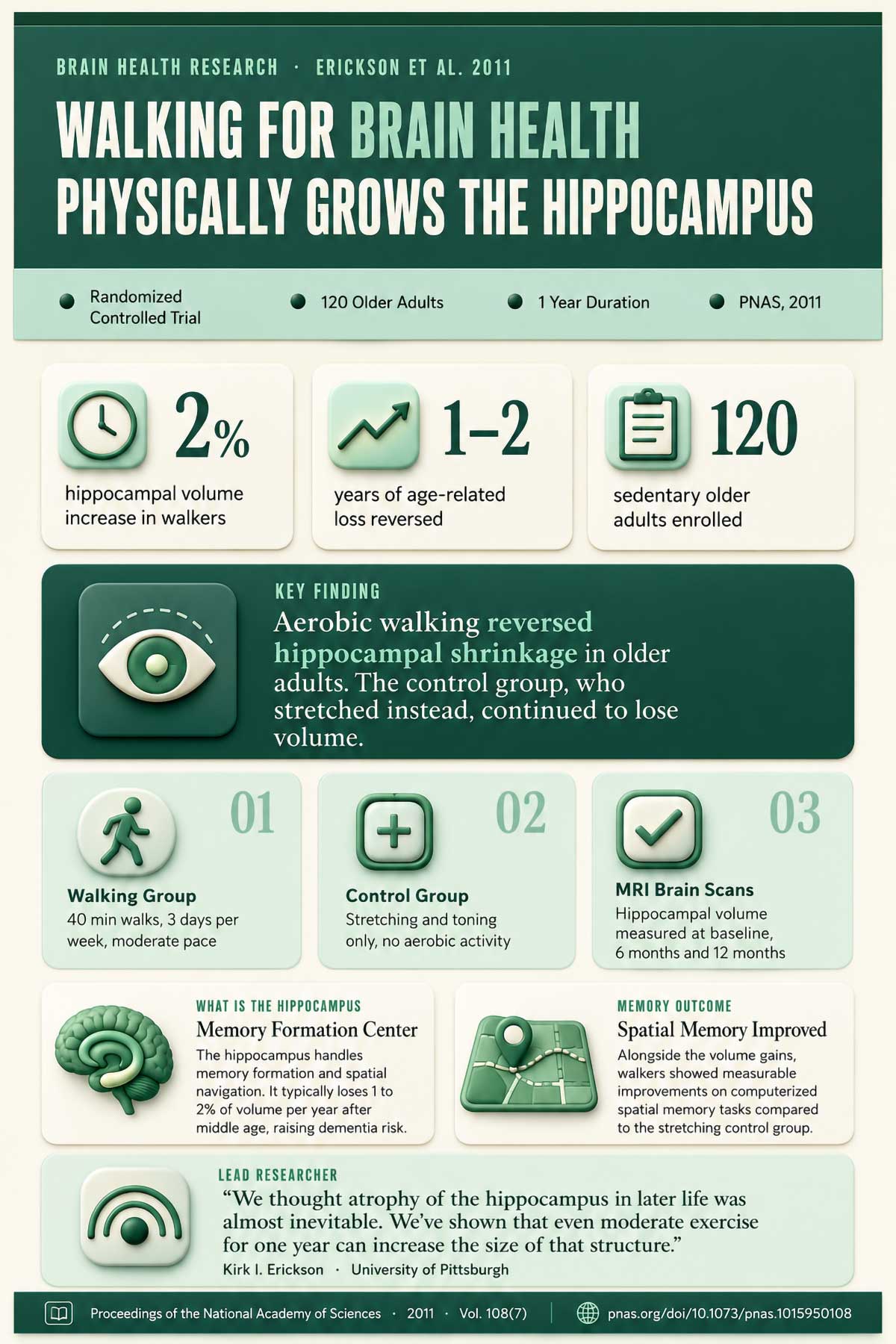
Two percent sounds modest. But Kirk I. Erickson, the lead author and professor of psychology at the University of Pittsburgh, put it plainly: the walking group didn’t just slow the decline. They reversed roughly one to two years of age-related atrophy. The hippocampus grew.
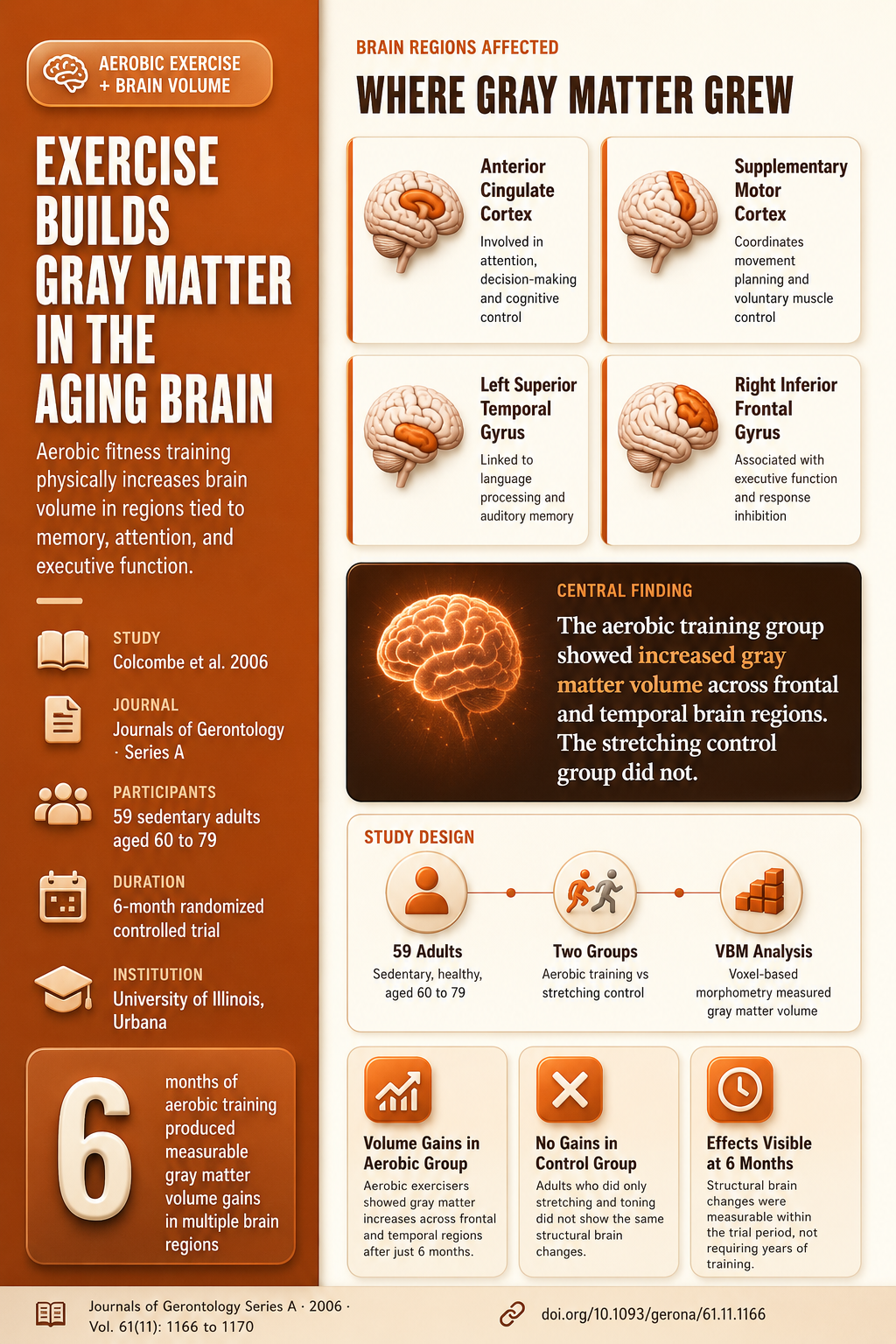
That finding did not stand alone. An earlier study by Stanley J. Colcombe and colleagues at the University of Illinois put 59 sedentary adults aged 60 to 79 through a six-month aerobic fitness program and found increased gray matter volume in frontal and temporal regions.
The aerobic training group showed gains in the anterior cingulate cortex, the supplementary motor cortex, and the temporal lobe. The stretching control group did not. These are regions linked to executive function, attention, and memory retrieval. The brain was not only maintained through aerobic exercise. It was structurally changed.
What’s Actually Changing in the Blood
Volume changes on an MRI scan are the visible result of a more complex process happening at the vascular level. Before a brain region can grow, its blood supply has to support it. The hippocampus is particularly sensitive to changes in cerebral perfusion, the rate and quality of blood flow through its tissue.
A 2015 study by Alexandra Maass and colleagues, published in Molecular Psychiatry, tracked older adults through a three-month exercise program and found that exercise enhanced hippocampal vascular plasticity. Specifically, changes in hippocampal blood vessel structure were linked to fitness improvements and correlated with memory gains. The vascular network in the hippocampus wasn’t static. It adapted.
A 2016 study confirmed this at a finer level of detail: twelve weeks of aerobic exercise increased hippocampal perfusion and was associated with structural adaptation in the same region. The blood supply wasn’t just improving; it was physically remodeling alongside the tissue it fed. Increased perfusion in the hippocampus is associated with better memory performance, and it appears to be one of the earlier, faster-acting changes exercise produces, showing up before the volumetric gains that take months of training to register on a scan.
The Idea That Wasn’t Supposed to Be Possible
For most of the twentieth century, neuroscience operated on a firm conviction that the adult human brain cannot generate new neurons. You were born with your full complement, and from there, the trajectory was one of slow loss. That dogma began to crack with animal studies in the 1990s, but confirming it in living humans required a different kind of evidence.
In 2007, Ana C. Pereira and colleagues at Columbia University used MRI-based measurements of cerebral blood volume to approach the question indirectly. Their work, published in PNAS, rested on a known biological link: when new neurons form, they require new blood vessel growth to support them.
By tracking cerebral blood volume in the dentate gyrus, the specific hippocampal subregion where adult neurogenesis is thought to occur, they found that exercise produced a primary increase in dentate gyrus blood volume, the only hippocampal subregion associated with neurogenesis. In the mouse component of the study, these blood volume changes correlated directly with postmortem measurements of new neuron growth.
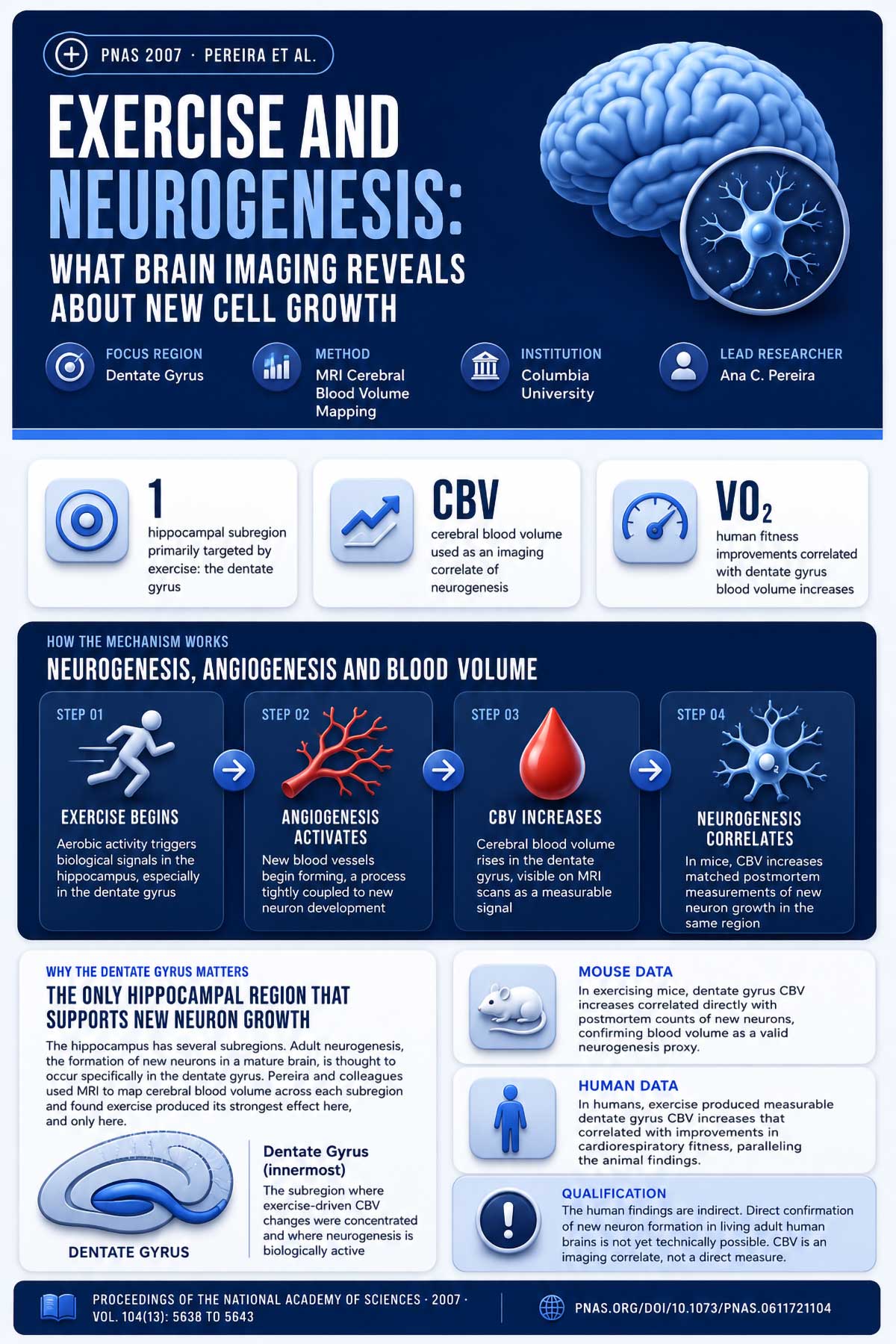
In parallel human data, exercise-induced blood volume increases in the dentate gyrus correlated with improvements in cardiorespiratory fitness. The human data is an indirect signal, not a direct confirmation of neurogenesis, but it points in the same direction: aerobic exercise specifically targets the one hippocampal subregion where new cell growth is biologically possible.
The implication is significant enough to consider. What this research suggests, given the limits of indirect imaging, is that walking may not only preserve existing brain tissue. It may be stimulating the conditions for new cellular growth in the region most responsible for memory.
What Happens When You Just Walk
Most of the clinical brain scan data comes from structured exercise programs, which can make the findings seem unrelated. The question, then, is whether daily unstructured walking, the kind people do without any fitness goal, has an impact on hippocampal health?
A 2015 observational study by Varma and colleagues, published in Hippocampus, looked at daily movement patterns in older adults and found that greater daily walking was associated with larger hippocampal volume. There was no structured program. People who moved more throughout their days had measurably larger hippocampi.
A 2014 study by Niemann and colleagues in Frontiers in Aging Neuroscience similarly found that physical exercise was associated with hippocampal volume increases in older adults, with effects that held across different types and intensities of movement.
These observational studies cannot prove causation the way a randomized trial does. But they add a different dimension to the picture. The interventional data tell us what happens when walking as a regular activity. The observational data suggest the relationship between daily movement and hippocampal size is continuous and present at the population level.
A Pattern Across the Literature
One review that captures the breadth of this research is a Frontiers in Physiology paper examining the relationship between exercise and hippocampal neuroplasticity across multiple studies. The consistent signal across the literature is that aerobic exercise, and walking specifically, given that it’s the modality used in most of the controlled trials above, is reliably associated with structural and functional changes in the hippocampus.
The mechanisms include vascular remodeling, increased perfusion, possible stimulation of neurogenic processes, and gray matter volume changes that can be measured on standard MRI equipment. These aren’t effects seen only in elite athletes or people with exceptional fitness. They appear in older adults after moderate walking programs of a few months.
What the Scans Don’t Settle
None of this research is without limitations. Most of the controlled trials recruited sedentary older adults, so the findings may reflect the particular response of a deconditioned brain to a new stimulus. Whether the same structural gains occur in people who have been consistently active for years is less clear.
The neurogenesis data in humans remain indirect; direct confirmation of new neuron formation in living adult brains is technically out of reach with current imaging. And the memory improvements seen alongside volumetric gains, while real, are modest in size. Walking doesn’t restore a 70-year-old hippocampus to the functional capacity of a 40-year-old one.
What the research does establish is that the hippocampus is not a fixed, passively declining structure. It responds to aerobic movement. It grows blood vessels, increases perfusion, and under the right conditions, gains measurable volume. That response is accessible to people with no particular athletic background, no gym membership, and no special equipment.