You don’t need hours in the gym to improve leg strength after 50. One surprisingly simple movement targets the muscles that help you stay steady, mobile, and independent.
Climbing stairs is something most people over 50 treat as an inconvenience. Researchers at KU Leuven in Belgium recently treated it as training, and the results complicated a long-standing piece of advice about aging and exercise.
After 12 weeks, a group of adults averaging 71 years old who did nothing but structured stair climbing matched the leg-power gains of a group using proper gym machines. On one test, they won.
That finding changes the question. Not because it is surprising that stairs are good exercise, but because it raises a specific one: if a staircase can do what a supervised resistance program does, why is everyone still being told to join a gym?
The answer, at least for leg strength, may be that nobody tested it carefully enough until now.
The Research That Changed the Case for Stairs
The Van Roie 2025 trial, published in the Journal of Strength and Conditioning Research, recruited 46 older adults (30 men, 16 women, average age about 71) and assigned them at random to one of two 12-week programs. One group trained on leg machines, doing power-oriented resistance work with loads set at 40 to 55 percent of their one-repetition maximum. The other group climbed stairs (two flights of six steps per bout, progressing to four bouts of two flights as fast as possible) with no equipment and no gym membership.
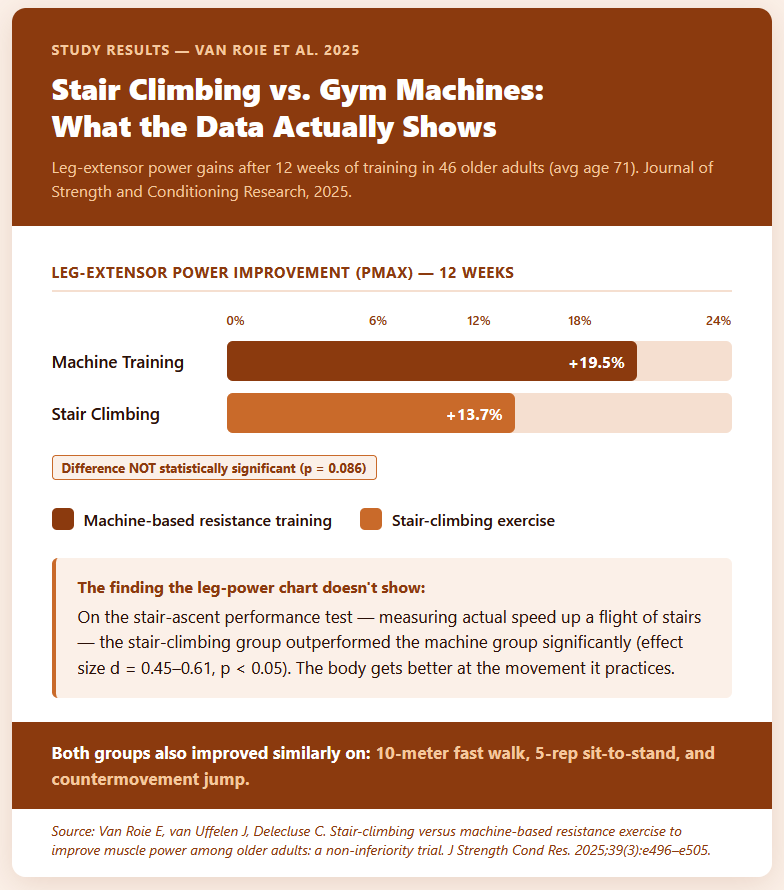
After 12 weeks, the machine group improved leg-extensor power by 19.5 percent. The stair-climbing group improved by 13.7 percent. The difference between those two numbers was not statistically significant.
That is already a meaningful result. But there is a detail in the data worth sitting with. On the stair-ascent performance test, measuring how quickly participants could actually climb a flight of stairs, the stair-climbing group outperformed the machine group.
The effect size was meaningful (d = 0.45 to 0.61). The stair climbers got better at the thing they were practicing in a way the machine users did not.
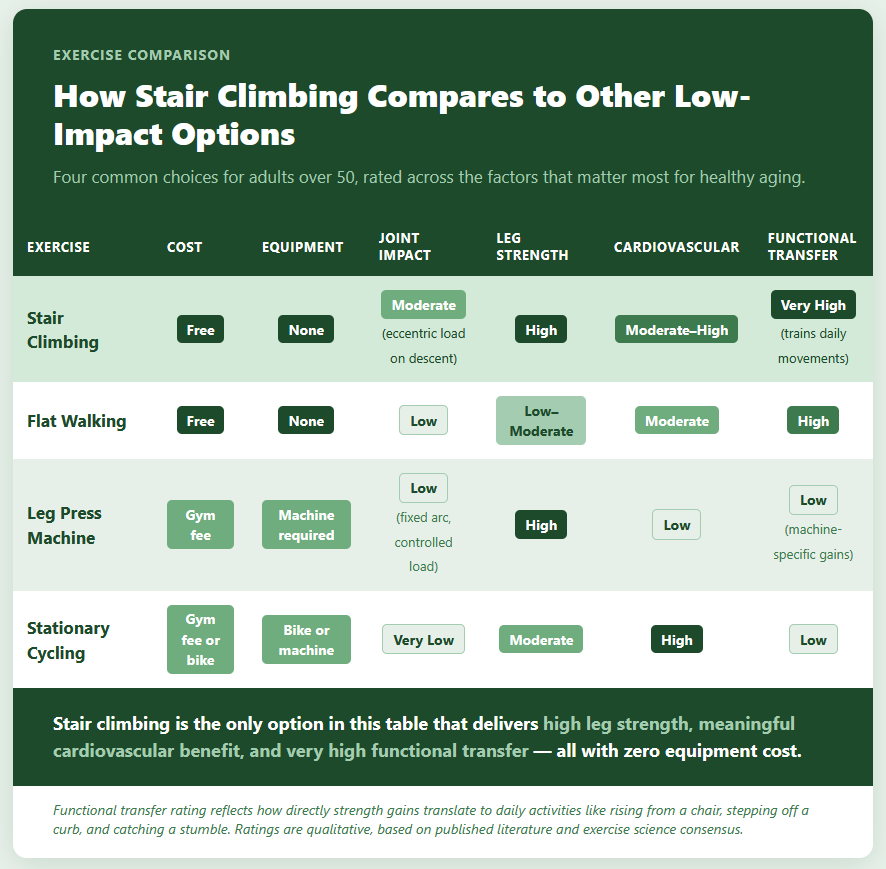
This is what exercise scientists call specificity of training. The body adapts to the exact movement it performs. A leg press produces gains in pressing a weighted sled. Stair climbing produces gains in stair climbing.
When you are over 50 and thinking about what strength actually needs to do in daily life (carrying groceries up a flight, stepping off a curb, catching yourself when you stumble), that specificity matters more than it might seem.
The study was powered as a non-inferiority trial, meaning the question it was actually asking was “is stair climbing at least close enough to be worth doing?” rather than “which is better?” The answer was yes. Access to a staircase, the evidence now says, is access to meaningful strength training with no membership, no commute, no equipment cost.
Think about what that implies. Standard gym training produces generic improvements across every machine it uses. Stair climbing produces specific improvements in the movement pattern that older adults actually need to master.
Both produce comparable leg power.
What Happens in the First Four Weeks
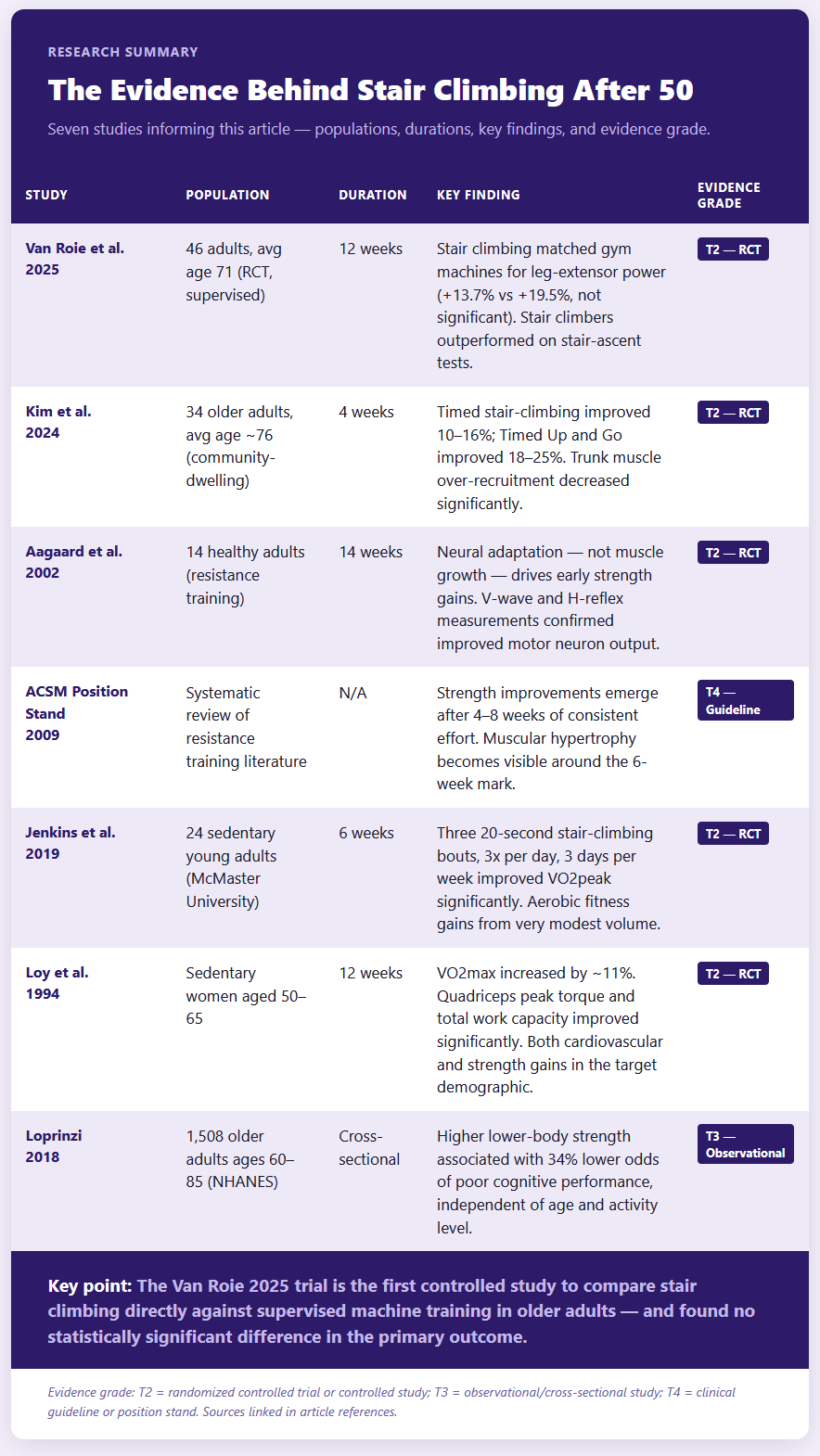
People tend to underestimate how quickly the body responds to stair climbing. A 2024 trial published in the journal Medicine by Kim and colleagues followed 34 community-dwelling older adults with an average age of about 76, dividing them into two groups based on foot-contact technique. Both groups climbed stairs three days per week for four consecutive weeks (12 sessions total), with each session lasting about 40 minutes.
Both groups improved on every measure. On timed stair-climbing performance, the two groups improved by 10 and 16 percent, respectively. On the Timed Up and Go test, which measures how quickly a person can rise from a chair, walk three meters, and return to sitting, both groups improved by 18 to 25 percent.
Four weeks. Three sessions per week. Twelve sessions total.
Something else happened that the researchers measured using electromyography. Before training, participants’ trunk muscles (the core stabilizers: the rectus abdominis, obliques, and erector spinae) were activating heavily during stair climbing. After four weeks, that activation decreased significantly in both groups.
The body was bracing less because it needed to brace less. Movements that require conscious effort early in training become automatic as confidence and balance improve.
The Kim study compared two stair-climbing techniques against each other, not stairs versus no exercise. Both technique groups improved significantly, regardless of which foot-contact method they used. That is the finding that applies here: four weeks of progressive stair climbing three times per week produces measurable gains in mobility and balance in adults averaging 76 years old.
Why You Feel Stronger Before Your Muscles Change
The timing in the Kim study is not a coincidence. In the first four to eight weeks of any strength training program, most of the improvement comes not from muscle growth but from the nervous system. Researchers have confirmed this across decades of work and in dozens of populations. The implication for how to interpret early training progress is specific.
Research by Per Aagaard and colleagues at the University of Copenhagen, published in the Journal of Applied Physiology in 2002, measured neural responses to resistance training using evoked V-wave and H-reflex techniques. The findings support the idea that early strength gains reflect improved neural drive: the nervous system learns to recruit more muscle fibers per contraction and to coordinate the timing of when those fibers fire.
The muscles themselves are largely unchanged in the first few weeks. What changes is the brain’s ability to use the muscles that were already there.
The American College of Sports Medicine’s 2009 position stand on progression in resistance training built on that body of evidence, noting that strength improvements typically emerge after four to eight weeks of consistent effort. Neural adaptations lead, and muscular hypertrophy (actual growth in fiber size) becomes more visible around the six-week mark.
For stair climbing specifically, this means the first month of training may produce little visible change in the legs. The nervous system is reorganizing, and the functional tests will show it before the mirror does.
The Kim participants improved substantially on timed stair-climbing and the Timed Up and Go test before any meaningful hypertrophy could have occurred. The nervous system was ahead of the muscles throughout.
Weeks 6 to 12: Where Real Muscle Change Begins
Around week six, the picture shifts. Neural adaptation is still occurring, but muscle fiber changes begin adding to the gains rather than carrying them alone.
Researchers at McMaster University, led by Martin J. Gibala, published a 2019 study in Applied Physiology, Nutrition, and Metabolism showing that brief, structured bouts of stair climbing (three times per day, three days per week for six weeks) improved peak oxygen uptake in previously sedentary adults. The participants were college-age, and what the study measured was aerobic fitness rather than muscular power. The mechanism it demonstrates is still relevant: cardiovascular adaptations to stair climbing begin within six weeks, even when total exercise volume is quite modest.
For women in the 50 to 65 age range, there is older and more directly relevant evidence. A 1994 study by Loy and colleagues, published in Medicine and Science in Sports and Exercise, followed sedentary women aged 50 to 65 through 12 weeks of progressive stairclimbing. VO2max (a measure of aerobic capacity) increased by roughly 11 percent, and isokinetic strength tests showed significant improvements in peak torque and total work capacity of the quadriceps.
Leg strength and cardiovascular fitness improved together in sedentary women aged 50 to 65, not college students or trained athletes, and the gains were still real.
By the time the Van Roie participants reached week 12, those gains extended across functional tests spanning a 10-meter fast walk, a five-repetition sit-to-stand, and a countermovement jump.
Getting up from a low couch. Stepping off a curb. Catching yourself when you stumble.
| Place after the plan section: 4-12 Week Blueprint table –>
What Makes Each Step Harder Than It Looks
Stair climbing works the legs so well partly because of a mechanical reality most people never think about. Every step involves two distinct phases of muscular effort, not one.
The concentric phase is when the muscles shorten as they contract, pushing the body upward from one step to the next. This is the part that feels like work. Quads fire, glutes engage, and the calf contributes as the foot pushes off.
The eccentric phase is when the muscles lengthen under load, controlling the body’s descent. This is the part most people ignore, and it is actually the more productive phase for building muscle. Eccentric loading creates more microscopic tension in the muscle fibers, which triggers the repair and growth response.
That is why going down stairs often leaves the legs sorer than going up, even though ascending feels harder in the moment. The descent is doing more structural work than it feels like.
Balance and postural control operate across both phases. A leg press machine moves in a fixed arc. Stairs require the body to stabilize itself on a single leg while generating force, recruiting stabilizing muscles in the hip and ankle that a machine would allow to stay dormant.
The result is strength that transfers to daily movement rather than strength that exists only in a seated, guided range of motion.
Beyond Leg Power: What Else Regular Climbing Does
The legs get the headline. The rest of the body benefits too, though the evidence is not equally strong across every claimed benefit.
Heart health responds to stair climbing more quickly than most people expect. The Loy 1994 study showed VO2max increasing by about 11 percent in middle-aged women after 12 weeks, and a decade of subsequent stair-specific exercise physiology research, including Gibala’s short-bout protocols, consistently shows that regular stair climbing improves cardiac output and aerobic capacity within weeks.
For older adults, this translates to better endurance on walks, less breathlessness on inclines, and a lower resting heart rate over time.
Bone density is a less obvious but meaningful benefit. Stair climbing is weight-bearing and impact-producing. Every step up loads the skeleton (the femur, tibia, and vertebrae all absorb the force of a footfall slightly harder than during flat walking), and that mechanical stress signals the bone-forming cells called osteoblasts to remain active.
For adults over 50, particularly women post-menopause, this matters. Bone loss accelerates in this period, and weight-bearing exercise is one of the few reliable signals that tells the skeleton to maintain its density.
Stair climbing also burns more energy than walking at a comparable pace. Exercise physiology research estimates the caloric cost at roughly two to three times that of flat walking, making it a more time-efficient option when weight management is a secondary goal. Three bouts of vigorous climbing spread across a day add up to less than two minutes of active effort.
The cognitive picture is more complicated and deserves honesty. A 2018 cross-sectional analysis in the Journal of Lifestyle Medicine, drawing on NHANES data from 1,508 adults aged 60 to 85, found that those with higher lower-body strength had 34 percent lower odds of poor cognitive performance, independent of age and physical activity level. That is a consistent signal across observational research.
It is also a correlation, not proof that building leg strength improves cognition. Nobody has yet run a controlled stair-climbing trial with cognitive outcomes as the primary measure. Researchers still do not agree on whether training leg strength causes the cognitive improvement or whether both decline together and stronger muscles are a marker rather than a cause.
Climbing Safely After 50
Form at the gym is supervised. Form on a staircase is not. For adults over 50, a few habits separate training from injury risk.
Foot placement is the foundation. The full foot should make contact with each step, not only the toes or ball of the foot. A full-foot plant distributes load across the knee and hip more evenly, reducing peak force on any single structure. This matters most during descent, when the eccentric load on the knee is at its highest.
Posture should remain upright. Leaning heavily forward compresses the lumbar spine and shifts the demand away from the glutes and into the lower back. A slight forward lean is natural and mechanically necessary, but a pronounced hunch is not.
Keep the torso relatively tall, and the right muscles will carry the load.
Speed belongs last. Climbing fast with poor form produces the same stress on the joints as running with poor form: the speed amplifies the error. In the first four weeks especially, deliberate and controlled beats fast and sloppy every time.
The handrail is a tool, not a concession. Using it during the early weeks, while balance and confidence are still developing, is the right choice. Most people find they rely on it less as the weeks pass, which is itself a measurable sign of progress.
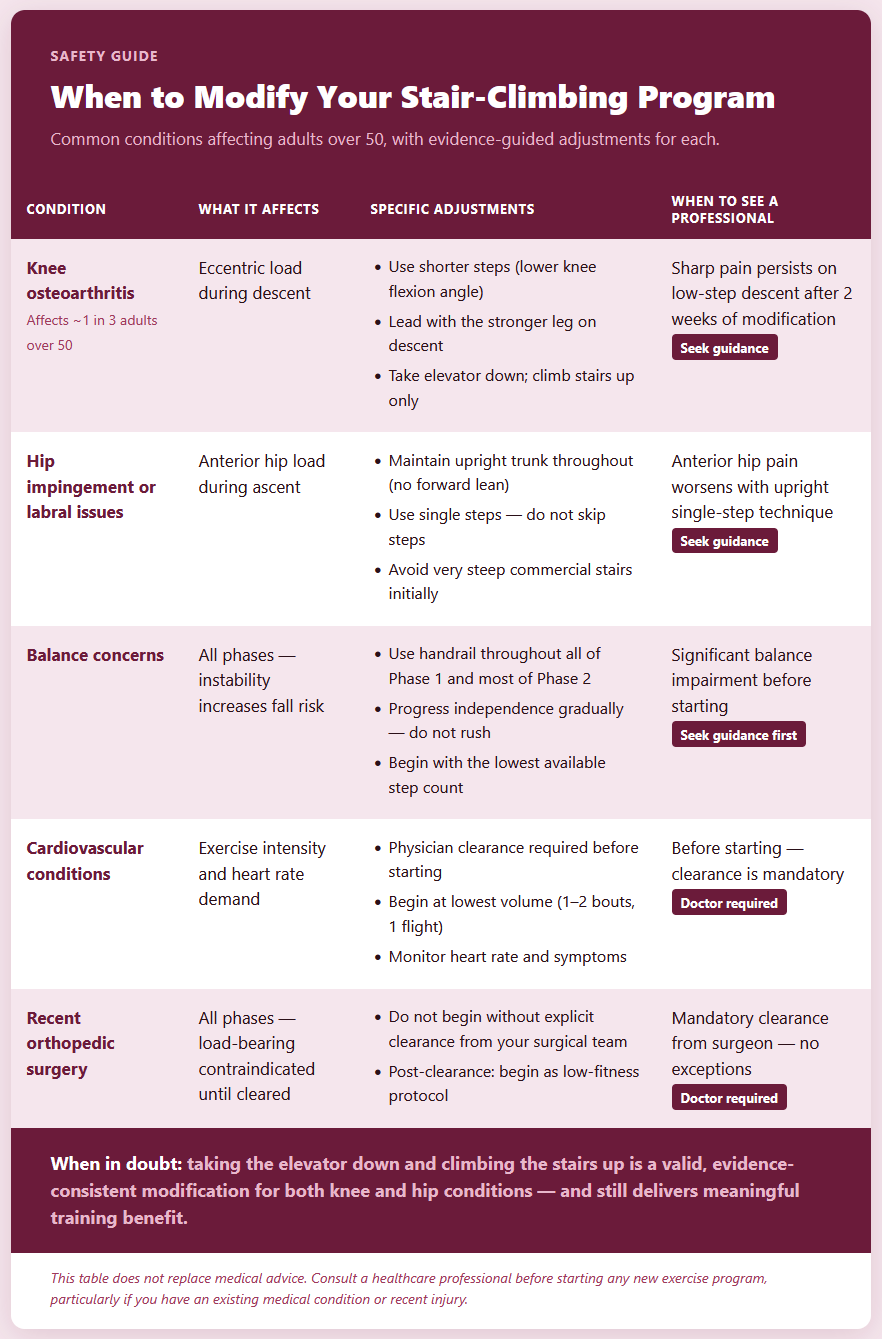
A note on knee pain. Knee osteoarthritis affects roughly one in three adults over 50. For this group, the eccentric load during stair descent can be a source of pain rather than just soreness. If descending is consistently uncomfortable, shortening the range of descent per step (shorter stairs, or leading with the stronger leg on the way down) reduces joint load without eliminating the training effect.
Going up while taking the elevator down is a legitimate modification. The goal is to keep climbing, not to train through pain that signals a structural problem.

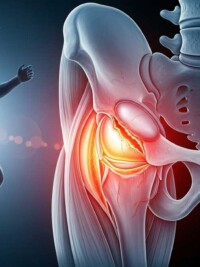
Hip involvement deserves acknowledgment too. Stair climbing recruits the hip flexors and external rotators with every step, and ascending steep stairs places meaningful demand on the anterior hip capsule.
Adults with a history of hip labral issues or anterior hip impingement may find that descending aggravates symptoms around the front of the hip. Single-step climbing rather than skipping steps typically reduces that load.
Your 4–12 Week Blueprint
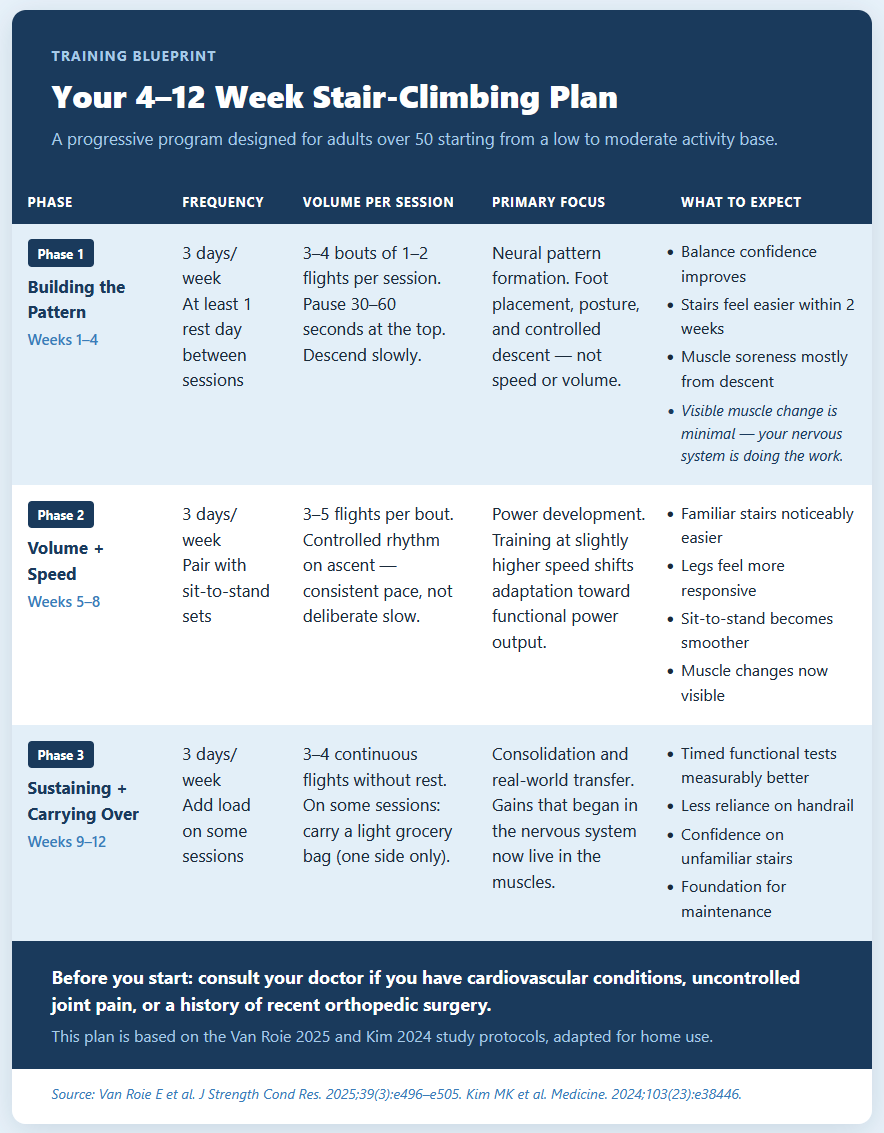
The plan below is designed for adults over 50 starting from a base of low to moderate activity. Anyone with existing cardiovascular conditions, uncontrolled joint pain, or a history of recent orthopedic surgery should speak with a physician before starting. The neural adaptation research is clear: the gains happen inside a specific progression, not from random climbing. Follow the structure.
Weeks 1–4: Building the Pattern
Train three days per week, with at least one rest day between sessions. Start with one to two flights of stairs per bout: climb to the top, pause 30 to 60 seconds, then descend slowly and deliberately. Repeat three to four times per session.
Nothing about this phase is about speed or volume. The brain is doing the hardest work of the entire 12 weeks right now, building the neural pattern that everything else depends on. Consistent foot placement, stable posture, and controlled descent are the only goals.
Weeks 5–8: Adding Volume and Controlled Speed
Continue three sessions per week and increase to three to five flights per bout. Introduce a controlled rhythm on ascent, not rushing but climbing at a consistent pace rather than a deliberate slow. Power is force times velocity, and beginning to train at slightly higher speed starts shifting the adaptation toward the power profile that functional tests like the Timed Up and Go actually measure.
Pair sessions with five to ten sit-to-stand repetitions (rising from a chair without using the hands). This recruits the same muscle pattern as stair climbing and reinforces the gains being made on the stairs.
Weeks 9–12: Sustaining and Carrying Over
Maintain three sessions per week. Add a small challenge to some sessions: carry a light grocery bag on one side (not balanced on both) to introduce a modest load and asymmetric demand. Aim for three to four continuous flights without a rest break on at least one session per week.
By week 12, the Van Roie data suggests that functional test scores on timed walking, sit-to-stand, and stair ascent will all be measurably better than at week zero. The gains that started in the nervous system will have moved into the muscles.
Personalized Stair-Climbing Plan Builder
Answer four questions to get a 4–12 week plan tailored to your starting point.
What If Your Knees or Hips Are Already a Problem?
A fair question, and one the earlier sections gesture toward without fully answering. The stair-climbing research is predominantly conducted in adults who can climb stairs without significant pain. Adults with moderate to severe knee or hip pathology occupy a different starting point, and the standard protocol may need modification before it becomes useful.
For knee OA, step height matters more than step count. A lower step reduces the knee flexion angle at peak load, which is where most OA-related pain occurs. Ordinary house stairs (typically 17 to 20 centimeters) are usually manageable, while taller commercial or outdoor steps may not be, at least initially.
If descent produces consistent sharp pain rather than manageable soreness, taking the elevator down and climbing up is a valid and evidence-consistent modification.
Hip impingement and labral pathology often respond differently to ascending versus descending. Keeping the trunk upright rather than bending forward reduces anterior hip load during ascent. If symptoms are ambiguous or worsening, structured rehabilitation before structured training is the right call.
Is 20 Minutes of Stair Climbing Enough?
It depends on what “enough” is measuring. For cardiovascular fitness, research on stair-climbing snacks (short bouts spread across the day) shows that even three vigorous 20-second climbing efforts three times daily improved peak oxygen uptake over six weeks in sedentary adults. Twenty minutes of continuous climbing at a moderate pace exceeds that stimulus considerably.
For leg strength, the Van Roie protocol that produced a 13.7 percent improvement in leg power ran two sessions per week for 12 weeks, with each session lasting roughly 30 to 40 minutes including rest periods. Twenty minutes of focused climbing three days per week sits within the effective range, particularly in weeks one through four when volume is less important than consistency and technique.
The more relevant question after the first four weeks is not “how long?” but “how hard?” Progress requires progressive overload, even when the only load is body weight and a longer staircase. Twenty minutes of comfortable climbing produces different adaptations than 20 minutes of climbing that actually challenges the cardiovascular and muscular systems. The duration is a starting point, not a target.
The word “exercise” carries a certain weight. It implies a place to go, equipment to use, a commitment that requires scheduling. Stair climbing carries none of that. It is what happens between where you are and where you need to be: in a building, in a station, in a parking garage.
What the Van Roie trial demonstrated, and what Kim and Loy support in different populations, is that the body does not require a gym setting to make the adaptations that matter. It requires movement, applied consistently over time. The staircase already exists.