Most articles claim walnuts boost memory. The best clinical evidence tells a far more nuanced story, and the biggest surprise wasn’t about memory at all.
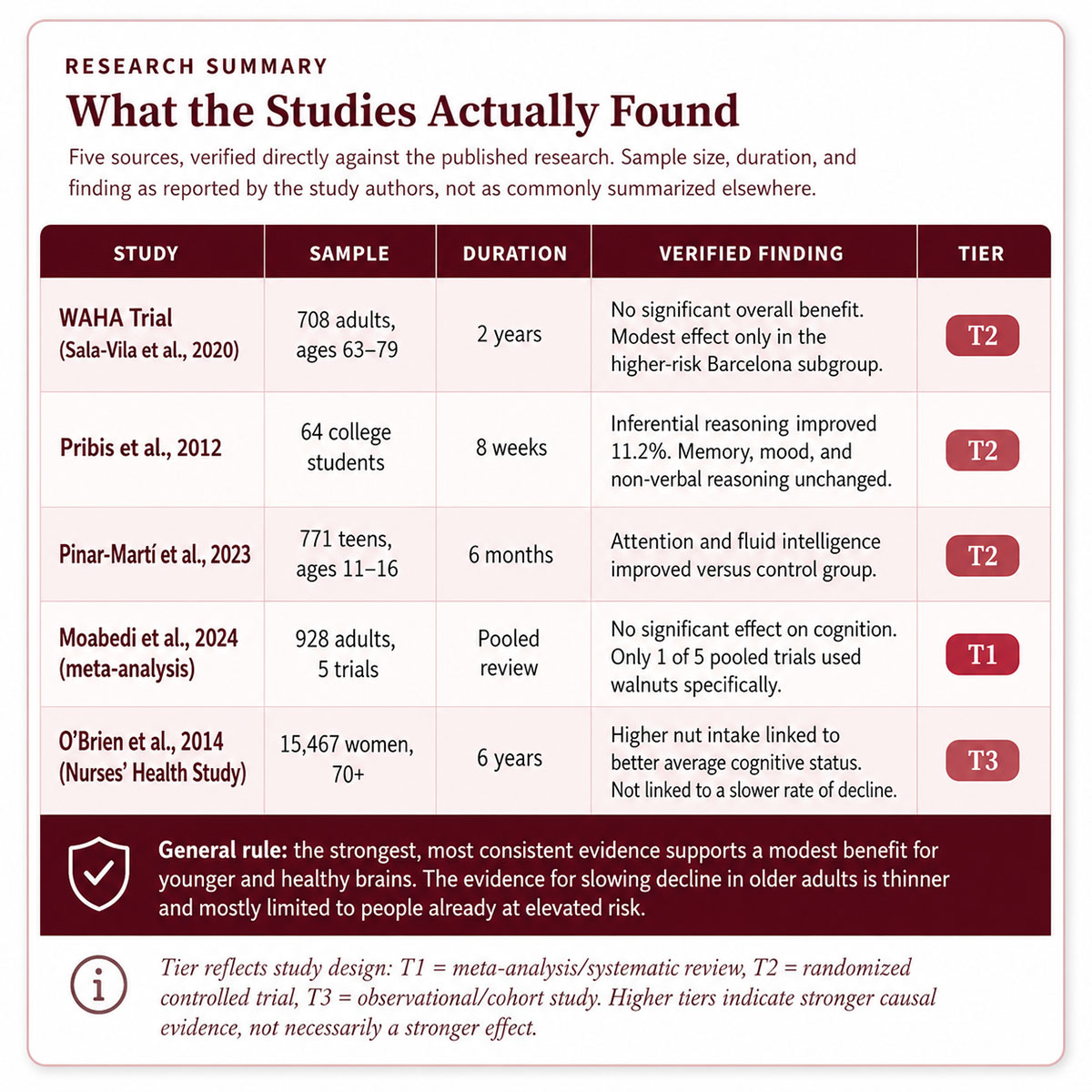
In 2020, researchers ran the largest, longest walnut trial ever attempted: two years, more than 700 older adults, a full battery of cognitive tests at the start and the end. On average, walnuts made no measurable difference to memory or thinking.
A closer look at who did benefit tells a more useful story than the headline result does.
Why This Nut Gets a Reputation as Brain Food
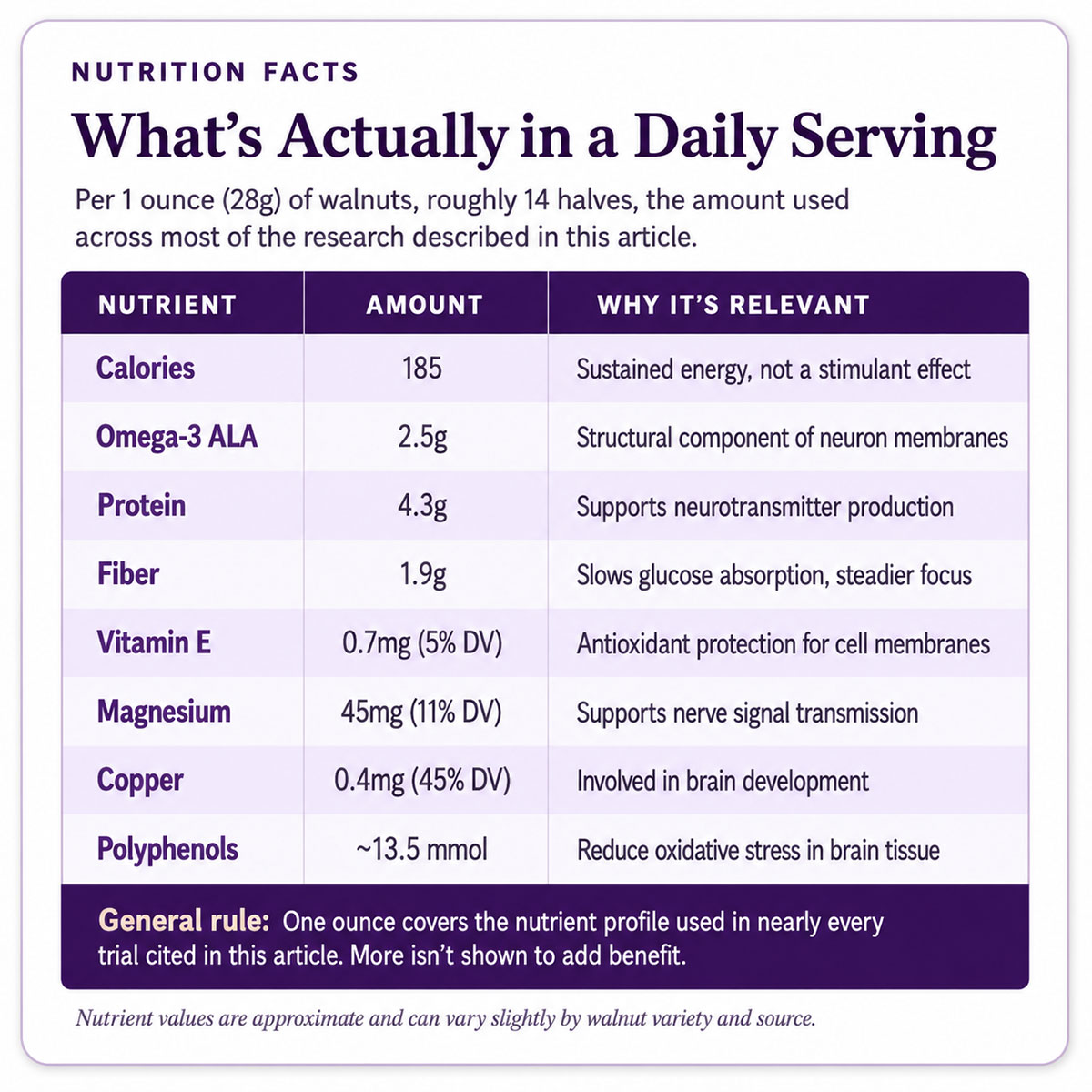
Walnuts contain more alpha-linolenic acid (ALA), a plant-based omega-3 fatty acid, than any other tree nut. A one-ounce serving supplies roughly 2.5 grams of it. ALA is a structural component of neuronal cell membranes, which is the main reason nutrition researchers keep returning to walnuts specifically rather than nuts in general.
The same serving also delivers about 13.5 millimoles of polyphenol antioxidants, more than almonds, cashews, or Brazil nuts contain per ounce. Polyphenols reduce oxidative stress, one of two processes researchers most consistently link to age-related cognitive decline. The other is chronic inflammation.
The resemblance between a shelled walnut and an actual brain, folds and all, is a coincidence nutrition writers love pointing out. It has nothing to do with why the fat inside actually matters.
None of this guarantees a cognitive effect on its own. Nutrient content explains a plausible mechanism. Whether that mechanism translates into a measurable difference in memory or attention is a separate question, and it’s the one the next section actually answers.
What the Research Actually Shows
Researchers at Loma Linda University and Hospital Clínic in Barcelona wanted to know whether a daily walnut habit could slow cognitive decline in older adults already at elevated risk. Their trial, called WAHA (Walnuts and Healthy Aging), randomized 708 free-living adults aged 63 to 79 to either a diet with walnuts at about 15% of daily calories or their usual diet, with no walnuts, for two years.
The result, published in the American Journal of Clinical Nutrition in 2020, surprised the team running it: no significant difference in global cognitive scores between the two groups. Joan Sabaté, the study’s principal investigator and a nutrition epidemiologist at Loma Linda University, called it the largest, best-controlled trial on nuts and cognition ever conducted, which makes the null result harder to dismiss than a smaller study’s would be.
A closer look at the data changed the picture somewhat. Participants in the Barcelona arm of the study, who on average smoked more, had less formal education, and started with weaker baseline test scores than their California counterparts, showed a modest cognitive benefit from the walnut diet.
The California participants, who started healthier, showed none. The researchers behind the study concluded that walnuts may only produce a measurable effect for people who have room to improve, not for people already doing well.
Younger brains tell a different story. Peter Pribis and colleagues at Loma Linda University and Andrews University ran a smaller, tightly controlled crossover trial in 64 college students: half a cup of walnuts a day for eight weeks, then a six-week break, then the reverse diet. Inferential reasoning, the kind of thinking used to draw conclusions from incomplete information, improved by 11.2 percent on the walnut diet.
Memory itself didn’t change. Neither did mood or non-verbal reasoning.
The implication is stranger than it sounds. A food can sharpen one specific kind of thinking without touching memory at all.
Move on a decade, and the pattern shifts again. A six-month trial across twelve Barcelona high schools gave 771 teenagers either 30 grams of walnuts a day or their normal diet, then measured attention, working memory, and fluid intelligence with standardized tests. The walnut group scored higher on attention and fluid intelligence, an effect Jordi Julvez, the study’s lead researcher at the Barcelona Institute for Global Health, linked to the developing adolescent brain’s particular sensitivity to omega-3 intake.
A 2024 meta-analysis in Frontiers in Nutrition, led by Mahdi Moabedi’s team at Kashan University of Medical Sciences in Iran, is often cited as proof that nuts reliably improve cognition. The actual pooled result, drawn from five randomized trials and 928 adults, only one of which used walnuts specifically, found no significant effect on cognition scores at all.
Researchers still don’t fully agree on why a food can meaningfully shift cognition in developing teenagers and healthy young adults, yet barely registers for people already older than 60.
A separate line of evidence adds one more data point without settling anything. Tracking 15,467 women aged 70 and older over six years, a Harvard Nurses’ Health Study analysis found that women who ate more nuts long-term had better average cognitive scores than women who ate fewer.
But higher intake wasn’t tied to a slower rate of decline over those six years, and the study’s own authors flagged that education and health habits could explain much of the association rather than the nuts themselves.
Not every group reviewing this literature is convinced there’s a real signal at all. The Alzheimer’s Drug Discovery Foundation’s own assessment of the walnut and cognition research concluded there isn’t yet a strong case that walnuts, specifically, protect against Alzheimer’s disease or general age-related decline.
That doesn’t rule walnuts out. It means the case for eating them is a reasonable bet, not a guarantee, and the size of that bet should depend on who’s making it.
How Many Walnuts You Need Each Day
A 2020 clinical review hosted on the National Institutes of Health’s PubMed Central database puts the effective daily range at 1 to 1.5 ounces, or 12 to 18 walnut halves (7 to 11 whole walnuts). That’s the range used across most of the trials described above, from the eight-week college study to the two-year WAHA trial.
Going higher doesn’t appear to add benefit. Going lower, somewhere under half an ounce, likely falls below what any of the studies actually tested.
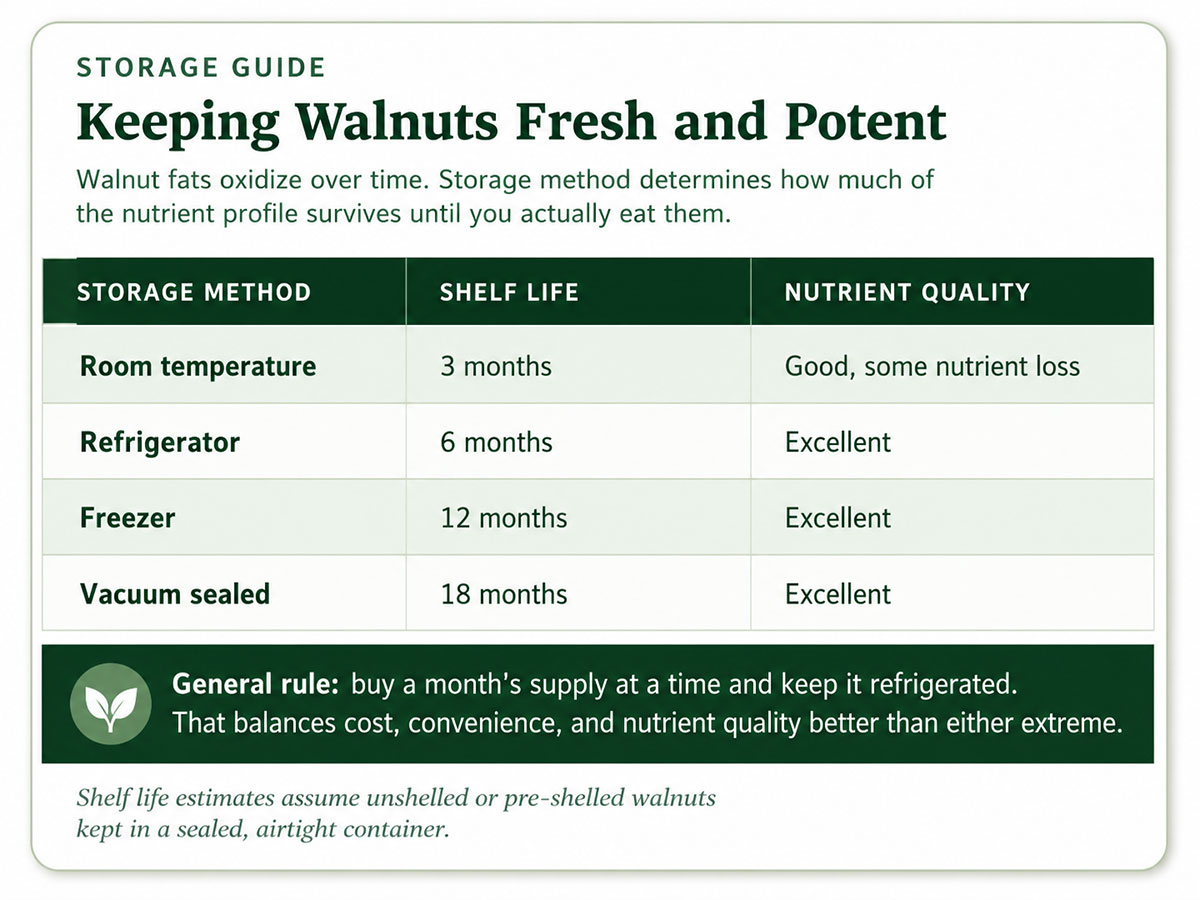
Buying in bulk and storing walnuts in the refrigerator or freezer keeps costs down and nutrient quality high. Left at room temperature, the fats in walnuts start to oxidize within a few months, which is also the point at which they start tasting bitter.
Daily ALA Tracker
See how today's food choices add up against the research-backed range
Can Walnuts Help With Memory Loss, Specifically?
This is a narrower question than “are walnuts good for memory,” and the evidence answers it more cautiously. Sharpening a healthy 20-year-old’s inferential reasoning is a different claim than slowing the kind of decline that leads to a dementia diagnosis.
The WAHA trial above is the closest thing to a direct test, and it found a benefit only in the subgroup already showing signs of higher risk, not in healthy older adults broadly. The Nurses’ Health Study data points in the same direction: an association with better standing, not a change in the rate of decline.
If memory loss prevention specifically is the goal, walnuts belong in the same category as most single-food interventions: worth including as part of a broader pattern (physical activity, sleep, blood pressure control) rather than being relied on alone. Some people look past whole foods entirely toward concentrated supplements instead.

Three Ways to Eat Your Daily Serving
A plain ounce of walnuts gets old fast. These three recipes were chosen because each pairs walnuts with something that adds a genuinely different nutritional angle beyond simple flavor.
Cognitive Power Smoothie Bowl
Blend 1 ounce of walnuts with a frozen banana, half a cup of blueberries, half a cup of Greek yogurt, a tablespoon of ground flaxseed, and half a cup of almond milk. Top with extra walnuts and fresh berries.
The flaxseed adds a second source of ALA. The blueberries contribute a different class of antioxidant, anthocyanins, than the polyphenols already in the walnuts, which is a genuinely useful pairing rather than a flavor-only add-on.
Omega-3 Walnut-Crusted Salmon
This is the only recipe here that stacks two different omega-3 sources, ALA from the walnuts and DHA from the salmon, which the body uses somewhat differently.
Mix 2 tablespoons of Dijon mustard with 1 tablespoon of honey and brush over two 6-ounce salmon fillets. Press 2 ounces of finely chopped walnuts onto the surface and bake at 400°F for 12 to 15 minutes, until the fish flakes easily.
Brain Food Energy Balls
Process 3 ounces of walnuts until finely chopped, then add a cup of pitted dates and blend until the mixture turns into a sticky paste. Mix in 2 tablespoons of almond butter, a tablespoon of dark cocoa powder, a teaspoon of vanilla extract, and a pinch of salt. Roll into 12 balls and chill for 30 minutes.
Dates supply fast-acting glucose, the brain’s primary fuel source, alongside the slower-digesting fats from the walnuts and almond butter.
What Changes, and When
The trials never tracked how people felt week by week, so a tidy four-stage timeline would be inventing precision that the research doesn’t support.
What the trial durations do suggest: eight weeks was long enough for the college students to show a measurable shift in reasoning, six months was the window across which the Barcelona teenagers improved on attention testing, and two years wasn’t long enough to change outcomes for otherwise healthy older adults. Individual experience inside those windows varies more than a week-by-week script can capture.
Who Should Be Careful With Walnuts
Tree nut allergies affect roughly 1% of the population. Reactions range from mild to severe, and anyone with a history of nut reactions should talk to an allergist before adding a daily serving.
Blood thinners are the other real interaction to watch. Walnuts can increase their effect, and the fiber in a daily serving can also shift how quickly other medications are absorbed, so anyone on blood thinners or diabetes medication should check with their doctor first.
At 185 calories per ounce, walnuts are calorie-dense. That’s not automatically a problem, since the protein and fiber they provide can support satiety, but anyone tracking total calorie intake should account for the addition rather than treating it as free.
What Else Matters
Sleep, exercise, and stress management all interact with whatever benefit walnuts provide, and none of them are optional extras.
Seven to nine hours of sleep supports the same memory consolidation processes the omega-3s in walnuts are thought to aid. Thirty minutes of daily walking increases blood flow to the brain. Chronic stress works against both: sustained cortisol exposure damages the same cell membranes ALA is believed to protect.
Walnuts pair well with other foods researchers associate with cognitive health, including blueberries, fatty fish, and leafy greens.

They pair poorly with a diet heavy in processed food and added sugar, which independently drives the inflammation walnuts are meant to counteract.
Conclusion
A two-year trial in over 700 adults failed to prove what casual nutrition advice has assumed for years. That’s not the same as walnuts doing nothing. It means the benefit, where it exists, is concentrated in people who start with more room to improve: teenagers, at-risk older adults, and anyone whose baseline diet is currently missing this specific fat.
Eating a daily ounce is a reasonable, low-cost bet for most people. Just don’t expect it to work like a switch. The honest version of this story is duller than the headline promised, and also more useful, because it tells you who’s actually likely to notice a difference.
FAQs
Can I eat too many walnuts?
Yes. More than 2 ounces daily can cause digestive discomfort and unnecessary added calories. The research described above was conducted at 1 to 1.5 ounces, which is the range worth sticking to.
Is 10 walnuts a day too much?
No. Ten walnut halves sit close to the lower end of the researched range of 12 to 18 halves, so it’s a reasonable amount rather than an excessive one.
What if I don’t like the taste of walnuts?
Toasting reduces bitterness, and pairing walnuts with something sweet, like honey or dark chocolate, masks the flavor most people object to.
Are walnut supplements as effective as whole walnuts?
Whole walnuts are the better choice. Every study described above used whole nuts, not extracts, and whole walnuts also supply fiber and protein that supplement forms leave out.
How do I know if it’s working?
Keep a simple weekly note on focus and recall rather than expecting a daily signal. Changes, where they happen, tend to show up gradually enough that a day-to-day check won’t catch them.
Can children eat walnuts daily?
Yes, assuming no allergy history. The adolescent trial described above tested exactly this, in 11- to 16-year-olds, at 30 grams a day.
Is there a best time of day to eat walnuts for memory?
No trial has tested timing directly, so there’s no strong evidence for a specific window. Morning works well for most people simply because it pairs walnuts with sustained energy through the day, not because of any documented cognitive timing effect.
What if I miss a day or two?
Resume the habit and keep going. None of the trials required perfect daily compliance to show an effect.
Does eating walnuts help specifically with memory loss, or general focus?
Mostly general focus and reasoning, based on the evidence above. The research on memory loss specifically is thinner and applies mainly to people already at elevated risk, not to healthy adults broadly.