One kombucha group, one control group. Eight weeks of daily tracking. Their bloodwork barely moved, but their gut bacteria didn’t stay nearly as quiet.
Search “kombucha for gut health,” and you’ll find claims of overnight detox, immune resets, and a rebalanced microbiome inside two weeks. Pull the actual trial data, and a quieter picture emerges. A handful of specific bacteria increase. Short-chain fatty acid production ticks up. Blood markers barely move at all.
Neither version is wrong exactly. They’re describing different altitudes of the same phenomenon, and the gap between them is where most of the confusion about kombucha for gut health actually lives.
How Much Kombucha Should You Drink for Gut Health?
It’s generally safe to consume up to four ounces of kombucha three times a day. Most people don’t need that much to notice a benefit, and starting smaller is the safer bet.
It’s recommended to ease in gradually rather than starting with a full glass, since your gut needs time to adjust to both the acidity and the new bacteria.
The clinical trial that tested kombucha against obesity-related gut bacteria used 200 milliliters a day, a little under 7 ounces, for eight straight weeks. That’s the dose with the most direct evidence behind it right now.
Once you’re above 12 to 16 ounces a day, you’re mostly adding sugar and acid without much additional benefit for your gut. Consistency also matters more than volume. A small daily glass with a meal outperforms an occasional large bottle, mostly because your gut bacteria respond to steady fuel, not sporadic spikes.
Before changing anything, it helps to know your starting point. The tool below scores your current digestive comfort, energy, and mood on the same categories researchers track at baseline, so if you try kombucha for two weeks, you’ll have something real to compare against.
Gut Health Baseline Quiz
Rate where you are today. Retake this in two weeks to see what actually changed.
What Kombucha Actually Puts Into Your Gut
The Bacteria That Survive the Trip
Kombucha’s live cultures have to survive stomach acid before they can do anything useful. Strains like Lactobacillus and Acetobacter manage this reasonably well, which is part of why they show up in nearly every kombucha study.
Once through, they compete with your existing gut flora for space and resources. Some of your resident bacteria tolerate the newcomers without issue. Others compete directly for the same food sources, and that competition is part of what causes the mild bloating some people notice in the first few days.
Why Short-Chain Fatty Acids Do Most of the Real Work
The more interesting story is what the probiotics produce once they’ve settled in, not the probiotics themselves.
As kombucha-associated bacteria colonize the gut, they ferment dietary fiber into short-chain fatty acids, mainly butyrate, acetate, and propionate. Butyrate is the primary fuel source for the cells lining your colon, and adequate butyrate production is tied to a stronger gut barrier and lower local inflammation.
Acetate and propionate work differently. They circulate more widely. Both influence appetite signaling and communicate with the immune system well beyond the colon itself.
That finding took researchers a while to connect back to a fermented tea. The idea that a bottle of kombucha reaches the same metabolic pathway as dietary fiber supplementation isn’t something most casual drinkers assume.

The Study That Actually Tracked This in Real People
Gertrude Ecklu-Mensah and colleagues at UC San Diego and the La Jolla Institute for Immunology published a controlled clinical study in Scientific Reports, the most direct human test of this so far. Twenty-four healthy adults on typical Western diets were split into a kombucha group and a small control group, then tracked for eight weeks.
The results were less dramatic than kombucha’s reputation suggests. Blood biochemistry and inflammation markers barely changed across the full group. Stool samples told a different story. Weizmannia coagulans, a bacterium that arrives with the kombucha itself, showed a measurable rise, along with several SCFA-producing species.
Researchers still don’t fully agree on how much of this shift reflects lasting colonization versus bacteria simply passing through in high enough numbers to register on a test. The study’s authors attributed part of the modest effect size to the small sample and wide variation between participants.
One detail worth knowing: this trial received funding support from GT Living Foods, a kombucha brand. That doesn’t invalidate the findings. The data itself shows a fairly restrained result rather than an inflated one. But it’s the kind of detail a person deciding how much weight to put on “clinical trial” claims should have.
Why the Same Kombucha Might Do More for Someone Else’s Gut
A separate trial published in the Journal of Nutrition split 46 adults into two groups, 23 at a normal weight and 23 with obesity, and gave both the same 200 milliliters of black tea kombucha daily for eight weeks.
Both groups saw their gut bacteria shift in beneficial directions, though the obese group saw more of it. Two bacterial genera linked to obesity, Ruminococcus and Dorea, dropped enough in that group to move closer to what the normal-weight group already had at baseline.
The honest interpretation is that kombucha’s effect on gut bacteria depends heavily on what your baseline microbiome looks like, not that kombucha functions as a hidden weight-loss drink. A gut that’s already balanced has less room to shift, while a gut carrying more of the bacteria tied to obesity and inflammation has more room to move, and in this trial, it moved further.
This also means the two-week transformation framing common in kombucha content sets people up to be disappointed. Two weeks of kombucha might change almost nothing you’d notice when your gut is already doing fine, and that’s actually the more common outcome than the marketing suggests.
If you’ve been drinking it dutifully for two weeks and feel exactly the same, that’s not a failure of willpower or the wrong brand. It simply means your gut wasn’t the audience with the most to gain.
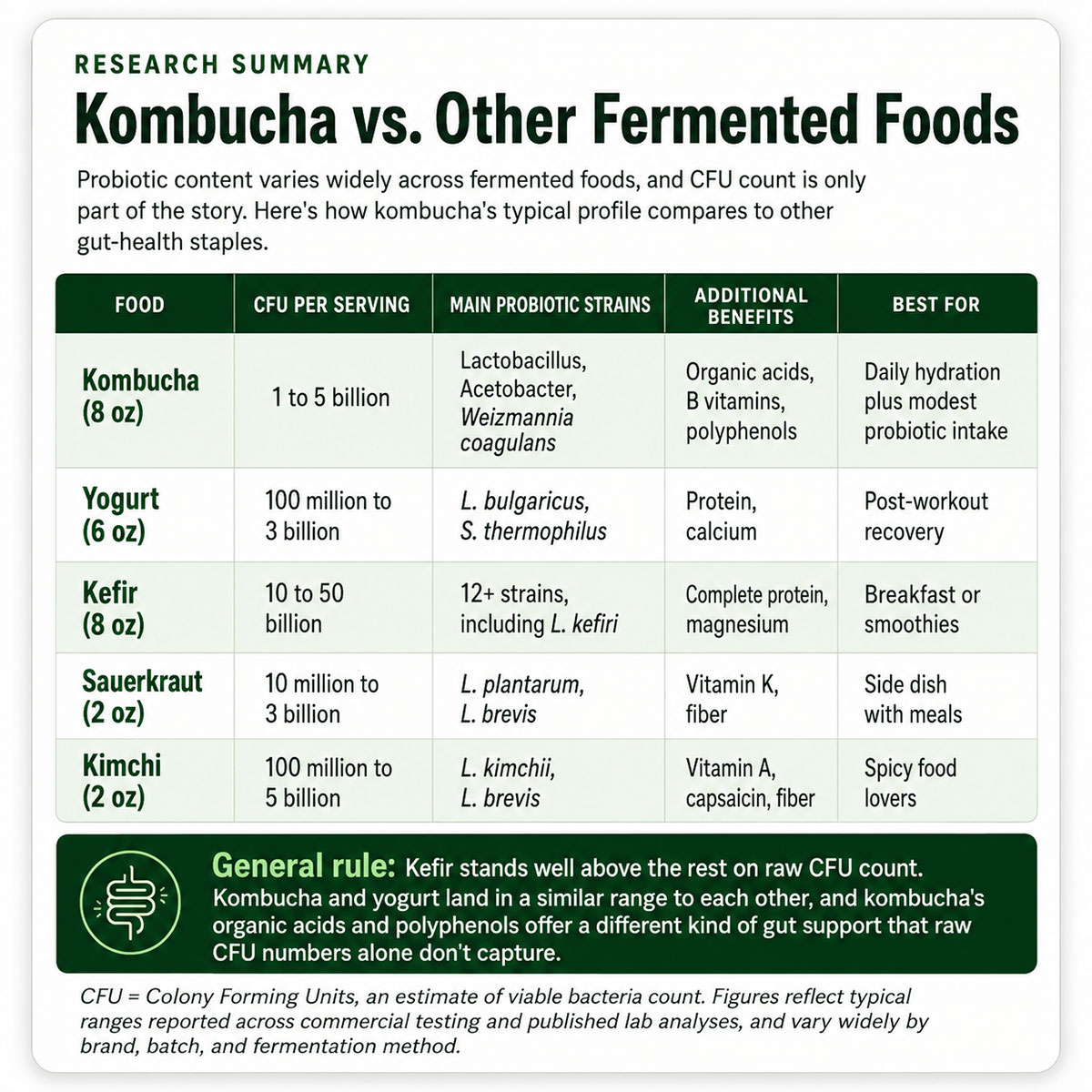
Here’s how kombucha’s typical probiotic content stacks up against other fermented staples.
Kombucha’s Other Claimed Benefits, and Where the Evidence Runs Thin
Acetic acid gives kombucha its tang, and it has real antimicrobial properties similar to vinegar. It helps create an environment less hospitable to unwanted microbes.
Glucuronic acid is where the marketing gets ahead of the science. It’s often described as a liver detoxifier, and it does play a documented role in how the liver processes and excretes certain compounds.
The catch is that nearly all of the supporting research comes from animal models and cell studies, not humans. Whether drinking kombucha meaningfully raises glucuronic acid availability in a person’s actual liver is still unknown.
Polyphenols round out the profile, carried over from the tea base and concentrated further by fermentation. These antioxidants have a much larger and more consistent evidence base across fermented and unfermented tea alike, so this part of kombucha’s reputation rests on firmer ground than the liver claims do.
What Could Go Wrong: Side Effects and Who Should Avoid Kombucha
Most side effects trace back to the same few causes: too much, too soon, or too much sugar. Bloating, gas, and mild nausea are the most common complaints, especially in the first week.
Rare but serious cases exist too. Case reports describe lactic acidosis and liver toxicity tied to excessive consumption. These almost always involve unpasteurized, poorly stored, or homemade batches gone wrong. Tooth enamel erosion is a slower-building risk from the drink’s acidity.
Certain groups face higher stakes than a bad afternoon of bloating.
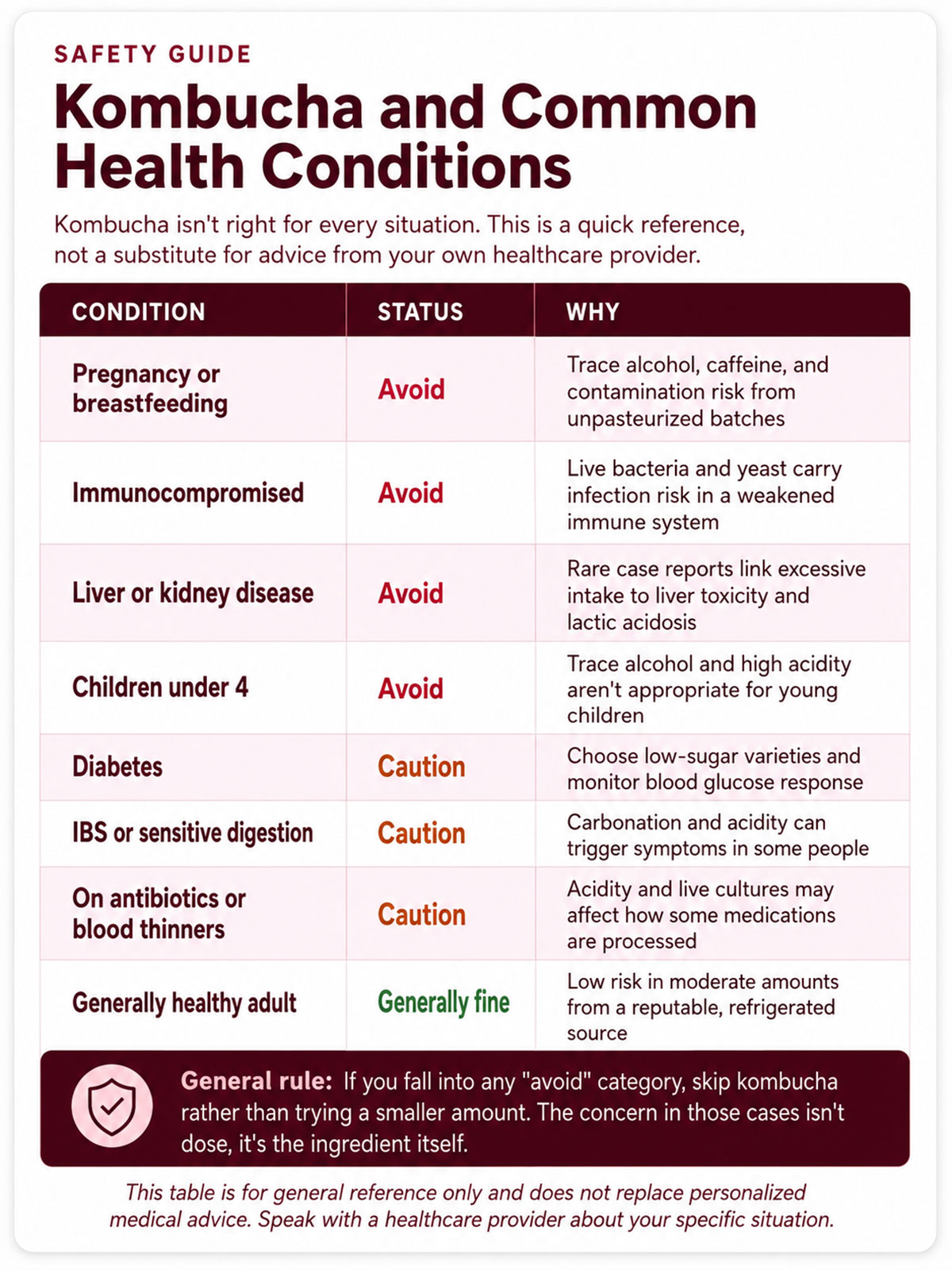
Beyond those groups, anyone starting a new medication involving antibiotics, immunosuppressants, or blood thinners should mention kombucha to their physician. Its acidity and live bacterial content can affect how some drugs are absorbed or processed.
Choosing a Kombucha Worth Drinking
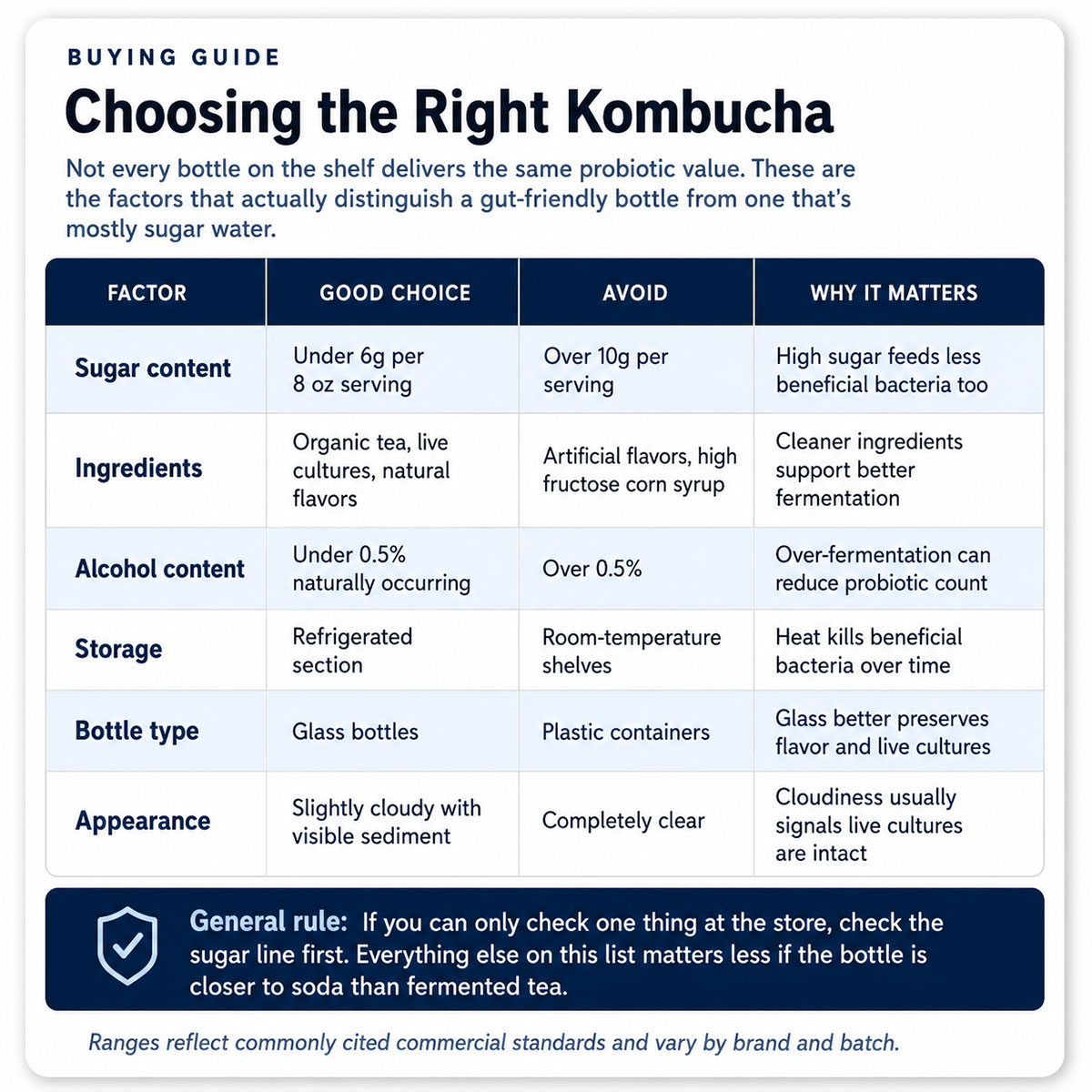
Not all bottles deliver the same probiotic value. Refrigerated, cloudy kombucha with visible sediment usually means the cultures are still alive. Shelf-stable, perfectly clear versions have often been pasteurized, which extends shelf life at the cost of the live bacteria you’re drinking it for.
Sugar content is the other variable worth checking. Under 6 grams per 8-ounce serving is a reasonable ceiling. Above 10 grams, you’re feeding your own sugar cravings more than your gut bacteria.
The Bottom Line on Kombucha and Your Gut
The honest version of kombucha’s gut health story is less dramatic than the marketing and more useful than the skeptics give it credit for. The bacteria are real. The short-chain fatty acids are real. The effect size depends on you, and for people starting from an already decent baseline, that effect will be genuinely modest.
That’s not a reason to skip it. A daily glass with a meal, paired with the fiber that feeds the bacteria that kombucha helps to establish, is a low-cost, low-risk habit with a small but real body of evidence behind it. It just isn’t a two-week transformation. It’s a slow nudge, repeated often enough to matter.
FAQs
Will kombucha interfere with my medications?
Kombucha’s acidity and live bacteria can affect how some drugs are absorbed and how your gut breaks them down. If you take antibiotics, immunosuppressants, or blood thinners regularly, mention your kombucha habit to your doctor rather than assuming it’s irrelevant.
Is store-bought kombucha as good as homemade?
Homemade batches often carry more diverse bacterial strains. Store-bought versions trade some of that diversity for consistency and quality control. Neither is the wrong choice. It depends on which of those two things you’d rather have more of.
Does the type of tea used in kombucha matter?
Yes, though not dramatically. Green tea versions tend to carry more antioxidants, black tea offers more B vitamins, and white tea is gentler on sensitive stomachs. All support bacterial fermentation effectively.
How long do kombucha’s gut benefits last if I stop drinking it?
Most of the microbiome shifts documented in clinical trials faded within two to four weeks after participants stopped drinking it. Kombucha behaves more like a daily habit than a one-time fix, so the benefits don’t stick around once you do.
Can I drink kombucha alongside a probiotic supplement?
Generally, yes. Kombucha introduces different bacterial strains than most supplements, which can broaden diversity rather than duplicate it. Start slowly if you’re combining both, since your gut is adjusting to more at once.
Is kombucha safe during pregnancy or breastfeeding?
Most healthcare providers recommend avoiding it, due to trace alcohol content, caffeine, and the risk of harmful bacteria in improperly fermented batches. Talk to your doctor before making an exception.
Can diabetics drink kombucha safely?
Lower-sugar varieties, under 6 grams per serving, are generally fine for diabetics. There’s a reasonable mechanism behind it too: acetic acid may modestly blunt blood sugar spikes the same way vinegar does, though individual response varies enough that it’s worth checking your own glucose response before trusting the mechanism.
Can I drink kombucha on an empty stomach?
It’s usually better with food, especially when you’re new to it. The acidity can irritate a sensitive stomach on its own. Pairing it with a meal or small snack eases that.
Can children drink kombucha?
Trace alcohol and high acidity make kombucha a poor fit for children under 4. Older children can sometimes try a small amount, but only after checking with a pediatrician first.