Week 1 and Week 12 looked surprisingly different inside the gut. Here’s what researchers discovered after people ate kimchi every day for three months.
Yes, kimchi is good for gut health. What popular summaries leave out is how those changes specifically work, and what has to happen inside your gut before the benefits show up.
Most nutrition coverage treats kimchi as a yes-or-no proposition. Fermented. Probiotic. Gut-healthy. The clinical research tells a more specific story. There is a window, eight to twelve weeks of daily consumption, during which your gut’s bacterial community shifts in documented, named, and measurable ways.
What your microbiome looks like at week twelve is different from what it looked like at week one. That difference is worth understanding before you buy the jar.
The 8–12 Week Window: Why Timing Matters
Think of your gut microbiome as a neighborhood. Short-term visitors cycle through constantly. Long-term residents are the ones who change the character of the place, and establishing them takes time.
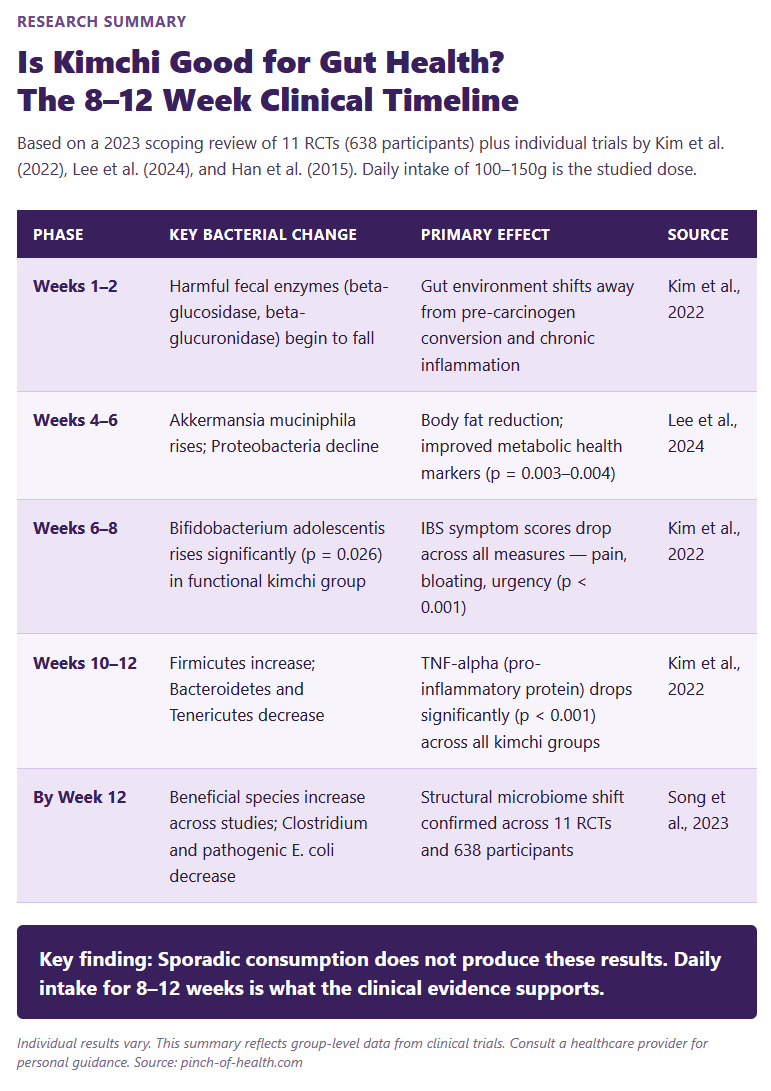
A 2023 scoping review published in the Journal of Ethnic Foods analyzed eleven randomized controlled trials involving 638 participants. Consistent increases in beneficial bacteria and decreases in harmful ones appeared across those trials. Most of the meaningful results appeared at or after the eight-week mark.
One important qualifier: this timeline assumes daily, consistent consumption. Sporadic intake (a few times a week) does not produce the same results in the research. Short-term studies of seven to ten days do show early bacterial population shifts, but the structural changes take longer.
The kind that affect how you digest food, how your immune system responds, and how your gut handles chronic stressors require sustained exposure to accumulate.
A daily serving of 100–150g sets that process in motion. That’s roughly one cup, the amount used consistently across the clinical trials. The research maps what happens at each stage.
Weeks 1–2: Early Colonization and the First Shifts
The moment kimchi enters your gut, bacteria start competing for territory. Kimchi is packed with lactic acid bacteria (LAB), live microorganisms produced during fermentation. These bacteria begin colonizing your gut immediately. Less beneficial microbes face new competition for space and resources from the start.
Some people notice mild bloating or changes in bowel habits during this period. The microbiome is adapting to new residents, and that adjustment is real. It usually settles within a week or two.
One of the documented changes across the twelve-week Kim trial, measured at the study’s endpoint, was a significant reduction in two harmful fecal enzymes: beta-glucosidase and beta-glucuronidase. When these enzymes are elevated, they convert pre-carcinogens into carcinogens inside the gut and contribute to chronic inflammation.
The 2022 randomized double-blind trial by Hee-Young Kim and colleagues at Pusan National University, which enrolled 90 adults with IBS symptoms across three kimchi groups over twelve weeks, found significant reductions in both enzymes across all three groups.
It’s a quiet change, one that doesn’t announce itself in how you feel, but it shifts the internal gut environment in ways that accumulate over the weeks ahead.
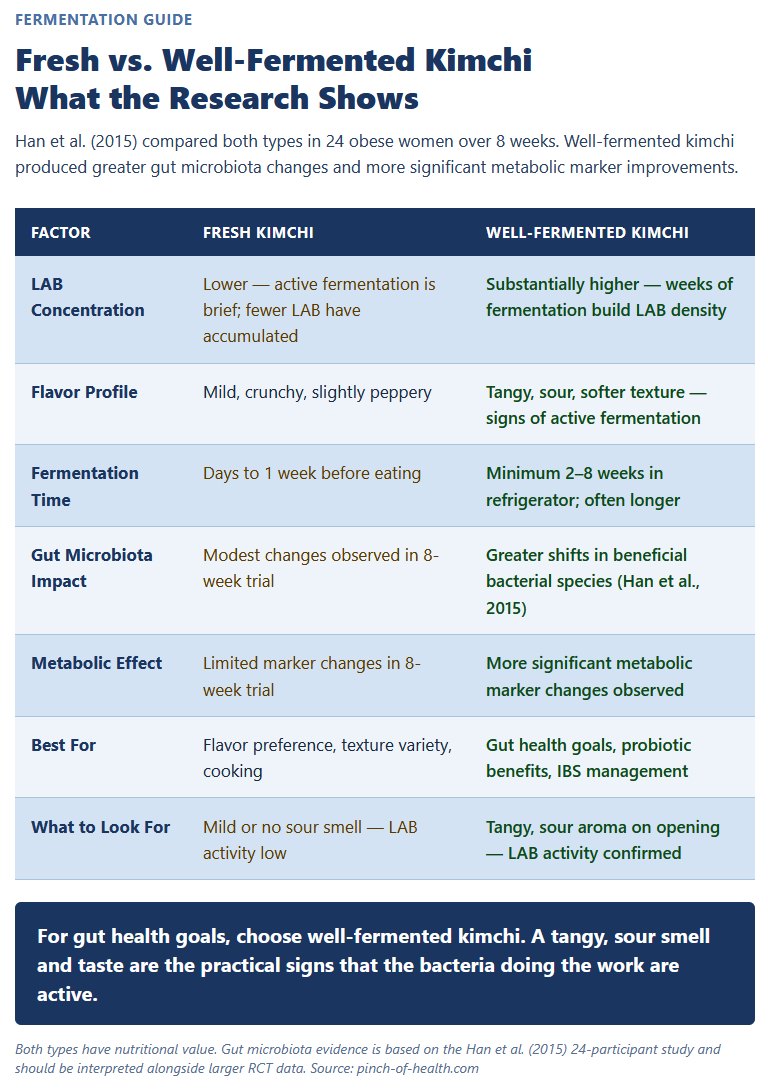
Fermentation quality matters from day one. Kyungsun Han and colleagues at Dongguk University studied 24 obese women for eight weeks. The trial compared fresh kimchi against well-fermented kimchi head-to-head.
Their 2015 study in Molecular Nutrition and Food Research found that the fermented version altered gut microbiota more significantly and produced greater changes in metabolic markers.
Well-fermented kimchi carries a substantially higher concentration of live LAB than fresh kimchi, which is why a tangy, sour smell and taste are the practical signs that the bacteria doing the work are actually present.
One finding from that same trial ran against the grain. CRP, an inflammation marker, trended upward in the fermented kimchi group (p = 0.052), a result the researchers flagged as unexpected. It didn’t reach statistical significance, and no larger trial has replicated it. But it’s the one moment in the fermented kimchi research where the data moved against the expected pattern.
Weeks 4–8: The Metabolic and IBS Shift
Most people know kimchi as a gut food. The finding that tends to surprise them is that by the one-month mark, the bacterial changes start affecting body composition.
Wooje Lee and colleagues at the World Institute of Kimchi ran a twelve-week randomized controlled trial published in the Journal of Functional Foods in 2024. The study tracked 90 overweight adults across two kimchi groups and a placebo.
Both kimchi groups showed significant reductions in body fat mass compared to the placebo group (p = 0.004 and p = 0.003), alongside an increase in Akkermansia muciniphila and a measurable decline in Proteobacteria, a bacterial group associated with metabolic disease and chronic gut inflammation.
Akkermansia muciniphila lives in the mucus layer of the intestinal wall. It maintains the gut barrier and plays a role in regulating blood sugar and fat storage. Higher abundance of this species is consistently linked to better metabolic health across multiple research contexts.
When kimchi drives an increase in this species while reducing Proteobacteria, the effect reaches well beyond microbiome composition. That bacterial shift is part of what most people actually feel around the four-to-six-week mark: digestion that seems less reactive, fewer urgency episodes, a reduction in the low-level bloating that had started to feel normal.
For people dealing with IBS, this phase is where the data becomes particularly pointed. The Kim et al. (2022) trial enrolled participants specifically for their IBS symptoms.
By week eight, significant reductions appeared across all major IBS symptom scores: abdominal pain, bloating, incomplete evacuation, and urgency, all reaching statistical significance at p < 0.001. Bowel transit also improved, which directly addresses the incomplete evacuation symptom that affects a large portion of IBS sufferers.
A specific bacterial actor drove part of that symptom relief. Bifidobacterium adolescentis, a species that supports the gut lining and produces short-chain fatty acids, increased significantly in the group consuming functional kimchi (p = 0.026).
The mechanism is direct: a stronger gut lining reduces the leakage of inflammatory compounds into the bloodstream, and less leakage produces less pain, less bloating, and better function overall. The trial tested three kimchi types: standard, nF1-added, and functional.
All three improved IBS symptoms, standard kimchi included. But the functional version, with mistletoe extract and additional LAB strains, produced the most significant Bifidobacterium adolescentis rise.
That matters: if you’re managing active IBS symptoms rather than general microbiome maintenance, the strain composition of your kimchi starts to matter more than most people realize.
Weeks 10–12: Inflammation Down, New Baseline Set
The gut improvements don’t stay in your gut. Most coverage of kimchi research stops before this part.
By the twelve-week endpoint of the Kim trial, all three kimchi groups showed significant reductions in serum TNF-alpha (p < 0.001). TNF-alpha is one of the body’s primary pro-inflammatory proteins, with chronically elevated levels linked to inflammatory bowel disease, cardiovascular disease, and metabolic disorders. This is people eating food. Not medication.
The mechanism behind this likely involves short-chain fatty acids (SCFAs). A 2024 study published in Nutrients tracked kimchi’s effects in a rat model and found that kimchi intake restored SCFA production (including acetic, propionic, and butyric acids) that had been suppressed by a high-fat diet.
To be clear: this is animal research. The specific SCFA restoration data comes from rats, not humans. What the human RCT data shows is the downstream result consistent with increased SCFA production: reduced systemic inflammation measured through TNF-alpha. Butyrate, in particular, is the preferred fuel for the cells lining the colon.
When those cells receive sufficient butyrate, the gut wall maintains a tighter barrier and the immune system receives fewer inflammatory signals from the digestive tract.
At the twelve-week mark, the Kim trial found that across the participant groups, kimchi consumption increased Firmicutes at the expense of Bacteroidetes and Tenericutes populations.
The 2023 scoping review, covering eleven trials and 638 participants, found consistent increases in beneficial bacterial species alongside decreases in Clostridium and pathogenic E. coli across studies. These reflect a genuine structural shift in which bacterial species dominate the gut community.
Here, the neighborhood analogy pays off. After twelve weeks of daily kimchi, the beneficial bacteria have stopped passing through. They have become residents, and the evidence suggests they’ve begun changing the character of the place.
One gap the trials haven’t addressed: how long these changes persist after stopping kimchi consumption. The twelve-week data is solid. What happens in month four or five without kimchi remains an open question.
Kimchi Gut-Health Timeline Tracker
Track where you are in the 8–12 week clinical evidence window
How to Make Daily Kimchi Work
The research is specific about what works. These three things separate kimchi that actually reshapes your microbiome from kimchi that doesn’t.
Aim for 100–150g per day, and eat it cold. This is the serving size used across the trials showing meaningful microbiome and symptom changes. A standard cup is roughly 150g. And temperature matters: heat kills LAB. Adding kimchi to a hot pan, or stirring it into soup near the end of cooking, destroys most of the live cultures. Room temperature works. Anything hotter doesn’t.
Choose well-fermented kimchi over fresh. The Han data showed that fermented kimchi produces superior microbiota changes compared to the fresh version. Kimchi that has been fermenting for several weeks will have that tangy, sour character. The bacteria doing the work are present and active.
Variety matters if your goal is symptom relief rather than general maintenance. The Kim trial showed that functional kimchi with additional LAB strains produced the most significant rise in Bifidobacterium adolescentis. Standard well-fermented kimchi holds up well for microbiome maintenance. For people managing active IBS symptoms, the strain composition starts to matter more.
Is Daily Kimchi Right for Everyone?
The sodium content is the practical barrier most people underestimate. Histamine sensitivity, adjustment bloating, and store-bought label literacy all matter too, but if you’re managing blood pressure, the salt calculation comes first.
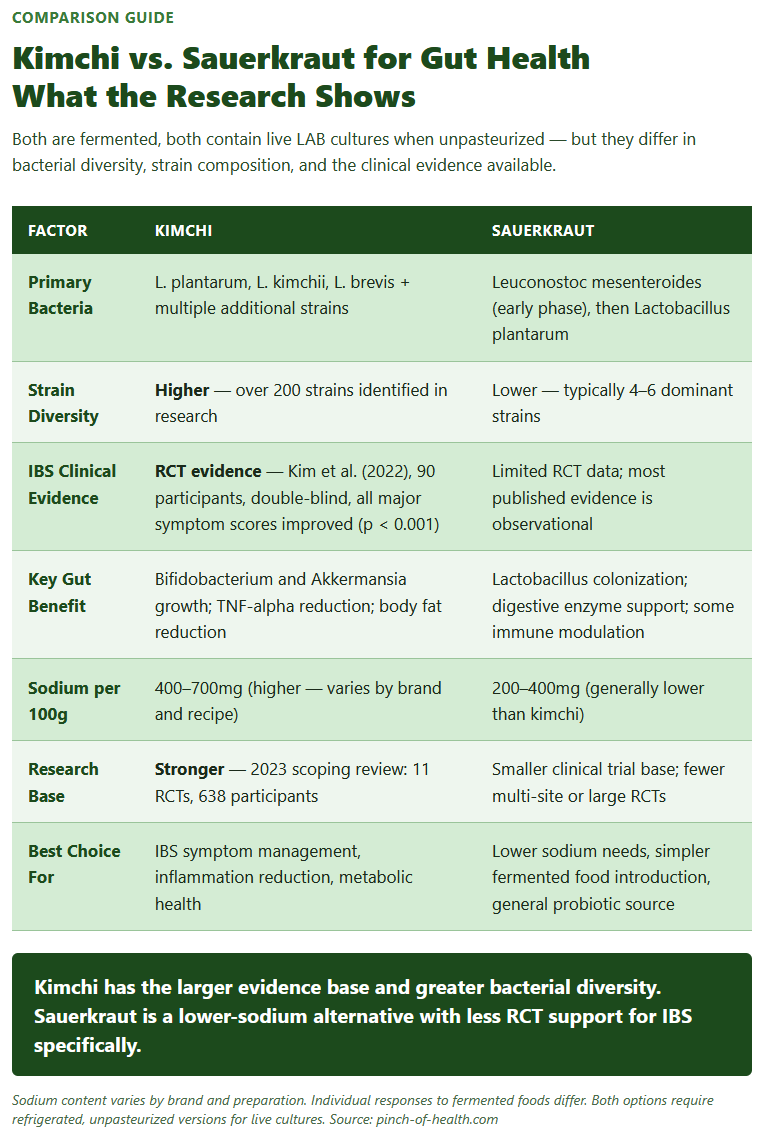
Sodium. A 100g serving typically contains 400–700mg of sodium, depending on the brand and recipe. If you manage high blood pressure or follow a sodium-restricted diet, speak to your doctor before making kimchi a daily staple. The microbiome benefits are real, and they need to be weighed against individual cardiovascular risk.
Histamine sensitivity. Fermented foods naturally contain histamine. People with histamine intolerance may experience headaches, skin flushing, or digestive upset with regular kimchi consumption. Starting at 30–50g per day and building gradually gives the system time to adapt without provoking a reaction.
New to fermented foods. If your gut hasn’t been regularly exposed to live cultures, expect a short adjustment period. The bloating some people experience in the first week or two is the microbiome adapting to a shift in its bacterial population, not a sign something is wrong. A few tablespoons per day for the first week or two makes the transition easier.
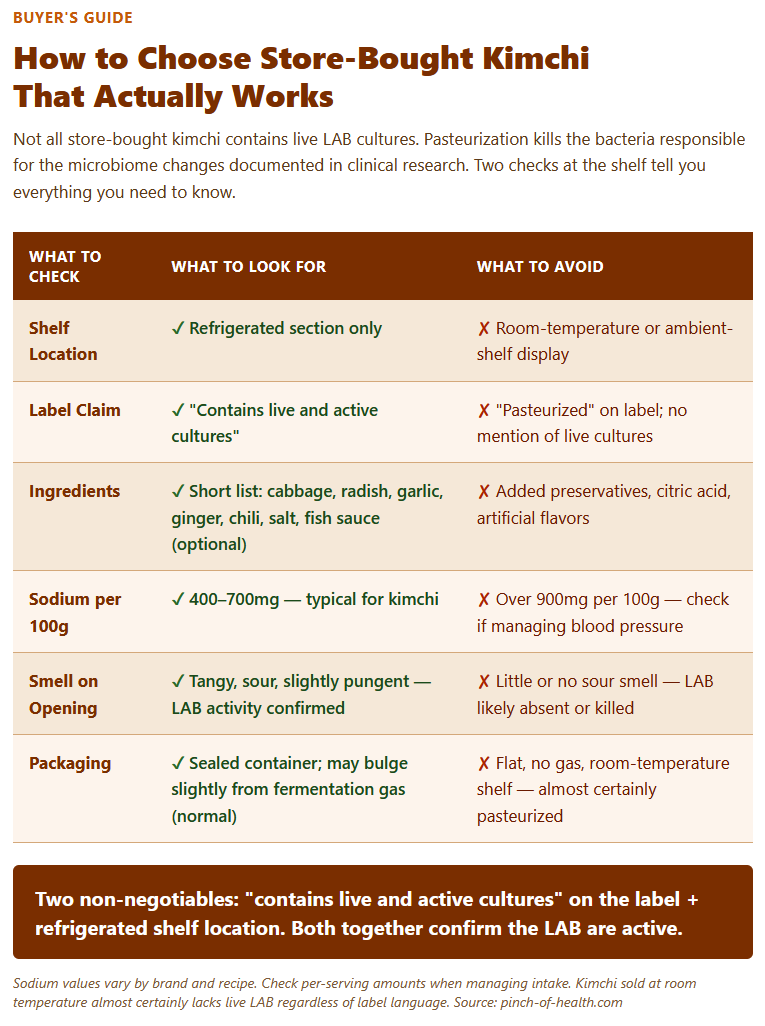
Store-bought kimchi. Refrigerated, unpasteurized kimchi contains live cultures. Shelf-stable or heat-processed varieties may not, because pasteurization kills the LAB responsible for the microbiome changes the research documents.
Two things to look for on the label: “contains live and active cultures” and a refrigerated shelf location in the store. Both confirm the bacteria are still active. Kimchi sold at room temperature from an unrefrigerated shelf almost certainly lacks live LAB regardless of what the label implies about fermented ingredients.
Conclusion
Calling kimchi a superfood is the kind of statement that promises too much and explains nothing. What the clinical record shows, across a 2023 scoping review of eleven trials and 638 participants, is more specific than that: named bacterial species, documented drops in inflammation markers, real symptom relief in people who had been dealing with IBS for years.
What the research cannot tell you yet is how long those changes last once you stop eating kimchi. That study hasn’t been done. The twelve-week window is established. What comes after it is still uncharted.