Tech Neck is the result of spending hours with your head tilted forward, putting enormous strain on your cervical spine. For every inch your head moves forward from its neutral position, your neck muscles work to support an extra 10 pounds of weight. That laptop you’ve been staring at? It’s turned your 12-pound head into a 32-pound burden your neck has to carry all day long.
Science shows that yoga works better than typical care or basic stretches for reducing neck pain. A 2020 review of 10 studies involving 666 people found that yoga reduced both pain intensity and disability in the short term. Multiple studies prove it can lower pain levels and boost your range of motion in as little as 10 days.
Research shows which five poses work best for Tech Neck relief.
The 5 Poses at a Glance
| Pose Name | Target Area | Time Required | Difficulty Level | Primary Benefit |
|---|---|---|---|---|
| Ear-to-Shoulder Lateral Stretch | Side neck muscles, upper trapezius | 2-3 minutes | Beginner | Restores side-to-side range of motion |
| Thread the Needle | Upper back, shoulders, neck rotation | 3-4 minutes | Beginner | Releases shoulder-neck tension simultaneously |
| Sphinx Pose | Upper back, chest, front neck | 2-3 minutes | Beginner | Counteracts forward head posture |
| Cat-Cow Sequence | Entire spine, neck flexibility | 3-5 minutes | Beginner | Improves spinal fluidity and circulation |
| Supported Child’s Pose | Base of skull, entire neck | 3-5 minutes | Beginner | Reduces overall stress and muscle tension |
Understanding Your Neck: A Quick Anatomy Lesson
Before we get into the poses, let’s talk about what’s actually happening in your neck.
Your cervical spine has seven small bones stacked on top of each other. These vertebrae, called C1 through C7, support your head and allow it to move in multiple directions.
Several muscle groups keep your head upright. The trapezius runs from your shoulders to the back of your skull. The levator scapulae connects your neck to your shoulder blades. The sternocleidomastoid muscles run along the sides of your neck.
When you look down at your phone or laptop, these muscles work overtime. Your head tilts forward. Your shoulders round in. Your upper back curves into a C-shape.
This position does two things. First, it forces your neck muscles to support much more weight than they’re designed for. Second, it stretches the muscles in the back of your neck while shortening the ones in front.
Over time, this creates muscle imbalances. Some muscles get weak and overstretched. Others get tight and short. The result? Pain, stiffness, and limited movement.
Yoga addresses both problems. The stretching releases tight muscles. The strengthening balances out weak ones. The breathing calms your nervous system, which tells those tense muscles to relax.
Research Results: What the Science Shows
Here’s what multiple clinical trials have found about yoga for neck pain:
| Study Duration | Number of Participants | Pain Reduction | Key Outcome |
|---|---|---|---|
| 10 days | 60 computer users | Significant decrease on pain scale | Improved range of motion in all directions |
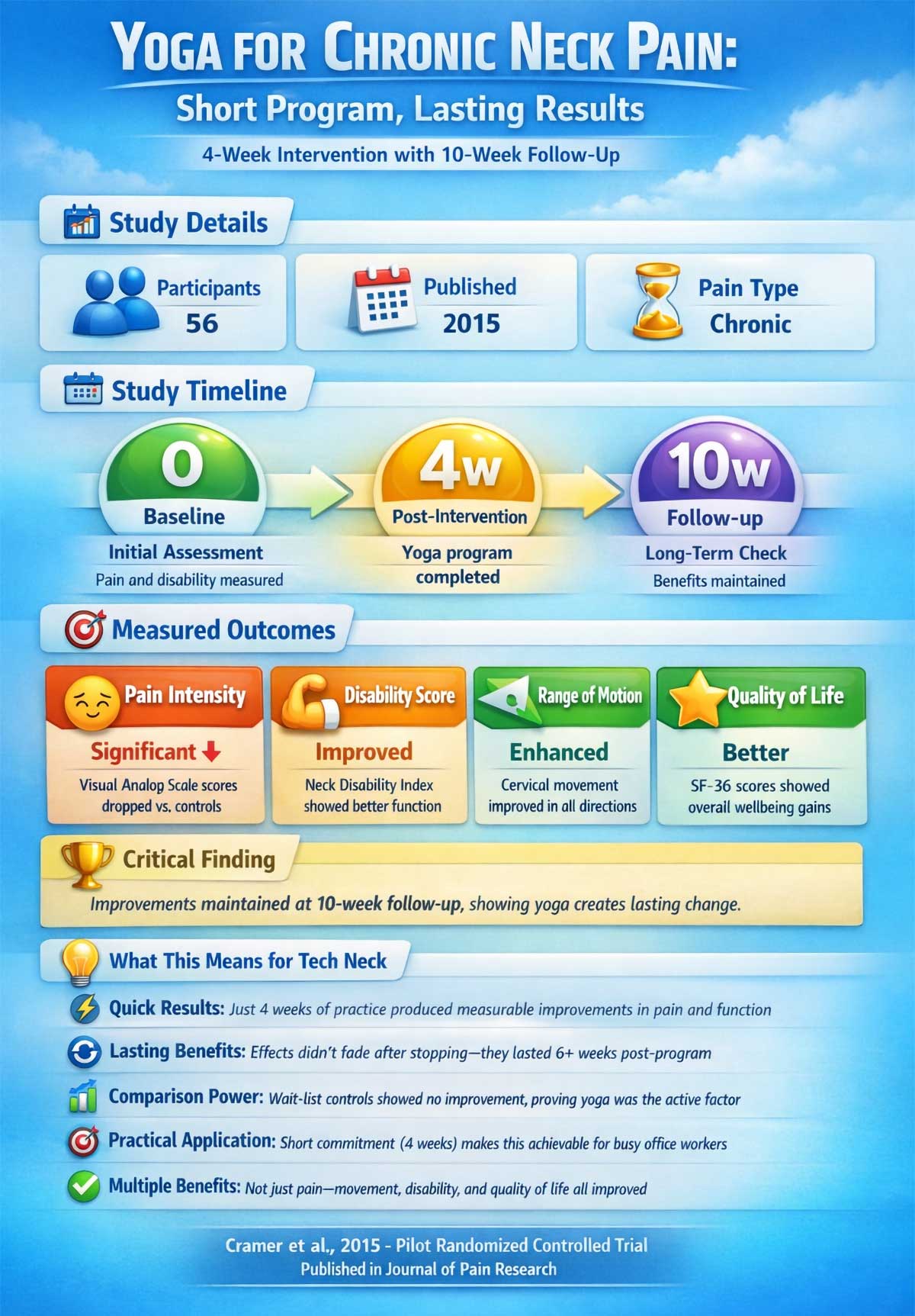
| 4 weeks | 56 adults with chronic pain | 2+ point drop on 10-point scale | Effects maintained at 10-week follow-up |
| 9 weeks | 77 adults with chronic pain | Significant reduction in pain intensity | Better cervical range of motion vs. usual care |
| 10 weeks | 52 office workers | Greater reduction than conventional stretching | Decreased disability scores |
| 12 weeks | 60 adults with chronic pain | Clinically significant improvement | Better than guideline-based self-care |
The numbers tell a clear story. Yoga works for neck pain, and the effects can last for months after you finish a structured program.
The 5 Science-Backed Poses for Targeted Relief
1. Ear-to-Shoulder Lateral Stretch (The Range-of-Motion Restorer)
Why It Works
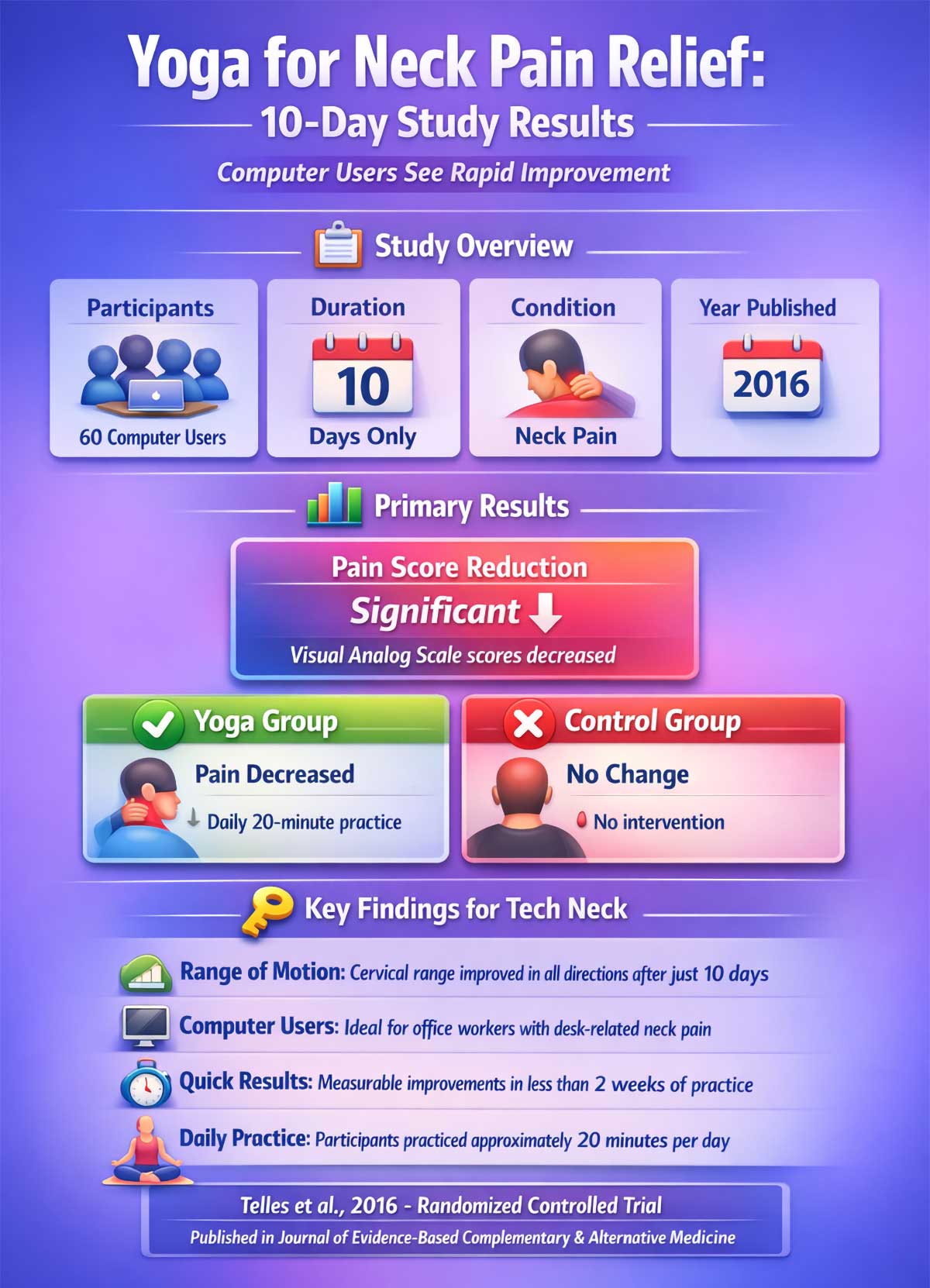
A 2016 study of 60 computer users showed that just 10 days of yoga practice significantly improved cervical range of motion in all directions. The researchers measured how far participants could move their necks to each side, and yoga practitioners showed clear improvements compared to people who didn’t practice.
This simple side stretch targets the often-neglected lateral flexion of your neck. It releases tension in your upper trapezius and levator scapulae muscles, which get incredibly tight from computer work.
When these muscles stay contracted all day, they create trigger points. These are small knots that refer pain to other areas. A trigger point in your upper trapezius can cause headaches. One in your levator scapulae can make it hard to look over your shoulder when driving.
How to Do It
Sit up tall in a chair or on the floor. Let your shoulders drop down and back.
Tilt your right ear toward your right shoulder. Keep your left shoulder anchored down.
Place your right hand gently on the left side of your head. Let the weight of your hand add a gentle pull. Don’t force it.
Breathe deeply for 5 to 8 breaths. You should feel a stretch along the left side of your neck.
Switch sides and repeat.
Modifications
- For severe pain: Skip the hand weight entirely. Just tilt your head gently without any added pressure.
- For limited mobility: Only tilt as far as comfortable. Even a small movement helps.
- Office version: Do this seated at your desk. Set a timer to repeat every two hours.
- Advanced: Add a gentle chin tuck while tilting to increase the stretch in the back of your neck.
Teacher’s Tip
Your hand is there for gentle weight, not aggressive pulling. Think of it like resting a light book on your head, not yanking your ear to your shoulder. If you feel any sharp pain or tingling down your arm, ease off immediately.
2. Thread the Needle (The Shoulder-Neck Connection)
Why It Works
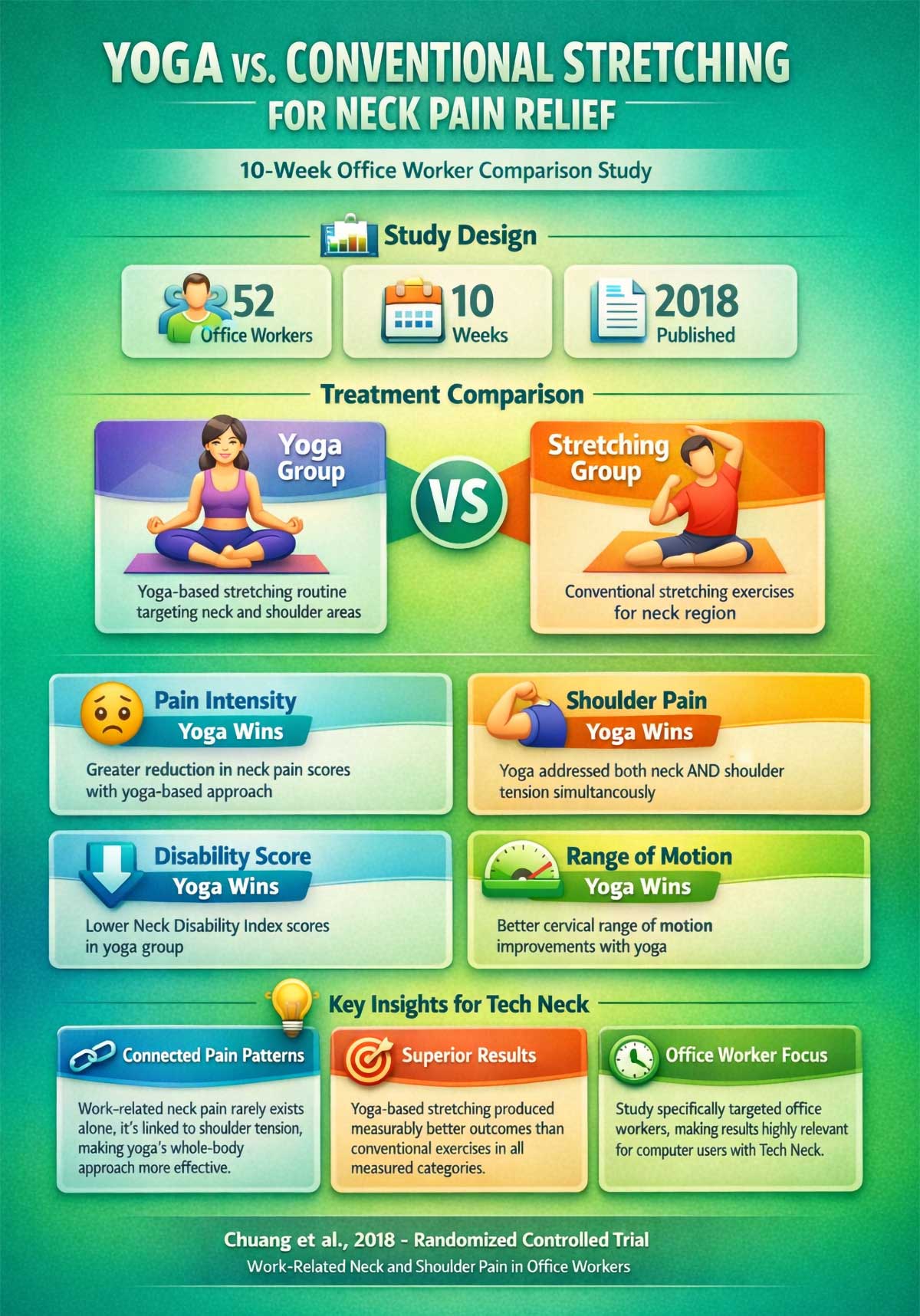
A 2018 study of 52 office workers compared yoga-based stretching to conventional exercises. The yoga group experienced greater reductions in both neck and shoulder pain intensity. The researchers noted that work-related neck pain rarely exists in isolation—it’s almost always linked to shoulder tension.
This pose addresses both areas at once. It opens your upper back, releases your shoulder blades, and gently rotates your cervical spine, which rarely happens during your typical day.
The rotation is key. Your neck can move in six directions: forward, back, left, right, and rotation to each side. Most people with Tech Neck lose rotation first. They can’t check their blind spot easily. They have to turn their whole body to look behind them.
Thread the Needle restores that rotation while releasing the fascia between your shoulder blades.
How to Do It
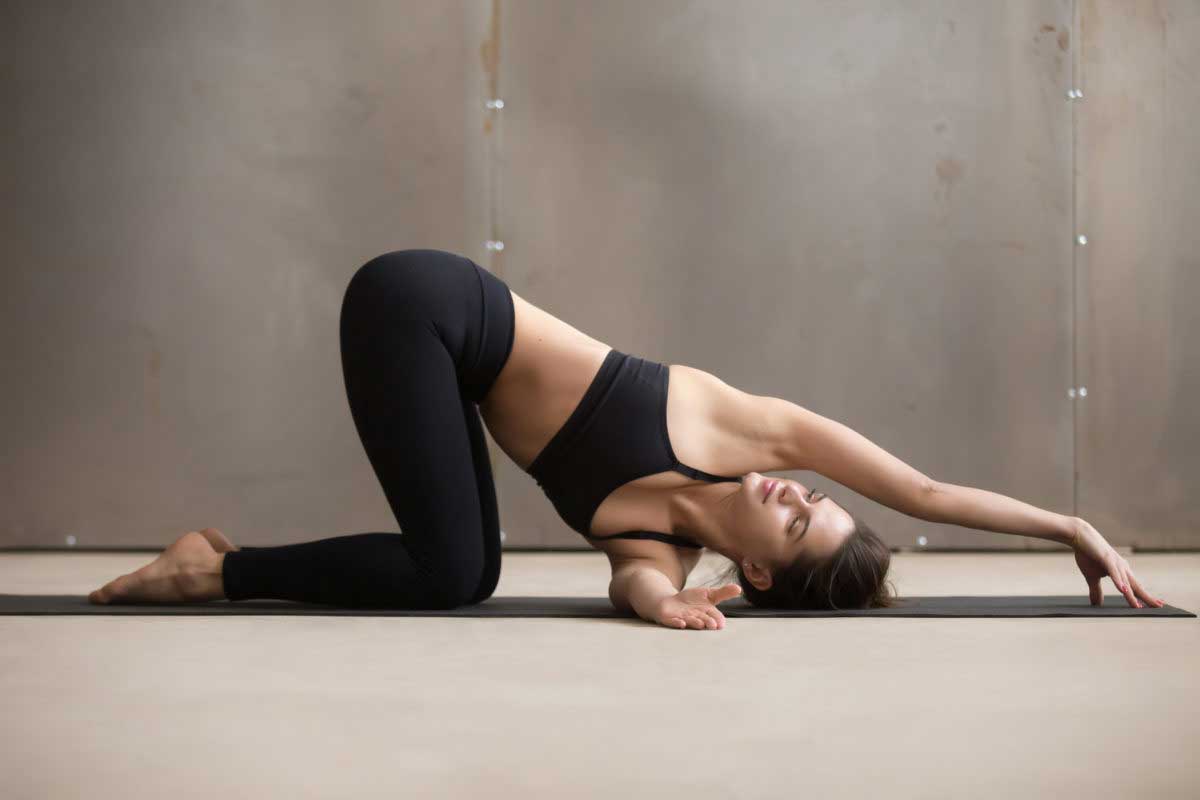
Start on your hands and knees in a tabletop position. Your wrists should be under your shoulders, knees under your hips.
Lift your right arm up toward the ceiling as you inhale. Follow it with your eyes.
As you exhale, thread your right arm underneath your left arm. Let your right shoulder and temple rest on the mat.
Keep your left hand planted or walk it forward for a deeper stretch.
Hold for 8 to 10 breaths. Feel the twist through your upper back and neck.
Press back up and repeat on the other side.
Modifications
- For severe pain: Place a folded blanket under your shoulder and head for support. Hold for fewer breaths.
- For limited mobility: Don’t thread as far under. Even a small rotation helps.
- Office version: Sit in your chair. Reach your right arm across your chest, thread it under your left arm, and twist gently to the left.
- Advanced: Walk your grounded hand further forward to deepen the stretch. Add a gentle lift of your hips toward the ceiling.
Teacher’s Tip
Keep your hips stacked over your knees. When your hips shift to the side, the stretch moves to your lower back instead of your upper thoracic spine and neck where you need it most.
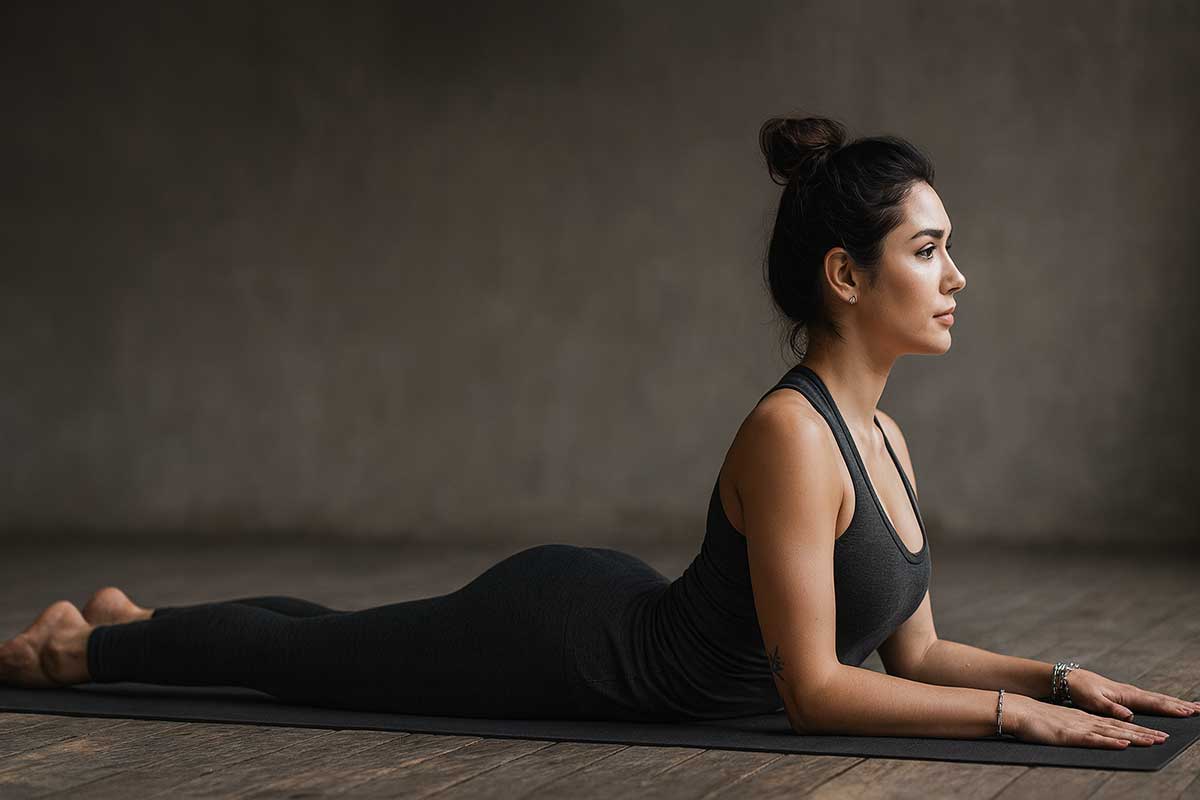
3. Sphinx Pose (The Counter-Slouch Opener)
Why It Works
Your spine forms a “C” shape when you slouch over screens. Sphinx pose creates the opposite curve, opening your chest and extending your thoracic spine.
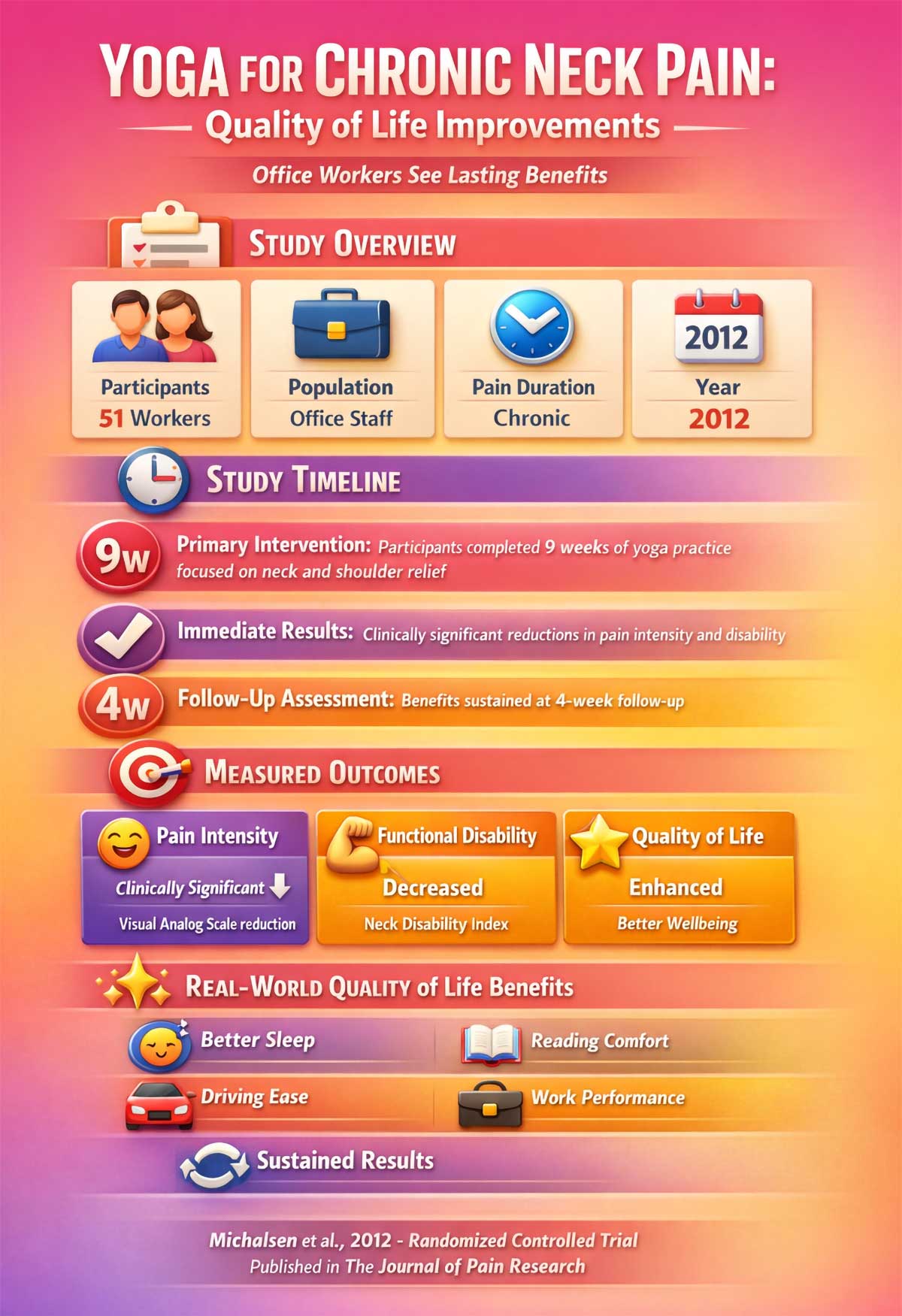
A 2012 study of 51 office workers found that yoga led to clinically significant reductions in pain intensity and functional disability at 9 weeks. The improvements held up at a 4-week follow-up. The yoga program included poses like Sphinx that counteract the forward-slouch position most office workers hold all day.
This type of extension work helps reverse forward head posture. It strengthens the muscles that hold your head in proper alignment and stretches the ones that have shortened from constant slouching.
The pose also opens your chest. When you slouch, your pectoral muscles get tight and short. This pulls your shoulders forward, which pulls your head forward. Sphinx stretches your chest while strengthening your upper back.
How to Do It
Lie face down on your mat. Place your forearms on the floor with your elbows directly under your shoulders.
Press into your forearms and lift your chest up. Your hips and legs stay on the mat.
Draw your chest forward like you’re trying to pull yourself through your arms.
Roll your shoulders back and down. Lengthen the back of your neck by tucking your chin slightly.
Hold for 10 to 15 breaths.
Modifications
- For severe pain: Place a folded blanket under your chest for support. Lower the height of your chest lift.
- For limited mobility: Start with your elbows further forward, which reduces the backbend.
- Office version: Sit at the edge of your chair. Clasp your hands behind your back and lift your chest while squeezing your shoulder blades together.
- Advanced: Press your forearms down more firmly and lift your chest higher. Keep your lower ribs on the mat.
Teacher’s Tip
Engage your lower core muscles to protect your lower back. You want the backbend to happen in your upper and middle back, not your lumbar spine. If you feel pinching in your low back, lower down a bit or place a folded blanket under your hips.
4. Cat-Cow Sequence (The Spinal Fluidity Flow)
Why It Works
This is the pose I recommend most to students with desk jobs. The 2016 study that showed results in just 10 days used a protocol that included Cat-Cow. Sixty computer users practiced for about 20 minutes daily. After 10 days, they had significantly lower pain scores and better cervical range of motion compared to people who didn’t practice.
The fluid movement creates motion in every segment of your spine. It wakes up the small muscles between your vertebrae and pumps fluid into your spinal discs, which get compressed from sitting all day.
Your spinal discs are like small jelly donuts between each vertebra. They need movement to stay healthy. When you sit still for hours, these discs get compressed and dried out. Movement rehydrates them.
Cat-Cow also teaches you something crucial: spinal awareness. Many people with neck pain have lost the ability to sense where their spine is in space. This sequence helps you reconnect with those sensations.
How to Do It
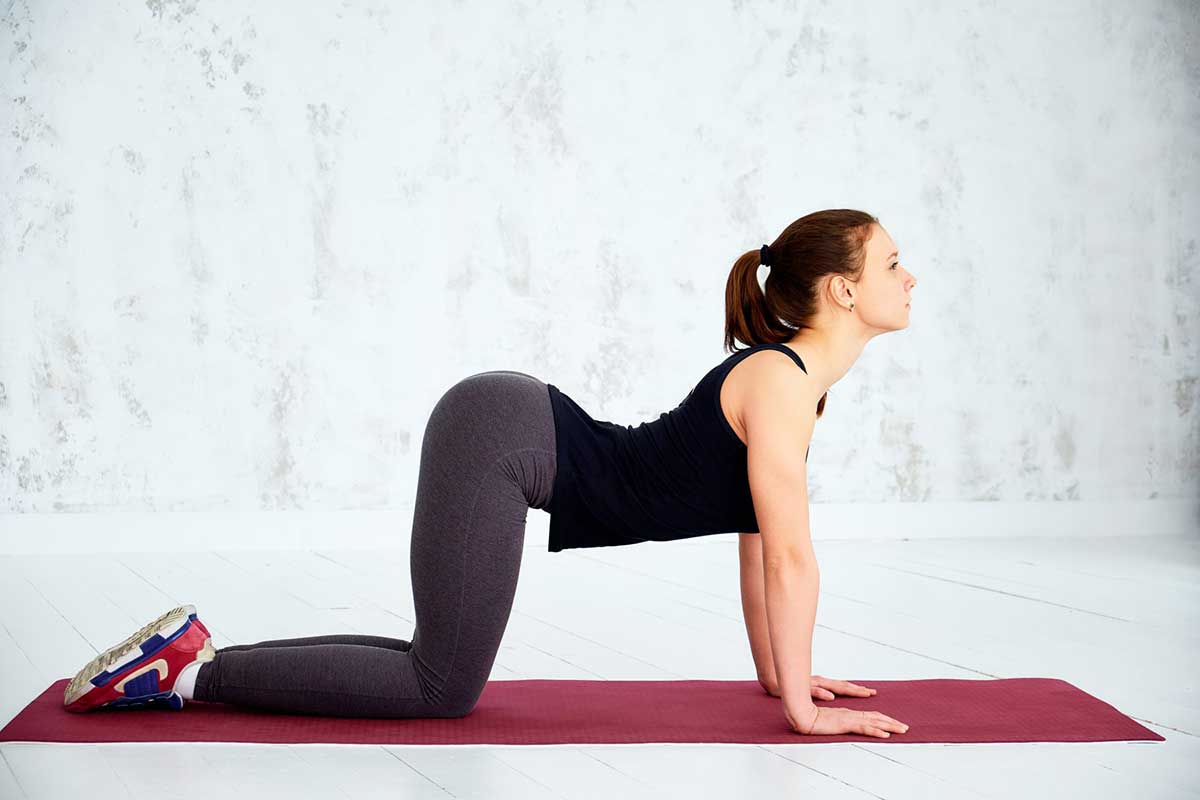
Start in tabletop position with your hands under your shoulders and knees under your hips.
Inhale into Cow pose. Drop your belly toward the floor, lift your chest and tailbone up, and look forward.
Exhale into Cat pose. Round your spine toward the ceiling, tuck your tailbone, and drop your head down.
Move slowly between these two positions. Match each movement to a breath.
Continue for 10 to 15 rounds.
Modifications
- For severe pain: Make smaller movements. Focus on gentle motion rather than deep stretching.
- For limited mobility: Do this seated in a chair. Arch and round your upper back while keeping your hips still.
- Office version: Sit at your desk. Place your hands on your knees. Arch your back and look up, then round your back and look down.
- Advanced: Add side-to-side circles. Move your spine in a clockwise circle for 5 rounds, then counterclockwise.
Teacher’s Tip
Focus on moving your shoulder blades away from your ears during both parts of the sequence. This creates space in your neck and upper back. Many people hunch their shoulders up by their ears, which defeats the purpose.
5. Supported Child’s Pose (The Disability Reducer)
Why It Works
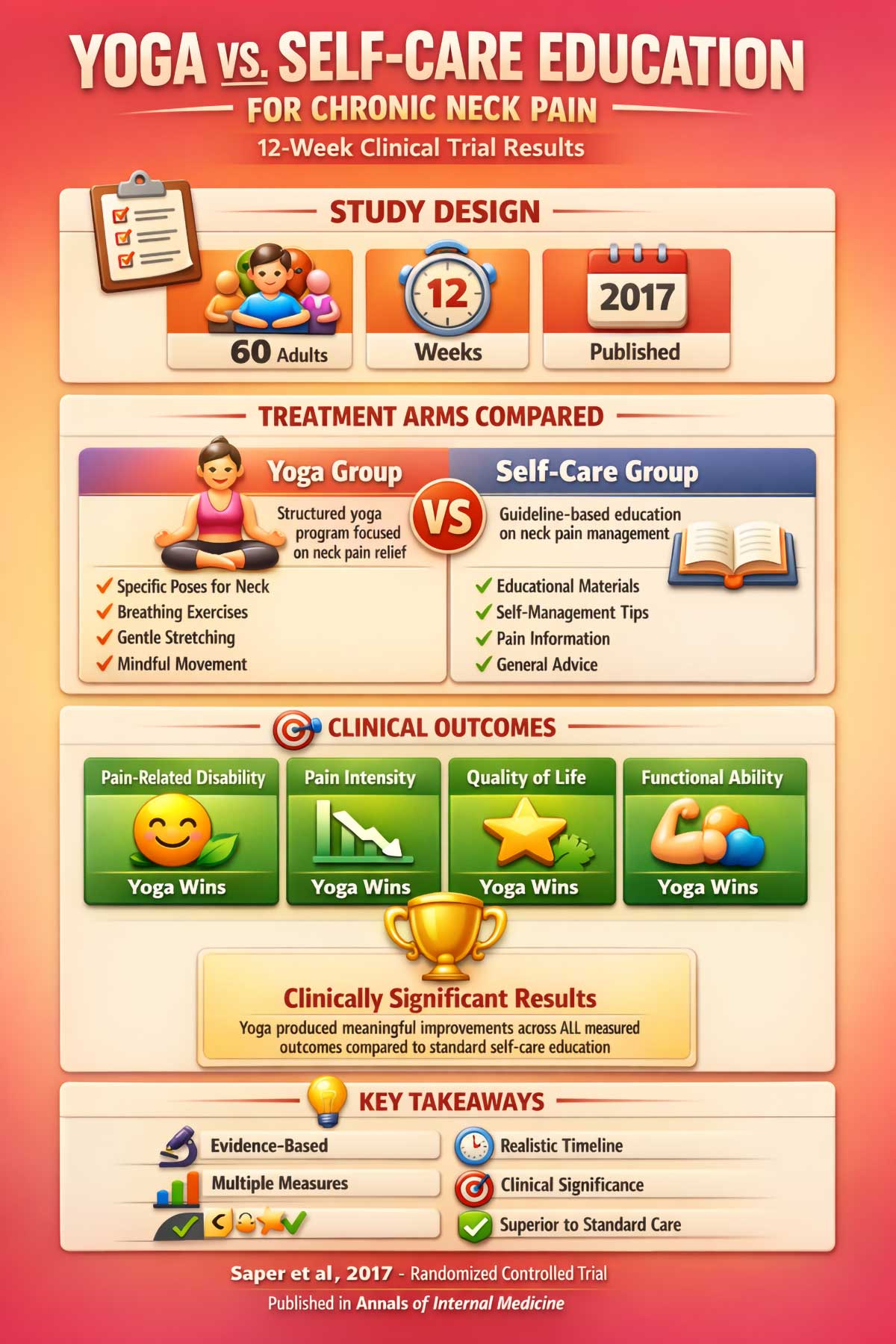
Multiple studies measured something called the Neck Disability Index (NDI), which tracks how much neck pain interferes with your daily life. The scale includes questions about sleeping, lifting, reading, concentrating, driving, and working.
A 2017 study of 60 adults found that yoga participants experienced clinically significant improvements in pain-related disability versus guideline-based self-care education. The disability scores dropped by more than 7 points on a 50-point scale after 12 weeks of practice.
Restorative poses like Child’s Pose lower your overall stress response. When you’re stressed, your neck and shoulder muscles stay contracted in a “fight or flight” pattern. This pose signals safety to your nervous system, allowing those muscles to release.
The pose specifically targets the suboccipital muscles at the base of your skull. These tiny muscles work constantly to hold your head up against gravity. When you rest your forehead down, they finally get to relax.
How to Do It
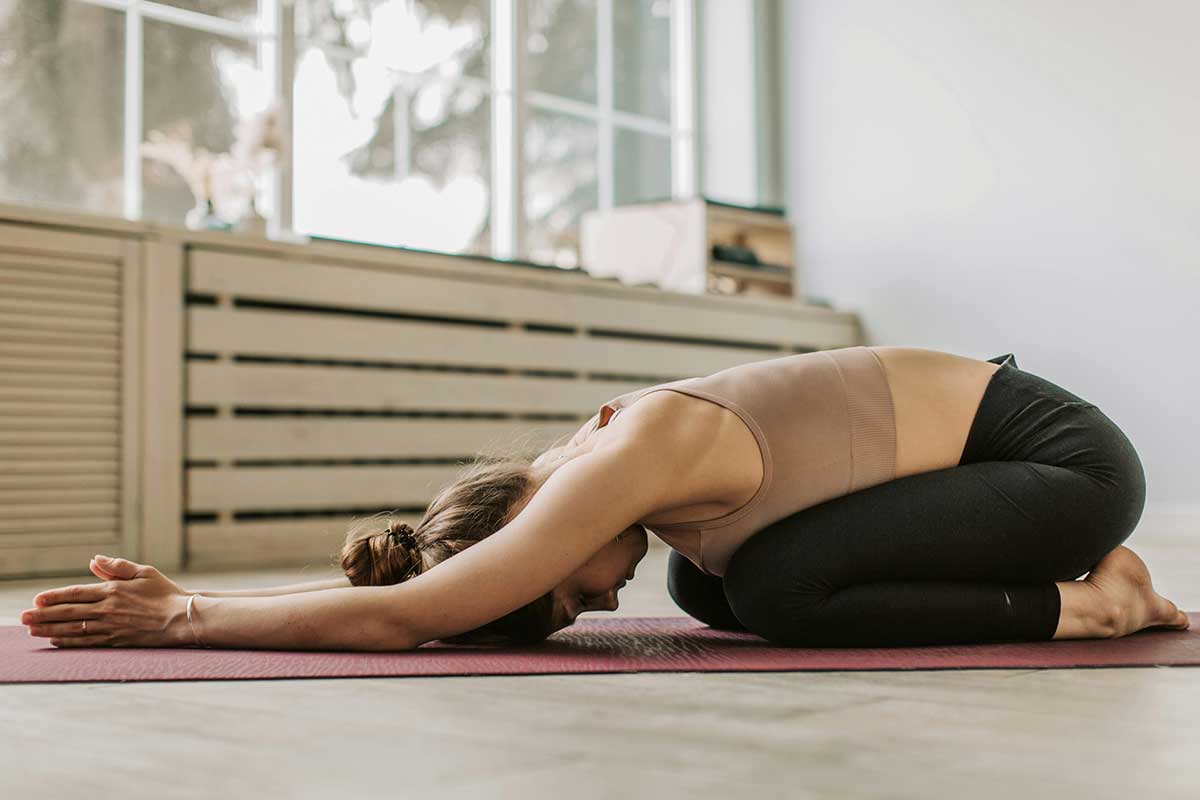
Kneel on your mat with your big toes touching and knees wide apart.
Place a bolster, pillow, or folded blanket between your thighs.
Fold forward and rest your torso on the support. Turn your head to one side.
Let your arms rest alongside your body or stretch them forward.
Close your eyes and breathe deeply. Stay for 2 to 5 minutes.
Switch your head to face the other direction halfway through.
Modifications
- For severe pain: Use more support. Stack two or three pillows so you don’t have to fold as far forward.
- For limited mobility: Sit back on a chair and fold forward over a desk or table with a pillow for support.
- Office version: Fold your arms on your desk and rest your forehead on them. Close your eyes for 2 to 3 minutes.
- Advanced: Remove some support to fold deeper. Reach your arms forward and walk your hands out.
Teacher’s Tip
Let your forehead feel heavy on the mat or your support. This “heavy head” sensation helps release the tiny suboccipital muscles at the base of your skull. These muscles get incredibly tight from looking at screens and are a major source of neck pain and headaches.
Yoga Practice Routines: Three Ways to Use These Poses
Recipe 1: The 10-Minute Morning Neck Reset
Total Time: 10 minutes
Best For: Starting your day with less stiffness
Equipment Needed: Yoga mat or carpet
Difficulty: Beginner
Instructions:
- Cat-Cow Sequence (2 minutes): 10-15 slow rounds to wake up your spine
- Ear-to-Shoulder Stretch (2 minutes): Hold 5-8 breaths each side
- Sphinx Pose (3 minutes): Hold and breathe deeply
- Supported Child’s Pose (3 minutes): Rest and release tension
Why This Works: You’ve been still all night. Your muscles are stiff. This sequence gently mobilizes your spine, stretches the sides of your neck, opens your chest, and ends with deep relaxation. You’ll start your day with better posture and less pain.
Teacher’s Note: Do this before you check your phone or open your laptop. Set yourself up for better alignment all day.
Recipe 2: The Desk Break Circuit (5 Minutes)
Total Time: 5 minutes
Best For: Taking breaks during work
Equipment Needed: Chair (optional mat)
Difficulty: Beginner
Instructions:
- Ear-to-Shoulder Stretch (1 minute): 3-4 breaths each side, seated at desk
- Cat-Cow (2 minutes): Modified version in chair, 8-10 rounds
- Thread the Needle (2 minutes): Seated twist version, 5 breaths each side
Why This Works: Short frequent breaks work better than one long session. This quick circuit hits all the key areas without requiring you to change clothes or leave your workspace.
Teacher’s Note: Set a timer for every 2 hours. Your body needs regular movement breaks to avoid cumulative strain.
Recipe 3: The Evening Wind-Down Sequence (15 Minutes)
Total Time: 15 minutes
Best For: Releasing accumulated tension after work
Equipment Needed: Yoga mat, pillows or bolster
Difficulty: Beginner to intermediate
Instructions:
- Cat-Cow Sequence (3 minutes): 15-20 slow, mindful rounds
- Thread the Needle (3 minutes): Hold 8-10 breaths each side
- Sphinx Pose (3 minutes): Build up slowly, hold at peak
- Ear-to-Shoulder Stretch (2 minutes): Very gentle, 8-10 breaths each side
- Supported Child’s Pose (4 minutes): Maximum support, complete rest
Why This Works: This is your full practice. It moves through all five poses in an order that progressively opens your body and calms your nervous system. You’ll sleep better and wake up with less pain.
Teacher’s Note: This sequence works best when you focus on your breath. Match your movements to your breathing. Let each exhale be a release of tension.
The Tech Neck Protocol: How to Practice for Results
Science gives us clear guidelines on how often and how long you need to practice to see real change.
Consistency Beats Intensity
You don’t need hour-long sessions. Research shows that short daily practice works better than occasional long practices.
The 2016 study that showed results in just 10 days used daily sessions of about 20 minutes. The 2013 trial that improved range of motion had participants practice for 90 minutes per week—split into two 45-minute sessions.
Start with 10 to 15 minutes per day. Do all five poses once, or pick two or three and spend more time in each one.
The key is daily practice. Your body needs consistent input to create change. Think of it like brushing your teeth. You wouldn’t skip six days and then brush for an hour on Sunday. Your neck needs daily care too.
Give It Time
Pain relief can start quickly. Some studies showed reduced pain in as little as 10 days. But functional improvements take longer.
For clinically significant changes in how much your neck pain affects your daily life, plan on 4 to 12 weeks of consistent practice. That’s when studies measured the biggest drops in disability scores and improvements in quality of life.
A 2015 study tracked participants for 10 weeks after a 4-week yoga program. The improvements they gained during the program held steady at the 10-week follow-up. This suggests the changes stick around if you keep practicing.
What to Expect Week by Week
Here’s a realistic timeline based on research findings:
Week 1: Building Awareness
- You notice how much tension you carry
- Small improvements in how far you can move your neck
- You might feel sore as muscles wake up
- Sleep quality may start to improve
Weeks 2-3: Initial Relief
- Pain intensity begins to drop
- You can turn your head further when driving
- Headaches become less frequent
- You catch yourself sitting up straighter
Weeks 4-6: Functional Changes
- You can work longer without needing to stretch
- Daily activities feel easier (driving, reading, exercising)
- Pain drops by 2+ points on a 10-point scale
- Range of motion improves noticeably
Weeks 8-12: Long-Term Transformation
- Pain becomes manageable or disappears
- The poses become a habit you don’t want to skip
- Your posture improves automatically
- You sleep better and wake without neck stiffness
Beyond 12 Weeks: Maintenance
- Practice 3-4 times per week to maintain gains
- You know which poses help you most
- Pain returns if you stop practicing but improves quickly when you restart
Your Daily Desk Break Checklist
Make these poses part of your workday routine. Check off each practice session to build the habit.
Track your practice for at least 4 weeks to see real change. Research shows this is the minimum time for clinically significant improvements.
Symptom Checker: Is Yoga Right for Your Neck Pain?
Use this table to determine if these yoga poses are appropriate for your situation.
| Symptom Type | Yoga Appropriate? | Action to Take |
|---|---|---|
| General stiffness from sitting | Yes | Start with all 5 poses |
| Mild to moderate aching pain (1-6 on 10-point scale) | Yes | Begin with gentle versions, progress slowly |
| Tension headaches starting at base of skull | Yes | Focus on Supported Child’s Pose and Ear-to-Shoulder |
| Difficulty turning head to check blind spot | Yes | Thread the Needle and Cat-Cow help most |
| Pain that improves with movement | Yes | These poses should provide relief |
| Pain after long periods at computer | Yes | Use the Desk Break Circuit every 2 hours |
| Chronic pain lasting more than 3 months | Yes, with doctor clearance | Start gently, track progress weekly |
| Sharp, stabbing pain | Caution | See doctor first, then start with gentlest modifications |
| Numbness or tingling down arms | No | See doctor immediately—possible nerve compression |
| Pain after recent injury or accident | No | Medical evaluation required first |
| Severe pain (7-10 on 10-point scale) | No | Seek medical care before starting yoga |
| Pain with fever or unexplained weight loss | No | See doctor immediately—these are red flags |
| Weakness in hands or arms | No | Medical evaluation required—possible nerve damage |
| Pain that worsens with movement | Caution | Doctor clearance needed, very gentle approach only |
Complementary Practices: Supporting Your Neck Health Beyond the Mat
Yoga works best as part of a bigger approach to neck health. These practices boost your results:
Ergonomic Setup Essentials
Your workspace setup matters as much as your yoga practice.
- Monitor height: Top of screen at or slightly below eye level
- Keyboard position: Elbows at 90 degrees, wrists straight
- Chair support: Lower back supported, feet flat on floor
- Phone use: Hold at eye level, never crane neck down
Breathing for Neck Tension
Stress makes neck pain worse. Your breath is the fastest way to calm your nervous system.
Try this when you notice tension building:
Sit up tall. Place one hand on your chest, one on your belly. Breathe in slowly through your nose for a count of 4. Your belly should expand, not your chest. Hold for 2 counts. Exhale slowly through your mouth for a count of 6. Repeat 5 times.
This activates your parasympathetic nervous system, telling your neck muscles to release.
Self-Massage Techniques
You can release tight suboccipital muscles yourself.
Lie on your back with a tennis ball or massage ball under the base of your skull. Turn your head slowly side to side. The ball will press into those tiny muscles. Do this for 2 to 3 minutes.
For your upper trapezius, use your opposite hand to squeeze and release the muscle between your neck and shoulder. Hold each squeeze for 5 seconds. Repeat 5 times on each side.
Hydration and Spinal Health
Your spinal discs are 80% water. When you’re dehydrated, they can’t absorb shock as well. This puts extra strain on your neck muscles.
Drink half your body weight in ounces of water daily. If you weigh 150 pounds, that’s 75 ounces of water.
Sleep Position Recommendations
How you sleep affects your neck health.
Best positions:
- Back sleeping with a pillow that supports your neck’s natural curve
- Side sleeping with a pillow that keeps your head level with your spine
Worst positions:
- Stomach sleeping (forces your neck to rotate for hours)
- Multiple pillows that push your head forward
Replace your pillow every 1 to 2 years. Old pillows lose support.
Common Problems and Solutions
Here’s how to troubleshoot the most frequent issues:
Problem: My neck feels stiffer after practicing
Solution: You’re probably pushing too hard. Back off on the intensity. Hold poses for fewer breaths. Make sure you’re breathing deeply—holding your breath creates tension. End every practice with Supported Child’s Pose for at least 3 minutes.
Problem: I don’t feel the stretch where I should
Solution: Check your alignment. In Ear-to-Shoulder, make sure your opposite shoulder stays down. In Sphinx, check that your elbows are under your shoulders. In Thread the Needle, keep your hips over your knees. Small adjustments make a big difference.
Problem: I fall asleep in Child’s Pose
Solution: This is actually fine. Your body needs rest. Falling asleep in a restorative pose means your nervous system feels safe enough to let go. Just set a timer so you don’t stay too long.
Problem: I can’t get down on the floor
Solution: Do chair versions of every pose. Ear-to-Shoulder and Cat-Cow work great in a chair. For Child’s Pose, fold forward over a desk with your arms supporting your head. For Sphinx, sit up tall and gently arch your upper back. For Thread the Needle, do a seated twist.
Problem: My pain gets worse during the day even though I practice in the morning
Solution: You need more frequent breaks. Do the 5-minute Desk Break Circuit every 2 hours. Your body can’t maintain good alignment for 8 straight hours without movement.
Problem: I’m not seeing results after 2 weeks
Solution: Two weeks is early. Most studies showed significant changes at 4 weeks or longer. Keep going. Make sure you’re practicing at least 5 days per week. Track your pain levels and range of motion weekly—you might be improving without noticing.
What You Need (and What You Can Use Instead)
You don’t need fancy equipment to practice these poses.
| Item | Purpose | Alternative |
|---|---|---|
| Yoga mat | Cushioning and grip | Carpet, thick towel, or folded blanket |
| Bolster | Support in Child’s Pose | 2-3 bed pillows, couch cushions |
| Yoga block | Height under chest in Sphinx | Stack of books, folded blankets |
| Timer | Tracking hold times | Phone timer app, kitchen timer |
| Mirror | Checking alignment | Practice against wall to feel alignment |
The most important thing is consistency. Start with what you have. Don’t let lack of equipment stop you from beginning.
How to Remember to Practice
Building a new habit is the hardest part. Use these strategies:
Habit Stacking: Link your practice to something you already do daily.
- After your morning coffee, do Cat-Cow
- Before you check email, do Ear-to-Shoulder stretches
- After lunch, do the 5-minute circuit
- Before dinner, do the full sequence
Environmental Cues: Make your space remind you to practice.
- Leave your yoga mat rolled by your desk
- Set a pillow on your chair as a reminder for lunchtime practice
- Put a sticky note on your computer monitor
- Keep this article bookmarked on your phone
Phone Reminders: Set recurring alarms.
- 9 AM: “Time for Cat-Cow”
- 11 AM: “Desk break—stretch your neck”
- 2 PM: “Thread the Needle time”
- 5 PM: “End-of-day Child’s Pose”
Accountability: Tell someone about your practice.
- Ask a coworker to join you for desk breaks
- Share your progress with a friend
- Post in an online community
- Keep a practice journal
The Research Behind the Results: Understanding How Yoga Works
Let’s dig deeper into why these poses create real, lasting change.
How Stretching Affects Muscle Fibers
Your muscles contain specialized sensors called muscle spindle fibers. These sensors tell your brain how stretched or contracted your muscle is.
When you hold a stretch for more than 30 seconds, these spindle fibers adapt. They reset their baseline length. Over time, your muscles learn that this new, longer position is safe.
This is why consistent practice matters. Each time you practice, you’re teaching your muscles a new normal.
The Role of Fascia in Neck Pain
Fascia is the connective tissue that wraps around your muscles. Think of it like plastic wrap around your muscle fibers.
When you hold the same position for hours—like looking at a screen—your fascia gets stiff and sticky. It loses its ability to glide smoothly.
The slow, sustained stretches in these yoga poses release fascial restrictions. The rotation in Thread the Needle is especially effective because fascia responds well to twisting motions.
A 2013 study found that yoga significantly reduced pain intensity scores (measured on a Visual Analog Scale) in 77 adults with chronic neck pain over 9 weeks. The researchers noted improvements in cervical range of motion, which suggests the yoga practice affected both muscle and fascial tissue.
Why Breathwork Activates Your Parasympathetic Nervous System
Your autonomic nervous system has two branches. The sympathetic branch activates your stress response. The parasympathetic branch activates rest and relaxation.
When you’re stressed, your sympathetic nervous system dominates. Your neck and shoulder muscles stay contracted, ready for action.
Deep breathing—especially exhales that are longer than inhales—activates your parasympathetic nervous system. This sends a signal to your brain: “Everything is okay. You can relax now.”
Your brain then tells your muscles to release. This is why focusing on your breath during these poses amplifies their effectiveness.
How Proprioception Improves With Practice
Proprioception is your sense of where your body is in space. People with chronic neck pain often have impaired proprioception. They’ve lost the ability to sense when their head is forward or their shoulders are hunched.
Yoga improves proprioception. As you move slowly and mindfully through these poses, you’re retraining your body’s position sensors.
Over time, you develop better awareness. You notice when you’re slouching. You automatically adjust your posture. This awareness prevents the pain from coming back.
Yoga Compared to Other Treatments
How does yoga stack up against other common approaches to neck pain?
Yoga vs. Physical Therapy
Similarities: Both use movement and stretching to restore function. Both require consistent practice over weeks or months.
Differences: Physical therapy is typically more targeted and individualized. A physical therapist assesses your specific issues and designs exercises for your needs. Yoga is more general but includes breathing and stress reduction, which physical therapy often doesn’t address.
Best approach: Use both. Physical therapy can identify specific weaknesses or imbalances. Yoga provides a sustainable long-term practice for maintenance.
Yoga vs. Massage
Similarities: Both release muscle tension and improve circulation. Both activate your parasympathetic nervous system.
Differences: Massage is passive—someone does it to you. Yoga is active—you create the change yourself. Massage provides immediate relief but doesn’t necessarily change movement patterns. Yoga takes longer but creates lasting change in how you move and hold yourself.
Best approach: Get massage when you need immediate relief or when muscles are too tight to stretch effectively. Use yoga as your regular practice to prevent tension from building up.
Yoga vs. Pain Medication
Similarities: Both can reduce pain levels. Both can improve your ability to function.
Differences: Medication works quickly but doesn’t address the cause of your pain. It can have side effects with long-term use. Yoga takes longer to work but addresses the root cause—muscle imbalances and poor posture. It has no negative side effects and improves overall health.
A 2015 study found that yoga participants showed significant improvements in pain intensity and disability scores compared to wait-list controls. The effects were maintained at a 10-week follow-up. This suggests yoga creates changes that medication can’t.
Best approach: Use medication for severe pain that prevents you from functioning. Start yoga as soon as you can move comfortably. Gradually reduce medication as your pain decreases.
Yoga vs. Chiropractic Care
Similarities: Both aim to improve spinal alignment and reduce pain. Both can provide relatively quick relief.
Differences: Chiropractic adjustments are passive and provide immediate (though sometimes temporary) relief. Yoga is active and builds strength and flexibility over time. Chiropractic focuses on joint alignment. Yoga addresses muscles, fascia, and breathing.
Best approach: See a chiropractor for acute pain or misalignment. Use yoga to strengthen the muscles that support proper alignment. Many people find that regular yoga reduces their need for chiropractic adjustments.
The Bottom Line
Yoga works best as part of a comprehensive approach. It’s particularly effective for prevention and long-term management. For acute pain or specific injuries, combine yoga with appropriate medical care.
Warning Signs During Practice
Pay attention to these sensations. They tell you when to stop or modify.
Normal sensations you should feel:
- Gentle pulling or stretching in your muscles
- Mild discomfort that you can breathe through
- A sense of release as you hold the pose
- Warmth in the stretched area
- Slight fatigue in muscles that are working
Warning signs to stop immediately:
- Sharp, stabbing pain anywhere
- Shooting pain down your arms
- Numbness or tingling in your hands or fingers
- Dizziness or feeling faint
- Nausea
- Pain that gets worse as you hold the pose
- Any pain that doesn’t go away within 30 minutes after practice
About cracking and popping sounds:
Gentle pops or cracks from your neck during movement are usually harmless. They’re just gas bubbles releasing from your joints. This happens when you create space in the joint.
But if cracking comes with pain, or if you feel you need to crack your neck constantly, see a doctor. This might indicate joint instability.
The difference between good and bad pain:
Good tension feels like stretching a rubber band. There’s resistance but no damage. You can breathe comfortably. The sensation is the same throughout the hold—it doesn’t get worse.
Sharp pain feels like something is tearing or pinching. You can’t breathe comfortably. Your body tenses up to protect itself. The pain gets worse if you push further.
Always honor the sharp pain. Never push through it.
Safety and Sustainability
When to See a Doctor
Yoga helps most neck pain, but some symptoms need medical attention right away.
Stop practicing and consult a doctor if you experience:
- Severe pain that doesn’t improve with rest
- Numbness or tingling that travels down your arms
- Weakness in your hands or arms
- Pain after an injury or accident
- Pain with fever, headache, or unexplained weight loss
- Loss of bladder or bowel control
- Pain that wakes you from sleep
- Pain accompanied by vision changes or dizziness
These could indicate serious conditions like nerve compression, spinal cord problems, infection, or other issues that need medical treatment.
Listen to Your Body
Learn to tell the difference between “good tension” and harmful pain.
Good tension feels like a stretch. It might be intense, but it doesn’t hurt. You can breathe through it comfortably. Your body feels open, not restricted.
Sharp pain, shooting sensations, or burning feelings mean you’ve gone too far. Back off immediately.
Never force your neck into any position. These poses work through gentle, consistent practice, not aggressive pushing.
If a pose doesn’t feel right, trust your instinct. Skip it. Try a modification. There are many ways to release neck tension.
Building a Sustainable Practice
The goal isn’t perfection. It’s consistency.
You won’t do a perfect practice every day. Some days you’ll have more time and energy. Other days you’ll barely manage 5 minutes.
Both count.
The research shows that regular practice creates change. Even short sessions add up over weeks and months.
Start with realistic expectations. Commit to 10 minutes a day for one week. Just one week. See how you feel.
Most people notice enough improvement in that first week to want to continue. That’s when the practice becomes self-sustaining.
Your neck has been accumulating tension for months or years. Give these poses at least 4 weeks to create measurable change.
Join the Movement
Ready to commit to relief? I challenge you to try these five poses daily for just one week.
Most of my students notice a difference in their pain levels and range of motion within those first seven days.
Take photos of your cervical range of motion before you start. See how far you can tilt your head to each side, look up, and look down. Check again after a week of practice.
The research shows these poses work. Multiple studies with hundreds of participants prove it. Now it’s your turn to experience the benefits.
You don’t need special skills or flexibility. You don’t need expensive equipment. You just need 10 to 15 minutes and a willingness to be consistent.
Signs You’re Making Progress
Sometimes change happens so gradually you don’t notice it. Watch for these milestones:
- You can look over your shoulder easier when driving
- You sleep through the night without neck pain waking you
- You can work for 2+ hours without needing to stretch
- Headaches become less frequent or less intense
- You catch yourself sitting up straighter automatically
- Your pain level drops from a 7 to a 4 on the 10-point scale
- You can reach overhead without neck pain
- You turn your head to talk to someone beside you without moving your whole body
- You wake up without neck stiffness
- You realize you haven’t thought about your neck pain all day
Celebrate these wins. They’re evidence that your practice is working.
Conclusion
Here’s what excites me most about the science behind yoga for neck pain. These studies didn’t just measure whether people felt a little better. They measured real, functional changes in quality of life.
The 2012 study used something called the SF-36 quality of life questionnaire. This tool asks about physical functioning, bodily pain, general health, energy, social functioning, emotional well-being, and mental health. Yoga participants improved across multiple categories.
Participants reported sleeping better. They felt less limited in their daily activities. They needed less pain medication. They could work at their computers with less discomfort.
One study measured whether people could lift objects, drive, sleep, read, and concentrate. After 12 weeks of yoga, their disability scores dropped by over 7 points on a 50-point scale. That’s a 14% improvement in their ability to function in daily life.
Yes, these poses are gentle. You can do them in your office clothes. You don’t need special equipment or even a mat.
But their impact on long-term pain management and functional ability is profound.
Research from multiple trials involving hundreds of participants confirms it. A 2013 study of 77 adults showed significant pain reduction and improved range of motion. A 2018 study of 52 office workers found greater pain relief with yoga than conventional stretching. The evidence is consistent and compelling.
Your neck has been carrying the weight of your screen time for long enough. These five poses give you a research-backed path to relief.
FAQs
How long should I hold each yoga pose for neck pain?
Hold each stretch for 5 to 15 breaths, which equals about 30 seconds to 2 minutes. Research shows that holding stretches for at least 30 seconds allows your muscles time to release. The 2016 study that showed results in 10 days had participants hold poses for 1 to 2 minutes each.
For restorative poses like Supported Child’s Pose, longer is better. Hold for 3 to 5 minutes to fully activate your parasympathetic nervous system.
Can yoga make neck pain worse?
Yes, if you push too hard, use poor alignment, or practice when you have certain conditions. Sharp pain, numbness, or tingling are signs to stop. Always start gently. If a pose increases your pain during or after practice, skip it and try a modification.
That said, some mild soreness in the first few days is normal. You’re using muscles that have been inactive. This soreness should fade within 2 to 3 days.
Should I do yoga for neck pain every day?
Yes, for best results. The most effective studies used daily practice. The 2016 trial that showed improvements in just 10 days had participants practice daily for about 20 minutes.
If daily feels like too much, aim for at least 5 days per week. Consistency matters more than duration.
What’s the difference between yoga and stretching for neck pain?
Yoga includes stretching but adds three key elements: breath awareness, body position awareness (proprioception), and nervous system regulation. The 2018 study that compared yoga-based stretching to conventional stretching found yoga produced greater pain reduction.
Regular stretching focuses on muscle length. Yoga addresses muscles, fascia, breathing, stress, and movement patterns. This comprehensive approach creates more lasting change.
Can I do yoga for neck pain if I have a herniated disc?
Maybe, but you need doctor clearance first. Some poses might be safe while others could make things worse. A herniated disc can compress nerves, causing pain, numbness, or weakness.
If your doctor clears you for yoga, avoid poses that involve looking up (extreme extension). Focus on gentle movements and Child’s Pose. Work with a physical therapist or experienced yoga teacher who understands spinal injuries.
How soon will I feel relief from yoga for neck pain?
This varies by person and pain severity. Some people notice less tension after their first practice. Research shows measurable improvements in as little as 10 days of daily practice.
For significant functional improvement—less disability, better quality of life—expect 4 to 12 weeks of consistent practice. A 2012 study of office workers found clinically significant reductions in pain intensity and functional disability at 9 weeks.
Is hot or cold better before yoga for neck pain?
Heat is generally better before practice. It increases blood flow and makes muscles more pliable. Apply a warm (not hot) compress to your neck for 10 to 15 minutes before practicing.
Use ice after practice if you feel inflamed or if the area is swollen. Ice for 10 to 15 minutes only.
Don’t use heat if your neck pain involves inflammation or recent injury. Stick with ice in those cases.
Can yoga help with cervical arthritis?
Yes, with modifications. A 2020 systematic review found low-certainty evidence that yoga reduced neck pain intensity in people with chronic neck conditions. While specific arthritis studies are limited, the gentle movements in these poses can help maintain mobility without stressing arthritic joints.
Focus on smooth, controlled movements. Avoid any position that causes sharp pain. Skip poses that compress your neck. Child’s Pose and gentle Cat-Cow are usually well-tolerated. Always check with your doctor first.