Chia seeds are packed with fiber, but timing, preparation, and consistency matter more than you think. Here’s what happened after four weeks of daily use.
Almost no study has directly measured what daily chia seeds do to your gut bacteria. That gap doesn’t mean chia fails to help your gut. It means researchers have mostly looked somewhere else.
Most chia research tracks blood sugar and inflammation, not your microbiome directly. Scientists infer gut benefits from those downstream results, the way a mechanic might guess an engine is running better without ever popping the hood.
So what actually happens over a month of eating chia seeds every day? The science breaks down cleanly by week, and the picture that emerges is more specific and more limited than most headlines suggest.
The Reality Check: What Science Actually Says About Chia and Your Gut
Before the week-by-week timeline, it helps to separate what the evidence actually supports from what it doesn’t.
Chia provides about 10 grams of fiber per ounce, according to USDA FoodData Central, roughly 40 percent of a day’s fiber needs in two tablespoons. That fiber supports gut health in real, measurable ways. The specific claims about chia healing your microbiome or feeding good bacteria rest on much thinner evidence.
No human study has directly tracked how daily chia intake changes the makeup of gut bacteria. The closest evidence comes from lab research: a 2018 study using a dynamic gut-simulation model found that chia mucilage influenced the growth of certain bacterial groups, including Enterococcus and Lactobacillus species, once it was digested outside the body, per a study in the Journal of Functional Foods.
That’s a meaningful clue about the mechanism. It isn’t proof of what happens inside a living person over weeks of eating chia. Researchers still don’t agree on how well a lab model like that translates to an actual gut.
What we do know comes from studies on blood sugar, inflammation, and digestion, and those studies are considerably stronger. Multiple trials show chia helps people with diabetes and metabolic syndrome.
The benefit is real. It’s just a different benefit than the microbiome claims promise.
Chia Seeds Nutritional Breakdown: How They Compare
Understanding what’s in chia seeds helps explain how they work in your gut. Here’s how they stack up against other popular seeds and fiber sources.
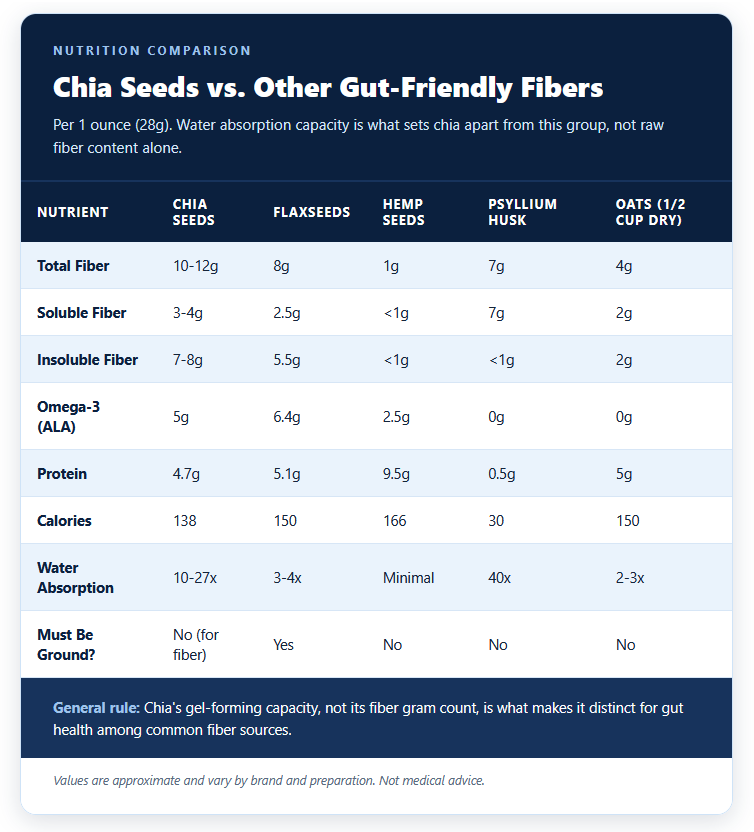
The standout feature is chia’s water absorption capacity combined with its balanced fiber profile. That gel formation is what makes chia distinct for gut health among this group.
Week 1: Your Body Meets the Fiber
The first week is about adjustment. Your digestive system is about to get 8 to 12 grams more fiber per day. That’s like going from a quiet country road to a busy highway.
What You’ll Feel
Your stomach will feel fuller after meals. Chia’s mucilage, the soluble fiber layer around each seed, can absorb 10 to 27 times its weight in water, according to food-science research on chia hydration, forming a thick gel that takes up space and slows digestion. Food moves through your stomach more slowly, so you stay satisfied longer.
Your bowel movements will likely change too, becoming more frequent or bulkier. That’s the fiber doing its job, adding weight and softness to your stool.
Here’s the part nobody warns you about. You might feel bloated, gassy, or uncomfortably full.
This is normal. It’s called fiber shock. Your gut bacteria haven’t adapted to the new food source yet, so they’re working harder to break it down, and that process creates gas as a byproduct.
The Science Behind What’s Happening
Chia seeds contain a type of fiber called mucilage. When mucilage gets wet, it forms that characteristic gel, which physically slows how fast food leaves your stomach. Think of it as speed bumps in your digestive tract.
Researchers at the University of Toronto tested this in 2013, giving 13 healthy adults doses of 7, 15, or 24 grams of chia baked into bread on separate occasions. The 24-gram dose produced the slowest rise in blood sugar afterward, according to a study in the European Journal of Clinical Nutrition. More chia meant a slower rise, in a clear dose-response pattern.
Your body is also adjusting to a fiber mix that’s roughly 70 percent insoluble and 30 percent soluble. The insoluble fiber acts like a broom, sweeping through your intestines. The soluble fiber feeds your gut bacteria.
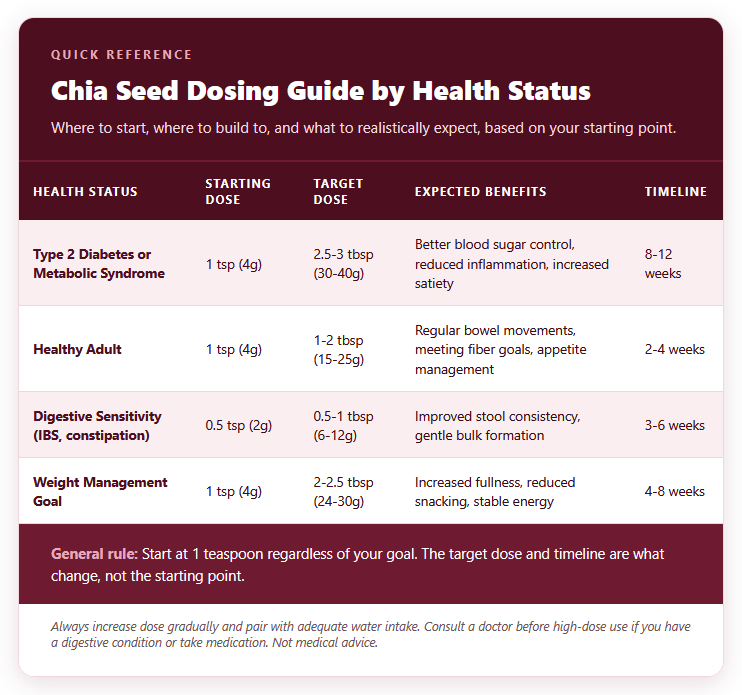
Quick Reference: Chia Seed Guide for Gut Health
How to Handle Week 1
Start small. Don’t jump straight to three tablespoons a day. Begin with one teaspoon and give your gut time to adapt.
Always soak your chia seeds for at least 20 minutes before eating. This forms the gel outside your body instead of inside your esophagus.
Mix one tablespoon of chia with 12 ounces of water and let it sit. This one step prevents most digestive discomfort.
Drink extra water throughout the day. For every tablespoon of chia, drink at least 12 ounces of water on top of your normal intake. Without enough water, chia can worsen constipation instead of helping it.
Week 2: Finding Your Tolerance
By week two, your gut is adjusting well. The bloating should start to ease as your bacteria adapt to their new food source.
What You’ll Notice
Digestive symptoms calm down. You’re not as gassy. The bloating lessens as your gut bacteria adapt to this new fiber load.
You might notice you’re naturally drinking more water. That’s your body signaling it needs more fluid to handle the fiber, and it’s worth listening to. It’s protecting you from constipation.
Your bowel movements should become more predictable now, not just more frequent. Many people find they can set their watch by their bathroom schedule after two weeks of consistent chia intake.
The Critical Hydration Rule
This is the week hydration stops being optional. Your chia seeds are moving through your intestines now, still absorbing water as they go.
If you don’t drink enough, the chia absorbs moisture from your intestinal walls instead. That makes your stool harder and more difficult to pass, leaving you more constipated than before you started.
This isn’t a hypothetical risk. A case report presented at the American College of Gastroenterology and published in the American Journal of Gastroenterology described a man who swallowed a tablespoon of dry chia seeds followed by water and developed a complete esophageal blockage.
He had an undiagnosed esophageal stricture, and doctors needed a specialized pediatric endoscope to clear the hydrogel mass after a standard adult endoscope failed.
The fix is simple but strict: 12 ounces of water per tablespoon of chia. That’s a minimum, not a suggestion.
Making It Stick
The chia gel method becomes your friend this week. Instead of sprinkling dry chia on food, prepare it in advance.
Mix your daily portion with water in a jar and let it sit in the fridge overnight. Add this gel to smoothies, yogurt, or oatmeal the next day.
This method gives you three things at once: guaranteed water intake, seeds that are easier to digest, and a gel that mixes more smoothly into other foods.
Week 3: The Metabolic Shift
Week three is where chia seeds show their real strength, but only for certain people.
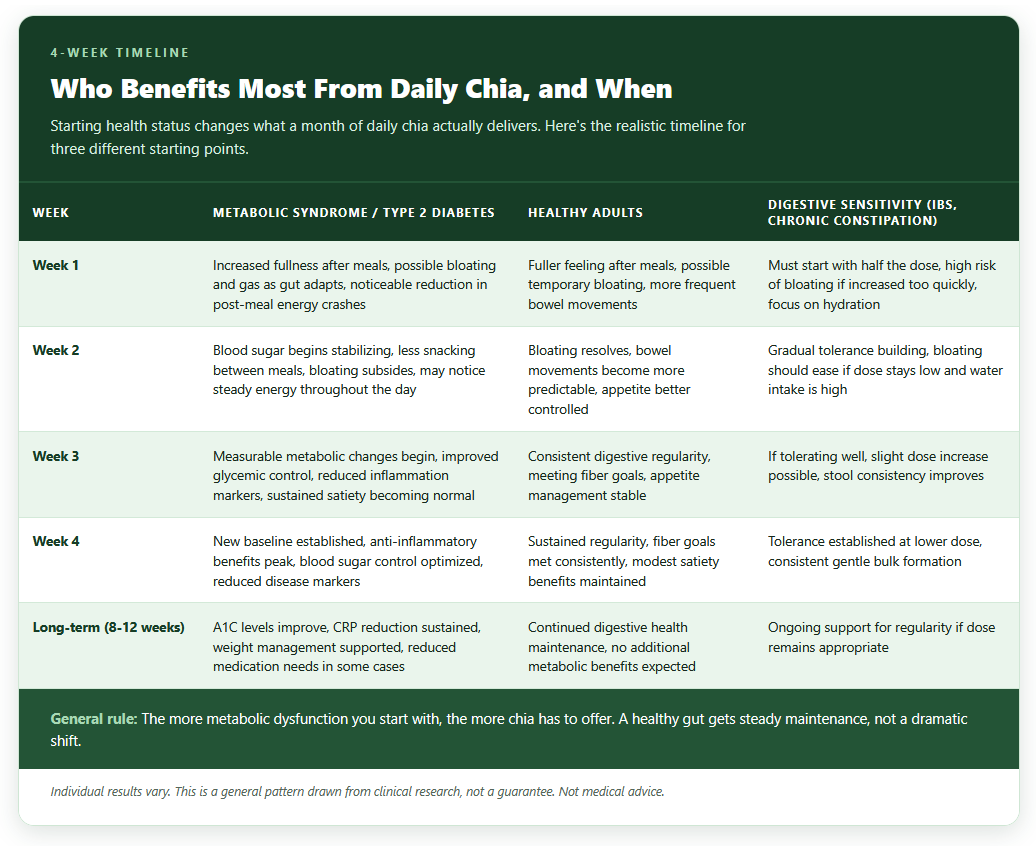
If you have insulin resistance, prediabetes, or type 2 diabetes, this is when you might notice significant changes. If you’re already healthy with normal blood sugar, don’t expect miracles. You’ll get the fiber benefits, and that’s about it.
What You’ll Feel (If You Have Metabolic Issues)
Your energy stays more stable throughout the day. You don’t crash as hard after meals, and you’re not reaching for snacks between breakfast and lunch the way you used to.
This happens because chia slows how fast sugar enters your bloodstream. That gel coats the food in your stomach, creating a barrier that slows carbohydrate absorption. Glucose trickles into your blood instead of flooding it.
You can’t feel your blood sugar stabilizing directly. But you can feel the results: fewer cravings, more even energy, less brain fog after eating.
A six-month trial published in Nutrition, Metabolism & Cardiovascular Diseases in 2017 followed 77 adults with type 2 diabetes on a calorie-reduced diet, according to research indexed on PubMed.
The group eating chia, at roughly 30 grams per 1,000 calories daily, lost more weight and showed better waist circumference and C-reactive protein numbers than the control group eating oat bran, while maintaining their existing blood sugar control.
That 2017 result wasn’t an isolated finding. The same Toronto research group had shown something similar a decade earlier, in a smaller trial that isolated the inflammation and blood pressure effects more directly.
Published in Diabetes Care in 2007, it followed 20 adults with type 2 diabetes for 12 weeks. Those eating 37 grams of chia daily on top of their usual treatment had about 40 percent less C-reactive protein than the control group, and their systolic blood pressure dropped by roughly 6 points too.
What You’ll Feel (If You’re Already Healthy)
Honestly? Not much different from week two.
Researchers at Appalachian State University gave 25 grams of milled chia daily to overweight, postmenopausal women for 10 weeks in 2012, according to a study in the Journal of Alternative and Complementary Medicine. They measured inflammatory markers before and after.
Nothing changed. No reduction in CRP. No change in IL-6, another inflammation marker.
The chia was safe and well tolerated. It didn’t produce measurable anti-inflammatory effects in people whose bodies were already working well.
Your win this week is consistency. You’re meeting a daily fiber goal that roughly 95 percent of Americans miss.
You’re staying regular, and you’re managing your appetite better. That’s real, but it isn’t dramatic.
The Omega-3 Question
This is a good time to address a common misconception. Chia seeds are rich in alpha-linolenic acid (ALA), a plant-based omega-3 fatty acid. But if you’re eating whole chia seeds, you’re not getting most of those omega-3s.
The seed coat resists digestion, so the seeds pass through your digestive system mostly intact, and most of their nutrients pass through right along with them.
For gut health benefits, the fiber, the mucilage, and the bulking effect, whole seeds work fine. For omega-3 benefits, you need to grind or mill your chia first.
Week 4: Your New Normal
By week four, chia seeds have become part of your routine. Your gut has fully adapted. This is what maintenance looks like.
What’s Changed
Your digestive system runs like clockwork. You’re having regular bowel movements without straining, and the fiber keeps things moving smoothly.
For people with metabolic concerns, the benefits have plateaued at a healthy new baseline. Blood sugar responses are better, and inflammatory markers have improved if they were high to start with.
These aren’t temporary fixes. They last as long as you keep eating the chia.
For healthy adults, you’ve built a routine that reliably hits your fiber targets, getting about 40 percent of your daily fiber needs from two tablespoons of seeds. That’s meaningful support for your digestive health.
The Anti-Inflammatory Truth
Let’s be clear about inflammation. Chia seeds don’t reduce inflammation for everyone. The anti-inflammatory benefit only shows up in people who had elevated inflammation to begin with.
If you have metabolic syndrome, type 2 diabetes, or obesity-related inflammation, chia might help reduce markers like CRP. This supports gut health indirectly by reducing body-wide inflammation that can affect your intestinal lining.
If you’re healthy with normal inflammation levels, don’t expect chia to lower them further. Your body is already at a good set point. There’s nowhere for the inflammation to go.
The Microbiome Mystery
Here’s where honesty about what we don’t know matters most.
The lab study mentioned earlier found that chia mucilage affects certain bacterial groups outside the body, in a simulated gut model. That’s a plausible mechanism. It isn’t proof of what happens in a living person.
We can make educated guesses based on how fiber works generally. Soluble fiber feeds bacteria, and those bacteria produce short-chain fatty acids like butyrate.
Butyrate feeds your intestinal cells and reduces inflammation.
Chia’s soluble fiber should do all this in theory, and lab research confirms gut bacteria can ferment chia fiber. But no human study has measured SCFA production from eating chia. No study has tracked which specific bacteria increase or decrease in a real person’s gut over time.
The honest answer is that chia’s gut-bacteria benefit is inferred, not measured. That’s still a reasonable bet based on how fiber works elsewhere. It’s not the same as proof.
Side-by-Side Timeline: Who Benefits Most and When
Different people experience different results from daily chia intake. Here’s what to expect based on your starting health status.
Comparing Chia to Other Gut-Friendly Fibers
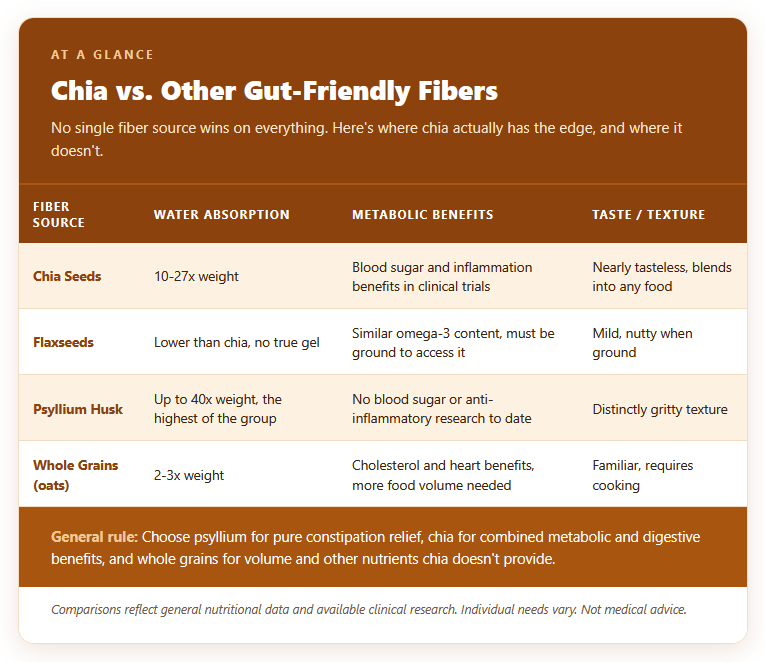
You might be wondering how chia stacks up against other popular fiber sources. Here’s what you need to know.
Chia vs. Flaxseeds
Both are tiny seeds packed with fiber and omega-3s, but they work differently in your gut.
Flaxseeds contain about 8 grams of fiber per ounce, slightly less than chia, and they don’t form the thick gel chia does when wet. That means less impact on satiety and gastric emptying.
Flaxseeds must be ground to get any nutritional benefit at all. The hard shell resists digestion entirely. At least whole chia seeds provide the fiber benefit even if you miss out on the omega-3s.
For gut health specifically, chia has a slight edge because of the mucilage. That gel formation provides more satiety and better stool consistency, though flaxseeds are cheaper and easier to find in most stores.
Chia vs. Psyllium Husk
Psyllium is the most potent soluble fiber in this comparison. It absorbs even more water than chia, up to 40 times its weight.
Psyllium is specifically studied for constipation relief, and the evidence there is stronger and more direct than for chia. If your main goal is moving your bowels, psyllium might work faster.
But psyllium doesn’t offer the metabolic benefits. No research has found blood sugar improvements or anti-inflammatory effects from psyllium in people with diabetes. Chia has those extra advantages.
The taste factor matters too. Psyllium has a distinctly gritty, unpleasant texture. Chia is nearly tasteless and blends into foods without changing the flavor.
Chia vs. Whole Grains
Whole grains like oats and quinoa provide excellent fiber, but you need to eat a lot more to match chia’s concentration.
You’d need about 1.5 cups of cooked oatmeal to get the same fiber as two tablespoons of chia. That’s a much bigger serving and more calories.
Whole grains offer other nutrients chia doesn’t, including B vitamins, iron, and more diverse minerals. They’re also more filling as actual food rather than a supplement.
The better approach is using both. Add chia to boost the fiber content of whole grain dishes, mixed into oatmeal or worked into bread dough.
Layer the benefits instead of choosing one over the other.
7-Day Chia Seed Meal Plan for Gut Health
This week-long plan shows how to work chia seeds into a daily routine without getting bored. Each day provides 15 to 25 grams of chia, plus preparation tips.
Day 1: Monday
Breakfast: Basic chia pudding. Mix 2 tablespoons of chia with 1 cup of unsweetened almond milk the night before, then top with fresh blueberries and sliced almonds in the morning. Let it sit 10 minutes before eating for full gel formation.
Lunch: Mediterranean salad with a chia gel dressing. Mixed greens, cucumber, tomatoes, chickpeas, and feta, dressed with 1 tablespoon of chia gel mixed with lemon juice, olive oil, and herbs.
Dinner: Regular meal, no chia needed.
Daily chia total: 3 tablespoons (36g). Gut health tip: drink at least 36 ounces of water today on top of your regular intake.
Day 2: Tuesday
Breakfast: Chia-boosted oatmeal. Cook your regular oatmeal, then stir in 1 tablespoon of pre-made chia gel while the oats are still hot, along with cinnamon and sliced banana.
Snack: Chia energy bites. Roll 1 tablespoon of chia gel with dates, almond butter, and dark chocolate chips. Make a batch for the week and eat 2 to 3 bites mid-afternoon.
Dinner: Regular meal, no chia needed.
Daily chia total: 2 tablespoons (24g). Gut health tip: the chia in energy bites absorbs less water, so drink extra fluids with this snack.
Day 3: Wednesday
Breakfast: Chia smoothie. Blend 1 tablespoon of pre-made chia gel with frozen berries, spinach, half a banana, and coconut water. Skip dry chia here since it clumps.
Lunch: Soup with a chia thickener. Stir 1 tablespoon of chia gel into any vegetable or lentil soup during the last 5 minutes of cooking for extra body.
Dinner: Regular meal, no chia needed.
Daily chia total: 2 tablespoons (24g). Gut health tip: hot liquids help chia disperse better, making it easier to digest.
Day 4: Thursday
Breakfast: Yogurt parfait. Layer plain Greek yogurt with berries, mix in 1.5 tablespoons of chia gel, and top with granola for crunch. The probiotics in yogurt plus prebiotic fiber in chia work together.
Lunch: Chia-boosted hummus with veggie sticks. Stir 1 tablespoon of chia gel into regular hummus for extra fiber without changing the taste.
Dinner: Regular meal, no chia needed.
Daily chia total: 2.5 tablespoons (30g). Gut health tip: combining chia with fermented foods like yogurt may provide extra gut benefits.
Day 5: Friday
Breakfast: Tropical chia pudding. Mix 2 tablespoons of chia with coconut milk from a carton overnight, then add diced mango and pineapple with unsweetened coconut flakes in the morning.
Lunch: Wrap with a chia gel spread. Spread 1 tablespoon of chia gel on a whole grain wrap before adding turkey, avocado, and veggies. It acts as a healthy binder.
Dinner: Regular meal, no chia needed.
Daily chia total: 3 tablespoons (36g). Gut health tip: by day 5, your gut should be adapting well. Notice if your energy feels more stable.
Day 6: Saturday
Breakfast: Chia pancakes. Add 1 tablespoon of ground chia to your regular pancake batter for structure and fiber. Ground chia works better here than whole seeds.
Snack: Chia water, agua fresca style. Mix 1 tablespoon of chia seeds with 16 ounces of water and fresh lime juice, let it sit for 30 minutes, then drink slowly over an hour.
Dinner: Regular meal, no chia needed.
Daily chia total: 2 tablespoons (24g). Gut health tip: chia water is a traditional Mexican drink that supports proper hydration.
Day 7: Sunday
Breakfast: Baked oatmeal with chia. Mix oats, milk, mashed banana, and 2 tablespoons of chia, bake for 30 minutes, then cut into squares that store well for several days.
Lunch: Light, no chia needed.
Dinner: Regular meal, no chia needed.
Daily chia total: 2 tablespoons (24g).
Gut health tip: evaluate your week. Are bowel movements more regular, and do you feel fuller at meals? Those are the signs it’s working.
Chia Preparation Methods That Work
How you prepare chia seeds matters as much as eating them. Here are the methods that support gut health while staying easy to digest.
Basic Chia Gel: The Foundation
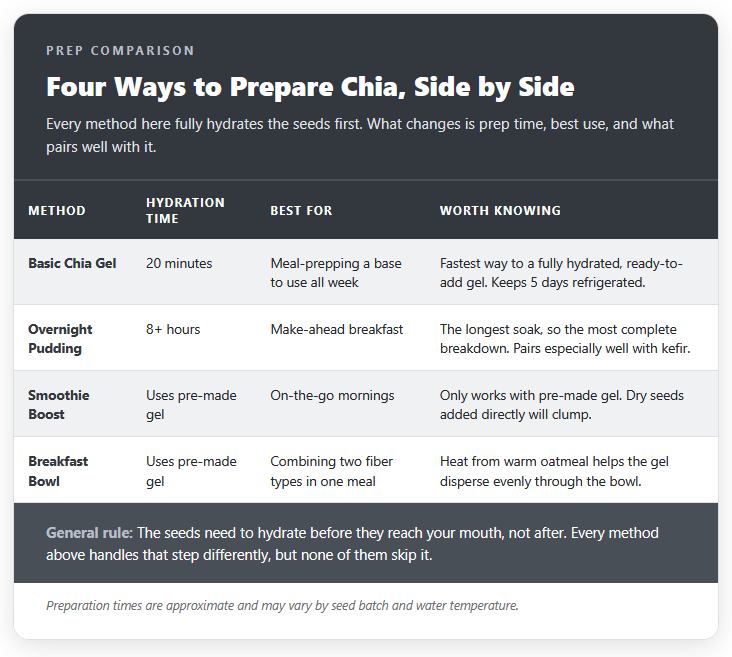
Mix 3 tablespoons of chia seeds with 2 cups of water in a jar. Stir well, then let it sit for 20 minutes, stirring once or twice. The mixture should turn thick and pudding-like.
This gel keeps in the fridge for up to five days. Make a batch Sunday night, and you have ready-to-use chia through the week.
Hydrate the seeds before they ever reach your mouth, and nearly all the discomfort people report simply doesn’t happen.
Add the gel to food instead of eating it plain. Stir it into yogurt, blend it into a smoothie, or mix it into soup so the fiber spreads across the whole meal.
Overnight Chia Pudding
Combine 3 tablespoons of chia seeds with 1 cup of unsweetened almond milk or any milk you prefer. Add a pinch of cinnamon and a small amount of vanilla extract, stir, and refrigerate overnight. Top with fresh berries and a handful of walnuts in the morning.
The long soak, eight hours or more, breaks the seeds down more completely before they ever reach your gut. Use kefir instead of plain milk, and you get the chia fiber plus live probiotic cultures working alongside it.
Chia Smoothie Boost
Blend 1 tablespoon of pre-made chia gel with frozen berries, spinach, half a banana, and coconut water. Skip the dry seeds here. Added directly to a smoothie, they clump instead of blending smoothly.
Add plain yogurt or kefir to combine chia’s prebiotic fiber with a dose of live probiotic bacteria in the same glass.
Chia Breakfast Bowl
Stir 2 tablespoons of chia gel into warm oatmeal while it’s still cooking, then top with sliced banana, a light drizzle of honey, and chopped almonds. The heat helps the gel disperse evenly through the oats.
Oats and chia bring two different fiber types to the same bowl. Let it cool slightly before eating. Food that’s too hot moves through the stomach faster, which cuts into chia’s fullness effect.
Chia Seed Quality Guide: What to Buy and How to Store
Not all chia seeds are created equal. Here’s how to identify quality seeds and keep them fresh.
Black vs. White Chia Seeds
Both colors come from the same plant species, Salvia hispanica. The color difference is natural genetic variation, like different colored beans.
Nutritionally, they’re nearly identical. Black chia has slightly more protein, and white chia has slightly more omega-3s.
The differences are too small to matter for gut health.
White chia is often marketed as premium, with a price to match. Don’t fall for it. Black chia works just as well, and avoid brown or tan seeds, which are immature and won’t gel properly.
How to Spot Fresh, Quality Chia
Look for seeds that are either consistently black or consistently white. A bag containing both colors is fine, since the concern is immature brown or tan seeds, not the black-versus-white mix.
Fresh chia has a mild, nutty smell. Bitter, musty, or rancid smells mean the omega-3 fats have started to oxidize.
Quality seeds should be completely dry and free-flowing. Clumping or moisture points to poor storage, and excessive debris or stems suggest poor processing.
Organic vs. Conventional
Chia is naturally pest-resistant, so farmers use fewer pesticides on it than on many crops. Honestly, the organic-versus-conventional debate barely applies here the way it does for berries or leafy greens, where the pesticide load actually differs enough to matter.
Buy organic if you prefer it, but conventional chia from a reputable brand is fine for gut health. Freshness matters more than certification.
Best Storage Methods
Store chia seeds in an airtight container in a cool, dark place, away from the stove. Heat and light degrade the omega-3 fats.
Properly stored, chia seeds last 2 to 4 years without refrigeration, since their high antioxidant content protects the fats from oxidation.
Once made into gel, chia lasts 5 to 7 days in a sealed jar in the fridge. Discard it if it develops an off smell or visible mold. Ground chia goes rancid much faster, often within a few weeks even refrigerated, so only grind what you’ll use within a week.
Where to Buy Quality Chia
Bulk bins at health food stores often have the best prices, though it’s worth checking turnover since slow-moving bulk chia can sit for months. Pre-packaged chia from established brands has more consistent quality, and online retailers offer good prices for larger quantities if the seller has high turnover and solid reviews.
Skip gas station or convenience store chia. It tends to sit on shelves too long under conditions that speed up spoilage.
Common Mistakes That Reduce Chia’s Gut Benefits
Even people who eat chia every day can miss out on its benefits by making a handful of avoidable errors.
Eating the Seeds Dry
Some people sprinkle dry chia over salad or yogurt and start eating right away. The seeds pull liquid from the digestive tract as they expand, which can cause discomfort or constipation instead of relieving it.
Pre-soak for at least 15 to 20 minutes. If the crunch of whole seeds appeals to you, soak them first and drain off the excess water afterward.
Not Drinking Enough Water
People eat their chia, drink their usual amount of water, and then wonder why they’re constipated days later. It’s the single most common problem, and almost nobody connects the dots the first time.
The seeds are pulling extra water from somewhere, and if it isn’t coming from a glass, it comes from the intestines instead. Add 12 ounces per tablespoon of chia, on top of normal intake, and the problem usually resolves within days.
Increasing the Dose Too Quickly
People consistently underestimate how long gut bacteria need to catch up. Two weeks, roughly, to build the populations that can handle a fivefold jump in fiber. Most people give it one meal.
Read the fiber content on the label, decide to start there, and end up bloated by Tuesday. Start at a teaspoon instead.
Expecting Whole Seeds to Deliver Omega-3s
Whole chia seeds pass through the digestive system mostly intact. The seed coat is too tough to break down, so the fiber benefit shows up but the omega-3s largely don’t. Grinding the seeds in a coffee grinder solves this, though it isn’t necessary if fiber and gut support are the only goals.
Ignoring the Body’s Signals
Some people push through bloating and discomfort, assuming it will pass on its own. Sometimes it does. Sometimes it means the current dose isn’t right for that particular gut.
Persistent bloating after two weeks is a signal to cut the dose in half, not push harder. If problems continue even at a lower dose, chia may simply not suit that person’s gut bacteria, and other fiber sources exist for a reason.
Troubleshooting: What to Do When Chia Causes Problems
Even with a careful introduction, some people run into issues. Here’s how to work through the most common ones.
Bloating That Persists Past Week Two
This usually comes down to one of three things: the dose is too high for the current gut bacteria, water intake is too low, or an underlying condition like small intestinal bacterial overgrowth is at play. Cut the dose in half for a week and raise water intake to 16 ounces per tablespoon. If bloating continues, stop chia entirely for a week, then restart at half a teaspoon and build up slowly.
Persistent bloating even at low doses is worth mentioning to a gastroenterologist. High-fiber foods can worsen SIBO specifically, and that’s not something to guess at.
Constipation That Gets Worse, Not Better
Nearly always a hydration problem. Chia is pulling water from the intestines because it isn’t getting enough from the glass. The immediate fix is more water, 16 to 20 ounces with the chia dose, and roughly 80 ounces total through the day.
If constipation hasn’t improved after three days of higher water intake, pause chia and come back to it using the pre-soaked gel method instead, which hydrates the seeds fully before they ever reach the gut.
Diarrhea or Loose Stools
Too much soluble fiber, introduced too fast, acts as a mild laxative, especially on a diet that was low in fiber to begin with. Cutting the dose in half usually resolves this within a few days. Eating chia alongside solid food rather than mixed into liquid slows things down further, and pairing it with binding foods like banana, rice, or applesauce helps balance the effect.
No Noticeable Benefit After Four Weeks
For a healthy adult with normal digestion, this might simply be the honest outcome. Chia’s more dramatic effects show up in people with metabolic issues, not in people whose blood sugar and inflammation were already in a good range.
Worth checking before writing chia off: are bowel movements regular, is there more fullness after meals, and are daily fiber goals actually being met?
Those are the realistic wins for a healthy person. If none of them show up, blood sugar or anti-inflammatory effects were never going to appear either.
The Gut-Brain Connection: How Chia Affects More Than Digestion
Your gut and brain communicate constantly through the gut-brain axis. Changes in your gut can affect your mood, focus, and stress response.
Short-Chain Fatty Acids and Mental Health
When gut bacteria ferment fiber, they produce short-chain fatty acids like butyrate. These compounds feed your intestinal cells, and they affect your brain too.
Pairing chia with a probiotic food doubles up on this mechanism instead of relying on fiber alone. Live cultures add bacteria directly, while chia’s fiber feeds the ones already there.
Butyrate can cross the blood-brain barrier, where it influences production of brain-derived neurotrophic factor, a protein that supports brain health and mood regulation.
We don’t have studies specifically on chia and mental health, but the mechanism is plausible. More fermentable fiber leads to more SCFA production, which could support better mood and cognitive function.
Don’t expect chia to treat depression or anxiety. But stable blood sugar from the gel effect might reduce mood swings and irritability for some people.
Blood Sugar Stability and Brain Function
Your brain runs on glucose. When blood sugar spikes and crashes, so does your mental clarity.
The glucose-blunting effect covered earlier carries an indirect brain benefit too. Stable blood sugar means a stable energy supply to your brain: less brain fog, better focus, more consistent cognitive performance.
This effect is most noticeable in people with insulin resistance. If your blood sugar was already stable, you won’t notice much difference.
When to Avoid Chia Seeds
Chia isn’t appropriate for everyone. Some situations call for caution or complete avoidance.
Active Digestive Flare-Ups
If you’re in the middle of an IBS flare, Crohn’s flare, or ulcerative colitis flare, skip the chia. High-fiber foods can make active inflammation worse. Wait until symptoms calm down, then introduce chia very gradually, starting with a quarter teaspoon daily.
Swallowing Difficulties
Anyone with dysphagia or a history of esophageal problems should avoid chia completely. The expansion risk is too high, even with pre-soaking.
Blood Thinning Medications
Chia’s omega-3 fatty acids have mild blood-thinning properties. If you’re on warfarin or another anticoagulant, talk to your doctor before adding chia to your daily routine. The risk is small but real, especially at high doses of 3 or more tablespoons daily.
Before Surgery
Stop eating chia seeds at least two weeks before scheduled surgery. The blood-thinning effect, combined with surgical risk, isn’t worth it.
Severe Constipation
This sounds backward, but if you’re severely constipated and haven’t had a bowel movement in several days, don’t add fiber yet. It can make the blockage worse.
Address the constipation first with hydration, movement, and possibly a gentle laxative. Once things are moving again, chia can help prevent it from happening again.
Pregnancy and Breastfeeding
Limited research exists on high-dose chia during pregnancy. Small amounts, 1 to 2 teaspoons daily, appear safe and can help with pregnancy-related constipation, but doses above 2 tablespoons daily haven’t been studied in pregnant women.
Talk to your OB-GYN before making chia a daily habit during pregnancy or while breastfeeding.
Children Under 5
Young children have smaller digestive systems and different fluid needs, and chia poses a choking risk if not fully hydrated. If you want to give chia to a young child, use only fully prepared chia gel mixed into food, never whole or partially soaked seeds. Many pediatricians recommend waiting until age 5 or older for regular chia consumption.
Conclusion
Chia seeds never got the microbiome research their reputation implies. What they got instead is something more useful: solid evidence on blood sugar, inflammation, and fiber intake in the populations who actually need it most.
That distinction matters more than it sounds. A supplement doesn’t need a headline-worthy mechanism to be worth taking, and for people managing type 2 diabetes or metabolic syndrome, chia clears that bar regardless.
For a healthy gut already doing its job, chia is maintenance, not medicine. There’s nothing wrong with that.
The seeds were never the hard part. Soaking them first was.
FAQs
Can I eat chia seeds every day forever?
Yes, daily chia consumption appears safe for long-term use based on studies running up to six months, and people across Central and South America have eaten it for centuries without documented problems. The main requirement is proper hydration. Mix in other fiber sources throughout the week rather than relying on chia alone.
Will chia help with IBS?
It depends on your IBS type. If you have IBS-C, constipation-predominant, chia might help by adding bulk and moisture to stool. Start with tiny amounts, about a quarter teaspoon daily.
If you have IBS-D, diarrhea-predominant, chia could make symptoms worse during a flare. The soluble fiber might help between flares, but avoid it during active symptoms.
If you have IBS-M, mixed type, you’ll need to experiment carefully and track symptoms and dose closely. Many people with IBS find chia helpful at low doses, roughly 1 teaspoon, but problematic at higher doses. Always introduce chia during a calm period, not during a flare.
Can kids eat chia seeds?
Children over age 5 can eat chia safely in small amounts, always fully soaked into a gel or pudding. Never serve dry seeds. The choking risk is real, and supervision matters.
Kids ages 5 to 10 should cap intake at about 1 teaspoon a day. Past age 10, that can move toward 1 tablespoon if it’s well tolerated.
Do chia seeds expire?
Dry chia seeds keep for 2 to 4 years stored in a cool, dark place. Any bitter or off smell means it’s time to toss them. Once made into gel, use it within 5 to 7 days in the fridge, and grind only what you’ll use within a couple of weeks, since ground chia turns rancid much faster.
Can I eat chia if I’m pregnant?
Small amounts, 1 to 2 teaspoons daily, appear safe during pregnancy and can help with constipation, a common pregnancy complaint. Larger amounts haven’t been studied in pregnant women. The omega-3 content is beneficial for fetal development, but a high fiber load might cause discomfort.
Talk to your doctor before making chia a daily habit. Some practitioners recommend it, others prefer more studied fiber sources during pregnancy, and you shouldn’t start high-dose chia (2 or more tablespoons) without medical guidance.
Will chia seeds help me lose weight?
Chia can support weight management indirectly, mostly through satiety. The fiber and gel-forming mucilage add bulk and slow digestion, which can mean eating less at the next meal and skipping between-meal snacks.
That’s a real effect, but it’s an appetite effect, not a metabolic one. Chia itself doesn’t burn fat or speed metabolism.
Combined with a calorie deficit through diet and activity, it can make sticking to that deficit easier. Without one, it won’t do the job alone.
Can chia seeds cause diverticulitis?
This is an old myth. Doctors once believed small seeds could lodge in the colon’s diverticula and trigger inflammation, but the evidence doesn’t back that up.
A study in JAMA that followed more than 47,000 men for 18 years found no increased risk of diverticulitis from nut, seed, or popcorn consumption. If anything, more frequent nut consumption was tied to lower risk.
Chia seeds are considered safe for people with diverticulosis, and the fiber may help by keeping bowel movements regular. During an active diverticulitis flare, though, all fiber, including chia, should wait until the inflammation settles.
Do I need to grind chia seeds?
Not for gut health. Whole seeds provide the same fiber and gel-forming benefit without any grinding required. Grinding only matters if the goal is absorbing the omega-3 fats, since the tough seed coat otherwise passes through undigested.
Can chia seeds get stuck in my intestines?
If you eat dry chia without enough water, they can theoretically cause a blockage, and medical journals document rare cases of esophageal obstruction from dry chia. This is easily prevented: always soak chia for at least 20 minutes and drink 12 or more ounces of water per tablespoon.
If you have a history of bowel obstructions, esophageal strictures, or swallowing problems, avoid chia entirely. For people with normal digestive function who follow hydration guidelines, intestinal obstruction from chia is extremely rare.
Are there any medications that interact with chia?
Chia can interact with blood thinners like warfarin due to its omega-3 content. The effect is mild but additive, so talk to your doctor if you take an anticoagulant.
Chia might lower blood sugar, so anyone on diabetes medication should monitor levels closely when starting it. A dose adjustment may become necessary as blood sugar improves. Chia also slows digestion, which could theoretically affect medication absorption timing, so take medications 1 to 2 hours before or after eating chia to be safe.
If you take thyroid medication, chia’s fiber might reduce absorption slightly. Take thyroid medication on an empty stomach, at least 2 hours away from chia.
Do chia seeds reduce belly fat?
Not on their own, and not in a way that targets the belly specifically. Spot reduction from any single food isn’t how fat loss works.
Chia’s fiber can support an overall calorie deficit by increasing fullness, and a calorie deficit is what actually reduces fat, wherever it comes off first. Anyone selling chia as a belly fat solution is overselling one part of the picture.
Can chia seeds help cleanse or detox the gut?
Detox and cleanse are marketing words chia doesn’t need. The liver and kidneys already handle that job continuously, and they don’t stop to wait for a supplement.
What chia can do is support the fiber intake that keeps digestion moving regularly, a real benefit dressed up in cleanse language it doesn’t need. Regular bowel movements aren’t a detox. They’re digestion working the way it’s supposed to.