Your brain hijacks your emotional intelligence before you even know an argument has started. The timing gap is 12 milliseconds. Here’s why that matters.
You’ve heard the advice a thousand times. Take a deep breath. Use “I feel” statements. Practice active listening. It all sounds perfectly reasonable until you’re in the middle of a heated argument and none of it works.
That’s not a character flaw. It’s biology.
Communication and emotional intelligence don’t fail because people are lazy or don’t care. They fail because of biology. The human brain has survival wiring that is far older and far faster than any skill learned in a workshop. When tension spikes, that ancient circuitry fires first. Your careful, empathetic, socially aware self doesn’t disappear. It just gets temporarily powered down.
The good news? Understanding exactly how this happens gives you a real way out. Not by trying harder, but by working with your brain instead of against it.
What Is Emotional Intelligence in Communication?
Emotional intelligence (EI) is the ability to notice, understand and manage your own emotions. It also means reading and responding to the emotions of others. In a communication context, it’s the skill that lets you stay present during a difficult conversation. It means choosing your words with care and genuinely hearing what someone is saying even when the topic is charged.
Psychologist Daniel Goleman, in his 1995 book Emotional Intelligence, described five core components: self-awareness, self-regulation, motivation, empathy and social skills. All five shape how people talk to each other. Self-awareness helps you notice when you’re getting triggered. Self-regulation helps you pause before reacting. Empathy lets you understand what the other person is experiencing. Social skills shape how you express yourself clearly and constructively.
These are genuinely powerful abilities. The problem is that they all depend on the prefrontal cortex, the brain’s reasoning center. And during an argument, that’s exactly the region that goes offline first.
Why “Just Stay Calm” Is Bad Advice
Most communication training treats emotional breakdowns as a willpower problem. You lost control because you weren’t disciplined enough. Or you hadn’t practiced your listening skills enough. Or you simply didn’t care enough to hold it together.
None of that is true.
The real story starts deep inside the brain, in a structure called the amygdala. It’s roughly the size and shape of an almond, and its job is to scan your environment for danger. During a calm conversation, it stays quiet. During a threatening one, it fires like a smoke alarm. When it does, it sets off a chain of events that’s nearly impossible to stop once it has started.
That’s where the 12-millisecond problem begins.
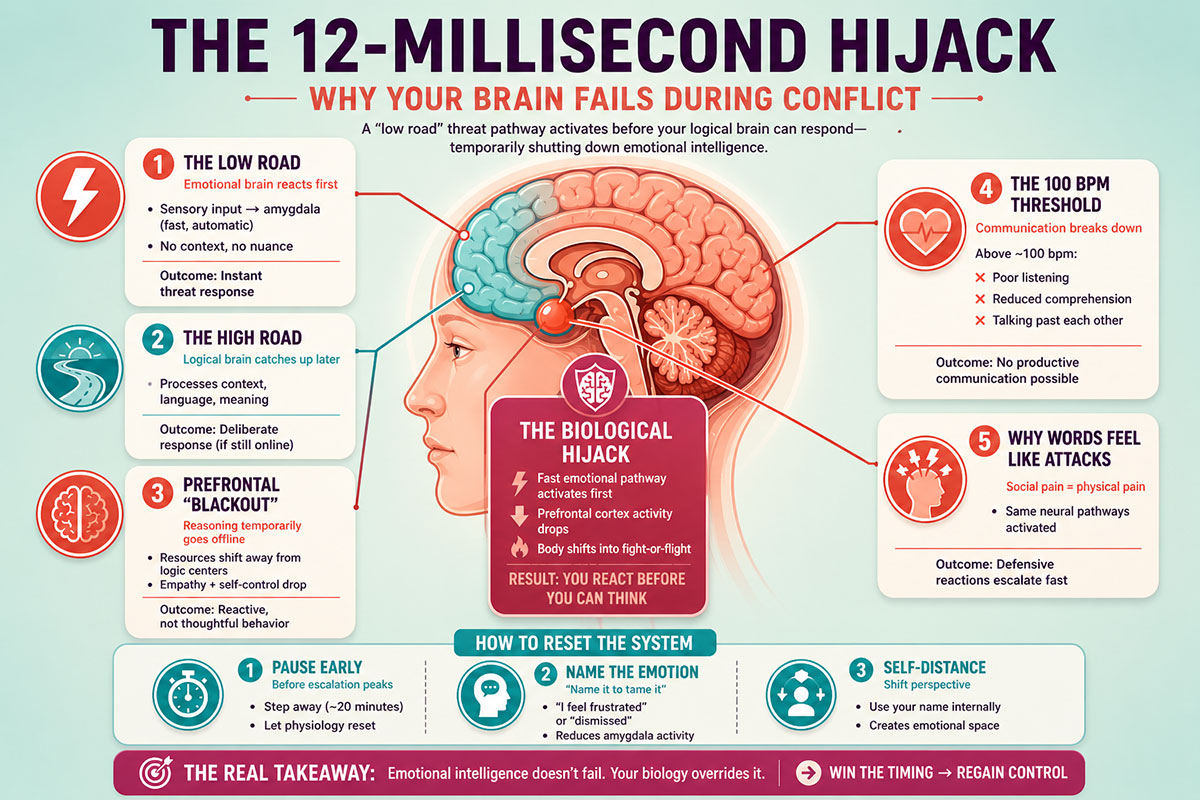
Mechanism 1: The Thalamic Shortcut (The 12-Millisecond Hijack)
When you’re in a conversation, every piece of sensory data enters your brain through a relay station called the thalamus. The tone of a voice, a dismissive look, a sharp word, all of it flows through this structure first. From there, the data splits and travels two different routes.
The first route, what neuroscientist Joseph LeDoux called the “Low Road,” sends information directly from the thalamus to the amygdala. It’s fast and unfiltered. No analysis, no context, no nuance. Just raw threat detection.
The second route, the “High Road,” sends the same information to the cortex first. There it gets processed with logic, language and context before any response is triggered.
In his research on the emotional brain, LeDoux mapped this shortcut through animal studies. That work has since shaped the broader understanding of the human threat response. His key finding was a timing gap between the two routes. Sensory data arrives at the amygdala before the cortex has finished processing the same input. By the time your logical brain works out what was actually said, your body is already flooded with cortisol and adrenaline. You’re primed to fight or flee, not to listen thoughtfully.
Your emotional intelligence didn’t leave. Your nervous system just made a faster decision.
Mechanism 2: The Prefrontal Blackout
When the amygdala fires, it doesn’t just trigger an alarm. It physically draws metabolic resources, including blood flow, away from the prefrontal cortex.
The prefrontal cortex handles empathy, self-awareness, careful judgment and the ability to choose words thoughtfully. These are the core functions of emotional intelligence in communication. When the threat response kicks in, the brain deprioritizes reasoning to redirect energy toward survival. This is what Daniel Goleman described as an “amygdala hijack” in his 1995 book. You aren’t choosing to be irrational. Your logical processor has been physically taken offline.
John Gottman’s decades of couples research confirms the real-world impact of this shutdown. His work found that once physiological arousal climbs past a critical threshold, the capacity for empathic listening collapses almost entirely. People stop processing new information and start scanning for threats. The logical brain isn’t just slower at that point. For practical purposes, it’s gone.
This is one reason emotional intelligence and communication training often produces disappointing results in real conflict situations. The skills are there. The hardware to run them has been temporarily disabled.
Mechanism 3: The Heart-Rate Lock (The 100 BPM Tipping Point)
Gottman identified a specific physiological marker for the moment when communication and emotional intelligence fully break down. Drawing from his research in Why Marriages Succeed or Fail, and subsequent peer-reviewed work, he described a state called Diffused Physiological Arousal (DPA). It typically activates once the heart rate crosses roughly 100 beats per minute.
At that threshold, something specific happens to verbal processing. The brain stops taking in new information effectively. Words are still heard, technically, but they aren’t being understood or integrated the way they would be in a calm exchange. Both people end up talking past each other. Not because they’re both bad listeners, but because neither nervous system can hold space for new input at that level of arousal.
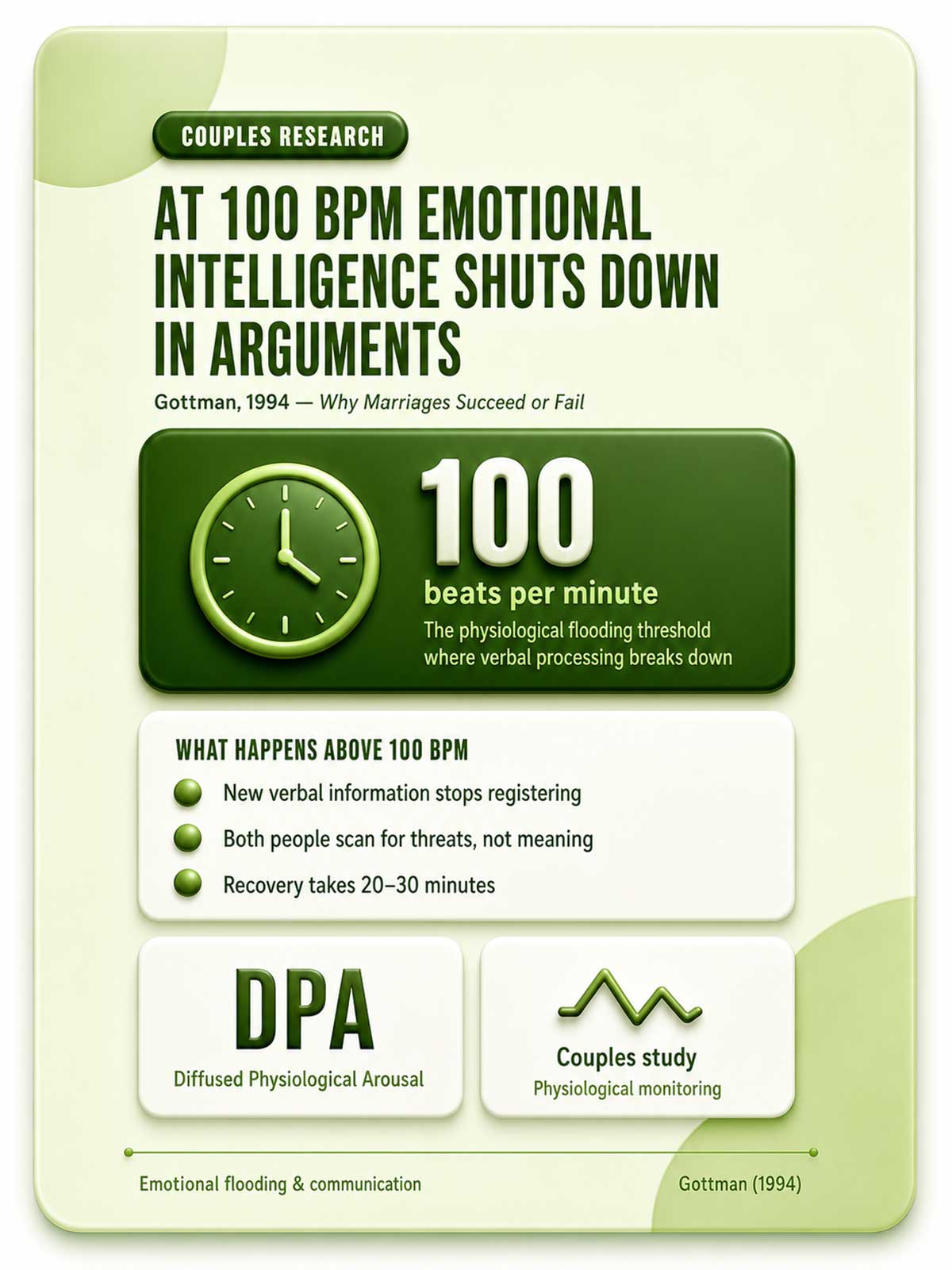
This explains a pattern most people recognize. You say something you were sure was clear. Your partner or colleague insists they never heard it. Nobody is lying. Both nervous systems were already past the point where verbal information could be processed and stored accurately.
Once you cross that 100 BPM line, no communication technique will work the way it was designed to. The window has closed. The only rational move is to wait for it to reopen.
→ Learn how gut health can be improved
Mechanism 4: Why Words Can Hurt Like a Punch
There’s one more piece of the puzzle that explains why arguments feel so physically intense, even when no one touches anyone.
In 2003, neuroscientist Naomi Eisenberger and her team at UCLA published a landmark study in Science. Participants played a virtual ball-tossing game called Cyberball and were eventually excluded by the other (computer-controlled) players. Using fMRI brain imaging, the researchers tracked what happened neurologically during that moment of social exclusion.
The dorsal anterior cingulate cortex (dACC) lit up. This is a brain region strongly associated with the distress of physical pain. Eisenberger’s team (2003) found that social rejection activates neural circuitry closely linked to the processing of physical injury. The brain makes no clean distinction between a broken bone and a harsh word.
This finding has a direct implication for communication and emotional intelligence in conflict. When someone feels personally attacked, criticized, or dismissed in an argument, their brain is not just processing an unpleasant emotion. It is registering something neurologically indistinguishable from being struck. The defensive response that follows isn’t dramatic or immature. It’s the nervous system doing exactly what it was built to do.
If you’ve said something that landed as a verbal punch, no amount of logical argument will reach the other person until their nervous system recovers. Pressing harder, repeating yourself or raising your voice will only extend the shutdown. The most effective move is to create space, lower your own arousal and return to the conversation when both systems are ready to receive information again.
What Healthy Emotional Intelligence in Communication Actually Looks Like
It helps to have a positive target, not just a picture of what goes wrong.
When both people in a conversation are below that physiological threshold and their prefrontal cortexes are fully online, emotional intelligence looks very different from the heat of an argument. It shows up as a genuine ability to sit with discomfort without needing to immediately defend or deflect. It looks like asking a clarifying question instead of assuming the worst. It’s the capacity to say “I hear that you’re frustrated” and actually mean it.
Self-awareness plays a big role here. People with strong emotional awareness tend to notice their own physiological cues early: a tightening in the chest, a faster heartbeat, a sudden urge to interrupt. Those physical signals are early warnings that the system is shifting toward threat mode. Catching them early is what makes the strategies below possible.
Empathy in communication doesn’t mean agreeing with everything. It means being able to accurately read what someone else is feeling and factor that into how you respond. In practice, it often looks like slowing down rather than speeding up, asking rather than telling and tolerating silence rather than filling it with more words.
This calm, regulated state is the goal. The science below explains how to get back to it when an argument has already pulled you away.
3 Science-Backed Strategies to Restore Emotional Intelligence During Conflict
Understanding why emotional intelligence collapses is only useful if it leads somewhere practical. Each strategy below targets a specific point in the neurological chain, ordered from earliest to latest intervention.
Strategy 1: The Antecedent Intervention (Act Before the Hijack Completes)
In 1998, psychologist James Gross published research on emotional regulation that identified something critical about timing. The earlier in the emotional cycle you intervene, the more effective the intervention. Gross described this as “antecedent-focused regulation.” It means acting before the physiological cascade reaches full intensity, rather than trying to manage emotions after the reaction is already running at full speed.
In the same research (Gross, 1998), Gross found that reappraisal was significantly more effective than suppression. Reappraisal involves reframing how you interpret a situation before the full stress response activates. Trying to push feelings down after they’ve fully activated often backfires, increasing rather than decreasing internal arousal. Acting early, before the system reaches its peak, is where the real advantage is.
In practical terms, this means monitoring your body like a gauge. The moment you feel your heart rate climbing toward that 100 BPM ceiling, call a stop to the conversation. Don’t try to push through. The flooding process, once it reaches full intensity, can take 20 to 30 minutes to fully reverse.
That’s not walking away from the problem. It’s giving your nervous system enough time to bring the prefrontal cortex back online so you can actually solve the problem.
Two things matter during that pause. First, say clearly that you’re coming back: “I need 20 minutes to calm down and I want to keep talking about this.” Second, don’t use the time to rehearse arguments. That keeps the arousal elevated. Do something unrelated and low-stimulation. Take a walk. Do a simple household task. Let the system reset on its own.
In a workplace setting, framing the pause as “let me take some time to think this through properly” preserves professionalism while achieving the same physiological result.
Strategy 2: Affect Labeling (“Name It to Tame It”)
In a 2007 fMRI study published in Psychological Science (Lieberman et al., 2007), Matthew Lieberman and his team at UCLA showed that simply naming an emotion out loud triggers a specific neurological response. When participants labeled what they were feeling, saying or thinking something like “I feel angry” or “I’m scared right now,” activity in the right ventrolateral prefrontal cortex (RVLPFC) increased. At the same time, amygdala activity dropped. The team found that RVLPFC and amygdala activity were inversely linked. The medial prefrontal cortex acted as the pathway between them.
The RVLPFC functions as a braking mechanism for the threat response. Lieberman’s team found the calming effect happened even when participants weren’t intentionally trying to regulate their emotions. Just the act of naming the feeling was enough to begin quieting the alarm.
Practically, saying “I’m feeling really frustrated and a bit attacked right now” is a neurological intervention, not just venting. You’re dampening the threat response and creating conditions for the logical brain to come back online. Specificity matters. “I feel bad” is less effective than a precise emotion word: “I feel dismissed,” “I feel afraid” or “I feel ashamed.” The more accurate the label, the stronger the braking effect appears to be.
In a workplace conflict, this doesn’t mean disclosing everything you’re feeling to a colleague or manager. It means doing the labeling internally, or in a private moment, before re-entering the conversation.
Strategy 3: Self-Distanced Speech (The Third-Person Shift)
Your inner monologue during a conflict directly affects your physiological arousal. When you talk to yourself in the first person during a fight, “I can’t believe they said that to me” or “why does this always happen to me?”, you stay inside the experience. The threat level stays high.
Ethan Kross and his team at the University of Michigan have produced a body of research on a simple alternative. Across multiple studies, including work published in the Journal of Personality and Social Psychology (Kross et al., 2014) and later replicated with ERP and fMRI measurements by Moser and colleagues in Scientific Reports (2017), shifting from first-person to third-person inner dialogue was found to reduce self-referential emotional reactivity. Using your own name instead of “I” creates psychological distance from the emotional event. That distance reduces physiological arousal and improves the quality of reasoning during and after conflict.
So instead of thinking “I can’t believe they said that,” the shift looks like this: “Why is so upset by this? What does actually need from this conversation?”
It feels odd at first. That slight unfamiliarity is part of why it works. Addressing yourself by name forces a small shift in perspective. You move from being inside the experience to observing it from a step back. Kross’s research found this shift can happen quickly, often within the first few seconds of making the switch.
In a high-stakes workplace setting, this strategy is particularly useful because it’s entirely internal. No one else in the room knows you’re doing it.
Building Emotional Intelligence Over Time
The three strategies above are built for the heat of the moment. Real, lasting improvement in communication and emotional intelligence comes from what happens between conflicts.
Mindfulness practice has the strongest research base here. Regular mindfulness training has been shown to increase gray matter density in the prefrontal cortex and reduce baseline amygdala reactivity over time. People who practice consistently tend to have a longer fuse and recover from emotional activation faster. Even ten minutes of daily attention practice, focused on breath or body sensation, builds the regulation circuitry that makes in-the-moment strategies work more reliably.
Journaling after a difficult interaction is another evidence-supported habit. Write about what happened with the specific goal of understanding the other person’s perspective, rather than replaying your own experience. This trains the same perspective-taking ability that empathy in communication requires. Doing it regularly builds a kind of emotional pattern recognition. Over time, it gets easier to catch the warning signs of arousal before they escalate.
For people whose emotional reactivity regularly damages important relationships or work performance, working with a therapist or counselor is worth serious consideration. Cognitive behavioral therapy (CBT) and dialectical behavior therapy (DBT) both include structured emotional regulation training that builds these skills systematically.
Low emotional intelligence in communication is not a fixed trait. It’s a set of skills that can be built, the same way physical fitness can be built. It requires the right type of practice and a working understanding of the biology you’re up against.
Rewiring Your Communication Blueprint
The standard model of emotional intelligence in communication focuses on skills: listen better, empathize more, respond less defensively. Those are genuinely useful capabilities. They just require a functioning prefrontal cortex to run.
The neuroscience adds something the standard model is missing: a biological reality check. When an argument turns heated, the goal isn’t to perform better under pressure. It’s to manage your nervous system well enough that pressure doesn’t hijack the process entirely.
That means watching your own arousal like a gauge. It means stepping back before the 100 BPM threshold, not after. It means naming what you’re feeling precisely, even silently in your own head. It means addressing yourself by name when your inner monologue starts to spiral.
None of this is soft. It’s applied neuroscience. And practiced consistently, it gives emotional intelligence in communication a real fighting chance against the biology that was designed to stop it.
FAQs
Can emotional intelligence be learned, or is it fixed at birth?
Emotional intelligence is largely a learned set of skills, not a fixed trait. Research consistently shows that self-regulation, empathy and emotional awareness can all be strengthened through deliberate practice, experience and structured training. Age and life experience tend to improve EI naturally, but targeted effort speeds the process considerably.
What are the signs of low emotional intelligence in communication?
Common signs include reacting defensively to mild criticism, struggling to stay calm during disagreements, misreading tone or intent in others, dominating conversations without noticing and having difficulty putting feelings into words. These patterns tend to show up most clearly under stress, which is precisely when good communication matters most.
How does emotional intelligence affect workplace communication?
In professional settings, emotional intelligence shapes how people give and receive feedback, manage disagreements, collaborate under pressure and build trust with colleagues. Research links higher EI to better leadership effectiveness, stronger team performance and lower rates of workplace conflict. Those who communicate with emotional awareness tend to be seen as more credible and easier to work with.
What’s the difference between emotional intelligence and empathy?
Empathy is one component of emotional intelligence, specifically the ability to sense and understand what another person is feeling. Emotional intelligence is broader. It includes self-awareness, self-regulation, motivation, empathy and social skills. You can be naturally empathetic but still struggle with self-regulation, which is a common pattern in people who feel deeply but react impulsively.
Why do I say things I regret during arguments?
This is the amygdala hijack in action. When physiological arousal crosses the threshold where the prefrontal cortex goes offline, the brain loses access to the considered, careful responses you’re capable of in a calm state. What comes out instead is faster, cruder and driven by survival instinct rather than intention. It’s not a reflection of who you are. It’s a reflection of what your nervous system is doing under acute stress.