Your 85% dark chocolate bar may have almost no brain benefits. The reason has nothing to do with cocoa content, it’s how it’s made
Most people have heard it before: dark chocolate is good for your brain. It’s an easy sell. Chocolate tastes great, and the idea that eating it makes you sharper feels almost too good to be true. Honestly, it partly is. The science is far more layered than the headlines let on. Short-term studies have given health writers a lot to celebrate, but newer, larger research tells a different story. Depending on who you are, what you eat, and which chocolate you buy, your results may range from modest gains to absolutely nothing.
Here is what actually happens to your brain when you eat dark chocolate every day, based on the research that matters most.
The First Few Hours: A Real But Narrow Boost
Something genuinely interesting does happen in your brain shortly after eating high-quality dark chocolate. A well-controlled study published in Nature Neuroscience (Lamport et al., 2015) found that cocoa flavanols increased blood flow to the brain within hours of intake. Flavanols are plant compounds found in raw cocoa. They signal blood vessels to relax and widen, which lets more oxygen-rich blood reach active brain areas.
A study in Psychopharmacology (Scholey et al., 2010) found that cocoa flavanols improved mental performance during tough, demanding tasks. So the boost is real. But here is the catch: it showed up mainly for complex cognitive work, not everyday thinking or simple focus.
Does eating a square of chocolate before a meeting help you think better? For straightforward tasks, probably not. For an intensely demanding mental challenge, there may be a small benefit. Either way, the effect is short-lived unless you keep it up.
The 30-Day Mark: What Sustained Intake Can Do
Some of the most encouraging findings come from studies tracking people over several weeks. A study in Scientific Reports (Nishimoto et al., 2019) followed 30 adults for four weeks and found that daily dark chocolate improved attention and processing speed compared to a control group. The benefits only became clear after consistent daily intake of at least 30 days.
An earlier study in the American Journal of Clinical Nutrition (Brickman et al., 2014) took this further with older adults. Thirty-seven participants completed the full three-month trial. Those who consumed high-flavanol cocoa showed better memory performance and improved activity in the dentate gyrus, a part of the brain tied closely to memory formation. A review in Frontiers in Nutrition (2020) pulled together multiple human trials and found that cocoa flavanols were linked to improvements in memory, executive function, and mental fatigue across a range of studies.
These are real, measured benefits. But here is what those studies do not usually tell you upfront: most of them used special high-flavanol cocoa that is not found in regular grocery stores. The chocolate in your pantry may not behave the same way at all.
The Surprise Finding: A Major 2-Year Trial Found No General Benefit
This is where things get interesting. If short-term and medium-term studies showed benefits, you would expect a large, rigorous, long-term study to confirm them. That did not happen.
The COSMOS trial, published in the American Journal of Clinical Nutrition (Vyas et al., 2024), gave more than 3,500 older adults a daily cocoa extract supplement containing 500 mg of flavanols for two full years. After all that time, researchers found no significant benefit for overall thinking or memory in the general population.
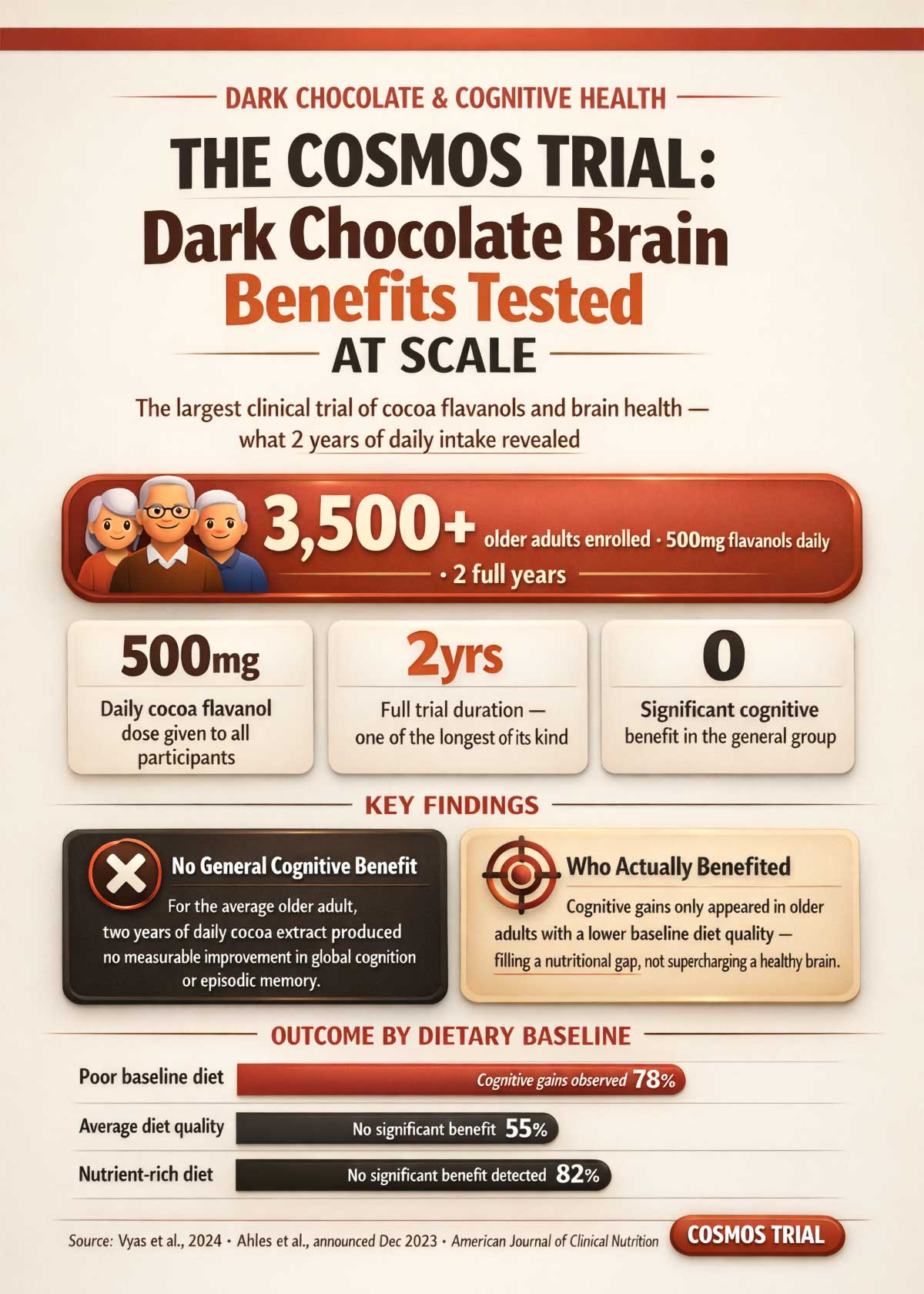
That finding stopped a lot people in their tracks. How could smaller studies show gains while a massive two-year trial found nothing?
A follow-up analysis from Mass General Brigham (Ahles et al., announced December 2023, with formal publication ongoing) offered a critical piece of the puzzle. The cognitive benefits of cocoa extract only appeared in older adults who already had a lower quality diet. If you already eat nutritious, whole foods regularly, adding cocoa extract or dark chocolate will not give your brain a significant boost. The chocolate appears to fill a nutritional gap rather than supercharge an already healthy brain.
This is an important shift in how to think about dark chocolate. It is not a universal brain medicine. For people eating well, it may add very little.
Why Your Chocolate Bar May Not Help at All
Even if you belong to the group that can benefit from cocoa flavanols, the chocolate you buy may not contain enough of them to make a difference. This is where commercial processing becomes a problem.
A food chemistry analysis (Miller et al., 2008) found that a very common processing method called Dutch alkalization destroys between 60% and 90% of the flavanols in cocoa. This process is used widely because it reduces bitterness and darkens the chocolate’s color. It makes the product taste smoother and look richer. But it strips out most of the compounds your brain would benefit from.
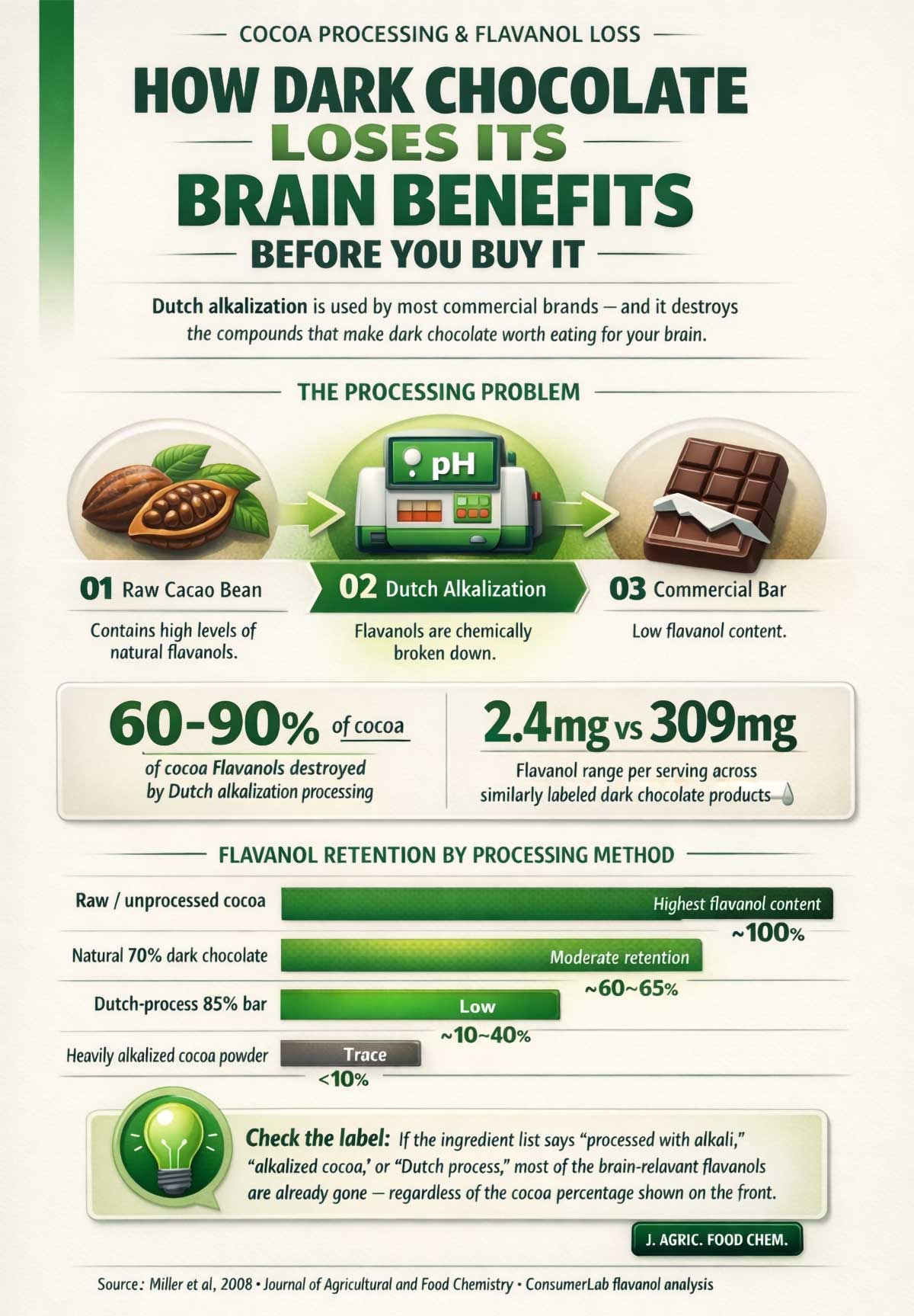
The cocoa percentage on the label tells you almost nothing useful about flavanol content. A product labeled 85% dark chocolate may have fewer active compounds than a raw, unprocessed 70% bar. The number on the wrapper reflects how much of the bar came from the cocoa plant. It says nothing about how that cocoa was treated afterward.
Consumer testing has found flavanol levels in dark chocolate ranging from just 2.4 mg to over 300 mg per serving across products with similar cocoa percentages. That is a massive gap. To know whether your chocolate has meaningful flavanol content, check the ingredient list. If it says “processed with alkali” or “Dutched cocoa,” most of the brain-relevant compounds are already gone.
Not Everyone Responds the Same Way
Here is something that does not get discussed enough: a meaningful share of people simply do not respond to cocoa flavanols at all. Even with clinical-grade, high-flavanol cocoa.
The Scientific Reports study by Gratton et al. (2020) followed 17 healthy young adults who were given a single high-dose serving of high-quality cocoa. About four of the seventeen showed no improvement in brain blood oxygenation or cognitive performance. That is roughly one in four people seeing zero benefit despite receiving the right product in the right dose.
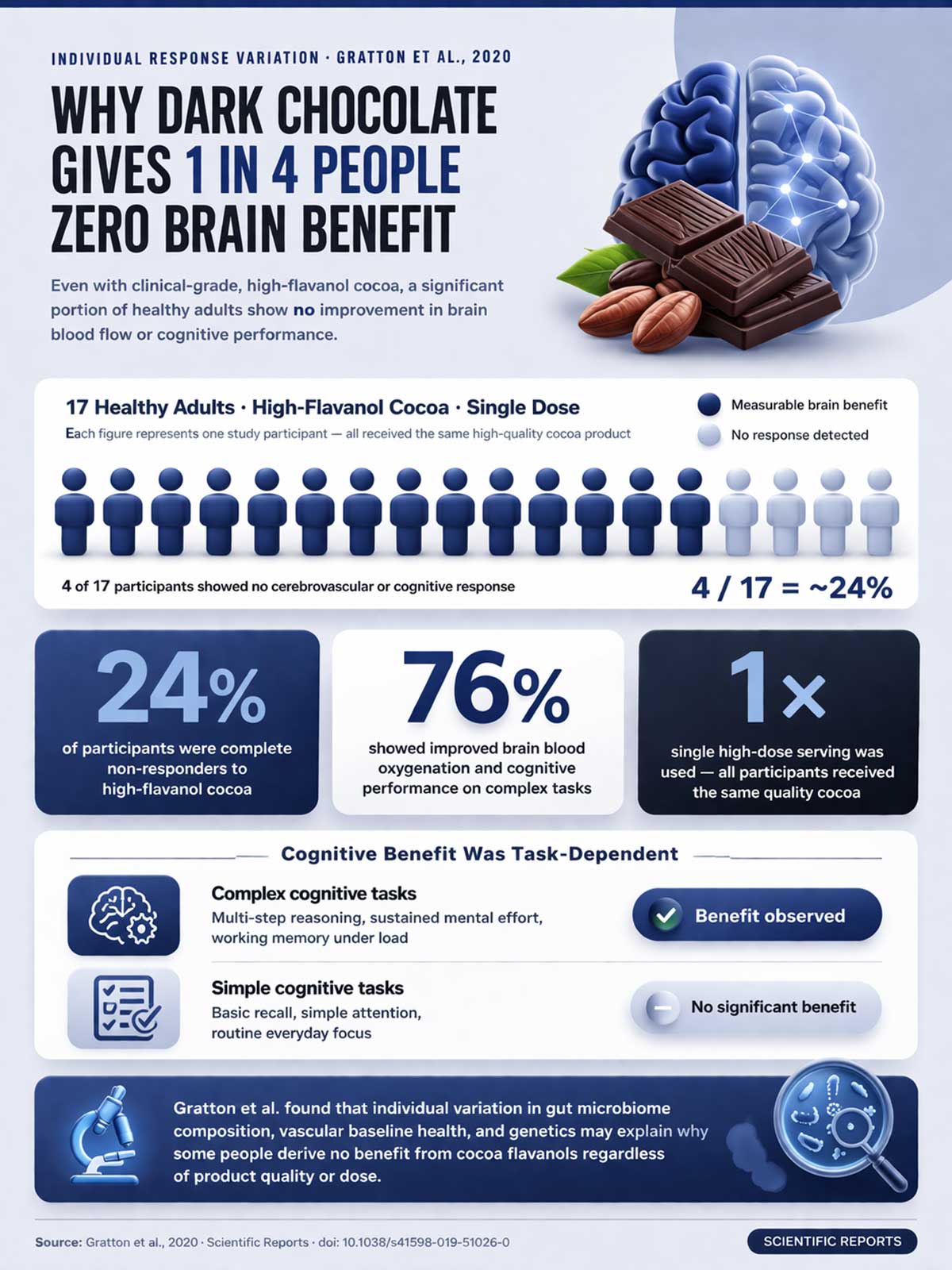
Dietary responses vary widely from person to person. Gut bacteria, genetics, and baseline health all affect how the body processes plant compounds. If you have been eating dark chocolate regularly and not noticing any mental lift, your biology may simply not be wired to respond to cocoa flavanols. That is not a failure. It is just individual variation.
The Safety Issue That Most Articles Skip
Almost every article about dark chocolate and brain health skips one inconvenient topic: heavy metal contamination. This is not a fringe concern.
A safety analysis published in Frontiers in Nutrition (2024) tested 72 dark chocolate and cocoa products. More than 43% of them exceeded acceptable lead levels. Over a third exceeded safe cadmium thresholds. These are naturally occurring heavy metals that accumulate in cacao plants from the soil. Processing does not remove them.
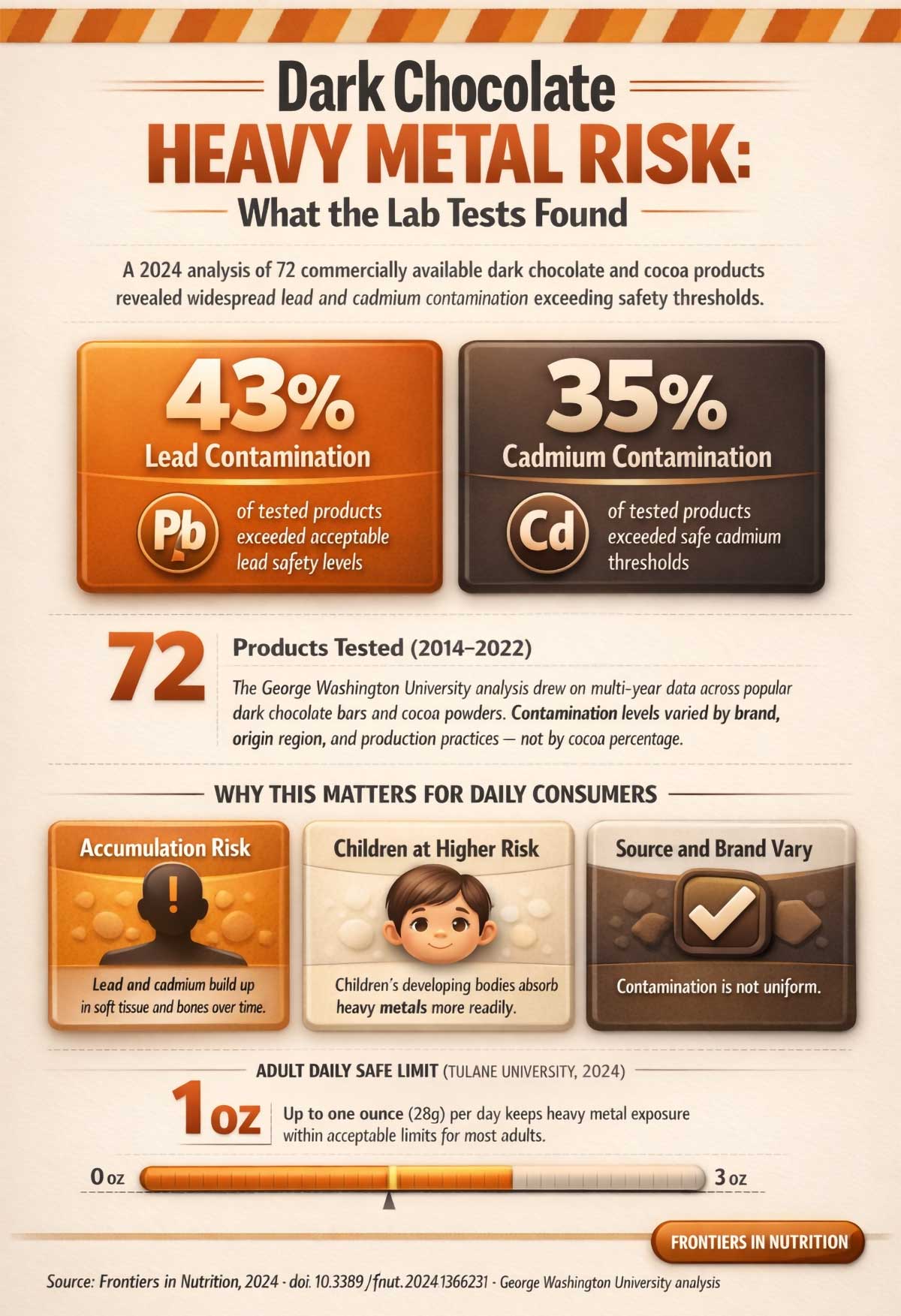
Lead and cadmium build up in the body over time. Chronic low-level exposure is linked to kidney damage and neurological effects. Children are especially vulnerable because their developing bodies absorb heavy metals more readily.
A 2024 Tulane University analysis of heavy metal exposure found that up to one ounce (roughly 28 grams) of dark chocolate per day keeps potential heavy metal exposure within safer limits for adults while still allowing for any potential vascular or cognitive benefit. For children, even that amount warrants caution, and regular daily intake is not advisable.
This does not mean dark chocolate is dangerous in normal amounts. It means daily large servings over months or years deserve more thought than most people give them.
What This All Means in Practice
Dark chocolate has real, measurable effects on brain blood flow and, in some groups, on cognitive performance. But those effects are conditional in ways that most popular coverage ignores. Whether you benefit depends on your diet quality, your individual biology, the processing method used to make your chocolate, and the amount you consume.
Here is a short, practical guide to getting the most from dark chocolate without unnecessary risk:
Check the processing method first. Look at the ingredient list. If it says “processed with alkali,” “alkalized,” or “Dutch process,” the flavanol content is likely very low. Seek out raw or minimally processed dark chocolate with natural cocoa listed as the first ingredient.
Put your diet in context. If you already eat a wide variety of vegetables, fruits, whole grains, and lean proteins, dark chocolate is unlikely to produce a noticeable cognitive shift. The COSMOS analysis suggests these benefits show up most clearly in people with nutritional gaps. Chocolate works best as part of a varied, nutrient-rich diet, not as a replacement for one.
Keep portions to one ounce a day. This is the ceiling that balances any potential benefit against the real risk of heavy metal accumulation. An ounce is about two small squares from a standard bar. It is enough to contribute to cardiovascular health and brain blood flow without pushing cadmium and lead intake into concerning territory.
Do not expect results overnight. The studies that showed cognitive improvements tracked people for four weeks to three months. Eating dark chocolate once or twice and waiting for sharper thinking is not how this works.
Recognize the limits of individual evidence. If you eat high-quality dark chocolate daily for two months and notice nothing, that is a valid data point about your own biology. Not everyone responds, and that is completely normal.
Dark chocolate is a genuinely enjoyable food with some real science behind its vascular and cognitive effects. It is just not the brain-boosting miracle it is often marketed as. Treat it as a small, enjoyable part of a healthy diet, buy it from brands that avoid Dutch processing, and keep your daily amount reasonable. For some people, that one ounce a day may offer a meaningful benefit. For others, it is simply a good piece of chocolate. Either way, that is enough.