What’s the difference between anxious, overwhelmed, and drained? If you’re not sure, you’re missing the skill that changes everything.
You stub your toe. You feel “bad.” Your boss passes you over for a promotion. You feel “bad.” A loved one says something hurtful. Still “bad.”
But these experiences are not the same. The first is physical pain. The second might be disappointment mixed with self-doubt. The third could be a sharp sting of rejection. Each of these calls for a different response. Yet if all you can say is “bad,” you’re working with a very blunt tool.
That’s where emotional granularity comes in.
What Is Emotional Granularity?
Emotional granularity is the ability to tell your feelings apart. It’s the skill of knowing not just that you feel “good” or “bad,” but how you feel — with precision and detail.
Think of it like the difference between a basic 8-color crayon box and a set of 120. The person with 8 colors can draw something. But the person with 120 has far more to work with.
Someone with high emotional granularity doesn’t just feel “stressed.” They might recognize they feel overwhelmed by a deadline, worried about a friend, and irritated by a noisy environment — all at once, and all separately. That clarity matters more than most people realize.
Researchers also call this skill emotion differentiation. The two terms are used side by side in the scientific literature, introduced by psychologist Lisa Feldman Barrett and her colleagues. Today, this idea is championed by experts like Dr. Marc Brackett, founding director of the Yale Center for Emotional Intelligence. In his research and his bestselling book Permission to Feel, Brackett argues that a rich, precise emotional vocabulary is the true foundation of emotional intelligence. It’s not about being more sensitive. It’s about being more specific. The core idea shared across this research is simple: some people are specific about their feelings, and some are not. That difference shapes everything from mental health to physical choices.
Why Emotional Granularity Matters More Than You Think
Most people assume emotions are something you just have, not something you can get better at. But the research tells a different story.
In a landmark 2001 study, Barrett, Gross, Christensen, and Benvenuto followed a group of undergraduates over 14 days using experience sampling, prompting them to log their emotional states in real time. The researchers also gave participants a series of emotion regulation tasks. People who could label their negative emotions with more specificity were found to regulate their emotions far more often and more effectively, especially during times of high emotional intensity. In short: knowing the name of what you feel helps you do something about it.
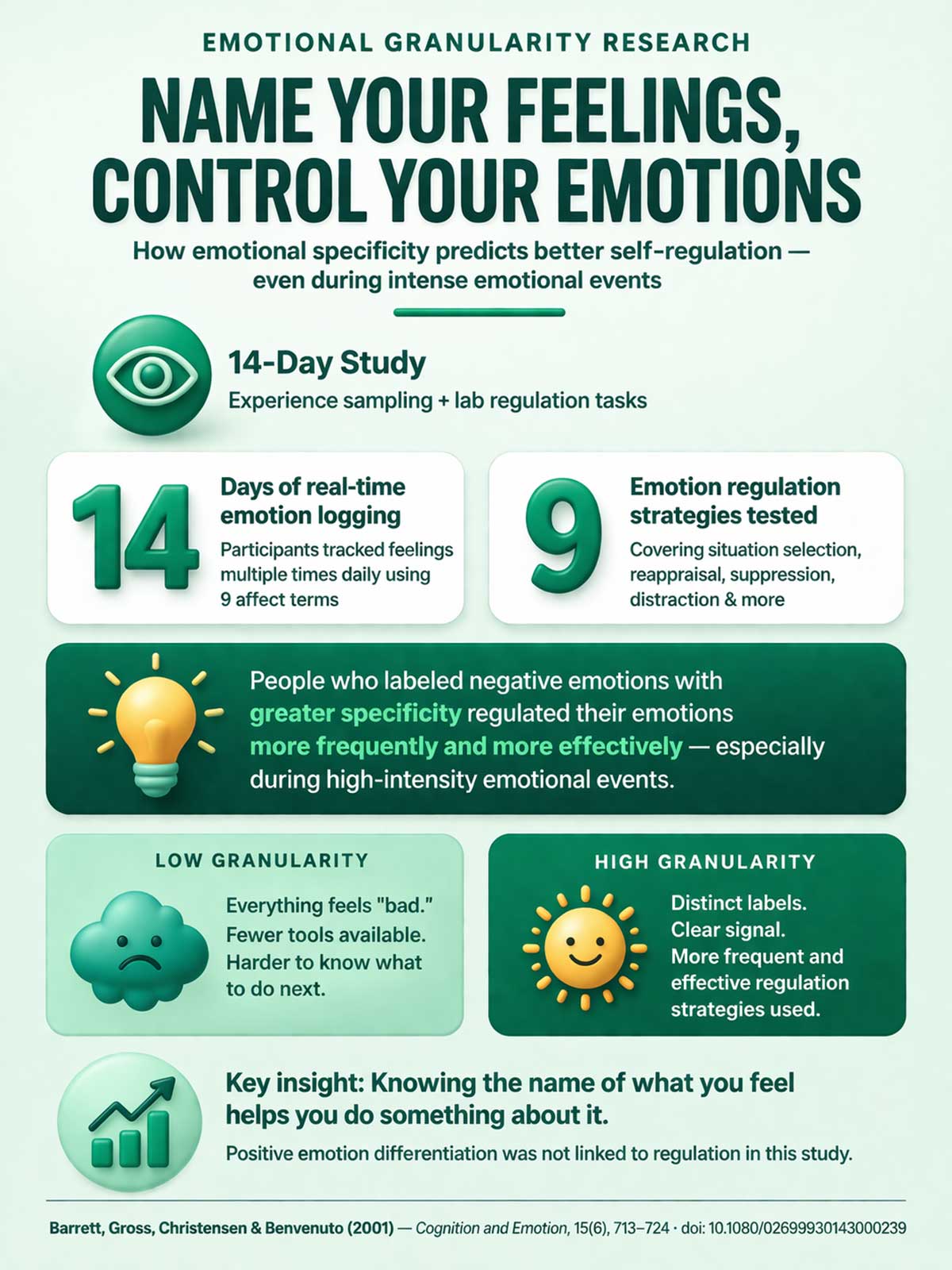
This is a key insight. Emotions carry information. If you can read that information clearly, you can act on it. If it’s a blur, you’re guessing.
Emotional Granularity and Stress Recovery
Not all the benefits of granularity involve negative emotions. A 2004 study by Tugade, Fredrickson, and Feldman Barrett found that people who scored high on psychological resilience also showed higher positive emotional granularity. These individuals could tell apart feelings like joy, pride, amusement, and contentment, rather than lumping them all together as “happy.” That nuanced awareness of positive emotions appeared to help them bounce back faster from stress and find meaning in hard situations.
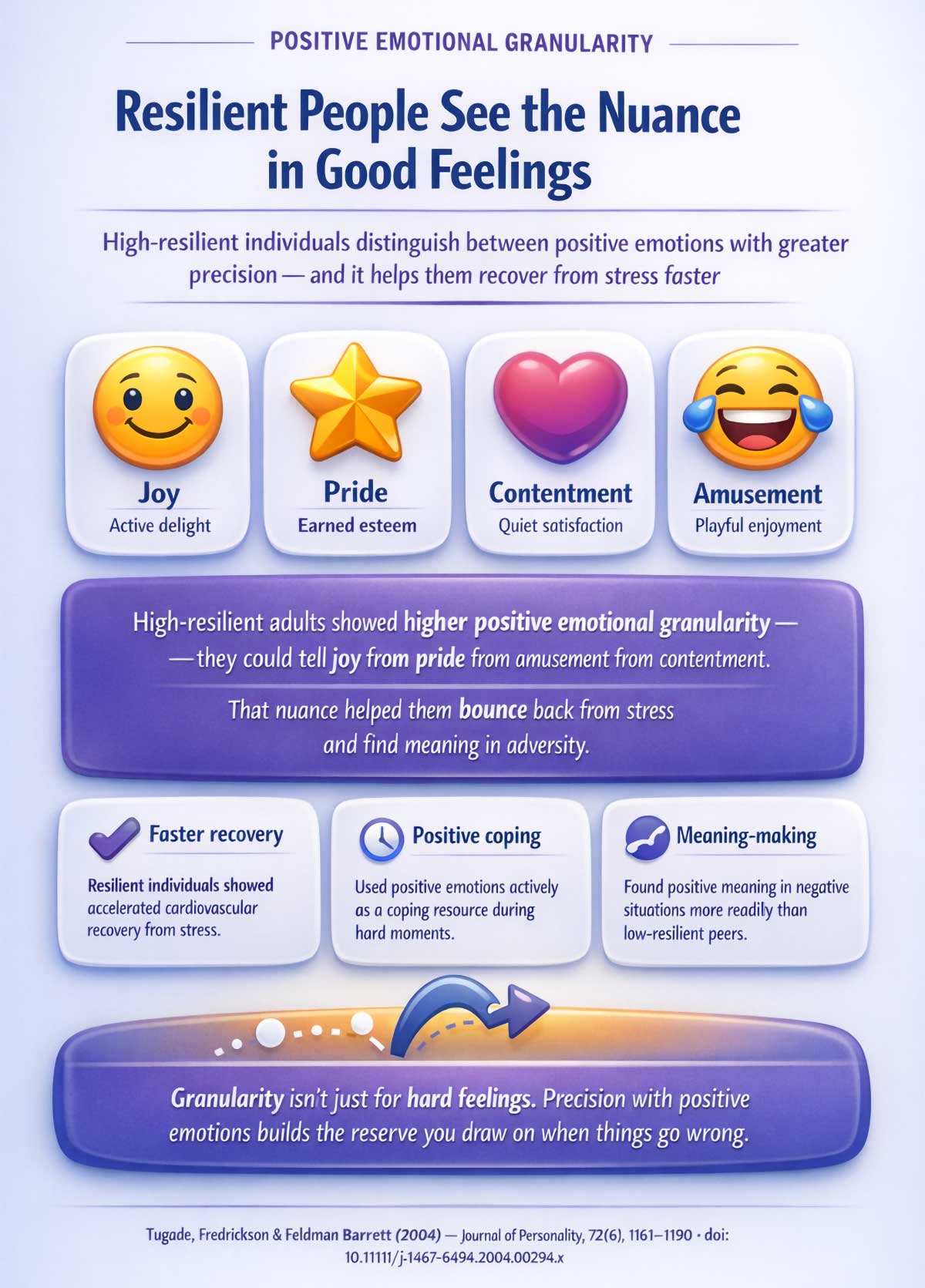
The takeaway: emotional precision isn’t only for managing pain. It also helps you draw more value from the good moments.
The Link Between Low Granularity and Unhealthy Behaviors
Here’s where things get especially relevant for health and wellness.
A comprehensive 2015 review by Kashdan, Barrett, and McKnight examined data from multiple adult populations and found a striking pattern. People with high negative emotion differentiation, meaning they could tell their unpleasant emotions apart clearly, were significantly less likely to use harmful coping strategies when distressed. These included binge drinking, physical aggression, and self-injury. The researchers concluded that being able to perceive distinctions in negativity actually transforms the experience of bad feelings, making them feel less overwhelming and easier to navigate.
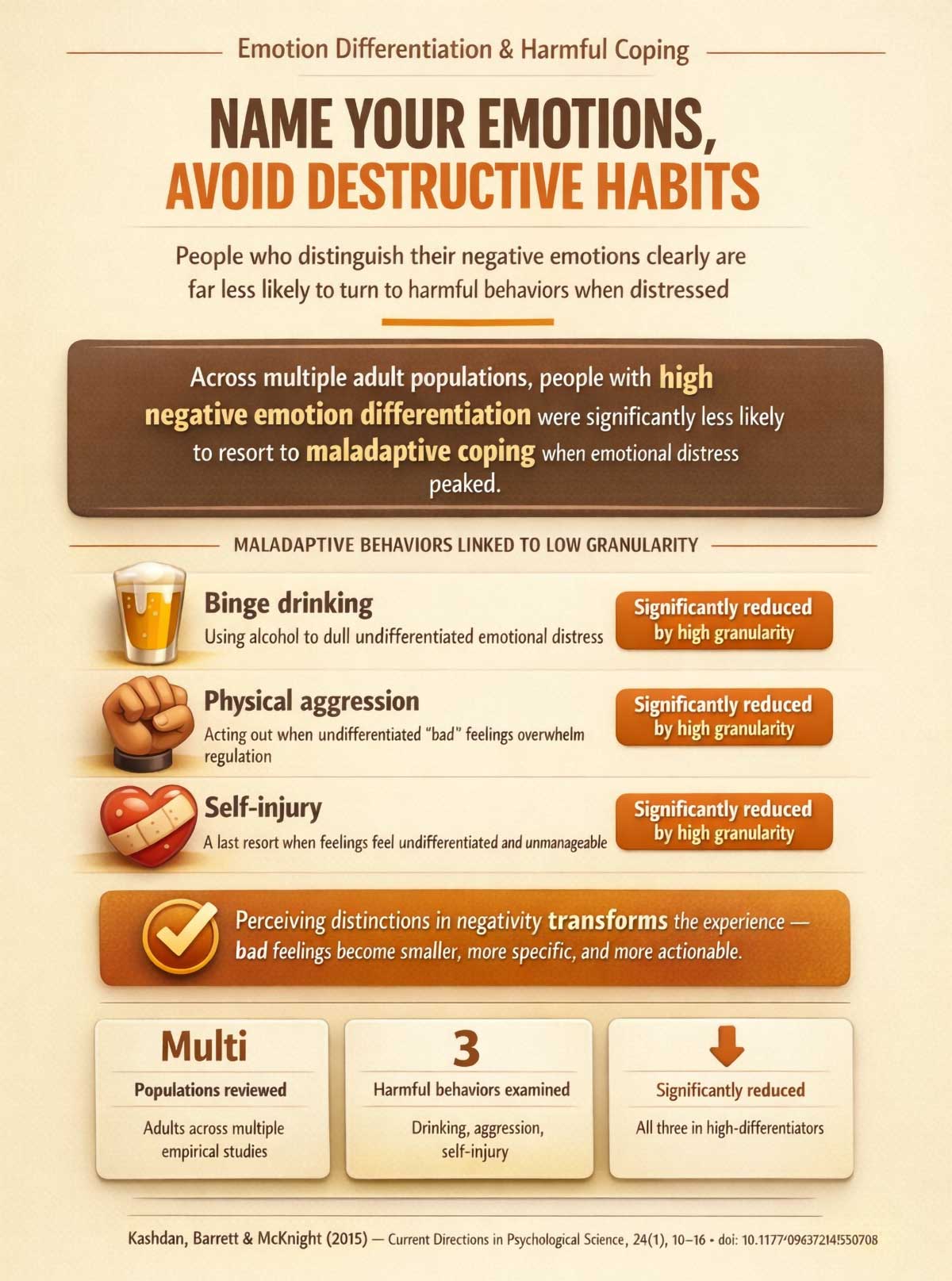
Think of it this way. When “bad” is one undifferentiated mass, it feels enormous. When you can see that it’s “loneliness” plus “guilt” plus “fatigue,” each piece is smaller, more specific, and more addressable.
“When ‘bad’ is one undifferentiated mass, it feels enormous. When you can see that it’s ‘loneliness’ plus ‘guilt’ plus ‘fatigue,’ each piece is smaller, more specific, and more addressable.”
Emotional Granularity and Food Choices
One of the most concrete ways low emotional granularity affects daily health is through eating behavior.
In a 2018 lab-based study, Jones and Herr had adult participants complete measures of emotion regulation and emotion differentiation, then put them through a mood induction followed by access to food. People with lower negative emotion differentiation consumed significantly more calories than high differentiators. This was true across both sad and positive mood conditions. The key mechanism: poor differentiators struggled to identify what they were actually feeling, and food became a go-to response to that murky sense of discomfort.
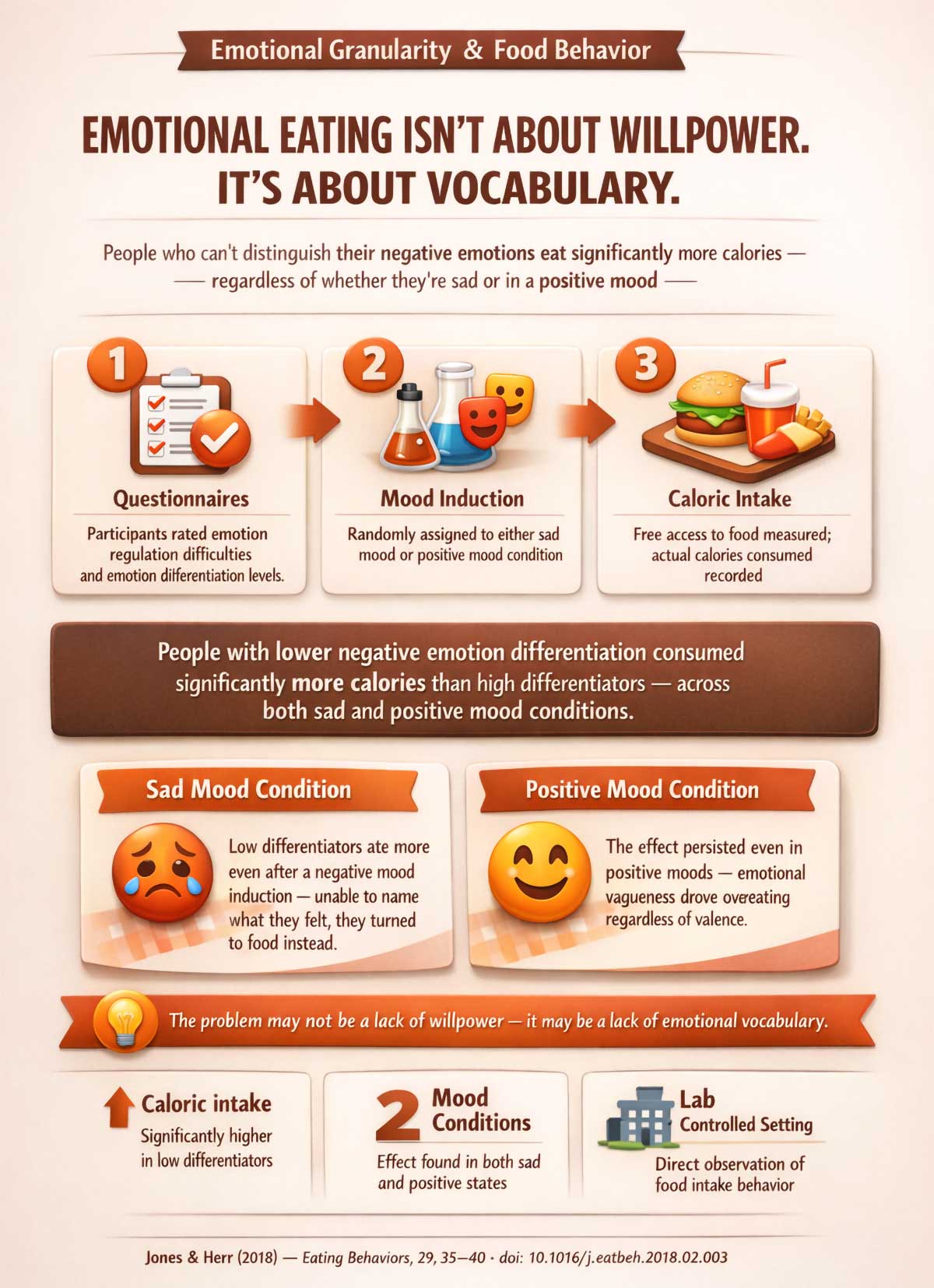
This research offers a new way to think about emotional eating. The problem may not simply be a lack of willpower. It may be a lack of emotional vocabulary.
What Happens Inside: Low Granularity and Well-Being
Beyond behavior, low emotional granularity appears to shape how intensely people feel things, and how they see themselves.
A 2014 study by Erbas, Ceulemans, Pe, Koval, and Kuppens conducted three separate correlational studies with adult participants, mapping out what low negative emotion differentiation actually looks like in daily life. They found consistent links between poor differentiation and higher neuroticism, lower self-esteem, and greater intensity of negative emotion. People who couldn’t tell their bad feelings apart not only felt worse, they also thought less of themselves and were more reactive overall.
On the clinical side, a 2015 review by Smidt and Suvak surveyed studies across both general and clinical populations, finding that more granular emotional experience predicted better emotion regulation and lower severity of mental health symptoms. Conditions like PTSD and borderline personality disorder were associated with lower emotional granularity, while higher granularity appeared to act as a buffer against these outcomes.
Together, these findings paint a clear picture. The ability to name feelings precisely isn’t a soft skill. It’s a core part of psychological health.
Can You Get Better at Emotional Granularity?
Yes. This is perhaps the most encouraging part of the research.
For a long time, emotional granularity was treated as a fixed trait, something you either had or didn’t. But more recent work suggests this isn’t the case.
A 2021 ambulatory study by Hoemann, Barrett, and Quigley tested whether emotional granularity could increase over time simply through the act of tracking and reflecting on emotions. Using daily emotional prompts over several days, they found that participants’ emotional granularity did increase with repeated practice. The more people attended to and logged their feelings, the more precise their emotional descriptions became.
This is significant. It means that practices many people already do, or could easily adopt, may actively build this skill.
Practical Ways to Build Emotional Granularity
The science points toward several accessible strategies. None of them require a therapist’s office, though working with a mental health professional can certainly help.
Expand your emotional vocabulary. The more emotion words you know, the more precisely you can label what you feel. Most adults use a surprisingly small set. Start paying attention to words like: frustrated, deflated, uneasy, wistful, apprehensive, embarrassed, tender, restless. When you notice a feeling, ask whether there’s a more exact word for it.
Keep an emotion log. This is one of the most evidence-backed approaches. At several points during the day, pause and note what you’re feeling, using specific terms rather than broad ones. Write “I feel anxious about the meeting and disappointed I didn’t speak up” rather than “I feel bad.” Over time, the act of doing this appears to increase your baseline ability to distinguish emotions.
Slow down before reacting. Many people act on emotions without naming them first. The next time you reach for food when you’re not hungry, pick up your phone to distract yourself, or feel a sudden urge to snap at someone, pause. Ask: what am I actually feeling right now? Is it hunger, or boredom? Anger, or embarrassment?
Use the “both/and” approach. Emotions often co-occur. Instead of forcing yourself to pick one, allow the possibility that you feel two things at once. “I’m proud of what I did and also scared it wasn’t enough.” Naming both feelings separately gives you more to work with.
Practice with positive emotions too. Granularity applies to good feelings as well. Rather than simply noting “I feel good,” try to get specific. Is it relief, excitement, contentment, or pride? Tugade and colleagues’ research shows that this kind of positive differentiation is linked to greater resilience.
The Role of Emotional Granularity in Physical Health
The connection between emotions and the body runs deep. Stress hormones, blood pressure, sleep quality, immune function, and appetite regulation are all tied to how we process our feelings. When emotional states stay vague and unprocessed, the body tends to stay in a prolonged state of arousal. When emotions are named and managed well, the nervous system can return to balance more quickly.
This is one reason emotional granularity turns up in so many different health contexts. The same skill that helps someone avoid binge eating after a stressful day is the same skill that helps them sleep better, respond more calmly to conflict, and feel more in control of their choices.
Emotional Granularity in Mindfulness and Therapy
Mindfulness-based practices have long emphasized what is sometimes called “noting” — pausing to name what you observe in your thoughts and feelings without judgment. The research on emotional granularity gives this practice a scientific foundation.
When you sit quietly and label what you feel — not just “stressed” but “tight in my chest, thoughts jumping ahead, worried about being judged” — you’re doing something that the brain responds to differently than simply experiencing the emotion raw. The act of labeling appears to create just enough distance to make it more manageable.
Many evidence-based therapies, including dialectical behavior therapy (DBT) and emotion-focused therapy, include emotion identification as a core skill. Emotional granularity research helps explain why this works: naming emotions with precision shifts the relationship you have with them.
Who Can Benefit From Developing Emotional Granularity?
Everyone, to some degree. But some people may find it especially useful.
People who notice they often eat when they’re not physically hungry. Those who find themselves easily overwhelmed by stress and unsure why. Individuals who tend toward rumination or who struggle to “shake off” a bad mood. People working on anxiety, depression, or anger. Anyone who has been told they’re “too emotional” or who feels disconnected from their feelings.
In all of these cases, the problem is often not the feelings themselves. It’s the lack of a clear signal telling you what they are and what to do about them.
A Note on Emotional Granularity and Children
Emotional granularity develops over time, and research suggests it follows a U-shaped pattern: relatively higher in young children, lower during adolescence, and rising again into adulthood. This has implications for parents and educators. Teaching kids a rich emotional vocabulary early, and modeling the habit of naming emotions specifically, may help them develop this skill before they need it most.
Phrases like “it sounds like you might be feeling disappointed, not just sad” or “that sounds more like frustration than anger” can do more than soothe a child in the moment. They may build a habit of emotional precision that serves them for life.
The Bottom Line
Emotional granularity is the ability to tell your feelings apart with accuracy and detail. It’s not about being more emotional. It’s about being more clear about what you feel.
The research is consistent: people with higher emotional granularity regulate themselves better, cope more effectively, make healthier choices under stress, and show better mental health outcomes overall. And the good news is that this skill can be built. It doesn’t require rare talent or unusual circumstances. It requires practice, vocabulary, and the habit of pausing long enough to ask: what am I actually feeling right now?
That single question, asked often enough, may be one of the most useful health habits you can develop.
References
Barrett, L. F., Gross, J., Christensen, T. C., & Benvenuto, M. (2001). Knowing what you’re feeling and knowing what to do about it: Mapping the relation between emotion differentiation and emotion regulation. Cognition and Emotion, 15(6), 713–724. https://doi.org/10.1080/02699930143000239
Erbas, Y., Ceulemans, E., Pe, M. L., Koval, P., & Kuppens, P. (2014). Negative emotion differentiation: Its personality and well-being correlates and a comparison of different assessment methods. Cognition and Emotion, 28(7), 1196–1213. https://doi.org/10.1080/02699931.2013.875890
Hoemann, K., Barrett, L. F., & Quigley, K. S. (2021). Emotional granularity increases with intensive ambulatory assessment: Methodological and individual factors influence how much. Frontiers in Psychology, 12, 704125. https://doi.org/10.3389/fpsyg.2021.704125
Jones, A. C., & Herr, N. R. (2018). Emotion differentiation mediates the association between emotion regulation difficulties and caloric intake. Eating Behaviors, 29, 35–40. https://doi.org/10.1016/j.eatbeh.2018.02.003
Kashdan, T. B., Barrett, L. F., & McKnight, P. E. (2015). Unpacking emotion differentiation: Transforming unpleasant experience by perceiving distinctions in negativity. Current Directions in Psychological Science, 24(1), 10–16. https://doi.org/10.1177/0963721414550708
Smidt, K. E., & Suvak, M. K. (2015). A brief, but nuanced, review of emotional granularity and emotion differentiation research. Current Opinion in Psychology, 3, 48–51. https://doi.org/10.1016/j.copsyc.2015.02.007
Tugade, M. M., Fredrickson, B. L., & Feldman Barrett, L. (2004). Psychological resilience and positive emotional granularity: Examining the benefits of positive emotions on coping and health. Journal of Personality, 72(6), 1161–1190. https://doi.org/10.1111/j.1467-6494.2004.00294.x