A growing body of clinical research points to a simple, affordable food that can make a real difference to blood pressure: ground flaxseed. Not flaxseed oil. Not whole flaxseeds. Ground flaxseed — about 4 tablespoons a day, taken consistently for 12 weeks.
The numbers from clinical trials are hard to ignore. For people with hypertension, that combination has been linked to a drop in systolic blood pressure of up to 13 mmHg or more. That’s comparable to the effect of some first-line blood pressure medications.
Here’s exactly what the science says, what you can expect based on your starting point, and how to do it right.
The 13 mmHg Drop: Why 12 Weeks Is the Key Window
Blood vessels don’t change overnight. That’s the most important thing to understand about flaxseed and blood pressure.
The benefits don’t come from a single dose. They come from a slow, steady process of vascular change that builds over weeks. The 12-week mark is where the most meaningful results tend to appear in clinical trials.
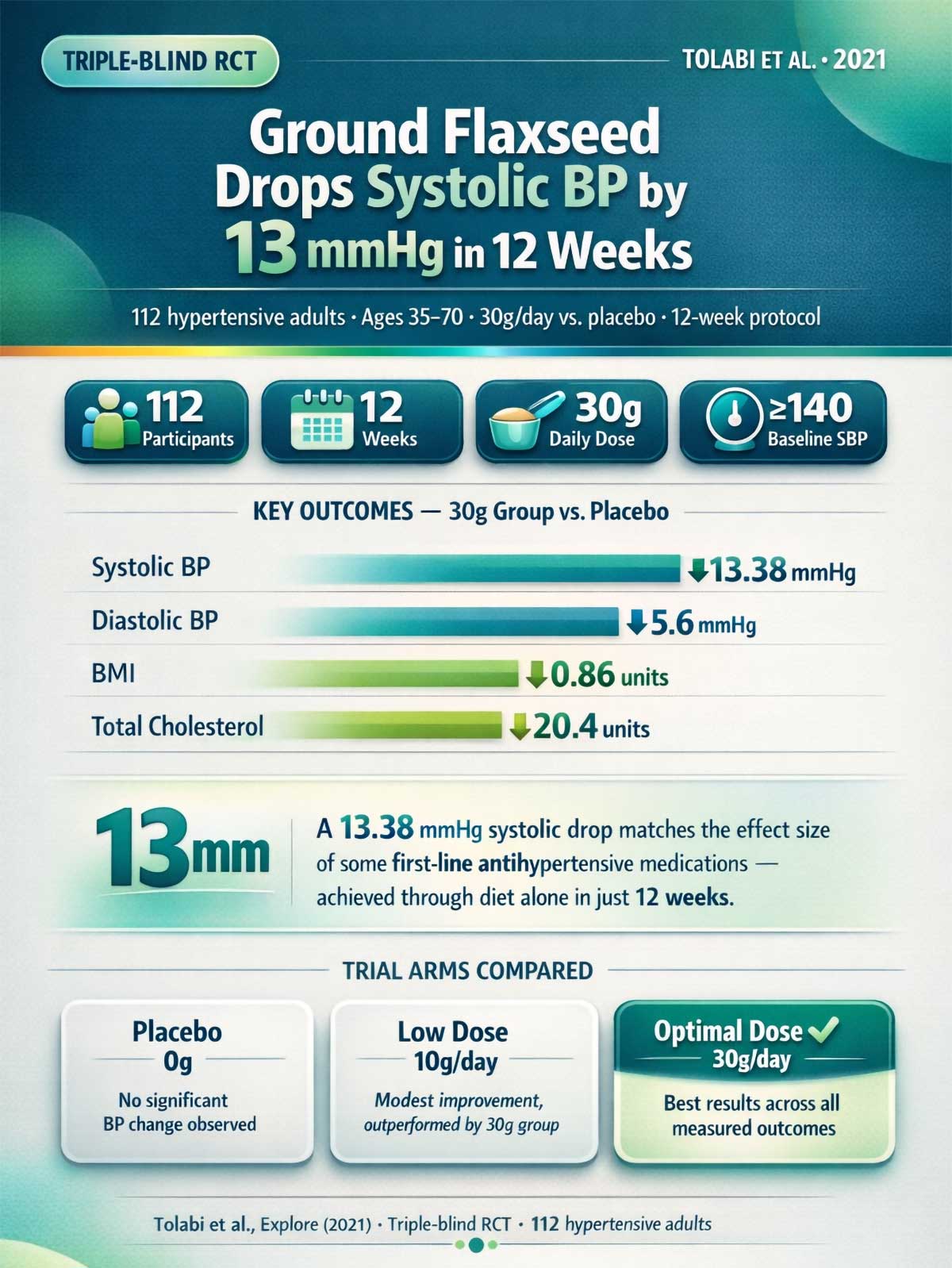
In a 2021 triple-blind randomized controlled trial by Tolabi and colleagues, 112 adults with hypertension were split into three groups: a placebo group, a 10g/day flaxseed group, and a 30g/day flaxseed group. After 12 weeks, the 30g group — that’s roughly 4 tablespoons — saw their systolic blood pressure (SBP) drop by 13.38 mmHg and their diastolic blood pressure (DBP) drop by 5.6 mmHg compared to placebo. The same group also improved their BMI and total cholesterol. This is one of the most rigorously designed trials on this topic, and its parameters match the “4 tablespoons, 12 weeks” protocol exactly.
Why does it take 12 weeks? The short answer is that the body needs time. The anti-inflammatory compounds in flaxseed, especially its Omega-3 fatty acids and plant lignans, work gradually to reduce stiffness in artery walls. Blood vessels become more flexible. Nitric oxide production increases. Inflammation in the vascular lining slowly decreases. None of that happens in a week.
Think of it like slowly loosening a tight rubber band — you can’t rush it without snapping it.
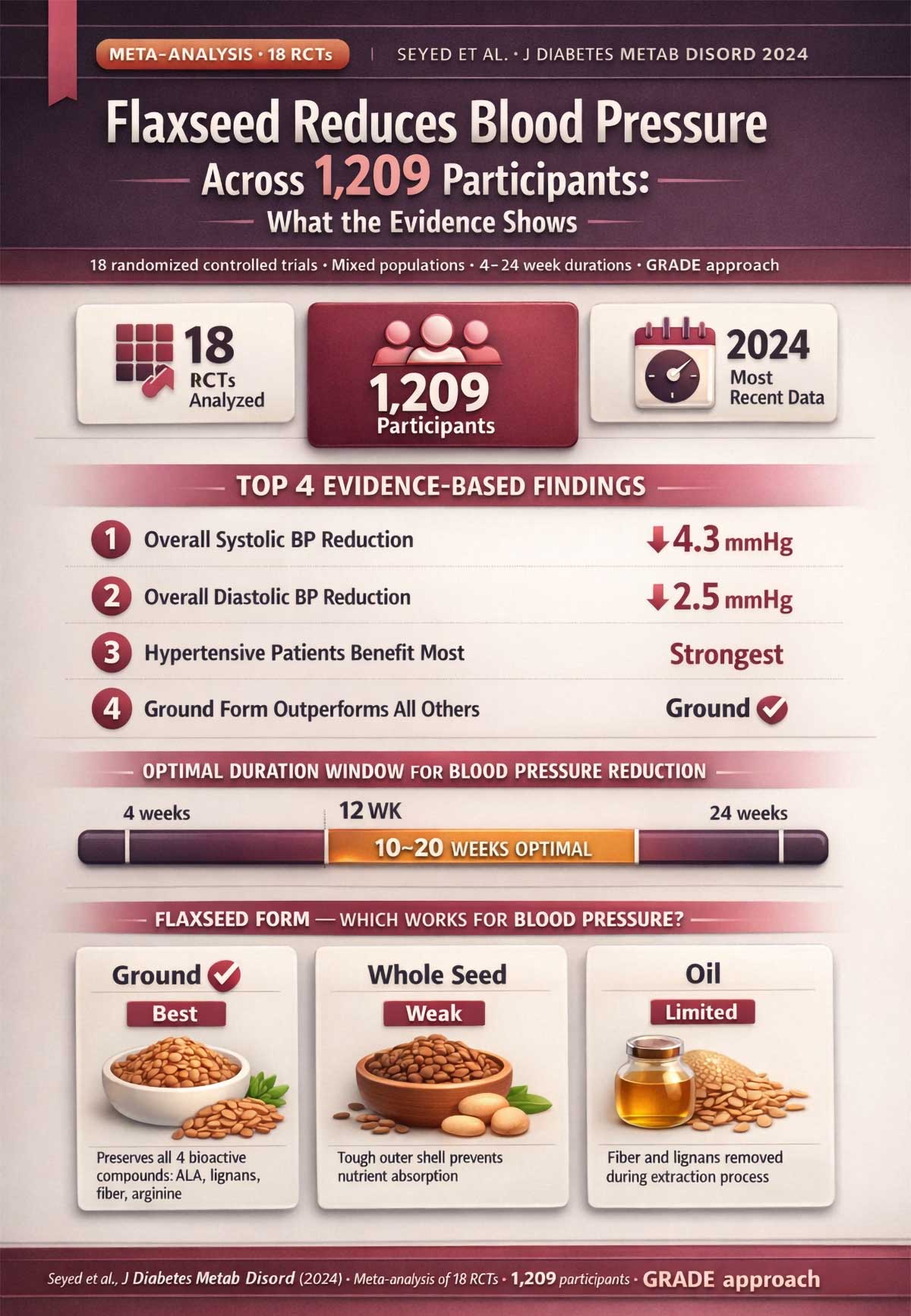
The 12-week window also lines up with findings from a large 2024 meta-analysis by Seyed and colleagues, which analyzed 18 randomized controlled trials involving 1,209 participants. Their analysis found that the optimal duration for blood pressure benefits from flaxseed falls between 10 and 20 weeks — placing the 12-week mark right in the sweet spot.
The Power of 30 Grams: Why 4 Tablespoons Is the Right Dose
Four tablespoons of ground flaxseed weighs about 30 grams. That’s the dose used in the most rigorous clinical trials. It’s not arbitrary.
Lower doses do produce some benefit. The Tolabi trial tested both 10g and 30g daily — and the 30g group consistently outperformed the 10g group on every measure. More is more, at least up to this threshold.
Ground vs. Whole vs. Oil: This Matters More Than Most People Realize
Many articles about flaxseed treat all forms as interchangeable. They’re not.
Whole flaxseeds have a tough outer shell. When you swallow them without chewing, they often pass through the digestive tract intact. The nutrients inside never get absorbed. You’re essentially paying for fiber you can’t use.
Flaxseed oil is the opposite problem. The oil extraction process removes the fiber and lignans — two of the four key compounds responsible for the blood pressure benefits seen in clinical trials. Oil gives you ALA (the Omega-3 fatty acid), but it leaves out the rest of the active ingredients.
Ground flaxseed keeps everything: the ALA, the lignans, the soluble fiber, and the arginine. That’s why the 2015 meta-analysis by Khalesi and colleagues, which reviewed 11 randomized controlled trials, found that ground flaxseed significantly outperformed both whole seeds and oil for blood pressure reduction — particularly in people with hypertension.
Buy whole flaxseeds and grind them at home using a coffee grinder, or buy pre-ground. Store ground flaxseed in the fridge or freezer to extend shelf life and preserve freshness — the oils oxidize over time at room temperature.
Fitting 150 Calories Into Your Day
Four tablespoons of flaxseed adds roughly 150 calories to your daily intake. That’s not a small amount. Adding it on top of your current diet without adjusting anything else can lead to slow weight gain.
A smarter move: treat flaxseed as a swap. Use it to replace something else. Add it to oatmeal in place of granola. Blend it into a smoothie instead of protein powder. Use it as part of a baked good recipe in place of some flour. The goal is to keep your daily calorie intake roughly the same while adding the flaxseed.
The “Big Four” Bioactives: How Flaxseed Loosens Up Your Arteries
Flaxseed doesn’t work through just one mechanism. It works through four distinct compounds, each of which acts on blood pressure through a different pathway. That’s part of why the effect is so consistent across different populations and study designs.
Alpha-Linolenic Acid (ALA)
ALA is the plant-based Omega-3 fatty acid found in flaxseed. It’s not the same as the EPA and DHA in fish oil, but it has its own role. ALA helps reduce systemic inflammation — particularly in the walls of blood vessels. When inflammation in arterial tissue drops, the vessels become less stiff and blood flows more easily. Lower resistance means lower pressure.
Lignans
Flaxseed is one of the richest dietary sources of lignans on the planet — containing up to 800 times more than most other plant foods. Lignans are polyphenols, which are plant-based compounds with strong antioxidant properties. In the body, gut bacteria convert flaxseed lignans into enterodiol and enterolactone. These metabolites reduce oxidative stress in blood vessel walls. Less oxidative damage means healthier, more elastic arteries.
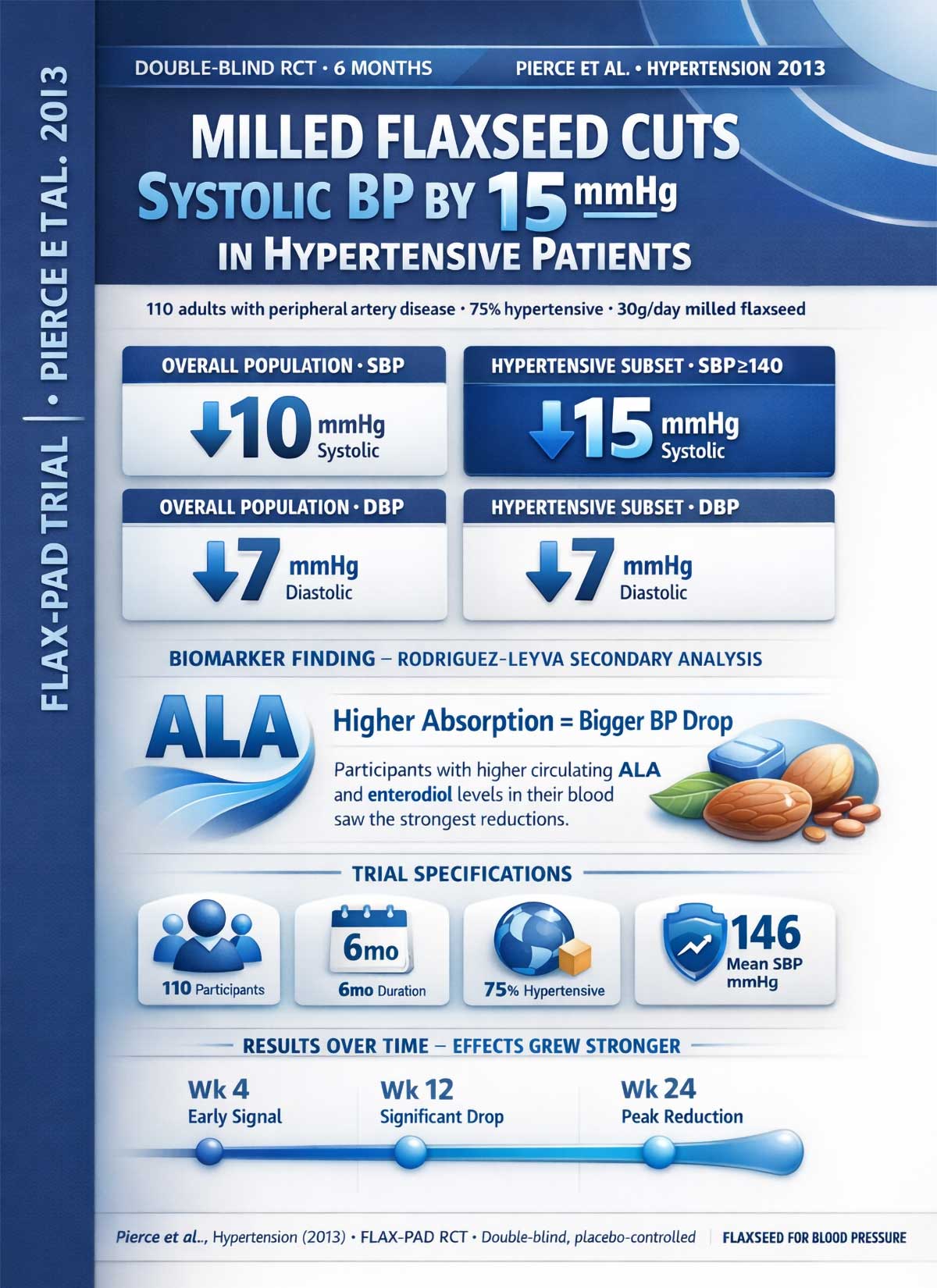
The 2013 FLAX-PAD trial, led by Grant N. Pierce and colleagues at the University of Manitoba, followed 110 adults with peripheral artery disease (75% of whom had hypertension) for six months. Those who ate 30g of milled flaxseed daily saw an overall SBP reduction of 10 mmHg and a DBP reduction of 7 mmHg. In the hypertensive subgroup — those starting with an SBP of 140 or above — the SBP dropped by 15 mmHg. A secondary analysis of this same trial, published by Rodriguez-Leyva and colleagues in 2013, found that participants with higher circulating levels of ALA and enterodiol in their blood saw the strongest blood pressure reductions. In other words, the people who absorbed more of the active compounds got more of the benefit.
Soluble Fiber
Flaxseed is about 28% fiber by weight, roughly split between soluble and insoluble forms. The soluble fiber forms a gel-like substance in the digestive tract. This slows the absorption of sugar and cholesterol into the bloodstream. Lower blood sugar spikes and lower LDL cholesterol both reduce the strain on blood vessels over time. Fiber also feeds beneficial gut bacteria, which in turn support overall cardiovascular health.
Arginine
Flaxseed contains notable amounts of the amino acid arginine. Inside the body, arginine gets converted into nitric oxide — a molecule that signals blood vessel walls to relax and widen. This process is called vasodilation. It’s the same basic mechanism targeted by several cardiovascular medications. More nitric oxide means wider blood vessels. Wider vessels mean lower blood pressure.
These four compounds don’t work in isolation — they reinforce each other. That’s why whole-food ground flaxseed outperforms any single extracted compound in supplement form.
Results by the Numbers: What to Expect Based on Where You Start
Not everyone will see the same results from 4 tablespoons a day. Your starting blood pressure matters a great deal. The higher your baseline, the more room there is for improvement — and the more dramatic the response tends to be.
If You Have Hypertension (SBP at or above 140 mmHg)
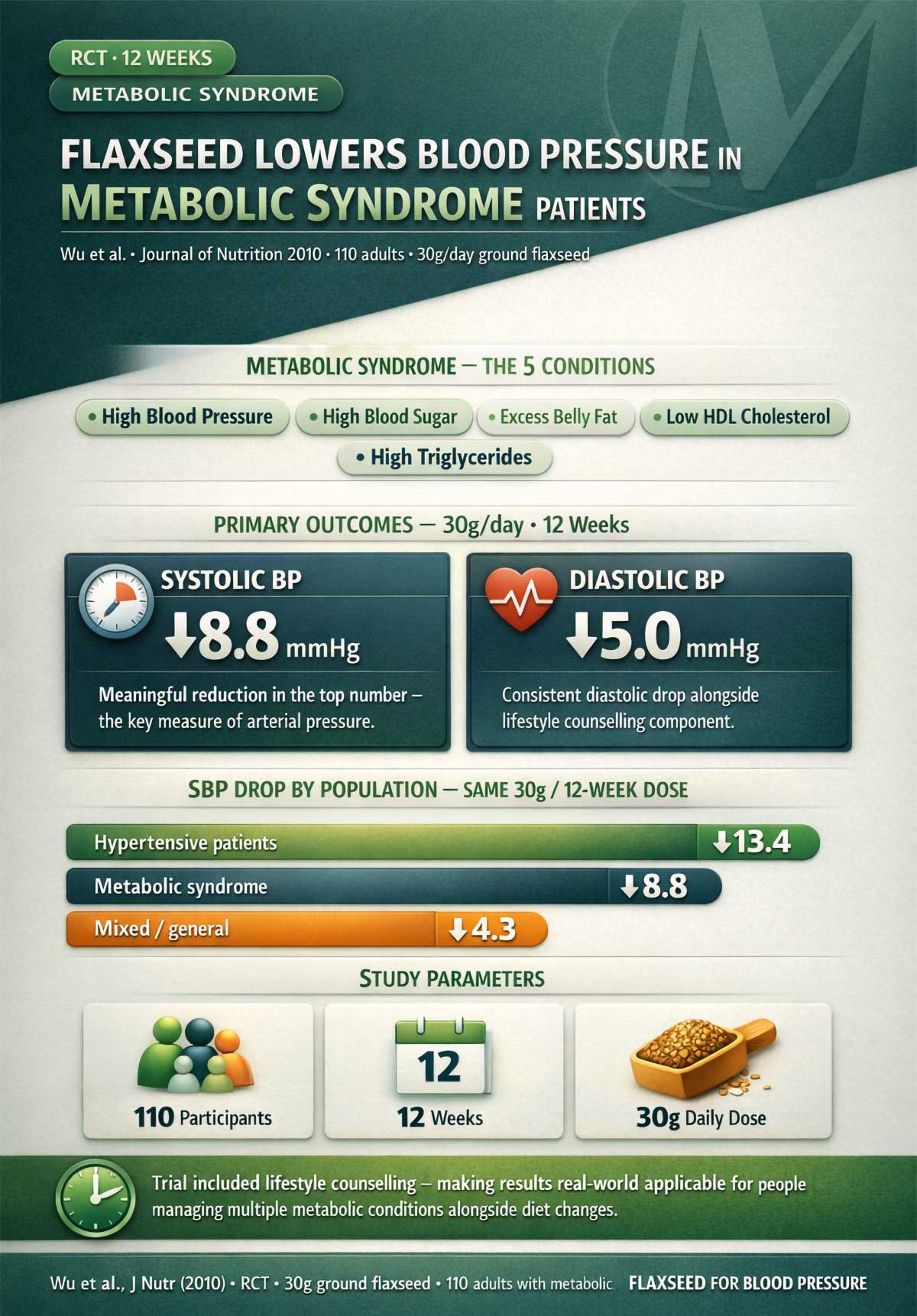
This is where the evidence is strongest. The Tolabi trial (2021) found a 13.38 mmHg SBP reduction. The FLAX-PAD hypertensive subset (Pierce, 2013) showed a 15 mmHg drop. A 2024 meta-analysis focused exclusively on hypertensive patients — pooling five randomized controlled trials — found an average SBP reduction of 8.64 mmHg and a DBP reduction of 4.87 mmHg. These are clinically meaningful numbers. A 10 mmHg drop in SBP is associated with a roughly 20% reduction in the risk of major cardiovascular events. Keep in mind these are average reductions across study populations. Individual responses varied within each trial, with some participants seeing drops of 20 mmHg or more and others seeing smaller changes.
If You Have Metabolic Syndrome
Metabolic syndrome is a cluster of conditions — high blood sugar, excess belly fat, abnormal cholesterol, and elevated blood pressure — that together raise cardiovascular risk. A 12-week randomized controlled trial by Wu and colleagues (2010) gave 30g of ground flaxseed daily to 110 adults with metabolic syndrome. After 12 weeks, SBP dropped by 8.8 mmHg and DBP by 5.0 mmHg. The results were consistent and meaningful, though slightly less dramatic than in pure hypertension populations.
If Your Blood Pressure Is Normal or Only Slightly Elevated
You’ll still benefit, but the effect is more modest. The 2024 Seyed meta-analysis, which included mixed populations, found an overall SBP reduction of 4.3 mmHg and a DBP reduction of 2.5 mmHg across all participant types. A one-year study by Dodin and colleagues (2005), involving 51 healthy postmenopausal women taking 40g of ground flaxseed daily, found a 5 mmHg SBP drop by the end of the year. For people who are already in the healthy range, this is more about prevention than correction.
The Bioavailability Factor: Why Your Gut Changes Everything
Here’s something most articles completely skip over: two people can eat the exact same amount of flaxseed and have very different results. The difference often comes down to gut microbiota.
Flaxseed’s lignans need to be converted by gut bacteria into their active forms (enterodiol and enterolactone) before they can lower blood pressure. People with a rich, diverse gut microbiome convert more lignans and absorb more ALA. People with disrupted gut bacteria — from chronic stress, poor diet, antibiotics, or illness — convert less, and get less benefit.
This explains why some people see dramatic drops in 12 weeks and others see more modest changes. It’s not that the flaxseed isn’t working. It’s that the gut is processing it differently.
Supporting your gut health — through fermented foods, dietary variety, and consistent fiber intake — may amplify your response to flaxseed over time.
The 12-Week Protocol: How to Add 4 Tablespoons to Your Daily Routine
Going straight to 4 tablespoons on day one is a mistake most people make. It’s one of the main reasons people quit. A sudden large dose of fiber causes bloating, gas, and digestive discomfort that feels unpleasant enough to abandon the whole plan.
The right approach is to ease in.
Week 1: The Acclimation Phase
Start with 1 tablespoon of ground flaxseed per day. Mix it into food — more on that below. This gives your digestive system a week to adjust to the increased fiber load. Most people tolerate this well.
Week 2: Building Up
Increase to 2 tablespoons daily. Drink an extra glass of water each day compared to your normal intake. Fiber absorbs water, so your hydration needs go up.
Week 3: Getting Close
Move to 3 tablespoons. By this point, most people have minimal digestive discomfort. Energy levels are often steady. You’re building toward the therapeutic dose.
Week 4 Through Week 12: The Therapeutic Phase
Hit the full 4 tablespoons daily and stay there. This is where the vascular changes accumulate. Consistency is what drives the result — not perfection. If you miss a day, don’t double up the next day. Just continue as normal.
The Best Ways to Use It
The easiest delivery methods are also the most reliable. Ground flaxseed has a mild, slightly nutty taste. It doesn’t overpower food.
The Power Smoothie Method: Add 2 to 4 tablespoons to any blended drink. Flaxseed blends easily and adds a slightly thick texture. Pair it with fruit, leafy greens, or yogurt. This is the most convenient option for busy mornings.
The Oatmeal Stir-In: Stir ground flaxseed into hot oatmeal after cooking. It dissolves almost completely and adds a subtle richness. This is probably the simplest integration for people who eat breakfast at home.
The Baking Swap: Ground flaxseed can replace eggs in baking (1 tablespoon flaxseed + 3 tablespoons water = 1 flax egg). It can also replace up to 25% of flour in muffins, pancakes, or bread. This method works well for people who bake regularly or want to reduce their egg intake. Note that a single flax egg contributes only about 1 tablespoon of flaxseed toward your daily target — so baking alone won’t get you to 4 tablespoons.
The Yogurt or Soup Mix-In: Stir flaxseed into plain yogurt, cottage cheese, or soups. It thickens slightly and adds texture. Works well as a snack or side.
Splitting your daily dose across two meals can make it easier to manage. Two tablespoons at breakfast and two at lunch, for example.
The Fiber Warning: Managing Side Effects So You Don’t Quit
Four tablespoons of ground flaxseed provides around 8 grams of fiber. For most adults eating a typical Western diet, that’s a significant addition all at once. Your digestive system needs time to catch up.
Hydration Is Not Optional
This is the single most important rule. Soluble fiber absorbs water as it moves through your gut. If you don’t increase your fluid intake, the fiber can become sluggish in the digestive tract and cause bloating, constipation, or cramping.
Aim for at least one additional glass of water per tablespoon of flaxseed added. For the full 4 tablespoons, that’s roughly 4 extra cups of water daily above your baseline intake.
Managing Bloating and Gas
The gradual ramp-up schedule above is the best tool for avoiding this. But even with a slow build, some people experience mild bloating in the first two weeks. This is normal. It typically fades as your gut bacteria adapt to processing more fiber.
If gas or discomfort persists beyond the first few weeks, split the dose across more meals. Three meals with roughly 1.5 tablespoons each is often more comfortable than two larger servings.
Medication Interactions
Flaxseed fiber can slow the absorption of some oral medications. If you take prescription drugs — especially for blood pressure, diabetes, or thyroid conditions — take your medications at least one to two hours before or after your flaxseed dose. Ask your pharmacist about your specific medications, as some require longer separation than others. This applies especially to blood thinners. Flaxseed has mild blood-thinning properties and can amplify the effect of anticoagulant medications.
Always tell your doctor you’re adding flaxseed to your diet if you’re on any prescription medications.
One Missed Day Won’t Break It
Missing a single day within a 12-week program has no meaningful impact on overall results. The cumulative effect of consistent daily use over weeks is what produces blood pressure changes — not any one day. Don’t try to compensate. Don’t stress about it. Just pick back up the next day and continue.
Beyond 12 Weeks: What Happens If You Keep Going?
The good news is that the benefits don’t plateau at 12 weeks and then vanish. They hold — and in some cases, they deepen.
The FLAX-PAD trial (Pierce, 2013) ran for six full months, with follow-up data collected at 12 weeks and again at the end of the study period. The blood pressure reductions that appeared at 12 weeks were maintained and slightly improved through the six-month endpoint. In the hypertensive subgroup, the effect was sustained for the full duration of the trial.
Long-term, the key question is sustainability. Can you realistically eat 4 tablespoons of ground flaxseed every day for years?
For many people, the answer is yes — because the delivery methods above make it easy to build into existing habits. It’s not a supplement routine. It’s a food addition. That distinction matters for long-term adherence.
If the full 4 tablespoons feels like too much after 12 weeks, some evidence suggests that even 2 to 3 tablespoons daily can provide meaningful maintenance benefits — particularly for people who have already completed a full 12-week protocol and brought their baseline blood pressure down.
It’s also worth noting that most clinical trials stop data collection at 12 weeks or six months. Long-term safety and results beyond one year haven’t been studied as much. That said, flaxseed is a whole food that humans have eaten for thousands of years, and there’s no evidence of harm from continued use at these amounts.
One more question often comes up: can you just take flaxseed capsules or supplements instead? Clinical trials used whole ground flaxseed, not isolated compounds in pill form. Flaxseed supplements haven’t shown the same blood pressure results, likely because they can’t replicate the combined effect of all four bioactive compounds working together in whole food form.
Work With Your Doctor
This is especially important for anyone on antihypertensive medication. If your blood pressure drops significantly over 12 weeks — which is possible based on the trial data — your existing medication may start to push your pressure too low.
Monitor your blood pressure regularly throughout the 12 weeks. Keep a simple log of your readings. If you see consistent readings below 120/80 while on blood pressure medication, bring that data to your doctor. They may need to adjust your dosage downward.
That’s a good problem to have. But it’s a conversation worth having.
Conclusion
The evidence is clear: 30g of ground flaxseed per day — about 4 tablespoons — taken consistently for 12 weeks produces real, measurable blood pressure reductions. For people with hypertension, those reductions can be clinically significant. For people with metabolic syndrome, the benefits are meaningful. Even for healthy individuals, the effect is real, just more modest.
The form matters: ground flaxseed only. The dose matters: 4 tablespoons daily. The timeline matters: 12 weeks of consistent use.
Start slow. Drink more water. Pick two or three delivery methods you’ll actually stick with. Tell your doctor you’re adding it to your routine.
And give it time. Your arteries didn’t stiffen overnight. They won’t soften overnight either. But 12 weeks from now, the numbers may tell a different story.
This article is for informational purposes only and does not constitute medical advice. Always consult a qualified healthcare provider before making changes to your diet or medication regimen.