94 independent studies involving over 8,000 people that covered achievement, health, and relationship goals. It wasn’t about trying harder, it was one specific habit most people never try.
Every January, millions of people make the same promise to themselves. By February, most have already broken it. The usual explanation is that they didn’t want it badly enough, that somewhere below the surface their willpower gave out before the goal could take hold.
The same story repeats beyond January as well, in the promotion someone keeps meaning to pursue, the diet that resets every Monday, or the conversation with a partner that was supposed to go differently this time.
A review spanning 94 separate studies and more than 8,000 people says the willpower explanation is mostly wrong. The people who reached their goals in those studies weren’t made of sterner stuff than everyone else. Before they ever started, they did one specific thing that most goal-setting advice skips entirely.
Why Trying Harder Doesn’t Work (Even When You Mean It)
Researchers wanted to know something simpler than most goal-setting studies attempt to answer: if you make someone want a goal more, does that alone change what they do?
Psychologists Thomas Webb and Paschal Sheeran tested it directly in a review published in Psychological Bulletin, pooling 47 experiments that used real interventions to raise people’s motivation and then tracked what happened next.
Interventions like these usually take a familiar shape: a persuasive message about why the goal matters, an exercise asking someone to write down their own reasons for wanting it, information about what’s at stake if they don’t follow through. All of it is designed to make someone want something more, and by that measure, it worked.
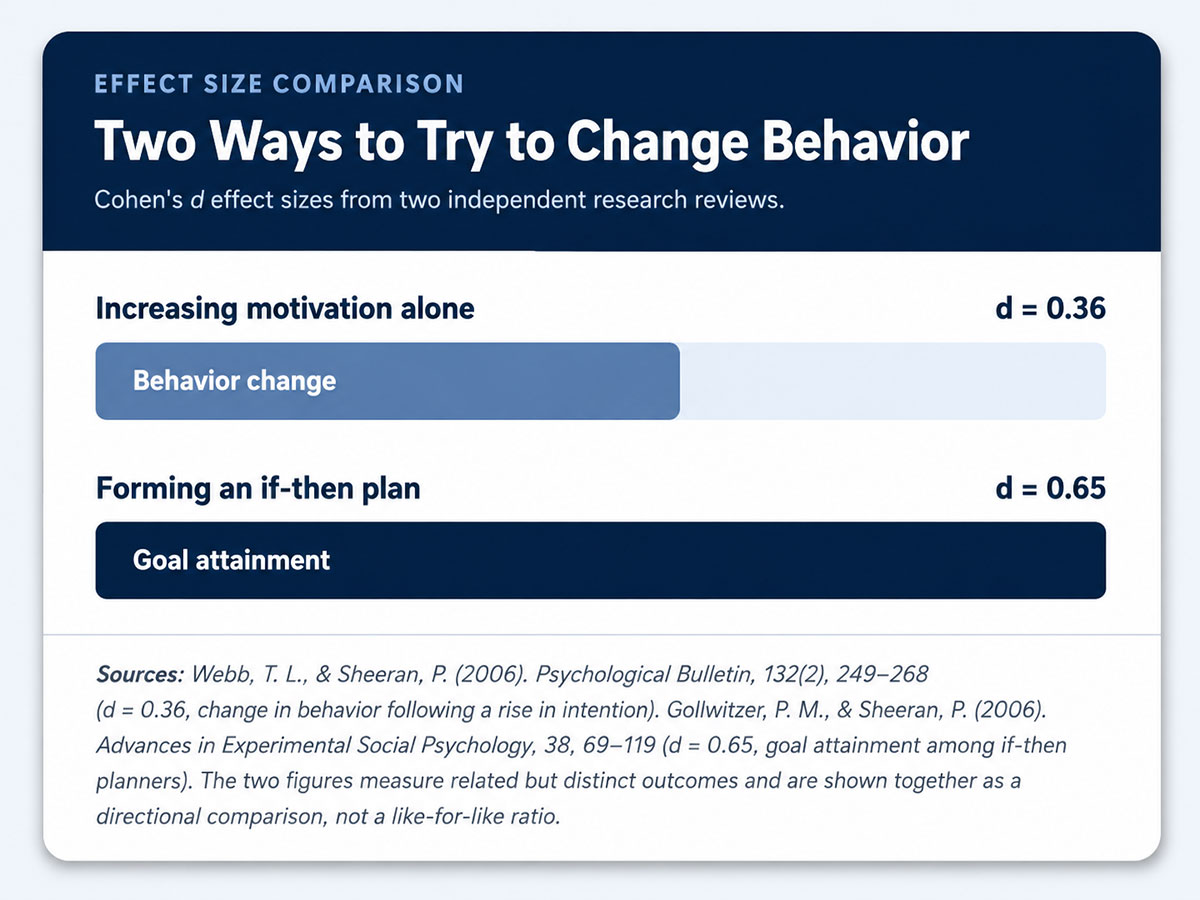
The boost in motivation was substantial, a medium-to-large shift by standard measures. The change in what people actually did afterward was much smaller, roughly half the size. That number is smaller than it sounds.
Wanting something more is a weak reason on its own. It moves how people feel about a goal far more reliably than it moves what they do about it, and the gap between the two is where most resolutions quietly die.
This is part of why New Year’s resolutions have such a poor track record. December is when motivation peaks: a new year, a clean slate, a renewed sense of purpose. None of that intensity does much to change what happens on a random Tuesday in February, when the alarm goes off, and the old routine is still the path of least resistance.
What Actually Moves the Needle
The assumption behind most goal-setting advice is that intensity is the missing ingredient, that stronger resolve produces stronger follow-through. A separate, much larger body of research points to a different lever entirely.
Peter Gollwitzer had spent nearly two decades studying why good intentions collapse before they become action. By 2006, he and Sheeran, who had also examined how rising motivation translates into behavior, had pooled enough data to answer the question at scale.
Their review, published in Advances in Experimental Social Psychology, combined 94 independent studies covering more than 8,000 people, spanning achievement, health, and relationship goals alike.
Across all of them, one factor produced a comparably large improvement in whether people actually reached their goal: deciding in advance, in specific terms, when and how they would act. The effect size was nearly double what Webb and Sheeran found for boosting motivation alone, though the two reviews measured related but distinct outcomes, so the comparison is a strong signal rather than an exact ratio.
SMART goals and most familiar frameworks already ask the right questions. They just leave out this one step, the piece that actually determines whether any of the answers turn into action.
Gollwitzer had actually proposed the core idea seven years earlier, in a 1999 paper in American Psychologist describing how people could hand control of a behavior over to a cue in their environment instead of relying on remembering to act in the moment.
The 2006 review was the point where that early theory finally got tested at scale, across thousands of people rather than a handful of lab experiments.
What came out of that research program was a clinical name and a strikingly simple structure.
The One Sentence That Changes Everything
Psychologists call it an implementation intention. Everyone else can just call it an if-then plan.
The format is fixed: if a specific situation happens, then I will do a particular thing. Not a vague resolution. A single sentence that links a moment already built into daily life to an action that moves the goal forward.
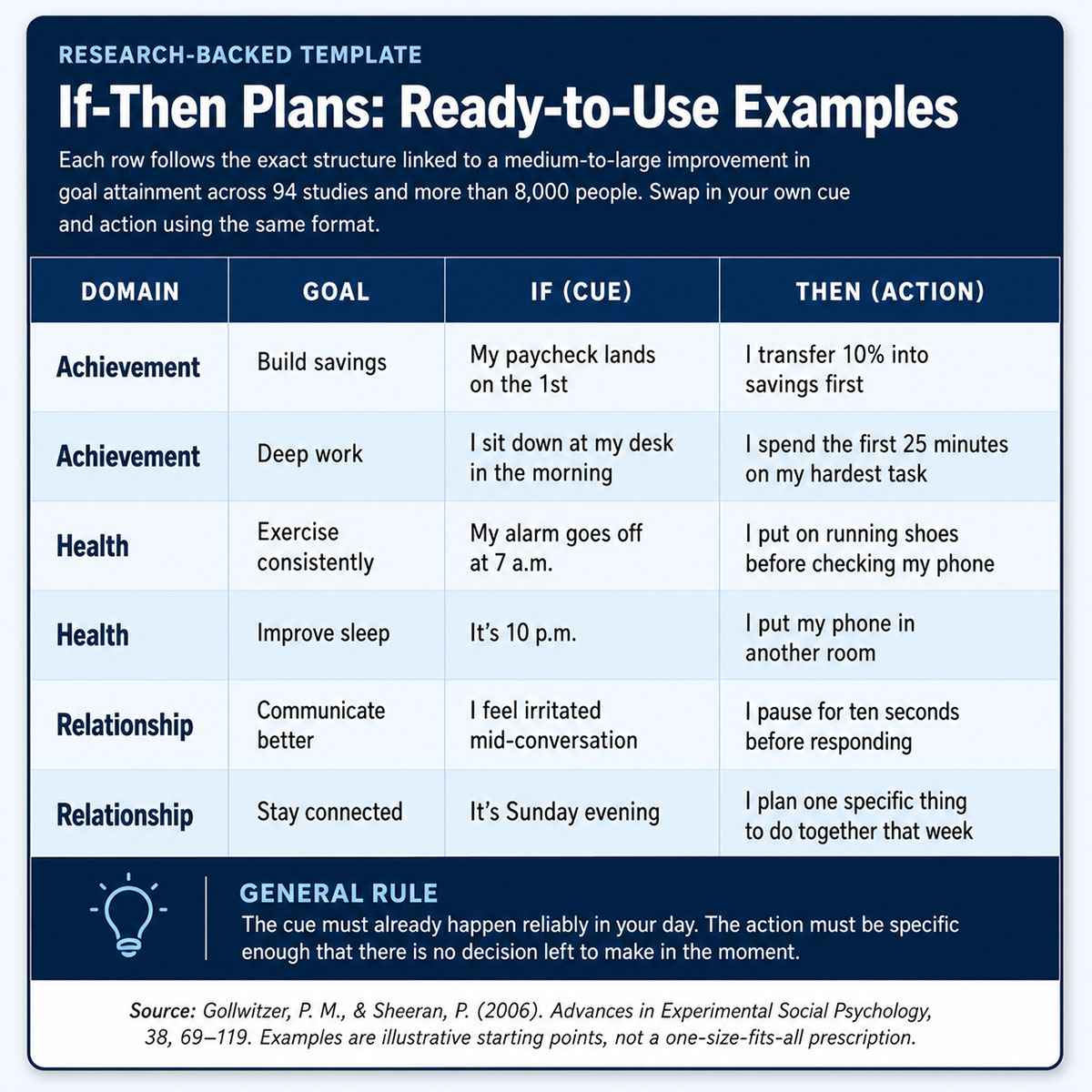
A savings goal might become: if my paycheck lands on the first of the month, then I will transfer 10% into savings before I spend on anything else. Without the plan, that same paycheck usually gets absorbed into groceries, a bill, an impulse purchase, and whatever’s left over becomes “savings,” which most months is nothing.
A fitness goal might sound like: if my alarm goes off at 7 a.m., then I will put on running shoes before I check my phone. The phone is the part that matters. Once the scrolling starts, the fifteen minutes it takes usually swallows the window where the workout was supposed to happen.
A relationship goal might be as small as: if I feel irritated mid-conversation with my partner, then I will pause for ten seconds before responding. Ten seconds doesn’t sound like much. It’s just long enough to skip saying the thing that would have needed an apology later.
None of these sentences requires extra motivation. They function because the decision has already been made before the moment of temptation or distraction shows up to interfere with it.
The best ones start with the moment things tend to fall apart, a specific hour, mood, or setting, rather than the goal itself.
Why Handing Off the Decision Works
Gollwitzer’s original explanation was that an if-then plan works by delegating control of a behavior to the cue itself, so that when the moment arrives, the response happens without the person having to consciously decide anything. Willpower doesn’t disappear from the equation. It just isn’t needed at the one moment it usually fails, the moment of choosing.
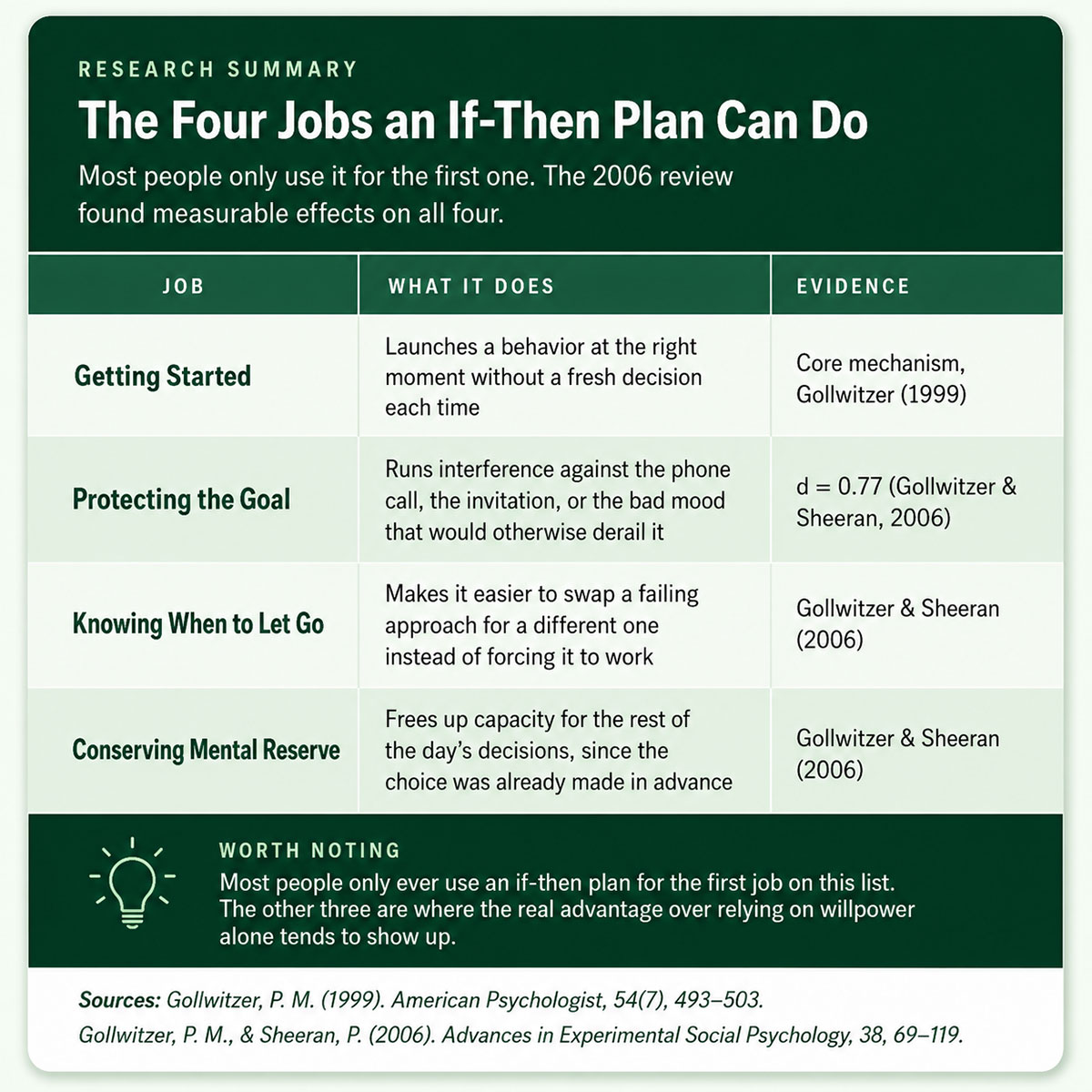
The 2006 review broke this down into four separate jobs a plan can do, more than most people would guess from something this small. Getting started is the obvious one, the one everyone assumes is the whole point: the alarm goes off, the shoes go on.
A subtler job is protecting a goal that’s already underway, and the same 94-study review found an even larger effect here, d = 0.77. A plan doesn’t just launch a behavior. It also runs interference against the phone call, the invitation, or the bad mood that would otherwise derail it.
There’s a role most people don’t expect, too: knowing when to let go of a plan that isn’t working, swapping a failing approach for a different one instead of grinding through it out of stubbornness. Quieter than all three: because the decision was made in advance, acting on it doesn’t spend down the same mental reserve that effortful self-control does, leaving more of that reserve for the rest of the day’s decisions.
None of this helps equally in every situation. The effect shrinks for goals that were already nearly automatic to begin with, such as tying a shoelace or arriving at a regular weekly meeting. There’s simply less room for a plan to improve something a person was already going to do anyway.
Why Willpower Gets Credit It Doesn’t Deserve
Self-control predicts real-world behavior only modestly. When researchers pooled 102 studies and more than 32,000 people in a 2012 meta-analysis in Personality and Social Psychology Review, the correlation between trait self-control and what people actually did barely cleared small-to-medium, and it was strongest for behaviors that had already become automatic rather than ones requiring active resistance in the moment. That’s a smaller number than most self-help advice assumes.
Researchers still don’t fully agree on why self-control research and popular advice about it drifted so far apart. One likely explanation comes from the mechanism already discussed: self-control looks powerful mainly once a behavior has become automatic, and an if-then plan manufactures that automaticity on purpose, borrowing the one advantage naturally disciplined people have without requiring anyone to become one.
Picture two people who both manage to hit the gym at 6 a.m. every day. One of them white-knuckles it, negotiating with themselves every morning about whether today is the day they skip it. The other doesn’t experience it as a negotiation at all, the alarm goes off, and their body is already moving before the debate can start.
From the outside, both look equally disciplined. Only one of them is spending willpower to get there.
Where If-Then Plans Go Wrong
None of this works if the plan itself stays vague. If the cue could apply to a dozen different moments in a day, the brain never quite knows which one is supposed to trigger the response, and the automatic link Gollwitzer described never really forms.
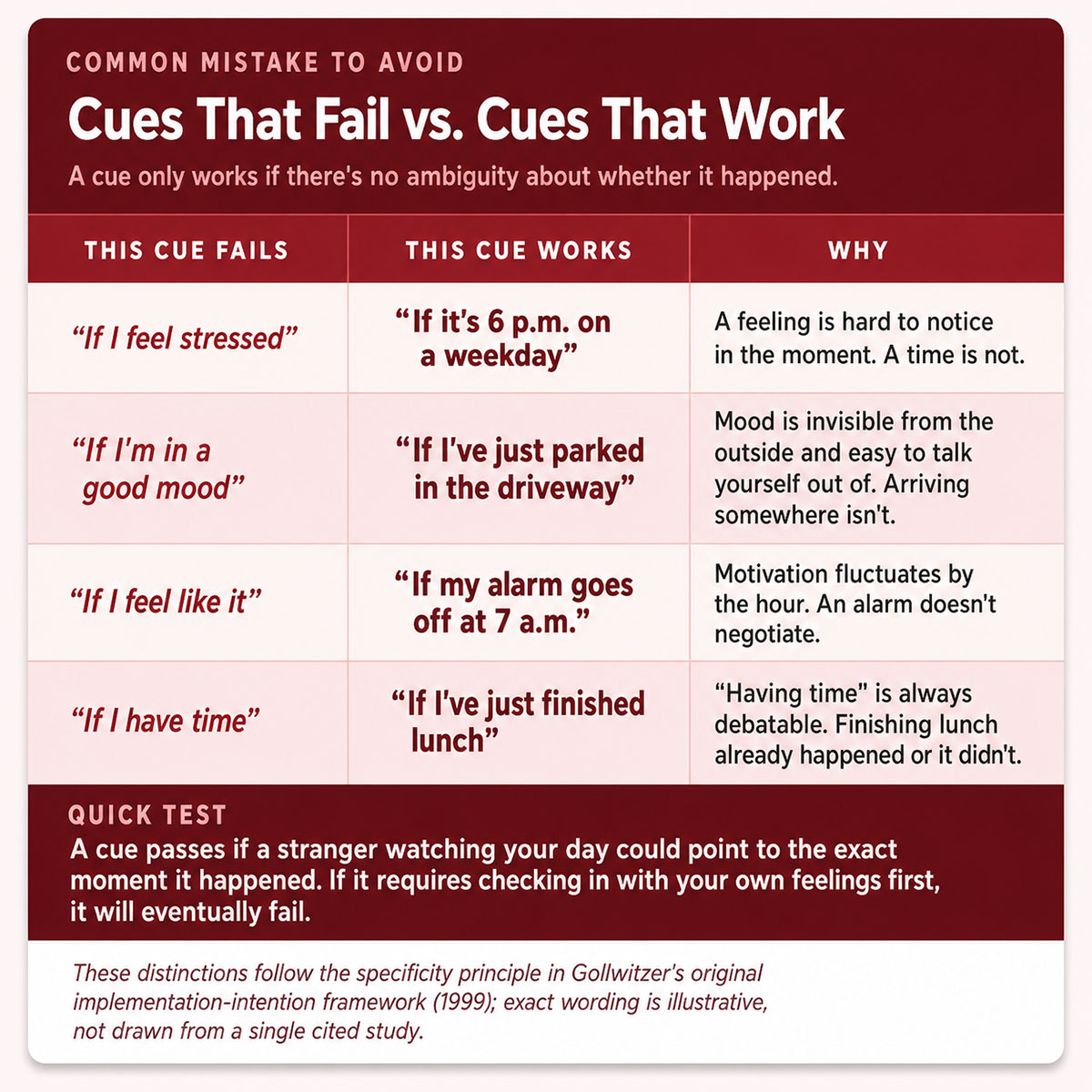
The most common failure is writing the action just as loosely as the goal it was supposed to replace. “If I feel stressed, then I will destress” is not an if-then plan. It’s the same vague resolution wearing a new format.
The cue has to be something that happens on a specific, recognizable occasion, and the action has to be concrete enough that there’s nothing left to figure out in the moment.
A cue like “if I’m in a good mood” fails for the same reason a New Year’s resolution fails: it depends on a state that’s hard to notice in the moment and easy to talk yourself out of. A cue like “if it’s 6 p.m. on a weekday” or “if I’ve just parked in the driveway” works because there’s no ambiguity about whether it has happened.
Volume causes a different kind of failure. Writing eight of these at once for eight different goals spreads the same attention across too many cues, and most of them quietly stop getting noticed within a week or two. A habit that works with one or two plans often collapses under six.
There’s a third mistake worth naming: treating the plan as permanent once it’s written down. Part of what makes if-then plans effective is the option to let go of one that isn’t working and rewrite it, rather than forcing it to work through sheer persistence. Even so, some plans fail for reasons that are hard to diagnose from the outside: a cue that seemed reliable on paper turns out to compete with something else in the moment, and no amount of rewriting fixes that on the first try.
How to Write Your Own If-Then Plan
Name a cue that already happens every day, such as waking up, finishing lunch, or closing a laptop, and attach one specific action to it, not a general intention. “Then I will exercise more” doesn’t qualify. It still requires a decision at the exact moment willpower is weakest.
“Then I will put on my shoes and walk to the end of the block” does, because there’s nothing left to decide.
Not every goal comes with an obvious cue already built into the day. When that’s the case, the easiest fix is anchoring the new action to a habit that already runs on autopilot, brushing teeth, starting the coffee maker, sitting down at a desk, and borrowing its reliability instead of hoping a brand-new cue sticks on its own.
Write the full sentence down somewhere it will actually be seen again, not just thought once and forgotten.
None of this makes willpower irrelevant, and it doesn’t guarantee that any single goal gets reached. What the evidence changes is where the credit belongs and where the next attempt should start.
The people who reach their goals are not, on average, built with more resolve than everyone else. They wrote one sentence in advance and let the plan carry weight their motivation was never going to sustain on its own. The missing ingredient turns out to be a sentence you can write before the next Monday you promise yourself will be different.
It doesn’t require becoming a different kind of person. It just requires writing the sentence down.