Gratitude fatigue isn’t burnout from too much thankfulness. It’s your brain sending a very specific warning.
You’ve been told that gratitude is a proven path to happiness. Maybe you started a gratitude journal. Maybe you just try to think grateful thoughts. Or maybe you’ve been encouraged to focus on your blessings when things get hard.
But lately, the practice feels like a chore. The words feel hollow. Worse, they feel like a lie.
You’re not lazy. You’re not ungrateful. You’re experiencing gratitude fatigue, and the reason it’s happening isn’t what most people think. It’s not about how often you’re doing it. It’s not about your journal routine at all.
The real cause is a hidden pattern that most people never notice: using gratitude to silence your own feelings.
The Pattern You Didn’t Notice: Gratitude as a Silencer
Think about the last time you felt stressed, frustrated, or genuinely upset. Did you try to talk yourself out of it with thoughts like:
“I shouldn’t feel this way. At least I have a job.” “Others have it so much worse. I’m lucky.” “I need to be more grateful.”
This is the pattern. It’s not malicious. In fact, it feels responsible. Mature, even. But what’s actually happening is that you’re using gratitude as a tool to shut down a negative emotion before it gets a chance to be heard.
Psychologists call this emotional suppression. And it has a serious cost.
Researcher James Gross studied this in 1993, running controlled experiments on adults to track what happens when people actively suppress their emotional responses. The results were stark. While suppression did reduce outward signs of distress, it increased internal cardiovascular stress, created significant cognitive load, and actually impaired memory. The bad feeling didn’t go away. It just went underground, and it took a lot of mental energy to keep it there.
This is the “suppression tax.” Every time you use gratitude to overwrite a negative emotion, you don’t erase the feeling. You just pile the effort of hiding it on top of the original burden.
Why Your Brain Feels So Drained
The suppression tax adds up fast. When you’re genuinely distressed but working to maintain a grateful outlook, you’re running two competing processes at once. Your brain is holding the actual feeling in check while simultaneously generating a replacement narrative. That takes up working memory, the same mental resource you use to solve problems, follow conversations, and get through your day.
Think of it like trying to write an email while someone is playing loud music right next to you. You can do it. But it costs more. You finish more slowly. You feel more tired when it’s over.
Research by Moore and colleagues in 2008 found that emotional suppression increases the demands on working memory and impairs memory consolidation afterward. In plain terms: bottling up feelings creates a cognitive tax that leaves you foggy, irritable, and mentally drained.
This is the brain fog and fatigue that people often chalk up to “burnout” or “journaling too much.” But the journal isn’t the problem. The suppression is.
The Physical Price of Forced Thankfulness
This isn’t just a mental phenomenon. The body keeps score too.
There’s a meaningful biological difference between authentic appreciation and forced appreciation. When gratitude arises naturally, research shows it’s associated with lower heart rate, reduced cortisol, and a genuine calming effect on the nervous system. A landmark randomized controlled trial by Emmons and McCullough in 2003 found that gratitude practice improved mood, optimism, and life satisfaction in healthy adults without significant baseline distress. Their effects were more modest in people already under meaningful strain.
Research on gratitude interventions also shows that, like many psychological practices, they can lose power with excessive use. Wood and colleagues, reviewing the evidence in 2010, found that gratitude’s benefits depend heavily on context, individual differences, and whether the practice is chosen freely. Overuse can lead to what researchers call “gratitude satiation,” where the practice simply stops working. This matters, because it means the hollowness you’re feeling may not be a personal failing. It may be a predictable outcome.
The key distinction, though, runs deeper than frequency. When gratitude is imposed on someone already under real strain, something more damaging happens. Recent research suggests that forced gratitude, particularly when used to mask genuine hardship, functions as a form of toxic positivity. In people facing real difficulties, this pattern has been associated with elevated cortisol levels, the very stress hormone gratitude is supposed to reduce.
The act of physically suppressing what you feel while performing thankfulness activates the same stress response the emotion was trying to signal in the first place. You’re not calming the system. You’re confusing it.
Why Timing and Context Change Everything
Gratitude isn’t a universal tool. Its effectiveness depends entirely on context.
A 2013 study by Troy and colleagues put this to the test, examining how emotion regulation strategies performed under different types of stress. When a stressor was outside a person’s control, strategies aimed at shifting perspective worked well. But when a stressor was controllable, those same strategies backfired. In those cases, reframing the situation actually made outcomes worse.
Why? Because when a problem is solvable, your brain knows it. If you use gratitude to cope with a toxic job, an unfair relationship, or a situation you actually have the power to change, your brain sends a fatigue signal. It’s trying to stop you from staying in a harmful loop by making the coping strategy feel exhausting.
Gratitude is a tool for shifting perspective on things you cannot change. It was never designed to substitute for problem-solving on things you can.
This doesn’t mean perspective-shifting is bad. It means perspective-shifting on problems you cannot solve is entirely different from using it to avoid action on problems you can. One broadens your view. The other keeps you stuck.
A follow-up study by Shallcross and colleagues in 2010 confirmed this: perspective-shifting strategies are most effective in low-stress, controllable situations, and their effectiveness drops sharply as the situation becomes more stressful or less within your control.
In other words, forcing gratitude on a situation that needs action is like taking a painkiller instead of removing the splinter. The pain signal exists for a reason.
The Guilt Spiral: Feeling Bad About Feeling Bad
Gratitude fatigue rarely arrives alone. It usually brings a second layer of pain with it.
If you’ve been taught that gratitude is a reliable path to happiness, then failing to feel grateful starts to feel like a personal flaw. You feel stressed. You try to feel grateful. It doesn’t work. Now you feel stressed and guilty for not being grateful enough. The cycle feeds itself.
Researchers Ford and Mauss described this phenomenon in a 2015 literature review on what they called the “paradox of hedonism.” Their finding: the more aggressively a person pursues positive emotions and tries to eliminate negative ones, the worse their psychological well-being becomes. Acceptance of all emotions, including the difficult ones, consistently produced better mental health outcomes.
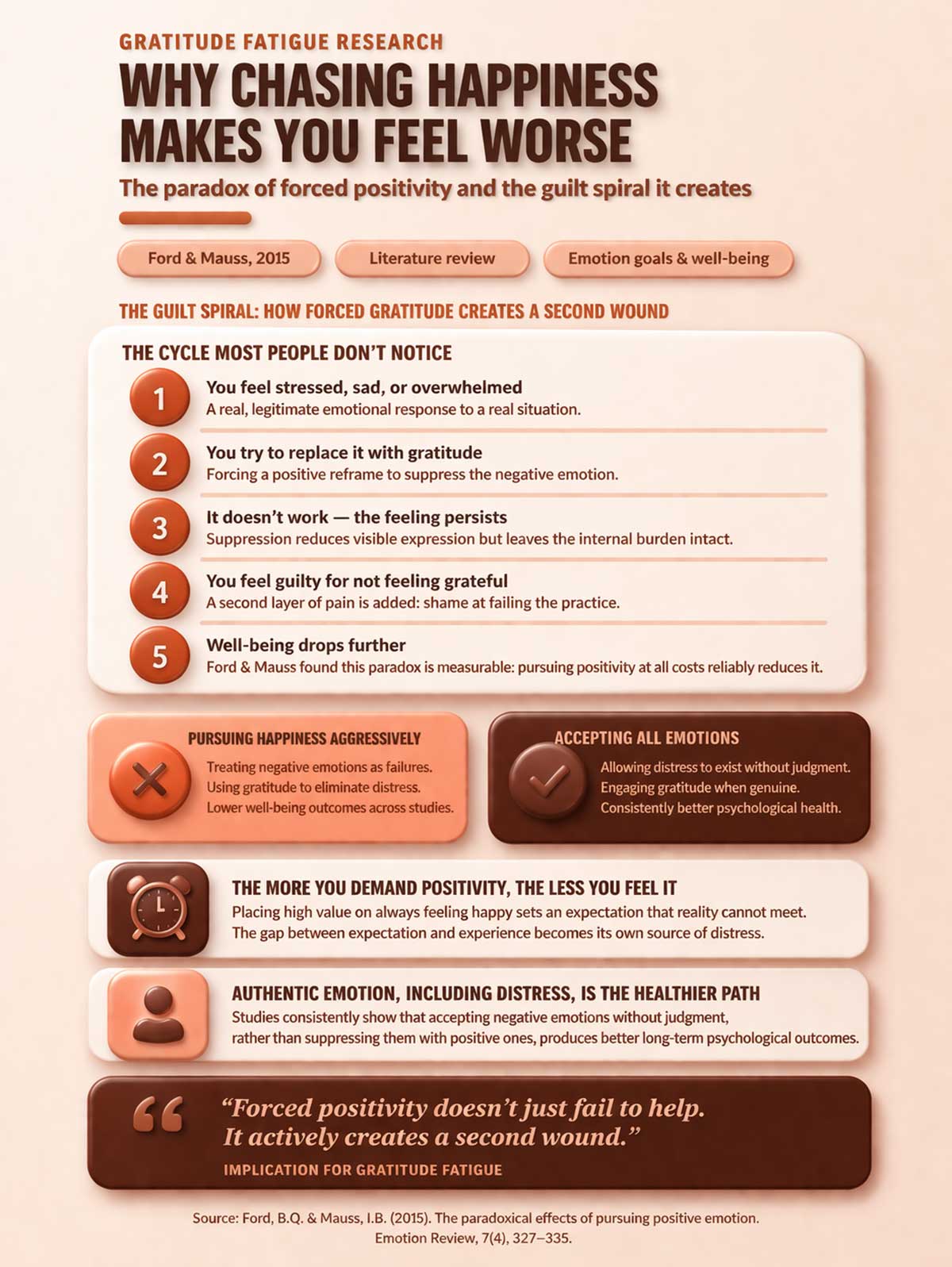
Forced positivity doesn’t just fail to help. It actively creates a second wound.
The Real Solution: Psychological Flexibility
If rigid positivity is the problem, the antidote is flexibility.
A comprehensive literature review by Kashdan and Rottenberg in 2010 synthesized research across mental health outcomes and landed on a clear conclusion: psychological flexibility is one of the most fundamental qualities of a healthy mind. What they found was that rigidly applying even a “positive” strategy, like gratitude or reappraisal, can backfire when it’s used without sensitivity to what the situation actually calls for.
Healthy emotional regulation isn’t about staying positive. It’s about being able to access the right response for the right moment. This aligns with acceptance-based approaches in psychology, which show that the ability to hold the full range of emotions, rather than control or suppress them, produces more lasting well-being than any attempt to stay in a fixed positive state.
This was further confirmed by Bonanno and colleagues in a 2004 longitudinal study following adults exposed to the trauma of 9/11. The researchers found that people who had the capacity to shift their emotional expression, meaning they could both express and suppress emotions as the situation called for, showed significantly better adjustment over two years than those who relied rigidly on any single strategy. Flexibility mattered more than the strategy itself.
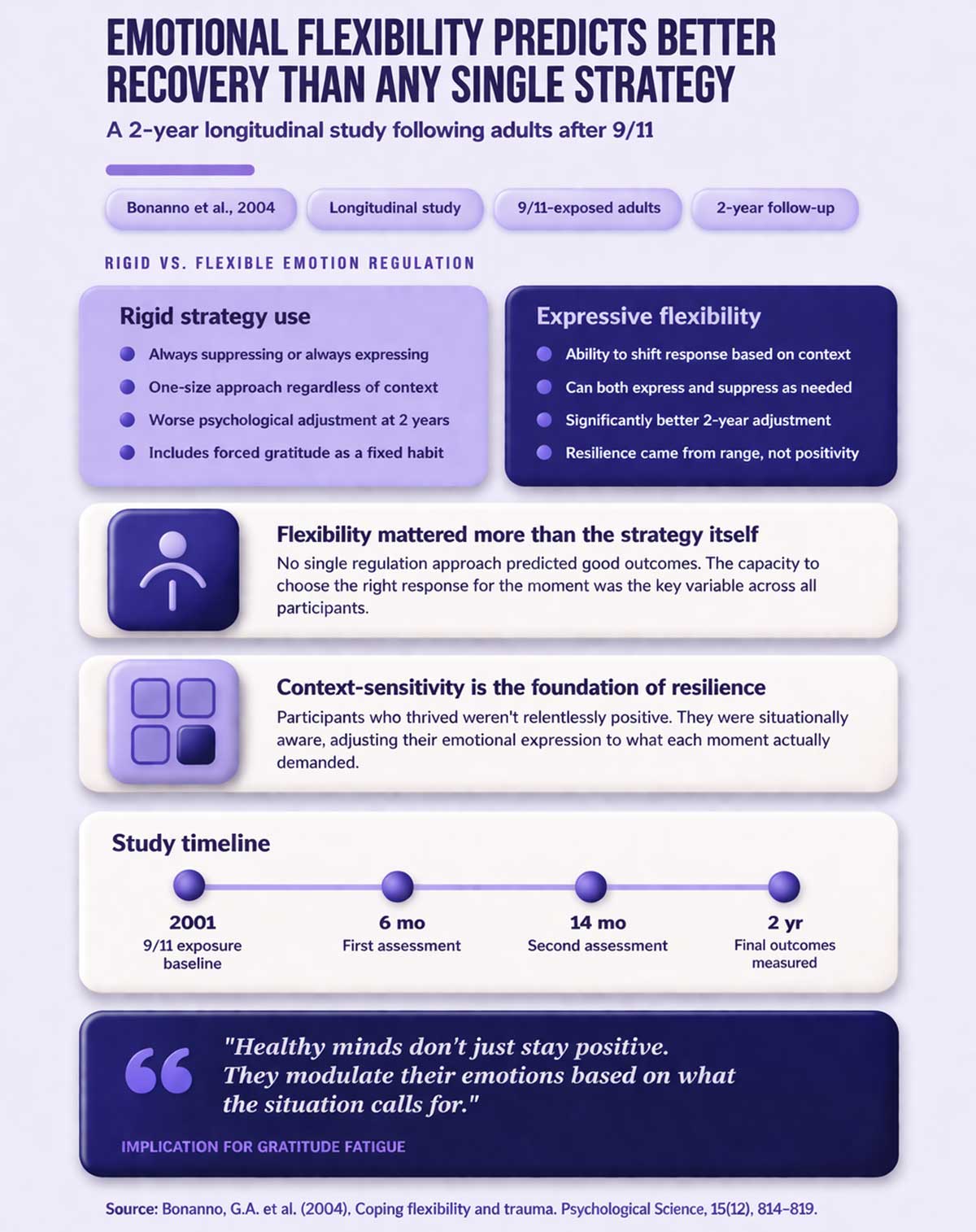
This quality is sometimes called “expressive flexibility.” And it’s the opposite of what gratitude culture often promotes.
Trading Rigid Positivity for Honest Complexity
So what does psychological flexibility look like in practice?
It often starts with something as small as a single word.
Most people default to “but” when they’re trying to hold two emotional truths at once. “I’m exhausted, but I’m lucky.” “This is hard, but I should be grateful.” The word “but” is a silencer. It signals that the second thought is canceling out the first. The negative emotion gets pushed down.
Replace “but” with “and.”
“I’m exhausted, and I’m grateful for what I have.” “This is painful, and there are things in my life worth appreciating.” The “and” holds both truths without erasing either one. It gives each feeling legitimate space.
This isn’t just a rhetorical shift. It reflects what the research actually supports. John and Gross demonstrated in 2004 that habitual suppression is linked to lower well-being, more negative affect, and worse social functioning. In contrast, strategies that allow genuine emotional processing, including acknowledging the difficult feeling before engaging any positive reframe, produce measurably better outcomes.
Give yourself permission to be authentically angry, sad, or overwhelmed. It is psychologically healthier to be genuinely distressed and sit with that for a moment than it is to immediately suppress it with forced thankfulness.
The new metric isn’t a gratitude streak. It’s emotional honesty.
When Gratitude Actually Works
None of this means gratitude is the problem. Used well, it’s genuinely powerful.
Gratitude works best when it arises naturally rather than on demand. It works when it acknowledges difficulty without trying to erase it. It works when it’s paired with real action on problems you have the power to change. And research consistently shows it supports well-being when it’s practiced freely, in conditions of relative stability, rather than used as a pressure valve for pain.
The goal isn’t to abandon gratitude. It’s to stop using it as a tool for suppression and let it be what it actually is: a genuine response to what’s good, held alongside an honest acknowledgment of what’s hard.
Reclaiming Authentic Joy
The fatigue you feel is not a character flaw. It’s a signal.
Your brain is telling you that it’s tired of doing extra work to keep your real feelings hidden. It’s telling you that the version of gratitude you’ve been practicing isn’t gratitude at all. It’s emotional management. And that work is exhausting.
Real gratitude doesn’t demand that you feel good about everything. It doesn’t ask you to cancel out pain with appreciation or pretend hardship isn’t real. It exists alongside difficulty, not instead of it.
When you stop using gratitude as a shield against your own experience, something shifts. The practice starts to feel honest again. And honest gratitude, the kind that coexists with struggle rather than erasing it, is where the real benefit lives.
Gratitude is a surplus of the heart. When you let it be that, the fatigue disappears.