You’ve told yourself you’ll start tomorrow. Again. You know what you need to do. You’ve read the productivity blogs. You’ve downloaded the apps. Yet here you are, scrolling through your phone while that deadline gets closer.
The problem isn’t you. It’s the way you’ve been trying to fix it.
The Willpower Myth That’s Keeping You Stuck
Here’s what no one tells you: trying harder usually doesn’t work.
When you rely on pure grit to power through tasks, you’re draining a resource that runs out fast. To understand why willpower keeps failing you, we need to look at what’s actually happening in your brain when you procrastinate.
Scientists have discovered something surprising. Procrastination isn’t about poor time management. It’s about emotion regulation.
Your brain prioritizes immediate emotional relief over long-term goals. When a task feels boring, difficult, or overwhelming, your brain wants to escape that discomfort now. The future benefits? Those feel abstract and far away.
This isn’t about being lazy or lacking discipline. It’s how your brain is wired.
Researchers Fuschia Sirois and Timothy Pychyl analyzed dozens of studies in 2013 and found that procrastination is essentially a failure to manage negative emotions around a task. You’re not avoiding the work itself. You’re avoiding how the work makes you feel.
That’s why “just try harder” backfires. You’re fighting feelings with force. And feelings usually win.
You don’t need more willpower. You need better systems.
Habits work differently. They reduce your brain’s resistance instead of fighting it head-on. They make starting easier. They remove the emotional friction.
Think about brushing your teeth. You don’t debate it. You don’t psych yourself up. You just do it.
That’s the shift we’re making. From effort to automation. From “I have to” to “I just do.”
Discover Your Procrastination Type
Answer 5 quick questions to get personalized strategies
Your Top 3 Strategies:
Habit 1: The Micro-Start — Make Your First Step Stupidly Small
Your brain treats tasks like mountains. The bigger they look, the more you avoid them.
Want to write a report? Your brain sees hours of work. Want to clean the house? It pictures an entire day lost. That mental distance creates what scientists call task aversion.
The fix is almost too simple. Make your first step so small it feels ridiculous.
Don’t tell yourself to “work on the project.” Tell yourself to open the document. That’s it. Not to write anything. Not to make progress. Just open it.
Psychologist Bluma Zeigarnik discovered something interesting in the 1920s. Once we start a task, our brain has trouble letting it go. Incomplete tasks stick in our memory and create a gentle pull to finish them. This is why starting, even in the tiniest way, often leads to continuing.
Behavioral scientist BJ Fogg has spent years studying habit formation at Stanford. His research on “tiny habits” shows that making behaviors small enough removes the need for motivation. When you shrink the action to something that takes less than 30 seconds, you eliminate most of the resistance.
Here’s what this looks like in practice:
- Don’t “go to the gym.” Put on your workout shoes.
- Don’t “study for the exam.” Open your notes to page one.
- Don’t “call the client.” Pull up their contact info.
You’ll notice something strange happens. Once you start, momentum often takes over. Opening the document usually leads to writing a sentence. Putting on shoes frequently leads to a full workout.
Your brain’s resistance lives at the starting line. Not in the middle of the race.
I use this daily. When I don’t want to work, I tell myself I only need to sit at my desk for two minutes. No pressure to produce. No guilt if I stop. Just two minutes.
I rarely stop.
Action Step: Pick your hardest task right now. Write down the 10-second version of starting it. Not the whole task. Just the first tiny action.
Habit 2: The “If-Then” Plan — Let Your Environment Do the Thinking
Every time you face a distraction, your brain has to make a choice. Should I check my phone or keep working? Should I grab a snack or finish this email?
Each choice costs energy. Each one creates another chance to procrastinate.
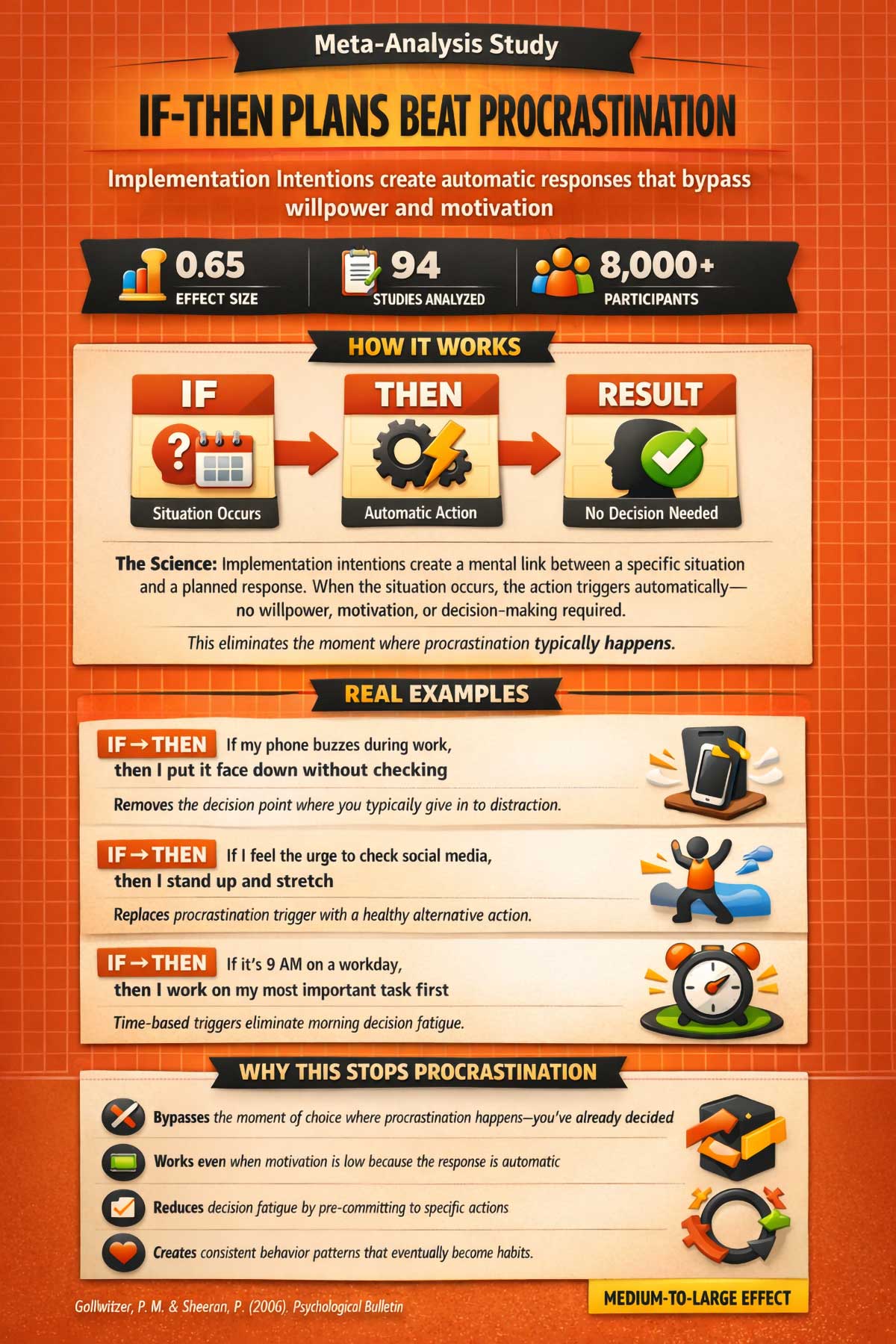
If-then plans remove the choice completely. You decide ahead of time what you’ll do when temptation hits.
The format is simple: “If , then .”
A 2006 meta-analysis by psychologists Peter Gollwitzer and Paschal Sheeran analyzed dozens of studies on this technique. They found it has a medium-to-large effect on reaching goals. The effect size (d = 0.65) means it works for most people, most of the time.
Why does this matter?
When you create an if-then plan, you’re building an automatic bridge between a cue and a response. Your brain links them together. When the situation appears, the action fires without debate.
If your phone buzzes, then you put it face down.
If you feel the urge to check social media, then you stand up and stretch.
If you start thinking about a snack, then you drink a glass of water first.
This isn’t about restriction. It’s about pre-deciding so your tired brain doesn’t have to.
Think of it like setting up dominoes. When the first one falls, the rest follow. No effort required.
The research shows these plans work best when they’re specific. “I’ll be more focused” doesn’t cut it. “If my coworker stops by to chat, then I’ll say I’m on a deadline and suggest coffee at 3 PM” does.
Action Step: Write three if-then plans for your most common distractions. Be specific about the situation and the exact action you’ll take.
Habit 3: The Time-Box Trick — Set a Hard Stop, Not a Finish Line
Waiting for motivation is like waiting for perfect weather. It’s never quite right.
The secret isn’t to wait. It’s to set a timer.
Tell yourself you’ll work for just 25 minutes. Not until the task is done. Not until you feel productive. Just 25 minutes, then you stop.
This flips how your brain views the task. Instead of an endless commitment, it’s a short experiment. Instead of “I have to finish this,” it’s “I only need to survive this timer.”
Research on procrastination by Fuschia Sirois and Timothy Pychyl in 2013 examined why people delay tasks. They found that procrastination often stems from trying to avoid negative emotions. Time limits help by creating boundaries that feel safe.
Here’s where this gets interesting for perfectionists. If you’re someone who delays tasks because you want them to be perfect, time limits become your best friend.
When you know there’s an end point, perfectionism loses its grip. You can’t overthink when the clock is ticking. You don’t have time to make it perfect. You only have time to make it exist.
Research by Gordon Flett and Paul Hewitt has shown that perfectionism is one of the strongest predictors of procrastination. Perfectionists often delay starting because they fear they can’t meet their own standards. A timer removes that pressure. You’re not trying to do it perfectly. You’re just trying to do it for 25 minutes.
I’ve written entire blog posts in 25-minute sprints. Are they perfect? No. But they’re done. And done beats perfect every single time.
The timer also creates a game. Can you beat the clock? Can you get more done than yesterday? Your brain loves games. It hates obligations.
Action Step: Set a timer for 25 minutes right now. Pick one task. Work until it beeps. Then decide if you want to continue or stop.
Habit 4: The No-Choice Environment — Clear the Deck Before You Start
Your brain makes thousands of choices each day. What to wear. What to eat. Which task to tackle first. Each one takes mental energy.
By the time you’re ready to work, that energy is depleted.
The fix is to remove choices before they happen. Set up your workspace the night before. Put only one task in front of you. Close every browser tab except the one you need.
This is about creating what I call an “environment of no-choice.” When you sit down, there’s only one thing you can do.
Research on decision fatigue shows what happens when we make too many choices. A famous study looked at judges making parole decisions. Early in the day, they granted parole about 65% of the time. After hours of consecutive decisions, that rate dropped to nearly zero. Their decision-making quality degraded as the day went on.
The same thing happens to you. Every decision you make about what to work on uses the same mental resources you need for the actual work.
Think of it like this: every decision is a tax on your focus. The fewer taxes you pay, the more you keep.
Here’s what this looks like:
- Lay out your workout clothes the night before.
- Set your desk with only the materials for your first task.
- Put your phone in another room before you start.
- Open one document, one tab, one project.
No options. No debates. Just action.
I’ve noticed something powerful about this. When my desk is cluttered, I browse. When it’s clear except for one notebook, I write. The environment decides for me.
Action Step: Tonight, prepare your workspace for tomorrow’s first task. Remove everything that isn’t needed. Leave only what you need to start.
Habit 5: The Forgiveness Reset — Break the Shame Spiral
You procrastinated. Again.
Now you feel guilty. That guilt makes you avoid the task even more. Which creates more guilt. The cycle feeds itself.
This is the shame spiral. It’s one of the biggest reasons procrastination becomes chronic.
Here’s what science says: beating yourself up often makes you procrastinate more, not less.
A 2010 study by Michael Wohl, Timothy Pychyl, and Shannon Bennett tracked students over an entire semester. Students who forgave themselves for procrastinating on their first exam tended to procrastinate less on later exams. The ones who stayed stuck in guilt and shame? They were more likely to keep putting things off.
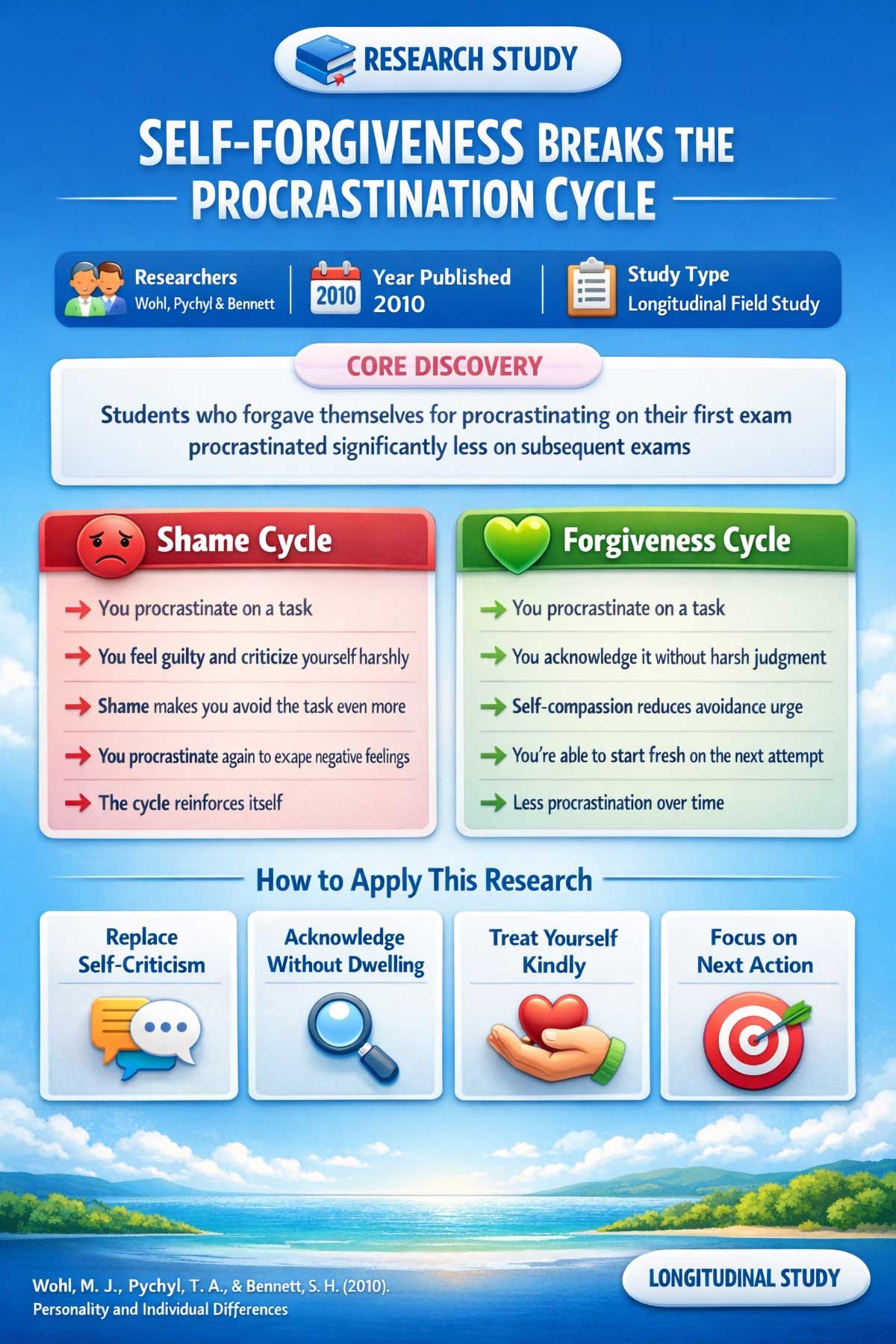
Self-compassion doesn’t mean making excuses. It means treating yourself like you’d treat a good friend. With kindness. With understanding. With the knowledge that everyone struggles sometimes.
When you catch yourself procrastinating, try this instead of self-criticism:
“I had a slow start. That’s okay. I’m starting fresh right now.”
Not: “I wasted the whole morning. I’m so lazy.”
The difference seems small. But it changes everything.
Shame makes you want to hide. Compassion makes you want to try again.
Think about learning to ride a bike. If you fell off and someone yelled, “You’re terrible at this! You’ll never learn!” would you get back on? Probably not. But if they said, “That’s okay. Everyone falls. Let’s try again,” you’d keep going.
Treat your brain the same way.
Action Step: Next time you procrastinate, notice your self-talk. Replace one harsh statement with one compassionate one. Then start your next 20 minutes fresh.
Habit 6: The Visual Win-Streak — Make Your Progress Impossible to Ignore
Your brain craves evidence that you’re moving forward. Without it, motivation fades.
The problem is that most progress is invisible. You can’t see the words you wrote yesterday. You can’t feel the strength you built last week.
Making progress visible changes this completely.
Use a calendar. Use a chart. Use anything that lets you mark an X when you show up. The only rule: you get the X for starting, not for finishing.
Did 10 minutes of work? X. Opened the document? X. Sat at your desk even though you didn’t feel like it? X.
A 2016 meta-analysis by Benjamin Harkin and colleagues examined the effect of monitoring progress on goal achievement. They found that keeping track of your progress significantly increases the likelihood of success. Visual tracking gives your brain concrete proof that you’re making headway.
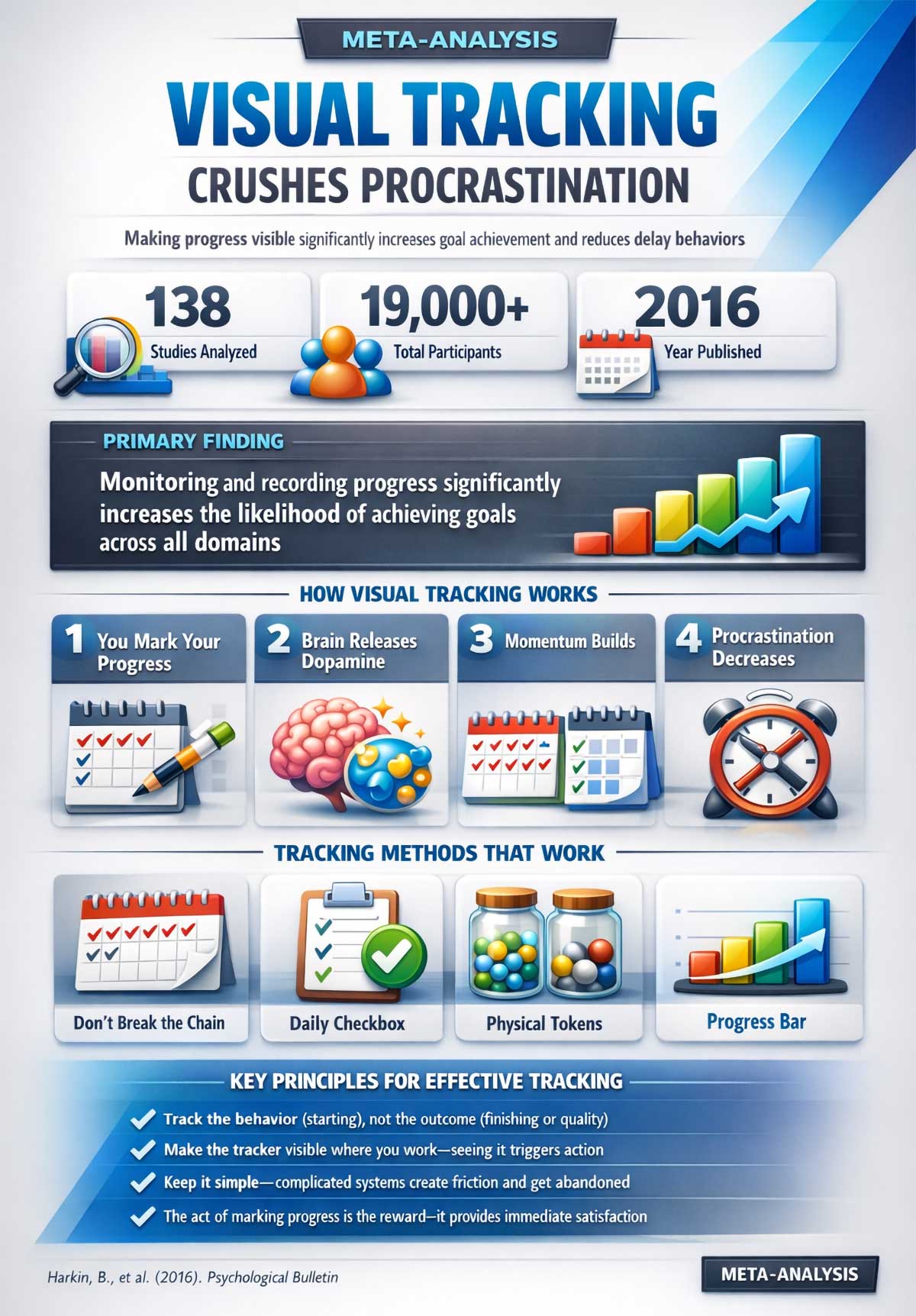
This taps into something called the progress principle. Small wins create momentum. Each X releases a tiny hit of dopamine. Your brain starts to crave that feeling. It wants another X.
Before you know it, you don’t want to break the chain.
Jerry Seinfeld used this method to write jokes every day. He didn’t track how good the jokes were. Just whether he wrote. The chain of X’s became its own motivation.
I keep a simple grid on my desk. One box for each day. When I write for any amount of time, I fill in the box. Some days it’s 10 minutes. Some days it’s three hours. Doesn’t matter. The box gets filled.
Seeing those boxes fill up makes me want to keep going.
Action Step: Create a visual tracker for your most important habit. It can be a calendar, a piece of paper, a jar of marbles. Just make it visible. If you’ve made any progress on your goal today, mark your first X. If not, set it up now and mark tomorrow as Day 1.
Habit 7: Value-Mapping — Connect Your Task to Who You Want to Become
Here’s the difference between tasks that get done and tasks that get delayed:
One feels like an obligation. The other feels like a choice.
When you do something to avoid guilt, you’re using what researchers call controlled motivation. It works, but it’s exhausting. You have to push yourself constantly.
When you do something because it matters to you, that’s autonomous motivation. It pulls you forward instead of pushing from behind.
Psychologists Edward Deci and Richard Ryan developed Self-Determination Theory, which shows that autonomous motivation leads to better outcomes than controlled motivation. People who connect tasks to their personal values and sense of identity tend to procrastinate less.
Research by Timothy Pychyl has shown that when people view their tasks as personally meaningful rather than externally imposed obligations, they experience less procrastination and more engagement.
This isn’t about lying to yourself. It’s about uncovering the real reason the task matters.
Filing your taxes isn’t fun. But it means you’re taking care of your future self. That’s the person you want to be.
Answering work emails isn’t exciting. But it means you’re reliable. That’s how you want others to see you.
Studying for an exam isn’t thrilling. But it means you’re building the knowledge you need for the career you want.
The shift from “I have to” to “I choose to because” is subtle. But it’s powerful.
Ask yourself: “How does finishing this task serve the person I want to become?”
Not: “Why do I have to do this?”
The first question connects to meaning. The second connects to resentment.
I use this when I don’t want to work out. I don’t think about the workout. I think about being the kind of person who keeps promises to himself. That’s who I want to be. The workout is just evidence.
Action Step: Pick your most dreaded task. Write one sentence about how completing it aligns with your values or long-term identity.
Conclusion
Let’s be honest. You probably won’t use all seven habits tomorrow. That’s not the point.
The point is to stop relying on willpower alone. It’s a resource that runs out. You need systems that work even when you’re tired.
Habits are those systems. They reduce resistance instead of fighting it. They work when you’re tired. They keep going when motivation fades.
Start with one. Just one.
Pick the habit that resonated most. Try it for three days. Not three weeks. Not a month. Just three days.
If it works, keep it. If it doesn’t, try another.
The goal isn’t to become perfect. It’s to become consistent. To shift from effort to automation. To stop wrestling with your brain and start working with it.
A Note on Chronic Procrastination:
These strategies work well for situational and moderate procrastination. If you’ve struggled with severe, chronic procrastination that impacts multiple areas of your life despite genuine effort, consider speaking with a mental health professional. Sometimes procrastination is a symptom of conditions like ADHD, anxiety, or depression that benefit from additional support. There’s no shame in getting help when you need it.