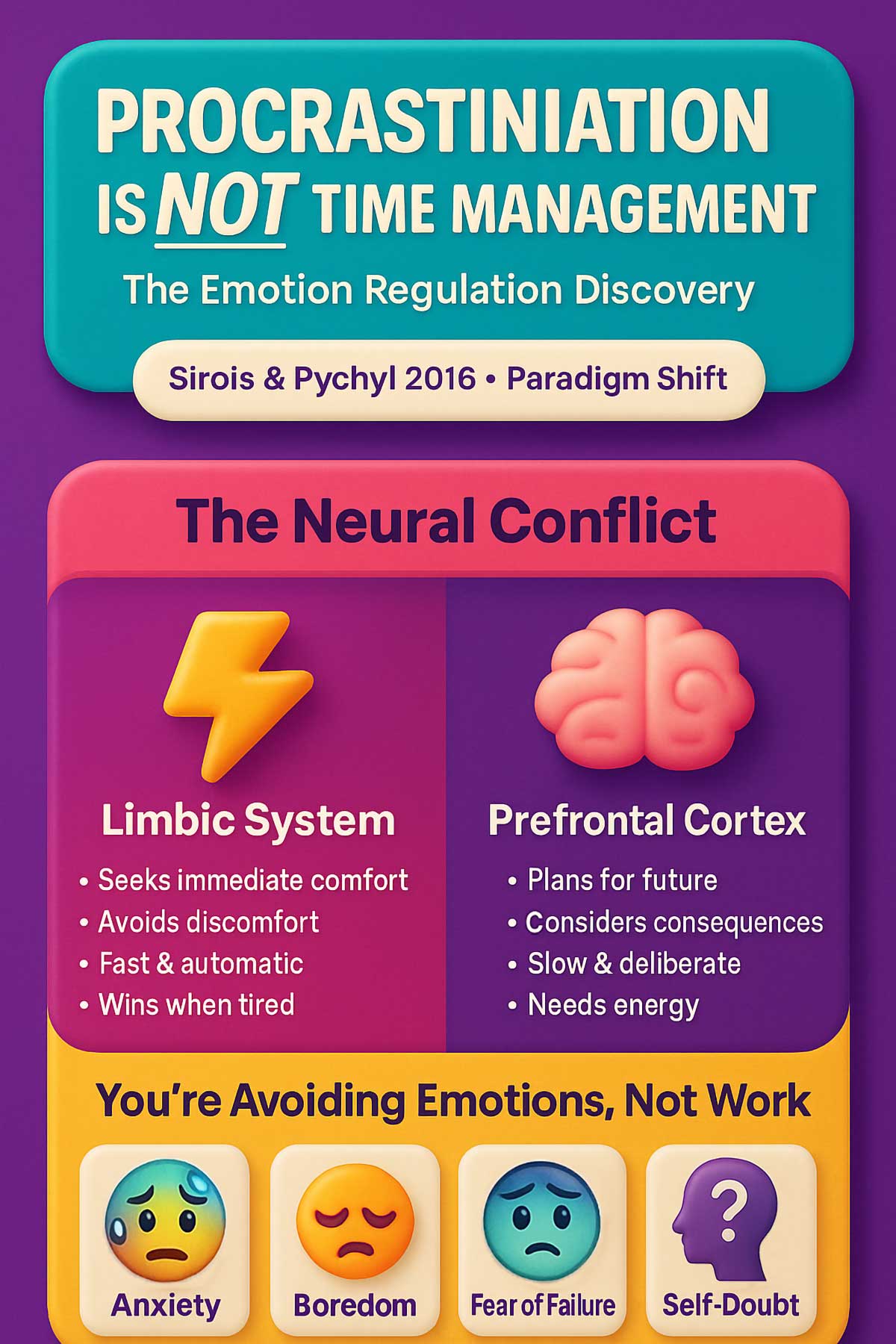
Research shows that when you put things off, you aren’t avoiding work. You’re avoiding the bad feelings tied to that work. Boredom. Anxiety. Fear of failing. Your brain sees these emotions as threats and does what brains do—it looks for an escape.
This isn’t about being lazy. It’s about how your brain handles stress.
Understanding Your Procrastination Brain
Two parts of your brain are constantly fighting for control:
The Limbic System (Your “Right Now” Brain)
- Controlled by the amygdala and nucleus accumbens
- Seeks instant comfort and pleasure
- Avoids anything that feels uncomfortable
- Operates automatically and fast
- Stronger when you’re tired, stressed, or hungry
The Prefrontal Cortex (Your “Future Planning” Brain)
- Handles planning, organizing, and long-term thinking
- Thinks about consequences and future rewards
- Operates slowly and uses lots of mental energy
- Gets weaker with each decision you make
- Needs rest and glucose to function well
When your prefrontal cortex is tired or overwhelmed, your limbic system takes over. That’s when you choose comfort over progress.
What Type of Procrastinator Are You?
Understanding your pattern helps you pick the right strategies:
| Procrastination Type | What It Looks Like | Root Cause | Best Strategies |
|---|---|---|---|
| The Perfectionist | Won’t start until conditions are perfect; fears making mistakes | Anxiety about judgment | Self-forgiveness, Five-minute method, CBT |
| The Dreamer | Great ideas, poor follow-through; gets lost in planning | Weak implementation skills | If-Then plans, Time-structuring, Environmental design |
| The Avoider | Puts off anything uncomfortable or boring | High discomfort with negative emotions | Temptation bundling, Urge surfing, Exercise |
| The Crisis-Maker | Only works under pressure; believes they perform better with deadlines | Dopamine-seeking behavior | Commitment devices, Breaking larger deadlines into micro-deadlines |
| The Busy Procrastinator | Always busy but avoids priority tasks | Fear of failure on important work | If-Then plans, Self-forgiveness, Five-minute method |
Discover Your Procrastination Type
Answer 5 quick questions to get personalized strategies
Your Top 3 Strategies:
The strategies below work with your brain, not against it.
Phase 1: Rewiring the Trigger
These strategies change how your brain responds to difficult tasks. They work by reducing the emotional threat and building automatic responses.
1. Forgive Yourself for Wasting Time
Evidence Strength: High | Time to Implement: Immediate | Difficulty: Low
This sounds soft. It’s not.
A study followed students through two exams. Those who forgave themselves for putting off the first exam waited less before the second one. Those who beat themselves up? They fell behind again.
Here’s why: Guilt floods your system with cortisol. This stress hormone keeps your amygdala—your brain’s alarm system—on high alert. When you’re in threat mode, you can’t focus. You freeze or flee.
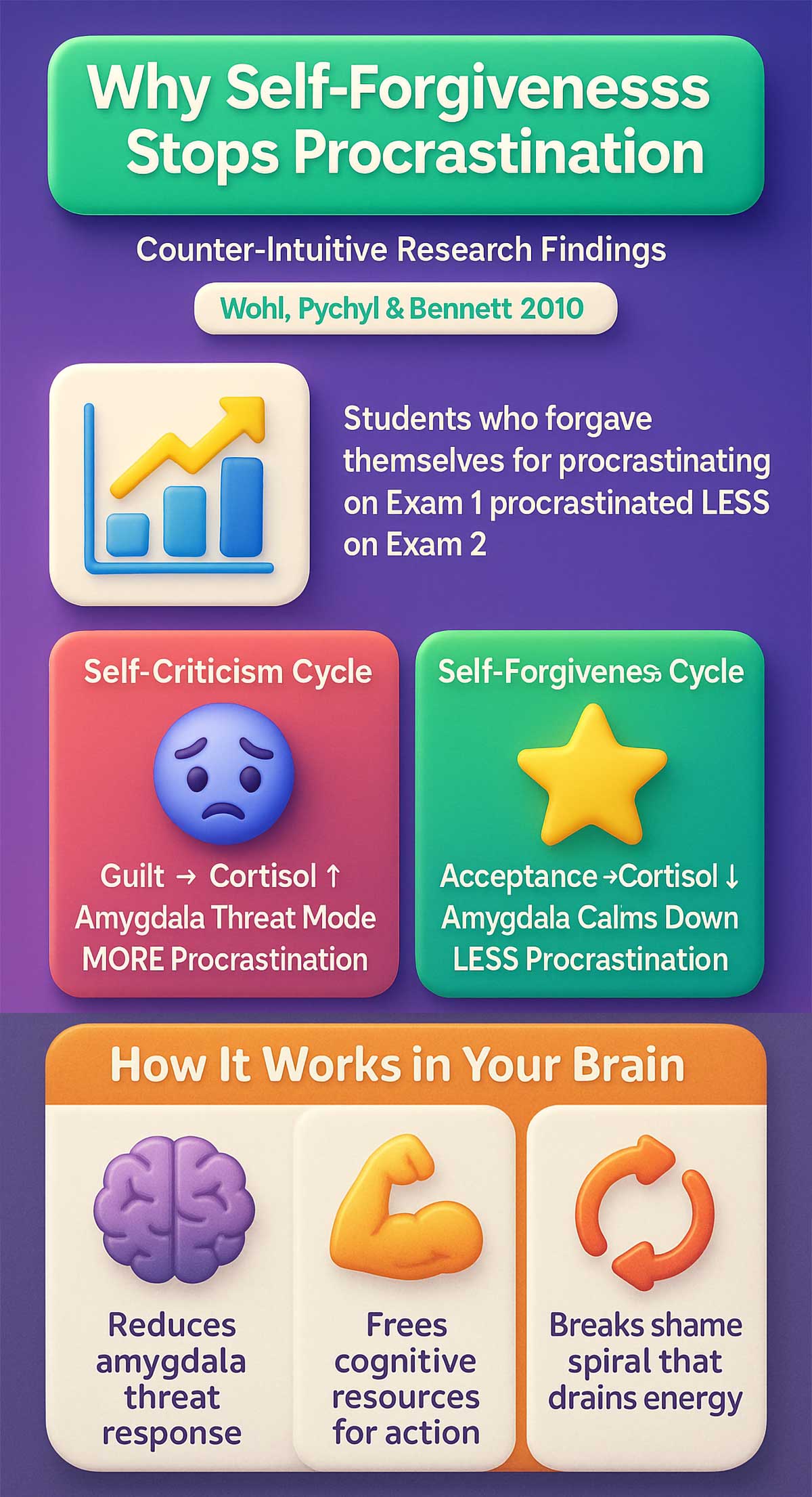
Self-criticism doesn’t motivate you. It drains the mental energy you need to start working.
What to do: When you catch yourself saying “I’m so stupid for waiting,” stop. Replace it with “I messed up. That’s human. I can start now.”
This isn’t about letting yourself off the hook. It’s about giving your brain the calm it needs to function.
Self-Compassion Script for Common Situations:
- Missed a deadline: “I missed this deadline. It happens. What’s one small step I can take right now to move forward?”
- Wasted hours online: “I got distracted today. My brain was looking for comfort. Tomorrow I’ll remove my phone from my workspace.”
- Failed at a previous attempt: “Past attempts didn’t work because I didn’t have the right tools. Now I know about If-Then planning.”
- Feeling overwhelmed: “This feels huge right now. It’s okay to feel this way. I’ll just focus on five minutes of work.”
2. Create If-Then Plans
Evidence Strength: Gold Standard | Time to Implement: 5 minutes | Difficulty: Low
Vague goals fail. Your brain needs clear instructions.
Say you want to exercise more. That goal sits in your prefrontal cortex, using up mental energy every time you decide whether to work out. Each decision is a chance to say no.
If-Then planning removes that decision.
A massive study of 8,155 people found that If-Then plans boost goal success by 30%. They work because they shift the behavior from your prefrontal cortex to your basal ganglia—the part that runs habits. When the situation happens, the action fires automatically.
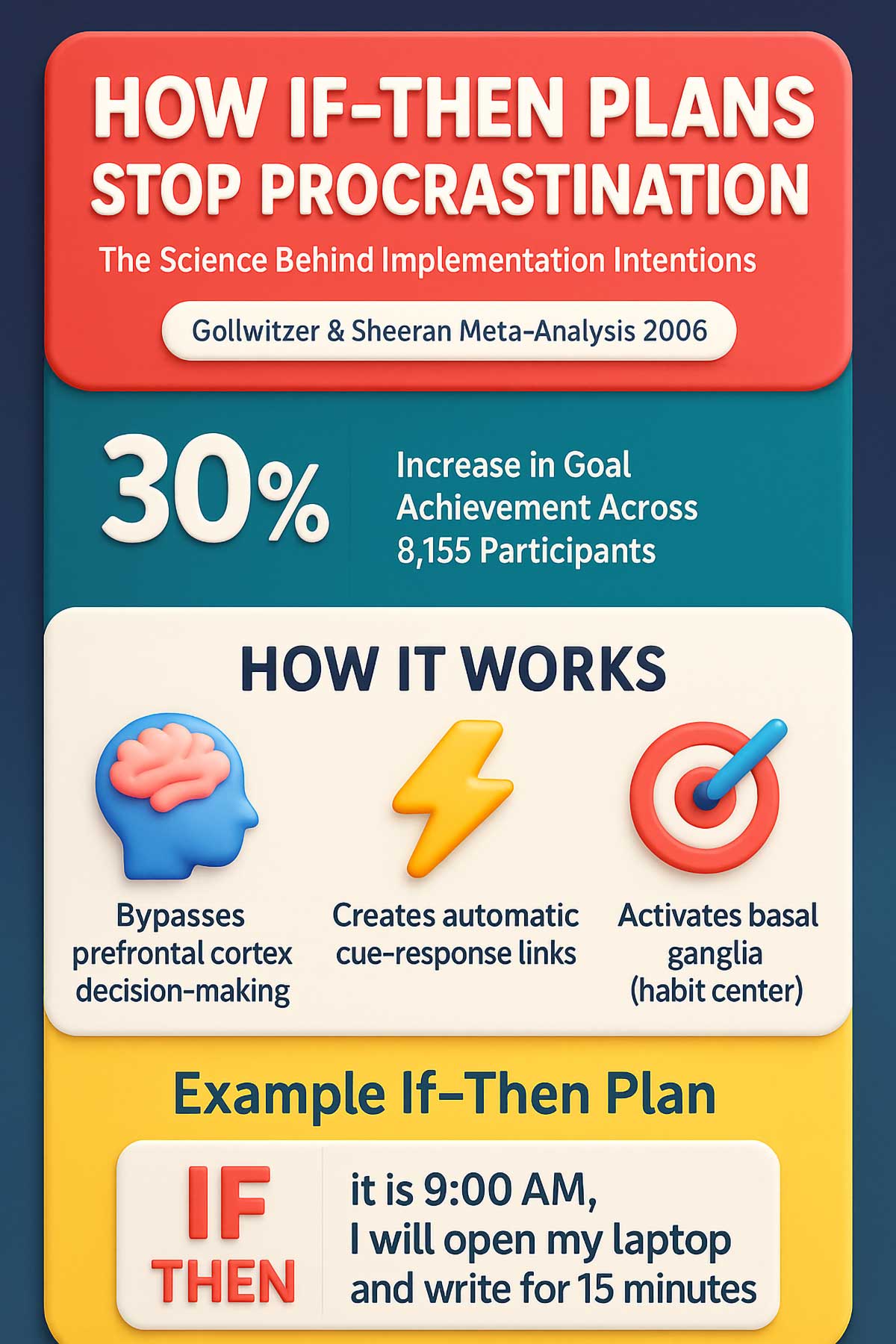
What to do: Write down three specific plans. Use this format: “If , then I will .”
If-Then Plans That Work:
| Your Goal | Weak Plan (Won’t Work) | Strong If-Then Plan (Will Work) |
|---|---|---|
| Exercise more | “I’ll work out when I have time” | “If it’s 7:00 AM on weekdays, then I will put on gym clothes and walk for 20 minutes” |
| Stop checking phone | “I’ll use my phone less” | “If I sit at my desk with coffee, then I will put my phone in the drawer and open my work document” |
| Eat healthier | “I should eat better” | “If I’m hungry between meals, then I will eat the apple I pre-cut this morning” |
| Start writing | “I need to write more” | “If I finish breakfast on weekends, then I will write for 15 minutes before checking email” |
| Reduce social media | “I’ll scroll less” | “If I feel the urge to open Instagram, then I will take three deep breaths and write one sentence of my project” |
The key is making them concrete. “I’ll work harder” doesn’t work. “When I sit at my desk with coffee, I’ll write” does.
Your If-Then Planning Template:
- Pick a consistent situation (time, location, or trigger event)
- Choose one specific action you can complete in 5-20 minutes
- Write it down: “If ________, then I will ________”
- Put the written plan somewhere you’ll see it daily
- Track completion for two weeks to build the automatic link
3. Surf Your Urges
Evidence Strength: Moderate to Strong | Time to Implement: Immediate | Difficulty: Medium
You’re working. The urge to check your phone hits hard. That itch to escape.
Most people either give in right away or try to white-knuckle through it. Both fail over time.
There’s a third option: Watch the urge without acting on it.
This is called urge surfing. Research shows that people who practice this skill shrink their amygdala’s reactivity. Your brain learns that discomfort isn’t dangerous. The panic button gets less sensitive.
What to do: When you feel that pull to quit or distract yourself, pause. Name what you’re feeling: “I’m bored right now” or “I’m anxious about this task.”
Take three slow breaths. Notice the feeling without judging it. Then keep working.
The urge will peak and pass, usually in less than a minute. Each time you ride it out, you get stronger at it.
The 60-Second Urge Surfing Method:
- Notice (5 seconds): “I want to check my phone right now”
- Name (5 seconds): “This is anxiety” or “This is boredom”
- Breathe (30 seconds): Take three slow, deep breaths while observing the feeling
- Rate (5 seconds): On a scale of 1-10, how strong is this urge?
- Wait (15 seconds): Continue breathing and notice if the urge changes
- Choose (immediately): Either return to your task or take a planned 5-minute break
The more you practice, the faster urges lose their power. After two weeks of daily practice, most people report 40-50% reduction in impulsive behavior.
Phase 2: Hacking Your Reward System
Your brain puts off tasks when the reward feels too distant. These strategies bring rewards closer or make boring tasks more appealing.
4. Bundle Tasks with Treats
Evidence Strength: Strong | Time to Implement: 10 minutes | Difficulty: Low
Your brain puts off boring tasks because the reward is too far away. A clean house tomorrow doesn’t compete with Instagram right now.
Temptation bundling fixes this.
Researchers ran an experiment with 226 gym members. One group could only listen to page-turner audiobooks at the gym. They showed up 51% more often than the control group.
The trick? They got immediate pleasure (gripping story) while doing the thing with delayed benefits (exercise). This spikes dopamine during the boring task, tricking your limbic system into cooperating.
What to do: Pick something you love but feel slightly guilty about. Podcasts, trashy TV shows, fancy coffee, your favorite playlist.
Now make a rule: You only get that treat while doing a specific task you hate.
Temptation Bundling Combinations That Work:
| Unpleasant Task | Tempting Activity | The Bundle Rule |
|---|---|---|
| Cleaning house | True crime podcasts | “Only listen while vacuuming/organizing” |
| Sorting paperwork | Favorite TV show | “Only watch while filing or processing documents” |
| Exercise/cardio | Page-turner audiobooks | “Only listen during workouts” |
| Meal prep | Comedy specials | “Only watch while chopping vegetables” |
| Commuting | Premium music playlist | “Only play during drive/transit” |
| Folding laundry | Guilty pleasure reality shows | “Only watch while folding and putting away” |
| Data entry work | Fancy coffee or tea | “Only drink premium beverage during this task” |
| Expense reports | Video game podcast | “Only listen while doing administrative work” |
The key is sticking to the rule. If the treat becomes freely available, it loses power.
Pro tip: Keep a list of temptations ranked by how much you love them. Save your absolute favorites for your most dreaded tasks. Use medium-level temptations for medium-level annoyances.
5. Start with Five Minutes
Evidence Strength: Moderate | Time to Implement: Immediate | Difficulty: Low
Big projects feel like threats. Your brain sees a 10-hour task and panics.
The five-minute method lowers the alarm. You’re not committing to finish. You’re just starting.
This works because getting started is the hardest part. Once you begin, something called the Zeigarnik Effect kicks in. Your brain creates tension around unfinished tasks. That tension often pushes you to keep going past your five minutes.
What to do: Set a timer for five minutes. Tell yourself you can stop when it goes off.
Start working. Don’t think about the whole project. Just focus on those five minutes.
Most of the time, you won’t stop. But if you do, that’s fine. Five minutes is better than zero. Do another five-minute session later.
This method works especially well for tasks you’ve been avoiding for days. Lower the bar until you can step over it.
The Five-Minute Method Step-by-Step:
- Choose your smallest possible task: Don’t pick “write report.” Pick “write one paragraph” or “outline three main points”
- Set a visible timer: Use your phone or a kitchen timer. Seeing time count down helps
- Remove all distractions: Close other tabs, silence notifications, put phone away
- Start immediately: No preparation rituals. Timer starts, you start
- Focus only on these five minutes: Don’t think about what comes after
- When timer rings, assess: Do you want to stop or keep going?
- If stopping, schedule your next session: “I’ll do another five minutes at 3 PM”
Reality check: On average, 70% of people who start a five-minute session continue for 15 minutes or more. The activation energy is the barrier, not the work itself.
6. Lock Yourself In
Evidence Strength: Strong | Time to Implement: 15 minutes | Difficulty: Medium
Your future self has great intentions. Your present self wants comfort.
Commitment devices bridge this gap. They make the pain of quitting immediate instead of distant.
Studies show that people who use commitment devices—public pledges, money on the line, deadlines with penalties—stick to goals 25% more often.
This works because of loss aversion. Losing $20 hurts twice as much as gaining $20 feels good. When you put something at stake, your brain fights harder to keep it.
What to do: Choose a commitment device that matches your task:
Commitment Device Options by Intensity:
| Intensity Level | Method | How It Works | Best For |
|---|---|---|---|
| Low | Website blockers | Apps like Freedom or Cold Turkey block distracting sites during set hours | Daily focus sessions |
| Low | Public declaration | Tell a friend or post your goal on social media | Building accountability |
| Medium | Accountability partner | Check in daily with someone; report progress | Ongoing projects |
| Medium | App-based tracking | Use Beeminder or Forest; track streaks and progress | Habit building |
| High | Financial stakes | Put $10-50 on the line through StickK; lose it if you fail | Important deadlines |
| High | Donation to anti-charity | If you fail, money goes to an organization you oppose | Major commitments |
Start small. Don’t bet $500 on your first try. A $10 stake or a promise to a friend works fine.
Setting Up Your First Commitment Device:
For website blocking:
- Download Freedom, Cold Turkey, or browser extensions
- List your top 5 distraction sites
- Block them during your most important work hours
- Start with 2-hour blocks, then increase
For accountability partners:
- Find someone also working on a goal
- Text each other every morning with your plan
- Check in each evening with results
- Keep it specific: “I’ll write 500 words” not “I’ll be productive”
For financial stakes:
- Go to StickK.com or Beeminder
- Start with $10-25 (enough to sting, not devastate)
- Set a clear, measurable goal
- Choose who gets the money if you fail
- Set up automatic tracking if possible
Phase 3: Preparing Your Brain
These strategies optimize your physical and mental state so your prefrontal cortex can function at full capacity.
7. Remove All Friction
Evidence Strength: Strong | Time to Implement: 15 minutes | Difficulty: Low
Your brain is lazy—in a good way. It conserves energy by taking the easiest path.
Want to work out? Put your gym shoes by the door. Want to stop checking your phone? Put it in another room.
One study found that having your phone on your desk—even face down and silent—reduces your thinking power. The mere presence drains mental resources.
Research on behavior change shows that each extra step between you and a behavior cuts completion rates dramatically. Two clicks to open an app? Much less tempting than one.
What to do: Spend 15 minutes designing your space.
The 20-Second Rule: Make desired behaviors take less than 20 seconds to start. Make undesired behaviors take more than 20 seconds.
Environmental Design Checklist:
The goal: Make good choices require less than 20 seconds to start. Make bad choices require more than 20 seconds.
8. Move Before You Work
Evidence Strength: Strong | Time to Implement: 15-30 minutes | Difficulty: Medium
Sitting at your desk, staring at a blank screen, willing yourself to focus—this rarely works.
Exercise does.
Multiple studies show that 15 to 30 minutes of moderate cardio improves executive function—the brain skills you need for focus and self-control. The effects last one to two hours.
Here’s what happens: Blood flow to your prefrontal cortex increases. Your brain releases BDNF, a protein that helps neurons grow and connect. Dopamine receptors become more sensitive. Your amygdala calms down.
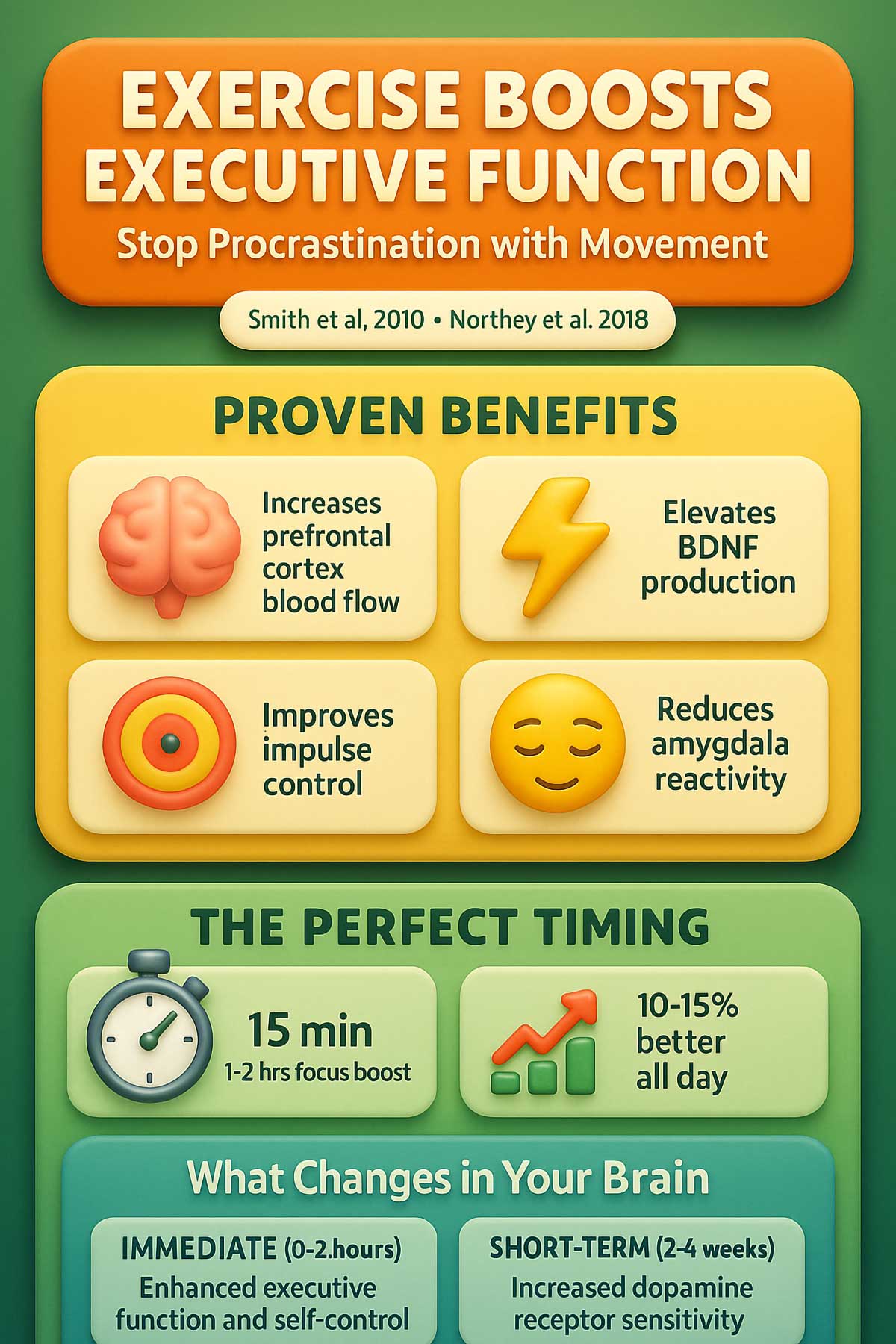
For that brief window after exercise, it’s physically easier to start hard tasks.
What to do: Before your most important work session, move your body.
Exercise Timing for Maximum Focus:
| Time of Day | Best Exercise Type | Benefit | Ideal For |
|---|---|---|---|
| Morning (6-8 AM) | Moderate cardio (20-30 min) | Activates cortisol and dopamine for day ahead | Morning workers, early meetings |
| Mid-morning (9-11 AM) | Brief movement break (5-10 min) | Resets attention, prevents slump | Long focus sessions |
| Before lunch (11 AM-12 PM) | Brisk walk (15 min) | Reduces post-lunch energy dip | Afternoon productivity |
| Afternoon (2-4 PM) | Light cardio or yoga (15-20 min) | Counters natural circadian dip | Evening work sessions |
| Early evening (5-7 PM) | Vigorous exercise (30-45 min) | Processes day’s stress, improves sleep | Not ideal before bed |
Quick Pre-Work Movement Options:
5-Minute Options (when time is tight):
- 50 jumping jacks
- Run up and down stairs 3 times
- Dance to two upbeat songs
- Jump rope
- High knees and butt kicks
- Shadow boxing
15-Minute Options (optimal for focus boost):
- Brisk walk around the block
- YouTube workout video
- Bike ride
- Jump rope intervals
- Quick yoga flow
- Bodyweight circuit
30-Minute Options (maximum cognitive benefit):
- Jog or run
- Cycling
- Swimming
- Sports (basketball, tennis)
- Group fitness class
- Longer yoga session
It doesn’t need to be intense. Moderate effort works best. You want to feel energized, not exhausted.
Stuck in a slump? Don’t sit there hoping motivation appears. Stand up. Move. Reset your brain chemistry.
The Exercise-Focus Connection:
- 15 minutes of exercise = 1-2 hours of improved focus
- Morning exercise = 10-15% better task completion all day
- Post-exercise window = easiest time to start difficult work
9. Protect Your Sleep
Evidence Strength: Strong | Time to Implement: Ongoing | Difficulty: Medium
Sleep deprivation wrecks self-control.
When you’re tired, the connection between your prefrontal cortex and amygdala weakens. Your planning brain can’t regulate your emotional brain. Every task feels harder. Every distraction pulls stronger.
Studies show that each hour of sleep debt reduces self-control by 10 to 15%. Miss two hours of sleep, and you’ve lost a quarter of your willpower tank.

This creates a vicious cycle. You put things off during the day because you’re tired. You stay up late because you feel guilty about what you didn’t finish. You wake up even more tired.
What to do: Treat sleep as your primary tool for focus, not a reward you earn after finishing work.
Sleep Optimization Protocol:
The Evening Routine (2-3 hours before bed):
| Time Before Bed | Action | Why It Matters |
|---|---|---|
| 3 hours | Last caffeine intake | Caffeine half-life is 5-6 hours; affects sleep quality |
| 2 hours | Dim lights, reduce screen brightness | Signals melatonin production |
| 1 hour | No screens (or use blue light filters) | Blue light suppresses melatonin |
| 30 minutes | Cool down room to 65-68°F | Body temperature drop triggers sleep |
| 15 minutes | Light reading or meditation | Calms racing thoughts |
| At bedtime | Same time every night | Regulates circadian rhythm |
Sleep If-Then Plans:
- “If it’s 10:30 PM, then I will put away all devices and start my bedtime routine”
- “If I’m still working at 11 PM, then I will stop, make a quick list for tomorrow, and go to bed”
- “If I can’t sleep after 20 minutes in bed, then I will get up and read something boring until drowsy”
- “If I wake up in the middle of the night, then I will do deep breathing instead of checking my phone”
Your Sleep Environment Checklist:
The Sleep-Procrastination Connection:
| Hours of Sleep | Self-Control Level | Procrastination Risk | What This Feels Like |
|---|---|---|---|
| 7-9 hours | 100% (optimal) | Low | Tasks feel manageable, decisions come easily |
| 6 hours | 85-90% | Moderate | Slightly harder to start, more tempted by distractions |
| 5 hours | 70-75% | High | Difficult to focus, frequently give in to urges |
| 4 hours or less | 50-60% | Very High | Everything feels impossible, constant distraction |
Aim for seven to nine hours. Not because you’re weak. Because your brain literally cannot function at full capacity without it.
Fixing Bedtime Procrastination:
If you consistently stay up too late doing nothing important:
- Set a “reverse alarm” for bedtime
- Create an If-Then plan for your bedtime routine
- Use temptation bundling: favorite relaxing activity only during wind-down time
- Track your bedtime for one week to see patterns
- Remove temptations from bedroom (no laptop, no phone)
Your Personalized Action Plan
Most advice about putting things off treats it like a character flaw. Just be more disciplined. Just want it more. Just push through.
That’s not how brains work.
You aren’t lazy. Your limbic system is doing exactly what it’s designed to do—avoid discomfort and seek immediate relief. Your prefrontal cortex is trying to plan ahead, but it’s fighting an uphill battle against biology.
The strategies above work because they respect that biology. They either strengthen your prefrontal cortex, calm your limbic system, or create automatic responses that bypass the conflict.
Week 1: Foundation Building
Choose Your Starting Three:
Pick strategies based on your procrastination type:
| If You’re A… | Start With These 3 | Why These Work |
|---|---|---|
| Perfectionist | Self-forgiveness + Five-minute method + If-Then plans | Reduces anxiety, lowers entry barrier, creates automatic starts |
| Dreamer | If-Then plans + Environmental design + Commitment devices | Converts intentions to action, removes barriers, adds accountability |
| Avoider | Temptation bundling + Exercise + Urge surfing | Makes unpleasant tasks rewarding, boosts mood, handles discomfort |
| Crisis-Maker | Commitment devices + Time-structuring + Sleep optimization | Creates earlier pressure, breaks deadline into chunks, improves impulse control |
| Busy Procrastinator | If-Then plans + Five-minute method + Environmental design | Ensures priority tasks get automatic slots, reduces activation energy |
Your Week 1 Implementation Checklist:
Week 2-4: Building Momentum
Add These Strategies Gradually:
Week 2: Add exercise before your most important work session. Start with just 10 minutes.
Week 3: Implement full sleep optimization protocol. Track how sleep affects your focus.
Week 4: Add time-structuring for long projects. Break them into five-minute sessions.
The Anti-Procrastination Daily Routine
Here’s what an ideal day looks like using these strategies:
Morning (7:00-9:00 AM):
- Wake at same time (sleep optimization)
- 15-minute walk or exercise (pre-work movement)
- Healthy breakfast (brain fuel)
- Five-minute planning session (write today’s If-Then plans)
Work Block 1 (9:00 AM-12:00 PM):
- Phone in drawer (environmental design)
- First task: use five-minute method to start
- Work for 25 minutes, break for 5 (time-structuring)
- When urge to check phone hits, practice urge surfing
- Temptation bundle: favorite podcast only during admin work
Lunch (12:00-1:00 PM):
- Eat away from desk
- Brief 10-minute walk
- No work discussion
Work Block 2 (1:00-5:00 PM):
- Check in with accountability partner (commitment device)
- Use If-Then plans for afternoon tasks
- Practice self-forgiveness if morning didn’t go perfectly
- Exercise break if energy dips (mid-afternoon movement)
Evening (5:00-10:30 PM):
- Stop work at designated time (prevent guilt cycle)
- Light exercise or relaxation
- Prepare tomorrow’s workspace (remove friction)
- Start bedtime routine at 10:30 PM (sleep optimization)
Common Obstacles and Solutions
“I started strong but lost momentum after a few days”
- This is normal. The Zeigarnik Effect works against you here.
- Solution: Use commitment devices. Put money on completing week one.
- Lower your expectations. One five-minute session is success.
“I keep forgetting to use my If-Then plans”
- Your plans aren’t tied to strong enough cues.
- Solution: Link them to existing habits you never miss (morning coffee, lunch, etc.)
- Write them on sticky notes where you’ll see them.
“These strategies feel like too much work”
- You’re trying to implement too many at once.
- Solution: Pick only ONE strategy this week. Master it before adding another.
- Remember: Five minutes of one strategy beats zero minutes of nine strategies.
“I did everything right and still procrastinated”
- Sleep-deprived? Even perfect strategies fail without rest.
- Stressed about something else? Address the root emotion.
- Task genuinely awful? Use your strongest temptation bundle.
“I feel guilty using ‘tricks’ instead of just being disciplined”
- Discipline is a myth. Willpower depletes.
- These aren’t tricks—they’re tools that respect how brains actually work.
- Solution: Practice self-forgiveness for this thought, then use the tools anyway.
When to Seek Professional Help
These strategies work for typical procrastination. Consider therapy if you experience:
- Chronic procrastination affecting job, relationships, or health
- Severe anxiety or depression preventing any task completion
- Thoughts of self-harm related to failures or delays
- Inability to complete basic self-care tasks
- Procrastination persisting despite six weeks of consistent strategy use
Cognitive Behavioral Therapy for procrastination shows large, lasting improvements. It’s not a failure to seek help—it’s a smart strategy.
You Don’t Need a New Personality
Start with three strategies. Just three.
- Write one If-Then plan for tomorrow
- Remove your biggest distraction from your workspace
- Forgive yourself for today’s delays
You don’t need to overhaul your entire life. Small changes to how you work with your brain compound over time.
Progress beats perfection. Always.
Quick Reference Guide
When You’re About to Procrastinate:
- Name the emotion you’re avoiding
- Use the five-minute method
- Practice urge surfing for 60 seconds
- Start anyway, forgive yourself if it’s hard
When You’re Stuck Mid-Task:
- Check: are you tired or hungry?
- Take a 10-minute movement break
- Switch to a temptation bundle
- Break the task into smaller pieces
When You’ve Already Procrastinated:
- Practice self-forgiveness immediately
- Don’t try to “make up” lost time tonight
- Set one If-Then plan for tomorrow
- Get good sleep to restore self-control
Your brain isn’t broken. It’s just following its programming. These strategies give you the override codes.
FAQs
What is the root of procrastination?
Procrastination stems from emotion regulation failure, not poor time management. Your limbic system (the emotional brain) tries to avoid uncomfortable feelings like anxiety, boredom, or fear of failure. When these negative emotions feel too intense, your brain chooses immediate relief over long-term goals. This is a survival mechanism, not a character flaw.
The neuroscience is clear: procrastination happens when your prefrontal cortex (planning brain) loses the battle against your amygdala (fear center). Stress, sleep deprivation, and decision fatigue all weaken your prefrontal cortex, making procrastination more likely.
What emotion is behind procrastination?
Different emotions drive different types of procrastination:
- Anxiety causes perfectionist procrastination. You avoid starting because you fear the result won’t be good enough.
- Boredom triggers avoider procrastination. Tasks that feel tedious or unrewarding get pushed aside.
- Overwhelm leads to analysis paralysis. The task feels too big, so you freeze.
- Resentment causes resistant procrastination. When you feel forced to do something, you rebel by delaying.
- Self-doubt creates shame-based procrastination. You avoid tasks that might expose your weaknesses.
The key is naming the specific emotion you’re avoiding. Once you identify it, you can use targeted strategies like self-forgiveness (for shame), temptation bundling (for boredom), or the five-minute method (for overwhelm).
Is there a cure for procrastination?
There’s no permanent “cure,” but procrastination is highly manageable with the right strategies. Research shows that implementation intentions increase goal completion by 30%, CBT for procrastination produces large effect sizes, and environmental design dramatically reduces delay.
Think of procrastination management like fitness. You don’t “cure” the need for exercise—you build habits that keep you healthy. Similarly, you don’t eliminate the brain’s tendency to avoid discomfort—you build systems that work with your biology.
The good news: These strategies become easier with practice. After 2-4 weeks of consistent use, many behaviors become automatic, requiring less willpower to maintain.
Is procrastination linked to ADHD?
Yes, procrastination and ADHD are strongly connected, but not everyone who procrastinates has ADHD.
ADHD affects executive function—the same brain system involved in task initiation and impulse control. People with ADHD often struggle more with procrastination because:
- Their prefrontal cortex develops more slowly
- Dopamine regulation is impaired, making boring tasks feel unbearable
- Working memory limitations make planning harder
- Time blindness makes deadlines feel less urgent
If procrastination severely affects your life despite consistent strategy use, and you also experience chronic inattention, impulsivity, or hyperactivity, consider an ADHD evaluation. Many strategies in this article (implementation intentions, commitment devices, environmental design) are particularly effective for ADHD-related procrastination.
How can I identify my procrastination triggers?
Track your procrastination for one week using this method:
When you procrastinate, immediately note:
- What task were you avoiding?
- What emotion were you feeling? (anxious, bored, overwhelmed, tired, resentful)
- What did you do instead?
- What time of day was it?
- How much sleep did you get last night?
- What else was stressing you?
After seven days, look for patterns. You might discover:
- You always avoid certain task types (creative work, administrative tasks, phone calls)
- Specific times are worse (afternoons, Mondays, after meetings)
- Certain emotional states trigger avoidance (anxiety about judgment, boredom with repetitive work)
- Physical factors play a role (hunger, tiredness, lack of movement)
Once you know your triggers, you can preemptively use strategies. If afternoons are hard, schedule exercise at 2 PM. If anxiety triggers avoidance, practice self-forgiveness before starting.
What is the 2-minute rule for procrastination?
The 2-minute rule states: If a task takes less than two minutes, do it immediately instead of adding it to your list.
This works because:
- It prevents small tasks from piling up and creating overwhelm
- The mental load of remembering a task often exceeds the effort to complete it
- Quick wins provide dopamine hits that motivate further action
- It builds momentum—completing one task makes starting the next easier
The 2-minute rule pairs well with the five-minute method in this article. Use the 2-minute rule for tiny tasks (replying to an email, putting away dishes). Use the five-minute method for larger projects you’ve been avoiding.
Why does the 2-minute rule actually work?
The 2-minute rule works because of three brain mechanisms:
Reduced Activation Energy: Two-minute tasks require minimal prefrontal cortex effort. There’s no time for your limbic system to build up resistance or find distractions.
The Zeigarnik Effect: Your brain creates psychological tension around incomplete tasks. Finishing quick items immediately clears mental space for harder work.
Momentum Building: Completing small tasks releases dopamine, making your brain more receptive to starting the next task. This is why “just start anywhere” often leads to productive sessions.
The rule also prevents “decision fatigue”—the mental exhaustion from having too many open loops. Each undone task drains cognitive resources, even if it only takes two minutes.
Is the 2-minute rule good for ADHD?
Yes, the 2-minute rule is particularly helpful for ADHD brains, but with modifications:
Why it works for ADHD:
- Reduces working memory load (fewer things to remember)
- Provides immediate dopamine rewards
- Prevents the “out of sight, out of mind” problem
- Creates clear start and end points
ADHD-specific adaptations:
- Set a timer to prevent hyperfocus on the 2-minute task
- Write down any new tasks that pop up during the two minutes (don’t switch immediately)
- Use it only during designated “clearing time,” not during deep work
- Pair with body doubling (doing it while someone else is working nearby)
Be cautious: Some people with ADHD use 2-minute tasks to procrastinate on harder work. If you find yourself doing only 2-minute tasks, you’re avoiding the bigger priorities. Use implementation intentions to protect time for important work first.
What is the 3-2-1 rule for procrastination?
The 3-2-1 method is a countdown technique to force action:
3 – Take three deep breaths to calm your amygdala
2 – Identify two concrete actions you can take right now
1 – Count down from three, then start one action immediately
The countdown interrupts rumination and creates urgency. It’s similar to the five-minute method but more aggressive—useful when you’re stuck in analysis paralysis.
Some people use “3-2-1” differently as a daily planning rule:
- 3 most important tasks for the day
- 2 medium-priority tasks
- 1 small quick win
Both interpretations work. Choose based on whether you need help starting (use the countdown) or planning (use the priority system).
What is the 80-20 rule for procrastination?
The 80-20 rule (Pareto Principle) states that 80% of your results come from 20% of your efforts.
Applied to procrastination:
- Identify the 20% of tasks that create 80% of your stress or value
- Focus your anti-procrastination strategies on those high-impact tasks
- Accept that you’ll procrastinate on some low-value tasks—that’s fine
This prevents perfectionism about productivity. You don’t need to stop procrastinating on everything. Focus on what matters most.
Practical application:
- List everything you’re procrastinating on
- Mark which 2-3 items would most improve your life or reduce stress if completed
- Apply your strongest strategies (If-Then plans, commitment devices, environmental design) only to those
- Let yourself procrastinate on the rest without guilt
This also helps with the “busy procrastinator” pattern—people who do lots of easy tasks to avoid important hard ones.
What is the 3-3-3 rule for productivity?
The 3-3-3 rule structures your day:
- 3 hours of deep, focused work on your most important task
- 3 shorter tasks that need attention
- 3 maintenance activities (email, admin, planning)
This rule prevents procrastination by creating realistic expectations. You’re not trying to work intensely all day—just three hours. The rest is manageable.
How to implement with anti-procrastination strategies:
- Use your best three hours (often morning) for the most important work
- Schedule exercise right before your three-hour block
- Use If-Then plans to protect those three hours from interruptions
- Save temptation bundling for the maintenance activities
- Practice self-forgiveness if you don’t complete all three segments
The rule also prevents burnout, which often leads to increased procrastination. Sustainable productivity beats heroic effort that collapses.
What are the 4 pillars of procrastination?
The four pillars that support chronic procrastination are:
- Emotion Avoidance: Using delay to escape uncomfortable feelings rather than addressing them.
- Low Self-Efficacy: Believing you can’t complete the task successfully, which becomes a self-fulfilling prophecy.
- Impulsiveness: Weak impulse control makes immediate gratification always win over delayed rewards.
- Poor Time Perception: Underestimating how long tasks take and overestimating how much time you have.
Breaking each pillar:
- Emotion avoidance: Use urge surfing and self-forgiveness
- Low self-efficacy: Use the five-minute method and track small wins
- Impulsiveness: Use commitment devices and environmental design
- Time perception: Use time-structuring and implementation intentions with specific times
Most people have one or two dominant pillars. Identify yours and target those strategies first.
What is the biggest cause of procrastination?
The single biggest cause is fear of negative emotions associated with a task, not the task itself.
Research by Sirois and Pychyl definitively shows that procrastination is mood regulation, not time management. Your brain sees the task as a threat to your emotional wellbeing and chooses immediate relief.
This explains why you can enthusiastically work on one project while avoiding another similar one. The difference isn’t the work—it’s how the work makes you feel.
The most common fear-based emotions:
- Fear of judgment or criticism
- Fear of failure or inadequacy
- Fear of boredom or frustration
- Fear of success and increased expectations
- Fear of making the wrong decision
Understanding this changes everything. Instead of beating yourself up for being “lazy,” you can ask: “What emotion am I avoiding?” Then use strategies that address that specific emotion.
What is the 3-second rule for laziness?
The 3-second rule states: When you think of something you need to do, count down from three and start moving within those three seconds.
This bypasses the limbic system’s fear response. Your brain doesn’t have time to generate excuses or anxiety. Physical movement (standing up, walking toward your workspace) often carries mental momentum with it.
The neuroscience: Action precedes motivation more often than motivation precedes action. Moving your body signals to your brain that it’s time to work, which then generates the mental energy to continue.
How to use it:
- Notice the thought “I should start working”
- Immediately count: “3… 2… 1…”
- Stand up or physically move toward the task
- Start any small action related to the task
Pair this with the five-minute method: Use the 3-second rule to get moving, then commit to just five minutes of work.
How do I train myself to stop procrastinating?
You can’t “train” yourself through willpower alone. Instead, build systems that make procrastination harder and action easier.
The most effective training protocol based on research:
Week 1: Foundation
- Write three If-Then plans (30% success boost)
- Redesign your environment to remove friction
- Practice self-forgiveness daily
Week 2: Physical Optimization
- Add 15 minutes of exercise before important work
- Fix your sleep schedule (7-9 hours consistently)
- Track when you procrastinate and what emotion you’re avoiding
Week 3: Reward Systems
- Implement one temptation bundle
- Set up a commitment device with real stakes
- Use the five-minute method for tasks you’ve been avoiding
Week 4: Refinement
- Adjust strategies based on what worked
- Add time-structuring for long projects
- Practice urge surfing when distractions hit
The key: You’re not building willpower. You’re building automatic systems that bypass the need for willpower. Implementation intentions move behaviors from your prefrontal cortex (limited capacity) to your basal ganglia (automatic habits).
After 4-6 weeks, many of these behaviors become automatic, requiring less conscious effort to maintain.
How do I rewire my brain to stop procrastinating?
Brain rewiring happens through consistent practice of specific strategies over 4-8 weeks.
What actually changes in your brain:
Implementation Intentions: Create new neural pathways in your basal ganglia. After 2-3 weeks, the “if-then” link becomes automatic—you don’t need to decide, you just act.
Mindfulness/Urge Surfing: Shrinks amygdala reactivity. After 4-6 weeks of daily practice, uncomfortable emotions trigger less panic, making task avoidance less appealing.
Exercise: Increases BDNF production and dopamine receptor density. Regular aerobic exercise (3-4x weekly for 8 weeks) measurably improves executive function.
Sleep Optimization: Restores prefrontal cortex glucose metabolism. After one week of 7-9 hour nights, impulse control improves 15-25%.
Environmental Design: Doesn’t change your brain but changes which neural pathways get activated. After 2 weeks of consistent environment, new patterns become default.
The rewiring protocol:
- Pick 2-3 strategies from this article
- Practice them daily for 6 weeks minimum
- Track your progress weekly
- Adjust based on results, not feelings
Brain change is physical and measurable. You’re not trying to develop character—you’re building new neural infrastructure. That takes time but works reliably.