Avocados raised a protective antioxidant by 68% in 5 weeks. That surge may explain why the dangerous form of LDL dropped — not just the total count.
All LDL is bad, but small, dense LDL is particularly bad. That’s not a wellness blogger’s opinion. It’s a direct quote from Penny Kris-Etherton, a Distinguished Professor of Nutrition at Penn State University. And it gets to the heart of why avocados may do more for your cholesterol than most people — and most articles — give them credit for.
You’ve probably heard that avocados are good for your heart. You may have even read that they can lower your “bad” cholesterol. The part that rarely gets explained, though, is this: which LDL gets lowered matters just as much as how much gets lowered. Most heart-health content skips that distinction entirely — and so does a detail about a specific antioxidant in avocados that may be doing more protective work than their healthy fats.
The Study That Changed the Conversation
In 2015, researchers at Penn State published a study in the Journal of the American Heart Association that was quietly remarkable. The team recruited 45 overweight or obese adults — all with moderately elevated LDL cholesterol — and put them through a carefully controlled, randomized crossover trial.
Each participant followed three different diets for five weeks at a time. One of those diets included one whole Hass avocado per day (about 136 grams). The other two — a low-fat diet and a moderate-fat diet — were matched for calories but had no avocado.
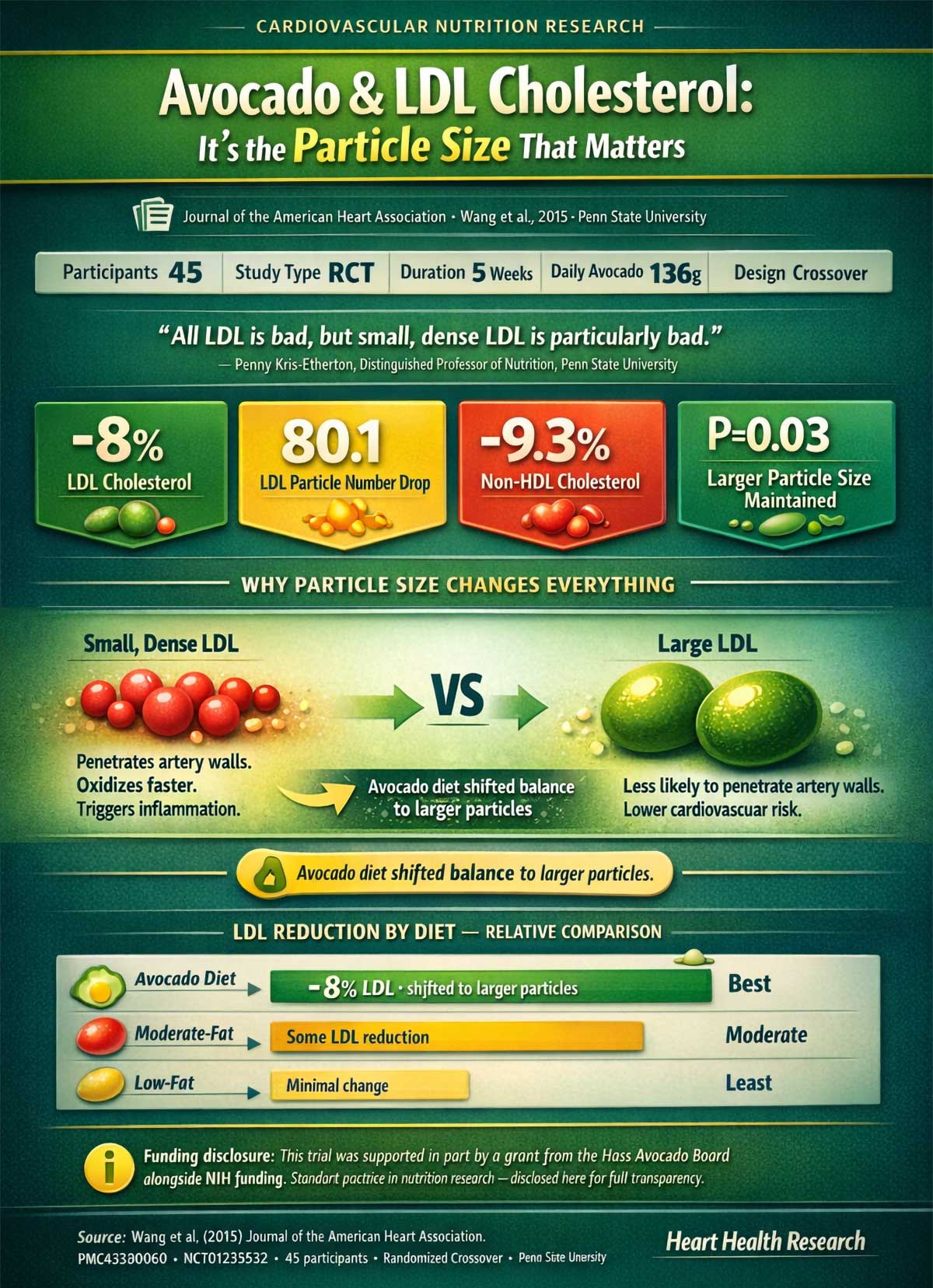
The results were clear — and the most important finding wasn’t the one most readers would expect.
If your doctor has flagged your LDL numbers, the distinction below matters directly for you.
It’s Not Just About the Number: The Particle Size Discovery
Most standard cholesterol tests give you a single LDL number. But that number doesn’t tell the whole story. LDL cholesterol actually comes in different particle sizes, and those sizes matter enormously for your heart health.
Think of it this way. Imagine sending two types of objects through a narrow pipe. Small, dense objects — like steel ball bearings — scrape the walls, get stuck in gaps, and cause damage over time. Larger, fluffier objects — like foam balls — move through more easily and cause far less harm. LDL particles work in a similar way inside your arteries.
Small, dense LDL particles are more likely to squeeze into artery walls, oxidize, and trigger the inflammation that leads to plaque buildup. Larger LDL particles are comparatively harmless.
Here’s where the Penn State avocado trial gets interesting. After five weeks on the avocado diet, participants saw their total LDL cholesterol drop by around 8% compared to control diets. Their total LDL particle number fell by 80.1 nmol/L. But more critically, the avocado diet specifically reduced the concentration of small, dense LDL particles — the dangerous kind — and maintained a larger average LDL particle size compared to the low-fat control diet (P=0.03).
A broad meta-analysis of 10 randomized controlled trials, published in the American Journal of Clinical Nutrition by researchers at Tufts University (Mahmassani et al., 2018), found that avocado consumption was linked to significant reductions in total cholesterol (-18.80 mg/dL), LDL (-16.50 mg/dL), and triglycerides (-27.20 mg/dL) across 229 participants. The studies in that meta-analysis used avocado extracts rather than whole fruit, so the figures differ from the Penn State whole-avocado results — but the direction is consistent.
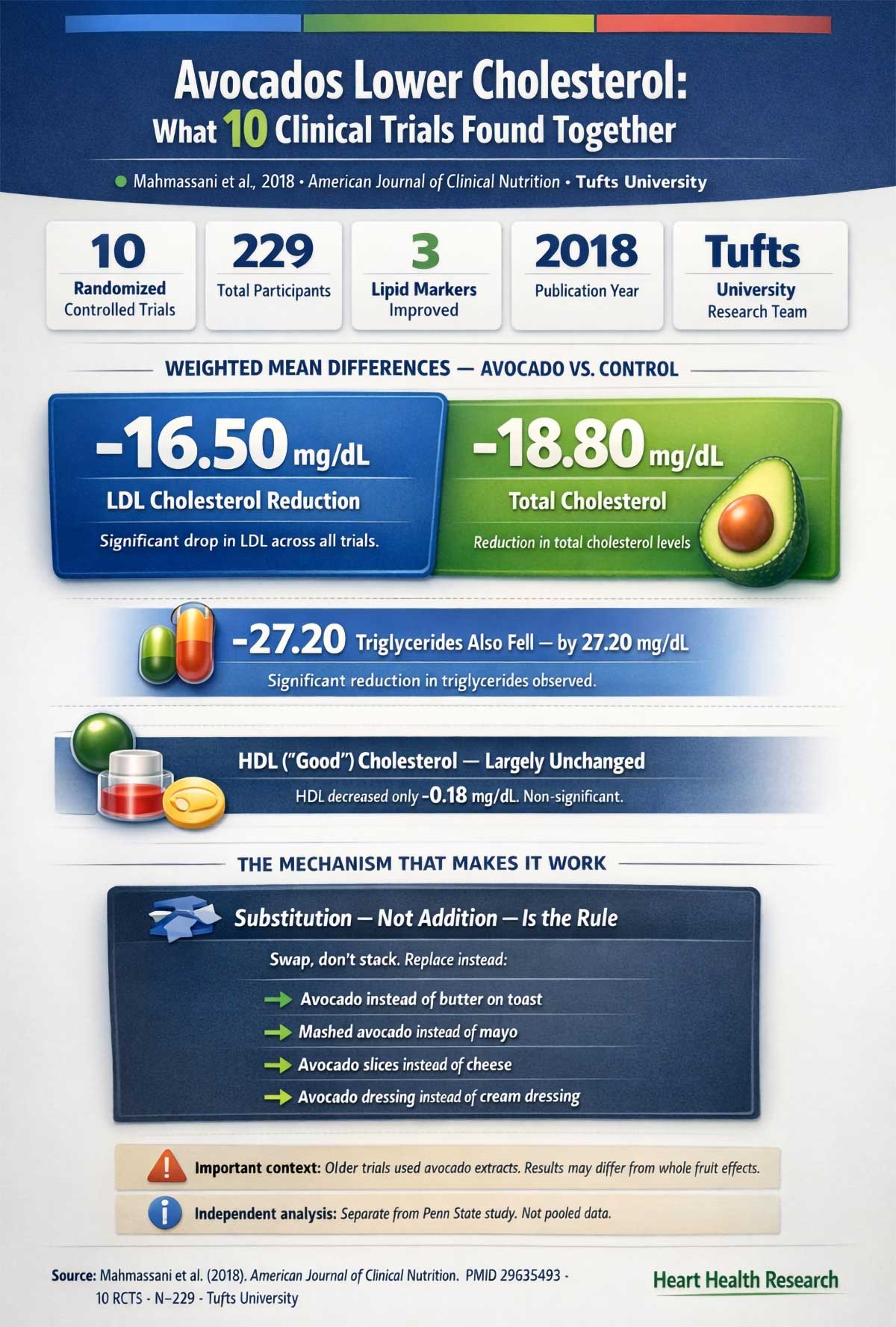
The takeaway? Eating one avocado a day may not just lower your LDL number. It appears to shift the type of LDL in your blood toward less dangerous particles.
The Oxidized LDL Factor — Neutralizing a Real Threat
If particle size is the first layer of this story, oxidation is the second.
Cholesterol on its own isn’t the villain. It only becomes truly dangerous when it oxidizes — a process that’s a bit like metal rusting from the inside. Oxidized LDL (oxLDL) is what triggers the immune response that leads to arterial plaque. It’s a key step in the chain that leads to heart disease.
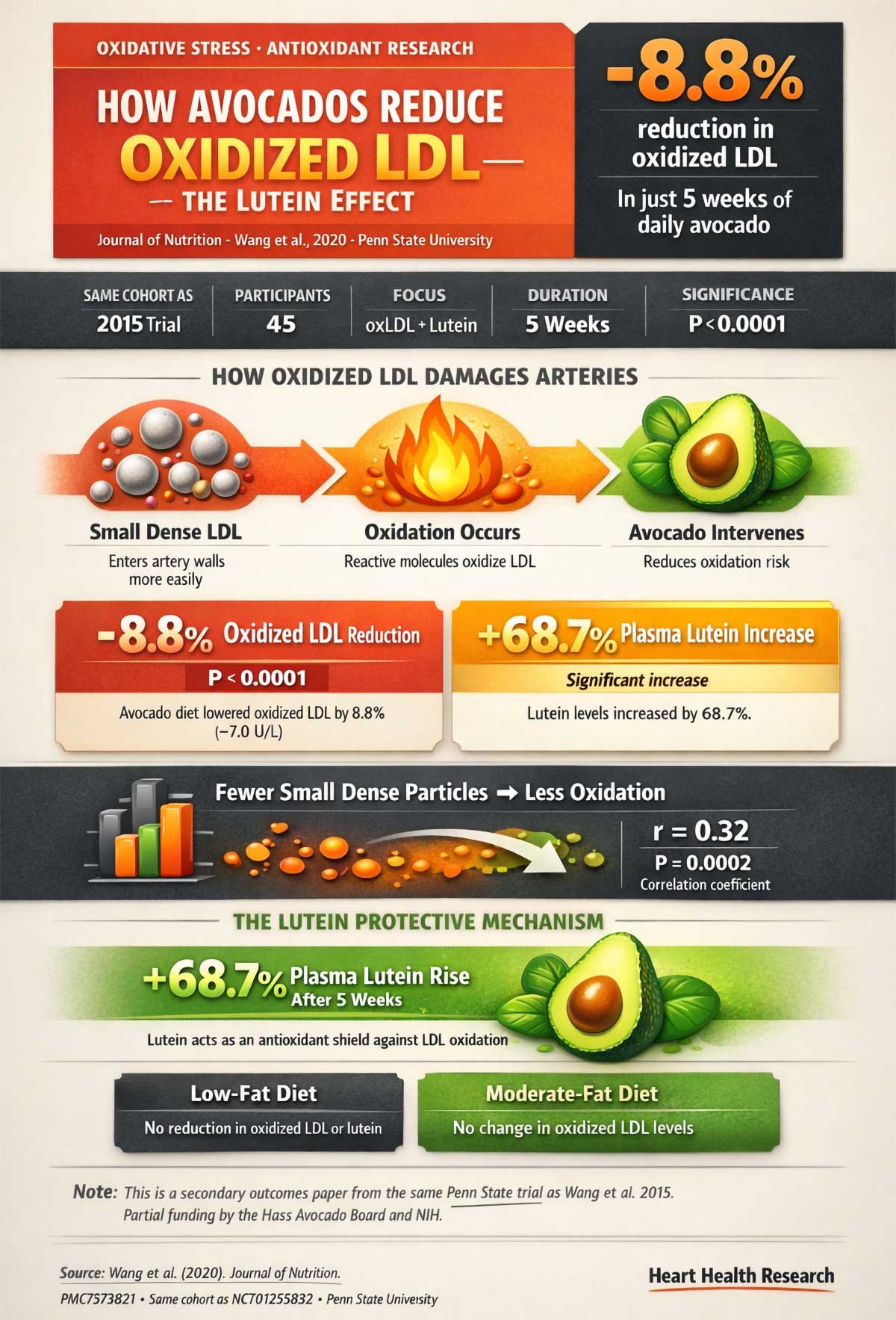
A follow-up paper from the same Penn State team, published in the Journal of Nutrition in 2020 (Wang et al., 2020), analyzed oxidative stress outcomes from the same 45-participant trial. The findings were striking. Five weeks on the avocado diet reduced oxidized LDL by 8.8% — a highly statistically significant drop (P<0.0001). Neither the low-fat nor the moderate-fat control diet produced a significant change in oxidized LDL.
There’s also a direct link between the two findings. The reduction in oxidized LDL was significantly correlated with the reduction in small, dense LDL particle count (r=0.32, P=0.0002). In other words, eating less small, dense LDL into circulation appears to directly reduce how much LDL gets oxidized. Less fuel for the fire.
The Lutein Connection — More Than Just Healthy Fats
Most of the credit for avocados’ heart benefits goes to their monounsaturated fats (MUFAs). That’s fair — MUFAs are a big part of the picture. But the Penn State 2020 paper pointed to another compound that deserves attention: lutein.
Lutein is an antioxidant found naturally in avocados. After five weeks on the avocado diet, plasma lutein levels in participants increased by 68.7%. That’s a substantial jump. And it’s meaningful beyond eye health, which is what lutein is typically associated with.
In the context of cholesterol, lutein appears to act as a kind of protective coating for LDL particles. By reducing oxidative stress in the bloodstream, it may help shield LDL from the oxidation process that makes it dangerous in the first place. The monounsaturated fats get the headlines, but lutein may be doing quiet, important work in the background.
This is part of what makes whole avocados more interesting than avocado extracts or supplements. The combination of healthy fats, fiber, and bioactive compounds like lutein working together is difficult to replicate in a pill.
The ApoB/ApoA-I Ratio — A Metric Your Doctor Actually Cares About
Standard lipid panels measure total cholesterol, LDL, HDL, and triglycerides. Those are useful numbers. But cardiologists increasingly look at a different marker: the ApoB/ApoA-I ratio.
Here’s the short version. ApoB is a protein found on LDL and other “bad” lipoprotein particles — it’s a proxy for your total plaque-building traffic. ApoA-I is a protein on HDL, the “good” cholesterol — it represents your plaque-clearing capacity. The ratio between the two gives a sharper picture of cardiovascular risk than total LDL alone.
The American College of Cardiology highlighted this finding from the Penn State 2015 trial in a 2015 clinical summary: only the avocado-rich diet, not the low-fat or moderate-fat control diets, produced a significant improvement in the ApoB/ApoA-I ratio. That’s a meaningful distinction. The other diets moved the LDL number — but only the avocado diet shifted this more precise risk marker.
Non-HDL cholesterol also fell by 9.3% on the avocado diet, another figure that cardiologists track closely. If you’ve had a conversation with your doctor about cardiovascular risk and they’ve mentioned LDL particle testing or ApoB levels, this is directly relevant to that conversation.
The Real Rule: Substitution, Not Addition
One of the most important — and least talked about — details of the Penn State trial is this: participants didn’t just add an avocado on top of their existing diet. They replaced other dietary fats with avocado.
This matters a great deal. Avocados are nutrient-dense. A single medium Hass avocado — the size used in the study — contains around 220 calories. If you simply pile one on top of a typical Western diet without adjusting anything else, you’re adding a significant caloric load. The benefits found in the study came from substitution — swapping out saturated fats for the monounsaturated fats in avocado.
The Tufts meta-analysis reinforced this point explicitly: substituting dietary fats with avocado, rather than adding avocado to an unchanged diet, was identified as the correct approach for cholesterol improvement.
Practical swaps are easier than they sound:
- Avocado instead of butter on toast or a baked potato.
- Mashed avocado instead of mayo in sandwiches or tuna salad.
- Avocado slices instead of cheese on a burger or salad.
- Avocado-based dressing in place of a cream or oil-heavy option.
None of these changes require a complete diet overhaul. They’re small shifts with potentially meaningful cumulative effects over five weeks and beyond.
Is a Daily Avocado Worth It for Your Cholesterol?
The evidence behind avocados for cholesterol is more specific — and more interesting — than most articles let on. One Hass avocado a day, substituted for other dietary fats over five weeks, appears to do three things at once: reduce total LDL and LDL particle count, shift particles toward a larger and less dangerous size, and reduce the amount of LDL that gets oxidized. The lutein increase may be part of the reason why.
These findings come primarily from a single well-designed trial at Penn State, with two published papers (Wang et al., 2015 and Wang et al., 2020) reporting from the same 45-participant cohort. It’s worth noting that the trial received partial funding from the Hass Avocado Board alongside NIH support — standard in nutrition research, but something readers should be aware of when weighing the evidence.
The broader meta-analysis from Tufts adds context, showing consistent LDL-lowering signals across multiple trials. Taken together, the evidence is solid enough to take seriously — especially for people who are already working to improve their cholesterol through diet.
If you’re managing high cholesterol and your doctor has recommended dietary changes, bringing up LDL particle testing — not just your standard LDL number — is worth doing at your next appointment. The question isn’t just how high your LDL is. It’s what kind of LDL you’re carrying.