Millions of people deal with low self-esteem every single day. It affects how you see yourself, how you relate to others, and what you believe you can do.
Here’s the good news: self-worth isn’t fixed. It’s not something you either have or don’t have. Think of it like a muscle. You can build it through specific, proven actions.
Psychologists have spent decades studying what actually works. The habits below aren’t motivational fluff. They’re backed by research, tested in clinical trials, and shown to help people feel better about themselves.
What You’ll Learn:
- How to quiet your inner critic using proven techniques
- Daily habits that build lasting self-worth
- Science-based strategies that actually work
- Practical steps you can start today
What Low Self-Esteem Actually Looks Like
Before we get into solutions, let’s talk about what low self-esteem really means. It’s more than just feeling bad sometimes.
Low self-esteem shows up in patterns:
In Your Thoughts:
- Constant self-criticism over minor mistakes
- Comparing yourself unfavorably to others
- Dismissing your achievements as “not that big a deal”
- Assuming people are judging you negatively
- Replaying embarrassing moments for days or weeks
In Your Behavior:
- Avoiding new challenges because you fear failure
- Staying in unhealthy relationships or jobs
- Struggling to accept compliments
- Over-apologizing for things that aren’t your fault
- Seeking constant reassurance from others
In Your Body:
- Tension in your shoulders and jaw
- Poor posture (hunched, making yourself small)
- Avoiding eye contact
- Speaking quietly or hesitantly
- Physical exhaustion from negative self-talk
Recognizing these patterns is the first step. Once you see them, you can start changing them.
The Self-Esteem Building Framework
The 10 habits below work together. They target different parts of the self-esteem puzzle:
| Category | Habits | What They Target |
|---|---|---|
| Mental Patterns | Self-compassion, Cognitive restructuring, Rumination breaking | How you think about yourself |
| Behavioral Changes | Mastery goals, Assertiveness, Values-aligned action | What you do daily |
| Physical Foundation | Sleep, Exercise | Your body’s impact on mood |
| Social Environment | Digital curation, Real connections | External influences on self-view |
Let’s explore each habit in detail.
Habit 1: Talk to Yourself Like You’d Talk to a Friend
You wouldn’t tell a struggling friend they’re worthless. So why do you say it to yourself?
This habit is called self-compassion. It means treating yourself with the same kindness you’d offer someone you care about.
Why It Works
When you judge yourself harshly, your brain activates threat responses. Stress hormones flood your system. You feel worse, not better.
Self-compassion does the opposite. It activates the caregiving system in your brain. This reduces stress and helps you cope with setbacks.
Dr. Kristin Neff, a leading researcher in this field, breaks self-compassion into three parts:
- Self-kindness vs. self-judgment
- Common humanity vs. isolation
- Mindfulness vs. over-identification
The second part is crucial. When you mess up, you often think “I’m the only one who does this. Everyone else has it together.”
That’s not true. Everyone struggles. Recognizing this helps you feel less alone.
The Friendship Test Exercise
Next time you catch yourself thinking “I’m such an idiot,” stop. Ask yourself: “What would I say to a friend in this situation?”
Maybe you’d say: “That was tough, but you’ll get through it.” Or “Everyone makes mistakes. You can try again.”
Say that to yourself instead.
Advanced Practice: The Self-Compassion Break
When you’re having a hard moment, try this three-step process:
- Acknowledge the pain: “This is really hard right now.”
- Remember common humanity: “Other people feel this way too. I’m not alone.”
- Offer yourself kindness: “May I be patient with myself. May I give myself the care I need.”
It feels awkward at first. That’s normal. Keep practicing.
A 2018 study of 79 self-compassion programs found they improve self-esteem with medium-sized effects. People who learned self-compassion felt better about themselves and less depressed.
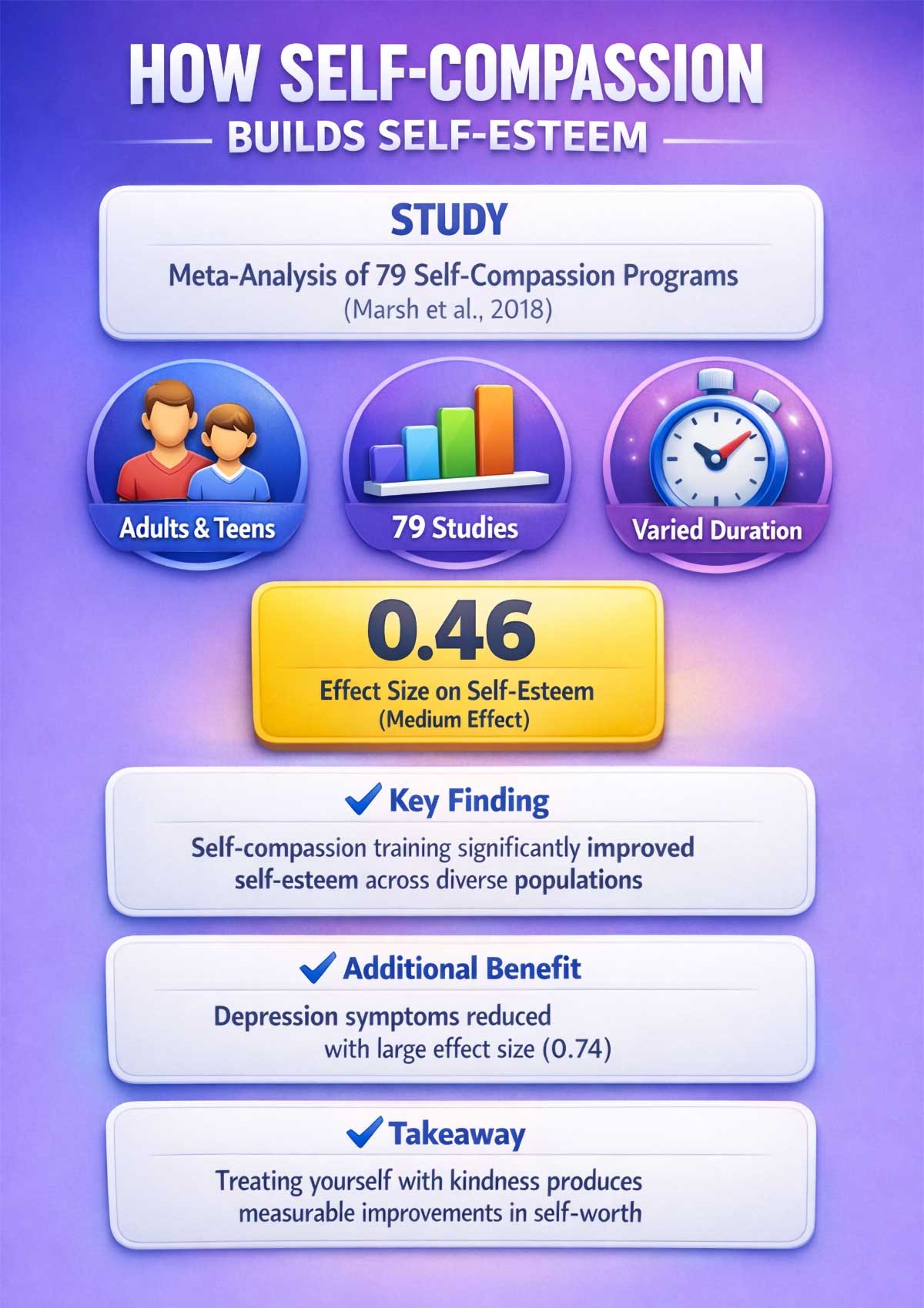
Another analysis found that self-compassion has a strong positive correlation with self-esteem, with a correlation of 0.59. That’s considered a large effect in psychology research.
Habit 2: Question Your Negative Thoughts
Your brain lies to you. It tells you absolute truths that aren’t actually true.
“I always fail.” “Nobody likes me.” “I’ll never be good enough.”
These thoughts feel real. But they’re usually exaggerations or distortions.
Why It Works
Cognitive Behavioral Therapy (CBT) teaches you to spot these distorted thoughts. Then you challenge them with evidence.
This process is called cognitive restructuring. It helps you see situations more clearly instead of through a negative filter.
Common Cognitive Distortions
Psychologists have identified specific thinking errors that damage self-esteem:
| Distortion | What It Sounds Like | Reality Check |
|---|---|---|
| All-or-Nothing | “I got a B on the test. I’m a total failure.” | Most things exist on a spectrum, not extremes. |
| Overgeneralization | “I messed up this presentation. I always mess everything up.” | One event doesn’t define all events. |
| Mental Filter | Focusing on the one negative comment while ignoring 10 positive ones. | Your brain has a negativity bias. Actively look for balanced evidence. |
| Discounting Positives | “They only said that to be nice. It doesn’t count.” | Achievements are real even if you feel uncomfortable accepting them. |
| Fortune Telling | “I know I’ll fail the interview, so why bother?” | You can’t predict the future. This is anxiety, not prophecy. |
| Mind Reading | “They think I’m stupid.” | You don’t have telepathy. You’re projecting your fears. |
| Should Statements | “I should be further along by now.” | “Should” creates shame without solutions. |
| Labeling | “I’m a loser.” | You’re not a label. You’re a complex person who had one bad experience. |
The Evidence Log Method
Write down a negative thought you had recently. Now ask yourself:
- What evidence supports this thought?
- What evidence contradicts it?
- What would I tell a friend who had this thought?
- Is there a more balanced way to view this?
Let’s say you think “I always mess up at work.”
Supporting evidence: You missed a deadline last week.
Contradicting evidence: You completed three other projects on time this month. Your boss praised your work on the client presentation. You received positive feedback in your last review.
Balanced thought: “I missed one deadline, which was stressful. But I generally meet my deadlines and do good work. I can learn from this and plan better next time.”
Weekly Practice Schedule
- Monday: Identify one negative thought and write it down
- Tuesday: Challenge it using the evidence log
- Wednesday: Create a balanced alternative thought
- Thursday: Notice when the negative thought appears again
- Friday: Replace it with your balanced thought
- Weekend: Reflect on patterns you’re noticing
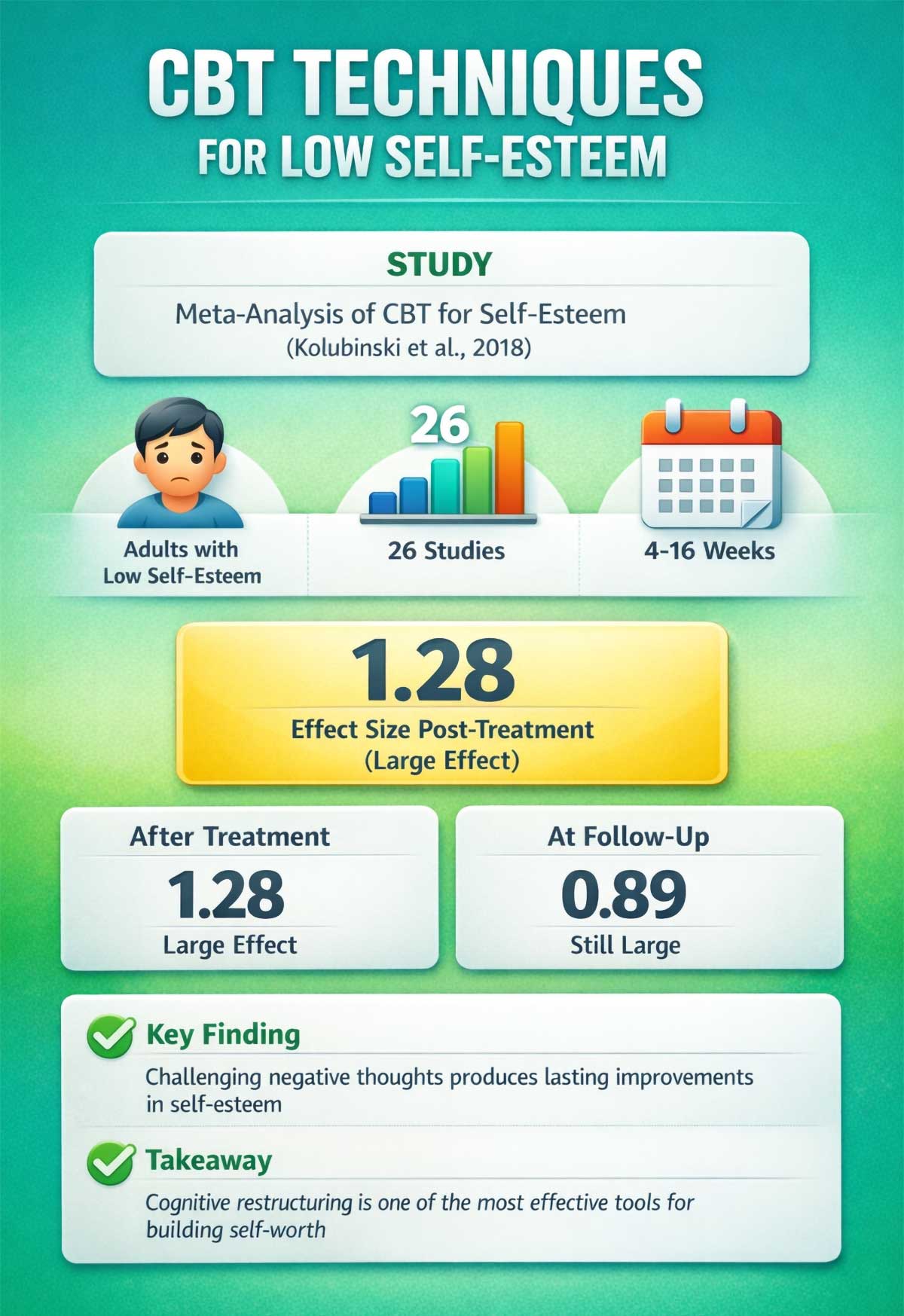
A 2018 analysis of 26 studies found that CBT programs targeting low self-esteem produced large improvements. The effect size was 1.28 right after treatment and 0.89 at follow-up. These are considered large effects in research terms.
Habit 3: Chase Progress, Not Perfection
Perfectionists often have the lowest self-esteem. They set impossible standards. Then they feel terrible when they can’t meet them.
People with healthy self-esteem focus on mastery instead. They celebrate small wins and learn from setbacks.
Why It Works
Each time you accomplish something, your brain releases dopamine. This feel-good chemical reinforces the behavior. You start believing you can succeed.
Psychologist Albert Bandura calls these “mastery experiences.” They’re one of the strongest ways to build self-belief.
The key difference:
- Perfection focus: “I need to write the perfect novel or I’m worthless.”
- Mastery focus: “I’m going to write for 15 minutes and see what happens.”
The Micro-Goal System
Set a micro-goal. Something you can finish in less than 10 minutes.
Not “get in shape.” Instead: “Do 10 pushups.”
Not “write a book.” Instead: “Write for 5 minutes.”
Complete it. Notice how you feel. That’s your brain building confidence.
Building Your Mastery Ladder
Create a ladder of increasingly challenging goals in one area:
Example: Public Speaking
- Share an opinion in a group text (micro)
- Speak up once in a small meeting (small)
- Lead a portion of a team meeting (medium)
- Present to a larger group (challenging)
- Give a formal presentation (mastery)
Start at your current comfort level. Move up one rung at a time.
The Progress Journal
Track your wins, no matter how small:
Daily Format:
- Date:
- What I accomplished today:
- What I learned:
- How I felt:
- Tomorrow’s micro-goal:
Review this weekly. You’ll be amazed at how much you’re actually doing.
Research shows that achieving goals significantly boosts self-belief and self-worth. The key is making goals small enough that you can actually hit them.
One meta-analysis found that goal setting increased self-efficacy with a moderate effect size. That increased self-belief translates directly into higher self-esteem.
Habit 4: Clean Up Your Social Media Feed
You scroll through Instagram. Everyone looks happier, more successful, more attractive than you.
Your self-esteem drops with every swipe.
This isn’t in your head. It’s a real effect called upward social comparison.
Why It Works
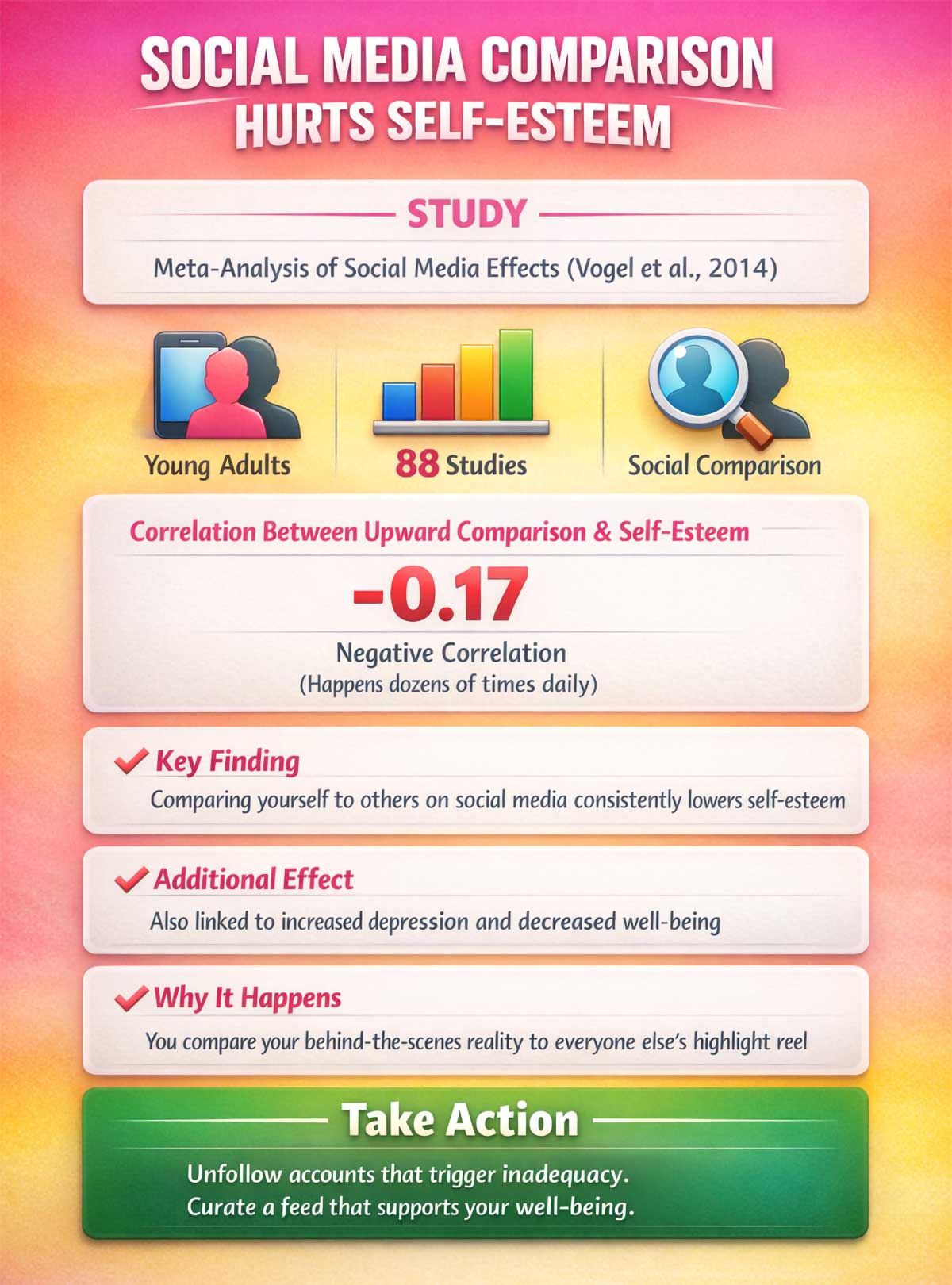
Social media shows you highlight reels, not real life. When you compare your behind-the-scenes to everyone else’s highlight reel, you’ll always come up short.
The average person spends 2-3 hours per day on social media. That’s a lot of time for comparison to chip away at your self-worth.
Limiting this comparison reduces the damage to your self-image.
The Digital Audit Process
Step 1: Track Your Feelings
For three days, notice how you feel after using each social media app. Rate your mood from 1-10 before and after.
Step 2: Identify Trigger Accounts
Scroll through your feed and ask yourself: “How does this account make me feel?”
If it triggers feelings of inadequacy, jealousy, or self-doubt, unfollow it. No guilt. No explanation needed.
Step 3: Curate Intentionally
Fill your feed with accounts that:
- Teach you something useful
- Make you laugh
- Inspire you without making you feel less-than
- Align with your values
- Show real, unfiltered life
Step 4: Set Boundaries
Use app timers to limit social media use. Many phones have built-in tools for this.
Consider these rules:
- No social media in the first hour after waking
- No social media in the hour before bed
- No scrolling during meals or conversations
- One day per week completely offline
The Reality Reminder
Create a note on your phone that says:
“What I’m seeing:
- Carefully chosen photos
- Edited and filtered images
- Best moments, not typical moments
- Curated stories, not full truth
What’s real:
- Everyone has struggles they don’t post
- Everyone has bad days
- Everyone deals with insecurity
- My life is just as valuable as what I see online”
Read this when comparison hits hard.
A 2014 analysis of 88 studies confirmed that upward social comparison on social media is linked to lower self-esteem. The correlation was -.17, which might seem small but is meaningful when it happens dozens of times per day.
One study even found that taking a one-week break from Facebook improved life satisfaction, especially for people who compared themselves frequently to others.
Habit 5: Live By Your Values
You spend your days doing what others expect. Following rules that don’t match what you truly care about.
No wonder you feel disconnected from yourself.
Why It Works
Acceptance and Commitment Therapy (ACT) shows that acting in line with your values improves self-worth. Even if you’re still dealing with problems or symptoms.
When your actions match your values, you feel authentic. You respect yourself more.
Values are different from goals:
- Goals: Things you accomplish (get promoted, lose 20 pounds)
- Values: Ongoing directions you move toward (creativity, connection, growth)
You can achieve goals. You can’t “achieve” values. You live them.
Discovering Your Core Values
Exercise: The 80th Birthday Test
Imagine you’re turning 80. People who love you are giving speeches about your life.
What do you hope they say about you? What qualities do you hope they mention? How do you hope you affected others?
Your answers reveal your values.
Common Core Values:
- Authenticity
- Creativity
- Connection
- Growth
- Kindness
- Independence
- Adventure
- Contribution
- Health
- Learning
- Family
- Justice
- Fun
- Courage
Choose three to five that resonate most deeply.
The Values-Action Connection
For each value, identify specific actions:
| Value | Daily Action | Weekly Action | Monthly Action |
|---|---|---|---|
| Creativity | Doodle for 5 minutes | Try a new creative hobby | Visit a museum or gallery |
| Connection | Send a genuine text to someone | Have a real conversation | Plan quality time with loved ones |
| Growth | Read 10 pages | Learn one new skill | Reflect on progress and set intentions |
| Health | Take a 10-minute walk | Cook a nutritious meal | Try a new form of movement |
The Values Check-In
At the end of each day, ask yourself:
“Which of my core values did I honor today? How?”
If you didn’t honor any, don’t judge yourself. Just notice. Then choose one small action for tomorrow.
A 2015 analysis of 39 studies found that ACT produces medium-to-large improvements in anxiety and depression. The approach works by helping people live more consistently with what matters to them.
When you live by your values, you build self-respect. That’s the foundation of healthy self-esteem.
Habit 6: Protect Your Sleep
You stay up late scrolling. You wake up groggy and irritable. By noon, you’re beating yourself up about everything.
Poor sleep doesn’t just make you tired. It crashes your self-esteem.
Why It Works
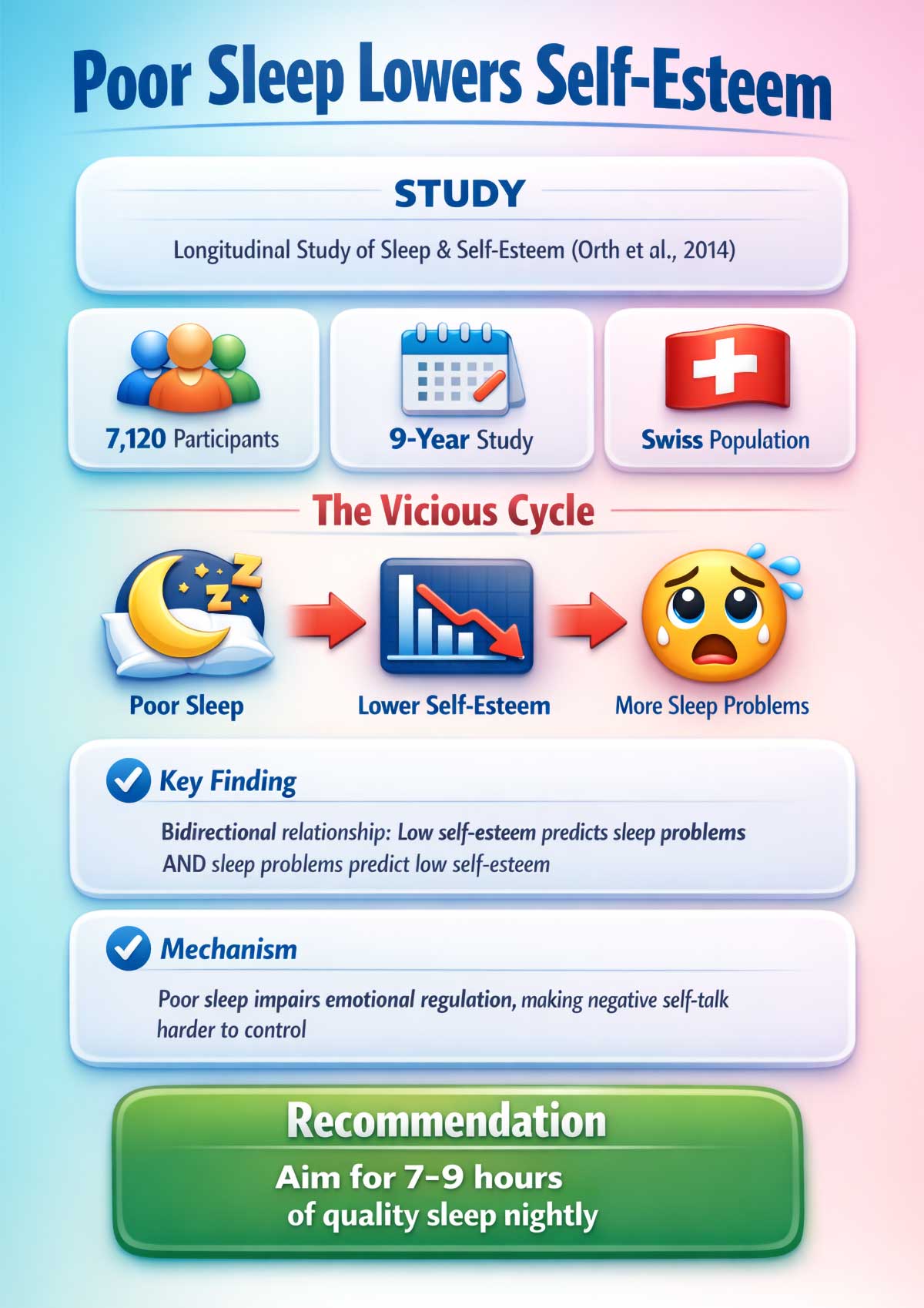
Sleep deprivation impairs your prefrontal cortex. That’s the part of your brain that regulates emotions and makes good decisions.
When you’re sleep-deprived, negative emotions hit harder. Small setbacks feel massive. Your self-critic gets louder.
One study tracked college students for two weeks using daily diaries. Poor sleep quality predicted next-day drops in self-esteem. The effect was mediated by increased negative emotions.
Another study followed over 7,000 people for nine years. It found that low self-esteem and sleep problems create a vicious cycle over time. Poor sleep lowers self-esteem. Lower self-esteem makes it harder to sleep well.
The Sleep-Worth Connection
Here’s what happens when you don’t sleep enough:
In Your Brain:
- Reduced emotional regulation
- Heightened threat perception
- Impaired decision-making
- Increased negative bias
In Your Day:
- More reactive to criticism
- Less able to see the positive
- Lower frustration tolerance
- Harder to control impulses
In Your Self-Talk:
- Harsher inner critic
- More rumination
- Stronger negative emotions
- Less resilience
Building Better Sleep Habits
The Consistent Sleep Window
Set a bedtime and wake time. Stick to them even on weekends.
Why? Your brain runs on a circadian rhythm. Consistency helps regulate this internal clock.
Aim for 7-9 hours between your bedtime and wake time.
The Wind-Down Routine (60 Minutes Before Bed)
- 60 minutes before: Stop work, intense conversations, or stressful content
- 30 minutes before: Turn off screens (blue light disrupts melatonin)
- 20 minutes before: Do a calming activity (read, stretch, meditate)
- 10 minutes before: Prepare your space (cool, dark, quiet)
- Bedtime: Get into bed only when sleepy
The Sleep Environment Checklist
- Room temperature: 60-67°F
- Complete darkness (blackout curtains or eye mask)
- No screens in bedroom
- White noise or fan if needed
- Comfortable mattress and pillows
- No clock watching (turn clock away from bed)
What to Avoid
- Caffeine after 2 PM
- Heavy meals within 3 hours of bedtime
- Alcohol (disrupts deep sleep)
- Exercise within 3 hours of bedtime
- Long naps after 3 PM
When Sleep Won’t Come
If you can’t fall asleep after 20 minutes, get up. Do something calm and boring in dim light. Return to bed when sleepy.
Don’t lie there frustrated. That teaches your brain that bed equals frustration.
Habit 7: Move Your Body
Exercise isn’t just about weight loss or muscle gain. It changes how you see yourself.
Why It Works
Physical activity improves what researchers call “physical self-concept.” You start appreciating what your body can do instead of just how it looks.
Movement also releases endorphins, serotonin, and dopamine. These are natural mood boosters. You feel more capable. More confident.
A 2005 analysis of 113 studies found that exercise produces small-to-moderate improvements in physical self-concept and overall self-esteem.
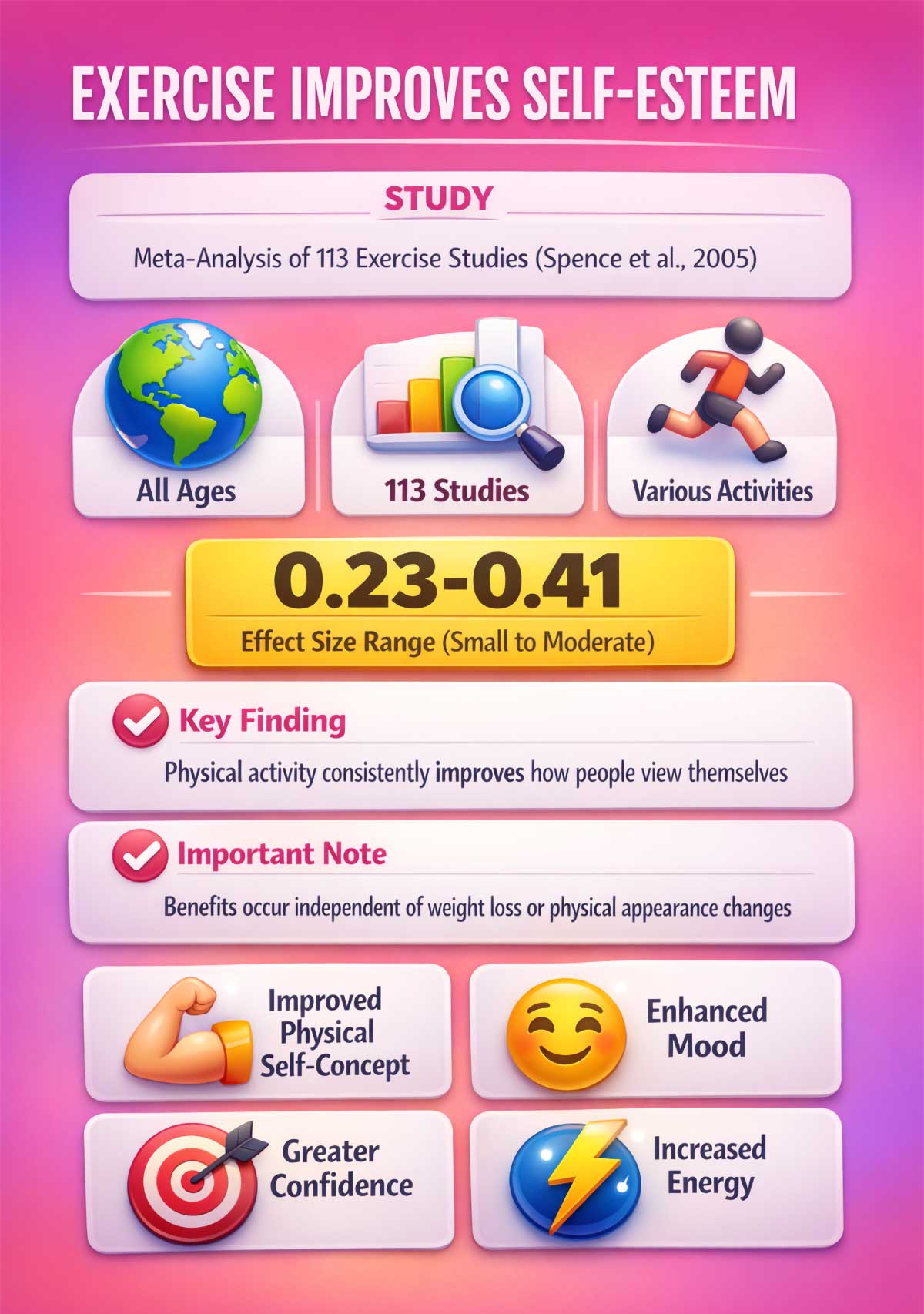
Another study of 23 controlled trials with children and teens showed exercise interventions had moderate positive effects on self-esteem, with an effect size of 0.49.
Shifting Your Exercise Mindset
Most people approach exercise with a focus on appearance. “I need to lose weight.” “I need to look better.”
This approach often backfires. It reinforces the idea that you’re not acceptable as you are.
Instead, focus on function and feeling:
| Appearance Focus | Function Focus |
|---|---|
| “I need to burn calories” | “I want to feel energized” |
| “I hate how I look” | “I’m amazed at what my body can do” |
| “I have to exercise” | “I choose to move because it helps me feel good” |
| “I’m not thin enough” | “I’m getting stronger each week” |
The 20-Minute Movement Rule
Do 20 minutes of moderate activity most days. Walk, dance, swim, bike, or do bodyweight exercises.
Focus on how it feels, not how you look doing it:
- Notice your breathing getting deeper
- Feel your muscles working
- Appreciate your body’s strength
- Enjoy the mental clarity that follows
Finding Your Movement Type
Not everyone loves the gym. That’s fine. Try different types of movement:
Low Impact:
- Walking in nature
- Swimming
- Yoga
- Tai chi
- Stretching
Moderate Impact:
- Dancing
- Cycling
- Rowing
- Hiking
- Recreational sports
High Impact:
- Running
- HIIT workouts
- Team sports
- Boxing/martial arts
- Jump rope
Social Movement:
- Group fitness classes
- Sports leagues
- Walking groups
- Dance classes
- Partner activities
The best exercise is the one you’ll actually do. Pick what you enjoy.
Tracking Progress Without Scales
Instead of weighing yourself, track functional improvements:
- “I walked up three flights of stairs without getting winded”
- “I did 15 pushups. Last month I could only do 5”
- “My mood improved significantly after moving”
- “I slept better on days I exercised”
- “I felt more confident after my workout”
Habit 8: Stop the Thought Spiral
You made a mistake at work. Now you can’t stop thinking about it.
“Why did I do that? What will people think? I always mess things up. I’m probably going to get fired. I’ll never find another job. I’m a failure.”
This is rumination. It’s one of the fastest ways to destroy your self-esteem.
Why It Works
Rumination keeps you stuck in abstract “why” questions. These have no answers, so you spiral.
“Why am I like this?” has no productive answer. It just generates more negative feelings.
Breaking the cycle means shifting to concrete “how” questions or distracting yourself entirely.
A 2012 analysis of 77 studies found a strong negative link between rumination and self-esteem. The correlation was -.43, which is considered large in psychology research.
Experimental studies showed that rumination actively decreases self-esteem and impairs problem-solving compared to distraction techniques.
Recognizing Rumination vs. Problem-Solving
| Rumination | Problem-Solving |
|---|---|
| “Why does this always happen to me?” | “What can I do differently next time?” |
| Replays past events repeatedly | Identifies specific actions |
| Focuses on feelings | Focuses on solutions |
| Increases negative emotions | Decreases negative emotions |
| Abstract and vague | Concrete and specific |
| Feels stuck | Feels forward movement |
The Two-Minute Distraction Rule
When you catch yourself ruminating, set a timer for two minutes.
During those two minutes, do something that fully engages your mind:
- Count backwards from 100 by sevens
- Name all the blue objects in the room
- Do 20 jumping jacks or pushups
- Play a quick word game
- Call someone and ask about their day
This interrupts the spiral before it deepens.
The Why-to-How Shift
When you catch a “why” question, convert it to “how”:
- “Why am I so awkward?” → “How can I prepare for social situations better?”
- “Why don’t people like me?” → “How can I show up more authentically?”
- “Why do I always fail?” → “How can I approach this differently?”
“How” questions lead to action. Action builds confidence.
Scheduled Worry Time
If rumination keeps coming back, try this technique:
Schedule 15 minutes each day as “worry time.” When worrying thoughts come up during the day, tell yourself: “I’ll think about that during worry time.”
During your scheduled time, write down your worries. Then problem-solve or challenge them.
When the 15 minutes end, move on with your day.
This prevents rumination from taking over your entire day while still acknowledging your concerns.
Habit 9: Set Clear Boundaries
You say yes when you want to say no. You let people treat you poorly because you don’t want to cause conflict.
Each time you ignore your own needs, you tell yourself: “What I want doesn’t matter.”
Why It Works
Assertiveness training teaches you to express your needs clearly and respectfully. This reinforces self-respect.
You start seeing yourself as someone worthy of consideration. Someone whose feelings count.
A 2018 analysis of 18 studies found that assertiveness training produces significant improvements in both assertiveness skills and self-esteem. The effect size for self-esteem was 0.49, considered a moderate effect.
Three Communication Styles
| Passive | Aggressive | Assertive |
|---|---|---|
| Avoids conflict at all costs | Wins at others’ expense | Respects both self and others |
| Doesn’t express needs | Expresses needs demandingly | Expresses needs clearly |
| “Whatever you want is fine” | “We’re doing it my way” | “Here’s what works for me. What works for you?” |
| Builds resentment | Damages relationships | Builds mutual respect |
| Low self-esteem | Often masks low self-esteem | Healthy self-esteem |
The “I” Statement Formula
Practice “I” statements. These express your feelings without blaming others.
Formula: “I feel when because . I would like .”
Examples:
Instead of: “You always interrupt me!”
Try: “I feel frustrated when I can’t finish my thoughts because I lose track of what I wanted to say. I would like you to let me finish before responding.”
Instead of: “You never help around the house!”
Try: “I feel overwhelmed when household tasks pile up because I can’t keep up alone. I would like us to split the chores more evenly.”
The Boundary-Setting Script
Step 1: State your boundary clearly
“I’m not available to work on weekends.”
Step 2: Briefly explain (optional)
“I need that time to rest and recharge.”
Step 3: Offer an alternative if appropriate
“I can prioritize this first thing Monday morning.”
Step 4: Hold firm if pushed
“I understand this is important, and I’ll give it my full attention on Monday.”
Small Boundary Practices
Start with low-stakes situations:
Week 1:
- Say no to one small request
- Express one preference (“I’d prefer to meet at 2 PM instead”)
- Decline one invitation you don’t want to attend
Week 2:
- Correct someone who calls you the wrong name
- Ask for what you need in a restaurant or store
- End one conversation when you need to go
Week 3:
- Address one small annoying behavior
- Disagree with someone on a minor topic
- Ask someone to change their behavior
Week 4:
- Set a boundary with a challenging person
- Say no to a bigger request
- Speak up about something that matters
Notice how you feel after each boundary. Your self-respect grows with each one.
Habit 10: Invest in Real Connection
You isolate when you’re feeling low. You tell yourself you’re not worth anyone’s time.
This makes everything worse. Humans need connection to thrive.
Why It Works
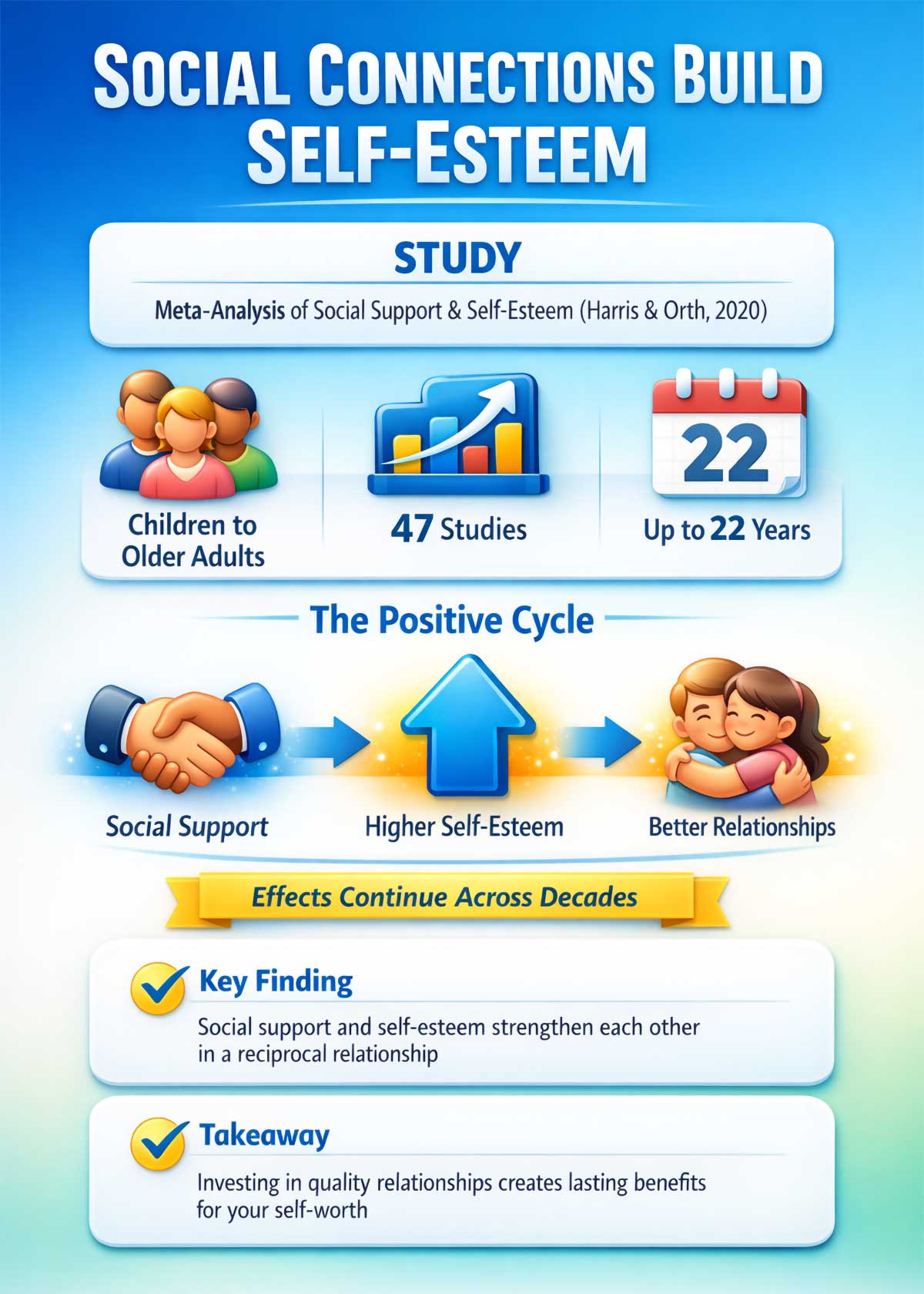
The Social Investment Model explains this: Good relationships boost self-esteem. Higher self-esteem helps you build better relationships.
It’s a positive cycle that builds on itself.
A 2020 analysis of 47 studies showed that social support and self-esteem have a reciprocal relationship over time. Social support predicts later self-esteem, and self-esteem predicts later social support. This cycle continues across years and even decades.
Quality Over Quantity
You don’t need 100 friends. You need a few genuine connections.
Research shows that one high-quality friendship provides more benefit than multiple superficial ones.
High-Quality Connection:
- You can be yourself completely
- They listen without judgment
- You feel energized after seeing them
- They support your growth
- Conversations go beyond surface level
Low-Quality Connection:
- You feel drained after interactions
- You can’t be authentic
- Conversations stay superficial
- You feel judged or criticized
- The relationship is one-sided
The Weekly Connection Practice
Schedule one face-to-face interaction each week with someone who makes you feel good about yourself.
Not a text. Not a phone call. In-person time where you’re fully present.
During the interaction:
- Put your phone away
- Make eye contact
- Ask genuine questions
- Share something real
- Listen actively
- Let yourself be seen
Building Deeper Connections
The Vulnerability Ladder:
Start with small disclosures and gradually share more:
- Share a preference or opinion
- Tell a mildly embarrassing story
- Admit a struggle you’re facing
- Share a fear or insecurity
- Discuss your dreams and values
Move up the ladder as trust builds. Vulnerability creates intimacy.
The Connection Audit
List the people you spend time with. For each person, ask:
- How do I feel after spending time with them?
- Do they support my growth or hold me back?
- Can I be authentic around them?
- Is the relationship reciprocal?
- Do they respect my boundaries?
Invest more time in people who score high. Reduce time with people who consistently score low.
When You’re Starting From Scratch
If you don’t have supportive people in your life right now, here’s how to build connections:
Join groups around your interests:
- Book clubs
- Sports leagues
- Hobby classes
- Volunteer organizations
- Professional associations
- Online communities that meet in person
Be the one who initiates:
- Invite someone for coffee
- Suggest a specific activity
- Follow up after meeting someone
- Show genuine interest in others
Give it time:
- Friendships develop slowly
- Not every person will be a match
- Keep showing up consistently
- Be patient with the process
Supporting Others Supports You
Helping others is one of the best ways to boost your own self-esteem.
Volunteer for a cause you care about. Mentor someone. Be there for a friend in need.
When you contribute to others’ lives, you see yourself as capable and valuable.
Creating Your Personal Action Plan
You’ve learned 10 habits. Don’t try to implement all of them at once. That’s overwhelming.
Instead, create a phased approach.
Month 1: Foundation Building
Choose two habits to focus on:
Recommended starter habits:
- Self-compassion (Habit 1)
- Sleep hygiene (Habit 6)
These create a foundation for everything else. When you’re rested and kind to yourself, other changes become easier.
Month 2: Mental Patterns
Add two more habits:
- Cognitive restructuring (Habit 2)
- Breaking rumination (Habit 8)
These help you manage your thoughts better.
Month 3: Action and Connection
Add two more habits:
- Mastery goals (Habit 3)
- Real connections (Habit 10)
These get you moving forward and supported.
Month 4: Full Integration
Add the remaining habits:
- Digital curation (Habit 4)
- Values-aligned action (Habit 5)
- Movement (Habit 7)
- Assertiveness (Habit 9)
Your Daily Self-Esteem Routine
Once you’ve built these habits, a typical day might look like:
Morning:
- Wake at consistent time (sleep habit)
- 5-minute self-compassion practice
- Review your core values
- Set one micro-goal for the day
Midday:
- Challenge one negative thought
- Take a walk or movement break
- Curated social media check (time-limited)
Evening:
- One meaningful connection
- Practice assertiveness in one interaction
- Note progress in your journal
- Wind-down routine for sleep
As Needed:
- Use two-minute distraction when ruminating
- Apply cognitive restructuring to distortions
- Check if actions align with values
Measuring Your Progress
Self-esteem doesn’t improve in a straight line. You’ll have good days and hard days.
Track your progress over weeks and months, not days.
The Monthly Self-Esteem Check-In
On the first day of each month, answer these questions:
Self-Talk:
- How often did I practice self-compassion this month?
- Am I noticing and challenging negative thoughts?
- Is my inner critic quieter than last month?
Behavior:
- How many micro-goals did I achieve?
- Did I set boundaries when I needed to?
- Am I taking action aligned with my values?
Connections:
- How many quality interactions did I have?
- Do I feel more supported than last month?
- Am I showing up more authentically?
Physical:
- How consistent was my sleep?
- How often did I move my body?
- Do I have more energy than last month?
Signs You’re Making Progress
You might not feel dramatically different at first. Look for these subtle signs:
- You catch negative thoughts faster
- You recover from setbacks more quickly
- You say no without excessive guilt
- You accept compliments more easily
- You try new things despite fear
- You spend less time ruminating
- You feel more authentic
- You take up more space physically
- Your relationships improve
- You feel deserving of good things
When to Seek Professional Help
These habits help many people build healthier self-esteem. But sometimes you need additional support.
Consider working with a therapist if:
- Low self-esteem is severely impacting your daily life
- You’re experiencing depression or anxiety
- You have a history of trauma
- Negative thoughts feel uncontrollable
- You’re having thoughts of self-harm
- You’re stuck despite consistent effort
- You need personalized guidance
Therapy isn’t a sign of weakness. It’s a tool for growth.
Look for therapists trained in:
- Cognitive Behavioral Therapy (CBT)
- Acceptance and Commitment Therapy (ACT)
- Compassion-Focused Therapy
- Schema Therapy
Building Self-Worth Takes Time
You won’t wake up tomorrow with perfect self-esteem. That’s not how it works.
Think of this as a long-term project. Some days you’ll feel confident. Other days you’ll struggle.
That’s normal. Self-esteem isn’t constant. It fluctuates based on what’s happening in your life.
The key is consistency. Pick one or two habits from this list. Practice them daily. After a few weeks, add another.
Small actions compound over time. Six months from now, you might look back and barely recognize the person you were.
Your inner critic might never fully disappear. But you can learn to question it. To challenge it. To choose self-compassion instead.
Common Obstacles and How to Overcome Them
You’ll face challenges as you build these habits. Here’s how to handle the most common ones.
“I Don’t Have Time”
You don’t need hours each day. Most of these habits take 5-15 minutes.
Start with just one micro-habit:
- 5 minutes of self-compassion practice
- One negative thought challenged
- One boundary set
- 10 minutes of movement
Build from there as the habits become automatic.
“I Keep Forgetting”
Create triggers and reminders:
- Set phone alarms for specific practices
- Stack habits onto existing routines (after brushing teeth, during lunch break)
- Put sticky notes where you’ll see them
- Use habit-tracking apps
- Tell someone about your commitment
“It Feels Fake or Uncomfortable”
Everything feels awkward at first. You’re creating new neural pathways.
Self-compassion might feel weird if you’ve been self-critical for years. That’s your brain resisting change, not evidence that it won’t work.
Keep practicing. The discomfort fades.
“I Had a Bad Day and Did Nothing”
One missed day doesn’t erase your progress. Don’t let perfectionism sabotage you.
Tomorrow is a fresh start. Begin again without judgment.
Progress isn’t linear. You’ll have setbacks. What matters is getting back on track.
“I’m Not Seeing Results Fast Enough”
Self-esteem changes happen gradually. You might not notice day-to-day differences.
But look back over weeks and months. Compare yourself to where you were, not where you think you should be.
Small shifts accumulate into major transformations.
The Ripple Effect of Healthy Self-Esteem
As your self-esteem improves, you’ll notice changes beyond how you feel about yourself.
In Your Relationships:
- You attract healthier connections
- You set boundaries more easily
- You communicate more clearly
- You tolerate mistreatment less
- You show up more authentically
In Your Work:
- You take on challenges you previously avoided
- You negotiate better for yourself
- You share ideas more confidently
- You handle criticism more constructively
- You pursue opportunities
In Your Health:
- You prioritize self-care
- You make better food choices
- You exercise more consistently
- You sleep better
- You manage stress more effectively
In Your Growth:
- You try new things
- You learn from failures instead of avoiding them
- You set bigger goals
- You trust yourself more
- You take calculated risks
Healthy self-esteem creates a foundation for the life you want.
Conclusion
Here’s what I want you to remember:
You deserve to feel good about yourself. Not someday when you’re perfect. Right now, exactly as you are.
Your worth isn’t determined by your achievements, your appearance, or other people’s opinions. It’s inherent.
The habits in this article aren’t about becoming someone else. They’re about seeing yourself more clearly and treating yourself with the kindness you deserve.
Start small. Be patient. Celebrate tiny wins.
You’re capable of more than you think. Your inner critic has convinced you otherwise, but that voice is wrong.
Every time you practice one of these habits, you’re telling yourself: “I matter. My well-being matters. I’m worth the effort.”
Quick Reference: Your 10 Habits Summary
| Habit | Core Action | Time Needed |
|---|---|---|
| 1. Self-Compassion | Talk to yourself like a friend | 5 min daily |
| 2. Challenge Thoughts | Use evidence log for negative thoughts | 10 min daily |
| 3. Mastery Goals | Set and achieve one micro-goal | 5-10 min daily |
| 4. Digital Curation | Audit and limit social comparison | Weekly + daily limits |
| 5. Values Alignment | One action aligned with core values | 10 min daily |
| 6. Protect Sleep | Consistent sleep schedule + wind-down | 7-9 hours nightly |
| 7. Movement | Moderate physical activity | 20 min daily |
| 8. Break Rumination | Two-minute distraction when spiraling | As needed |
| 9. Set Boundaries | Practice “I” statements and saying no | As needed |
| 10. Real Connection | One quality face-to-face interaction | Weekly |
Your Next Steps
Here’s exactly what to do after reading this article:
Right Now:
- Choose one habit to start with today
- Set a reminder on your phone
- Do the first practice before the day ends
This Week:
- Practice your chosen habit daily
- Notice how you feel
- Add it to your routine
This Month:
- Keep practicing consistently
- Add a second habit
- Track your progress
Three Months From Now:
- Review how far you’ve come
- Add more habits as you’re ready
- Adjust what’s not working
You don’t need to be perfect. You just need to start.
Pick one habit. Do it today. That’s enough.
FAQs
How long does it take to build self-esteem?
Research shows meaningful changes happen within 8-16 weeks of consistent practice. But self-esteem continues developing throughout your life. Think months and years, not days and weeks.
Can medication help with low self-esteem?
Medication can help if low self-esteem is linked to depression or anxiety. But medication works best combined with therapy and habit changes. Talk to a mental health professional about your specific situation.
Is low self-esteem the same as depression?
No, but they’re related. Low self-esteem is a symptom of depression, but you can have low self-esteem without being depressed. If you suspect depression, see a mental health professional.
Will these habits work for everyone?
These habits are backed by research across diverse populations. But everyone’s different. Some habits will resonate more than others. Try different approaches and stick with what helps you most.
What if I have really severe low self-esteem?
If low self-esteem severely impacts your life or you’re experiencing thoughts of self-harm, please reach out to a mental health professional. These habits can supplement professional treatment but aren’t a replacement for it.
Do I need to do all 10 habits?
No. Even practicing 2-3 habits consistently can create meaningful change. Start small and build gradually.
How do I know if I’m making progress?
Use the monthly check-in questions in this article. Also watch for subtle signs: recovering from setbacks faster, accepting compliments easier, setting boundaries without excessive guilt, and trying new things despite fear.
Can childhood experiences be overcome?
Yes. While early experiences shape self-esteem, your brain remains capable of change throughout life. This is called neuroplasticity. Consistent practice can rewire unhelpful patterns, even from childhood.