447 older adults. Three diets. Six years. Only one group actually improved their memory scores — and it wasn’t the one eating less fat.
A growing number of people in their 50s and 60s notice it. A word slips away mid-sentence. A name vanishes right when you need it. For many, these moments spark real worry. What if what you eat could change that? A landmark clinical trial suggests it might.
A 6-Year Window Into the Aging Brain
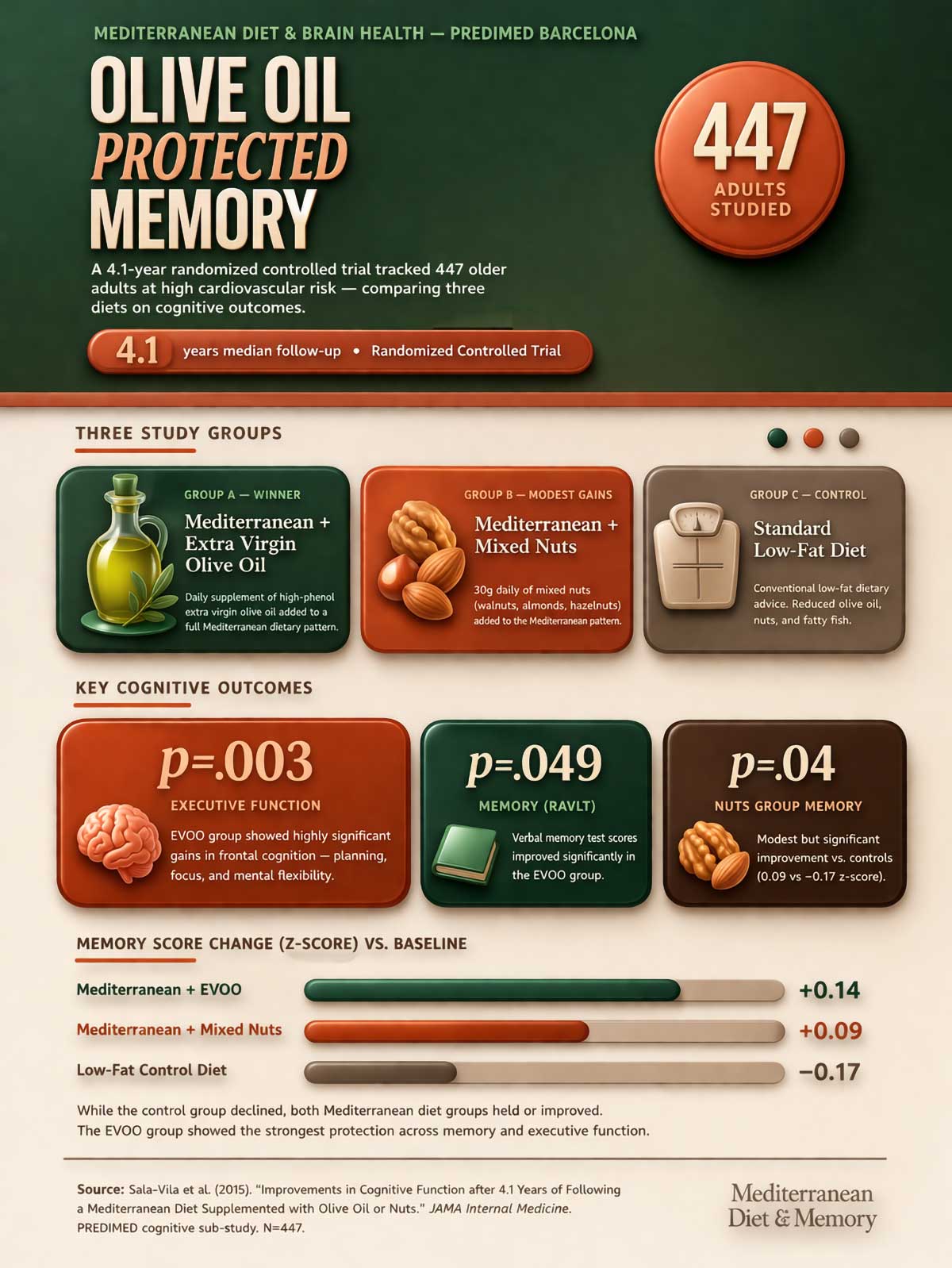
In Barcelona, researchers enrolled 447 older adults who all shared one thing: high cardiovascular risk. These weren’t people in perfect health. They were, in many ways, the hardest group to show results in.
The team split participants into three groups. One followed a standard low-fat diet — the kind doctors commonly recommend. The other two followed a Mediterranean-style eating pattern, but with one key difference. One Mediterranean group added extra virgin olive oil (EVOO) to their daily routine. The other added a daily mix of nuts — typically walnuts, almonds, and hazelnuts.
Then they waited. And they watched.
Over a median of 4.1 years, something striking emerged. While many participants in the control group saw their cognitive scores fall, the Mediterranean diet groups held steady — or improved. The group using extra virgin olive oil showed the strongest gains in memory and executive function (Sala-Vila et al., 2015, PREDIMED cognitive sub-study).
This wasn’t a small pilot study. It was a well-designed randomized controlled trial, which is the gold standard in nutrition research. The findings carry real weight.
Olive Oil vs. Nuts: What the Data Actually Shows
Not all fats are equal when it comes to your brain. The PREDIMED Barcelona trial made that clear.
The EVOO group showed the biggest improvements. Their scores on verbal memory tests (the RAVLT, which tests how well people learn and recall word lists) improved significantly — a statistically meaningful result with a p-value of .049. Their executive function scores were even more striking, with a p-value of .003. Executive function covers things like planning, focus, and mental flexibility — the skills that keep daily life running smoothly.
The nut group also did better than the control group. Their memory scores improved by a modest 0.09 z-score points, while the control group dropped by 0.17. That gap matters. But their gains in frontal cognition — the brain’s command center — weren’t as strong as those seen in the olive oil group.
What does this mean in practice? Using high-quality extra virgin olive oil as your primary cooking fat may offer a cognitive edge that goes beyond general “heart-healthy” advice.
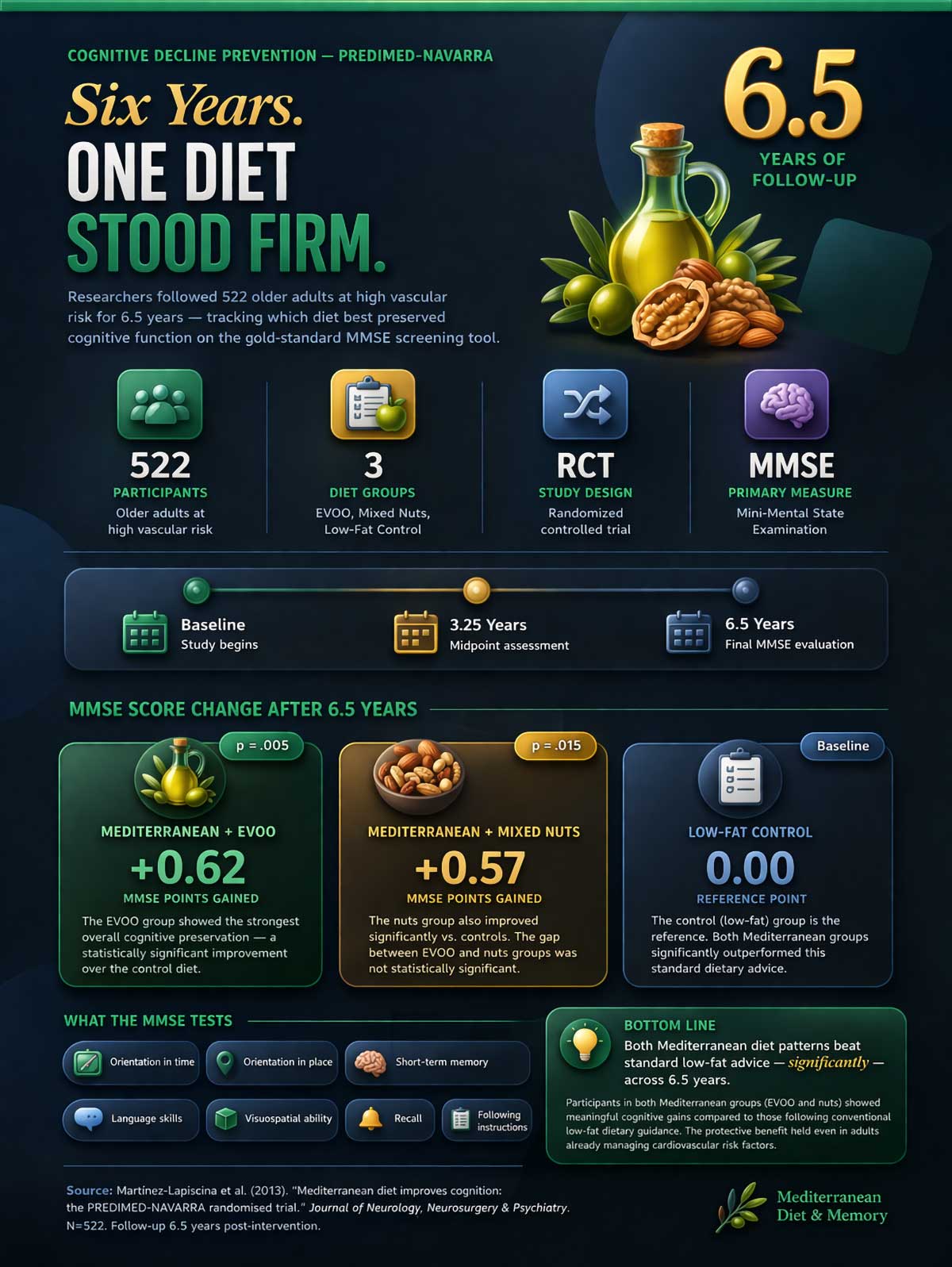
A second PREDIMED sub-study — the PREDIMED-NAVARRA trial — reinforced this picture. Researchers followed 522 older adults at high vascular risk for 6.5 years after the original intervention. Both the EVOO and nut groups scored significantly better on cognitive tests than the low-fat control group. The EVOO group gained an average of 0.62 points on the MMSE (a standard cognitive screening tool), while the nut group gained 0.57 points. The difference between those two groups wasn’t significant — but both clearly outperformed the control diet (Martínez-Lapiscina et al., 2013).
Taken together, these trials point to a consistent message: the Mediterranean eating pattern protects the aging brain, and the combination of nuts, olive oil, vegetables, and fish working together appears to drive that protection.
Walnuts and Cognition: What a National Health Survey Found
The PREDIMED trials focused on older adults at health risk. But what about the general population? A large national health survey fills in part of that picture — with a specific focus on one nut in particular.
Researchers analyzed data from 4,822 U.S. adults collected across two rounds of the National Health and Nutrition Examination Survey (NHANES). They compared people who ate walnuts with those who didn’t, then measured performance across a battery of cognitive tests — including story recall, reaction time, and digit-symbol substitution (Arab et al., 2015).
The results were notable. Walnut consumers scored better across nearly every cognitive test, with statistically significant differences (p<0.01 for most measures). The benefits were especially strong in adults aged 60 and older. That group scored 7.1 percentile points higher on story recall and 7.3 points higher on the digit-symbol test compared to non-consumers.
The average walnut intake among the 60+ group? About 13.1 grams per day — roughly a small handful, or about 7–8 walnut halves.
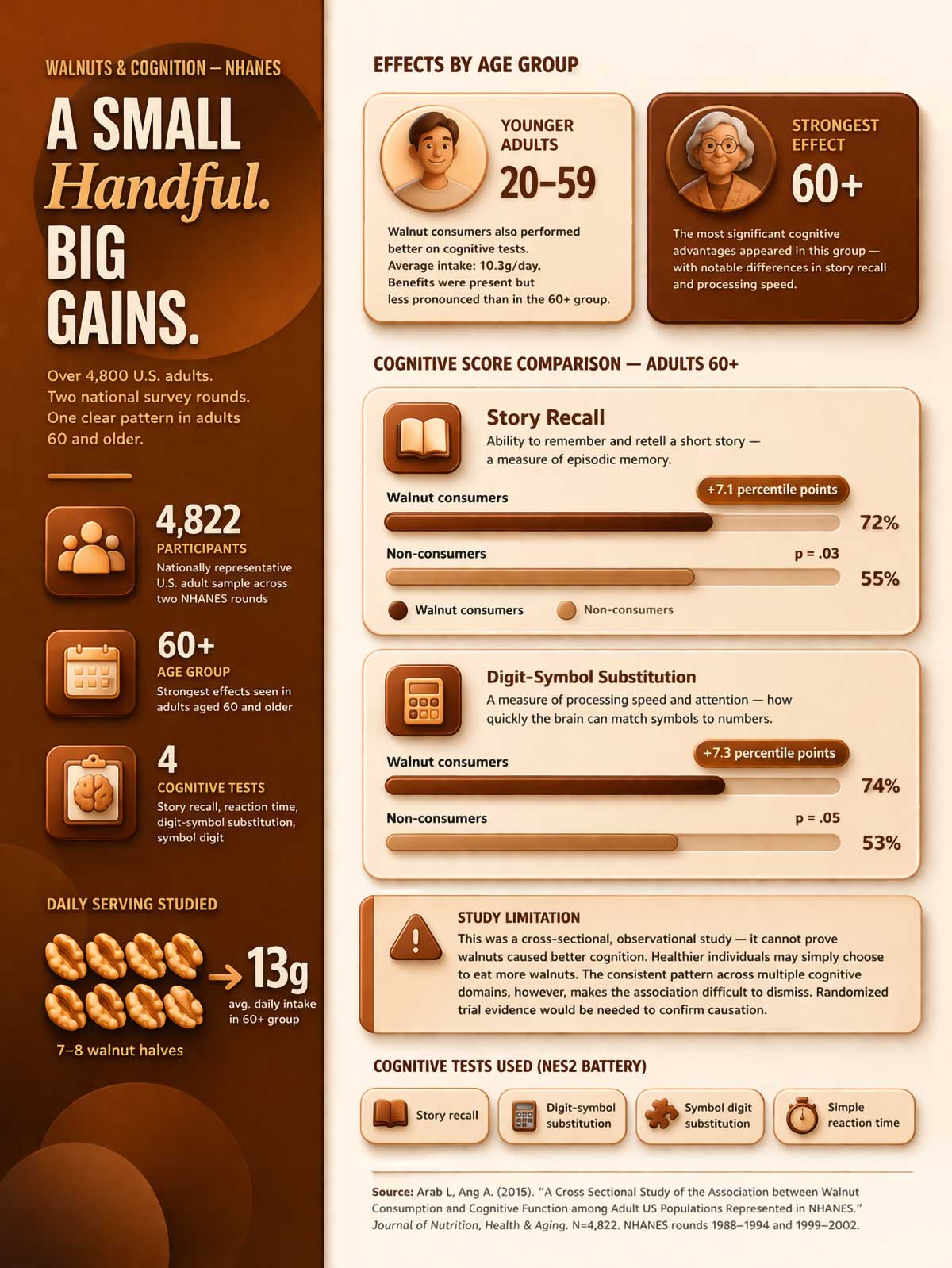
It’s worth being clear about what this study can and can’t tell us. Because it was observational and cross-sectional, it can’t prove that walnuts caused better cognition. Healthier people may simply eat more walnuts. But the pattern across cognitive domains — and the size of the effect in older adults — is worth taking seriously.
It’s also worth noting that the PREDIMED nut group consumed a mix of nuts, not walnuts alone. Those trials didn’t break down cognitive benefits by individual nut type, so they can’t confirm that walnuts outperformed almonds or hazelnuts in that context. What the NHANES data adds is a specific association with walnuts in the general population. Together, the evidence suggests walnuts may be particularly valuable — while the broader Mediterranean pattern’s protection comes from many foods working together.
How the Mediterranean Diet Feeds Your Brain
To understand why this diet pattern works, it helps to understand what it’s actually doing inside the body.
The brain depends on a steady supply of oxygenated blood. Anything that improves blood flow — lower inflammation, healthier arteries, reduced blood pressure — benefits the brain directly. That’s the vascular connection. Heart-healthy foods aren’t just good for your heart; they protect the vessels that feed your brain.
Extra virgin olive oil is rich in polyphenols, plant compounds with strong anti-inflammatory effects. These compounds appear to reduce oxidative stress — the cellular damage linked to aging and cognitive decline. Fatty fish like salmon and sardines deliver omega-3 fatty acids — building blocks for brain cell membranes. Legumes and vegetables supply B vitamins, folate, and fiber. Together, these foods address several risk factors for cognitive decline at once.
One point deserves emphasis here: not all olive oil delivers the same benefits. Most supermarket “extra virgin olive oil” has modest polyphenol content — nowhere near what the PREDIMED researchers selected. To get closer to the oil used in these studies, look for bottles that list a harvest date (fresher is better), choose dark glass containers that protect the oil from light, and expect a peppery, slightly bitter taste — both are signs of high polyphenol content. Oils that list a polyphenol or phenolic count of 150 mg/L or more are a good benchmark. Price often reflects quality here. Storing EVOO in a cool, dark place also preserves its active compounds after opening.
5 Things to Get Right With the Memory-Protective Mediterranean Diet
The research points to a few specific practices that matter most. Here’s what the data actually supports.
1. Choose high-phenol extra virgin olive oil
The EVOO used in PREDIMED trials wasn’t standard supermarket oil — it was selected for its polyphenol content. Look for a listed harvest date, dark glass bottles, and a peppery or bitter taste. Oils with a polyphenol count above 150 mg/L are worth the extra cost for this purpose. Use it generously as your primary cooking fat and for dressings.
2. Eat a daily serving of nuts — walnuts included
The PREDIMED nut group consumed about 30 grams of mixed nuts daily, typically a combination of walnuts, almonds, and hazelnuts. Separately, the NHANES analysis found that people who ate walnuts specifically — averaging about 13 grams per day in the 60+ group — scored better across multiple cognitive tests. Adding a small handful of walnuts to your daily routine is grounded in both lines of evidence, while eating a variety of nuts aligns with what the RCT actually tested.
3. Eat fatty fish and legumes regularly
Walnuts, fatty fish, and legumes are all rich in nutrients associated with brain health — omega-3 fatty acids, B vitamins, and folate. While the NHANES study observed that walnut consumers showed better story recall, it didn’t directly measure which specific nutrients drove that association. What broader research supports is that omega-3s and B vitamins both play roles in neurological health. Aim for fatty fish — salmon, sardines, mackerel — two to three times a week, and legumes like lentils, chickpeas, or black beans several times weekly.
4. Know what the control diet looked like — and avoid it
In the PREDIMED trials, the control group followed a low-fat diet. They reduced olive oil, nuts, and fatty fish in favor of lower-fat options. Over the years, their cognitive scores dropped. The lesson isn’t that fat is always good — it’s that replacing healthy fats with refined carbohydrates or low-fat processed foods may be a net negative for brain health.
5. Think in years, not weeks
The PREDIMED Barcelona study ran for over four years. PREDIMED-NAVARRA followed participants for 6.5 years. Cognitive protection isn’t something a two-week “cleanse” can deliver. The participants who saw the biggest benefits were those who consistently followed the Mediterranean pattern over the long term. Consistency, not perfection, is what the data supports.
What “High Vascular Risk” Really Means for You
This question matters to a lot of people, and the answer requires some precision.
The PREDIMED trials enrolled adults with cardiovascular risk factors — many had hypertension, high cholesterol, or type 2 diabetes. But here’s an important detail: participants were still cognitively healthy at the start of the studies. The Mediterranean diet helped slow the age-related cognitive decline that would normally occur over time. It wasn’t tested as a treatment for significant memory loss or existing cognitive impairment.
That distinction matters. If you’re already experiencing notable memory problems, the evidence for diet as a reversal tool is more limited. What the PREDIMED findings do show is that people with common health conditions — the kind many adults in their 50s and 60s are already managing — can still benefit meaningfully from a dietary shift. Earlier action appears to produce better results.
It’s also worth noting what “global cognition” means in these studies. The researchers weren’t just measuring whether someone could recall names or dates. The tests covered processing speed, working memory, verbal learning, executive function, and visuospatial skills. These are the mental tools that support focus, planning, and daily independence. Even modest improvements in these areas can make a real difference in quality of life.
A long-term study of over 15,000 older women from the Nurses’ Health Study found that those who ate more nuts over the long term showed better overall cognitive function in later life (O’Brien et al., 2014). While that study didn’t isolate walnut effects specifically, it adds to a consistent body of evidence linking nut consumption and long-term cognitive health.
A Practical Weekly “Memory Menu”
Translating research into real meals doesn’t have to be complicated. Here’s what a week of memory-supportive eating might look like, grounded in the PREDIMED and NHANES findings.
Every day: Use 2–4 tablespoons of high-phenol extra virgin olive oil. Eat a small handful of mixed nuts, with walnuts as a regular part of the rotation. Include at least two servings of vegetables, especially leafy greens.
Three times a week: Eat fatty fish — salmon, sardines, or mackerel. These supply the omega-3 fatty acids that support brain cell structure and function.
Four to five times a week: Include legumes — lentil soup, hummus, bean salads. These provide folate and B vitamins that support neurological health.
Daily pattern: Base meals on vegetables, whole grains, fish, and olive oil. Reduce red meat, processed snacks, and sugary drinks. The Mediterranean pattern isn’t about restriction — it’s about building meals around foods that have earned their place.
Each meal is either an opportunity to support brain health or an opportunity missed. That framing — practical and low-pressure — is one the PREDIMED researchers would likely endorse. Over months and years, consistent small choices add up. The research suggests they may add up in ways that matter most.
Start with one change. Swap butter for olive oil. Add a small handful of walnuts to your morning. The data doesn’t promise miracles. But it does suggest that what you eat today is quietly shaping what you’ll remember tomorrow.