BDNF, the protein that tells your brain to grow, spiked in one group and stayed the same in the other. Both groups exercised equally hard. One moved differently
Most people who start exercising for their brain imagine the same thing: a treadmill, a steady pace, the satisfying rhythm of an increasing heart rate. There’s logic to it. Work the body hard enough and the brain must benefit. More blood flow. More oxygen. More protection against the fog that so many people dread as they age.
That logic isn’t exactly wrong. But it’s missing something important. And the gap between what cardio does for the brain and what a different kind of movement, dance, in particular, does is wider than almost anyone currently running on a treadmill has been told.
The Cardiovascular Disconnect
Fitness improvements and brain adaptations are not the same thing. This distinction is easy to ignore, but it matters a lot. A stronger heart and a more plastic brain can function together, or they can function entirely separately.
A 2013 study published in Frontiers in Aging Neuroscience by Kattenstroth and colleagues found that six months of dance training meaningfully improved balance, sensorimotor performance, cognitive reaction time, attention, and tactile sensitivity in older adults.
Cardiopulmonary fitness didn’t change at all. The brain-level gains arrived without any detectable shift in cardiovascular conditioning, which tells you something important: the mechanism behind those changes wasn’t just increased blood flow.
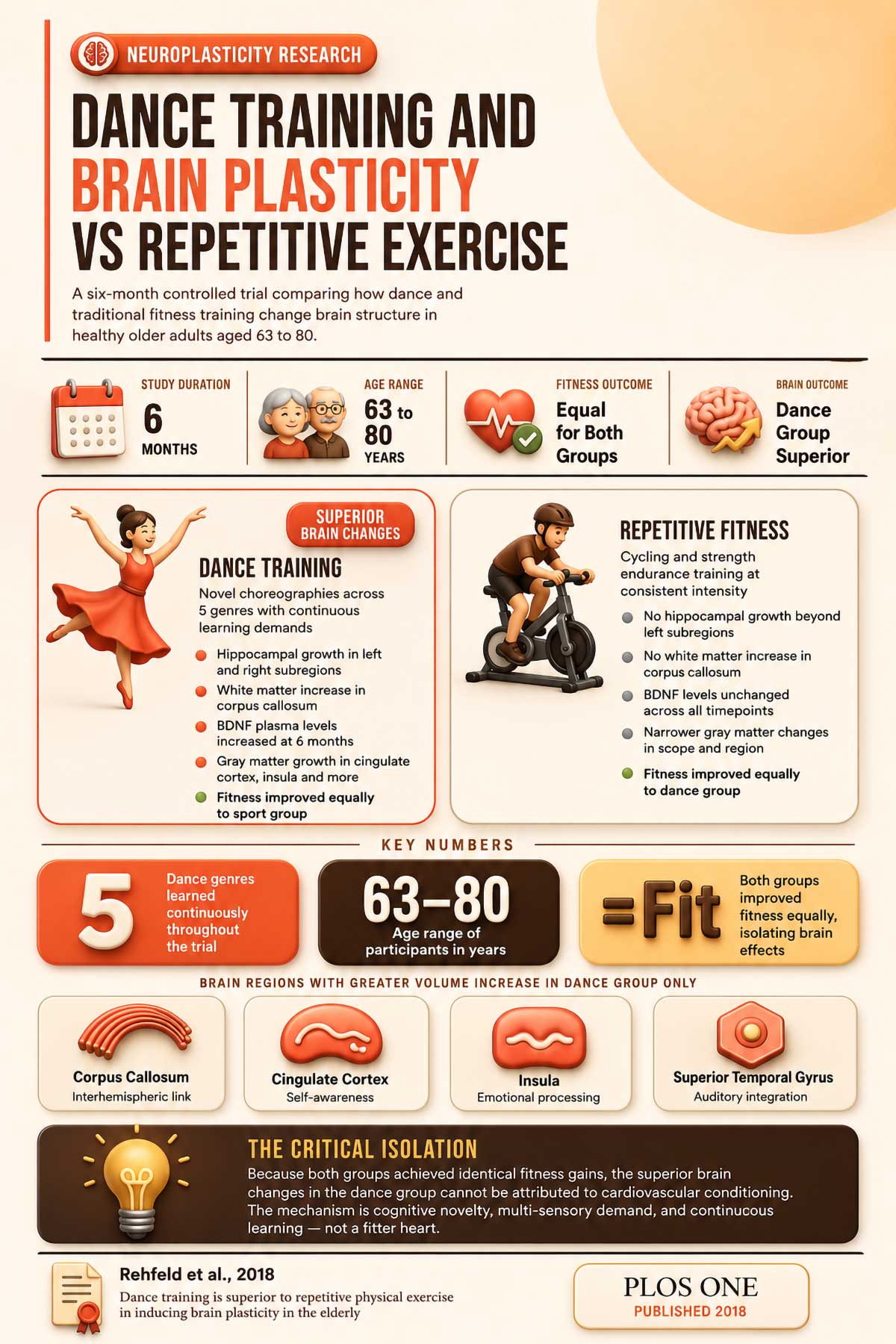
A later 2018 PLOS ONE study by Rehfeld and colleagues made this even clearer by putting two groups of healthy older individuals (ages 63–80) through six months of either dance training or repetitive fitness training, cycling, and strength-endurance work. Both groups improved their fitness by roughly the same amount.
That equal fitness outcome is actually the key finding: it controlled for the cardiovascular effect and isolated what dance was doing beyond it. The brain changes that only the dance group showed couldn’t be explained by a fitter heart.
What Actually Changes Inside the Brain
The hippocampus is the brain region most associated with memory formation, spatial navigation, and learning. It’s also one of the first areas to shrink with age. Any intervention that can meaningfully slow that shrinkage, or reverse it, is worth paying close attention to.
In an 18-month trial published in Frontiers in Human Neuroscience, Rehfeld and colleagues tracked changes in hippocampal volume in seniors who engaged in either dance or traditional fitness training. Both groups showed hippocampal growth, primarily in the left hippocampus (specifically the CA1, CA2, and subiculum subregions).
The dance group went further. Dancers showed additional volume increases in the left dentate gyrus and the right subiculum, with the latter uniquely tied to improvements in balance ability. That spatial comprehensiveness, growth across more hippocampal subregions, matters because different subfields handle different cognitive functions.
The structural changes weren’t limited to the hippocampus. The same 2018 Rehfeld PLOS ONE study found that dancers showed greater increases in white matter volume in the corpus callosum’s truncus and splenium, the main communication bridge between the brain’s two hemispheres.
They also showed greater gray matter growth in the cingulate cortex, insula, supplementary motor area, and superior temporal gyrus. These are regions involved in self-awareness, emotional processing, motor planning, and auditory integration. None of those gains showed up in the repetitive fitness group at the same magnitude.
The clinical population data is, if anything, more striking. A randomized controlled trial published in Frontiers in Aging Neuroscience by Zhu and colleagues in 2022 assigned older adults with amnestic mild cognitive impairment (aMCI, a condition that sits between normal aging and dementia) to either aerobic dance or a control condition for three months.
The dance group showed significantly greater right and total hippocampal volumes. They also scored better on delayed recall, a direct measure of episodic memory. The structural and functional changes moved together, which is exactly what you’d want to see.
Why Novelty Drives the Chemistry
BDNF, brain-derived neurotrophic factor, is sometimes described as the brain’s fertilizer. That’s not far off. It’s a protein that supports the survival of existing neurons, promotes the growth of new ones, and plays a central role in learning and memory. Physical exercise generally raises BDNF levels. The question researchers began asking was whether all types of physical exercise raise it equally.
They don’t. A 2017 paper in Frontiers in Aging Neuroscience by Müller, Rehfeld, and colleagues followed healthy seniors through an 18-month program of either dance training (requiring continuous learning of new choreographies) or repetitive exercise. At the 6-month mark, BDNF plasma levels had increased significantly in the dance group.
The sports group showed no equivalent rise. The researchers also found a substantial increase in gray matter in the left precentral gyrus, a motor control region, in dancers at the same 6-month point, coinciding with the BDNF spike. By 18 months, BDNF in the dance group had returned to near baseline, even as structural brain changes continued to accumulate. Dancers showed greater gray matter volume growth in the parahippocampal region at the longer time point. The sports group stayed flat on BDNF throughout.
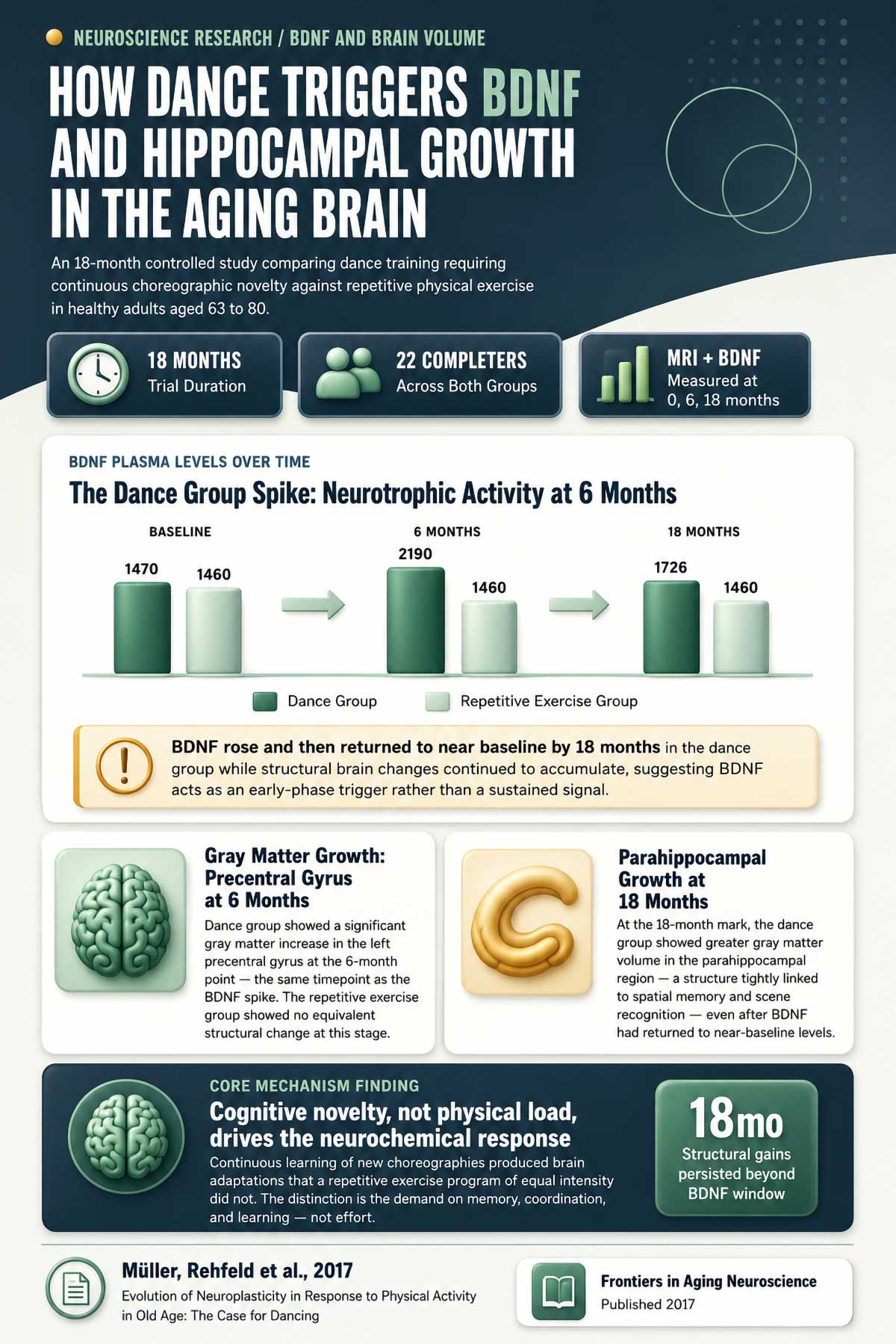
That pattern is worth taking note of. BDNF appears to act as an early-phase trigger for structural changes that then persist and deepen independently. It’s not a sustained elevation; it’s a signal that fires during an active learning period and then steps back while the structural results it helped initiate continue to develop. The sports group never received that signal in the first place.
How Many Brain Systems Dance Activates at Once
Repetitive exercise, even intense repetitive exercise, activates a relatively narrow set of neural circuits. The motor cortex fires. The cerebellum coordinates. The cardiovascular system responds. That’s meaningful, but it’s also limited compared to what happens when movement requires simultaneous attention to music, spatial orientation, social cues, memorized sequences, and real-time correction.
A 2023 narrative review in Frontiers in Aging Neuroscience by Meulenberg and colleagues identified enhanced prefrontal cortex activation and improved motor-cognitive integration as hallmark mechanisms of dance-induced neuroplasticity.
Dance simultaneously recruits the somatosensory, visual, auditory, and motor cortices, as well as the prefrontal cortex and the limbic system. That degree of simultaneous co-activation across brain systems creates more neuroplastic triggers than any single-domain movement can.
A systematic review in Neuroscience and Biobehavioral Reviews by Teixeira-Machado and colleagues (2019) added another dimension: the literature reviewed identified evidence that dance modulates GABAergic and dopaminergic pathways, neurotransmitter systems tied to mood regulation, motivation, and inhibitory control.
The structural changes seen across studies (gray matter volume, white matter integrity) were paired with functional connectivity changes in regions governing memory, motor control, and emotion. This isn’t one mechanism. It’s several working simultaneously.
The Dual-Task Frontier: When the Stakes Get Real
Imagine trying to hold a conversation while walking on uneven ground. Or counting backward while balancing. That’s dual-task demand, the brain managing two things at once, and it’s the kind of cognitive-motor challenge that everyday life throws at older adults constantly. Falls happen when that coordination breaks down. Cognitive decline accelerates when the brain stops being stretched by demanding, simultaneous tasks.
What researchers call cognitive-motor dual-task (CMDT) training deliberately puts this principle to work. A 2020 overview published in Neurophysiologie Clinique by Gallou-Guyot and colleagues looked across multiple studies of older adults with cognitive impairment and found that CMDT interventions outperformed active control conditions on both cognitive and physical outcomes.
The clearest gains showed up in global cognition and executive functions, planning, and inhibition specifically, which are exactly the capacities most vulnerable to age-related decline.
A 2025 randomized controlled trial in Frontiers in Aging Neuroscience by Lai and colleagues enrolled older adults with cognitive frailty, a condition combining mild cognitive impairment with physical frailty, and assigned one group to 16 weeks of exercise-cognitive dual-task training, while a control group received health education.
The dual-task group showed considerable improvements in frailty status, cognitive assessment scores, balance, walking ability, and psychological well-being. For a population at high risk of dementia and loss of independence, those outcomes are not small. They represent a meaningful intervention window that’s still open, if the right type of movement is chosen.
What This Means in Practice
None of this argues against cardiovascular exercise. A healthy heart matters, and the fitness gains from cycling or walking are real. The problem is treating cardio as the whole answer to brain health when the evidence consistently points to something more specific: movement that demands cognitive novelty, multi-sensory engagement, and ongoing learning produces a different class of brain adaptation than movement that doesn’t.
Dance is the most studied example of that kind of movement, but the principle extends beyond it. Any activity that requires you to learn new sequences, coordinate with another person or rhythm, adapt in real time, and do two things at once is working the brain differently than a steady-state effort at a familiar task.
The brain adapts to what it’s challenged by. A treadmill set to a comfortable pace still produces some neural response. The repetitive fitness group in the Rehfeld studies did show brain volume changes, but those changes were narrower in scope, concentrated in fewer regions, and smaller in magnitude than those achieved by the dance group.
The practical implication is worth sitting with. Adding one or two sessions per week of something genuinely new, something that still feels slightly awkward, something with a learning curve that hasn’t flattened yet, appears to be a meaningful addition to any brain health strategy. The harder it is to get right, the more likely it is to be working.
The Bigger Picture
The research framing dance as superior to cardio for neuroplasticity is still growing. Most trials involve relatively small samples of healthy older adults, and the long-term effects on dementia risk remain an open question.
These are honest limitations. But the consistency of the structural findings across independent research groups, hippocampal volume, white matter integrity, BDNF, and multi-region gray matter changes points in a direction that’s harder to dismiss than a single study.
What’s already clear is that the brain doesn’t simply respond to effort. It responds to novelty, complexity, and the sustained demand of learning something that isn’t mastered yet. That’s a different instruction set than most exercise advice currently offers, and probably a more accurate one.