A major scientific review has put hard numbers on a question millions of people have quietly wondered about: can what you eat reduce your risk of dementia? The short answer is yes. And the even better news is that you don’t have to overhaul your entire diet to start seeing a difference.
The Scale of the Evidence
This isn’t based on a single small study. In 2023, researchers published a systematic review and meta-analysis in the journal Neurology — pooling data from 867,316 adults across 10 prospective cohorts in the US, UK, Australia, and Europe. Participants were followed for anywhere from 3 to nearly 15 years.
The finding was striking. People with the highest intake of ultra-processed foods (UPFs) had a 44% higher risk of developing dementia compared to those with the lowest intake (RR = 1.44, 95% CI: 1.11–1.87). That’s not a marginal difference.
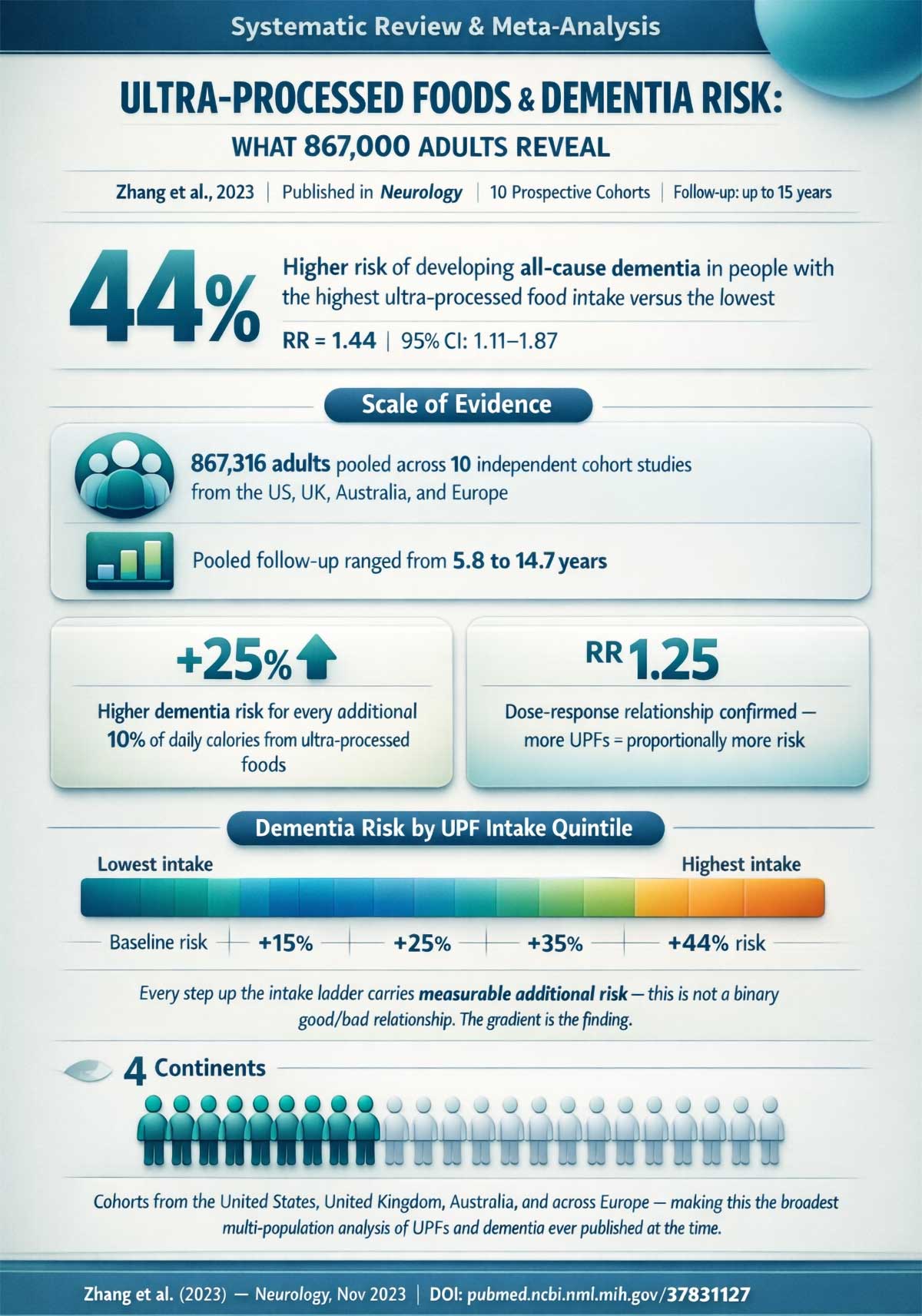
What makes this study stand out is the dose-response pattern it revealed. The researchers found that every 10% increase in UPF consumption was associated with a 25% higher risk of dementia (RR 1.25). Think of it like a dial, not a switch. More UPFs = more risk, in a measurable, predictable way.
The 10% Rule: A Small Change, a Big Payoff
Here’s where the science gets encouraging.
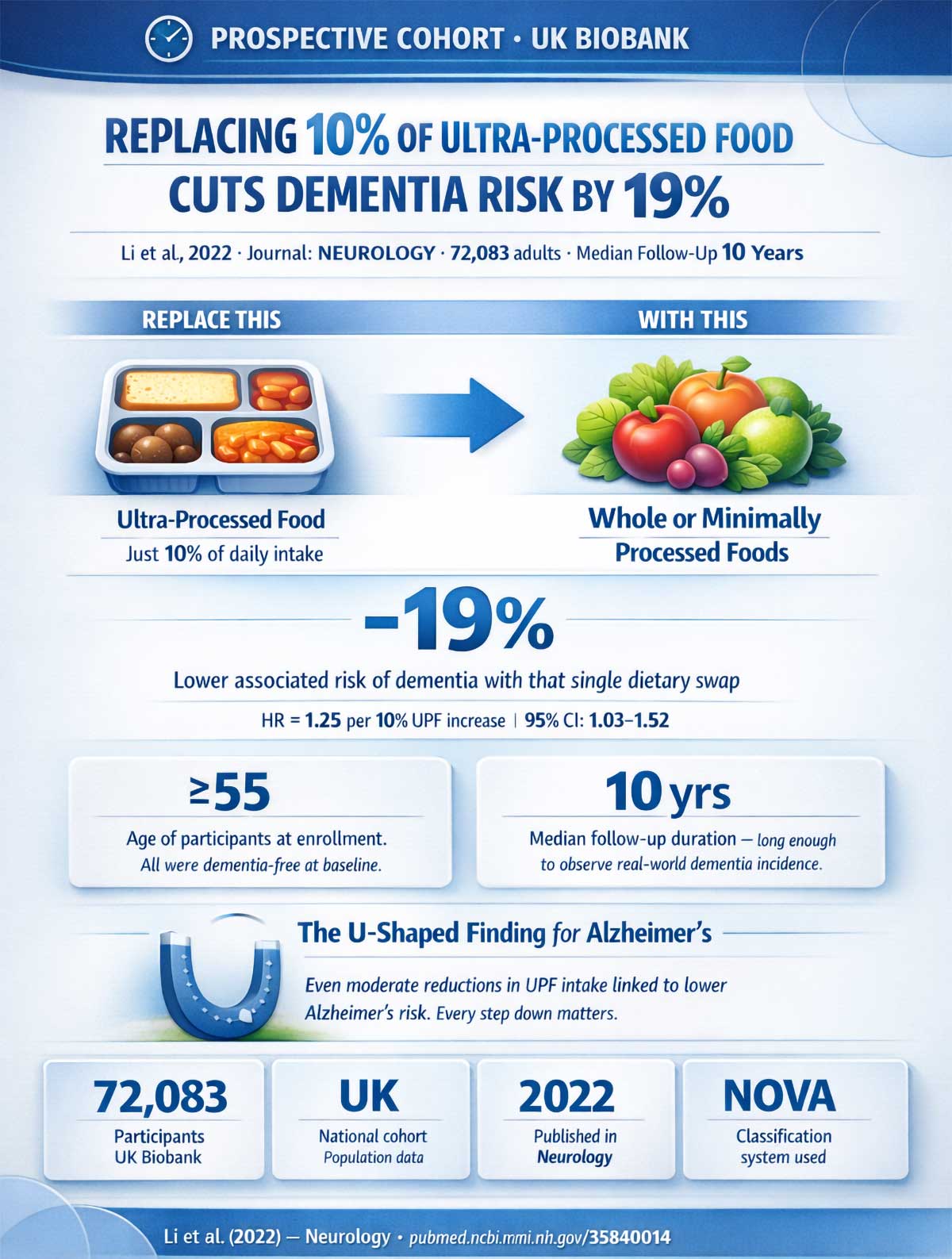
A separate large study published in Neurology drew on data from the UK Biobank — 72,083 adults aged 55 and older, tracked for a median of 10 years. The Li et al. (2022) study found that substituting just 10% of your ultra-processed food intake with unprocessed or minimally processed foods was linked to a 19% lower risk of dementia. The per-10%-increment hazard ratio was 1.25 (95% CI: 1.03–1.52) — statistically meaningful, and consistent with the larger meta-analysis despite the lower bound sitting close to the threshold. In science, that kind of consistency across independent datasets matters.
Ten percent. That’s not a radical transformation. It might mean swapping your morning flavored instant oatmeal for plain rolled oats with honey and walnuts. It might mean choosing roasted chicken instead of deli meat a few times a week.
What does 10% actually look like in practice? For most people eating a typical Western diet, it amounts to roughly half a serving of a processed food per day — maybe a handful of crackers, or half a serving of nuggets. That’s it. And replacing that with something whole and unprocessed could meaningfully shift your risk.
The same UK Biobank study also found a “U-shaped” relationship specifically with Alzheimer’s disease — suggesting that even moderate reductions in UPF intake carry protective effects, and that the benefits aren’t reserved for people who eat perfectly.
It’s Not Just About Diagnosis — Cognitive Decline Matters Too
Many people, especially younger adults, aren’t worried about a dementia diagnosis yet. But here’s something that should get everyone’s attention: ultra-processed foods don’t just raise the risk of dementia. They appear to speed up the natural decline of cognitive function — even in people who never get diagnosed.
A 2023 study published in JAMA Neurology tracked 10,775 Brazilian adults aged 35 to 74 over a median of 8 years as part of the ELSA-Brasil (Brazilian Longitudinal Study of Adult Health). The researchers found that people with the highest UPF intake experienced a 28% faster rate of global cognitive decline — meaning measurable differences in memory, processing speed, and mental flexibility that accumulate over years — and a 25% faster rate of executive function decline compared to those with the lowest intake.
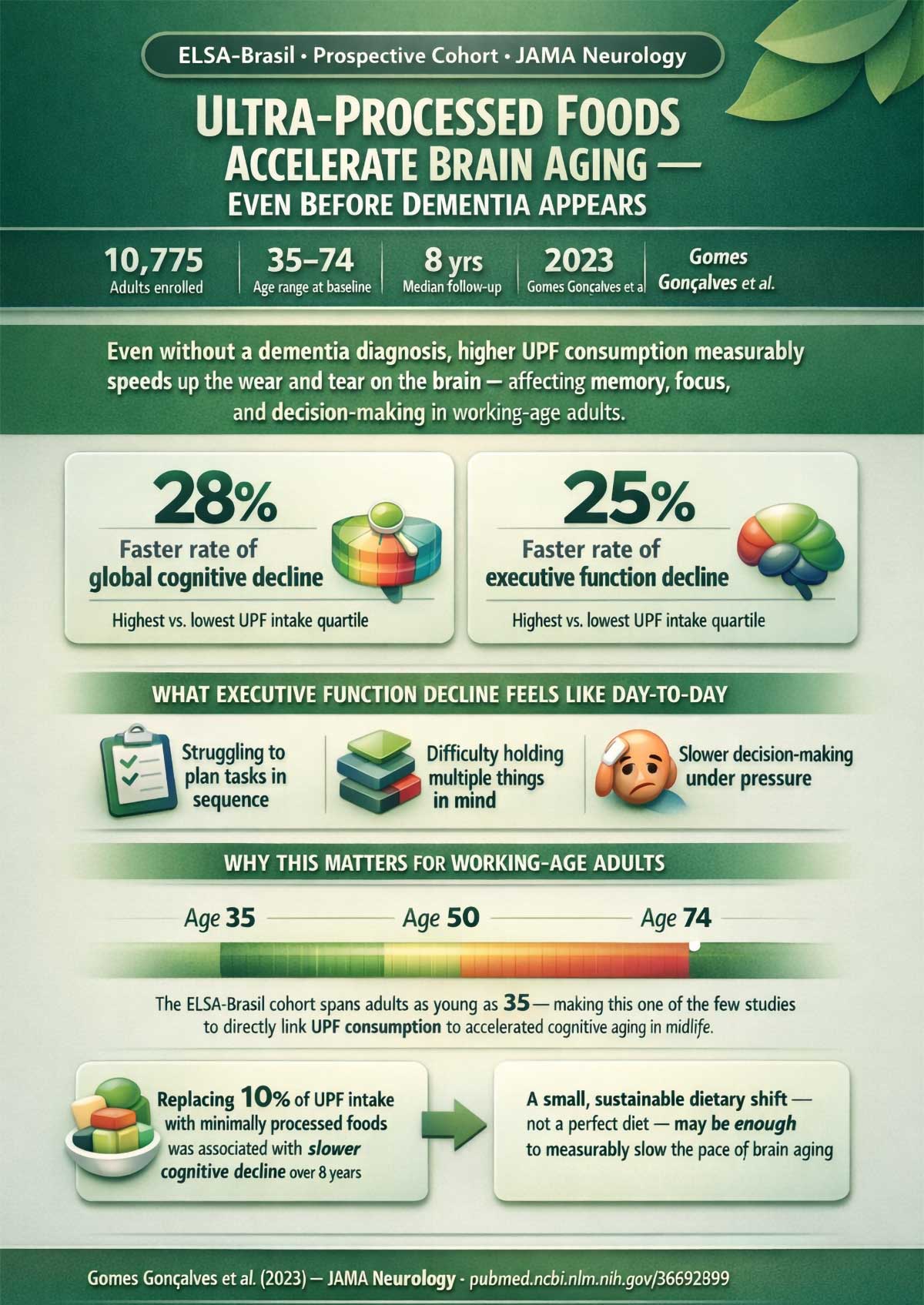
Executive function covers the skills you use every day: planning, focusing, managing competing tasks, and making decisions. A 25% faster decline in that domain isn’t just a clinical statistic — it’s the difference between feeling sharp and feeling foggy. And it starts well before any diagnosis.
The ELSA-Brasil study also found that replacing 10% of UPF intake with minimally processed foods was associated with slower cognitive decline, reinforcing the same message from the UK data.
Processed vs. Ultra-Processed: Know the Difference
Before you swear off bread forever, let’s clear something up. Not all food that comes in a package is an ultra-processed food. Researchers use a system called the NOVA classification to sort foods into four groups based on how much industrial processing they’ve gone through.
Group 1 covers whole, unprocessed foods — a fresh apple, raw oats, plain chicken breast.
Group 3 includes processed foods — think canned chickpeas, cheese, or natural peanut butter with salt. These have been altered, but in straightforward ways you could replicate at home.
Group 4 is ultra-processed. These are products made primarily from industrial ingredients — refined starches, hydrogenated fats, protein isolates, and a list of additives you’d need a chemistry degree to pronounce. Apple-flavored gummy snacks. Reconstituted meat sticks. Sodas. Flavored instant noodles. Packaged pastries with a shelf life measured in months.
The research pointing to dementia risk targets Group 4 — not your sourdough loaf, your canned tomatoes, or your block of cheddar. This distinction matters because diet fatigue is real. When people feel like all food is dangerous, they tend to give up on eating better entirely. The science is more specific than that, and that’s worth knowing.
Why Do Ultra-Processed Foods Harm the Brain?
The biology here involves a few different pathways, none of which are fully understood yet — but the picture is becoming clearer.
Systemic inflammation is one key mechanism. UPFs are typically low in fiber and high in refined ingredients that disrupt the gut microbiome. That gut disruption promotes inflammation throughout the body, and emerging evidence suggests that this inflammation can affect the brain through multiple pathways — including potential weakening of the blood-brain barrier, which is supposed to protect brain tissue from harmful compounds circulating in the bloodstream. The exact mechanisms are still being mapped, but the connection between gut inflammation and cognitive outcomes is now an active area of research.
Nutrient displacement is another factor. Ultra-processed foods are often calorie-dense but nutrient-poor. People who eat a lot of them tend to get less of the micronutrients the brain specifically needs — Vitamin B12, Vitamin E, folate, and omega-3 fatty acids. These aren’t optional extras. They’re involved in nerve function, reducing oxidative stress, and maintaining the structural integrity of brain cells.
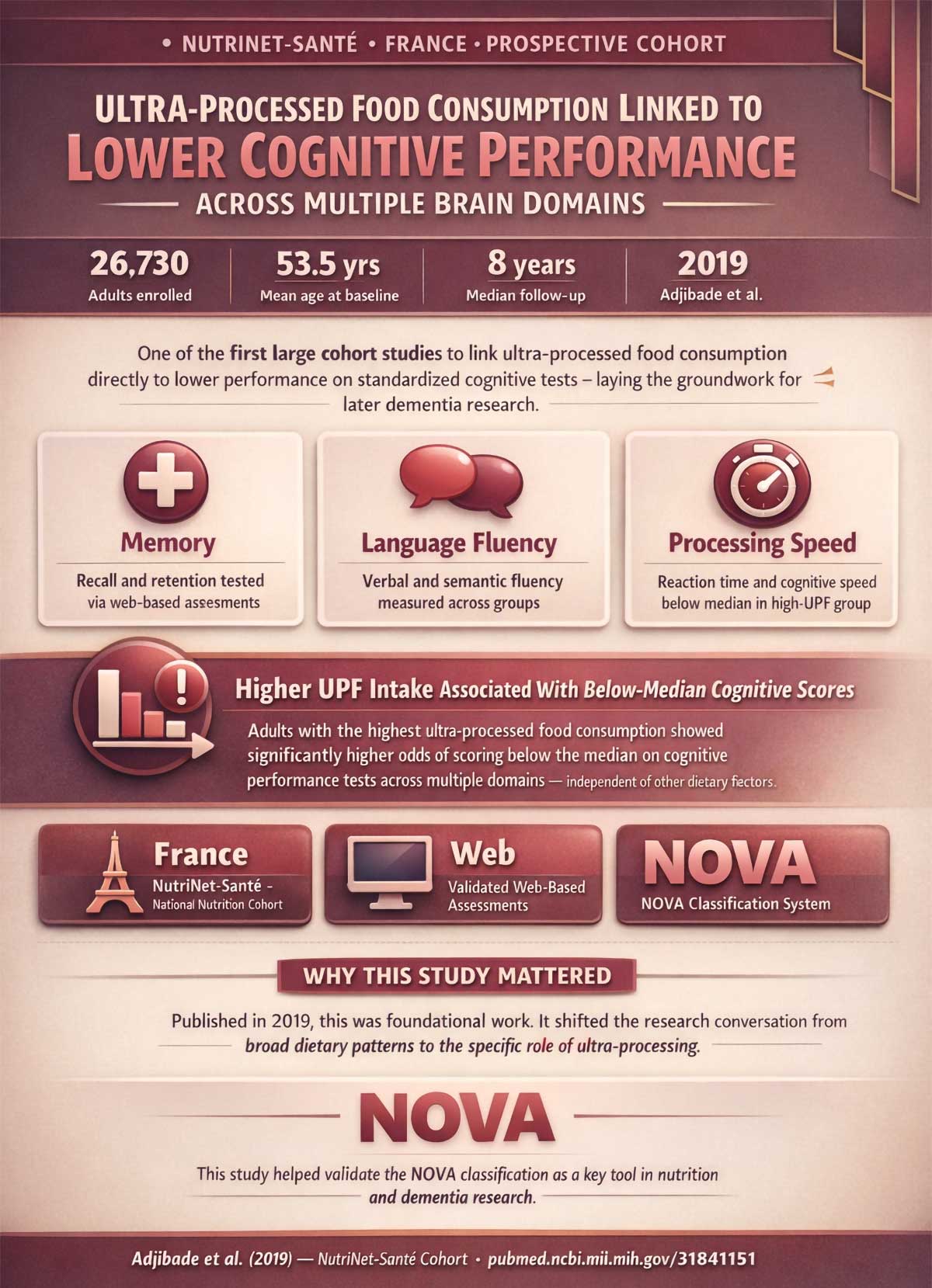
Earlier research from the NutriNet-Santé cohort in France — a prospective study of over 26,000 adults followed for nearly a decade — found that higher UPF consumption was associated with worse cognitive performance across multiple domains. This work helped lay the foundation for the larger studies that followed, pointing researchers toward the mechanisms that might explain the pattern.
Finally, there’s the question of additives. Emulsifiers, artificial sweeteners, and colorants found in UPFs may disrupt the gut-brain axis — the two-way communication system between your digestive tract and your brain. This research is still developing, but the early signals are concerning enough that several countries have begun re-evaluating food additive regulations.
The “Healthy” Foods That Are Actually Ultra-Processed
This is where things get tricky. Some foods marketed as nutritious fall squarely into the UPF category. Here are some common ones that often surprise people.
Fruit-flavored yogurts frequently contain added sugars, thickeners, and artificial flavors that push them into Group 4 territory. Plain yogurt with fresh fruit is a Group 1 swap.
Many commercial protein bars and most energy drinks are made from protein isolates, artificial sweeteners, and a long list of stabilizers — putting them firmly in UPF territory. That said, some bars made with whole ingredients like nuts, dates, and oats are closer to Group 3. The ingredient list tells the story. Whole-food protein sources — eggs, nuts, legumes, canned fish — remain a simpler bet.
“Healthy” breakfast cereals made from refined grains with added vitamins are still ultra-processed. The fortification doesn’t undo the processing. Plain rolled oats, muesli with no added sugar, or whole-grain toast are simpler alternatives.
Plant-based meat alternatives, despite their health-food reputation, are often among the most heavily processed products on shelves. They’re made from isolated proteins, binders, dyes, and flavorings designed to mimic meat. A serving of lentils or roasted chickpeas does the job with none of the additives.
Reading the ingredient list is the fastest test. If you see more than four or five ingredients, and several of them are things you wouldn’t find in a home kitchen, you’re likely looking at a UPF.
Your Action Plan: The Equivalent Swap Strategy
The research from Li et al. frames the goal clearly: replace 10% of your UPF intake with unprocessed or minimally processed alternatives. Here’s what that looks like day to day.
Morning: Swap flavored instant oatmeal — which typically contains sugar, maltodextrin, and artificial flavor — for plain rolled oats cooked with water, topped with a drizzle of honey and a handful of walnuts. Same warm, filling breakfast. Completely different ingredient profile.
Lunch: Swap deli meat slices for leftover roasted chicken breast, canned tuna in water, or hard-boiled eggs. Deli meats are typically Group 4 foods due to the curing agents, preservatives, and fillers involved.
Snack: Swap packaged crackers or a protein bar for a handful of almonds or a piece of fruit with plain nut butter. It takes about the same amount of time to grab from the kitchen.
Dinner: Swap a store-bought pasta sauce — which often contains high-fructose corn syrup, modified starch, and flavor enhancers — for crushed canned tomatoes cooked down with olive oil and garlic. Four ingredients, no additives, and it tastes better.
None of these swaps require cooking skills. They require awareness — knowing what you’re picking up and why it matters. It’s also worth acknowledging that these changes assume access to whole foods, which isn’t equally available in all communities. Broader food system reforms matter alongside individual choices.
Who Carries the Most Risk?
The Zhang et al. meta-analysis drew its data from adults across the US, UK, Australia, and multiple European countries, making the findings broadly relevant across different dietary cultures. The dose-response pattern — more UPFs, more risk — appeared consistent across these populations, regardless of other lifestyle factors.
The Li et al. UK Biobank study focused on adults 55 and older, but the ELSA-Brasil cohort included adults as young as 35. The finding that cognitive decline accelerates with UPF consumption in that younger group matters. Brain health isn’t something you start protecting at 60. The habits you build in your 30s and 40s set the trajectory. It’s also worth noting that we don’t yet have long-term data on people who’ve eaten high-UPF diets since childhood — since these foods only became truly widespread in recent decades. That gap doesn’t weaken the evidence; if anything, it adds to the case for acting carefully now rather than waiting for certainty later.
The U-shaped relationship found in the Alzheimer’s-specific analysis in the UK Biobank study is worth noting too: even people in the middle of the UPF intake range — not the highest consumers, just moderate ones — showed reduced risk compared to high consumers. This reinforces the idea that every reduction counts, and that modest changes are not pointless.
The 50-Gram Solution
Fifty grams. That’s roughly what a 10% reduction in UPF intake works out to for the average person eating a typical Western diet. Half a serving of something ultra-processed, replaced with something whole. Every day.
The combined weight of this evidence — 867,000 people, multiple countries, follow-up periods spanning more than a decade — points consistently in one direction. Ultra-processed foods are associated with faster cognitive decline and a substantially higher risk of dementia. And reducing them, even modestly, is associated with real protection.
Food isn’t a cure. But it may be the most accessible and underused tool most people have for protecting their cognitive health over the long term.
Start with one item in your pantry this week. Look at the ingredient list. If it reads like a lab formulation, find a simpler swap. That’s the 10% rule in action — and the science says it’s worth it.