The harder you push yourself to start, the more threatening the task becomes. Science explains exactly why willpower backfires here.
There’s a specific kind of suffering that comes with being someone who cares. You want to write the report, finish the application, start the project. You know what it means to you. You might have even imagined finishing it, felt the relief of it being done. And then you sit down, open the document, and something shuts off. Your body stays in the chair but your mind runs in twelve directions at once, none of them the one that matters.
This is not laziness. A lazy person doesn’t suffer. They’re genuinely indifferent, unbothered by the gap between what they intend to do and what they actually do. The procrastinator feels that gap like a splinter that goes deeper the longer it’s left alone.
What drives the delay has nothing to do with caring too little. According to a growing body of neuroscience and psychology research, it has everything to do with the way a threatened brain responds to certain kinds of tasks, and the lengths it will go to protect you from them.
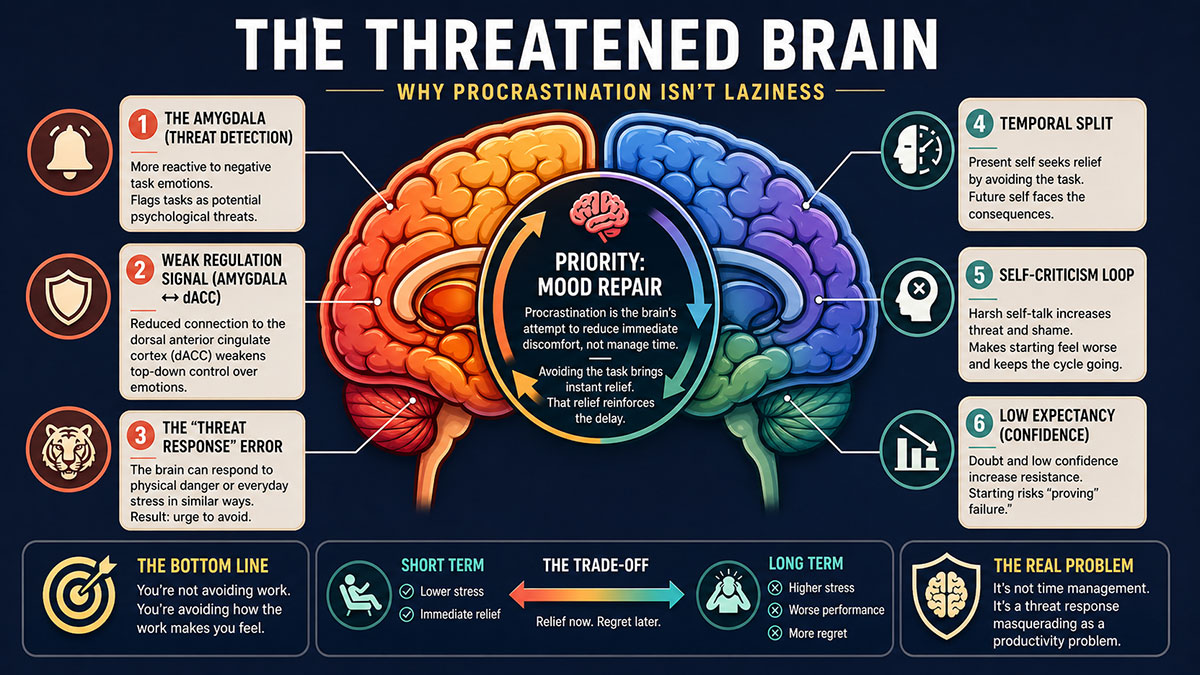
The Brain’s Threat Detector Is Larger Than It Should Be
In 2018, a team of researchers at Ruhr-Universität Bochum scanned the brains of 264 adults and compared their anatomy to self-reported scores on action control, the ability to translate intentions into behavior. What they found was structural.
People with poor action control, the ones most likely to hesitate and delay, had a measurably larger amygdala, the brain’s primary threat detection center, along with a weaker functional connection between the amygdala and the dorsal anterior cingulate cortex (dorsal ACC), a region responsible for regulating emotions and directing behavior toward goals.
The researchers concluded that a larger amygdala may make people more sensitive to the negative emotions surrounding certain tasks, and that a poor connection to the dorsal ACC means those emotions aren’t being filtered or redirected effectively (Schlüter et al., 2018).
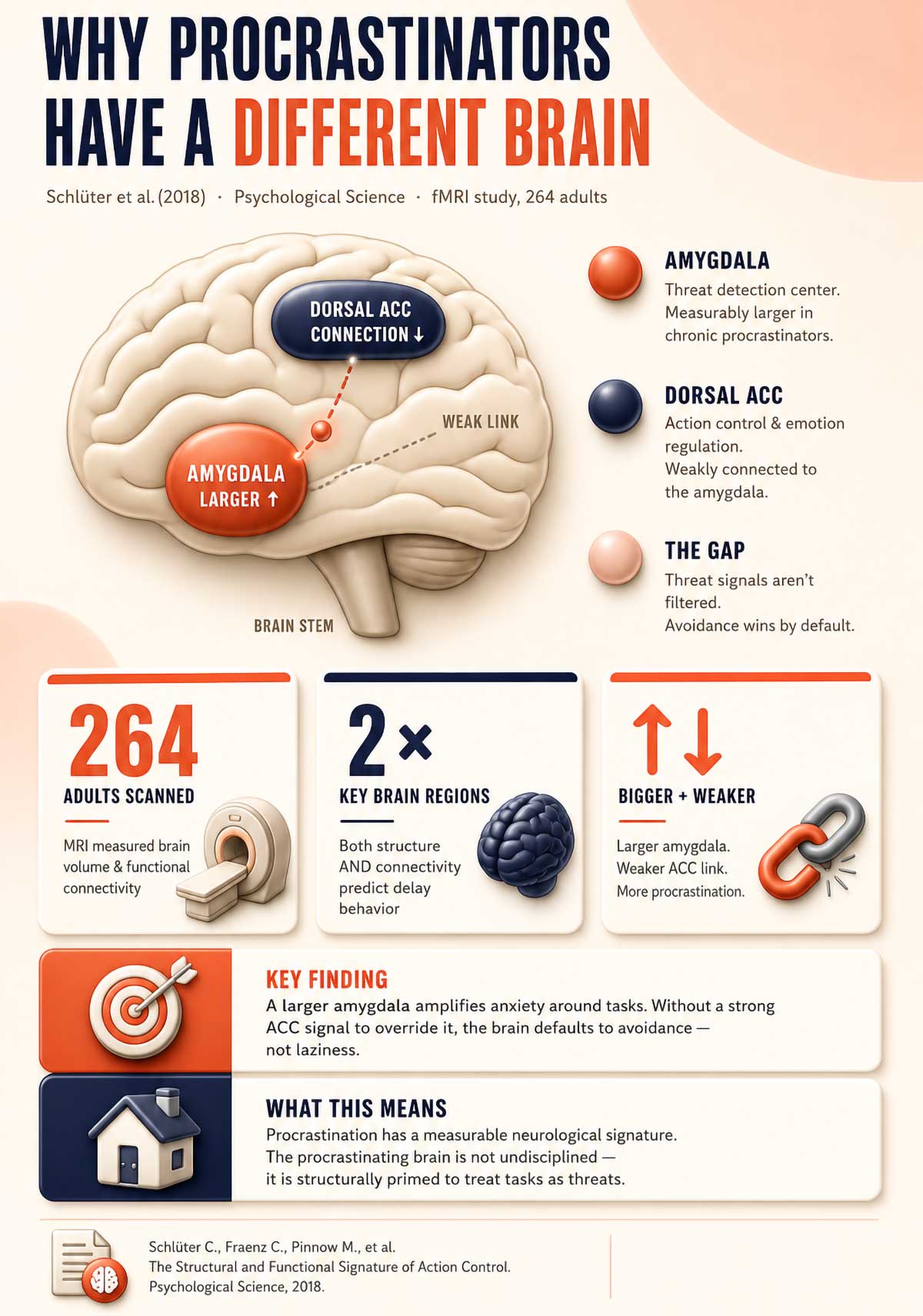
This matters because it reframes the entire conversation. When a procrastinator looks at a task and freezes, that response isn’t volitional in any meaningful sense. The amygdala is doing what it was built to do: flagging a perceived threat.
→ See how blueberries support memory and brain function
The problem is that it can’t distinguish between a tiger and a tax return. Both register as danger. Both trigger the same biological impulse to flee, and without a strong enough signal from the dorsal ACC to override that impulse, fleeing wins.
The question researchers kept returning to was: what makes a task feel like a threat in the first place?
Mood First, Work Second
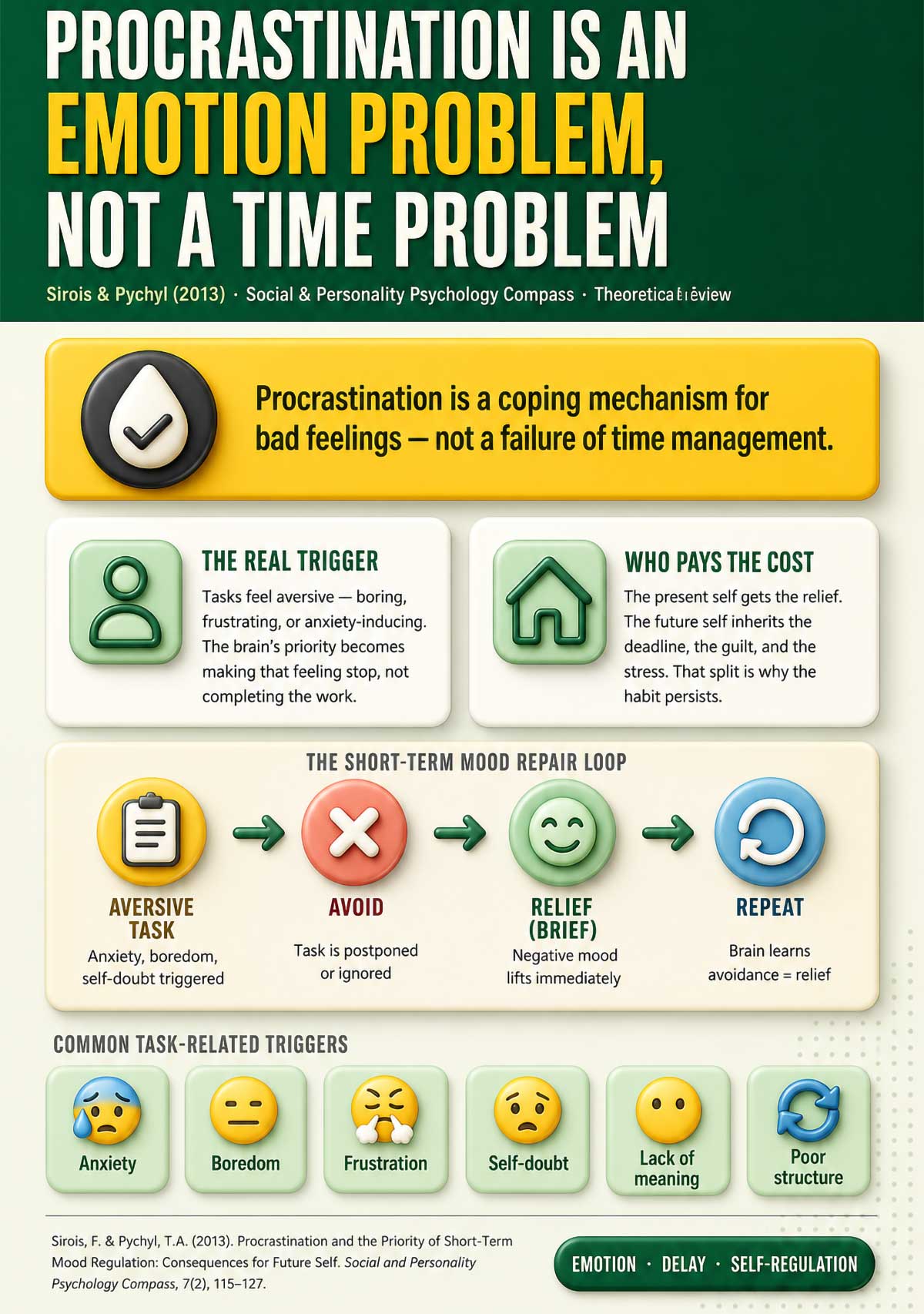
The short answer is that almost anything can become threatening if it’s tied to a bad feeling. Psychologists Fuschia Sirois and Timothy Pychyl reviewed the existing literature on procrastination in 2013 and came to a conclusion that reoriented how the field thinks about the problem.
Procrastination, they argued, is primarily about managing negative mood in the present moment, not about managing time. When a task triggers anxiety, boredom, frustration, or self-doubt, the brain’s priority becomes making those feelings stop as quickly as possible.
Putting the task off does exactly that. The unpleasantness lifts the moment you close the tab or tell yourself you’ll start tomorrow. That relief is real and it’s immediate, which is precisely why avoidance becomes habitual (Sirois & Pychyl, 2013).
This is where a lot of popular advice about procrastination fails. It assumes the core problem is scheduling, or prioritization, or a lack of discipline. Willpower gets blamed most often. But willpower is a tool for pushing through resistance, it was never designed to override a threat response. If the actual mechanism driving delay is emotional, then more discipline doesn’t fix anything, and neither does a better calendar. You can’t time-block your way out of what is essentially a fear reaction.
What makes this worse is the time dimension Sirois and Pychyl identified: the costs of procrastination are almost always paid by the future self, not the present one. The present self gets the mood relief. The future self gets the panic, the missed deadline, the regret. This temporal split between who benefits and who suffers is one of the reasons procrastination is so persistent.
Short-Term Calm, Long-Term Cost
Dianne Tice and Roy Baumeister tested exactly how that trade-off plays out in the real world. In a longitudinal study published in 1997, they tracked students across an academic semester, measuring their stress levels, health, and performance at multiple points.
Early in the semester, procrastinators reported lower stress and fewer illnesses than their non-procrastinating peers. This is the mood repair effect in action. But by the end of the semester, that pattern had completely reversed.
Procrastinators reported significantly higher stress and more illness than non-procrastinators overall, and their academic performance was worse across every assignment (Tice & Baumeister, 1997).
The brain’s attempt to protect itself from immediate discomfort directly guaranteed worse outcomes and measurably worse physical health later on. The coping mechanism created the very problem it was designed to prevent, just on a delay.
Think of it like borrowing calm from your future self at an interest rate you never agreed to.
The Harshest Critics
Here is what I find most striking about this research: the people most likely to procrastinate are often the people who judge themselves most harshly for it. That harsh self-judgment doesn’t help. It makes things worse in a precise, measurable way.
In a 2012 study, Sirois found that procrastinators tend to have lower levels of self-compassion, meaning they respond to their own failures and delays with criticism rather than understanding. That internal criticism increases the sense of threat around the task itself.
The more you berate yourself for not starting, the more psychologically dangerous starting becomes, because starting means confronting both the task and your own record of avoiding it. The result is a self-reinforcing stress loop: avoidance generates self-criticism, which makes the task feel more threatening, which makes avoidance more likely (Sirois, 2012/2013).
The cruelest part of this loop is that it functions as a punishment system that punishes effort. Attempting the task means stepping into territory loaded with shame. Not attempting it provides a brief, reliable release. Over time, the brain learns which choice feels safer.
The Math of Motivation
Piers Steel’s 2007 meta-analysis drew on 691 correlations from the procrastination literature to identify what actually predicts whether someone will delay. His findings challenged the assumption that task aversiveness is the whole story.
Yes, tasks that feel unpleasant or frustrating are more likely to be avoided. But Steel found that two other variables were just as powerful: impulsivity (sensitivity to delay and distraction) and expectancy, which is essentially confidence in your ability to succeed (Steel, 2007).
Expectancy is worth sitting with. A person who genuinely believes they can do the thing is significantly less likely to delay it, even if the task is hard or unpleasant. A person who doubts their ability faces a compounding problem: the task is already unpleasant, and starting it also risks confirming their worst fear about themselves.
Steel’s Temporal Motivation Theory captures this mathematically, with motivation decreasing as both impulsivity rises and confidence falls. The task aversiveness alone doesn’t predict procrastination. The belief that you might fail at it does.
Protecting the Image of a Capable Person
Ferrari, Johnson, and McCown’s 1995 research on chronic procrastinators revealed something that feels almost paradoxical on first read. Chronic procrastinators delay, at least in part, to protect their self-esteem. If you never fully commit to a task, you can always attribute failure to timing rather than ability. The work wasn’t your best effort; you were rushed, or distracted, or started too late. The implicit self-image of a capable person remains intact because it was never really tested (Ferrari et al., 1995).
This is one of the more uncomfortable truths in the entire literature. The chronic procrastinator actively sabotages their own results specifically to protect their self-concept as someone capable of better results. The delay isn’t evidence of not caring. It’s evidence of caring so much about being seen as competent that actually being tested feels like too great a risk.
The Stranger in the Future
Part of what allows this trade-off to feel acceptable is how disconnected most people are from their future selves. Zhang and colleagues’ 2019 review of the neuroscience of procrastination pointed to a phenomenon called episodic foresight: the brain’s ability to simulate future events in vivid, emotionally real detail.
People who procrastinate chronically show structural and functional differences in the parahippocampal cortex and prefrontal cortex, regions involved in constructing those future simulations. When episodic foresight is poor, future rewards and future consequences feel less real, more abstract, more like something happening to someone else (Zhang et al., 2019).
This connects directly to what Sirois and Pychyl described about the temporal self. The present self and the future self feel like different people. Leaving the work to the future self doesn’t feel like self-harm. It feels like delegating. And when the future self eventually arrives and inherits the mess, it discovers that it is now the present self, and the cycle starts again.
When the Work Itself Feels Meaningless
There is one more piece of this that doesn’t get enough attention. Blunt and Pychyl’s 2000 research on task aversiveness across stages of personal projects found that procrastination is particularly intense during the action stage of projects that feel low in personal meaning or autonomy. Meaning matters at every stage, but in the planning phase, a person can still imagine the goal and connect to it.
Once actual work begins, the gap between the task in your head and the task in front of you becomes impossible to ignore. When there’s no sense that the work is yours, that it reflects something you actually value or chose, action feels like moving through resistance with no real reason to push through (Blunt & Pychyl, 2000).
This suggests that some procrastination isn’t about threat detection or mood repair at all. It’s a signal. The task genuinely isn’t meaningful enough to justify the difficulty of doing it.
What This Actually Changes
None of this is a set of excuses. The delays are real, the consequences are real, and the suffering they cause is real. But the explanation changes what a useful response looks like.
If procrastination is a mood regulation problem built on a biological threat response, amplified by self-criticism and poor future self-continuity, then treating it like a discipline failure is like treating a fracture with a better pair of shoes. Willpower assumes the obstacle is effort. The research says the obstacle is threat perception, and those require completely different solutions.
The procrastinating brain isn’t broken. It’s doing exactly what brains do when they encounter something that feels dangerous. The work, somewhere along the way, started registering as a threat.
That shift didn’t happen because of laziness. It happened because of caring, because of doubt, because of a nervous system doing its job too aggressively. Gritting your teeth harder won’t change that. Understanding it might.