People judge confidence faster than you think. These small habits quietly change how others see you—and why they start taking you seriously.
You can walk into a room feeling great about yourself and still leave feeling invisible. That’s because confidence isn’t only about your internal state. It’s also a signal — something you broadcast through your words, your follow-through, and the way you hold yourself in a conversation.
The good news is that you don’t need a personality overhaul. Research shows that small, repeatable behaviors change how others read you. These habits shape what psychologists call your external credibility — the impression of authority and reliability you project to the people around you.
Here are seven of those habits, each backed by real psychological evidence.
The Psychology Behind Being Taken Seriously
Your brain is a pattern-recognition machine. So is every other person’s brain in your social circle.
When people meet you, they run what psychologists call a “credibility scan” — a rapid, mostly unconscious evaluation of whether you’re worth listening to. This scan happens in seconds. It pulls from your eye contact, your word choices, your reliability, and dozens of other micro-signals most people never think about.
This is sometimes called the Credibility Loop: small behaviors stack on top of each other, either building or chipping away at your perceived authority over time. A single conversation rarely defines your reputation. But dozens of small, consistent habits absolutely do.
That’s the good news. Your reputation is largely in your hands. You shape it daily, one interaction at a time.
Habit 1: Replace Filler Words with Intentional Silence
Most people say “um,” “like,” and “uh” without even noticing. It’s a nervous reflex — a way of buying time while the brain catches up with the mouth.
But those filler words carry a cost.
A 2022 peer-reviewed study by Schick and colleagues found that excessive filler words reduce a speaker’s credibility, weaken how well their message lands, and signal nervousness or under-preparation to listeners. Put simply, people hear “um” and their brain quietly registers this person isn’t sure of themselves.
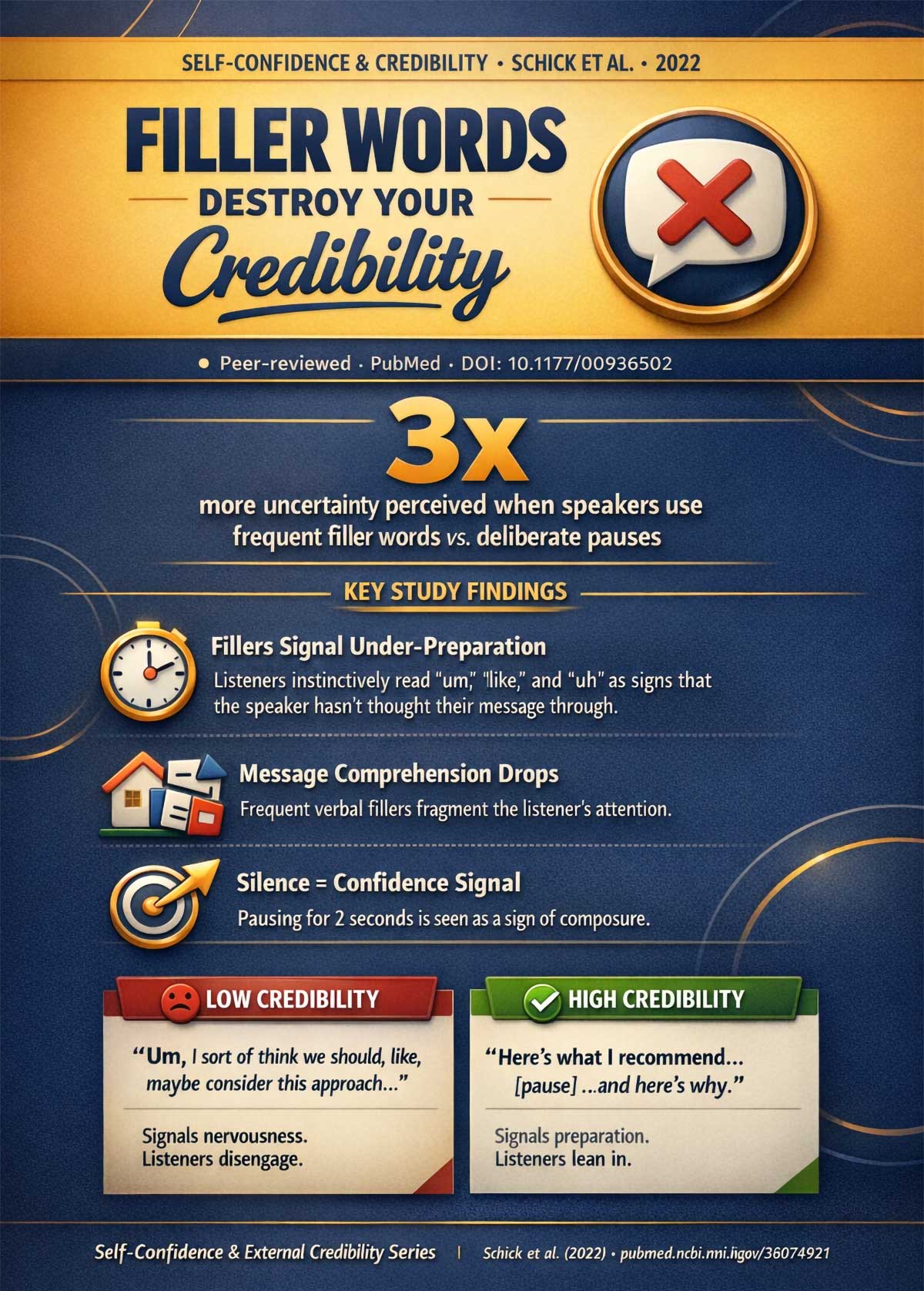
The fix isn’t to speak faster. It’s to get comfortable with silence. A two-second pause feels far longer to you than it does to your listener. To them, it reads as thoughtful and composed.
Try this: Record a 60-second voice memo answering a question about your work. Count how many filler words you use. Then re-record with deliberate pauses instead. Even one week of this practice produces noticeable change.
Habit 2: Keep Every Small Promise
There’s a common belief that charisma is the key to being trusted. Research suggests otherwise.
A 2023 meta-analysis by Xing and colleagues found that consistency — specifically, the predictability of your behavior over time — is a stronger predictor of trust than charisma. People who say what they’ll do and then do it are trusted more than people who are simply charming. And that trust builds faster when small commitments are treated with the same weight as big ones.
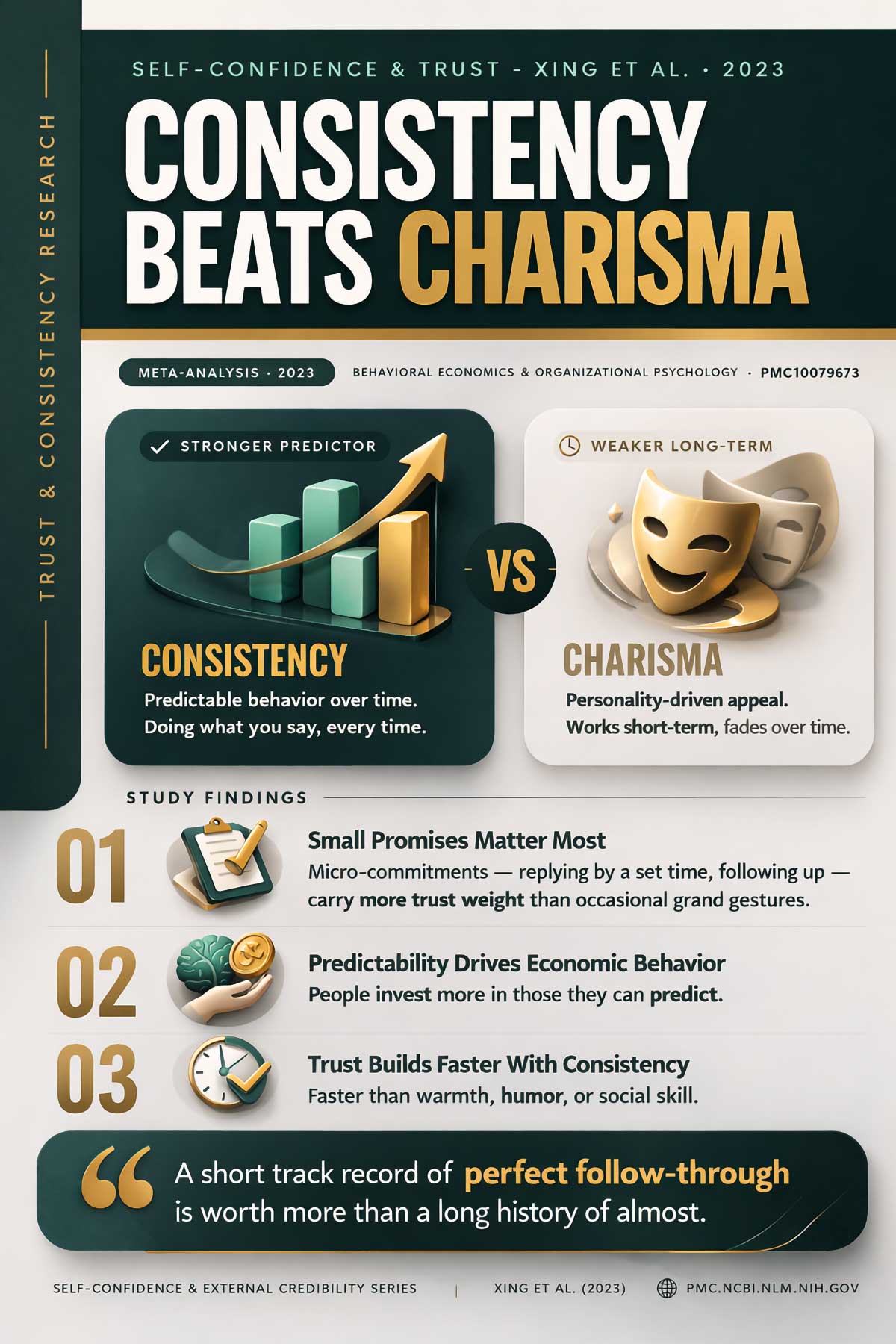
Think about the small promises people often drop: “I’ll send that over by end of day.” “Let’s connect next week.” “I’ll look into that.” When these don’t happen, people notice — even if they never say so.
A practical rule: under-promise and over-deliver on daily micro-commitments. Agree to fewer things and follow through on all of them. A short track record of perfect follow-through is worth more than a long history of “almost.”
Habit 3: Own Your Mistakes Without Hedging
Admitting you were wrong feels like a risk. Most people avoid it — they deflect, they soften it with “yes, but,” or they quietly move on hoping no one noticed.
Here’s the counterintuitive truth: owning an error fast actually builds your credibility rather than harming it.
Research covered by Phys.org in 2026, drawing on multiple studies in leadership and organizational behavior, found that intellectual humility — the willingness to admit when you were wrong — consistently increases perceived trustworthiness. People trust someone who says “I made a mistake, here’s how I’m fixing it” far more than someone who appears defensive or evasive.
Perfectionism, ironically, does the opposite of what people hope. It signals fragility, not strength. When you can say “I got that wrong” without flinching, people see someone confident enough to be honest.
Try this formula: Acknowledge the mistake. State the correction. Move forward. Three steps, no defensive detours. This approach keeps things clean and signals high integrity.
Habit 4: Show Warmth Before You Show Competence
Imagine meeting someone at a work event. They immediately launch into what they know, what they’ve done, and how they’d solve your problem. They’re clearly skilled. But something feels off.
That “something off” has a name in psychology. It’s the absence of warmth.
Foundational research by Fiske, Cuddy, and Glick (2002), which remains widely cited and supported today, found that warmth and competence together govern roughly 90% of positive social judgments. Crucially, warmth comes first. People decide how they feel about you before they evaluate what you know. When warmth is missing, even genuine competence can read as arrogance.
This doesn’t mean you have to be overly friendly. It means you make a small, genuine connection before you go into “expert mode.”
Try this: Before getting into the point of a conversation, ask two real questions about the other person. Skip the surface-level pleasantries. Instead of “How’s your day going?” try “What’s the most interesting problem you’re working on right now?” or “What would make your role easier?” Questions like these show genuine curiosity. When people feel seen, they become far more receptive to what you have to say next.
Habit 5: Hold Eye Contact at the Right Moments
Eye contact is one of the oldest trust signals there is. And the research behind it holds up.
Studies by Beebe in 1974 and 1976, which have been replicated and cited more than 128 times, found that eye contact significantly increases perceived speaker credibility in both public speaking and one-on-one conversation. Gaze is described in this research as a nonverbal determinant of credibility — meaning that without it, even strong words lose some of their authority.
Avoiding eye contact reads as evasiveness. Too much comes across as intimidating. The right range is three to five seconds of direct gaze during key points of a conversation, then a natural break.
Try this drill: When you meet someone today, make a point of noticing their eye color before they speak. This small act forces your gaze to land exactly where it needs to be. It sounds almost too simple. It works.
Habit 6: Ask Better Questions Instead of Making More Statements
Most people try to demonstrate intelligence by talking. The more self-assured move is often to ask a well-placed question.
Research compiled on the psychology of question-asking shows that asking thoughtful questions signals critical thinking, preparation, and genuine interest — all of which contribute to how credible you appear to others. A smart question tells the room that you’ve already thought ahead and you’re probing for the next layer.
There’s also a social dynamic at play. Asking genuine questions positions you as someone who values the other person’s thinking. That’s a form of respect that gets returned.
Try this: Before any important conversation, prepare one question that goes a level deeper than the obvious. Open with it. You’ll signal right away that you came prepared to think, not just to show up — and that’s a rare thing people notice immediately.
Habit 7: Cut the Hedging Language
This one is subtle but powerful.
Listen for these phrases in your own speech: “I think maybe…” “I’m not 100% sure, but…” “This might be a stretch, but…” “I sort of feel like…”
These are hedge words — soft qualifiers that cushion your statements. People use them to avoid seeming too strong or too certain. But the effect is the opposite of what’s intended. Research by Hosman (1989) in the journal Communication Research, as well as subsequent work by Stanford researchers, found that assertive language increases speaker credibility and persuasiveness, while hedging language weakens authority and invites others to doubt your conviction.
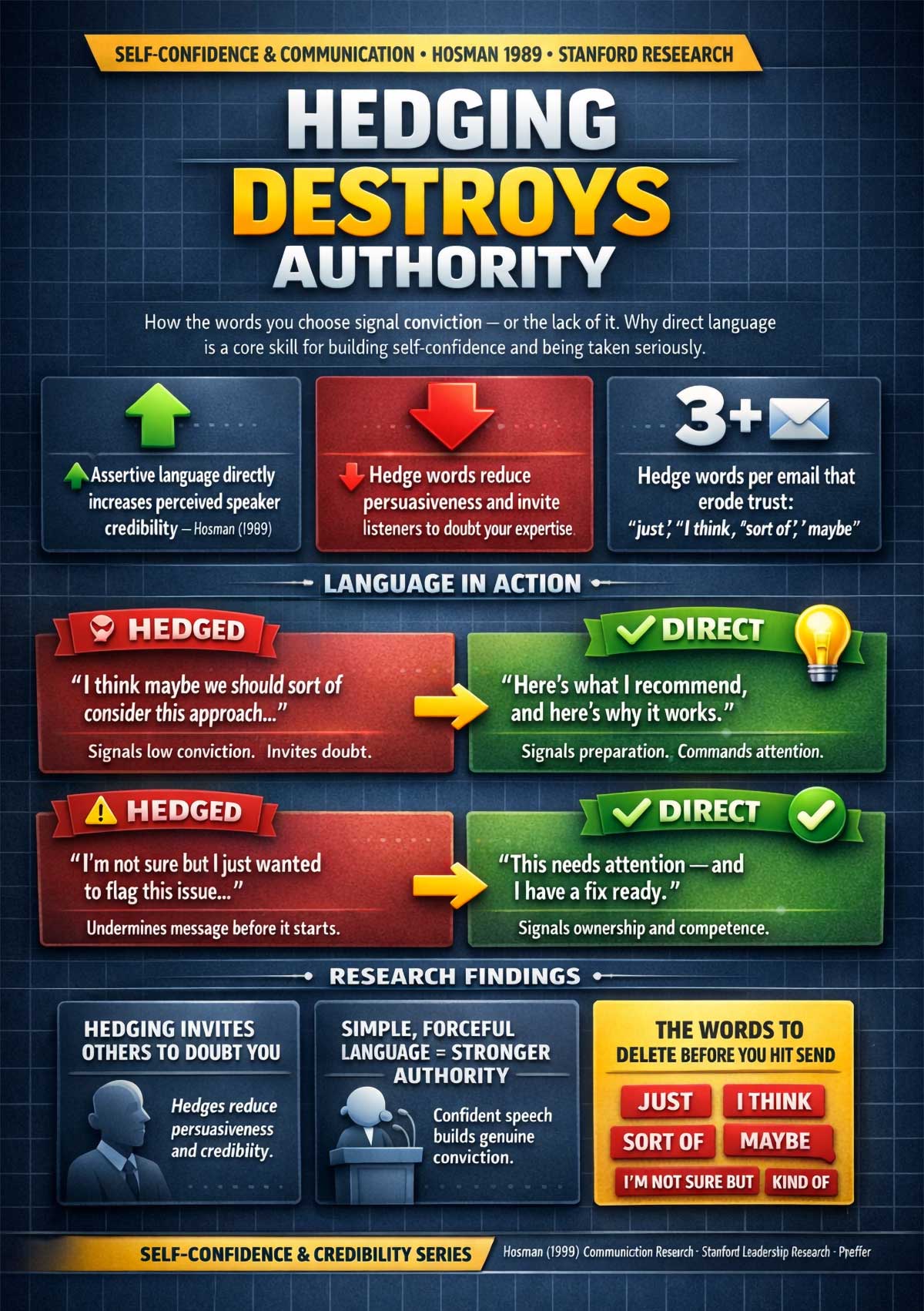
When you say “I think maybe we should consider…” you’re signaling uncertainty. When you say “Here’s what I’d recommend…” you’re signaling competence.
Try this: Before sending any email, scan it for the words “just,” “I think,” “sort of,” and “maybe.” Delete every one that isn’t genuinely necessary. Read the message again. You’ll likely find it sounds sharper, clearer, and more confident — because it is.
Why These Habits Compound Over Time
None of these habits will transform your reputation overnight. But that’s actually the point.
Credibility builds the way interest builds — slowly, then all at once. Each small act of follow-through, each clear sentence, each direct look during a conversation adds a data point to how others perceive you. Over weeks and months, these data points form a pattern. That pattern becomes your reputation.
The seven habits in this article work together. Direct language is more powerful when you hold eye contact. Consistent follow-through means more when you admit mistakes honestly. Warmth opens doors that competence alone can’t unlock.
Self confidence isn’t something you either have or don’t have. It’s something you build — through action, through consistency, and through the small choices you make in every interaction. Start with one habit. Get consistent with it. Then add another.
It’s worth naming something clearly: research also shows that women and people from underrepresented groups often face extra barriers to being taken seriously, even when applying these habits well. The psychology here is real and useful. But so are the structural gaps that exist in many workplaces and social settings. These habits can help shift the dynamic — they don’t erase the inequity.
When you take your own communication seriously, the people around you tend to follow.