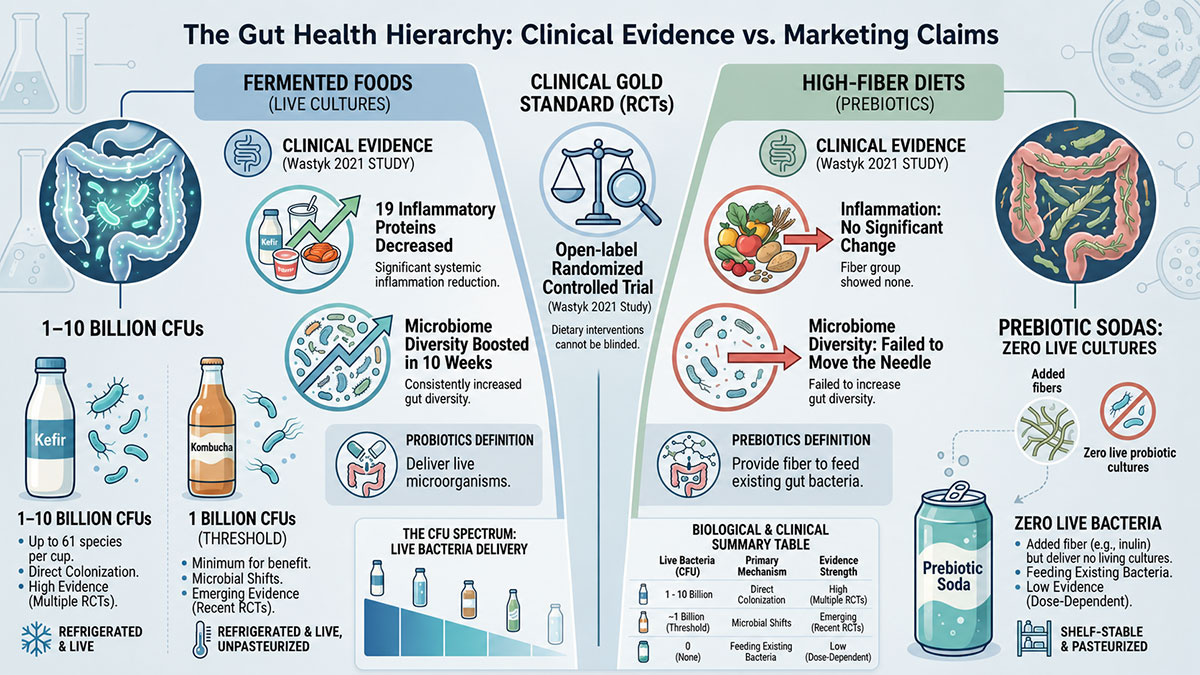
Researchers at Stanford set up a simple head-to-head: 10 weeks of fermented foods versus 10 weeks of a high-fiber diet. Most of the nutrition world would have predicted fiber to win. Fiber is the gut health story everyone tells. It didn’t win.
The group eating fermented foods (yogurt, kefir, kombucha, kimchi) increased their gut microbiome diversity and saw 19 inflammatory proteins drop. The fiber group showed neither effect, according to the study published in Cell in 2021.
That finding matters here because the fermented drink aisle has become almost impossible to navigate. Real probiotic drinks sit next to “prebiotic sodas” with nearly identical packaging and near-identical health claims. An $8.9 million class-action settlement involving Poppi (one of the fastest-growing gut health soda brands in the US) made it official: “gut health” marketing and actual live-bacteria delivery are two very different things.
This guide covers what the clinical evidence says about each major type of probiotic drink, what to look for on a label, and where the marketing stops and the biology starts.
The Category Confusion Worth Getting Clear First
A probiotic drink contains live microorganisms (bacteria or yeasts) that must survive your stomach acid and reach your intestine to do anything useful. A prebiotic drink contains fiber that feeds bacteria already living in your gut. These are not the same thing, though both can appear under “gut health” marketing.
Kombucha, kefir, kimchi juice, and water kefir are all fermented, and they contain live cultures as a product of the fermentation process itself. Prebiotic sodas like Poppi and Olipop contain inulin fiber added to carbonated water, with no fermentation and no live bacteria.
Here is where a regulatory distinction matters more than it might first appear. The NIH Office of Dietary Supplements notes that kombucha and kimchi “do not typically contain proven probiotic microorganisms” in the clinical sense, not because they lack live cultures, but because those cultures haven’t been tested at specific doses in human trials and cleared the bar for a certified probiotic claim.
Live cultures are not automatically classified as probiotics under the strict scientific definition, which requires demonstrated health benefits at specific doses. Most fermented drinks fall in between: genuinely containing live organisms with growing evidence for benefits, but not yet carrying the regulatory certainty of pharmaceutical probiotics. The gap between “has live bacteria” and “is a certified probiotic” is real, and it’s the gap most marketing ignores entirely.
Prebiotic sodas sit in a different category entirely. Fiber that feeds gut bacteria is real biology. The question is whether the dose in a single can is enough to matter.
Kefir: The Strongest Clinical Track Record
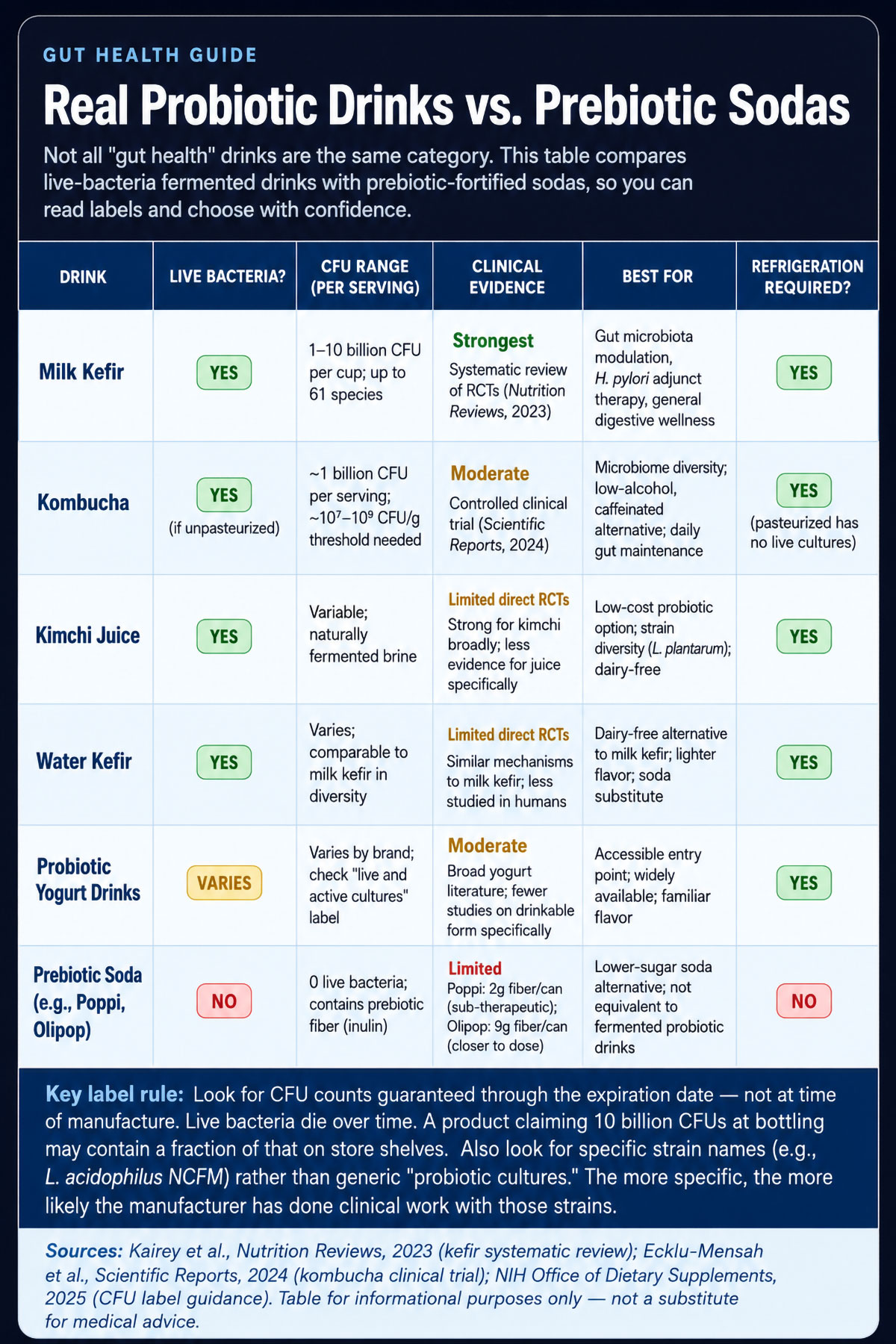
Of all the fermented drinks, kefir has the most extensive human trial literature. A 2023 systematic review in Nutrition Reviews (covering randomized controlled trials pulled from PubMed, Scopus, AMED, and the Cochrane database) found that fermented-milk kefir may modulate gut microbiota and improve quality of life in the short term.
The authors, led by Lana Kairey, noted that evidence quality across individual trials was heterogeneous, meaning not every outcome was consistent, but the directional finding for gut microbiota effects held.
The review also turned up something less expected: potential for kefir as adjunct therapy in Helicobacter pylori eradication. H. pylori is a stomach-lining infection that affects roughly half the world’s population and meaningfully raises lifetime stomach cancer risk. That a fermented dairy drink might assist in its treatment was not the headline finding, but it’s the one that sticks.
Part of why kefir performs consistently in trials is structural, and the numbers are more striking than most people expect. Milk kefir typically contains between 1 and 10 billion colony-forming units (CFUs) per cup across a diverse range of bacterial and yeast strains.
Some analyses have counted up to 61 different species. For comparison, a standard probiotic supplement usually carries 2 to 5 strains. The kefir matrix also appears to protect live organisms during digestion better than some capsule formulations, which matters because bacteria that die in stomach acid deliver no benefit.
The practical upshot: kefir bought from the refrigerated section, not shelf-stable or pasteurized versions, is the single fermented drink with the most consistent human evidence behind it. Dairy-free versions exist (coconut water kefir, water kefir), and both are genuinely fermented with live cultures, though their species profiles differ from milk kefir and have less clinical research supporting them specifically.
Kombucha: Real Fermentation, Mixed Clinical Results
Kombucha is fermented tea, produced by a SCOBY (symbiotic culture of bacteria and yeast) that converts sugar into organic acids, B vitamins, and live microorganisms. The fermentation is real, and the live cultures are real. The clinical picture is more complicated.
A 2024 controlled clinical study from UC San Diego, published in Scientific Reports, gave 16 participants four weeks of daily kombucha while 8 acted as controls. Gut microbiota composition did change: the kombucha group showed colonization by Weizmannia coagulans, a spore-forming probiotic bacterium present in the kombucha itself, along with shifts toward short-chain fatty acid-producing species.
What the study did not find: significant changes in inflammatory markers or biochemical parameters. Gut bacteria shifted. Measurable health markers did not, at least not within the study’s timeframe.
That’s a nuanced result, not a damning one. Microbiome shifts take time to translate into downstream effects, and eight weeks may not be long enough. A separate 2025 randomized trial on fiber-modified kombucha found it increased Bifidobacterium while reducing Ruminococcus torques, a genus associated with intestinal inflammation. The kombucha evidence is building. It just isn’t as consolidated as kefir’s yet.
For most people, refrigerated unpasteurized kombucha is the right starting point. Roughly 1 billion CFUs per serving is considered the minimum threshold for meaningful benefit, and that threshold only holds if the cultures are still alive when you open it.
Pasteurized kombucha, which some brands produce for a longer shelf life, kills the live cultures entirely. Check the label for “contains live cultures” or look specifically for unpasteurized products in the refrigerated section
Kimchi Juice and the Underrated Options
The liquid in a jar of kimchi is probiotic-rich brine from lacto-fermented cabbage. It is also the cheapest probiotic drink that most people already have access to if they eat kimchi at home. No special purchase required. The species profile, primarily Lactobacillus strains (particularly L. plantarum and L. mesenteroides), differs from kefir and kombucha, which means the two work on different microbial populations.
Rotating fermented drinks likely provides broader microbiome coverage than drinking a single one daily. Different drinks colonize different bacterial niches, so kefir and kimchi juice aren’t redundant, they’re additive. The RCT evidence specifically for kimchi juice as a standalone drink is thinner than for kimchi as a food, which is worth noting.
Water kefir follows a similar logic to milk kefir but uses sugar water or coconut water as its base instead of milk. It is naturally dairy-free and genuinely fermented with live cultures. The species composition varies depending on the kefir grains used, and it typically has a lighter, less tangy flavor than milk kefir, which makes it more approachable for people new to fermented drinks.
Probiotic yogurt drinks (drinkable yogurt with live cultures) occupy similar territory to milk kefir: fermented, dairy-based, high in live bacteria if unpasteurized and refrigerated. They tend to have fewer probiotic strains than kefir and are often higher in added sugar, so label reading matters.
Prebiotic Sodas: What You’re Actually Getting
Poppi settled a class-action lawsuit in 2025 for $8.9 million. The allegation: its marketing overstated gut health benefits from a product that contains 2 grams of inulin fiber per can, an amount the complaint said was “too low to cause meaningful gut health benefits.”
The company denied wrongdoing. The nutritional math, however, is relatively straightforward: research on agave inulin from 2022 found that 7.5 grams daily for three weeks produced no meaningful prebiotic effect. A single can of Poppi provides roughly a quarter of that dose.
Olipop, Poppi’s main competitor, provides 9 grams of fiber per can from a blend of chicory root inulin, cassava root fiber, and other plant sources. That’s closer to a therapeutic dose. Marion Nestle, emeritus professor of nutrition at NYU, says it’s still “not clear if the sodas contain enough prebiotics to significantly affect the gut,” but Olipop is in a different conversation than Poppi on dosage.
Julia Zumpano, a registered dietitian at the Cleveland Clinic, put it plainly: prebiotic sodas are better than regular soda, and they are fine in moderation. They are not equivalent to fermented drinks with live cultures.
This is the distinction worth holding onto: prebiotic sodas feed gut bacteria with fiber. Fermented drinks deliver bacteria directly. Both matter. They are not interchangeable, and the evidence base for the two categories is not comparable.
How to Read a Probiotic Drink Label
The NIH recommends looking for products that list CFUs at the end of shelf life, not at the time of manufacture. This distinction matters because bacteria die over time: a product that claimed 10 billion CFUs when bottled may contain a fraction of that by the time it reaches your refrigerator. Reputable brands guarantee CFU counts through the expiration date, which appears on the label as a different designation than the manufacture date.
Refrigeration is a signal, not a guarantee. Live cultures require cold storage to remain viable, so a probiotic drink that sits unrefrigerated on a warm shelf for weeks has likely experienced significant bacterial die-off. Pasteurization kills live cultures entirely. Pasteurized kombucha, for example, is essentially a flavored tea with none of the fermentation biology intact.
Spore-forming bacteria (like Weizmannia coagulans) are an exception: they can survive room temperature and stomach acid better than traditional Lactobacillus strains, which is why some shelf-stable probiotic drinks use them specifically.
What to look for on the label: “contains live and active cultures,” a CFU count guaranteed through the expiration date, and the specific strain names (generic “probiotic cultures” is less informative than “L. acidophilus NCFM” or “B. longum BB536”). The more specific the strain identification, the more likely the manufacturer has done clinical validation on those specific organisms.
Which Probiotic Drink Is Right for You?
Answer 5 questions to get a personalized recommendation based on your gut, diet, and preferences.
How Much Should You Drink, and When
There is no universal clinical dose for probiotic drinks because the “right” amount depends on the drink, the strain, and what you’re trying to accomplish. As a practical baseline, 8 ounces of kombucha or 4 to 8 ounces of kefir daily is what most clinical trials used, and it is what Mayo Clinic Press suggests as a starting point for new consumers. If you have never had fermented drinks regularly, starting with 4 ounces daily for the first week reduces the likelihood of gas and bloating as your gut adjusts.
Consistent daily consumption outperforms occasional large amounts, and the trial timelines explain why. The Sonnenburg RCT ran for 10 weeks because that’s roughly how long it takes for microbial populations to stabilize at new diversity levels.
The kombucha clinical trial saw meaningful microbiome shifts after just four weeks, but only in participants who drank it every day. A large amount once a week almost certainly won’t move the same levers, because bacterial colonization depends on repeated exposure more than total volume.
A note on timing: taking fermented drinks with food generally helps bacteria survive stomach acid, though spore-forming strains can be taken on an empty stomach without significant die-off. If you are on antibiotics, timing matters: some research suggests taking probiotic-rich foods at least two hours away from antibiotic doses reduces the chance of the antibiotics killing the probiotic bacteria before they reach your gut.
Who Should Be Cautious
Probiotic drinks are generally safe for healthy adults, but some populations should exercise caution. People with severely compromised immune systems (those undergoing chemotherapy, organ transplant recipients, or individuals with advanced HIV) face a small but real risk of bacteremia (bacteria entering the bloodstream) from ingesting large amounts of live cultures. The NIH recommends that immunocompromised individuals consult a physician before consuming probiotic products.
Kombucha contains trace amounts of alcohol (typically 0.5% to 3%, depending on fermentation time) and small amounts of caffeine from the tea base. Neither is clinically significant for most adults, but both matter for people avoiding alcohol entirely, pregnant women, and children. Kombucha also contains acetic acid. At high daily intakes (more than 12 ounces), there is a theoretical concern about tooth enamel erosion, similar to other acidic beverages.
Prebiotic sodas, particularly those high in inulin, can cause significant bloating in people with irritable bowel syndrome or those who are sensitive to FODMAPs (fermentable carbohydrates). Several dietitians, including Tamara Duker Freuman, have reported patients with severe bloating who improved immediately after stopping prebiotic sodas.
Of the three cautions in this section, this is the one most worth flagging up front: the inulin/FODMAP connection is the least intuitive, the most commonly missed, and the most likely to send someone down a two-week spiral of blaming their symptoms on the wrong thing.
The Sonnenburg group’s finding is worth thinking about: 10 weeks of fermented food consumption did something for gut diversity and inflammation that a high-fiber diet (often positioned as the gold standard of gut health) could not replicate in the same timeframe.
That doesn’t mean fiber doesn’t matter. It means fermented drinks appear to do something distinct. Kefir has the deepest clinical evidence. Kombucha has real fermentation biology behind it, with early evidence that its effects take longer to measure.
Kimchi juice is genuinely probiotic and largely ignored. Prebiotic sodas are better than regular soda, but they are not probiotic drinks. That distinction is worth more than any marketing claim on the label.