Three sessions a week sounds like the minimum requirement. It isn’t. Researchers tested one, two, and three sessions a week. The weakest schedule almost matched the strongest.
There’s a particular moment many people describe, somewhere in their fifties or sixties, when they reach for something on a high shelf or hoist a heavy bag of groceries and feel the effort in a way they never used to. The arms comply, but they complain. It’s not dramatic. Nobody pulls a muscle. There’s just this quiet awareness that something has changed, and the unspoken question underneath it: is this just how it goes now?
The standard answer, join a gym, lift heavy, do pushups, tends to stop a lot of people before they even start. Joints that have collected a few decades of wear don’t always welcome that kind of invitation. And so the question quietly gets shelved. Most people assume the window has closed. It hasn’t.
The Real Reason Arm Strength Matters After 50
Arm strength in older adults isn’t really a vanity issue. It’s a functional one. The ability to lift, carry, push, and pull without pain or hesitation is what lets people stay in their own homes, drive themselves to appointments, and keep doing the things that make daily life feel like their own. That’s not a small thing.
A review by Seguin and Nelson, published in The Physician and Sportsmedicine, found that strength training in older adults builds muscle mass and strength, preserves bone density, and counters the physical frailty that tends to accumulate with age. The review found that home-based programs produce meaningful results with minimal supervision. A clinical facility isn’t a requirement. Neither is a personal trainer, at least not to get started.
The barrier for most people over 50 isn’t willpower. It’s the assumption that real results require equipment and environments that feel inaccessible, or frankly, uninviting. That assumption is wrong, and the clinical record makes it clear.
What’s Actually Happening to Your Arms as You Age
From roughly the age of 50 onward, adults lose between 1% and 2% of muscle mass per year without deliberate resistance training. The technical term is sarcopenia, the gradual loss of skeletal muscle that comes with aging. It’s not just a size issue. Muscle loss affects strength, coordination, and the speed at which the nervous system can activate muscle fibers when you need them.
This is why everyday tasks start to feel harder. The muscles are smaller and slightly slower to respond. The good news, and this is genuinely good news, is that sarcopenia responds to resistance training at almost any age. The body doesn’t stop building muscle after 50. It just needs a reason to.
Connective tissue, tendons, and ligaments do become less elastic with age, which is why the pushup-and-heavy-barbell approach carries more injury risk for older adults than it does for someone in their thirties. That’s a real consideration. It’s also exactly why research on lower-load, home-based training matters so much for this age group.
You Don’t Need Heavy Weights. Here’s Why That’s Not Just a Comfort Statement
Most strength training guidance defaults to progressive overload at high intensity, typically around 80% of a person’s maximum lifting capacity. That framework works. It’s well-supported. But it’s also the kind of prescription that can put people off entirely, and it turns out it may not be necessary.
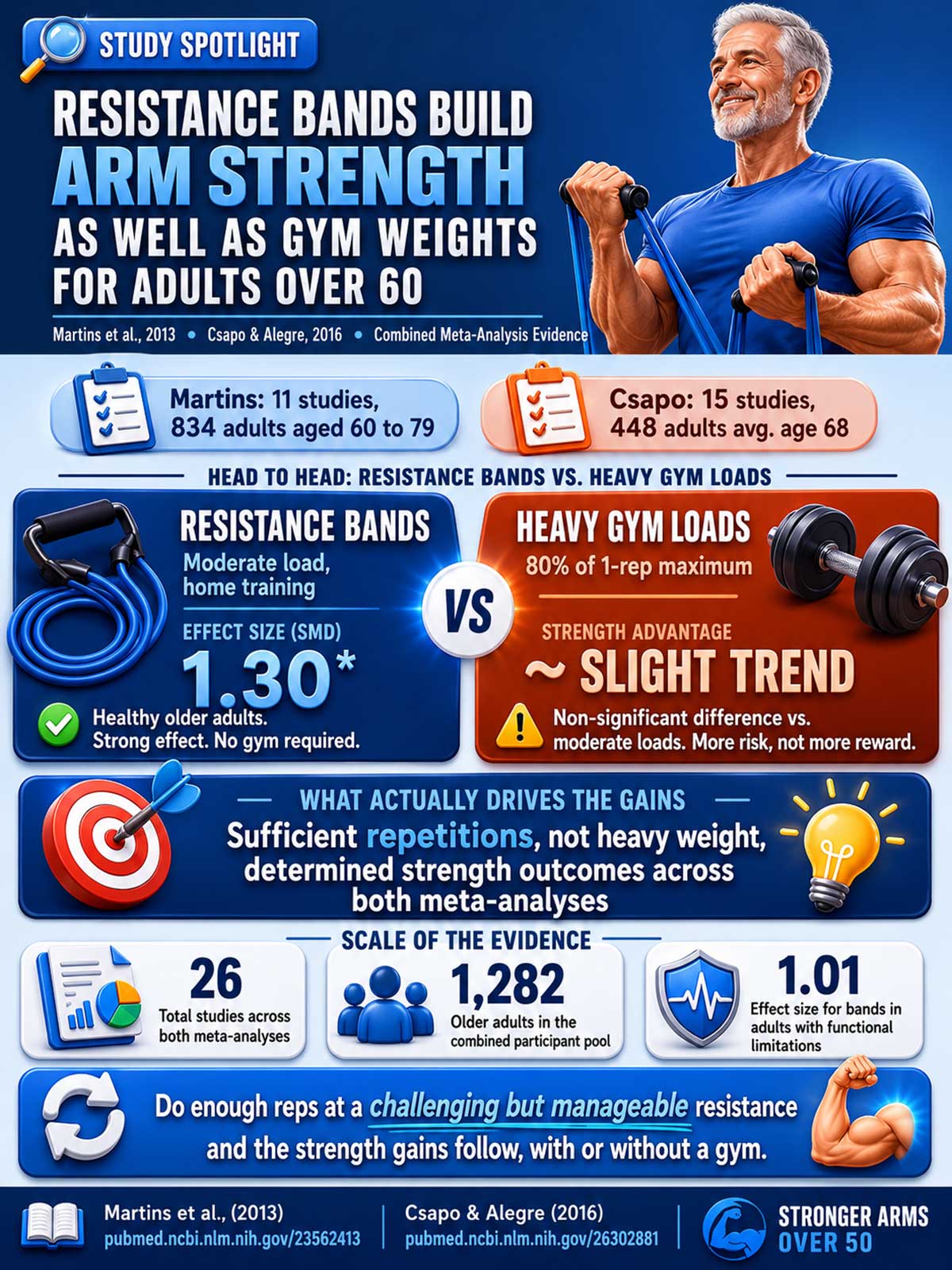
A meta-analysis by Csapo and Alegre examined 15 studies involving nearly 450 older adults and compared moderate loads (around 45% of maximum capacity) with heavy loads (around 80% of maximum capacity). Both groups made substantial strength gains. The heavier group showed a slight trend toward larger gains, but the difference was not statistically significant, meaning both approaches work. What actually determined the outcome was whether people performed enough repetitions, not how much weight they stacked.
That finding is corroborated by a meta-analysis by Martins and colleagues, covering 11 studies and about 800 older adults, which found that elastic resistance band training produced strong effect sizes for strength gains: an SMD of 1.30 in older adults in good health and 1.01 in those with functional limitations. Resistance bands, the kind that cost under $20, matched results seen in gym-based programs. That’s not a workaround. It’s a legitimate training method with solid evidence behind it.
What Six Weeks Actually Does to Aging Muscle
Six weeks sounds short. It is short, by most fitness standards. But the physiology of early-stage resistance training, especially in older adults who haven’t been training consistently, moves faster than most people expect.
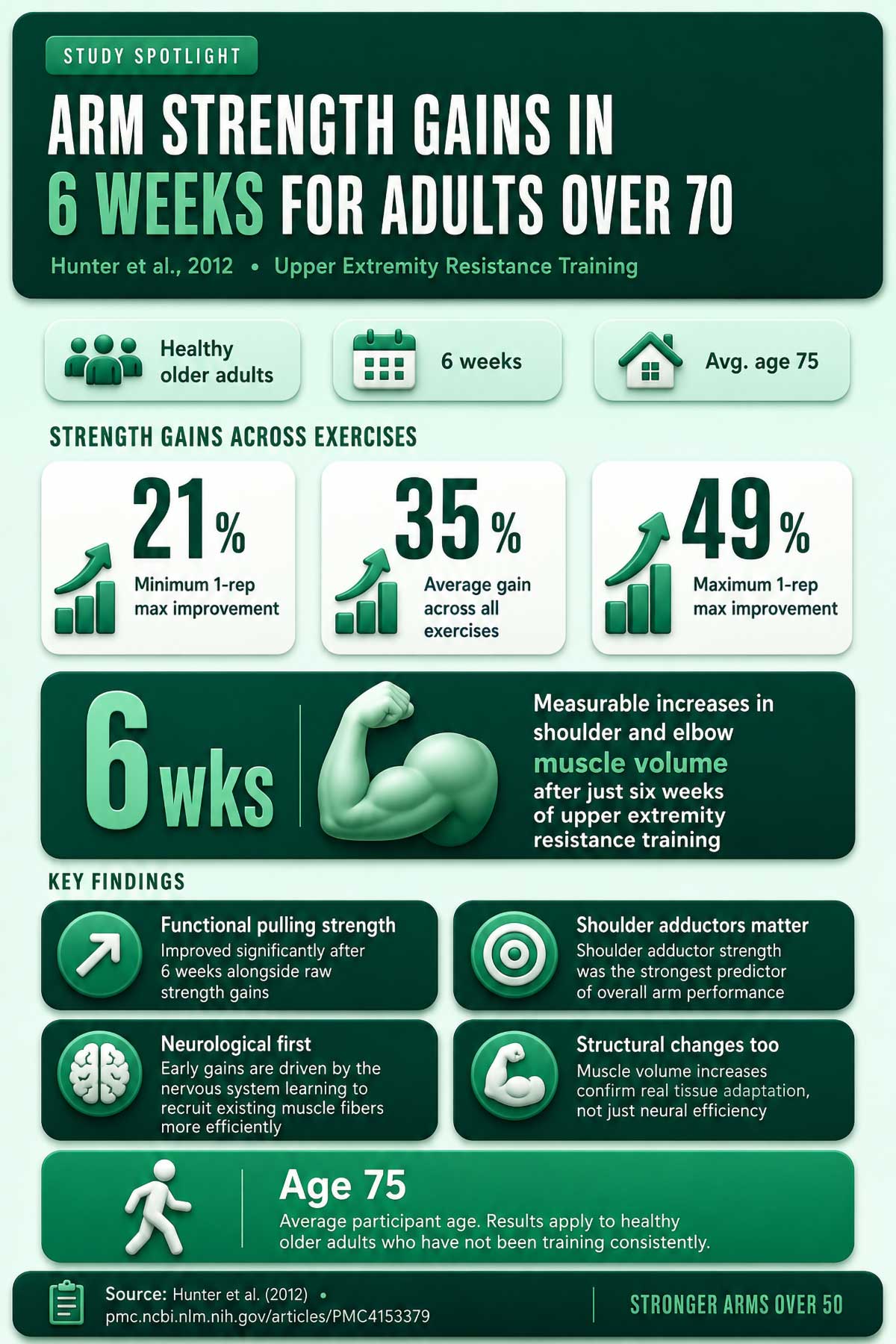
A study by Hunter and colleagues enrolled healthy older adults (average age around 75) in an upper-extremity resistance program for 6 weeks. Strength gains across exercises ranged from 21% to 49% of one-rep maximum. Functional pulling strength improved. Shoulder and elbow muscle volume measurably increased. Six weeks. The early gains are partly neurological; the nervous system gets more efficient at recruiting existing muscle fibers, but structural changes in the muscle tissue itself also begin within this window.
One detail from that Hunter study worth noting: shoulder adductor strength was a strong predictor of overall arm performance. If you’re going to prioritize anything in the first few weeks, pulling movements that work the muscles drawing the upper arm toward the body deserve attention.
How Often Do You Actually Need to Train?
This is where most people’s instincts work against them. The assumption is that more sessions per week means faster progress, and anything less than three days feels like cutting corners. The data doesn’t support that.
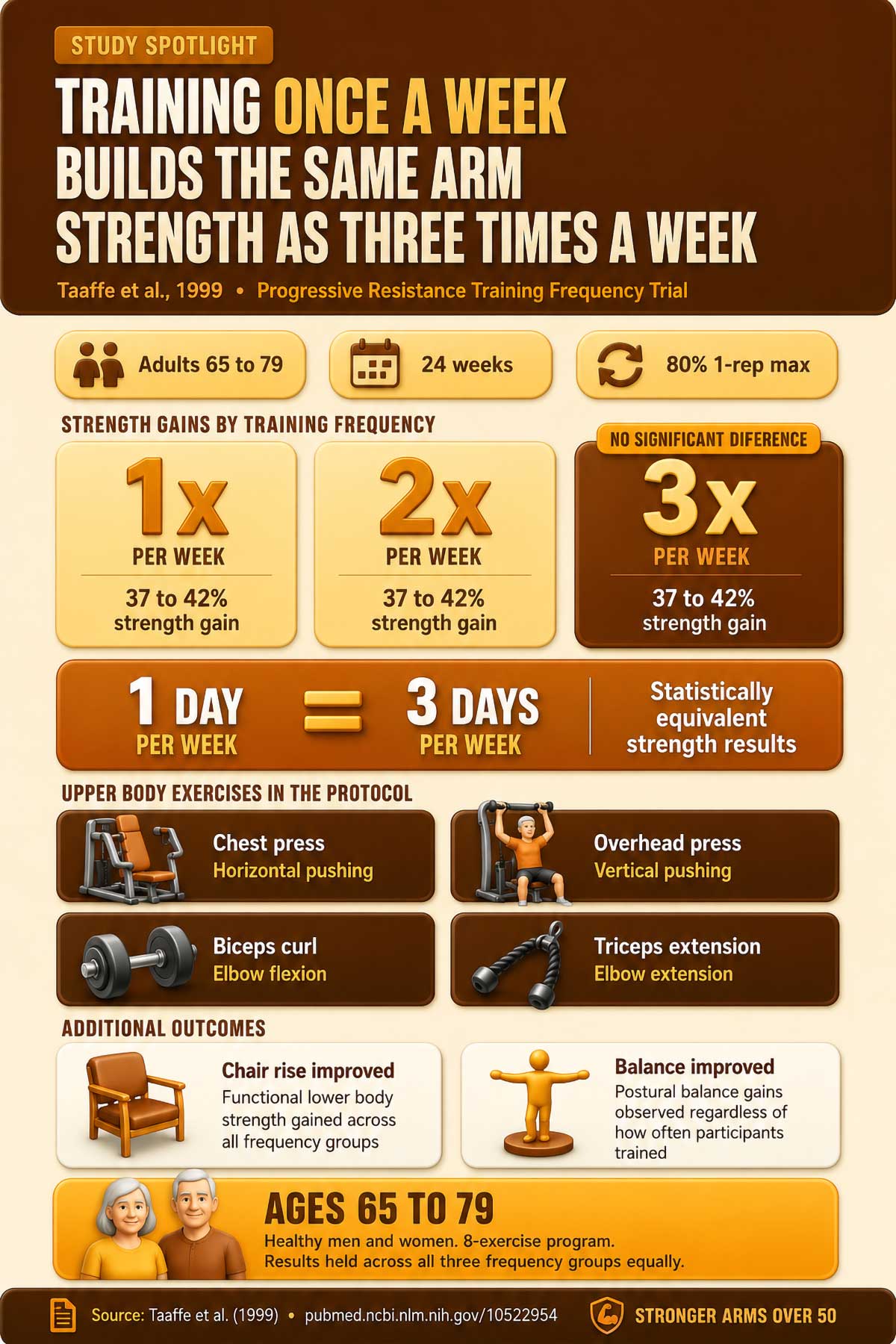
A study by Taaffe and colleagues assigned adults aged 65 to 79 to training once, twice, or three times per week using an eight-exercise progressive resistance program at 80% of one-rep maximum. After 24 weeks, the once-weekly and twice-weekly groups achieved strength gains of 37% to 42%, which were statistically comparable to the three-times-weekly group. Chair rise and balance improved across all three groups.
Once a week produced nearly the same result as three times a week. That’s a meaningful finding for anyone whose schedule, joints, or recovery capacity make frequent training feel impossible. You don’t need to train every other day to get somewhere real. What you need is consistency over time, and that’s much easier to maintain when the commitment feels manageable.
The Protocol: An 8-Exercise Upper and Lower Body Framework
Based on the Taaffe protocol and the exercise categories confirmed across the research to improve upper-body strength gains in older adults, an effective home session covers four upper-body movements and four lower-body movements. The upper body: chest press, overhead press, biceps curl, and triceps extension. The lower body: squats or chair rises, hip abduction, calf raises, and back extension. That pairing matters, arms don’t work in isolation, and neither should your training.
Using resistance bands or light dumbbells, perform each exercise for two to three sets of 10 to 15 repetitions. Work at a resistance level where the last two or three reps of each set are genuinely effortful, but form stays clean. If you finish a set and feel like you have five more easy reps in you, the resistance is too light. If form breaks down before you reach 10 reps, ease back. The target is controlled fatigue, not struggle.
Rest 60 to 90 seconds between sets. Keep the session to 30-45 minutes total. One or two sessions per week, with at least 48 hours between them, are enough to produce meaningful strength gains, according to research. Three sessions a week are an option if you enjoy the routine and recover well, but they aren’t required to see results.
A Closer Look at the Upper Body Exercises
Form matters more than load, especially early on. Here’s what each of the four upper-body movements does and how to approach them using bands or light dumbbells.
Chest press: Lie on your back or sit upright in a chair. Push both arms forward and slightly up from chest height, then return slowly. The slow return, the eccentric phase, is where a notable portion of strength development happens. Don’t rush it.
Overhead press: Start with hands at shoulder height, palms facing forward. Press upward until arms are extended, then lower with control. Keep the core lightly engaged to avoid arching the lower back. People with shoulder discomfort can reduce the range of motion to whatever feels pain-free.
Biceps curl: Stand or sit with arms at sides, palms facing up. Curl both hands toward the shoulders, keeping the upper arms still. This is one where resistance bands work particularly well because the tension increases throughout the range of motion, matching the biceps’ strength curve.
Triceps extension: Hold a light weight or looped band overhead with both hands. Lower behind the head by bending at the elbows, then press back up. The triceps make up roughly two-thirds of upper arm volume, so they deserve as much attention as the biceps, arguably more.
Progressive Overload: The One Rule You Can’t Skip
Every study that produced meaningful strength gains used progressive resistance training, meaning the load or difficulty increased over time as the participant got stronger. This is the mechanism that actually drives adaptation. Without it, training plateaus quickly.
In practice, this means adding resistance every two to three weeks once the current level no longer feels challenging. With bands, that means moving to a heavier resistance level. With dumbbells, it means adding a small increment of weight. The progression doesn’t need to be large. Even a modest increase is enough to keep the muscles adapting.
A simple rule: when you can complete all three sets of 15 reps with good form and still feel like you have more left, it’s time to increase the resistance. This doesn’t require a fitness tracker or a coach. It just requires paying attention.
Why Your Arms Aren’t the Whole Story
The strength gains that translate most directly into real-world function come from full-body resistance programs, not isolated arm work. Carrying groceries requires grip, yes, but it also requires postural stability, leg strength, and core control. Training only the arms produces narrower results than the eight-exercise structure outlined here.
A Cochrane review by Liu and Latham that analyzed 121 randomized controlled trials involving more than 6,700 older adults found that progressive resistance training had a large positive effect on strength overall (SMD 0.84), with modest but real improvements in gait speed and chair-rise performance. A separate meta-analysis by Peterson and colleagues covering 147 trials found an average strength effect size of 1.10, with larger effects when intensity and consistency were higher. Both reviews confirmed upper-body benefits across diverse populations and ages.
The National Strength and Conditioning Association’s position statement, authored by Fragala and colleagues, is direct on this point: resistance training counters age-related muscle loss, improves mobility and quality of life, and is recommended for various health conditions in older adults. Not suggested. Recommended.
Common Mistakes That Slow Progress
The most common error is training too lightly for too long. People worry about injury, which is reasonable, but they often stay at a beginner resistance level for months without progressing. The muscles adapt quickly and then stop adapting if the challenge doesn’t increase. If you’ve been using the same resistance band for three months and it still feels easy, that’s the issue.
The second mistake is skipping lower-body movements because the goal is “arm strength.” The lower body exercises in this protocol aren’t filler. Chair rises build the leg and hip strength that supports everything else, including upper body stability during pressing movements. Calf raises and hip abduction work the postural muscles that keep the body balanced under load. A wobbly base limits what the arms can do.
The third: not resting enough between sets. Sixty to 90 seconds feels like a long time when you’re standing around, but it’s the recovery window that lets the muscles produce close to full effort on the next set. Shortening rest periods too much turns strength training into endurance work, which is a different adaptation entirely.
What to Expect in the First Six Weeks
Weeks one and two will feel unfamiliar. The movements may feel awkward, and muscle soreness 24 to 48 hours after sessions is normal. This is delayed onset muscle soreness (DOMS), a sign that the muscles are responding to an unfamiliar stimulus. It typically fades as the body adjusts.
By weeks three and four, the soreness usually decreases, and the movements start to feel more natural. This is the neurological adaptation phase; the nervous system is getting more efficient. You may notice that a resistance level that felt hard in week one now feels manageable. That’s progress, and it’s the signal to start thinking about increasing the load.
Weeks five and six are when the structural changes in muscle tissue become more apparent. Functional tasks that felt labored in week one, lifting something overhead, pulling open a heavy door, start to feel different. Not effortless, but noticeably easier. That’s the adaptation the Hunter study measured, and it’s real within this timeframe for most people who train consistently.
Starting Is the Actual Hard Part
The research here is more settled than most people realize. Older adults build meaningful muscle strength in a matter of weeks. They do it at home, with bands or light weights, once or twice a week. The mechanism works regardless of whether someone is 55 or 75. The physiology doesn’t distinguish between those who “used to be active” and those who haven’t trained in decades. The body responds to the stimulus.
What the data can’t do is make the decision. Most fitness content aimed at older adults either treats readers like they’re fragile or glosses over genuine concerns about pain and injury. The evidence here does neither. It says the load can be light. The frequency can be low. The setting can be a living room. And the timeline to something real is six weeks, not six months. That’s a reasonable ask.