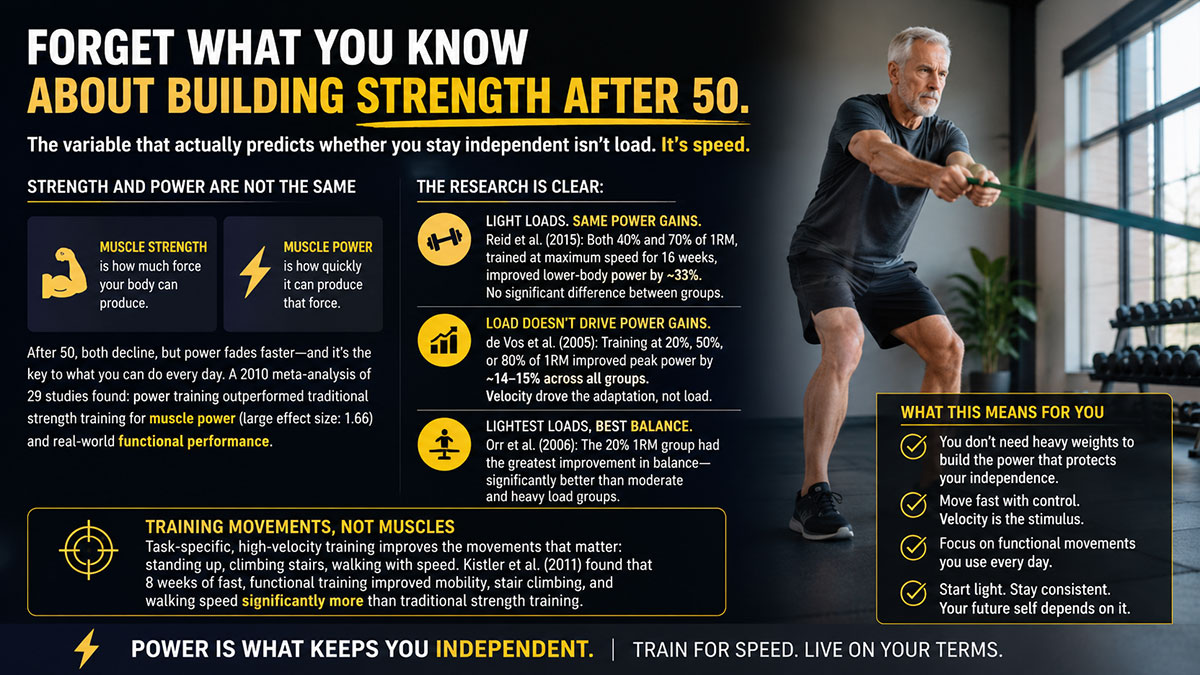
Forget what you know about building strength after 50. The variable that actually predicts whether you stay independent isn’t load. It’s speed.
There’s a specific moment most people over 50 can identify. Getting up from a low chair takes a half-second of mental preparation. Carrying groceries up a flight of stairs feels different than it used to. Nothing’s broken, nothing’s injured. Things just don’t respond the way they once did.
The standard advice is to lift weights. Build muscle, regain strength, reverse the decline. The advice isn’t wrong. But it skips a critical distinction, one that changes everything about how training should work for aging bodies.
Most people over 50 assume their body has simply gotten weaker. Strength is part of it. But there’s a second quality that fades even faster, and it’s the one that actually governs what you can do on any given day.
Strength and Power Are Not the Same Thing
Muscle strength is how much force your body can produce. Muscle power is how quickly it can produce that force. After 50, both decline, but they don’t decline at the same rate, and they don’t respond to training in the same way.
The gap matters more than most people realize. Standing up from a chair doesn’t require exceptional leg strength. It requires your muscles to fire fast enough to get the job done before your balance shifts. Catching yourself when you stumble doesn’t need raw force. It needs speed.
Traditional resistance training (moving heavy loads slowly) is very good at rebuilding maximal strength. It’s less effective at rebuilding the explosive quality that daily function depends on. A 2010 meta-analysis by Steib and colleagues, covering 29 randomized controlled trials and over 1,300 older adults, confirmed this directly. High-intensity progressive resistance training outperformed power training for maximal strength gains. But power training outperformed standard resistance training on two counts: muscle power, where the effect size was large (SMD = 1.66), and real-world functional performance, where power training again came out ahead despite no advantage in raw strength.
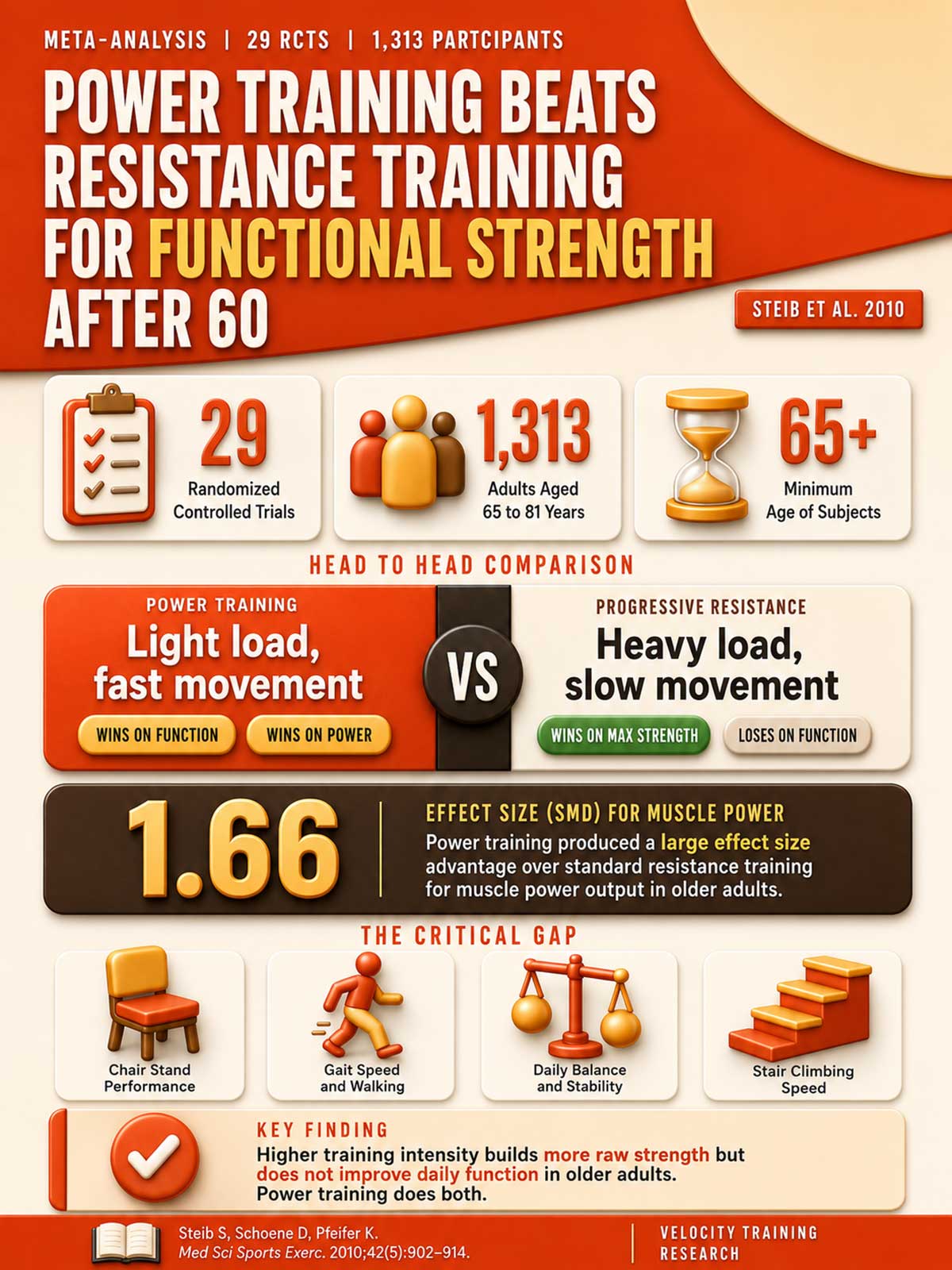
Lifting heavier doesn’t automatically translate to moving better. The two adapt through different pathways.
What Happens When You Train for Speed Instead of Load
Power training means moving a weight as fast as possible during the lifting phase, regardless of how heavy that weight is. The intent is everything. A light resistance band snapped upward with full intention produces a different neuromuscular stimulus than a heavy dumbbell lifted slowly and carefully. The muscle fiber recruitment patterns are distinct, and so are the functional gains.
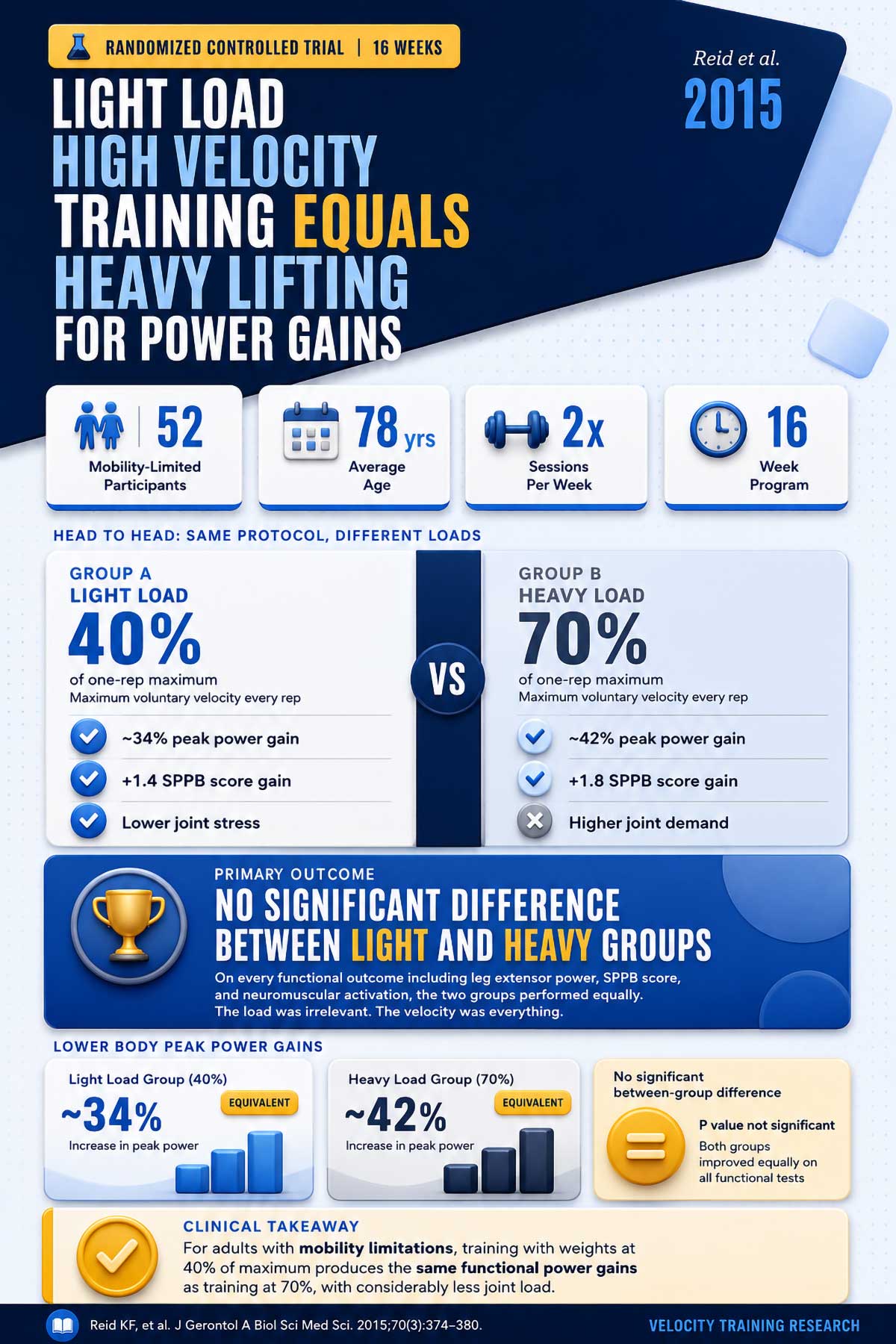
What makes this practically relevant for people over 50 is that “light” genuinely means light. You don’t need 70% of your maximum load to build the kind of power that protects your independence. A 16-week randomized controlled trial by Reid and colleagues (2015) put this to a direct test in mobility-limited older adults averaging 78 years of age. One group trained at 40% of their one-rep maximum. The other trained at 70%. Both groups performed every rep at maximum voluntary velocity. The result: both groups improved lower-body peak power by roughly a third, and physical performance scores rose by comparable amounts. No significant difference between the light group and the heavy group on any functional outcome.
This gets confirmed again from a different angle by de Vos and colleagues (2005), whose randomized trial assigned 112 healthy older adults to train at 20%, 50%, or 80% of their maximum load. Peak muscle power improved by around 14 to 15% across all three groups. The lightest weight produced the same power gains as the heaviest.
Strength and endurance showed a dose-response relationship with load intensity, but power didn’t. The velocity of the movement drove the adaptation, not the resistance on the bar.
This is a meaningful shift in what “effective” training looks like for an aging body. Joints under 40% load move differently than joints under 70% load. The wear is different. The barrier to starting is different. And as the evidence shows, the power gains are the same.
The Balance Finding That Defies Expectation
Of all the falls an older adult will take, most happen in the time between losing balance and reaching for something to grab. That window is under a second. Slowing it down isn’t an option. The only thing that helps is muscle power fast enough to respond before the fall is inevitable.
Falls are the leading cause of injury-related death in adults over 65. Balance and fall prevention are, in practical terms, the most important outputs of any fitness program for older adults. The finding from Orr and colleagues (2006), a randomized trial of 112 community-dwelling older adults across the same three load groups as de Vos, is worth sitting with. Power training improved balance significantly across all three training groups. But the lowest-load group (20% of maximum) produced the greatest balance improvement, significantly outperforming both the moderate and heavy groups.
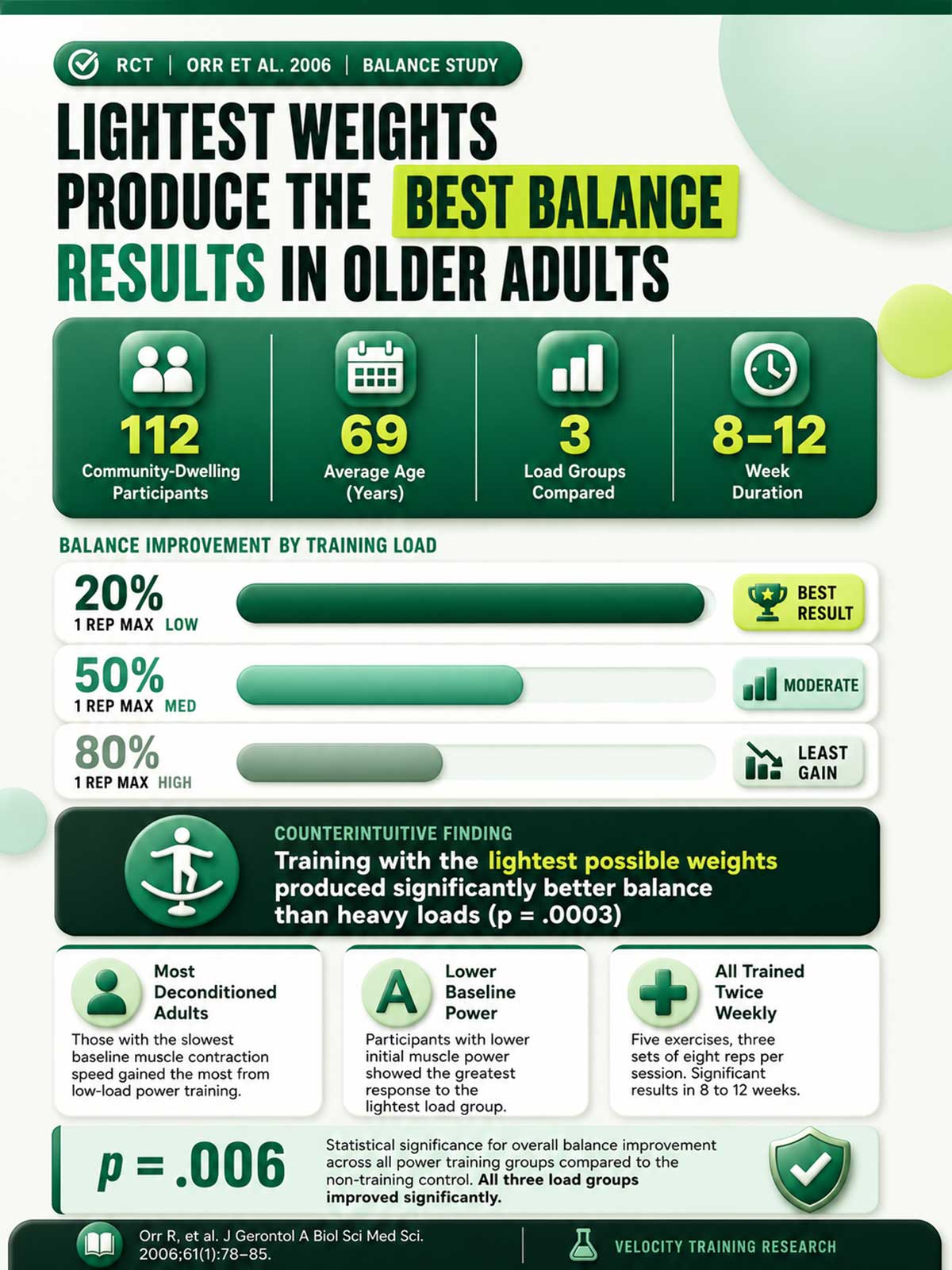
The lightest weights produced the best balance outcomes. This runs against almost everything the gym industry has told people over 50 about what “serious” training requires. The researchers also found that people who had the slowest contraction speeds at baseline, meaning those who were most deconditioned, benefited the most from low-load power work. The people who feel least capable of training are precisely those who respond best to it.
Training Movements, Not Muscles
There’s a version of power training that goes further than basic fast-rep resistance work. It targets the specific movements that functional decline actually disrupts: getting up from a chair, climbing stairs, walking at pace. The approach is called task-specific, high-velocity training, and the clinical evidence behind it is notably strong.
Bean and colleagues (2009) ran a 16-week randomized controlled trial with 138 mobility-limited older adults, published in the Journals of Gerontology Series A. They compared the InVEST (Increased Velocity Exercise Specific to Task) protocol against the standard NIA strength training program. The task-specific group showed significantly greater gains in limb power per kilogram of bodyweight (p = 0.02). Both groups improved on the Short Physical Performance Battery, a real-world mobility test, but the power group pulled ahead on the measures that required explosive speed.
An earlier pilot by the same research group reinforced this. Bean and colleagues (2004) studied women over 70 with mobility limitations across 12 weeks. The high-velocity task-specific group significantly improved leg power, chair-stand time, and gait speed compared to the slow-velocity control. Chair-stand time is exactly the kind of measure that connects directly to daily function. Gait speed in older adults is also one of the most reliable predictors of survival and health outcomes available.
What these trials point to is that training doesn’t just need to be explosive. It works best when it mirrors the functional demands of the movements people are losing. A fast squat-to-stand. A quick step-up. A rapid weight transfer. These aren’t just exercises. They’re rehearsals for the moments that determine whether someone stays independent.
How to Actually Use This
One of the persistent barriers to older adults starting any strength program is complexity. Lengthy routines, intimidating equipment, high training frequency are often cited as reasons people don’t start or don’t stick with a program. The evidence, conveniently, points toward simplicity.
A 2016 systematic review by Byrne and colleagues covering 31 power training studies found that the best protocols shared a few features: maximal intended movement speed, low load, simple methods, and low training volume and frequency. Ten of the 13 studies that compared power training directly to standard resistance training found power training superior for power or functional outcomes.
Low frequency matters here. Two sessions per week was the common protocol across the key trials cited throughout this article. That’s a manageable commitment, and the studies were explicit that it was sufficient. Combining this with endurance activity is also supported. A review by Cadore and Izquierdo (2013) found concurrent training (pairing strength and endurance work) is effective in older adults. They also recommend doing strength or power work before endurance in the same session, to avoid dulling the neuromuscular response.
In practical terms, this is accessible exercise. Light resistance bands or dumbbells. Bodyweight squat-to-stands performed with intent and speed. Step-ups done briskly. The weight is almost irrelevant if the intent to move fast is genuine and consistent. That’s the core principle, and it’s one the research supports clearly.
The Actual Missing Variable
The fitness industry defaults to load because load is visible and quantifiable. You can see how much someone is lifting. You can track progression in kilograms. Velocity is harder to measure informally, and “move it fast” isn’t the kind of advice that fills a gym program template.
But for older adults who want to stay functional, the missing variable isn’t more weight on the bar. It’s the speed of muscle contraction. Specifically, the intent to contract as fast as possible when a light load allows for it. That intent, practiced twice a week over 12 to 16 weeks, produces power gains equal to heavy lifting, with lower joint stress, a lower barrier to starting, and, for balance, measurably better results.
The body doesn’t need to be pushed to its structural limits to recapture what aging has taken. It needs to be trained to be fast again.