Most people think sleep deprivation starts with feeling tired. Brain imaging suggests the earliest changes happen much sooner, and they’re surprisingly easy to mistake for stress.
For most of the twentieth century, doctors treated sleep as passive downtime, the brain idling until morning. Brain scans have spent the last two decades quietly taking that assumption apart.
What they show instead is a brain that changes shape under sleep loss. Not metaphorically. An alarm system that overreacts, a judgment center that goes quiet, and in some cases, measurable shrinkage in the tissue itself.
None of it announces itself the way a headache does, which is exactly why it’s worth understanding before a rough week turns into a pattern.
The Signs Your Brain Is Already Running a Deficit
Most people wait for a genuinely bad night to notice sleep loss. The brain usually signals it earlier, in ways that are easy to mistake for stress or a slow morning.
Attention narrows first. Reaction time slows, working memory gets patchy, and small decisions start requiring visible effort. Mood follows close behind: a shorter fuse, a harder time reading someone else’s tone correctly, a sense that everything feels slightly more personal than it should.
The physical tells are more familiar. Heavier eyelids. A slower blink rate. Microsleeps, those two- or three-second lapses where the brain drops into sleep without you really wanting to, usually during something monotonous like driving or a long meeting.
Behaviorally, cravings for sugar and caffeine climb noticeably, a pattern the brain’s reward circuitry explains further down.
Is Seven Hours Actually Enough?
For most adults, no. The National Heart, Lung, and Blood Institute and the Sleep Foundation both put the healthy range at seven to nine hours a night, with anything under seven counted as insufficient for the majority of people. A small percentage of adults do function well on less, a trait tied to a specific genetic variant rather than something most people can train themselves to do.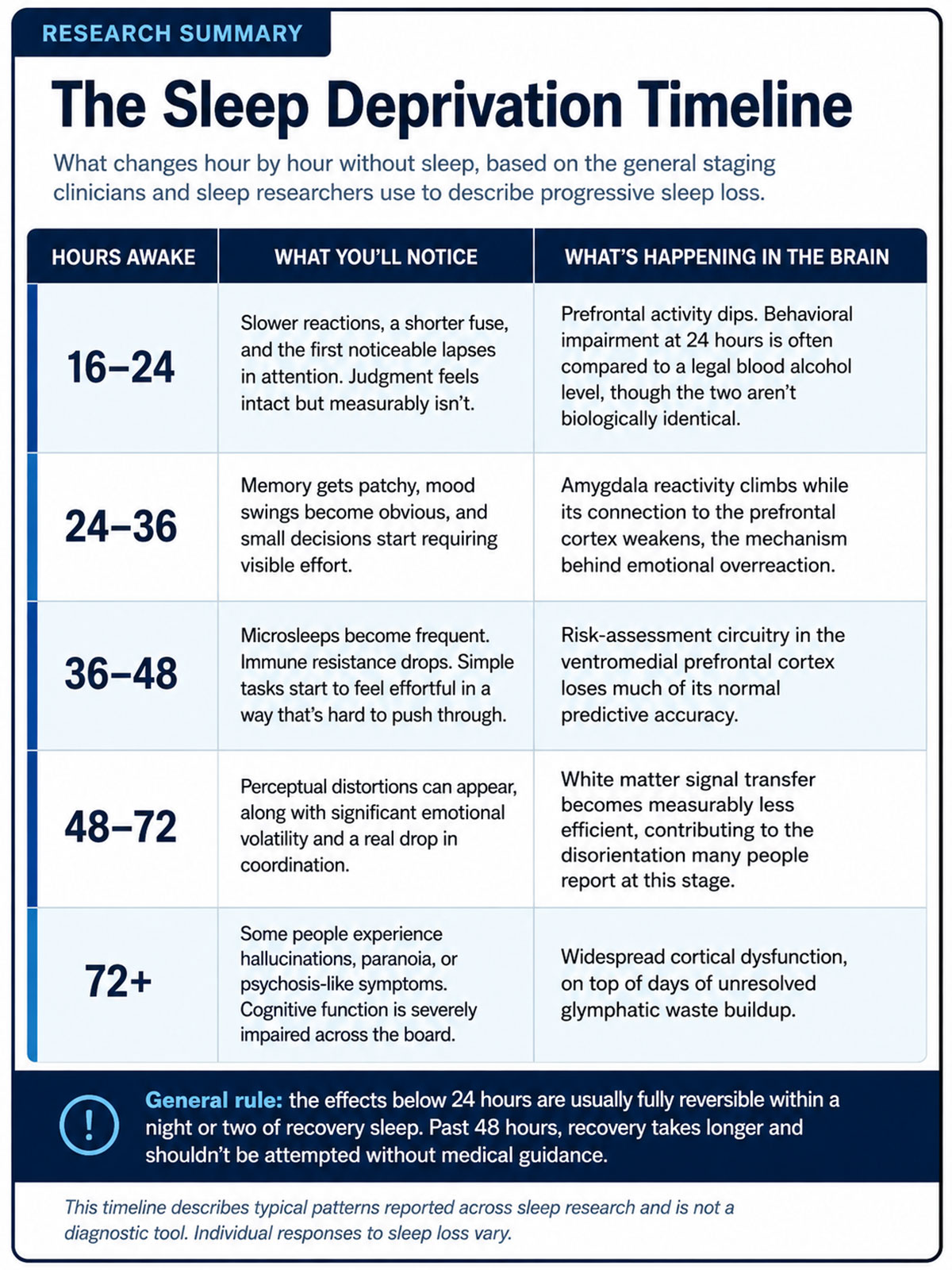
The Emotional Brake Line Gets Cut
Researchers at UC Berkeley wanted to know why a single bad night makes ordinary frustrations feel disproportionate. What they found involves two brain regions that normally work as a team.
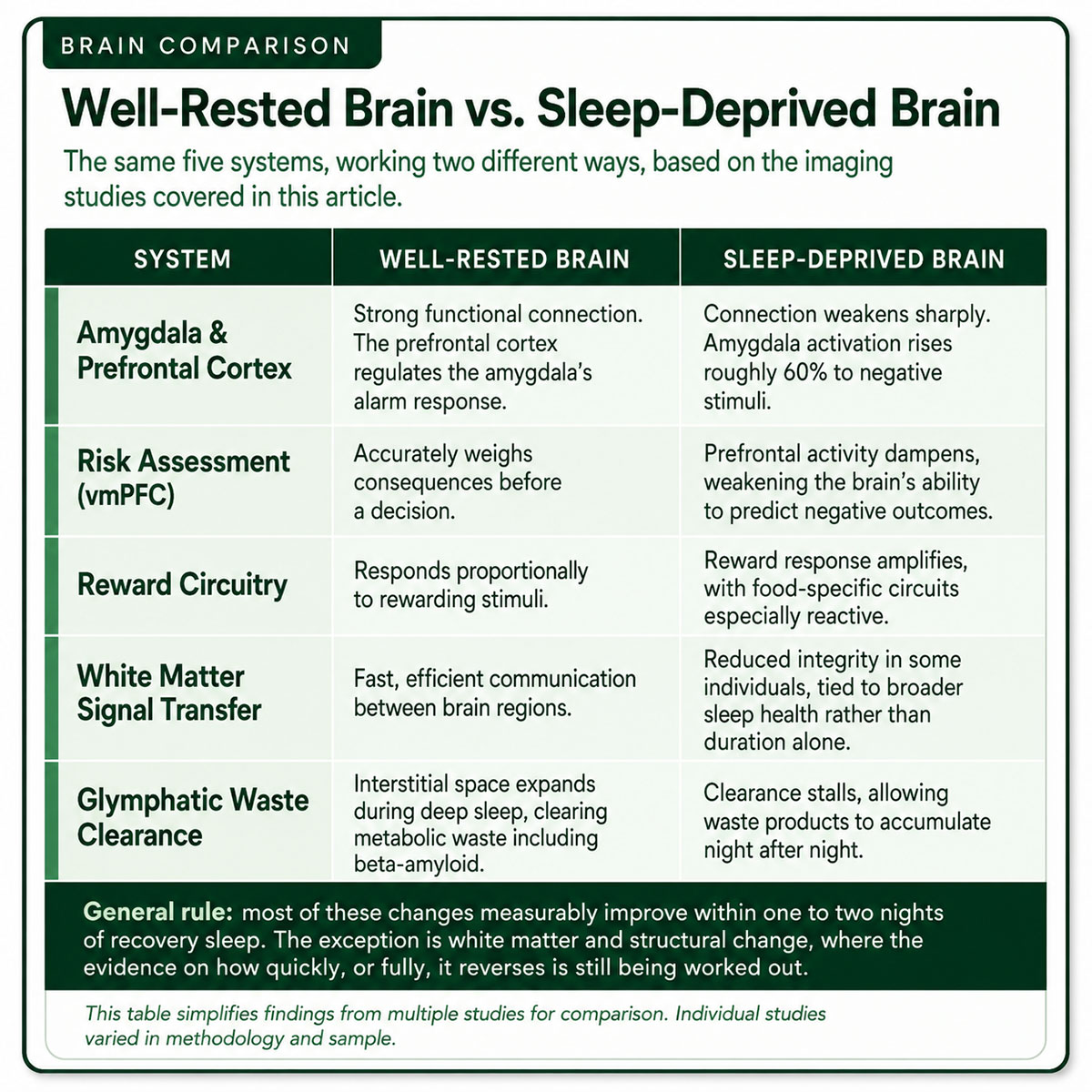
The amygdala works as the brain’s alarm system, firing when something feels threatening or upsetting. The medial prefrontal cortex works like a brake pedal, keeping that alarm from taking over.
Well rested, the two stay in close communication. The prefrontal cortex tells the amygdala to calm down, the emotion gets processed, and the moment passes.
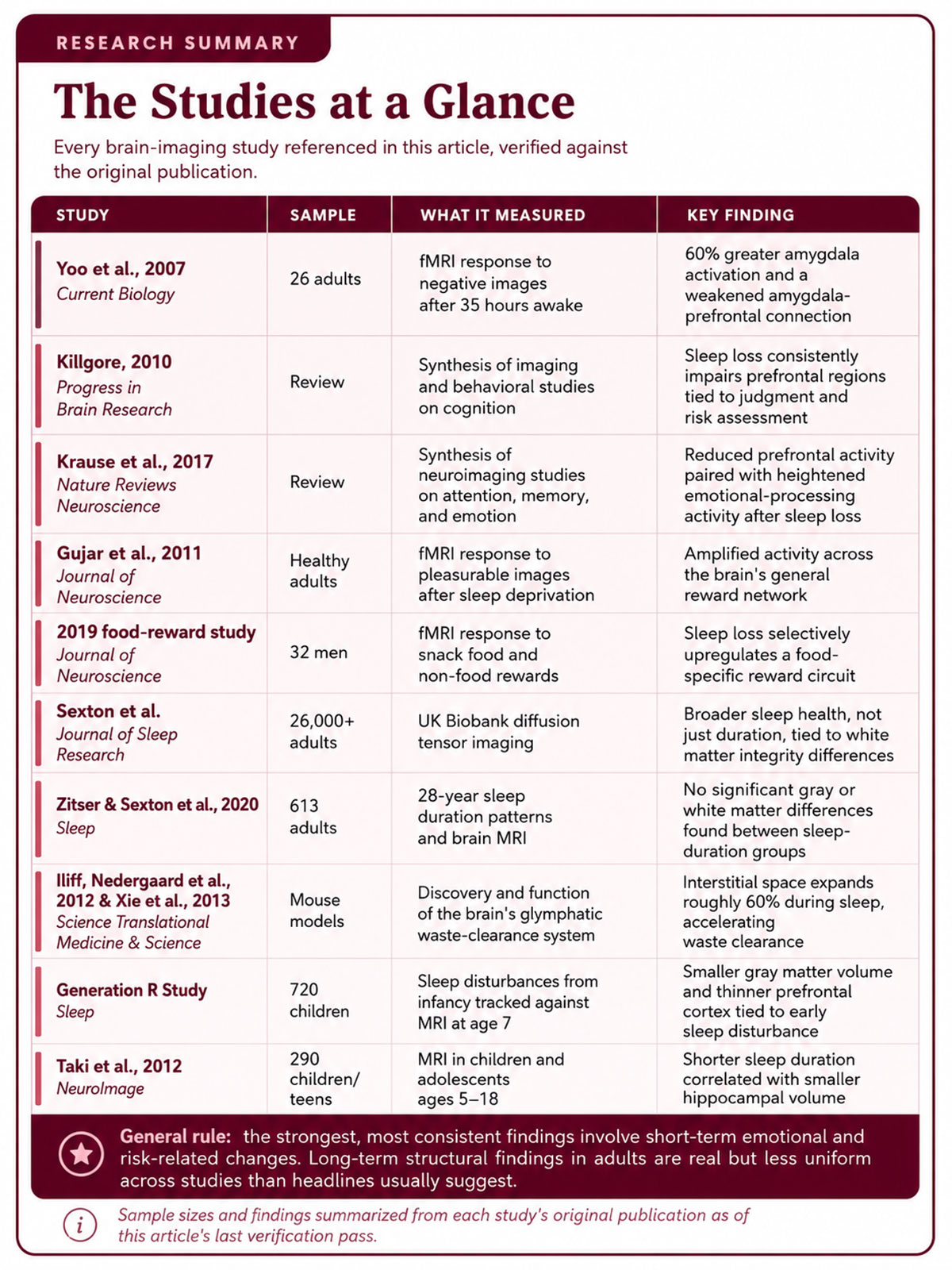
Seung-Schik Yoo and colleagues scanned 26 healthy adults after roughly 35 hours of continuous wakefulness, publishing the results in Current Biology in 2007. Sleep-deprived participants showed 60% greater amygdala activation in response to negative images than the well-rested group.
The functional connection between the amygdala and the prefrontal cortex had largely disappeared. The brake pedal had stopped working.
That’s the mechanism behind snapping at a partner over something small, or reading catastrophe into a routine email at midnight. The nervous system isn’t being dramatic. It’s short one key connection.

The Risk Radar Goes Dark
The assumption used to be that sleep-deprived people simply got slower, not necessarily worse at judgment. A body of neuroimaging work reviewed by William Killgore in 2010 pushed back on that.
The ventromedial prefrontal cortex runs a constant background check on decisions: Is this a good idea? What could go wrong? Is the reward worth the risk? Killgore’s review, published in Progress in Brain Research, found consistent evidence across multiple imaging and behavioral studies that sleep loss dampens exactly these regions.
A 2017 review by Adam Krause and colleagues at UC Berkeley, in Nature Reviews Neuroscience, sharpened the picture further: sleep-deprived brains showed reduced activity in prefrontal regions alongside heightened activity in areas tied to emotional processing, the brain getting quieter where it needs judgment and louder where it needs restraint.
The real-world version of this shows up in fatigued drivers who underestimate their own impairment, and in exhausted parents making calls they’d never make when well-rested. It isn’t recklessness by choice. It’s a brain making decisions without its usual safety checks.
The Reward System Gets Hijacked
Craving chips and cookies after a bad night’s sleep is the brain’s reward circuitry doing something specific and measurable, not a discipline problem.
A 2019 study in the Journal of Neuroscience scanned 32 lean, healthy men using fMRI after one night of sleep deprivation and one night of normal sleep, testing their responses to snack food and small non-food rewards. Sleep loss selectively upregulated an amygdala-hypothalamic circuit tied to food reward in particular, not rewards in general.
The effect builds on earlier work by Ninad Gujar and colleagues, whose 2011 fMRI study found that sleep deprivation broadly amplifies activity across the brain’s reward network in response to pleasurable images of any kind.
Put together, the picture is a brain running low on fuel that knows a dopamine hit will help, and that zeroes in on high-calorie food to get it. The pull toward sugar and fat during a rough week is neurochemistry doing exactly what it’s built to do when exhausted.
Your Brain’s Wiring Starts to Fray
White matter has an image problem. It doesn’t light up dramatically on a scan the way an overactive amygdala does, so it gets a fraction of the research attention gray matter gets, even though it’s the part actually carrying the signal between every region that does light up.
A UK Biobank analysis led by Claire Sexton and colleagues, published in the Journal of Sleep Research, examined diffusion tensor imaging data from more than 26,000 adults and found measurable differences in white matter integrity tied to broader sleep health, not just total hours slept.
Healthy white matter works like a well-maintained highway system, with signals moving fast and cleanly between regions. Damaged white matter is a highway full of potholes. Traffic still moves, only slower, with more effort and more chances for something to go wrong along the way.
That’s a reasonable physical description of what most people call brain fog, the thick, sluggish feeling where thoughts won’t quite connect.
Structural Change Is Real, But the Adult Picture Is Messier Than You’d Think
Here the evidence gets less tidy than the sections above might suggest.
Whitehall II is one of the longest-running studies of aging in the world, following thousands of British civil servants since the 1980s. A 2020 analysis of 613 of those participants, led by Jennifer Zitser and Claire Sexton and published in the journal Sleep, took their self-reported sleep duration at multiple points across nearly three decades and grouped people by long-term pattern: consistently short, consistently adequate, or somewhere in between. Then the team scanned their brains.
The expectation going in was straightforward. Consistently short sleepers should show smaller gray matter volumes and weaker white matter integrity than the seven-hour group, the same kind of structural difference the sections above describe.
They didn’t find it. Cognition, gray matter, and white matter measures came back statistically indistinguishable across every sleep-duration group tested.
Researchers still don’t fully agree on why long-term studies and cross-sectional ones sometimes point in different directions. One likely factor: a single self-reported number for hours slept misses quality, consistency, and timing, all of which the newer UK Biobank data suggest matter as much as duration alone.
It’s also possible that 613 people, however carefully tracked, simply isn’t enough to catch an effect that a 26,000-person cross-sectional sample can. Duration by itself is a blunter measurement than the science headlines about it usually let on.
The Brain’s Overnight Cleanup Crew Stalls Out
Maiken Nedergaard spent years working on a basic anatomical puzzle: every organ in the body clears its metabolic waste through the lymphatic system, except the brain, which has no lymph vessels at all. Where was the waste actually going?
Her team at the University of Rochester found the answer in 2012, publishing in Science Translational Medicine. Cerebrospinal fluid moves along channels surrounding the brain’s blood vessels, flushing out toxic proteins, including beta-amyloid, a substance closely tied to Alzheimer’s disease. They named the pathway the glymphatic system.
A follow-up study from the same team in 2012, in the journal Science, found that the space between brain cells expands by roughly 60% during sleep, dramatically increasing how much waste gets cleared compared to waking hours.
Skip sleep, and that overnight cleanup gets skipped too. The waste doesn’t disappear. It accumulates, night after night, with consequences that researchers increasingly link to long-term neurodegenerative risk, even though the exact timeline from occasional short sleep to measurable harm is still being worked out.
A Developing Brain Pays a Steeper Price
A developing brain is not simply resting when it sleeps. It’s under active construction, pruning connections that aren’t needed and reinforcing the ones that are.
A Generation R Study analysis of 720 children, tracked from infancy through age 6 and scanned by MRI at age 7, found that sleep disturbances from age 2 onward were tied to measurably smaller gray matter volumes and a thinner prefrontal cortex, the region most responsible for planning and impulse control.
A separate MRI study out of Japan, led by Yasuyuki Taki and colleagues, examined 290 healthy children and adolescents between the ages of 5 and 18 and found that shorter sleep duration correlated with smaller hippocampal volume, specifically the brain structure most closely tied to forming new memories.
Taki’s data adds an uncomfortable wrinkle. The region affected isn’t the same one Generation R flagged, which suggests a developing brain doesn’t have one single sleep-sensitive spot. It has several, and they don’t fail on the same schedule.
For a developing brain, sleep isn’t scheduled downtime around the real work. It is largely the real work.
What Happens When You Start Sleeping Again
The brain does have a genuine capacity to recover, and the timeline depends heavily on how the debt built up.
After a single rough night, one or two nights of solid recovery sleep can restore much of the lost emotional regulation and functional connectivity. The amygdala calms back down.
The prefrontal cortex reconnects. The risk radar comes back online.
Chronic sleep debt is a longer negotiation. Weeks of consistent, adequate sleep can meaningfully improve cognitive function in people carrying a real deficit, though some of the structural changes described above appear to take longer to reverse, and researchers are still mapping exactly how much of that change is permanent versus slow to resolve.
None of this requires a dramatic overhaul. A short wind-down routine gives the nervous system a clear signal that the day is over, and the routine itself doesn’t need to take more than ten minutes.
Sleep Debt Calculator
See how much sleep you've actually missed this week
Sleep is when the brain consolidates memory, runs its cleanup crew, and maintains its own physical structure. An extra hour tonight is a direct deposit into gray matter volume, white matter integrity, and tomorrow’s emotional stability.
The Takeaway
This is a story about a brain that behaves differently depending on a variable most people treat as negotiable.
The scans make an uncomfortable case that sleep isn’t recovery time bolted onto the important part of the day. For the brain, it is an important part of the day, the hours when the actual maintenance happens.
Skip enough of those hours, and the system doesn’t announce its decline with a warning label. It quietly runs on a different set of rules, the ones this piece just walked through.
Tonight’s extra hour won’t undo years of shortchanging sleep. It will, measurably, start moving things back in the right direction.

Frequently Asked Questions
How do you cope with sleep deprivation in the short term?
Sleep scientists don’t fully agree on napping. Some argue that a 20-minute nap restores alertness without disrupting the next night’s sleep, others worry it just delays the debt rather than paying it down.
Where there’s more consensus: prioritize a single consistent wake time over a perfect bedtime, and get daylight exposure within an hour of waking. None of this substitutes for catching up on the underlying debt.
What are the five stages of sleep deprivation?
Researchers generally describe a progression from mild impairment around 24 hours, through perceptual disturbances around 48 hours, to hallucinations and severe cognitive breakdown by 72 hours and beyond. The timeline table above walks through what changes at each point.
Is chronic sleep deprivation different from an occasional bad night?
Yes. A single rough night mostly hits emotional regulation and reaction time, both of which recover quickly. Chronic short sleep is what shows up in the structural and white matter findings described above, and it takes considerably longer to reverse.