Two eggs a day. Three different diets. Five weeks of testing. Only one approach consistently improved LDL, and it probably isn’t the one most people expect.
For years, the fear about eggs was simple. Eat one, and you were eating cholesterol that would eventually turn up in an artery somewhere. Researchers have since separated cholesterol in food from cholesterol in the bloodstream, and eggs turned out to be the wrong target.
A 2025 clinical trial published in the American Journal of Clinical Nutrition tested that old assumption directly, not with a survey, but with a controlled diet study. Adults cycled through three different diets, each one built around a different combination of eggs and saturated fat, and the results didn’t line up with what most people still believe when walking into a grocery store.
The number that came out of it surprised the nutrition scientists who ran the trial. This is what actually happens to cholesterol when eggs become a daily habit, according to the research that exists right now, not the advice that’s been repeated since the 1970s.
The Trial That Actually Tested the Old Assumption
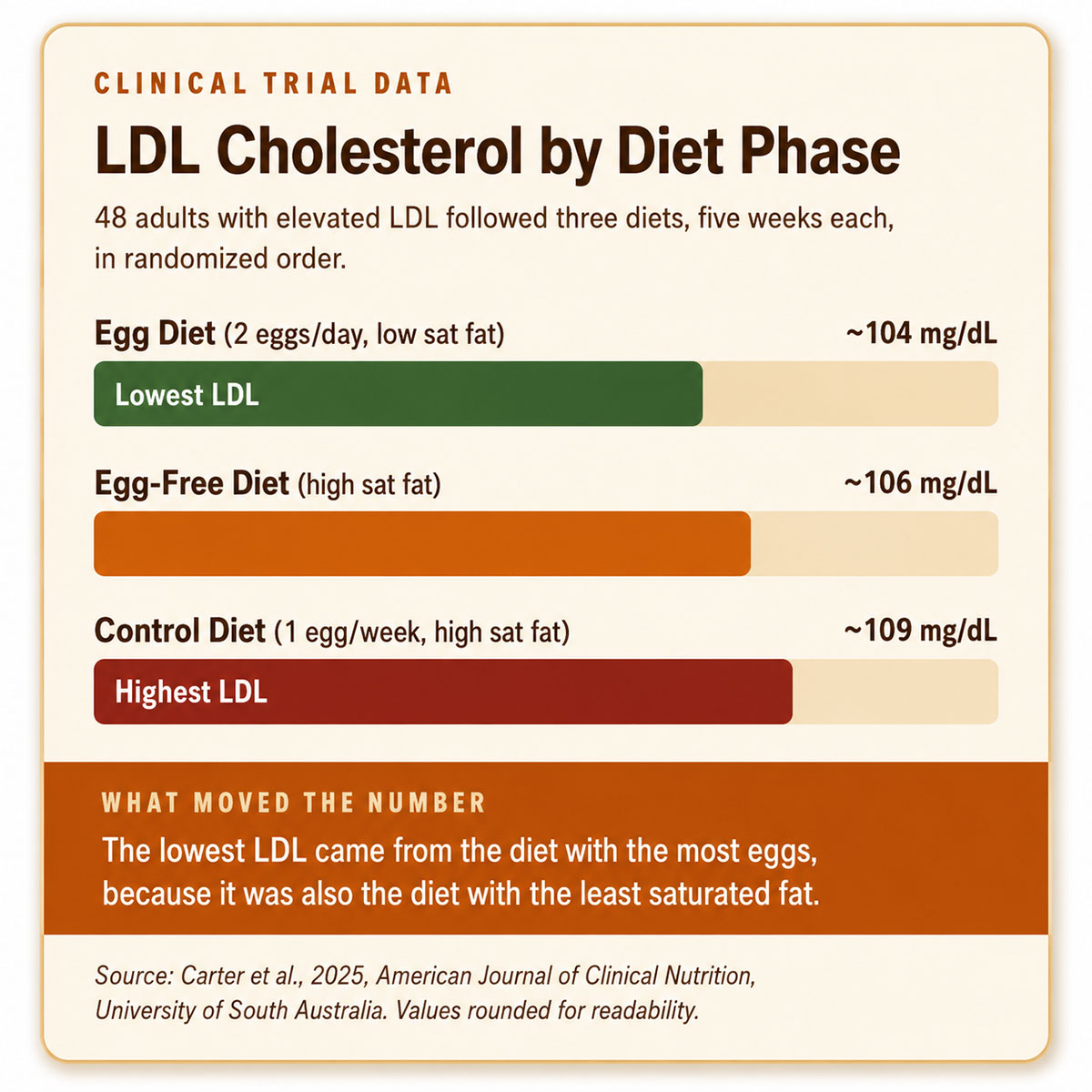
Researchers at the University of South Australia wanted to answer a question nutrition science had never tested cleanly: was it the eggs raising LDL cholesterol, or was it everything usually served alongside them? Forty-eight adults, all with elevated LDL cholesterol to start, completed three five-week diets in randomized order.
One diet included two eggs a day, with saturated fat kept low. Another swapped out eggs entirely but let saturated fat run higher. A third mimicked a typical Australian diet: barely any eggs and high saturated fat.
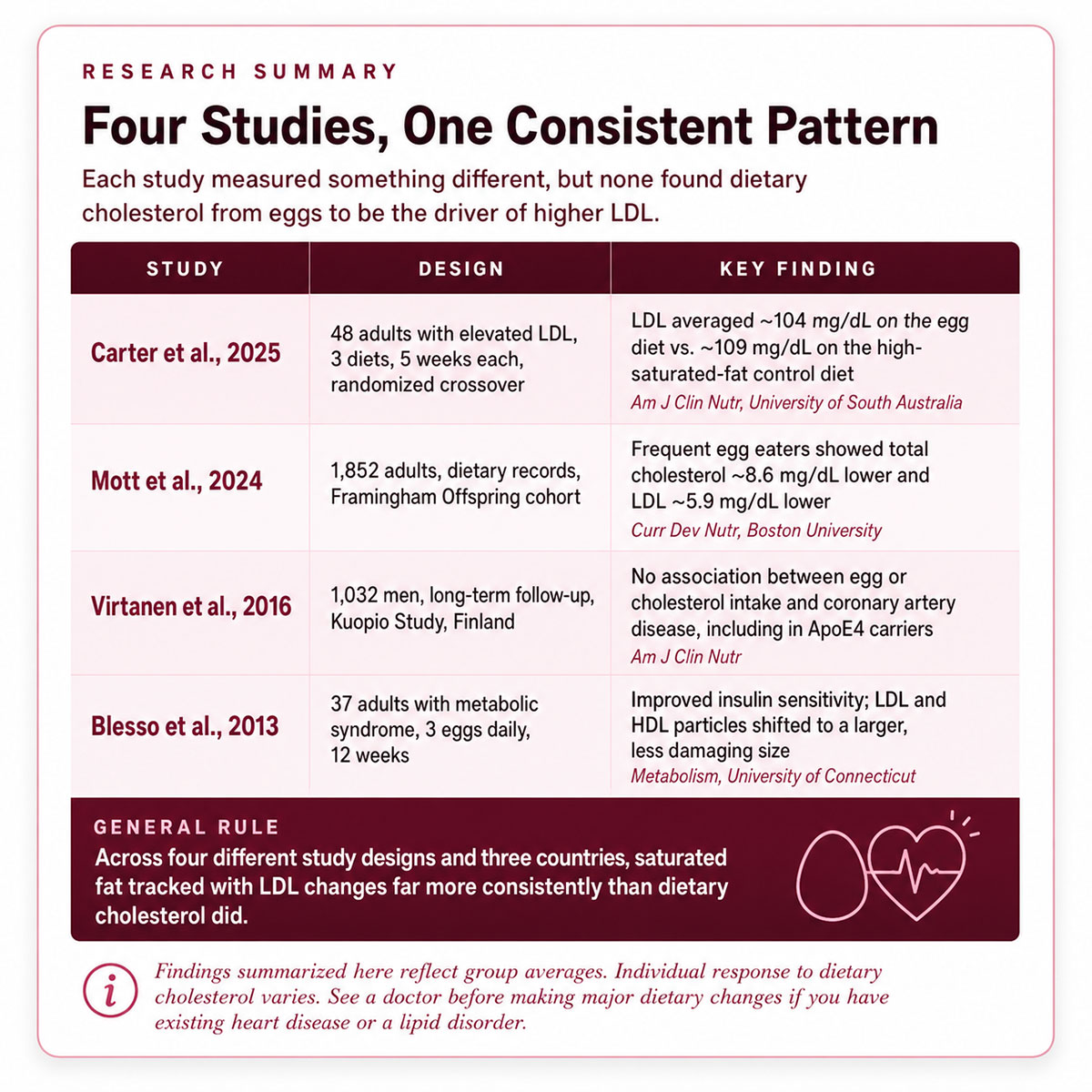
The egg diet won. LDL cholesterol landed around 104 mg/dL on the two-eggs-a-day plan, compared with about 109 mg/dL on the control diet, which was also high in saturated fat and had almost no eggs. The egg-free version didn’t improve anything either, settling close to the control at roughly 106 mg/dL.
Across all three diets, the pattern held: the more saturated fat someone ate, the higher their LDL climbed, regardless of the phase. Cholesterol intake itself showed no such relationship.
That finding took a while to sink in for people who grew up avoiding yolks. Jonathan Buckley, the senior researcher on the trial and a professor at the University of South Australia, put it bluntly in the university’s release: eggs have long been unfairly cracked by outdated dietary advice.
Worth mentioning: the study was funded by the Egg Nutrition Center. The funding question remains, but a randomized crossover trial, where every participant eats all three diets and serves as their own control, is a much harder thing for a funder to bias than a self-reported survey would be.
What a Longer Look at Real Diets Found
A single trial is convincing. A pattern that shows up again in a completely different kind of study is more convincing. Researchers analyzing the Framingham Offspring cohort, a group that’s been tracked by Boston University scientists since the 1970s, wanted to see whether the trial results held up in people eating their normal diets rather than a researcher-controlled menu.
Among the men in that 2024 analysis, those who ate eggs most days of the week showed total cholesterol about 8.6 mg/dL lower and LDL about 5.9 mg/dL lower than men who rarely touched them. Nobody ran that analysis expecting egg-eaters to come out ahead. The result held anyway, and it lined up with a variable the researchers weren’t primarily looking for: egg-eaters in this cohort also tended to eat more fiber, which may be doing some of the work alongside the eggs themselves rather than in spite of them.
Egg Consumption Planner
Build a personal picture from the research in this article
Does It Matter If High Cholesterol Runs in Your Family?
One real complication deserves more than a passing mention: genetics. A specific variant called ApoE4 changes how efficiently the body absorbs cholesterol from food, and people who carry it have long been told to be more careful with dietary cholesterol than everyone else.
More than 1,000 Finnish men, a mix of ApoE4 carriers and non-carriers, were tracked for years after enrolling in the Kuopio Ischaemic Heart Disease Risk Factor Study in the 1980s. Egg and cholesterol intake showed no association with coronary artery disease risk in either group.
Even the men genetically wired to absorb more dietary cholesterol didn’t show the pattern the theory predicted. That doesn’t mean genetics are irrelevant to cholesterol. It means this particular worry, that ApoE4 carriers face special danger from eggs specifically, hasn’t held up against the Kuopio data.
Anyone with a family history of very high cholesterol or a known genetic lipid disorder should still get individual guidance from a doctor rather than extrapolate from population averages.
Putting the Research Side by Side
Beyond Cholesterol: What Else Two Eggs a Day Might Do
Cholesterol isn’t the only reason eggs earned a bad reputation, and it isn’t the only outcome worth tracking either. Three effects have real evidence behind them.
The Nutrient Nobody Asks About
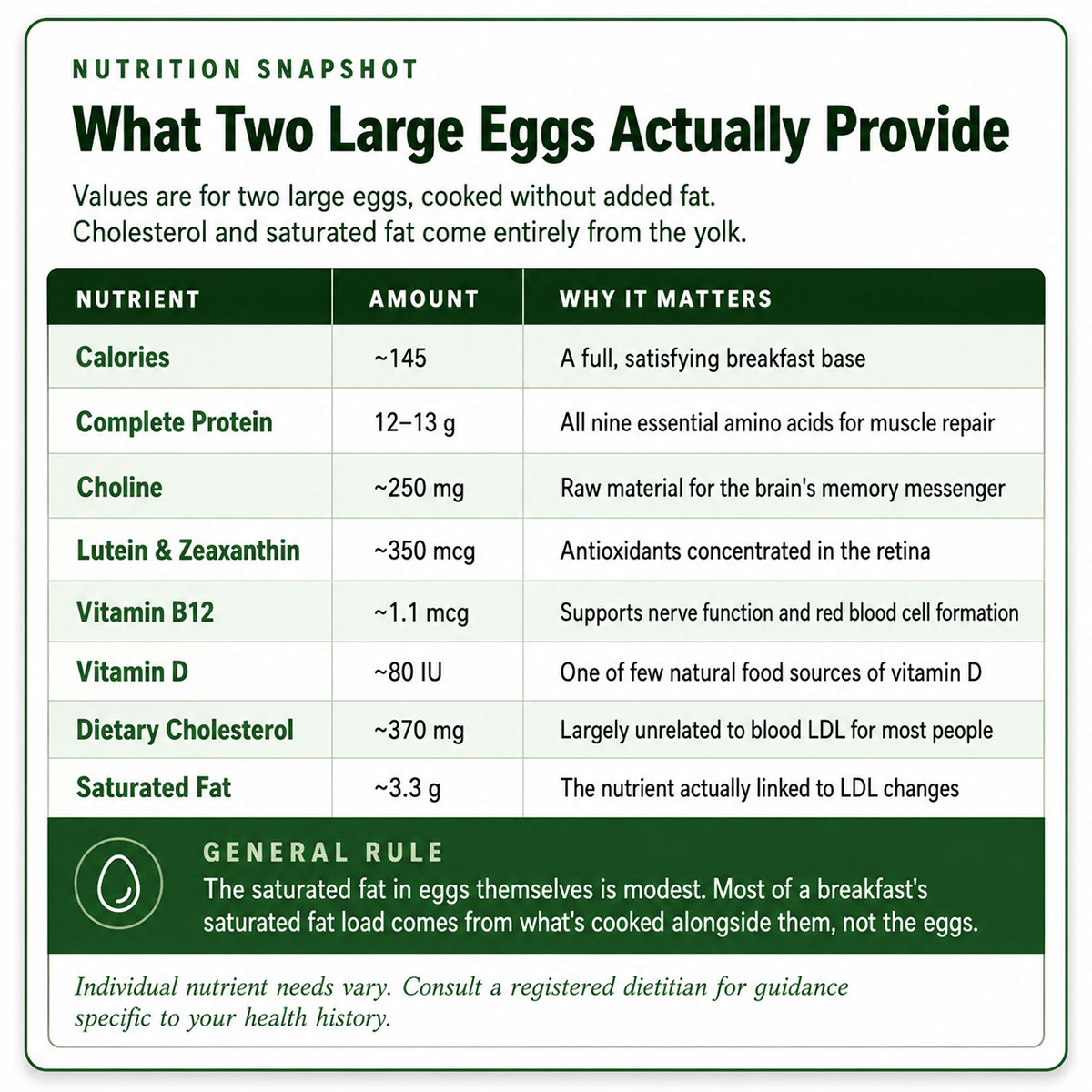
Choline is the one nobody thinks to ask about, which is strange, because it may be doing more for the brain than the protein does. One large egg yolk supplies roughly 125 milligrams of it. Choline is the raw material for acetylcholine, the messenger the brain relies on for memory and learning, and picture it as the delivery truck bringing parts to a factory that can’t run without them.
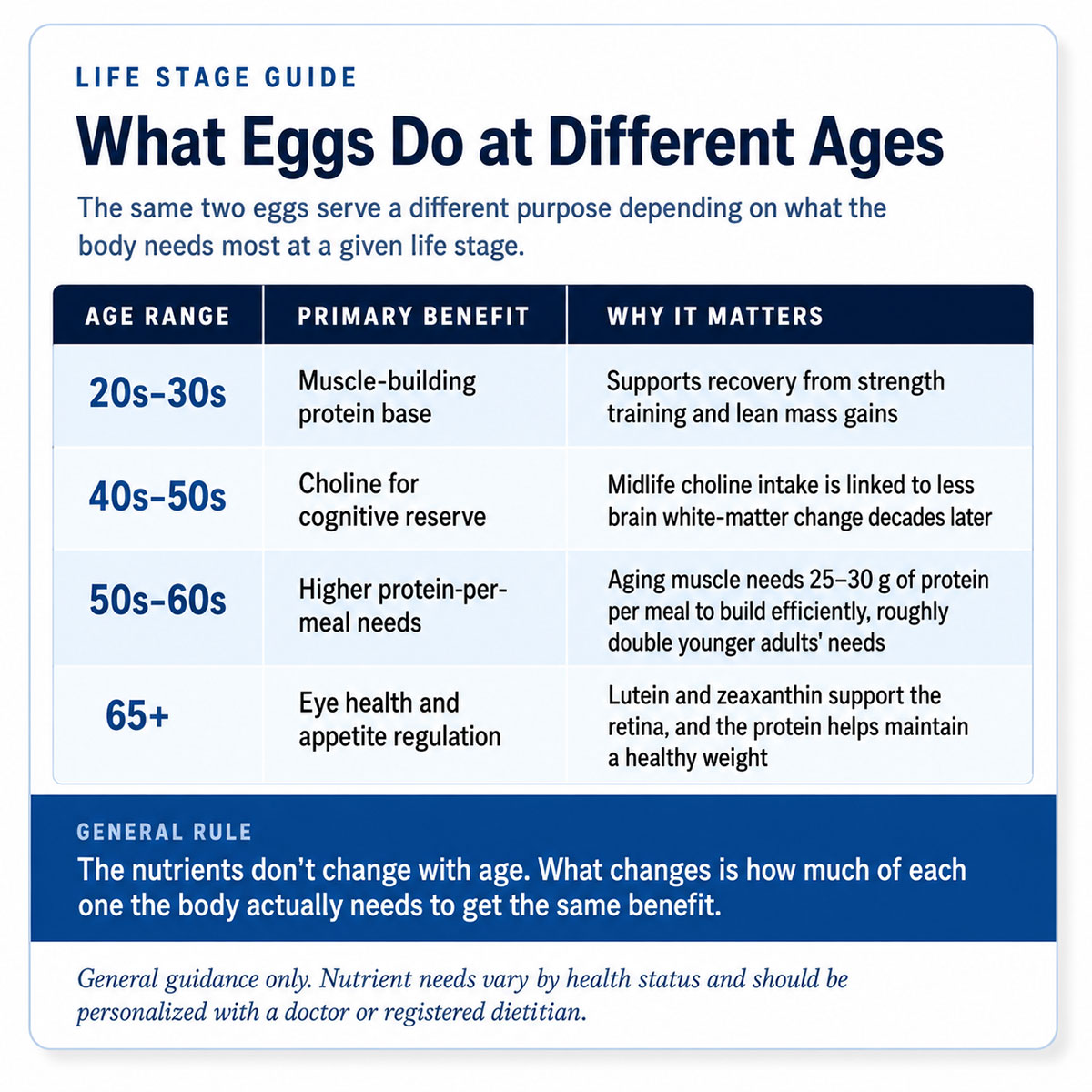
A Boston University team following the Framingham Offspring cohort found that people with higher choline intake performed better on cognitive tests, and those with higher choline intake in midlife showed less white matter damage, a marker linked to brain aging, decades later.
The implication is stranger than a simple “eat more choline” headline suggests: what someone eats in their 40s may be doing quiet work that doesn’t show up on a brain scan until their 70s.
The Breakfast That Changes Lunch
Thirty overweight women ate either two eggs or a bagel of equal calories for breakfast in a 2005 trial. By lunch, the egg group had eaten roughly 164 fewer calories, and the gap persisted into the following day.
Pair that egg breakfast with fiber, oats or fruit rather than white toast, and the satiety effect tends to run even longer, since protein and fiber slow stomach emptying through different mechanisms that stack rather than compete.

The Muscle Case, for Anyone Over 40
Two eggs supply 12 to 13 grams of complete protein, meaning every essential amino acid the body needs to build muscle tissue. Adults over 50 need closer to 25 to 30 grams of protein per meal to trigger muscle protein synthesis efficiently, roughly double what’s typically recommended for younger adults, because aging muscle becomes less responsive to smaller protein doses.
Two eggs alone won’t hit that number. Paired with Greek yogurt or a slice of turkey, they get most of the way there.
Does Age Change the Calculus?
A 25-year-old worried about eggs and a 70-year-old worried about eggs are, medically, asking two different questions. Muscle preservation, cognitive protection, and satiety all matter more as the body ages, and the margin for error narrows.
The Real Villain Isn’t the Egg
Every study in this piece points in the same direction: saturated fat drives LDL more than dietary cholesterol does. That distinction has a practical consequence that most egg advice skips. Two eggs fried in butter and served with bacon make a different meal than two eggs poached and served with avocado, even though the egg itself is identical in both.
Swap butter for olive oil. Trade bacon or sausage for smoked salmon or sautéed spinach. Serve eggs alongside avocado or whole-grain toast instead of white bread, fried in the same pan as the meat.
The eggs themselves stay exactly the same in every version of that plate. What changes is everything sitting next to them, which is where the actual saturated fat load comes from.
Three Ways to Eat Your Two Eggs
A daily habit only survives if it doesn’t get boring by day four. Three options, each built around the swaps above:
Mediterranean scramble. Two eggs scrambled in olive oil with spinach, cherry tomatoes and a few olives. Feta on top if the rest of the day’s saturated fat has room for it.
Avocado egg boats. Half an avocado, one egg cracked into the hollow, baked at 375°F for about 15 minutes until the white sets. Everything hitting the plate here is a fat that helps the numbers rather than working against them.
Smoked salmon and egg toast. One soft-boiled egg over whole-grain toast with smoked salmon and a thin layer of Greek yogurt in place of cream cheese. Protein from three sources, saturated fat from none of them.

Are You a Hyper-Responder?
Not everyone’s body handles dietary cholesterol identically. Roughly a third of people are classified as hyper-responders, meaning their blood cholesterol shifts more per gram of dietary cholesterol than the average person’s does. A 2013 University of Connecticut trial gave adults with metabolic syndrome three whole eggs a day for 12 weeks and tracked this group.
Hyper-responders in that trial saw both LDL and HDL rise, which is the reassuring half of the story for many people in this category. The word “many” is doing real work in that sentence, though, since the pattern didn’t hold for every single hyper-responder tested.
The trial also found something more specific: LDL particles shifted toward a larger, less artery-damaging size in the hyper-responders who ate eggs, alongside measurable improvements in insulin sensitivity. Nobody can tell which camp they’re in without a lipid panel, and that’s the one place in this entire subject where guessing isn’t a good enough answer on its own.
Your 12-Week Plan, If You Want to Try This Yourself
Nobody needs a research grant to run a version of the South Australia trial at home, just a baseline lipid panel and some patience. Weeks one through four: add two eggs a day to breakfast, prepared without butter or processed meat, and change nothing else. This isolates the variable the same way the trial did.
Weeks five through eight get less predictable. Some people see LDL hold steady. Some see it drop slightly, echoing the South Australia and Framingham results.
A smaller group, the hyper-responders described above, may see both LDL and HDL climb together, which is a different outcome than a plain increase and worth understanding rather than panicking over.
By weeks nine through twelve, a second lipid panel tells the real story better than any general guideline can. Compare it against the baseline. If LDL rose substantially and HDL didn’t move with it, that’s a conversation for a doctor, not a reason to declare eggs guilty on principle.
Warning Signs and When to Stop
Most people tolerate two eggs a day without issue. A few signals mean it’s time to check in with a doctor rather than push through:
- LDL cholesterol rises more than 15 to 20 percent from baseline after the 12-week trial period.
- Existing cardiovascular disease, diabetes, or a diagnosed genetic lipid disorder is already part of the picture.
- New symptoms appear, including chest discomfort, unusual fatigue or swelling in the legs.
- A family history of very early heart disease exists, since population-level findings don’t always apply to individual genetic risk.
The Verdict
The old advice asked the wrong question. It treated the egg as the variable worth watching, when the saturated fat sitting next to it on the plate was doing most of the damage the whole time.
Two eggs a day, prepared without butter or bacon, is exactly what a randomized trial designed to isolate this question found to be safe, backed now by a cohort tracked since the 1970s pointing in the same direction. The bacon was never innocent. The eggs, it turns out, mostly were.
Frequently Asked Questions
Should I still worry about eggs if I already have high cholesterol?
Not automatically. The South Australia trial specifically recruited adults with elevated LDL, and two eggs a day on a low-saturated-fat diet still improved their numbers. Anyone with diagnosed heart disease or a genetic lipid disorder should get individualized guidance rather than apply a population-level finding to their own chart.
What do cardiologists actually say about eggs?
Mainstream cardiology guidance, including from the American Heart Association, has moved away from a strict daily cholesterol ceiling and toward evaluating overall dietary patterns. For most healthy adults, that means eggs fit comfortably within a heart-healthy diet as long as saturated fat overall stays in check.
Is it the yolk or the white that carries the cholesterol?
All of it sits in the yolk, roughly 186 milligrams in a large egg. Egg whites carry none of it, which makes them a reasonable option for anyone who wants the protein without the cholesterol conversation at all, though they also skip the choline and most of the nutrients discussed above.
Does cooking method change the effect?
The egg itself doesn’t change based on how it’s cooked. What changes is what usually accompanies it. A fried egg cooked in butter with bacon on the side carries a very different saturated fat load than the same egg poached or boiled.
How many eggs a week is actually reasonable?
The research reviewed here supports up to two eggs a day, or roughly 14 a week, for most healthy adults following a diet that isn’t heavy in saturated fat elsewhere. That’s a considerably higher ceiling than the one-egg-a-week guidance many people grew up hearing decades ago.
Are hyper-responders actually at higher risk?
Not necessarily. Their LDL and HDL both tend to rise together, and in at least one trial, their LDL particles shifted toward a less damaging size in the process. The honest answer is that nobody can say for certain without a lipid panel, since averages don’t describe any one person’s chemistry.