Most people think low emotional intelligence looks like anger or cruelty. In reality, one of the biggest signs is a habit many intelligent people mistake for integrity.
It looks like a person who is always right. It sounds like “I am just being honest.” It feels, to the person doing it, like integrity. That is the trap.
Low emotional intelligence, often called low EQ, does not always mean being cold or unkind. Sometimes it means being so committed to facts and logic that you lose the human thread entirely. Because this behavior feels rational, even principled, it is one of the hardest patterns to spot and among the most resistant to change.
What Emotional Intelligence Actually Means
Before examining what low EQ looks like, it helps to understand what the concept actually is.
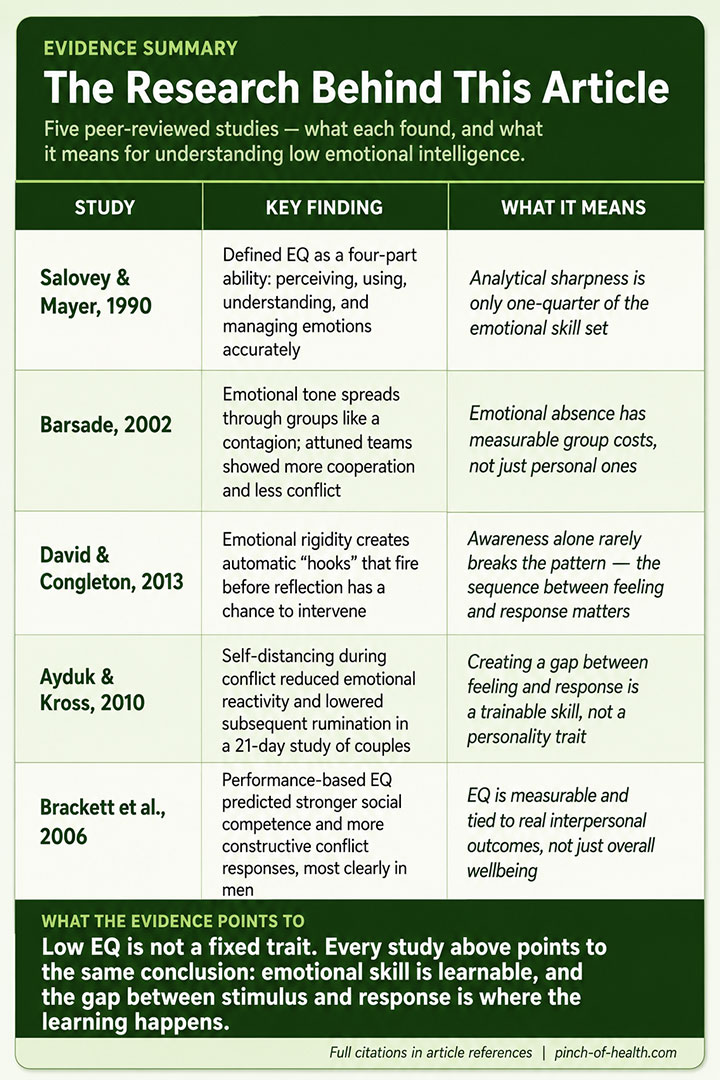
In 1990, psychologists Peter Salovey and John Mayer published one of the first formal frameworks for emotional intelligence in the journal Imagination, Cognition, and Personality. They described EQ as the ability to perceive emotions accurately, use them to support thinking, understand how they shift over time, and manage them in yourself and in others. Salovey and Mayer later refined this into a four-branch model. The 1997 update brought the concept fully into the research mainstream.
That distinction matters. Reading a situation accurately and responding in a way that is effective, not just truthful, is what EQ actually describes. Softness and agreeableness have nothing to do with it.
Why Being Right Can Work Against You
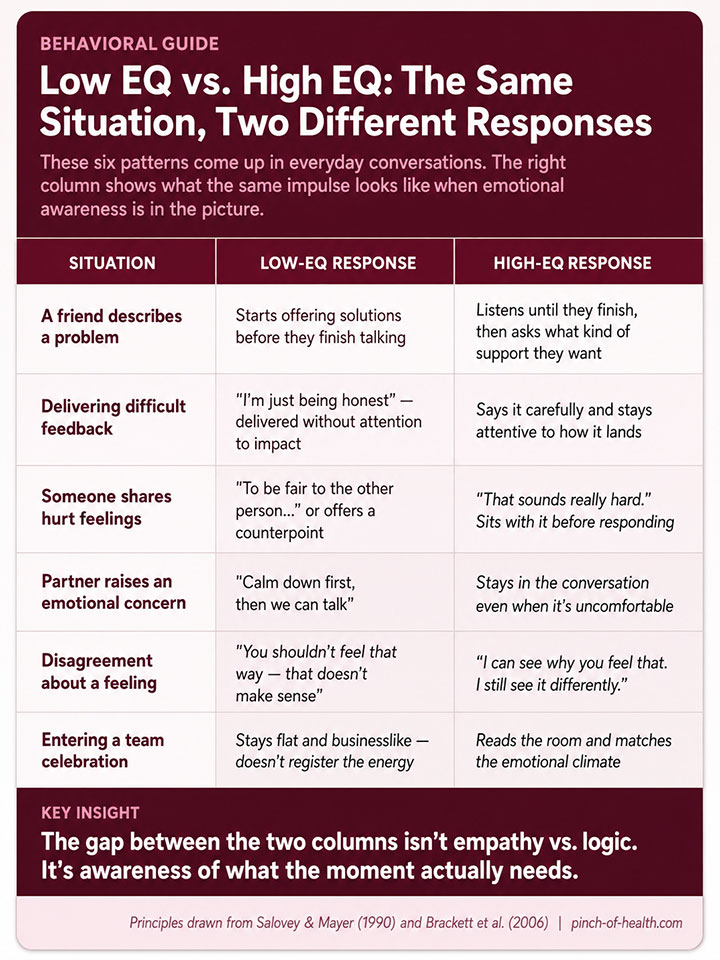
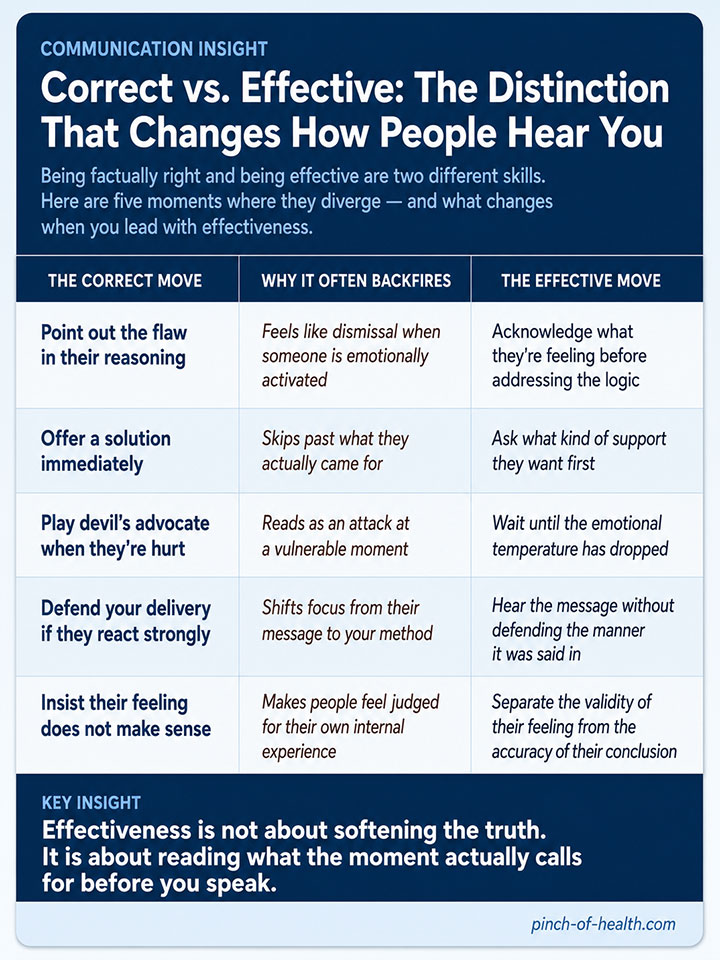
Someone shares a problem, maybe an upset about a conflict at work, maybe anxiety about a big decision. Instead of acknowledging how they feel, the listener jumps straight to analysis. They point out where the person’s logic is flawed. They offer a solution before being asked for one.
From the inside, this feels helpful. Rational. Efficient. From the outside, it feels dismissive.
People with low EQ often use facts to skip past the discomfort of emotion. The logic becomes a wall rather than a bridge. What the listener does not register is that the other person needed connection first, and received a spreadsheet instead.
A related pattern plays out repeatedly in close relationships. Before a friend finishes describing a problem, the listener is already sorting through solutions. “Here is what you should do.” The instinct comes from a real place, the discomfort of watching someone struggle without stepping in.
But it is that discomfort doing the driving, not the helpfulness. The listener is managing their own unease at the speed of a fix, and the person sharing is left feeling unheard.
Both habits share the same root: an inability to sit with someone else’s emotional state long enough to hear it out. Sigal Barsade, an organizational researcher at Yale, captured why this costs people more than they realize.
Her Ripple Effect study, published in Administrative Science Quarterly in 2002, found that emotional tone spreads through groups like a contagion, and that teams where members stayed attuned to one another showed more cooperation and less conflict than those that did not. Being technically right about something rarely compensated for being emotionally absent.
A doctor who gives a perfectly accurate diagnosis while being cold and dismissive is factually correct. But the information landed wrong because the delivery closed the door. You can be right and lose the room at the same time.
The Subtle Habit: Playing Devil’s Advocate at the Wrong Moment
One of the clearest signals of low EQ is a specific behavior that almost no one recognizes as a problem: playing devil’s advocate in emotional situations.
This looks like someone responding to a friend’s hurt feelings with “Well, to be fair to the other person…” or hearing about a painful experience and immediately offering the counterpoint. It happens in arguments too, where the person cannot let a point rest even when the other party is clearly distressed.
This habit signals something specific: an inability to validate someone else’s experience, even temporarily.
Validation does not mean agreement. It means acknowledging that the other person’s feelings make sense given what they have been through. People with low EQ often conflate validation with dishonesty. “I am not going to tell them they are right when they are wrong.” But that is not what is being asked. The person sharing hurt feelings is not asking for a verdict. They are asking to feel understood.
The Salovey and Mayer framework identifies “understanding emotions” as a core branch of EQ, specifically the capacity to recognize how emotions shift and evolve in others. Playing devil’s advocate in the middle of an emotional moment shows a gap in exactly this ability. The person is accurate and, in this moment, making things worse.

Signs of Low Emotional Intelligence Most People Don’t Notice
Low EQ rarely announces itself. It hides in habits that feel natural, even admirable, to the person doing them. Here are four patterns worth knowing.
The “I am just being honest” defense is one of the most common. Honesty is a virtue. Deploying truth carelessly and calling it integrity skips the part that actually takes skill: the awareness to say hard things in a way that the other person can receive.
When someone delivers a painful observation and then adds “I am just being honest,” they are placing the burden of their bluntness onto the listener, as if the listener’s reaction is the real problem.
Tone-policing as avoidance is subtler and worth understanding separately. It happens when someone responds to an emotional message by focusing entirely on how it was delivered. “I would be happy to discuss this when you calm down.”
Sometimes tone matters. But often, tone-policing is a way to sidestep the emotional content of what is being said. It shifts the conversation from the message to the delivery, and lets the listener avoid sitting with the weight of what they have just heard.
The “But You Are Wrong” default is probably the most damaging pattern in personal relationships. People with strong EQ can hold two things at once: “I see why you feel that way, and I still disagree.” This requires separating the validity of someone’s feelings from the accuracy of their conclusions.
For someone with low EQ, acknowledging another person’s emotional experience feels like conceding the argument. Instead, they push back on the feeling itself. “You should not feel that way.” “That reaction does not make sense given the facts.”
Consider what this looks like in a specific exchange. A partner says, “I felt left out when you did not tell me about the dinner plans.” A high-EQ response: “That makes sense. I should have told you.” A low-EQ response: “You are being oversensitive. It was not a big deal.”
The second version is not necessarily false. But it misses the entire point of the exchange. The other person was not asking for a verdict on whether their feeling was proportionate. They were asking to be heard.
There is also the emotional climate of a room entirely, which is different from the other patterns because it requires no conversation at all. Someone with strong EQ walks into a team celebration and reads the energy.
Someone with low EQ stays flat and businesslike in the same setting, not trying to be cold, but genuinely not registering what everyone else in the room is feeling. To everyone else, it reads as indifference.
Low EQ Pattern Self-Check
Six common patterns — how often do they show up for you?
The habits that signal low emotional intelligence rarely feel like problems. They feel like honesty, helpfulness, or logic. This check surfaces six of the most common ones — not as a diagnosis, but as a starting point for noticing.
For each statement, rate how often it fits your behavior in close relationships or tense conversations. There are no right answers, and your responses stay in your browser.
This is a reflective tool, not a clinical assessment. Results are patterns to notice, not a score.
For a deeper look, see the article above.
What Actually Drives These Patterns
These habits persist largely because of what psychologists call emotional rigidity: the tendency to get locked into a single way of responding to strong feelings, usually the one that feels safest.
Psychologist Susan David, writing in a 2013 article in Harvard Business Review co-authored with Christina Congleton, described how people develop what they call “hooks,” emotional patterns they get so entangled with that those patterns begin to drive behavior almost automatically.
What makes the hooks framing useful is that it explains why awareness alone rarely changes anything: the pattern fires before reflection has a chance to intervene. Their research found that flexibility in handling difficult emotions, rather than rigidity or defensiveness, predicts better outcomes at work and in relationships.
The brain learns early that strong feelings are unpredictable and sometimes unsafe, so it builds systems to manage them: logic, deflection, argument, correction. These systems work in some contexts and fail consistently in others.
Research on early emotional development points to a lack of healthy emotional role models in childhood as a common origin of low EQ. This is worth knowing because it reframes the pattern as something that developed for a reason, a learned adaptation rather than a fixed personality trait.
That origin story matters because it means the pattern can change. EQ is not fixed the way height is, and the technique described in the next section is one of the better-studied entry points into that work.
How to Create Space Between the Feeling and the Response
The most useful technique for building EQ does not involve suppressing logic. It involves creating distance between yourself and your immediate reaction.
Psychologists Ozlem Ayduk and Ethan Kross have studied this across multiple experiments over more than a decade. In a 21-day diary study of romantic partners, participants who spontaneously viewed conflict situations from a distanced, third-person perspective engaged in more constructive problem-solving during disagreements than those who stayed fully immersed in their own reaction.
Their work, summarized in a 2010 paper in Social and Personality Psychology Compass titled “Analyzing Negative Experiences Without Ruminating”, found that self-distancing reduced emotional reactivity and lowered the likelihood of rumination after the conflict ended.
In practice, this means noticing what you are feeling before you respond rather than inside the response. “I feel frustrated” is different from acting out of frustration. The naming itself is the gap. That gap changes the question you are asking more than it changes the answers you give.
You stop trying to resolve the situation and start asking what the other person actually needs in this moment: to be heard, to be given space, to receive information. Then you choose rather than react.
The gap between stimulus and response is where EQ lives. And unlike raw intelligence or technical skill, it gets wider with practice.

True Integrity Includes Awareness of Impact
Marc Brackett and colleagues at Yale spent years investigating whether measurable EQ actually predicts how people function in interpersonal situations. Their 2006 study in the Journal of Personality and Social Psychology, “Relating Emotional Abilities to Social Functioning,” found that performance-based EQ scores predicted stronger social competence and more constructive responses during conflict.
The effect was most pronounced in men, where the relationship was clearest across sub-studies. The study was about measurable performance in real interpersonal exchanges, not personality or warmth.
People with higher EQ tended to be more persuasive, more effective in negotiations, and more trusted in high-stakes situations. Their honesty landed better because it arrived with awareness of its impact.
This is a practical argument, not a moral one. High EQ makes people more effective in the interactions that shape actual outcomes, not abstractly better as people.
Many people who show signs of low EQ genuinely believe they are the most honest people in the room. They might be right about the facts. What they miss is that integrity covers both what you say and whether you have the awareness to manage your own discomfort long enough to say it in a way that actually helps.
Courage, in emotional terms, means staying present through the discomfort of someone else’s emotions long enough to respond thoughtfully, not just saying the hard thing regardless of consequence. That is not weakness. That is the harder, rarer skill, and unlike the ability to win an argument, it can be built.