You don’t need hours of meditation, expensive coaching, or a personality overhaul. Brain imaging studies suggest meaningful emotional growth can begin in just minutes a day.
Most people assume that putting a name to a feeling makes it more real. Say “I’m furious” out loud, and you’ve confirmed the fury. That’s the intuition. What Matthew Lieberman at UCLA found when he put 30 people inside an fMRI scanner runs directly against it.
When participants labeled what they felt, activity in the amygdala dropped measurably. Not through breathing, not through distraction. The act of naming the emotion shifted which part of the brain was in charge, moving processing from the alarm center to the reasoning center. It happened automatically.
This is the mechanism most emotional intelligence advice skips. The tips exist. What’s usually missing is an explanation of what actually happens in the brain when these habits work, and why that makes the difference between knowing something and being able to use it under pressure.
The nine habits below come from brain imaging studies and controlled training trials. Each one targets a specific neural pathway. None takes more than ten minutes. And the research shows the changes they produce last.
The Brain Science Behind Emotional Growth
Your brain has two main systems for processing emotions. The amygdala acts like an alarm system, firing fast when threats appear. The prefrontal cortex works more slowly, helping you think through situations and choose a response rather than react.
People with high emotional intelligence have strong connections between these two regions. They feel emotions as intensely as anyone else, but they can regulate those feelings more effectively. And that regulatory capacity can be built.
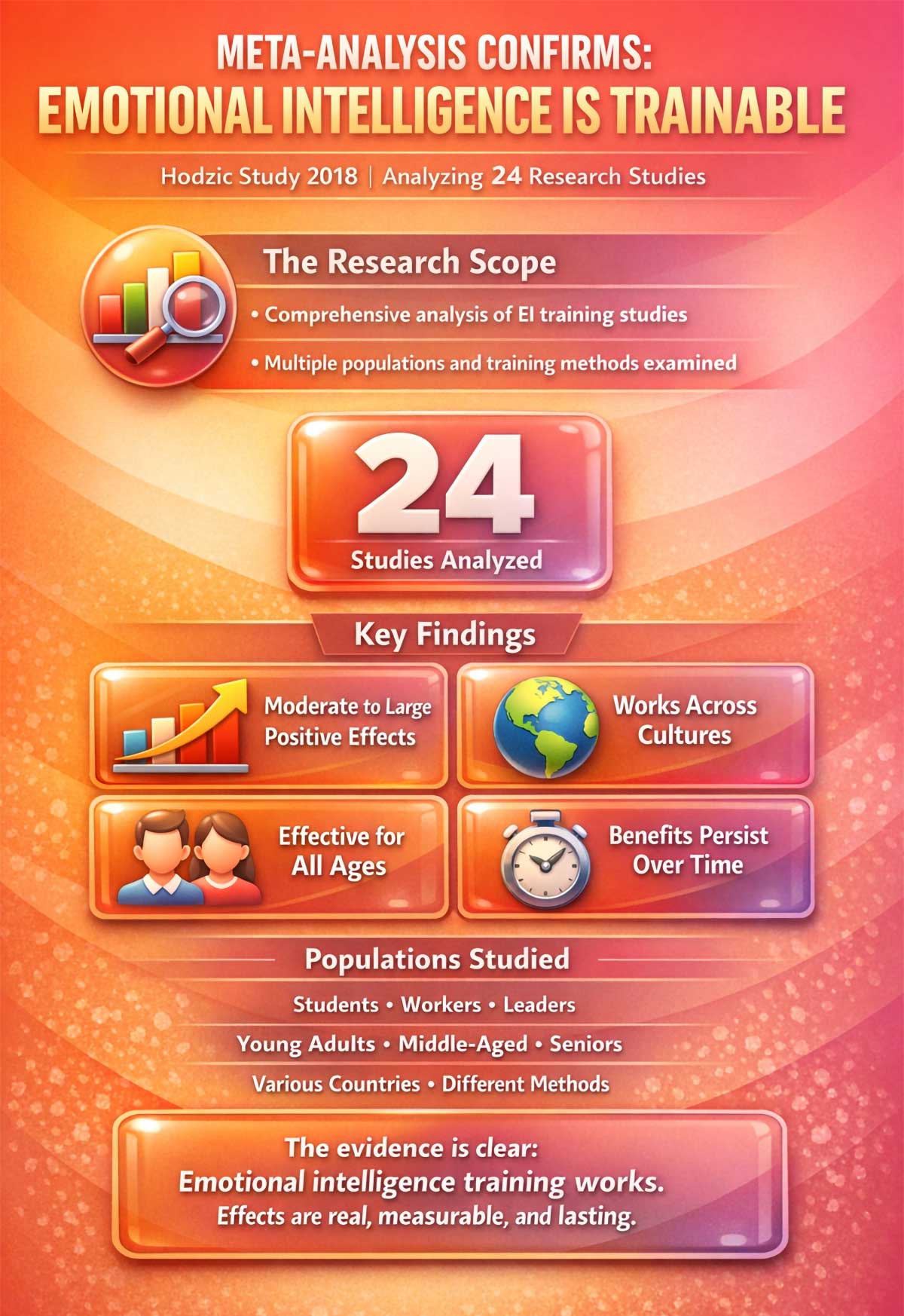
A 2018 meta-analysis by Hodzic and colleagues in Emotion Review examined 24 different EI training studies and found moderate to large positive effects across different populations and training methods. Participants who practiced specific skills showed improvements that held for months after training ended. The brain’s capacity to form new connections (neuroplasticity) makes this possible at any age.
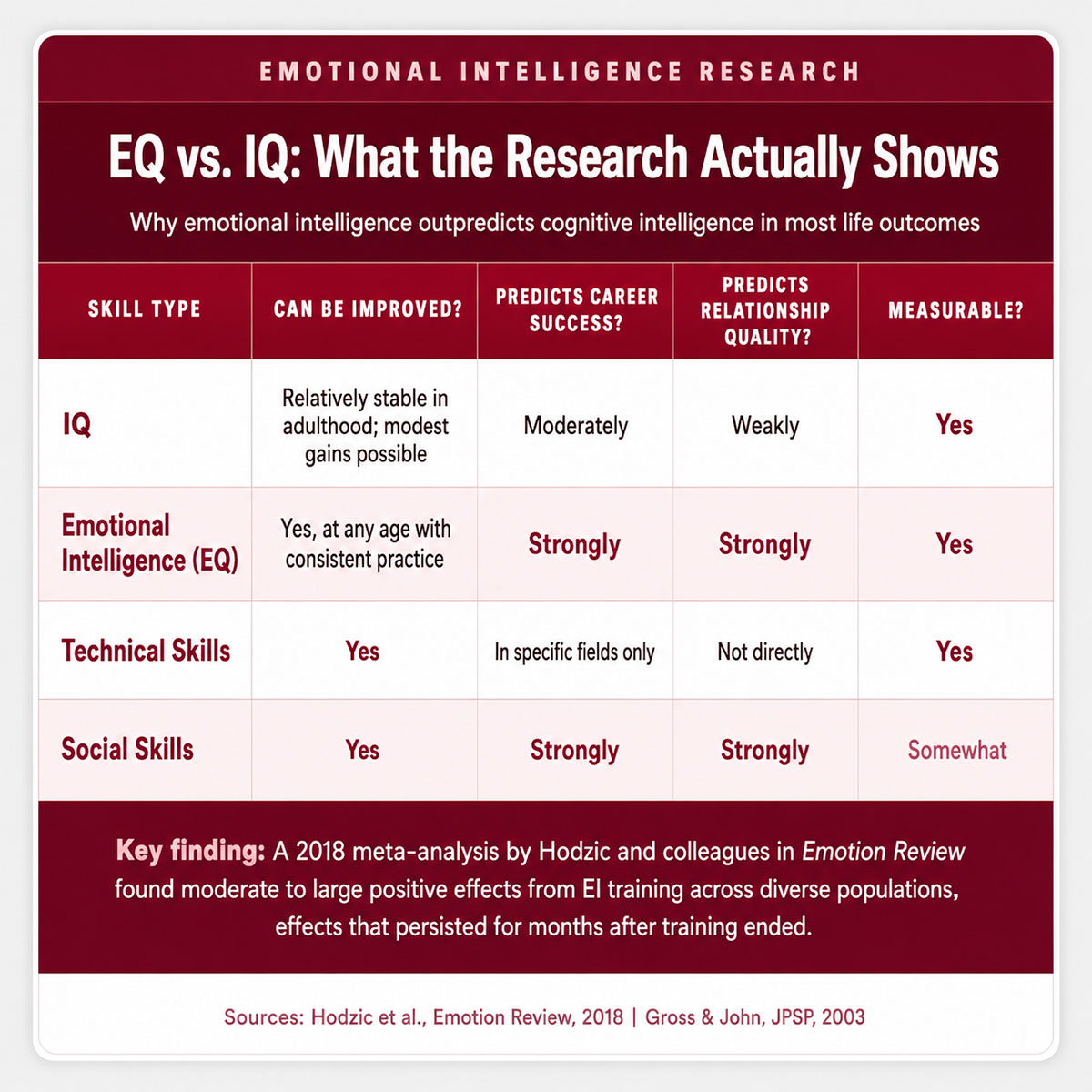
Understanding EI vs. IQ: What’s the Real Difference?
IQ measures cognitive abilities like logic, memory, and problem-solving. These skills are relatively stable in adulthood, though modest changes remain possible with effort. Emotional intelligence measures how well you recognize, understand, and manage emotions in yourself and others. This skill keeps developing as long as you practice it.
Research consistently shows that EI predicts workplace performance, leadership effectiveness, and relationship satisfaction more reliably than IQ in most fields. A person with an average IQ and high EI often outperforms someone with a high IQ and low EI, specifically because they can work well with others, handle stress, and adapt to changing situations.
Your 7-Day EI Quick-Start Plan
New to emotional intelligence practice? Start here instead of trying everything at once.
Days 1-2: Focus on Habit 1 (naming emotions) only. Set three daily reminders.
Days 3-4: Add Habit 2 (the pause technique). Practice before responding to emails or texts.
Days 5-7: Continue both habits and add Habit 3 (4-minute reset). Use it once per day.
After this first week, add one new habit per week. This gradual approach prevents overwhelm from setting in and gives your brain time to strengthen each new pathway before adding the next.
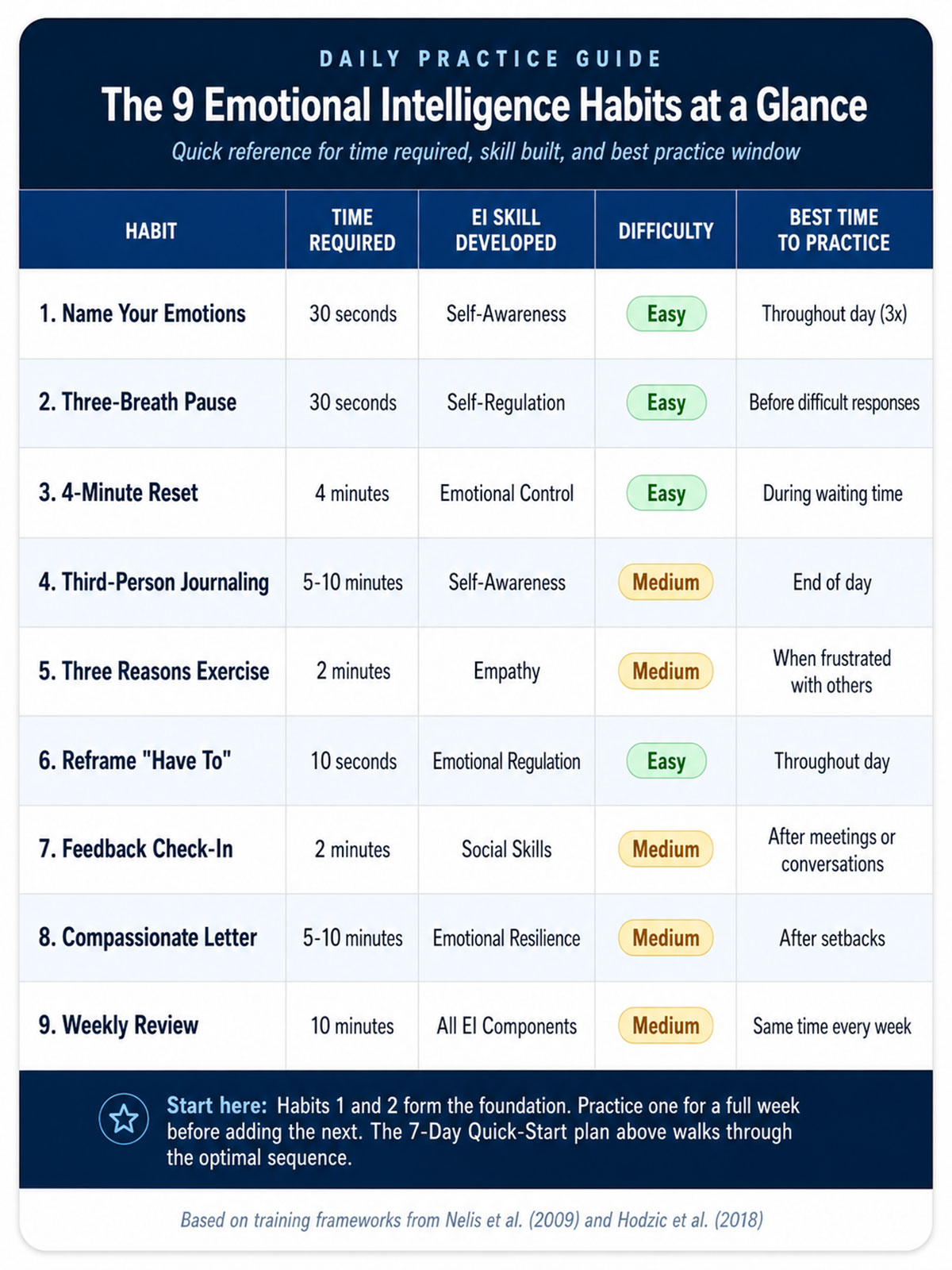
The 9 Habits at a Glance
The table above shows all nine habits, the time each requires, the EI skill it builds, and when to practice it. Bookmark this section as a reference as you build your routine.
Habit 1: Put Your Feelings Into Words
When you feel anxious, angry, or upset, try naming that emotion in one or two words. Say “I feel frustrated” or “I’m anxious about this deadline.”
This simple act triggers a specific shift in your brain. In a 2007 study published in Psychological Science, Lieberman and colleagues used functional MRI to observe what happens when people label their emotions. Thirty healthy adults viewed images of faces showing different emotional states. When participants put words to what they saw, amygdala activity dropped significantly, while activity increased in the right ventrolateral prefrontal cortex, the region associated with rational thinking and emotional control.
Scientists call this “affect labeling.” It’s not what most people expect. Naming the feeling doesn’t validate it or give it power. It hands it to the part of your brain that can actually do something with it. And a 2021 meta-analysis in Neuropsychologia by Berboth and Morawetz, reviewing multiple neuroimaging studies, confirmed that this amygdala-to-prefrontal pathway holds up consistently across populations.
Your Daily Practice:
Set a timer three times during your day. When it goes off, pause and ask yourself: “What am I feeling right now?” Name the emotion in one or two words. Don’t judge it or try to change it. Just notice and name.
You can do this while waiting in line, sitting in traffic, or between meetings. The 30 seconds you spend naming emotions helps your brain build stronger regulation pathways over time.
Example: Sarah in traffic
Sarah sits in traffic, feeling her chest tighten. Her old pattern: stew silently, arrive at work irritable, snap at her team.
New pattern with affect labeling: she notices the chest tightness, says aloud “I’m feeling anxious and rushed,” and follows it with “and a little bit angry at this traffic.” By the time traffic moves, she’s calmer. The emotion didn’t disappear. She moved from being controlled by anxiety to observing it. Two emotion labels. Less than ten seconds total.
Habit 2: Create Space Between Trigger and Response
You know that moment when someone says something that bothers you, and you want to fire back immediately? That’s your amygdala acting faster than your prefrontal cortex can respond. Here’s the problem the research has clarified: the two systems don’t activate on the same timeline.
The amygdala is built for speed. When a threatening signal arrives (including a pointed email or a sharp comment in a meeting), it fires before your prefrontal cortex has had time to assemble a considered response. The gap between those two events is where most regrettable reactions live. Most of what people describe afterward as “I don’t know why I said that” happened in that gap.
A Buhle and colleagues at Columbia mapped this across 48 neuroimaging studies in 2014: deliberate regulation strategies consistently activate the frontal regions that quiet the amygdala. The key word is “deliberate.” The pause gives those circuits time to engage. Without it, the amygdala is already in control.
Try this first:
Use the three-breath rule for emails or texts that raise your blood pressure. Before you type a response, take three slow breaths. Count them. After the third, ask yourself: “What do I actually want to achieve here?”
This tiny pause often shifts your response from reactive to thoughtful. You might send the same message, or you might choose different words. Either way, you’ve given your prefrontal cortex a chance to weigh in.
Marcus and the email
Marcus opens an email from his manager pointing out errors in his report. Gut reaction: defend himself immediately. Instead, he uses the three-breath pause. Breath one: he feels the defensiveness rising. Breath two: he notices his fingers hovering over the keyboard. Breath three: he asks what he actually wants to achieve. His goal isn’t to win an argument. It’s to fix the errors and maintain a good working relationship.
He writes: “Thanks for catching these. I’ll review the report and send a corrected version by the end of the day.” The three breaths took 15 seconds.
Habit 3: Practice 4-Minute Mental Reset Periods
You don’t need hour-long sessions to see results. What Fadel Zeidan’s team found in 2010 is still the most useful counter-argument to “I don’t have time to meditate.” The study gave 49 students who had never meditated four days of 20-minute sessions. The comparison group spent that time listening to audiobooks. By day four, the meditators showed measurable gains in attention, working memory, and emotional regulation. The audiobook group didn’t. Twenty minutes. Four days. No prior experience required.
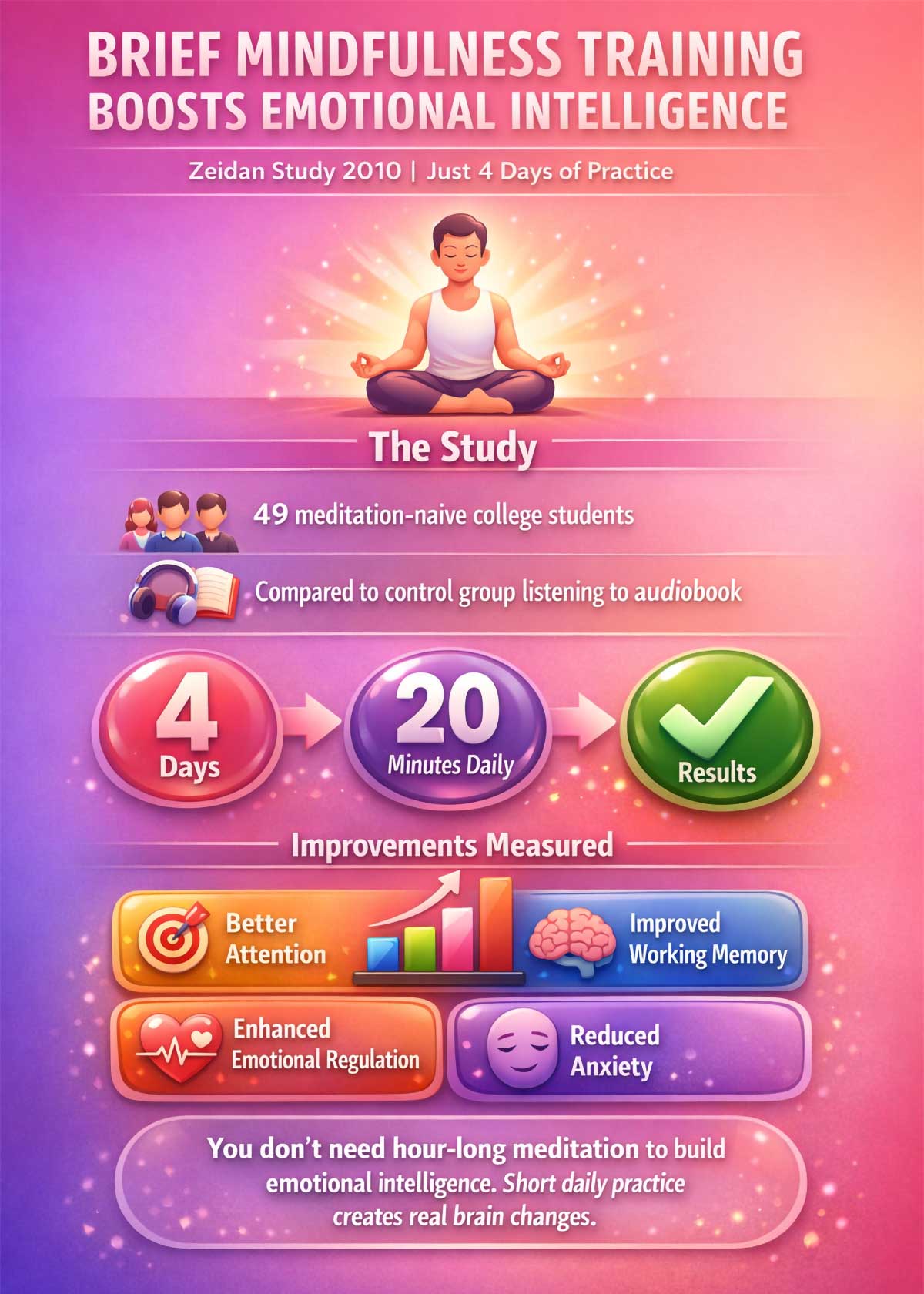
Short mindfulness exercises work because they train your brain to notice what’s happening right now instead of getting pulled into thoughts about the past or future. That awareness arrives before the emotional reaction escalates, which means you have more choices about what to do with it.
The actual exercise:
Use waiting time as practice time. Instead of reaching for your phone, spend four minutes focusing on physical sensations. Notice your breathing. Feel your feet on the floor or your back against the chair. When your mind wanders (and it will), gently return attention to those sensations. You’re not trying to relax. You’re training your brain to stay present.
What four minutes looked like
Chen stands in a long checkout line, phone in hand. Instead of scrolling, he spends four minutes on his reset. He feels his feet on the floor, notices the weight of the basket, and pays attention to three full breaths. His mind wanders to his to-do list. He notices the wandering and returns to physical sensations. Four minutes later, the line has moved. When he gets home, his partner comments that he seems less frazzled than usual after shopping. He didn’t “feel” anything special during it. The practice worked anyway.
Emergency Protocol: When You’re About to Lose It
Sometimes emotions spike fast. You need something that works in 90 seconds or less. Use this reset when you feel yourself about to lose control.
What You Need: A quiet space (bathroom, car, hallway, or even a corner) and 90 seconds of privacy.
- Remove yourself from the situation (0-10 seconds)
- Place one hand on your chest, one on your belly (10-15 seconds)
- Take 5 slow breaths, counting each exhale (15-45 seconds)
- Name the emotion you’re feeling out loud (45-50 seconds)
- Ask yourself: “What do I need right now?” (50-70 seconds)
- Choose one small action based on your answer (70-90 seconds)
This protocol combines three habits: the pause, affect labeling, and mindful breathing. It’s designed for moments when regular practice isn’t enough, when you’re at real risk of saying or doing something you’ll regret.
Quick Recap: Habits 1-3
- Name emotions to shift brain processing from the amygdala to the prefrontal cortex
- Pause for three breaths before reacting to give your regulatory circuits time to engage
- Use 4-minute resets during waiting time to build attention and emotional awareness
Habit 4: Look at Your Day From the Outside
Consider what happened to David as an example. He received harsh feedback on a presentation he’d spent two weeks preparing. His mental replay: “I worked so hard on that. They don’t appreciate anything I do. I’m terrible at presentations.” That loop ran for the rest of the afternoon.
Then someone suggested he try writing about it from a distance, using his own name instead of “I.” He wrote: “David received critical feedback on his presentation. David felt his chest tighten and his thoughts race as he tried to defend his work. David noticed he interpreted the feedback as a personal attack rather than specific suggestions for improvement.” From that outside view, something became visible that the first-person replay had buried: his defensiveness was blocking him from hearing useful information. He was treating a critique of three slides as an indictment of his worth as a person. That insight wasn’t available to him when he was replaying the scene in his own head.
A 2011 review by Ethan Kross and Ozlem Ayduk in Current Directions in Psychological Science synthesized multiple studies and found that analyzing negative experiences from a third-person view reduces emotional distress, lowers cardiovascular stress responses, and decreases rumination compared to first-person replay. When people shift from immersed to distanced reflection, they gain insight rather than losing it.
What to do tonight:
At the end of your day, pick one emotional moment that stands out. Write about it using your name instead of “I.” This word swap creates psychological distance. You’ll spot patterns in your reactions, other people’s possible motivations, and alternative responses that first-person replay tends to obscure.
Habit 5: Imagine What Others Are Actually Thinking
Jennifer’s colleague Tom walked past her in the hallway without saying hello. Her immediate thought: “He’s mad at me. What did I do wrong?” The certainty came fast and felt completely reasonable.
She tried a different exercise: listing three possible reasons for Tom’s behavior that had nothing to do with her. Reason one: Tom got off a difficult phone call moments ago and didn’t notice her. Reason two: Tom is mentally rehearsing something he needs to finish before a deadline. Reason three: Tom is dealing with a personal issue and is preoccupied. She didn’t know which was true. The point wasn’t accuracy. It was shifting from certainty to curiosity. When she later asked, “Hey, you seemed preoccupied earlier, everything okay?” Tom told her his father had just been scheduled for surgery. The interaction had nothing to do with Jennifer at all.
Research by Adam Galinsky and colleagues at Northwestern, published in Group Processes and Intergroup Relations in 2005, found that taking another person’s perspective increased empathic accuracy and reduced bias by creating what researchers called “cognitive overlap,” where your brain simulates the other person’s mental state rather than defaulting to assumptions based on your own experience. Another study by Galinsky and colleagues in Psychological Science in 2008 found the same perspective-taking approach improved negotiation outcomes in competitive settings. The exercise trains the brain to model other mental states rather than project its own.
A two-minute version:
When someone’s behavior bothers you, pause and list three possible reasons for their actions. Don’t judge whether the reasons are valid. Generate possibilities. This practice trains your brain to consider multiple perspectives before landing on a conclusion.
Habit 6: Change the Story You Tell Yourself
Two people experience the same event (a critical email from a manager, a flat response from a partner) and walk away with completely different emotional reactions. The difference is rarely the event itself. It’s the interpretation.
James Gross and Oliver John at Stanford examined this in a 2003 study in the Journal of Personality and Social Psychology spanning five studies with a broad adult sample. People who habitually reframed their situation rather than suppressing how they felt showed greater positive emotion, better social relationships, higher well-being, and lower rates of depression across every measure. Suppression, by contrast, didn’t reduce the emotional experience. It pushed it underground, where it continued to affect mood and relationships.
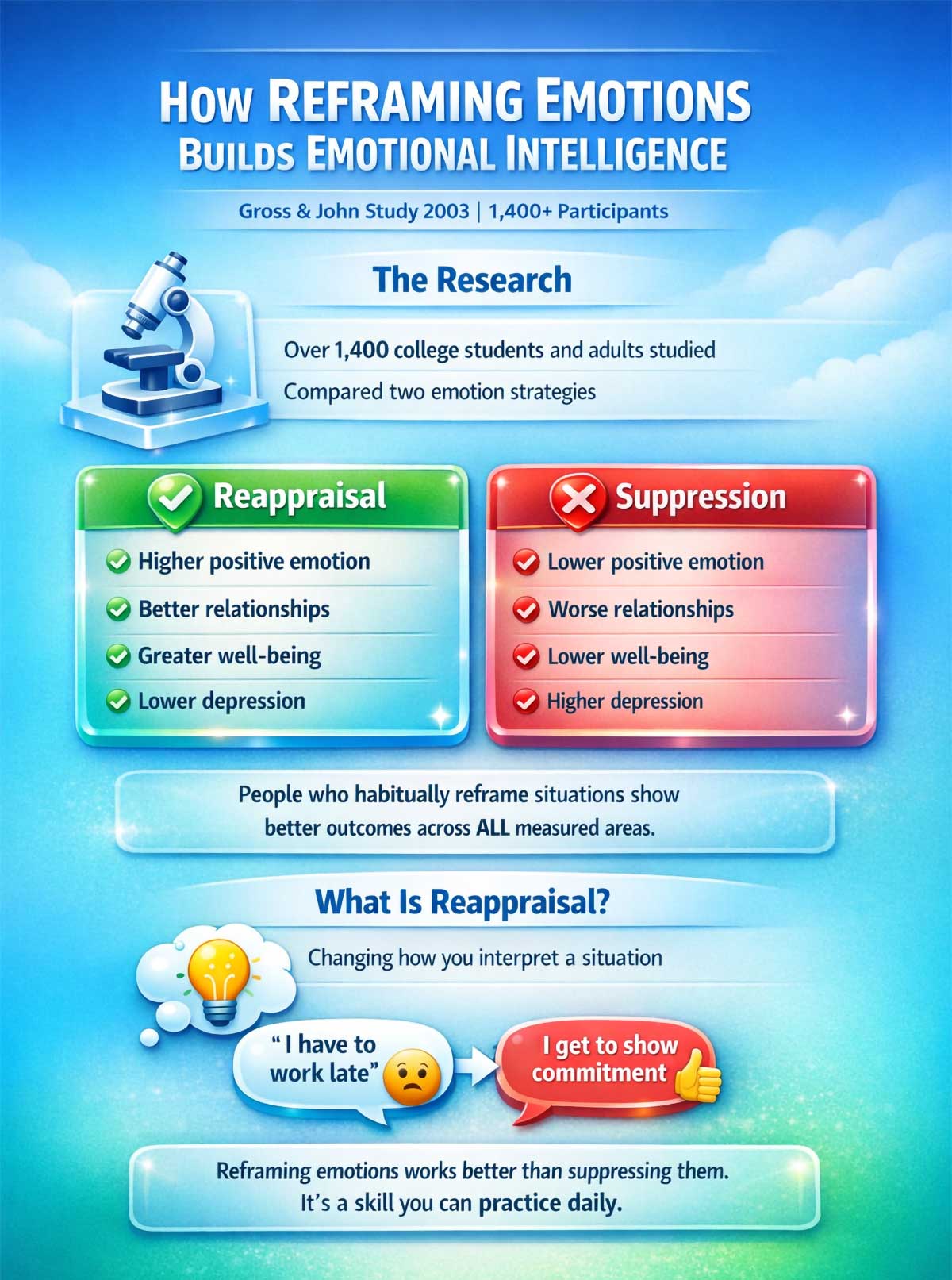
Reframing doesn’t mean pretending bad things are good. It means looking for alternative interpretations that are also true.
Start here:
Notice when you say or think “I have to.” That phrase frames tasks as burdens. Try replacing it with “I get to.” “I have to work late” becomes “I get to show my commitment to this project.” “I have to go to my kid’s game” becomes “I get to watch my kid play.” Not every situation fits. But you’ll find it fits more often than expected.
Rita on Saturday
Rita’s friend asks her to help move apartments on Saturday. First thought: “There goes my weekend. I have to help her move.” She notices the “have to” and shifts: “I get to help my friend during a stressful time. I get to be the kind of friend people can count on.” The physical work is the same. Rita’s experience of the day is not.
Quick Recap: Habits 4-6
- Journal about emotional moments using your name to gain psychological distance from the replay
- List three possible reasons for others’ behavior before landing on a conclusion
- Reframe “have to” as “get to” to shift your interpretation of daily obligations
Habit 7: Ask How You Make Others Feel
Most people fear feedback about their emotional impact. But that feedback is among the most useful data available for building EI. The people around you notice things about your emotional presence that you can’t see: your facial expressions, tone shifts, and body language patterns that register in others before they register in you.
A 2019 systematic review by Iliios Kotsou and colleagues in Emotion Review, synthesizing existing EI training research, found that emotion regulation and interpersonal feedback cycles were among the most consistent predictors of lasting EI development. The ability to adjust behavior based on what you learn from others (not just from self-reflection) is what separates people whose EI keeps growing from those who plateau.
Did that joke land well? Did your tone in the meeting come across as intended? You can’t know unless you ask.
The check-in:
After a meeting or important conversation, check in with one trusted person. Ask: “How did I come across just now? Did anything I said have an emotional impact I should know about?” Make the question specific to the recent interaction. Vague questions produce vague answers.
After Alex’s meeting
Alex leads a team meeting presenting a new policy. He thinks it went well. After the meeting, he asks Jordan, a colleague he trusts, how he came across. Jordan hesitates, then says, “You seemed really firm. A few people looked like they wanted to ask questions, but didn’t. Your tone said ‘this is final’ even when you asked for feedback.” Alex thought he was being clear. He came across as closed off. He sends a follow-up email clarifying that he’s genuinely open to concerns. Without Jordan’s feedback, he’d have had no idea his tone was contradicting his words.
Habit 8: Treat Your Mistakes With Kindness
When you mess up, the immediate reaction for most people is harsh self-criticism. “I’m such an idiot. Why do I always do this?” That internal response activates your brain’s threat system, the same one driven by amygdala activity, and makes it harder, not easier, to think clearly and learn from what happened.
Kristin Neff at the University of Texas and Christopher Germer trained community adults in Mindful Self-Compassion techniques over eight weeks in a study published in the Journal of Clinical Psychology in 2013. Compared to a waitlist control group, participants significantly increased self-compassion and mindfulness while reducing depression, anxiety, and stress. The benefits held at 6-month and 1-year follow-ups. Participants learned to treat themselves with the same basic steadiness they’d offer a friend who’d made the same mistake, not to excuse the error, but to remain functional enough to fix it.
Self-compassion is not self-indulgence. It’s treating yourself with enough decency to keep your nervous system online while you work out what to do next.
After the next setback:
After a setback or mistake, write yourself a short letter from the perspective of a compassionate friend. What would a caring friend say to you right now? What would they remind you of? How would they put this situation in context?
Priya’s letter
Priya completely forgets about a client deadline. The project is due tomorrow, and she hasn’t started. Her immediate reaction: “I’m so stupid. I’m going to get fired.” Then she writes herself a letter: “You made a mistake by missing this deadline. That’s rough, and you’re scared. But you’ve been managing five projects and dealing with a family health crisis. You’re human. What matters now is how you handle it. Call the client first thing tomorrow, own the mistake, and propose a solution. You’ve bounced back from setbacks before.” The letter doesn’t make the problem disappear. It calms her system enough to think clearly about next steps. She stays up late, completes what she can, and has a plan ready for the client call.
Habit 9: Track Your Emotional Hits and Misses
The research on EI training makes a point most habit guides skip: knowing what to practice matters less than knowing what worked. In a 2009 study published in Personality and Individual Differences, Delphine Nelis and colleagues at the University of Liège followed university students through four weekly training sessions, with a control group for comparison. The students who showed lasting improvement weren’t just the ones who practiced. They were the ones who reflected deliberately on what their practice produced. That improvement held at a 6-month follow-up. The reflection component, it turns out, was doing more work than the training itself.
You can replicate the reflection component without enrolling in a formal program.
Your weekly habit:
Once a week, spend ten minutes reviewing your emotional week. Note your hits (moments when you handled emotions well) and your misses (times you wish you’d responded differently). Focus on patterns, not isolated incidents. These patterns reveal where to concentrate your practice the following week.
Your 10-Minute Weekly Review
What You Need: Your weekly calendar, a notepad or notes app, and a quiet ten-minute window at the same time each week.
- Scan your week by reviewing your calendar for significant interactions (2 minutes)
- Identify 3 emotional “hits” (times you handled emotions well) (3 minutes)
- Identify 2 emotional “misses” (times you wished you’d responded differently) (2 minutes)
- Spot the pattern: what do your hits and misses have in common? (2 minutes)
- Choose one focus: pick one habit to emphasize next week (1 minute)
Storage tip: Keep review notes in a journal for pattern tracking over months. You’ll spot trends across 4-6 weeks that you’d miss in a single review.
Quick Recap: Habits 7-9
- Ask trusted colleagues for specific feedback on your emotional impact after interactions
- Write compassionate letters to yourself after setbacks to keep your nervous system functional
- Review your emotional hits and misses weekly to identify patterns and track progress
Emotional Intelligence Self-Assessment
Discover your EI strengths and the habits that will move the needle most
This assessment covers the four core components of emotional intelligence: self-awareness, self-regulation, empathy, and social skills. Answer each question honestly based on your typical behavior, not how you'd like to behave. 12 questions. About 3 minutes.
5 Mistakes That Sabotage Your EI Growth
Even with the best intentions, certain approaches stall progress. Here are the most common ones.
1. Trying All Nine Habits at Once. Your brain cannot build that many new neural pathways simultaneously. You’ll feel overwhelmed and quit. Stack habits slowly, one per week, giving each pathway time to form before adding the next.
2. Judging Your Emotions as Good or Bad. Judgment triggers shame, which blocks awareness. When you label anger as “bad,” you stop noticing it early. By the time you recognize it, you’re already in the middle of an outburst. Practice neutral observation instead. Anger is information, not a verdict on your character.
3. Expecting Instant Results. Neural pathways take weeks to strengthen. You might practice affect labeling for three days and still feel just as anxious. That doesn’t mean it isn’t working. It means the pathway is forming under the surface. Watch for the moment you catch an emotion slightly earlier than you used to. That’s the signal.
4. Skipping Practice When You’re Calm. Practice the three-breath pause in low-stakes moments: a slow meeting, a routine email, a checkout line. The habit won’t be available in a crisis if it’s only ever been attempted in one. New neural pathways don’t build under pressure. They build under repetition.
5. Comparing Your Progress to Others. Everyone’s starting point differs. Someone who grew up in an emotionally aware family has different neural pathways than someone who learned to suppress all feelings. The emotional vocabulary you’re building and the pause that’s becoming automatic are personal milestones measured against your own baseline. The only comparison that reveals anything useful is you now versus you a month ago.
7 Signs Your EI Is Growing
Progress isn’t always obvious day-to-day. These markers show the habits are working.
1. You Notice Emotions Before They Peak. You catch irritation before it becomes anger. Frustration before it becomes withdrawal. That window between what you feel and how you respond is what these habits are building. Once it exists, it tends to widen.
2. Other People Comment That You Really Get Them. Friends, family, or colleagues mention that you understand them, or that talking to you helps them feel heard. This is usually the last sign people expect. The EI gains show up in other people’s experience before they register in your own. It means your empathy and perspective-taking have reached the point where others can feel it, not just observe it.
3. You Recover From Setbacks Faster. A mistake that would have derailed your whole week now bothers you for a few hours. You still feel disappointed, but you process the emotion and move forward rather than spiral.
4. Conflicts De-escalate When You’re Involved. Heated discussions calm down when you join them. People seem less defensive around you. This happens because your improved regulation helps others regulate their emotions too. Emotional states are contagious in both directions.
5. You Feel Less Reactive to Criticism. The defensive surge is still there. It just doesn’t reach your mouth before your prefrontal cortex has had a chance to weigh in.
6. You Can Name Subtle Emotional Shades. Instead of just “good” or “bad,” you recognize distinctions like “hopeful but nervous” or “satisfied but slightly disappointed.” Researchers call this emotional granularity, and it is one of the most reliable indicators of high EI. A 2010 study by Todd Kashdan and colleagues in Psychological Science linked this ability to distinguish between closely related negative emotions with better coping and emotional resilience.
7. You Catch Yourself Using These Habits Without Thinking. The biggest sign: you realize you’ve paused three breaths before responding without consciously deciding to do it. The habit has moved from deliberate practice to automatic behavior. Your brain has built the pathway.
These signs emerge at different times for different people. Some appear within weeks, others take months. The timeline matters less than the direction you’re moving.
When Self-Practice Isn’t Enough
The nine habits work for most people building general EI skills. Some situations call for professional support. Consider working with a therapist or counselor if:
- Emotional reactions interfere with daily functioning (work, relationships, or basic tasks)
- You struggle to identify any emotions beyond “good” or “bad,” even after weeks of practice
- Past trauma makes emotional awareness overwhelming or triggering
- You have symptoms of depression, anxiety, or other mental health conditions
- Relationship problems persist despite a genuine effort to apply these skills
- You experience emotional numbness or disconnection from feelings
- You have intrusive thoughts about harming yourself or others
A therapist specializing in emotional regulation or dialectical behavior therapy (DBT) can provide personalized guidance. DBT was specifically designed to help people who struggle with intense emotions, and it teaches advanced regulation skills that go beyond what self-practice can achieve.
Seeking professional help isn’t a failure. It’s the recognition that some emotional challenges require more than a self-guided program. Think of it the way you would physical health: you can exercise and eat well on your own, but sometimes you need a specialist for specific problems.
The Case for Starting Small
Each of these nine habits takes only minutes per day. Name your emotions for 30 seconds. Pause three breaths before responding. Spend four minutes on mindfulness. Journal in third person. List three perspectives. Reframe one task. Ask for feedback. Write a compassionate letter. Review your week.
None of these is complicated. But the research makes the case for consistency over intensity. The 2018 Hodzic meta-analysis found that EI training produces moderate to large effects, and that those effects appear from structured daily practice, not from occasional effort. Doing these habits for ten minutes daily outperforms doing them for two hours once a week because the brain builds pathways through repetition, not through effort.
Month one, you might notice you’re catching emotions a few seconds earlier. By month three, friends might comment that you seem calmer or more present. The research on skill acquisition suggests most people reach a degree of automaticity (doing something without consciously choosing to do it) somewhere between 18 and 66 days, depending on the habit and the person. When these habits stop feeling like habits and start feeling like how you are, the pathways have formed.
That timeline varies more than the research suggests. Some people notice the pause becoming automatic within three weeks. Others practice for two months and still feel like they’re choosing it deliberately every time. Both are normal. The pathway is forming whether you feel it or not.
Start Where You Are
Don’t try to adopt all nine habits at once. Pick one that speaks to your actual current struggle. If you often feel overwhelmed by emotions you can’t name, start with affect labeling. If you tend to fire off messages you later regret, start with the pause. If you spiral after setbacks, start with the compassionate letter.
Practice that habit for seven days. Notice what changes. After a week, add a second. Stack them slowly. Some days you’ll handle emotions skillfully: name your frustration, pause before responding, choose your words carefully. Other days, you’ll snap at someone, spiral into anxiety, or shut down completely. That’s not a setback. That’s being human. What matters is the overall direction you’re moving.
Conclusion
There is something odd about the way emotional intelligence is usually taught. The advice focuses on behaviors (listen better, be more empathetic, pause before reacting) without explaining that the structural difficulty is the real problem. The amygdala and the prefrontal cortex operate on different timelines. The prefrontal cortex needs a window to engage, and without a deliberate practice that creates that window, the amygdala closes the conversation before reasoning arrives.
What the research in this article describes isn’t a personality transplant. It’s the repeated creation of that window, habit by habit, until the window opens on its own. The naming, the pause, the distanced reflection, the compassionate letter. None of these feels important in the moment. They feel almost too small. That is what the evidence says they need to feel like to work.
FAQs
How long does it take to improve emotional intelligence?
Measurable improvements appear in as little as 2 to 4 weeks with consistent daily practice. A 2009 study by Nelis and colleagues found that just four weekly training sessions produced changes that held at 6-month follow-up. Most people notice small shifts within the first week, catching an emotion slightly earlier or pausing once before reacting. Consistent management of difficult emotions typically takes 6 to 12 weeks of regular practice.
Can you improve emotional intelligence at any age?
Yes. Brain plasticity continues throughout life. The 2018 Hodzic meta-analysis included participants from ages 18 to 65 and older, and all age groups showed improvements. Some research suggests older adults may have advantages in certain EI skills because life experience provides more emotional data to learn from.
What’s the difference between EQ and IQ?
IQ measures cognitive abilities like logic, memory, and problem-solving. EQ (emotional quotient) measures how well you recognize, understand, and manage emotions, whether your own or others’. Both have predictive value. EQ better predicts relationship quality and career success in most fields. A person with an average IQ and high EQ often outperforms someone with a high IQ and low EQ because they can work well with others, handle stress, and adapt to changing situations.
What are the 5 C’s of emotional intelligence?
Different frameworks name different components. One widely cited model identifies Consciousness (self-awareness of your own emotional states), Control (the ability to regulate reactions rather than act on impulse), Curiosity (genuine interest in others’ emotional experiences), Compassion (responding to others’ distress with care rather than judgment), and Connection (the ability to form and maintain emotionally genuine relationships). These map directly onto the nine habits in this article, especially habits 1, 2, 5, 8, and 7.
How do you improve emotional intelligence in a relationship?
Three habits from this article apply most directly to relationship EI: Habit 5 (listing three reasons for a partner’s behavior before assuming the worst), Habit 7 (asking how you came across after a difficult conversation), and Habit 8 (treating mistakes in the relationship with self-compassion rather than shame spiraling). The Galinsky perspective-taking research specifically found that brief practice in imagining a partner’s mental state increased empathic accuracy in close relationships, not just in workplace or negotiation settings.
Is emotional intelligence the same as being nice?
No. High EI means you understand emotions and can manage them effectively. This sometimes means setting firm boundaries, having difficult conversations, or choosing not to help someone when doing so would harm them long-term. Being nice often means avoiding discomfort or conflict. High EI means handling discomfort with skill. The most emotionally intelligent response is sometimes to say no, give hard feedback, or let someone experience natural consequences of their choices.
How do you measure emotional intelligence?
Researchers use standardized assessments like the MSCEIT (Mayer-Salovey-Caruso Emotional Intelligence Test). For personal tracking, monitor specific behaviors: how often you pause before reacting, whether you can accurately name what you’re feeling, whether others say you understand them, and how quickly you recover from setbacks. These concrete markers give more useful information than vague self-assessments.
Can low emotional intelligence be a sign of a mental health condition?
Difficulty with emotional regulation appears in several conditions, including ADHD, autism spectrum disorder, anxiety disorders, and depression. If you struggle significantly with emotional awareness or management despite practicing these skills, consider consulting a mental health professional for evaluation. Some people need additional support beyond self-directed practice, and that’s completely normal.
What if I’m naturally introverted?
Introversion relates to where you get your energy (alone versus with others), not to emotional intelligence. Many introverts have strong EI because they spend time in self-reflection and careful observation. They may prefer smaller social circles, but they often read emotions accurately and form deep connections. The habits in this article work regardless of personality type. Introverts may find the solo practices (journaling, self-compassion) easier to start with, while the social practices (feedback, perspective-taking) may take more intentional effort.
Which habit should I start with?
Start with Habit 1 (naming emotions) or Habit 2 (the three-breath pause). Both are quick, immediately applicable, and form the foundation for everything else. You can’t regulate emotions you haven’t noticed. Practice one for a full week before adding a second. The 7-Day Quick-Start plan at the top of this article walks through the optimal sequence.