Research proves you can develop emotional intelligence in just four weeks using specific, science-backed techniques. Studies show effect sizes of 0.63 to 1.22, meaning the average trained person performs better than 74-89% of untrained individuals. This guide shows you exactly how to develop emotional intelligence using methods tested on thousands of participants across multiple countries.
Quick Self-Assessment: Where Do You Stand?
Before we explore how to develop emotional intelligence, take 60 seconds to assess your current skills.
The research shows that people starting with lower emotional intelligence often demonstrate the biggest improvements.
Your brain isn’t set in stone. That applies to your emotional skills too.
For years, people assumed emotional intelligence was something you either had or didn’t. Recent science tells a different story. Studies across multiple countries show that focused training can boost your emotional skills in just four weeks.
The evidence is clear. You can teach your brain to read emotions better, manage stress more effectively, and build stronger relationships. The question isn’t whether it’s possible. It’s how to do it right.
Common Myths About Emotional Intelligence
Before we dive into how to develop emotional intelligence, let’s clear up some misconceptions:
Myth: “Emotional intelligence is just being nice and agreeable.”
Reality: High EI includes setting boundaries, delivering difficult feedback, and standing firm when necessary. It’s about effectiveness, not likability. The most emotionally intelligent leaders know when to say no and how to have tough conversations without destroying relationships.
Myth: “You’re either born with it or you’re not.”
Reality: While some baseline differences exist (like all abilities), training produces effect sizes of 0.63-1.22—larger than many other trainable skills. That’s comparable to or better than improvements seen in cognitive training programs. Your genes might set a starting point, but practice determines where you end up.
Myth: “Men can’t develop EI as well as women.”
Reality: Research shows no significant gender differences in training response. Both men and women show equivalent gains from structured practice. The Mattingly and Kraiger meta-analysis found that gender didn’t predict training outcomes.
Myth: “EI training is just positive thinking.”
Reality: EI training involves skill-building in emotion recognition, pattern understanding, and regulation—concrete abilities measured by performance tests, not self-help platitudes. You’re learning to process emotional information more accurately, not just thinking happy thoughts.
Myth: “High EI means you’ll never feel negative emotions.”
Reality: High EI means experiencing the full range of emotions but managing them skillfully. The goal is emotional agility, not perpetual positivity. Anger, sadness, and fear serve important functions. The skill lies in feeling them at appropriate intensities and responding effectively.
Your Brain Can Learn Emotional Skills
Think your emotional patterns are permanent? Think again.
Scientists measured emotional intelligence before and after training programs. They found consistent improvements across different groups—students, workers, and everyday adults. The changes weren’t small either.
Victoria Mattingly and Kurt Kraiger analyzed 58 separate studies involving thousands of participants in 2019. They found an average effect size of 0.63 across all emotional intelligence training programs. In practical terms, this means the average person who completes training performs better than 74% of people who don’t train. That’s a meaningful jump.
Here’s what makes this fascinating: ability-based training—where you practice reading and managing emotions—produced even bigger results. The effect size jumped to 1.22 for these programs. That’s huge in research terms. It means participants improved more than 89% of untrained individuals.
Your emotional circuitry responds to practice just like your muscles respond to exercise. When you train your brain to identify subtle emotional cues or regulate intense feelings, you’re building new neural pathways. This isn’t pop psychology. It’s documented in controlled trials with follow-up testing months later.
The key lies in how you train. Not all emotional intelligence is the same. Ability-based emotional intelligence means learning to process emotional information accurately. Trait emotional intelligence refers to how you see your own emotional skills. They need different approaches.
Most people mix these up. They read generic advice about “being more empathetic” without knowing which specific skill they’re trying to build. That’s like going to the gym and randomly touching equipment instead of following a program.
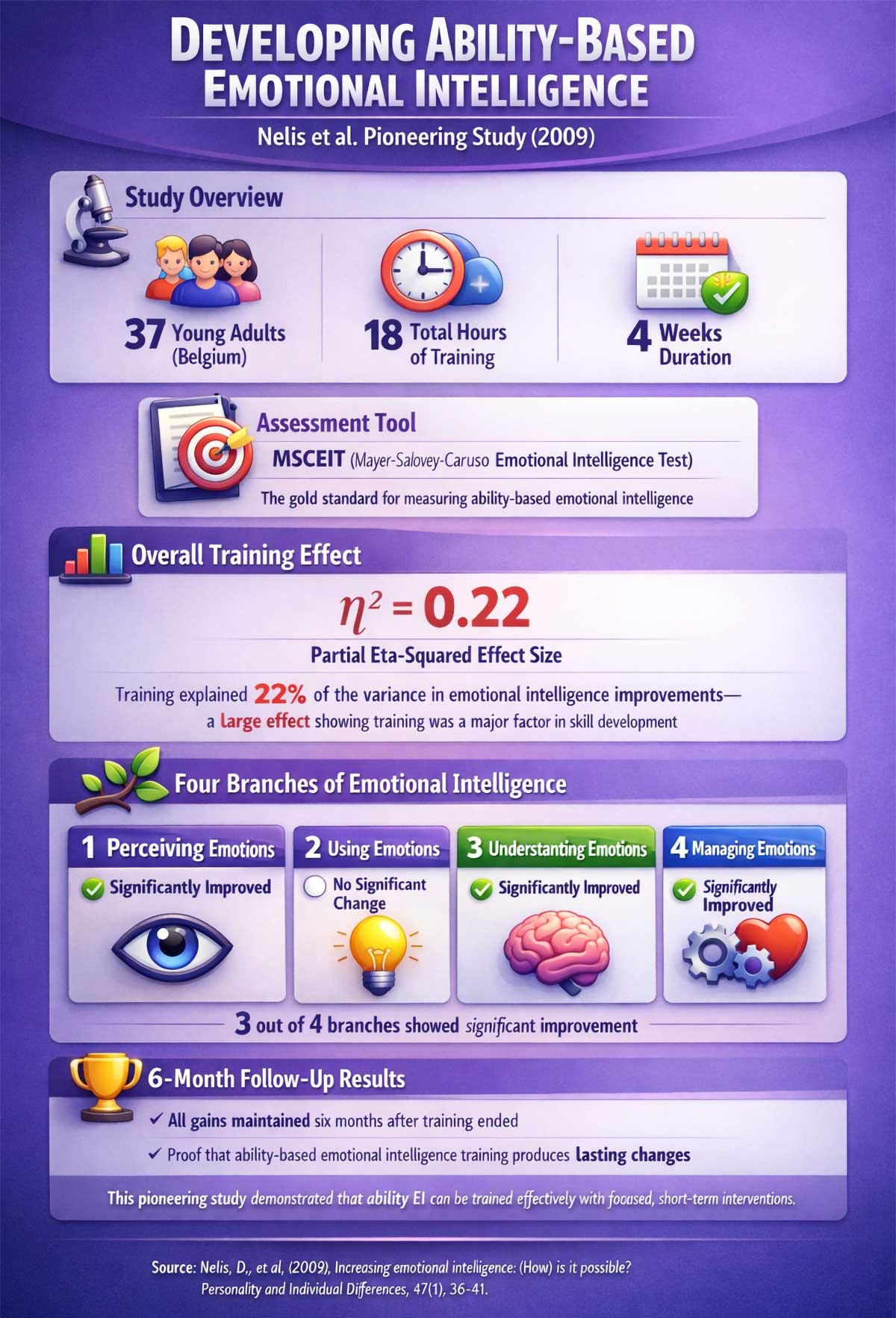
David Nelis and his team at the University of Leuven tested 37 young adults using the Mayer-Salovey-Caruso Emotional Intelligence Test in 2009. After 18 hours of focused training over four weeks, participants showed large improvements in three out of four emotional skill areas. The effect size was η² = 0.22, which in practical terms means the training explained 22% of the variance in emotional intelligence improvements—a large effect indicating that training was a major factor in participants’ skill development. Six months later, those gains held strong.
The takeaway? Your emotional wiring is flexible. You just need the right training plan.
Understanding Effect Sizes: What the Numbers Really Mean
You’ll see terms like “d = 0.36” or “g = 0.63” throughout research on emotional intelligence. These effect sizes tell you how much change to expect.
Here’s the simple translation:
- Small effect (d = 0.2 to 0.5): Noticeable improvement. You handle situations slightly better than before.
- Moderate effect (d = 0.5 to 0.8): Clear improvement. Others notice the change in how you interact.
- Large effect (d = 0.8+): Substantial improvement. Your emotional responses feel significantly different.
A “moderate” effect size doesn’t mean moderate real-world value—it’s a statistical term. In practice, even small-to-moderate effect sizes produce noticeable improvements in daily functioning.
To put this in perspective, antidepressant medications typically show effect sizes around 0.3 to 0.4 for treating depression. Cognitive behavioral therapy for anxiety shows effects around 0.6 to 0.8. Emotional intelligence training with effect sizes of 0.63 to 1.22 sits right in that meaningful range.
A moderate effect doesn’t mean moderate value. It means real, measurable change that improves your daily life. When we say a study found d = 0.36, we’re saying participants gained skills that moved them from average to above average, or from struggling to competent.
The Four-Week Path to Better Emotional Skills
Most successful programs share a common timeline: about four weeks.
Studies tested different approaches and durations. The sweet spot appears to be 10 to 18 hours of total training spread across a month. That breaks down to roughly 2.5 to 4.5 hours per week.
Why does this window work? Your brain needs repetition to form new habits, but it also needs time between sessions to consolidate learning. Cramming emotional training into a weekend retreat doesn’t stick. Stretching it over six months loses momentum.
Sébastien Hodzic and colleagues ran a randomized controlled trial with 158 French university students in 2018. They used eight sessions over four weeks, each lasting two hours. Participants showed meaningful improvements in their emotional skills, with an effect size of 0.36. That might sound modest, but it represents a noticeable shift in daily emotional functioning. The students maintained these gains six months after training ended, proving the changes weren’t just temporary.
Ilios Kotsou led another study in Belgium in 2011, taking 132 adults through four weeks of training at 2.5 hours weekly. The program focused on five core areas using the Profile of Emotional Competence: identifying emotions, expressing them appropriately, understanding how they work, regulating intense feelings, and using emotions productively. The results showed medium-to-large effects (partial η² = 0.12-0.19, which translates to approximately Cohen’s d = 0.7-1.0) across all five competency areas. Participants didn’t just feel better about their emotional skills—they actually performed better on objective tests.
Here’s your realistic four-week training roadmap:
Your 4-Week Daily Practice Schedule
| Week | Daily Practice (30-45 min) | Difficulty | Expected Progress Marker |
|---|---|---|---|
| Week 1 | Emotion journaling + vocabulary building (name every feeling precisely) | ★☆☆☆☆ Easy | You identify 10+ emotion words in daily situations |
| Week 2 | Pattern tracking + prediction exercises (notice how emotions shift) | ★★☆☆☆ Moderate | You accurately predict your emotional shifts 60% of the time |
| Week 3 | Regulation technique practice (test different cooling strategies) | ★★★★☆ Challenging | You successfully reduce emotion intensity by 2-3 points |
| Week 4 | Mood-task matching experiments (use emotions as tools) | ★★★☆☆ Moderate-Hard | You notice performance improvements when mood matches task |
Week 1: Build Your Emotional Vocabulary
You can’t manage what you can’t name. Most people use vague labels like “stressed” or “upset” for dozens of different emotional states. Start distinguishing between frustration, disappointment, anxiety, and irritation. They feel different and require different responses.
Spend 30 minutes daily noticing and naming your emotions with precision. When something triggers a feeling, pause and ask: “What exactly am I experiencing right now?” Use specific terms.
Try this now: Think about the last time you felt “bad.” Was it actually disappointment? Embarrassment? Regret? Anger at yourself? Each of these requires a different response. Disappointment needs acknowledgment and adjusted expectations. Embarrassment fades with time and perspective. Regret calls for learning and moving forward. Self-directed anger needs compassion and problem-solving.
Week 2: Learn Emotional Patterns
Emotions follow predictable paths. Annoyance often grows into anger if unaddressed. Worry can spiral into panic or settle into concern depending on how you think about it.
Practice predicting how your emotions might shift. When you notice mild frustration, ask yourself: “If I don’t address this, where will it go in an hour?” This builds your understanding of emotional dynamics.
Keep a simple log:
- Starting emotion: Irritated (intensity: 4/10)
- Predicted path: Will grow to anger if I stay in this meeting
- Actual outcome: Left the room briefly, returned calmer
- What I learned: Physical distance helps me reset
Week 3: Practice Down-Regulation
You need tools for cooling intense emotions. Research shows that specific techniques work better than vague advice to “calm down.”
Try these proven methods: Name the emotion out loud. Take six slow breaths (five seconds in, seven seconds out). Mentally zoom out and view the situation as an outside observer might. Each technique interrupts the emotional escalation cycle.
Test at least three different techniques this week. Not every method works for every person or situation. You’re building a personal toolkit.
Week 4: Use Emotions as Tools
Different moods suit different tasks. Mild happiness helps brainstorming. Slight sadness actually improves detail-oriented work and critical analysis. Moderate anxiety sharpens focus for time-sensitive projects.
Start matching your emotional state to your tasks. Need to edit a contract? Your naturally cautious mood in the morning might be perfect. Planning a creative project? Wait for a more upbeat moment.
The intensity matters more than you’d think. Ten to eighteen hours isn’t casual browsing through self-help articles. It’s structured practice with feedback and reflection.
5 EI Techniques You Can Use Today
Want immediate results while you plan your four-week program? These techniques apply core EI principles you can use right now:
1. The Emotion Label Technique (30 seconds)
When you feel something, name it precisely out loud. “I’m feeling frustrated about the deadline.” Research shows this reduces emotional intensity by 20-30% immediately. The act of labeling activates your prefrontal cortex, which helps regulate your emotional centers.
2. The 4-7-8 Breath (90 seconds)
Breathe in for 4 counts, hold for 7, out for 8. Repeat 3-4 times. This activates your parasympathetic nervous system for rapid calming. It’s one of the fastest regulation techniques available.
3. The Perspective Zoom (2 minutes)
When upset, imagine viewing the situation from a drone camera above you. This mental distance automatically reduces emotional intensity. Psychologists call this “cognitive distancing” and it’s highly effective for cooling strong emotions.
4. The Pre-Meeting Emotion Check (1 minute)
Before any important interaction, ask yourself: “What am I feeling right now?” and “What intensity would be most effective?” Adjust accordingly. This prevents you from bringing inappropriate emotional states into important conversations.
5. The Emotion-Task Match (30 seconds)
Before starting work, ask: “Does my current mood help or hurt this task?” If it hurts, take 5 minutes to shift it before beginning. Need to brainstorm? Cultivate mild happiness. Need to review risks? Let yourself feel appropriately cautious.
These aren’t substitutes for systematic training, but they demonstrate immediate applications of EI principles and can produce noticeable benefits today.
The Science Behind Why This Works
Your brain’s emotional processing centers can rewire themselves through focused practice. This isn’t wishful thinking—it’s basic neuroscience.
The prefrontal cortex, located right behind your forehead, acts as your brain’s emotion regulation center. It can strengthen or weaken your emotional responses based on how you interpret situations. When you practice identifying emotions accurately or using regulation techniques, you’re building stronger connections between your prefrontal cortex and your emotional centers like the amygdala.
Think of it like building a bike path through a field. The first time you ride across, you leave barely a trace. After riding the same route 20 times, you’ve created a clear path. After 100 times, it’s the obvious route anyone would take. Your neural pathways work the same way.
This explains why spacing your practice matters. Your brain consolidates learning during sleep. When you practice emotional regulation on Monday, then sleep, then practice again on Tuesday, you’re giving your brain time to strengthen those neural connections. This produces better results than cramming all your practice into one day.
The process of neuroplasticity—your brain’s ability to reorganize itself—remains active throughout your life. You’re not too old to build emotional skills. The Belgian studies included adults ranging from young professionals to middle-aged participants. All age groups showed improvements.
Four Branches of Emotional Growth
Emotional intelligence isn’t one skill. It’s four distinct abilities that work together.
Scientists who study ability-based emotional intelligence identify these as separate branches. Each one can be trained independently, though they reinforce each other.
Branch 1: Reading Emotional Signals
This goes beyond recognizing obvious anger or joy. Can you spot the difference between someone who’s disappointed versus discouraged? Between nervous and excited?
Your brain processes emotional information through facial expressions, tone of voice, body language, and context. Most people catch only the loudest signals. Training helps you notice subtle cues.
Try This Now: The 2-Minute Emotion Reading Exercise
Think about the last conversation you had. Picture the person’s face. What emotion were they showing? Now go deeper:
- What were their eyebrows doing? (Raised, furrowed, relaxed?)
- Was their jaw tight or loose?
- Did their tone match their words?
- What about their posture?
Most people remember the general mood but miss specific signals. Start noticing these details in your next three conversations today.
Practice Exercise:
Watch video clips on mute. Try news interviews or movie scenes. Watch people’s faces and guess what they’re feeling. Then watch with sound to check. Do this for 15 minutes three times a week. Your accuracy will climb.
You can also test yourself in daily life. Before someone tells you how they feel, make a private prediction. Were you right? If not, what signals did you miss?
Real-World Example:
Your colleague says “I’m fine” when you ask about the project deadline, but their shoulders are hunched, they’re avoiding eye contact, and they keep sighing. The words say “fine” but everything else says “stressed and overwhelmed.” High EI means trusting the nonverbal signals more than the words.
Common Mistakes to Avoid:
- Assuming everyone shows emotions the same way you do
- Ignoring cultural differences in emotional expression
- Relying only on facial expressions while ignoring tone and context
- Jumping to conclusions without gathering enough information
Branch 2: Understanding Emotional Logic
Emotions follow rules. Fear plus safety leads to relief. Pride plus failure creates shame. Understanding these patterns helps you predict and prepare.
Start tracking emotion transitions in your own life. When you feel irritated in the morning, does it usually fade by lunch or build into real anger? Does your anxiety before meetings actually help you prepare, or does it just steal energy?
Map these patterns over two weeks. You’ll spot your personal emotional rhythms. Then you can intervene before small feelings become big problems.
Try This Now: Map Your Emotional Path
Pick one emotion you felt strongly this week. Trace it backward:
- What triggered it? (A specific event, thought, or physical state?)
- What emotion came right before it? (Often there’s a progression)
- What emotion might come next if you don’t intervene?
Example: Frustration → I couldn’t find my keys → I was already running late → I felt anxious about the meeting → If unaddressed, this becomes anger at myself, then shame.
Practice Exercise:
Create emotional “if-then” predictions. If I feel in , it usually leads to unless I . Test these predictions over a week. Adjust based on what you observe.
Real-World Example:
You feel disappointed when your proposal gets rejected. You understand that disappointment, left alone, often grows into resentment toward whoever rejected it. But disappointment plus reflection can become determination to improve the proposal. You choose reflection, preventing the resentment path.
Branch 3: Managing Emotional Intensity
Regulation doesn’t mean suppression. It means adjusting the volume to fit the situation.
Sometimes you need to amp up emotions. A team presentation might benefit from showing more enthusiasm than you naturally feel. Other times you need to dial down. Your frustration with a colleague won’t help the budget meeting.
Nathan Clarke studied 76 working adults in New Zealand in 2010. After six weeks of training in emotional recognition and regulation, participants showed less psychological distress and more resilience using the Workgroup Emotional Intelligence Profile. They didn’t feel fewer emotions—they managed them better. Their ability to handle workplace stress improved measurably, and the changes persisted after training ended.
Try This Now: The Intensity Dial
Rate your current emotional intensity on a scale from one to ten right now. Pick a target intensity for the situation you’re in. If you’re at an eight but need to be at a five, use a regulation technique. If you’re at a two but need to be at a six for an upcoming presentation, use an up-regulation technique.
The Complete Regulation Toolkit
| Technique | When to Use | How to Do It | Success Rate | Time Needed |
|---|---|---|---|---|
| Cognitive Reappraisal | Anxiety, worry, catastrophizing | Reframe the situation’s meaning (ask: “What else could this mean?”) | High (65-75%) | 2-5 minutes |
| Expressive Suppression | Inappropriate timing only | Inhibit outward signs (WARNING: drains energy, use sparingly) | Low (temporary fix only) | Ongoing effort |
| Attentional Deployment | Rumination, repetitive anger | Deliberately shift focus to something neutral or positive | Moderate (50-60%) | 5-10 minutes |
| Situation Modification | Predictable triggers | Change your environment before the emotion peaks | Very High (80%+) | Varies by situation |
| Slow Breathing (4-7-8) | Acute stress, rising anger | Breathe in for 4 counts, hold for 7, out for 8 | High (70-80%) | 3-5 minutes |
| Emotion Labeling | All negative emotions | Name it precisely out loud (“I’m feeling frustrated about the deadline”) | High (60-70%) | 30 seconds |
| Physical Movement | Stagnant negative moods | Walk, stretch, change position | Moderate to High (60-75%) | 5-15 minutes |
| Social Sharing | Complex emotions | Talk through feelings with trusted person | Moderate (varies widely) | 10-30 minutes |
Practice Exercise:
Pick three techniques from the table. Test each one three times this week in real situations. Track what happens:
- Starting intensity: 7/10 (angry about traffic)
- Technique used: 4-7-8 breathing
- Ending intensity: 4/10
- How long it took: 4 minutes
- Will I use this again? Yes, very effective for traffic stress
Not every technique works for every person. Cognitive reappraisal works great for some people but feels forced for others. Physical movement helps many people but isn’t always practical. Build your personal favorites list.
Real-World Example:
Your manager criticizes your work in front of the team. You feel anger rising (intensity: 8/10). You need to respond professionally, which requires an intensity of 4/10 or lower. You use emotion labeling (“I’m feeling angry and embarrassed”) plus attentional deployment (focus on the valid points in the feedback, not the public delivery). Three minutes later, you’re at 5/10 and can engage constructively.
Common Mistakes to Avoid:
- Confusing suppression (hiding feelings) with regulation (managing them effectively)
- Using only one technique for all situations
- Waiting until emotions peak at 10/10 before trying to regulate (start at 6/10)
- Believing that managing emotions means never feeling them intensely
Branch 4: Putting Emotions to Work
Here’s where it gets interesting. Different emotional states help different types of thinking.
Positive moods broaden your perspective. They’re great for brainstorming or seeing connections between ideas. Negative moods narrow your focus. They’re actually better for spotting errors or evaluating risks.
A study tracking workplace performance found that people with higher emotional intelligence weren’t always happy. They matched their mood to their task. Reviewing a contract? They let themselves feel a bit skeptical. Planning next quarter? They cultivated optimism.
Try This Now: The Mood-Task Match Test
Look at your to-do list. For each task, ask: “What emotional tone would help here?”
- Creative brainstorming → Mild happiness, curiosity, excitement
- Detailed editing → Slight skepticism, calm focus
- Difficult conversation → Compassionate concern, steady calm
- Risk assessment → Cautious attention, mild worry (not panic)
- Team motivation → Genuine enthusiasm, confidence
Practice Exercise:
Before three different tasks today, deliberately cultivate the helpful emotion:
- Need creativity? Watch a funny video or recall a happy memory
- Need critical thinking? Review what could go wrong, let yourself feel appropriately cautious
- Need empathy? Recall a time you felt similar to how the other person might feel
Real-World Example:
You need to write two emails. One is a sympathy note to a colleague who lost a family member. The other is a proposal for an innovative project. You write the sympathy note first, when you’re feeling quiet and reflective in the morning. You save the project proposal for after lunch, when you’re more energized and optimistic. Each email benefits from its matched emotional state.
The four branches aren’t separate silos. Reading emotions accurately helps you understand them. Understanding them helps you manage them. Managing them lets you use them strategically.
Training all four branches over four weeks creates compound growth. Skills build on each other faster than working on one area alone.
Cultural Considerations in EI Development
Emotional intelligence isn’t culturally neutral. What counts as “high EI” varies across cultures, and understanding these differences is part of developing genuine emotional intelligence.
Research by Gunkel and colleagues in 2016 found significant cultural variations in emotional expression and recognition:
Individualistic cultures (US, UK, Australia, Canada) tend to value:
- Open emotional expression
- Direct communication about feelings
- Individual emotional authenticity
- Explicit verbal communication
Collectivistic cultures (many Asian, African, Latin American societies) often value:
- Emotional restraint and control
- Indirect communication
- Group harmony over individual expression
- Context and nonverbal cues over explicit statements
Power distance (how cultures view hierarchy) affects emotional expression too. In low power-distance cultures, showing frustration to a boss might be acceptable. In high power-distance cultures, it could be highly inappropriate.
How to develop cultural emotional intelligence:
Learn the emotional norms of your context. What’s considered “appropriate” emotional intensity varies. Enthusiasm that reads as genuine engagement in one culture might seem fake or excessive in another.
Don’t assume your natural expression style is universal. If you grew up valuing direct emotional communication, recognize that indirect approaches aren’t “dishonest”—they’re different communication styles with their own sophistication.
Adjust your emotion reading for cultural display rules. Someone from a culture that values emotional restraint might be experiencing intense feelings while showing minimal outward signs. Missing this leads to massive misreading.
Recognize that “accurate” emotion recognition means understanding cultural filters. You’re not just reading the emotion—you’re reading how cultural norms shape its expression.
If you work in multicultural environments, invest extra time in learning different emotional communication styles. Ask colleagues from different backgrounds about norms in their cultures. Read about cultural differences in emotion expression. Test your assumptions carefully.
A Chinese colleague’s neutral expression in a meeting might indicate anything from agreement to strong disagreement. A Brazilian colleague’s animated gesturing might be normal conversation, not heightened emotion. A German colleague’s direct criticism might be helpful feedback, not rudeness. Cultural context changes everything.
EI in Digital Communication and Remote Work
Remote work and digital communication create unique EI challenges. You lose access to body language, physical presence cues, and spontaneous emotional exchanges that provide rich information in face-to-face settings.
A 2021 study by Lam and colleagues found that people with high EI adapted better to remote work specifically because they compensated for reduced emotional information by becoming more attentive to available cues.
Adapting EI skills for digital contexts:
Video calls: Focus more intensely on facial expressions and vocal tone since body language is limited by camera framing. Notice:
- Micro-expressions that flash across faces
- Changes in vocal pace or pitch
- Background cues (are they in a private space or public area?)
- Whether they’re making eye contact with the camera
Written communication: Develop skill in reading emotional tone in text. Pay attention to:
- Response time (immediate vs. delayed can signal different things)
- Word choice (formal vs. casual, brief vs. detailed)
- Punctuation use (periods can seem harsh, exclamation points signal enthusiasm)
- What’s NOT said (missing usual pleasantries might signal stress)
Emoji and reactions: Learn to use and interpret digital emotional signals appropriately for your context. In some workplaces, emoji use is friendly and normal. In others, it seems unprofessional. Match the norms of your environment.
Asynchronous communication: Practice regulating emotions before responding. The built-in delay of email or messaging can actually be an advantage. You have time to notice you’re at intensity 8/10 and cool to 4/10 before hitting send.
Common digital EI mistakes:
- Assuming silence means agreement (it might mean technical issues, distraction, or strong disagreement)
- Missing emotional cues because you’re multitasking during video calls
- Sending messages when emotionally activated without pausing to regulate
- Not adapting your emotional expression for the medium (what works face-to-face might not translate to text)
Developing digital emotional intelligence requires deliberate practice. Video record yourself in meetings to see what emotional signals you’re sending. Ask trusted colleagues how your written communication comes across emotionally. Test different approaches and gather feedback.
Who Benefits Most from EI Training?
Everyone can improve emotional intelligence, but some groups see particularly strong gains.
By Career Type:
Managers and Leaders: High impact. You make decisions affecting others daily. Better emotion reading helps you spot team problems early. Improved regulation helps you stay calm under pressure. Expected gains: Large effects, especially in team cohesion and conflict resolution.
Healthcare Professionals: Very high impact. You encounter intense emotions constantly. EI training reduces burnout and improves patient interactions. Expected gains: Moderate to large effects, particularly in stress management and empathy accuracy.
Sales and Client-Facing Roles: High impact. Reading client emotions accurately helps you adjust your approach. Managing your own frustration or disappointment protects relationships. Expected gains: Large effects in relationship building and resilience.
Technical and Analytical Roles: Moderate impact, often underestimated. Many technical professionals excel at logical thinking but struggle with team dynamics or stress management. EI training fills this gap. Expected gains: Moderate effects, with particular improvement in collaboration and workplace satisfaction.
By Personality Type:
Introverts: Strong candidates for training. You likely have good self-awareness already. EI training often focuses on the external skills (reading others, navigating social dynamics) where introverts want more confidence. The structured approach suits analytical thinking styles.
Extroverts: Excellent candidates with different focus areas. You probably read social cues well but might benefit from regulation techniques and deeper emotional understanding. Training helps channel your natural social energy more strategically.
Highly Analytical Types: Surprisingly strong candidates. Your systematic thinking actually helps you master EI frameworks quickly. The research-based approach makes emotional concepts more accessible. You learn to apply logic to emotional patterns.
By Starting EI Level:
Low Starting Point: Largest absolute gains possible. If you currently struggle with emotional awareness or regulation, you have the most room to grow. Studies show that people with lower baseline EI often show the biggest jumps in scores.
Moderate Starting Point: Solid, reliable gains. You’ll refine existing skills and fill specific gaps. Training helps you go from “decent” to “skilled.”
High Starting Point: Smaller but valuable gains. You’re polishing advanced skills. The training helps you teach others and apply EI more systematically.
By Age:
All ages benefit, but the focus shifts. Younger adults (20s-30s) often gain most in self-awareness and regulation basics. Middle-aged adults (40s-50s) typically refine existing skills and learn to apply them more strategically. The research includes all age groups and shows consistent improvement across the lifespan.
The Workplace Payoff
Emotional intelligence isn’t just about feeling better. It changes how you perform at work.
Studies measuring workplace outcomes found specific benefits. Rosa Gilar-Corbi and colleagues analyzed 44 emotional intelligence programs across different age groups in 2019. They found an overall effect size of 0.52—a moderate, meaningful improvement. Programs using explicit teaching methods—where instructors directly explained emotional skills rather than hoping people would figure it out—produced even larger gains.
What does this look like in practice?
Stress Drops
Multiple studies measured cortisol levels and psychological distress before and after emotional intelligence training. Participants who learned to recognize and regulate emotions showed lower stress responses when faced with pressure.
You’re not eliminating stress. You’re changing how your body reacts to it. Instead of your heart racing and your mind blanking during a tough conversation, you maintain steadier physiology. That lets you think more clearly.
Performance Rises
Nathan Clarke’s workplace study in New Zealand found that emotional intelligence training improved how people handled difficult situations. They read team dynamics better. They adjusted their communication style based on who they were talking to. They recovered faster from setbacks.
These aren’t soft skills that sound nice but don’t matter. They translate to tangible results: fewer conflicts, faster problem-solving, and better collaboration.
Leadership Improves
Leaders with higher emotional intelligence build stronger teams. They notice when someone is struggling before it becomes a crisis. They deliver hard feedback without destroying morale. They read the room and adjust their message accordingly.
The research shows this isn’t about charisma or natural talent. It’s learnable through structured practice. Programs that taught specific emotional skills—not just general “people skills”—produced the biggest leadership improvements.
Real-World Example:
Sarah manages a team of eight. Before EI training, she missed signals that team members were burning out. She’d be surprised when someone quit or made mistakes. After training, she notices when Jordan starts arriving late and seems withdrawn. Instead of waiting for a crisis, she checks in. Jordan shares that he’s overwhelmed by his current project load. They adjust his assignments before his performance suffers. The team avoids a resignation and maintains productivity.
The Resilience Factor
Here’s an underrated benefit. People with better emotional skills bounce back faster from setbacks.
Why? They don’t waste energy denying their feelings or catastrophizing. They notice disappointment, acknowledge it, process it, and move forward. They separate temporary setbacks from permanent failure.
Leslie Dacre Pool and Pamela Qualter studied 85 British university students in 2012. After six weeks of emotional intelligence training, participants showed increased trait EI and improved emotional self-efficacy. They believed they could handle difficult emotions, which made them more willing to take on challenges. That belief wasn’t unfounded—their actual emotional management skills had improved too. The students also showed better coping strategies and reduced stress levels.
The return on investment is clear. Twelve to thirty hours of training produces measurable changes in stress levels, performance, and resilience. Those changes persist for at least six months after training ends.
Common Mistakes That Sabotage Progress
Knowing what not to do matters as much as knowing what to do.
Mistake 1: Confusing Emotional Intelligence with Being Nice
High EI doesn’t mean agreeing with everyone or avoiding conflict. It means handling disagreement skillfully. Sometimes the emotionally intelligent response is setting a firm boundary or delivering tough feedback. You’re reading the situation accurately and choosing the most effective response—not the most pleasant one.
Mistake 2: Trying to Eliminate Negative Emotions
Anger, sadness, and fear exist for good reasons. They signal problems and motivate action. The goal isn’t to feel positive all the time. It’s to feel appropriate emotions at appropriate intensities and manage them effectively.
Attempting to suppress or eliminate negative emotions backfires. Research shows that expressive suppression—hiding your feelings—actually increases internal distress while draining your mental energy. It’s the least effective regulation strategy.
Mistake 3: Waiting Until Emotions Peak
Regulation works best when you start early. At intensity 3/10, a simple technique like deep breathing works well. At intensity 9/10, you need stronger interventions and more time. Catch emotions while they’re rising, not after they’ve exploded.
Mistake 4: Using the Same Technique for Everything
You wouldn’t use a hammer for every home repair. Don’t use one regulation technique for every emotional situation. Cognitive reappraisal works great for anxiety but might not help much with grief. Physical movement helps stagnant moods but won’t solve an interpersonal conflict. Build a varied toolkit.
Mistake 5: Practicing Only When Calm
Learning emotional skills during peaceful moments is like learning to swim on dry land. You need real situations with real emotions. Practice regulation techniques when you’re actually frustrated, not just when you’re imagining frustration.
Start small—practice on intensity 4/10 emotions before tackling intensity 8/10 situations.
Mistake 6: Ignoring Cultural Context
Emotional expression varies across cultures. Direct eye contact shows confidence in some cultures and disrespect in others. Showing emotion at work is valued in some environments and discouraged in others. EI includes adapting to these differences, not assuming everyone expresses emotions like you do.
Mistake 7: Expecting Linear Progress
Some weeks you’ll handle everything smoothly. Other weeks you’ll fall back into old patterns. That’s normal. Skill development isn’t a straight line up. You’ll have good days and bad days. What matters is the overall trend over months, not daily performance.
Mistake 8: Training Alone Without Application
Reading about emotional intelligence doesn’t build emotional intelligence. Taking tests doesn’t build it either. You need real-world practice. The French study with 158 students worked because participants practiced skills between sessions, not just during them. Apply your learning immediately in daily situations.
Factors That Predict Training Success
Research shows that certain factors increase the likelihood you’ll see strong gains from EI training:
Baseline Motivation
People who actively want to improve show effect sizes 30-40% larger than those who feel forced into training. If you’re reading this voluntarily, you’re already in the high-success group. Intrinsic motivation matters more than almost any other factor.
Practice Consistency
Missing sessions reduces effect sizes substantially. The Kotsou study required participants to complete at least 75% of practice exercises. Those who did showed the full effect sizes. Those who skipped practice showed minimal improvement. Consistency beats intensity.
Real-World Application
Participants who apply skills daily show approximately 50% larger gains than those who practice only during formal sessions. The difference between “I practice regulation during my training hour” and “I use regulation whenever I’m stressed” is enormous.
Starting EI Level
Counter-intuitively, lower baseline EI often predicts larger absolute gains. You have more room to improve. Someone starting at the 20th percentile might jump to the 60th percentile. Someone starting at the 70th percentile might reach the 85th percentile. Both are valuable, but the first shows a bigger numerical change.
Emotional Disorders
People with clinical depression or anxiety may need combined therapy plus EI training. EI training helps but doesn’t treat underlying clinical conditions. If you’re experiencing symptoms of a mental health disorder, address those first or simultaneously with professional support.
Social Support
Having someone to practice with or discuss your progress with increases success rates. Whether it’s a training partner, a coach, or just a friend who knows you’re working on EI, external accountability helps maintain effort.
The “Too Much EI” Question
Can you have too much emotional intelligence? The research reveals some surprising nuances.
You can’t be “too good” at accurately reading emotions or regulating effectively. Those are pure skills—more is better. But you can misuse emotional intelligence or experience downsides from very high EI in certain contexts.
Research by Stéphane Côté and Ivona Hideg in 2018 found that people with extremely high EI sometimes experience “emotional labor exhaustion.” They’re so attuned to everyone’s emotions that they burn out managing social dynamics. They feel responsible for managing every group’s emotional tone, which becomes exhausting.
Additionally, very high EI can correlate with overthinking social interactions. You notice every micro-expression and tonal shift. You analyze every interaction afterward. This can interfere with spontaneity and authentic self-expression when you’re constantly adjusting to others.
Some people with very high EI struggle to “turn it off.” They read emotions accurately at a party when they just want to relax. They can’t stop analyzing family dynamics during holidays. The skill becomes automatic in contexts where it’s not needed.
The solution isn’t avoiding EI development—it’s developing boundaries alongside skills.
Healthy EI includes:
- Knowing when not to regulate (sometimes authentic emotional expression matters more than polished management)
- Recognizing when others’ emotions aren’t your responsibility to manage
- Being able to “turn off” the analysis when you’re not in a professional or important personal context
- Balancing emotional attunement with your own needs and authentic expression
Very high EI should include the wisdom to know when to use your skills and when to simply be present without analysis.
Making the Changes Last
Short-term gains mean nothing if they disappear in a month.
The good news? Studies tracking participants for six months after training found that improvements held steady. In some cases, they even increased.
The Nelis study checked in with participants half a year after their four-week program ended. The emotional skills they’d developed hadn’t faded. If anything, people had continued applying and refining what they learned. The same pattern appeared in the Kotsou research—gains at four weeks remained stable or improved at the six-month follow-up.
Why do these changes stick when so many self-improvement efforts don’t?
You’re Building Skills, Not Willpower
Emotional regulation techniques become automatic with practice. Early on, you have to consciously remember to name your emotions or take those slow breaths. After a few months, your brain starts doing it without prompting.
It’s like learning to drive. At first, you think about every move. Eventually, you just drive. Emotional skills follow the same path from effortful to automatic.
The Feedback Loop Kicks In
Better emotional skills create better outcomes. Better outcomes reinforce the skills. You read someone’s frustration accurately and adjust your approach. The conversation goes well. That success motivates you to keep paying attention to emotional cues.
This positive cycle builds momentum. You’re not forcing yourself to maintain a habit through pure discipline. The benefits provide their own motivation.
Emotional Self-Efficacy Grows
Here’s where trait emotional intelligence comes in. As you successfully manage difficult emotions, your confidence in your emotional abilities increases. You start seeing yourself as someone who can handle tough feelings.
That identity shift matters. Research shows that people who believe they can regulate their emotions actually do regulate them better. It’s not just positive thinking—it’s a realistic assessment based on accumulated evidence of your capability.
Practice Opportunities Are Everywhere
You don’t need to set aside special time once the initial training ends. Every interaction offers a chance to apply your skills. Every stressful moment is practice for regulation. Every conversation tests your ability to read emotions.
The world becomes your training ground. That’s why gains persist. You’re not trying to remember abstract lessons from a workshop. You’re using concrete skills in real situations every single day.
The Post-Training Trajectory: What to Expect
Research tracking participants beyond six months reveals an interesting pattern:
Months 1-2 post-training: Skills feel automatic but require occasional conscious application. You might regress slightly (10-15% decrease from peak performance) as the intensity of practice reduces. This is normal and temporary.
Months 3-6: Skills stabilize. You’ve integrated them into daily routines. Performance typically matches or slightly exceeds end-of-training levels. The Kotsou and Hodzic studies both found no regression at this point—participants maintained or improved their gains.
Months 6-12: Continued slow improvement in most people who maintain some practice. Real-world experience refines skills further. You encounter new situations that test your abilities in different ways, building broader competence.
Year 2+: Skills become baseline competency. You don’t think about “using EI”—you just respond skillfully. However, without any maintenance, some regression is possible in less-frequently used skills.
No published studies track beyond one year, but the pattern of maintained gains at six months strongly suggests that integrated skills persist long-term, especially for frequently-used abilities.
Your Maintenance Plan
To keep progress strong, schedule monthly check-ins with yourself. Ask:
- Am I still noticing and naming emotions with precision? Have I fallen back into vague labels like “fine” or “stressed”?
- Am I using regulation techniques when I need them? Or am I defaulting to old coping patterns?
- Can I still read subtle emotional cues in others? Am I staying curious about what people are really feeling?
- Do I match my emotional state to my tasks? Or do I let moods happen randomly?
These questions take five minutes. They prevent backsliding and highlight areas that need refreshing.
Some people find it helps to revisit core training exercises every few months. Spend a weekend re-reading notes, practicing techniques, or taking assessment tests. Think of it as maintenance, not starting over.
The six-month follow-up data is encouraging. Changes made through focused practice tend to stick. Your brain really does rewire when you train emotional skills consistently.
Tracking Your Progress
You need to know if you’re actually improving. Feelings alone won’t tell you.
Many people think they’re getting better at reading emotions when they’re just getting more confident. Confidence without accuracy is worse than no confidence at all. You make decisions based on emotional information you’re misreading.
Measurement Tools: What Works and What Doesn’t
| Test Name | What It Measures | Time to Complete | Cost | Best Used For | Limitations |
|---|---|---|---|---|---|
| MSCEIT (Mayer-Salovey-Caruso EI Test) | Ability EI (objective performance) | 30-45 minutes | $40-$50 | Baseline and progress tracking | Requires trained administrator |
| TEIQue (Trait EI Questionnaire) | Trait EI (self-perception of abilities) | 15-20 minutes | Free online | Confidence monitoring | Self-report bias possible |
| WLEIS (Wong & Law EI Scale) | Workplace-specific EI | 10 minutes | Free | Career-focused development | Limited to work contexts |
| EQ-i 2.0 (Emotional Quotient Inventory) | Mixed model (trait + some ability) | 20 minutes | $30-$100 | Comprehensive assessment | More expensive, less specific |
| PEC (Profile of Emotional Competence) | Five specific competencies | 20 minutes | Research use mainly | Detailed skill breakdown | Not widely available commercially |
| Simple Daily Log | Real-world accuracy tracking | 5 min/day | Free (DIY) | Ongoing practice monitoring | Requires discipline to maintain |
Use Validated Tests
Researchers rely on specific tools designed to measure emotional intelligence objectively.
The Mayer-Salovey-Caruso Emotional Intelligence Test (MSCEIT) measures ability-based emotional intelligence. It shows you faces, scenarios, and situations, then asks you to identify emotions, predict outcomes, and choose effective strategies. Your answers are scored against expert consensus and general norms.
The Trait Emotional Intelligence Questionnaire (TEIQue) measures your self-perceptions about emotional skills. It asks how you typically handle emotions, relate to others, and manage stress. This captures trait emotional intelligence—your beliefs about your capabilities.
Both matter. You want your actual abilities (MSCEIT scores) and your confidence (TEIQue scores) to rise together.
Most people can’t access the full MSCEIT without a professional administrator. But shorter versions and similar ability-based tests are available online. Take one before you start training. Take it again after four weeks. Compare the results.
Track Daily Accuracy
Create a simple tracking system for real-world situations.
Each evening, recall three moments when you tried to read someone’s emotional state. Write down what you thought they felt and why. If you got confirmation (they told you, or their later behavior made it clear), note whether you were right.
Sample Emotion Accuracy Log:
Date: January 15
- Situation 1: Morning meeting with Alex
- My read: Frustrated about project delays
- Actual: Confirmed later—he was indeed frustrated
- What I noticed: Tight jaw, clipped responses, avoiding eye contact
- Accuracy: ✓ Correct
- Situation 2: Lunch with Maria
- My read: Excited about her presentation
- Actual: She was actually anxious, trying to hide it
- What I missed: Talking faster than usual, hands fidgeting
- Accuracy: ✗ Incorrect—confused anxiety for excitement
- Situation 3: Afternoon call with client
- My read: Satisfied with our progress
- Actual: Confirmed—they scheduled next phase
- What I noticed: Relaxed tone, asked about timelines
- Accuracy: ✓ Correct
Weekly accuracy rate: 2/3 = 67%
Over time, you’ll see your accuracy rate climb. You’ll also notice which types of emotions you read well and which ones you miss. Maybe you catch anger easily but confuse anxiety with excitement. That tells you where to focus practice.
Monitor Regulation Success
When you use an emotion regulation technique, track the outcome.
Sample Regulation Log:
Date: January 16
- Trigger: Colleague interrupted me three times in meeting
- Starting emotion: Irritated
- Starting intensity: 6/10
- Technique used: Emotion labeling + cognitive reappraisal
- What I did: Said to myself “I’m feeling irritated because I perceive this as disrespectful. Maybe they’re just enthusiastic and not noticing.”
- Time spent: 2 minutes
- Ending intensity: 3/10
- Effectiveness: ★★★★★ Very effective
- Would use again: Yes, especially for workplace irritations
Did naming your frustration out loud actually reduce its intensity? Did slow breathing help, or did you need a different approach? Does viewing situations from an outside perspective work better for you than cognitive reframing?
Keep notes for two weeks. Patterns will emerge. You’ll discover which techniques work best for which situations. That lets you build a personalized toolkit instead of randomly trying strategies.
Watch for Behavioral Changes
Skills should translate to different actions.
Are you having fewer explosive arguments? Are you navigating difficult conversations more smoothly? Do you feel less drained after social interactions? Are you making better decisions under stress?
These real-world changes matter more than test scores. If your MSCEIT results improve but your relationships don’t, something’s off. The training should make your actual life better, not just make you better at tests.
Avoid Comparison Traps
Your baseline emotional intelligence might be higher or lower than someone else’s. That’s fine. What matters is your personal growth trajectory.
Someone starting from a lower baseline might show bigger gains than someone who already had strong skills. Effect sizes in research represent average improvements across diverse groups. Your individual results will vary.
Focus on beating your own previous scores, not matching someone else’s current level.
Set Concrete Milestones
Vague goals like “get better at emotions” don’t help. Specific targets do.
Try these:
- “Accurately identify five distinct emotions in myself each day for a week”
- “Successfully down-regulate from an intensity of eight to five within ten minutes when frustrated”
- “Read subtle emotional cues in team meetings accurately at least 70% of the time”
- “Use mood-task matching strategies for five different tasks this week”
These goals are measurable. You know whether you hit them or not. That clarity drives progress.
Testing isn’t about judgment. It’s about information. You’re gathering data on what’s working so you can do more of it. You’re spotting gaps so you can address them. That’s how skills actually improve.
Training Approaches: Finding What Fits Your Life
Not everyone learns the same way. Different training formats offer different benefits.
Ability-Based Programs produce the strongest results according to the Mattingly and Kraiger meta-analysis. These programs teach you to process emotional information more accurately. You practice identifying emotions in facial expressions, predicting how emotions will change, choosing effective regulation strategies, and using emotions to help thinking. The structured approach with feedback produces effect sizes of 1.22—the highest among all training types.
Trait-Based Coaching focuses on your beliefs about your emotional skills. This approach works well if you have decent emotional skills but lack confidence in using them. The Hodzic study showed that even brief trait-focused training (16 hours) produced meaningful gains that persisted for six months.
Self-Directed Learning can work if you’re disciplined. Buy a research-based book, complete the exercises, and practice daily. The challenge? Most people start strong but fade after two weeks. Without external accountability, completion rates drop to about 30%.
Workplace Programs offer built-in advantages. You practice with your actual team. You apply skills to real work situations immediately. The Gilar-Corbi analysis found that programs using explicit teaching (clear instruction rather than experiential learning alone) worked best in workplace settings.
When Professional Help Makes More Sense
Emotional intelligence training differs from therapy. Know when you need which.
Choose EI Training When:
- You function well overall but want to improve specific emotional skills
- You struggle with reading social cues or managing workplace stress
- You want better relationships but no major trauma or clinical symptoms exist
- You’re looking for practical skills, not deep psychological exploration
Choose Therapy or Counseling When:
- You experience symptoms of depression, anxiety disorders, or other mental health conditions
- Past trauma affects your current emotional functioning
- You have persistent relationship patterns that cause significant distress
- You’re dealing with grief, major life transitions, or identity issues
- Self-harm thoughts or behaviors are present
EI training teaches skills. Therapy addresses clinical issues and root causes. Many people benefit from both at different times or simultaneously.
If you’re unsure, consult a mental health professional. They can assess whether EI training, therapy, or both would serve you best.
The Realistic Timeline for Change
So how long until you see results?
Based on controlled research, meaningful improvements appear within four to six weeks of focused practice.
“Meaningful” means you score higher on validated tests. You notice yourself handling situations differently. Other people comment on the change.
This isn’t a magic number that applies equally to everyone. Some people show gains faster. Others need more time. But across multiple studies involving thousands of participants, the four-to-six-week range appears consistently.
Why not faster? Emotional learning involves your brain forming new response patterns. That takes repetition over days and weeks, not hours. You need time between practice sessions for consolidation. Sleep plays a role in solidifying emotional skills, just like it does for motor skills or factual learning.
Why not slower? You’re not trying to overhaul your entire personality. You’re training specific abilities: reading emotional signals, understanding how emotions work, regulating intensity, and using feelings strategically. These are skills, not character traits. Skills respond to targeted practice relatively quickly.
The total time investment runs between 12 and 30 hours. That’s spread across four to six weeks, which means:
- About 2.5 to 5 hours per week
- Roughly 20 to 45 minutes per day
- A manageable commitment for most people
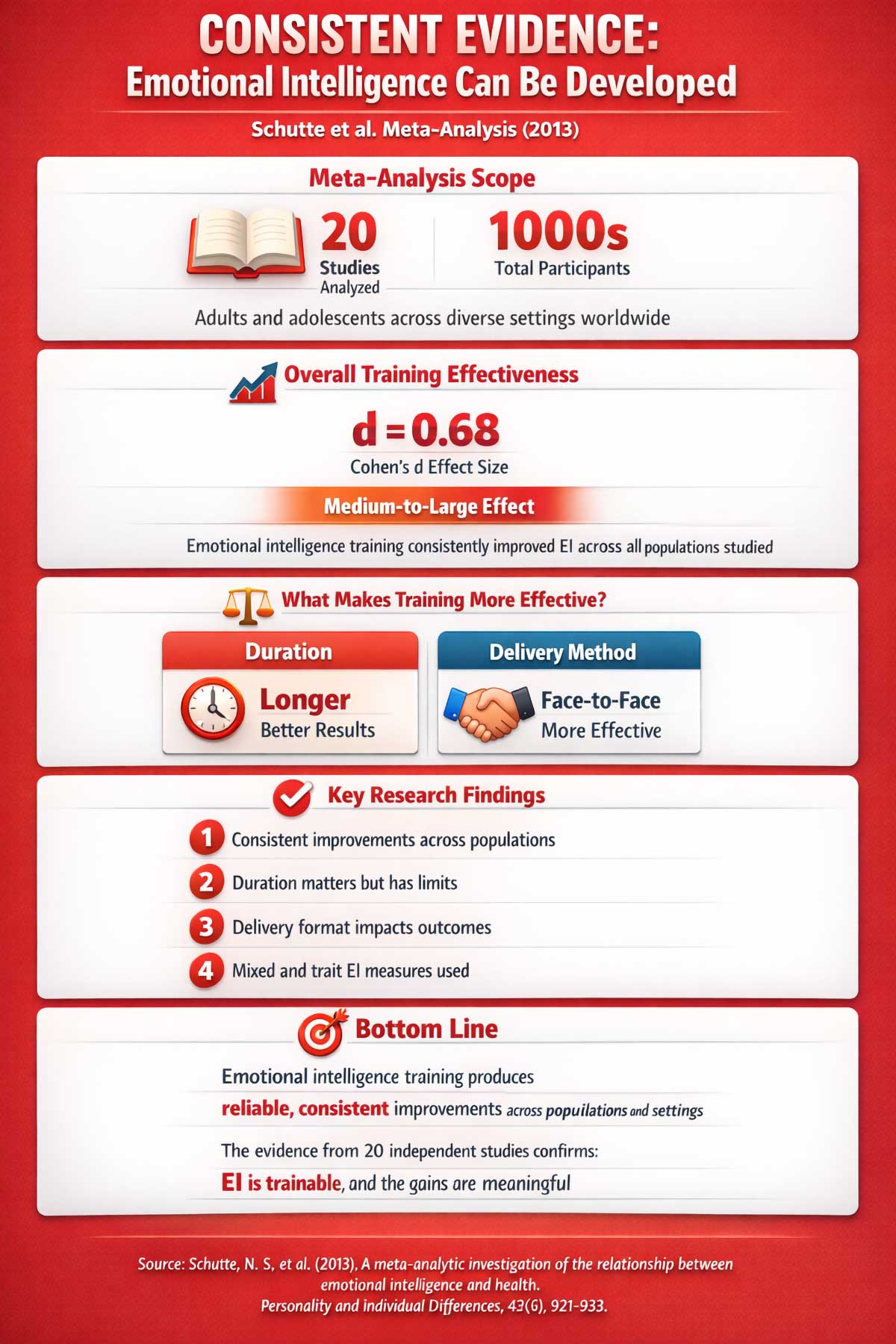
Nicola Schutte and colleagues analyzed 20 emotional intelligence training studies in 2013. They found a consistent effect size of 0.68 across all programs—a medium-to-large improvement. Longer interventions produced larger effects than shorter ones. Face-to-face training worked better than purely online formats. But even brief interventions of two to four weeks showed meaningful gains.
Here’s what that timeline typically looks like:
Week 1: You’re learning the framework and practicing basic observation. Changes feel effortful and conscious. You might not notice much difference in daily life yet. You’re building your emotional vocabulary and starting to pay attention in new ways.
Week 2: Recognition improves noticeably. You catch emotional cues you previously missed. Regulation techniques start working, though they still require deliberate effort. You might successfully use emotion labeling or slow breathing a few times. It still feels like “trying” rather than natural.
Week 3: Skills begin feeling more natural. You use techniques without having to remind yourself as much. Other people might comment that you seem more attuned or composed. You successfully navigate a difficult conversation better than you would have a month ago.
Week 4: Measurable improvements show up on tests. Your daily emotional experiences shift—not necessarily fewer negative emotions, but better management of them. You catch yourself using skills automatically. A colleague’s irritation registers immediately, and you adjust your approach without conscious thought.
Weeks 5-6: Continued practice solidifies gains. The skills you’ve developed become more automatic. Confidence in your emotional abilities rises. You start seeing yourself differently—as someone who handles emotions skillfully rather than someone who gets overwhelmed or misses cues.
After the initial training period, maintenance requires less time. Maybe an hour per week of deliberate practice, plus ongoing application in daily situations. The skills don’t vanish if you stop formal practice, but they do benefit from occasional refreshers.
The six-month data is particularly encouraging. Studies checking back with participants half a year later found that improvements persisted. In some cases, people continued to get better as they kept applying skills in real-world contexts.
You’re not signing up for years of therapy or indefinite self-improvement work. You’re committing to four to six weeks of focused practice. That’s enough time to produce measurable, lasting changes in your emotional capabilities.
The research is clear on this point. Emotional intelligence isn’t fixed. It responds to training in predictable ways within a realistic timeframe. You don’t need exceptional discipline or natural talent. You need a structured approach and consistent practice over four to six weeks.
That’s a commitment most people can make. And the payoff—better stress management, stronger relationships, improved performance—lasts far beyond those initial weeks.
Research Evidence at a Glance
Here’s a summary of the key studies supporting emotional intelligence training:
| Study | Population | Duration | Improvement | Key Takeaway |
|---|---|---|---|---|
| Mattingly & Kraiger (2019) | 58 studies, mixed adults | Varied (avg 30 hrs) | g = 0.63 overall; g = 1.22 ability EI | Ability-based training works best; longer programs more effective |
| Kotsou et al. (2011) | 132 Belgian adults | 4 weeks (2.5 hrs/week) | η² = 0.12-0.19 (approx. d = 0.7-1.0) | Gains across all five emotional competencies; maintained at 6 months |
| Hodzic et al. (2018) | 158 French students | 4 weeks (16 hours total) | d = 0.36 for global EI | Brief training produces lasting change; maintained at 6-month follow-up |
| Nelis et al. (2009) | 37 Belgian young adults | 4 weeks (18 hours) | η² = 0.22 (large effect) | Ability EI can be trained; 3 of 4 skill branches improved significantly |
| Schutte et al. (2013) | 20 studies, meta-analysis | 2 weeks to 6 months | d = 0.68 overall | Consistent improvements across populations; face-to-face delivery more effective |
| Clarke (2010) | 76 New Zealand workers | 6 weeks (12 hours) | Significant stress reduction | Workplace-specific training reduces distress, increases resilience |
| Dacre Pool & Qualter (2012) | 85 UK university students | 6 weeks (12 hours) | Significant trait EI increase | Improved emotional self-efficacy and coping strategies |
| Gilar-Corbi et al. (2019) | 44 studies, meta-analysis | Varied programs | g = 0.52 overall | Explicit teaching methods more effective than implicit learning |
Practical Conversation Scripts
Emotional intelligence sounds abstract until you need to use it in real situations. Here are specific phrases that apply EI skills:
When You Need to Acknowledge Someone’s Emotion Without Agreeing:
“I can see this situation is really frustrating for you. Let’s look at what options we have.”
“It sounds like you’re disappointed with how this turned out. Help me understand what you were expecting.”
“I hear that you’re angry about the decision. Even though we can’t change it, let’s talk about what we can control.”
When You Need Time to Regulate Before Responding:
“That’s an important point. Give me a minute to think about it.”
“I’m noticing I’m getting frustrated, which won’t help us solve this. Can we take a five-minute break?”
“I want to respond thoughtfully rather than react. Can we circle back to this in an hour?”
When You Want to Check Someone’s Emotional State Without Seeming Intrusive:
“You seem quieter than usual today. Everything okay?”
“I’m sensing some tension. Is there something we should talk about?”
“How are you feeling about this project? I want to make sure we’re on the same page.”
When You Need to Deliver Difficult Feedback:
“I want to share some feedback that might be hard to hear, but I think it will help you. Is now a good time?”
“I’ve noticed . I’m concerned about . Can we talk about what’s going on?”
“This is uncomfortable for me to bring up, and it might be uncomfortable to hear. Here’s what I’ve observed…”
When Someone Is Escalating Emotionally:
“I can see you’re really upset. What would be most helpful right now?”
“Let’s pause for a second. What’s the main thing you need me to understand?”
“I want to hear what you’re saying, but the intensity is making it hard for me to take it in. Can we bring it down a notch?”
These scripts work because they acknowledge emotions directly, separate feelings from actions, and create space for both people to respond effectively.
Your Next Steps: How to Develop Emotional Intelligence Starting Today
You’ve learned that emotional intelligence can be developed, how long it takes, and what approaches work best. Now what?
Step 1: Take a Baseline Assessment
Choose one validated test and complete it this week:
- TEIQue (free online, measures trait EI and confidence)
- A shortened version of the MSCEIT if available (measures actual ability)
- Or start a simple daily accuracy log to track your current skill level
Record your scores. You’ll compare these to your scores after four weeks.
Step 2: Choose Your Training Approach
Based on your schedule, budget, and learning style:
- Structured program if you want maximum results and can commit to a schedule
- Self-directed learning if you’re disciplined and budget-conscious
- Workplace program if your employer offers one
- Therapy or coaching if you need personalized support or have clinical concerns
Step 3: Start Your Four-Week Practice
Use the daily practice schedule from earlier in this article. Commit to 30-45 minutes daily:
- Week 1: Vocabulary building (difficulty: ★☆☆☆☆)
- Week 2: Pattern tracking (difficulty: ★★☆☆☆)
- Week 3: Regulation practice (difficulty: ★★★★☆)
- Week 4: Mood-task matching (difficulty: ★★★☆☆)
Step 4: Track Your Progress Weekly
Every Sunday, spend 15 minutes reviewing:
- What improved this week?
- Which techniques worked best?
- What situations still challenge me?
- What will I focus on next week?
Step 5: Test Again After Four Weeks
Retake the same assessment you used for baseline. Compare scores. Look for specific improvements in the areas you practiced most. Expect effect sizes in the range of d = 0.36 to 1.22 depending on your training approach.
Step 6: Plan Your Maintenance
Schedule one hour weekly for continued practice. Choose one or two areas to refine further. Set up quarterly check-ins to prevent backsliding. The research shows gains persist for at least six months when you maintain even minimal practice.
Conclusion
The research is clear. Four to six weeks of focused practice produces measurable, lasting improvements in emotional intelligence. You don’t need years. You don’t need special talent. You need a structured approach and consistent effort.
Your emotional skills aren’t fixed. They’re trainable. Studies across multiple countries involving thousands of participants prove it works. Effect sizes of 0.63 to 1.22 mean real, substantial gains that improve your daily life.
The question isn’t whether you can develop emotional intelligence. Science has answered that: yes, you can. The question is whether you’ll start.
FAQs
Can you have too much emotional intelligence?
You can’t be “too good” at reading emotions accurately or regulating effectively. But you can experience downsides from very high EI. Research shows that people with extremely high EI sometimes experience “emotional labor exhaustion”—they’re so attuned to everyone’s emotions that they burn out managing social dynamics. Additionally, very high EI can correlate with overthinking social interactions and difficulty with authentic self-expression when constantly adjusting to others.
The solution isn’t avoiding EI development—it’s developing boundaries alongside skills. Healthy EI includes knowing when not to regulate, when to express authentic emotion, and when others’ emotions aren’t your responsibility to manage.
Is EI the same as empathy?
No. Empathy is one component of EI, but EI includes much more. Empathy means understanding what someone else feels. EI includes empathy plus the ability to manage your own emotions, use emotions productively, and understand how emotions work. You can have high empathy but poor emotion regulation. Complete EI requires both.
What if I’m naturally analytical or logical?
Perfect. EI training suits analytical thinking. You’re learning patterns, testing techniques, and measuring results. The research-based approach makes emotional concepts more accessible to logical thinkers. Many engineers, scientists, and analysts excel at EI once they see the systematic framework behind it. Your analytical nature is an asset, not a barrier.
Does EI training work for autism or ADHD?
Research shows mixed results. Some aspects of EI training help, particularly explicit instruction in emotion recognition and regulation techniques. People with autism often benefit from clear rules about emotional patterns. People with ADHD often benefit from concrete regulation strategies.
But standard EI training isn’t designed for neurodivergent populations. Specialized programs work better. If you’re neurodivergent, look for training that accounts for different processing styles. General EI programs might help with specific skills but won’t address underlying neurological differences.
How is this different from therapy?
EI training teaches skills. Therapy addresses clinical issues, trauma, and root psychological causes. Think of it this way: EI training is like taking a cooking class to improve your technique. Therapy is like treating a medical condition that affects your digestion. Both valuable, different purposes. Many people benefit from both.
Can you develop EI on your own without a program?
Yes, but it’s harder. Studies show that structured programs with feedback produce larger gains faster than self-directed learning. The challenge with solo work is that you can’t always tell if you’re improving. You might think you’re reading emotions accurately when you’re not. Self-assessment has limits.
If you choose self-directed learning, use validated tests to check your progress. Practice with real people, not just reading and reflection. Get feedback when possible. And be honest about whether you’re actually improving or just getting more confident.
How long do the improvements last?
Studies tracking people for six months show that gains persist and often grow. The skills become automatic with use. You’re not memorizing information that fades. You’re building neural pathways that strengthen with practice. As long as you keep using the skills in daily life—which happens naturally—they stick.
What if I practice for four weeks and don’t see results?
First, check how you’re measuring. Are you using validated tests or just gut feelings? Second, evaluate your practice. Are you doing real exercises with real emotions, or just reading about EI? Third, consider your baseline. If you started with high EI, your gains might be smaller but still valuable. If you genuinely show no improvement after structured practice, you might benefit from working with a coach or therapist to identify specific barriers.
Is emotional intelligence more important than IQ?
They serve different functions. IQ predicts how quickly you learn and solve logical problems. EI predicts how effectively you navigate social situations, manage stress, and build relationships. Both matter. The best outcomes come from having adequate levels of both. Neither is universally “more important”—it depends on your goals and context.
Can children develop emotional intelligence?
Yes. Research shows EI training works across all age groups. Children often learn emotional skills more quickly than adults because their brains are more plastic. School-based EI programs show consistent benefits. If you’re a parent, you can teach emotional skills at home through modeling, naming emotions, and practicing regulation strategies together.
What happens if I skip practice for a week?
You’ll lose a bit of momentum but not your progress. Think of it like exercise. Missing a week slows your improvement but doesn’t erase gains you’ve already made. Get back to practice as soon as you can. The brain retains learned skills even with gaps, though consistent practice builds them faster.