A 9-day yoga retreat changed participants’ gut bacteria in ways that normally take months. Scientists weren’t expecting it. Neither will you.
For years, yoga’s connection to gut health has been explained in one of two ways. Either it “massages” the organs, helping move gas and waste through the body. Or it calms the nervous system, easing the kind of stress that triggers digestive flare-ups. Both are true. Both are useful.
But recent science is pointing to something deeper — and far more interesting.
A small but growing body of research now suggests that yoga may directly shape the types of bacteria living in your gut. Not just how your gut feels, but what’s actually living there. That shift in thinking is worth paying attention to.
From Moving Gas to Growing Gardens
Think of your gut microbiome as a garden. It contains trillions of bacteria, fungi, and other organisms. Some of those microbes help you break down food, regulate your immune system, and even produce chemicals that affect your mood. Others cause harm when they crowd out the beneficial ones.
For most of the yoga-science era — roughly the last 15 years — researchers focused on explaining yoga’s effects through indirect mechanisms: stress reduction, nervous system activation, and inflammation control. All true, but incomplete. A 2025 pilot study changed that conversation by offering the most direct evidence yet of actual microbial shifts.
That earlier work still holds. But new research suggests yoga might actually function like a kind of fertilizer — directly encouraging the growth of bacteria linked to better metabolic health and lower inflammation.
The 2025 Study That Changed the Conversation
The most direct evidence yet comes from a 2025 pilot study published in BMC Complementary Medicine. Researchers led by Swarup et al. followed 24 practitioners through a 9-day intensive Arhatic Yoga retreat.
Using 16S ribosomal RNA sequencing — a method that maps bacterial populations in fine detail — they analyzed changes in both oral and gut microbiota before and after the retreat. What they found was striking.
In just nine days, participants showed rapid growth of bacteria that produce short-chain fatty acids (SCFAs). These compounds are among the most important metabolic products your gut bacteria make. They feed the cells lining your colon, reduce gut inflammation, and help regulate blood sugar.
Three bacterial groups stood out: Akkermansia, Faecalibacterium, and Ruminococcus. All three are associated with reduced inflammation and better metabolic function. Akkermansia in particular has attracted significant attention for its role in maintaining the gut lining and improving insulin sensitivity.
Perhaps just as interesting was a “convergence effect.” Participants came to the retreat with quite different gut microbiome profiles — the diversity you’d expect across different individuals with different diets and lifestyles. By the retreat’s end, those profiles had moved closer together. Yoga appeared to steer everyone’s microbiome in a similar, beneficial direction.

The 2025 Arhatic Yoga study wasn’t the first to suggest a connection between yoga and microbiome changes. A 2023 observational study by Raman et al. of Isha Yoga practitioners found that a yoga retreat combined with a vegetarian diet altered microbiota composition, with increases in beneficial bacterial groups. That earlier signal pointed in the same direction. But the Swarup study offered the most methodologically detailed analysis to date — using 16S sequencing with timepoint comparisons across a controlled retreat setting.
It’s worth noting that this is a small, single-arm pilot study. It doesn’t have a control group. The participants also followed a vegetarian diet during the retreat, which likely played a role in the bacterial changes. The researchers acknowledged this openly. Still, as direct microbiome evidence goes, it’s among the most detailed we have so far.
Why Your Nervous System Is the Real Key
To understand how yoga influences gut bacteria, you need to understand the vagus nerve.
The vagus nerve runs from your brainstem down through your chest and into your abdomen. It’s the main communication line between your brain and your gut — and it runs both ways. When you’re calm, it activates what’s known as your parasympathetic nervous system: the “rest and digest” mode.
In a 2012 review published in the Journal of Alternative & Complementary Medicine, Streeter et al. proposed that yoga increases “vagal tone” — essentially, how well that nerve is doing its job. When vagal tone is high, the gut receives the signal that conditions are safe. Digestion improves. Inflammation cools. And the environment becomes more hospitable to the kinds of bacteria you actually want living there.
The opposite is also true. When you’re chronically stressed, your body stays in “fight or flight” mode. The gut gets deprioritized. Inflammation rises. Microbial diversity tends to drop. As Dinan and Cryan noted in a 2017 review in Nature Reviews Gastroenterology & Hepatology, gut bacteria themselves respond to stress hormones and nervous system signals — meaning the state of your nervous system is, quite literally, shaping who lives in your gut.
Cortisol: The Hidden Enemy of Your Microbiome
Chronic stress raises cortisol. Cortisol, when elevated over time, does several things to the gut: it increases intestinal permeability (sometimes called “leaky gut”), disrupts the gut lining, and changes the chemical environment that bacteria depend on.
A 2017 meta-analysis of 42 studies by Pascoe et al., published in Psychoneuroendocrinology, found that yoga — specifically yoga involving physical postures — significantly reduced both evening cortisol and waking cortisol levels. These are two of the most clinically relevant cortisol measures for long-term health.
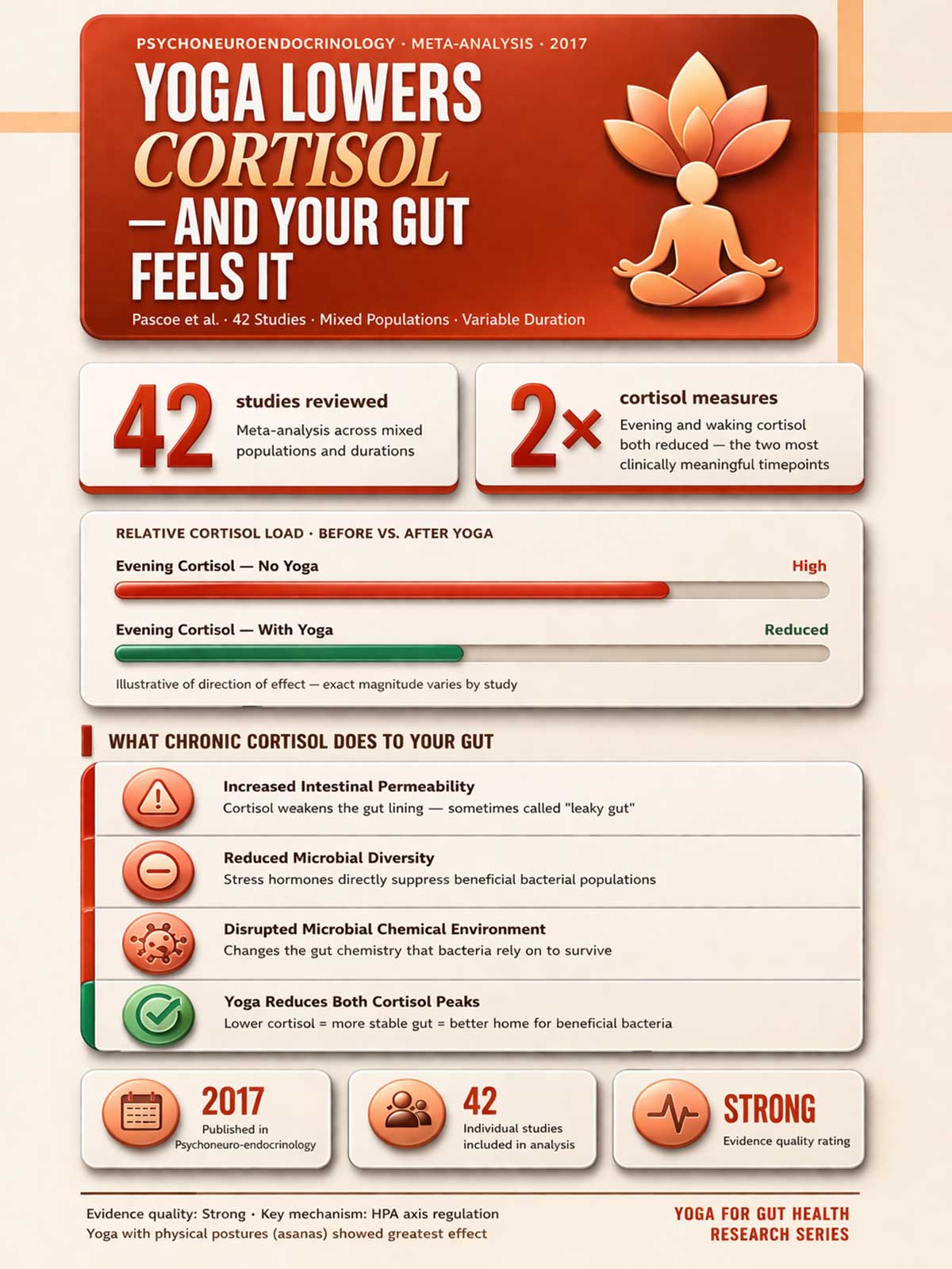
Lower cortisol means a more stable gut environment. A stable gut environment means fewer disruptions to your microbial community. That’s a meaningful chain of cause and effect, even if yoga’s direct bacterial effects are still being studied.
What Happens When Inflammation Drops
Inflammation is another critical variable. An inflamed gut is not a good home for beneficial bacteria. It favors hardier, more disruptive species — and crowds out the gentler, more helpful ones.
A 12-week RCT by Tolahunase et al., published in Frontiers in Immunology in 2018, found that regular yoga practice significantly reduced three key inflammatory markers in healthy adults: IL-6, TNF-α, and high-sensitivity CRP. These aren’t minor signals. Chronically elevated IL-6 and TNF-α are associated with conditions ranging from metabolic syndrome to depression.
By lowering these markers, yoga may essentially make the gut more livable for the bacteria that benefit your health. Think of it as lowering the heat in the kitchen so that the more delicate, useful ingredients can do their job.
The Gut-Brain Connection and IBS
For people who deal with irritable bowel syndrome (IBS), yoga’s effects on the gut-brain axis are more than theoretical — they’re practical.
A systematic review by Cramer et al., published in Clinical Gastroenterology & Hepatology in 2016, looked at multiple randomized controlled trials and found consistent improvements in IBS symptoms among people who practiced yoga regularly over six to twelve weeks. The proposed mechanism: yoga activates the parasympathetic nervous system, which reduces the oversensitivity of the gut nerves that drives IBS symptoms.
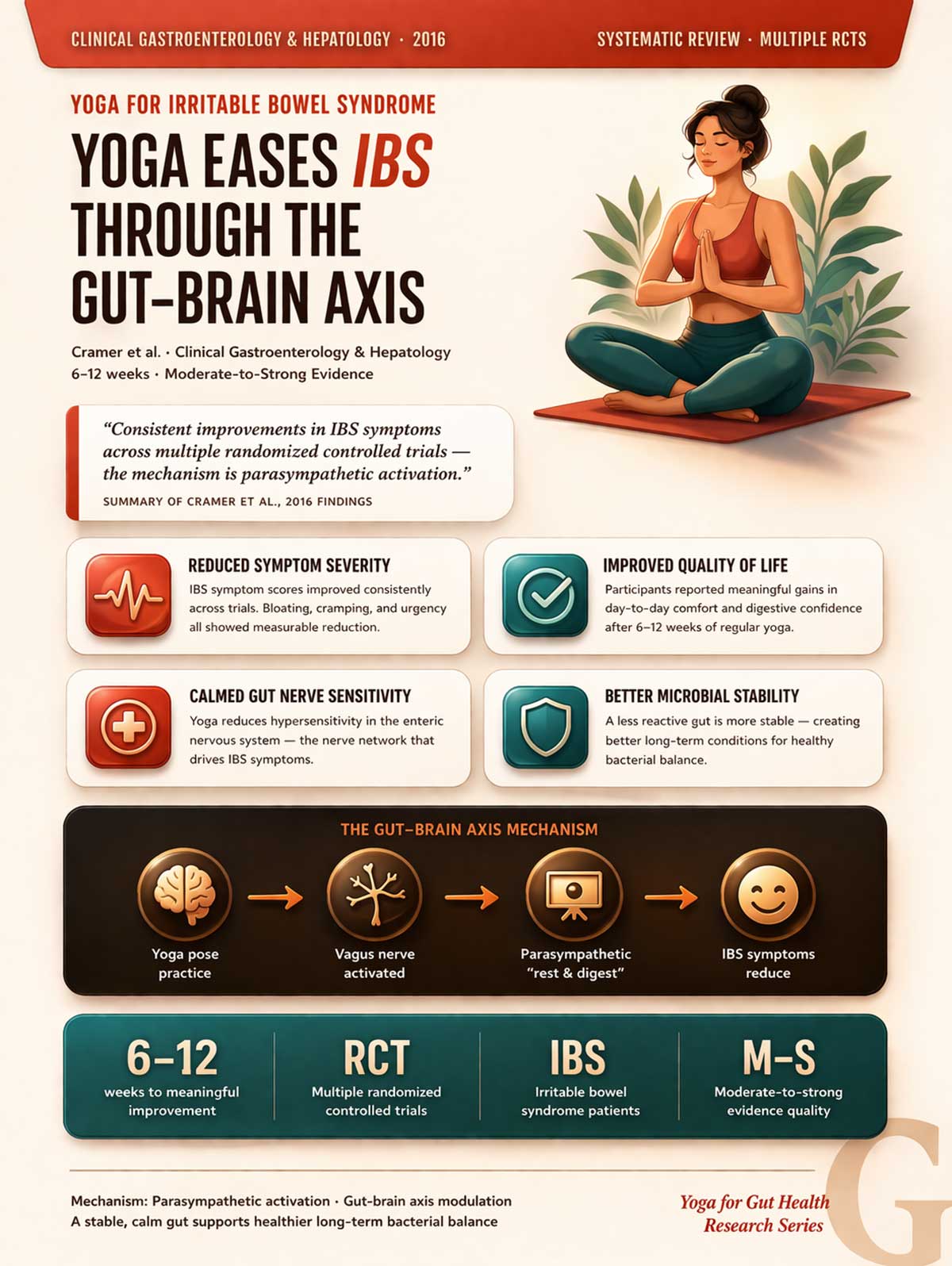
That’s not the microbiome, strictly speaking. But a less reactive gut is a more stable gut — and a more stable gut is more likely to support a healthy bacterial balance over time.
5 Practices That Directly Support Your Gut
Knowing the science is useful. Knowing what to actually do is better. Here are five specific practices backed by the available research.
1. Spinal Twists — The Enteric System Reset
Seated and reclined spinal twists are among the most commonly cited poses for gut health, and for good reason. They apply gentle compression to the abdominal area, stimulating the enteric nervous system — the network of neurons embedded in the gut wall that regulates digestion independently of the brain.
This isn’t just about moving food along. The enteric nervous system is in constant communication with your gut bacteria. Stimulating it through movement may help maintain the signaling environment that beneficial bacteria depend on.
2. Breathwork — Ujjayi and Bhramari
Of all the tools yoga offers, conscious breathing may be the most direct way to activate the vagus nerve. Ujjayi breathing — slow, controlled inhales and exhales through the nose with a slight constriction at the throat — is often associated with increased parasympathetic tone. Bhramari, or humming breath, creates vibration in the chest and throat that appears to stimulate vagal pathways directly.
These aren’t relaxation techniques only. They’re physiological interventions with measurable effects on nervous system function. Given what we know about the vagus nerve’s role in gut health, building these into a regular practice is a logical step.
3. Child’s Pose and Savasana — The Bacterial Growth Window
This might seem counterintuitive. Lying still doesn’t feel like health work. But the parasympathetic state activated during restorative poses like Child’s Pose and Savasana is exactly when your body performs gut repair and bacterial balance.
Cortisol drops. The gut lining gets the resources it needs for maintenance. Beneficial bacteria — particularly SCFA producers like Faecalibacterium — are thought to thrive in low-inflammation environments. Spending even five to ten minutes in true rest at the end of a session may be one of the most biologically significant things you do all class.
4. Abdominal Engagement — Nauli and Core Work
Moderate-intensity physical activity has a well-documented relationship with microbial diversity. A landmark cross-sectional study by Clarke et al., published in Gut in 2014, compared the gut microbiomes of professional athletes to sedentary controls. Athletes had significantly higher microbial diversity — a key marker of gut health.
Yoga’s core work, including practices like Nauli (abdominal churning) and sustained core engagement in poses like Boat Pose, may activate similar pathways. The key word is moderate. Extreme exercise can actually reduce microbial diversity. The rhythmic, moderate engagement yoga provides appears to be in the right range.
5. Consistency — The 12-Week Threshold
None of this happens overnight. The Tolahunase RCT showed significant inflammatory changes at 12 weeks. The registered YoGH-Biome trial, which is examining yoga’s effects on gut microbiota diversity and TMAO levels in heart failure patients, also uses a 12-week window as its primary measurement point (results anticipated from the BMJ Open Sports Medicine trial registered in early 2026). A related case-control intervention in mild Alzheimer’s patients, published in SAGE Open in January 2026, reported that a 12-week yoga program was associated with partial normalization of gut microbial function alongside cognitive improvements.
Twelve weeks appears to be a meaningful threshold. It’s long enough for the gut microbiome to show functional adaptation — not just temporary fluctuation. Committing to a consistent practice for three months gives the science the best chance of working in your favor.
What the Emerging Research Is Watching
Science rarely stops moving. Two areas in particular are drawing attention right now.
Yoga and cognitive health via the gut. The 2026 Alzheimer’s pilot study mentioned above is part of a broader hypothesis: that improving gut microbial function through lifestyle interventions like yoga may have downstream effects on brain health. The gut-brain axis runs in both directions. If yoga alters the bacteria that produce neuroactive compounds, it may — over time — influence mood, cognition, and even the risk of neurological conditions. These are early findings, but they’re meaningful enough to watch.
Cardiovascular health and TMAO. Trimethylamine N-oxide (TMAO) is a compound produced when gut bacteria process certain foods, particularly red meat and eggs. High TMAO levels are linked to cardiovascular risk. The YoGH-Biome protocol is actively investigating whether yoga can reduce TMAO through its effects on the microbiome. If that link is confirmed, yoga’s role in preventive medicine would take on a new dimension entirely.
Diet and the Mat: A Partnership
Any honest discussion of yoga and the microbiome has to address diet. In both major direct microbiome studies cited here — the Raman et al. 2023 Isha Yoga observational study and the Swarup et al. 2025 Arhatic Yoga trial — participants followed vegetarian or plant-based diets during the study period.
A fiber-rich diet is, on its own, one of the most effective tools for feeding beneficial bacteria. Fiber ferments in the colon to produce SCFAs — the same compounds that the Swarup study found elevated after yoga practice. It’s quite possible that the two effects compound each other: yoga shifts the nervous system toward a state that supports microbial health, while dietary fiber provides the fuel those bacteria need to grow.
This isn’t a reason to dismiss yoga’s independent contribution. But it is a reason to treat diet and movement as partners, not alternatives. The mat works better when it’s paired with a plate full of vegetables, legumes, and whole grains.
A Practical 12-Week Framework
The research is consistent on timing: 12 weeks is the threshold where meaningful internal change becomes measurable. That’s not a long time, but it does require showing up consistently. Here’s how to structure those three months in three phases.
Phase 1 — Weeks 1–2: Build the foundation. Three sessions per week, 30–40 minutes each. Focus on spinal twists, Child’s Pose, and five minutes of Ujjayi breathing at the end. The goal here is consistency, not intensity. You’re training your nervous system as much as your body.
Phase 2 — Weeks 3–4: Add activation. Introduce abdominal work — Boat Pose, gentle Nauli practice if you’re comfortable with it, and core-engaged standing poses. Keep the breathwork. Extend Savasana to 10 minutes. Notice how your digestion feels between sessions.
Phase 3 — Weeks 5–12: Sustain and deepen. Move to four sessions per week. Keep the full structure: twists, core work, breathwork, rest. The bacterial changes the research documents — the SCFA producers, the reduction in inflammation markers — emerge in this window. The first four weeks build the foundation. The next eight weeks are where the biology shifts.
The Bigger Picture
Yoga has always been more than a flexibility practice. But its potential role as a direct biological tool for the gut microbiome is a genuinely new idea — one that’s only becoming possible to study now, thanks to advances in DNA sequencing and microbial analysis.
The evidence so far is promising but still early. The most direct studies are small. Confounding variables like diet make it hard to isolate yoga’s contribution exactly. More rigorous, larger trials are underway, and their results over the next few years will sharpen our understanding considerably.
What we can say with confidence right now: yoga reduces cortisol, lowers inflammatory markers, activates the vagus nerve, and creates internal conditions that are measurably better for your gut. Whether it does this by directly changing bacterial populations — or by changing the environment those bacteria live in — the end result appears to be the same.
A calmer nervous system. A less inflamed gut. And a microbial community that’s better positioned to keep you healthy from the inside out.
That’s not a small thing. That’s the kind of shift that ripples through your whole body — and the research is only beginning to catch up with what practitioners have known for a long time.